Arid Land Geography ›› 2026, Vol. 49 ›› Issue (5): 987-997.doi: 10.12118/j.issn.1000-6060.2025.235
• Ecology and Environment • Previous Articles Next Articles
HE Jiahao1( ), HOU Guangliang1,2(), AO Min1, TANG Zhonghua1, SHI Hongfei1
Received:2025-04-28
Revised:2025-06-04
Online:2026-05-25
Published:2026-05-25
Contact:
HOU Guangliang
E-mail:jiahao025@163.com;hgl20@163.com
HE Jiahao, HOU Guangliang, AO Min, TANG Zhonghua, SHI Hongfei. Spatiotemporal distribution evolution of the microlithic populations on the Qinghai-Xizang Plateau based on MaxEnt[J].Arid Land Geography, 2026, 49(5): 987-997.
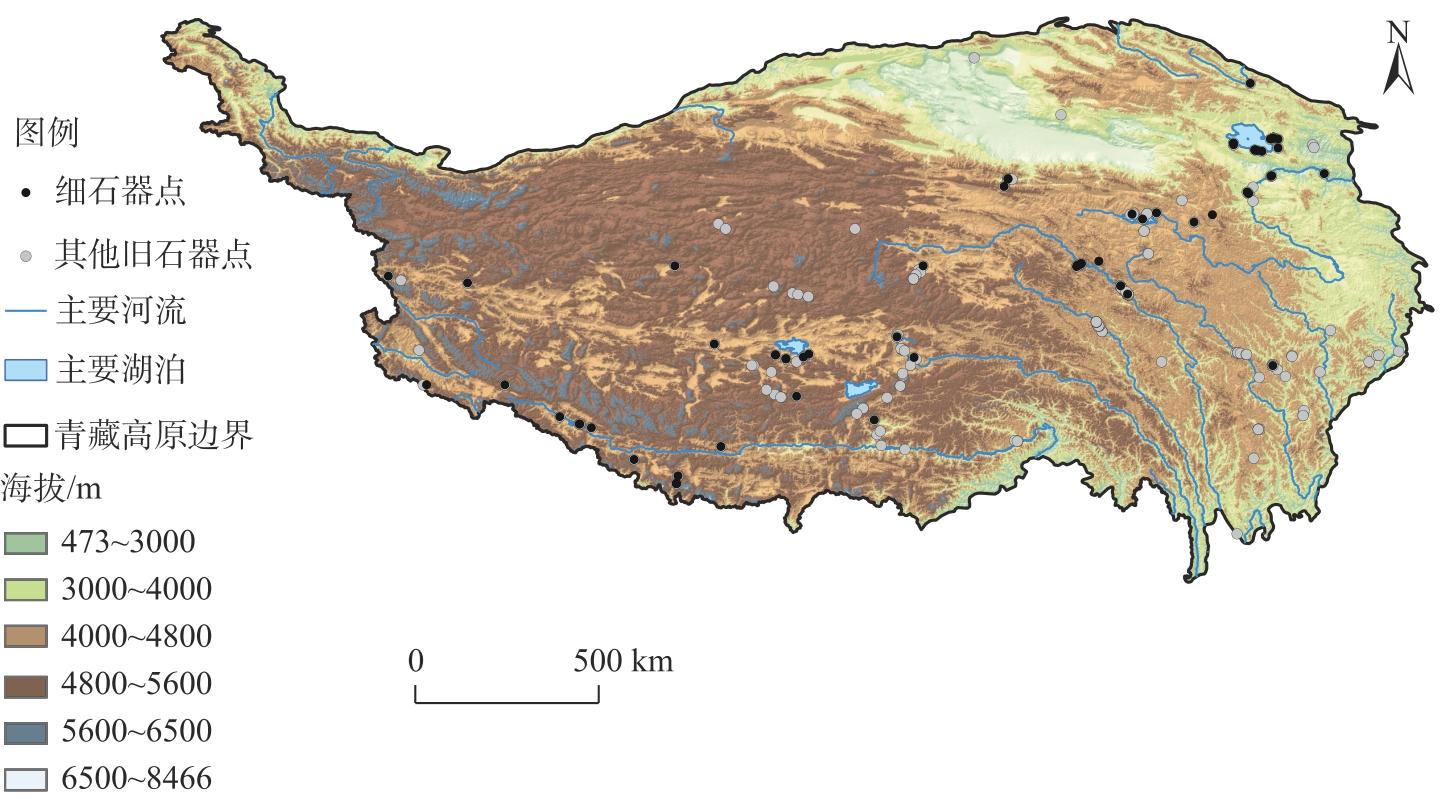
Fig. 1
Overview of the study area and distribution of archaeological sites"
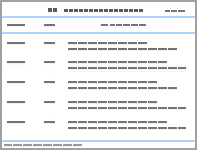
Tab. 1
Archaeological sites information utilized in this study"
| 遗址点 | 经度/°E | 纬度/°N | 距今年代/ka BP | 方法 | 遗址点 | 经度/°E | 纬度/°N | 距今年代/ka BP | 方法 |
|---|---|---|---|---|---|---|---|---|---|
| 马法木湖[ | 81.91 | 30.83 | 全新世早期 | 类型学 | 各听[ | 89.36 | 31.58 | 新旧石器过渡期 | 类型学 |
| 帕也真沟[ | 79.99 | 30.83 | 全新世早期 | 类型学 | 参雄尕朔[ | 96.02 | 33.48 | 8—7 | AMS14C |
| 戳错龙湖西岸[ | 85.08 | 29.00 | 全新世早期 | 类型学 | 角考[ | 95.95 | 33.76 | 8—7 | 类型学 |
| 定日苏热[ | 80.98 | 30.69 | 新旧石器过渡期 | 类型学 | 尕琼[ | 95.98 | 33.77 | 8—7 | 类型学 |
| 热角[ | 79.06 | 33.50 | 新旧石器过渡期 | 类型学 | 西琼达[ | 96.05 | 33.80 | 8—7 | 类型学 |
| 贡崩[ | 87.21 | 29.32 | 新旧石器过渡期 | 类型学 | 古沃达[ | 95.93 | 33.73 | 8—7 | 类型学 |
| 江西沟1号(JXG1)[ | 100.35 | 36.57 | 14.6±0.4 | AMS14C | 垄[ | 83.74 | 29.87 | 8.9—7.3 | 类型学 |
| 十火塘(10HTHS1)[ | 100.87 | 36.86 | 12.4±0.2 | AMS14C | 嘎加拉地[ | 83.75 | 29.87 | 8.9—7.3 | 类型学 |
| 尕海1号(GH1)[ | 100.68 | 36.86 | 11.2±0.1 | AMS14C | 年扎合(NZH)[ | 98.80 | 34.82 | 8.5 | OSL |
| 铜线3号(BWC3)[ | 100.75 | 36.87 | 12.1±0.3 | AMS14C | 雅江上游诸石器点(UYT sites)[ | 83.26 | 30.05 | 6.6 | OSL |
| 铜线4号(BWC4)[ | 100.75 | 36.88 | 5.5±0.1 | AMS14C | |||||
| 151(YWY1)[ | 100.49 | 36.58 | 8.6±0.1 | AMS14C | 多格则[ | 87.05 | 31.83 | 新旧石器过渡期 | 类型学 |
| 湖东种羊场(HZYC1)[ | 100.87 | 36.66 | 13.0±0.2 | AMS14C | 扎布[ | 81.00 | 33.33 | 新旧石器过渡期 | 类型学 |
| 拉乙亥[ | 100.70 | 35.95 | 6.7±0.09 | AMS14C | 西大滩2号[ | 94.15 | 35.69 | 9.2—6.4 | AMS14C |
| 野牛沟1号[ | 94.25 | 35.88 | 7.5±0.04 | AMS14C | 羊曲西(YQX)[ | 100.11 | 35.55 | 5.3±0.2 | AMS14C |
| 野牛沟2号[ | 94.23 | 35.87 | 7.4±0.04 | AMS14C | 仲巴县北[ | 84.03 | 29.78 | ≥4 | 类型学 |
| 尼阿底3号[ | 88.80 | 31.47 | 11—10 | AMS14C | 冬给措纳3号[ | 98.51 | 35.35 | 5.4—5.0 | AMS14C |
| 黑马河1号(HMH1)[ | 99.77 | 36.76 | 13.1±0.2 | AMS14C | 雅曲雅土[ | 89.35 | 33.00 | 新石器早期 | 类型学 |
| 黑马河3号(HMH3)[ | 99.74 | 36.78 | 8.4±0.1 | AMS14C | 错尼[ | 87.33 | 34.66 | 新石器早期 | 类型学 |
| 达玉台[ | 100.71 | 35.96 | 新石器早期 | 类型学 | 东果滩[ | 100.20 | 35.64 | 7.6—6.2 | AMS14C |
| 塘甘木大桥北[ | 92.16 | 33.75 | 新石器早期 | 类型学 | 羊圈台[ | 100.14 | 35.52 | 8—7 | 类型学 |
| 错那湖东南[ | 91.52 | 32.00 | 新石器早期 | 类型学 | 扎陵湖[ | 97.29 | 35.01 | 7.2 | 类型学 |
| 措则村[ | 91.94 | 31.50 | 新石器早期 | 类型学 | 下大武1号 | 99.26 | 35.00 | 11.2±0.07 | 碳屑 |
| 色林错[ | 89.23 | 31.51 | 13.6±0.2 | AMS14C | 黄藏寺 | 100.19 | 38.22 | 7.9±0.5 | OSL |
| 戈木错盆地[ | 86.08 | 33.75 | 新旧石器过渡期 | 类型学 | 代曲(DQ) | 96.47 | 33.86 | 9.3—8.1 | AMS14C |
| 炉霍虾拉沱[ | 100.74 | 31.30 | 13.5±0.3 | AMS14C | 老大桥 | 95.83 | 34.03 | 11 | OSL |
| 珠洛勒[ | 88.50 | 31.38 | 新旧石器过渡期 | 类型学 | 邦布 | 97.17 | 33.05 | 新旧石器过渡期 | 类型学 |
| 罗马松[ | 88.55 | 31.56 | 新旧石器过渡期 | 类型学 | 江西沟2号 | 100.37 | 36.57 | 8.2—8.0,5.6—5.4 | AMS14C |
| 亚司[ | 89.06 | 30.55 | 新旧石器过渡期 | 类型学 | 牛头山南 | 97.54 | 34.89 | 7.2 | 类型学 |
| 邱桑[ | 90.96 | 29.97 | 13—12, 8.4—7.4 | 类型学 | 鄂陵湖 | 97.88 | 35.05 | 7.2 | 类型学 |
| 亚里[ | 86.12 | 28.41 | 中石器或更晚 | 类型学 | 沙隆卡 | 102.00 | 36.01 | 8.5—7.3 | OSL |
| 羊圈[ | 86.16 | 28.60 | 中石器或更晚 | 类型学 |
Tab. 2
Detailed environmental variables data for pre-modeling input"
| 符号 | 变量 | 符号 | 变量 |
|---|---|---|---|
| bio1 | 年平均气温/℃ | bio16 | 最潮湿季度 降水量/mm |
| bio2 | 平均昼夜范围 | ||
| bio3 | 等温指数 | bio17 | 最干旱季度 降水量/mm |
| bio4 | 温度季节性指数 (标准偏差×100%) | ||
| bio18 | 最热季度 降水量/mm | ||
| bio5 | 最热月份最高温度/℃ | ||
| bio6 | 最冷月份最高温度/℃ | bio19 | 最冷季度 降水量/mm |
| bio7 | 温度年范围(bio5-bio6)/℃ | ||
| bio8 | 最潮湿地区平均温度/℃ | river distance | 距河流距离/km |
| bio9 | 最干旱地区平均温度/℃ | FVC | 植被覆盖度 |
| bio10 | 最热季度平均温度/℃ | soil type | 土壤类型 |
| bio11 | 最冷季度平均温度/℃ | land-use type | 土地类型 |
| bio12 | 年降水量/mm | altitude | 海拔/m |
| bio13 | 最湿润月份降水量/mm | slope | 坡度/(°) |
| bio14 | 最干旱月份降水量/mm | slope orientation | 坡向 |
| bio15 | 降水季节性变异系数 |
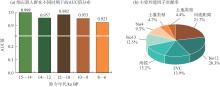
Fig. 2
Distribution of AUC values of microlithic populations across different periods and contributions of major environmental factors"
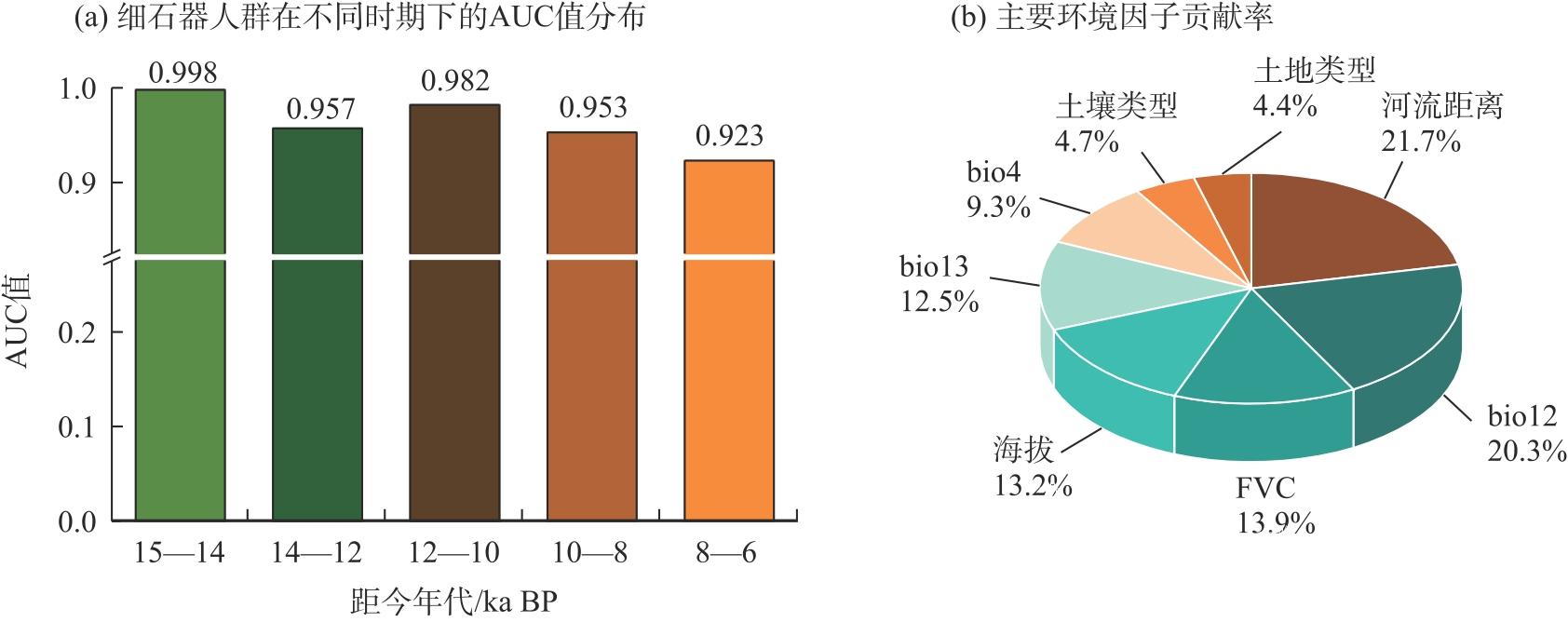
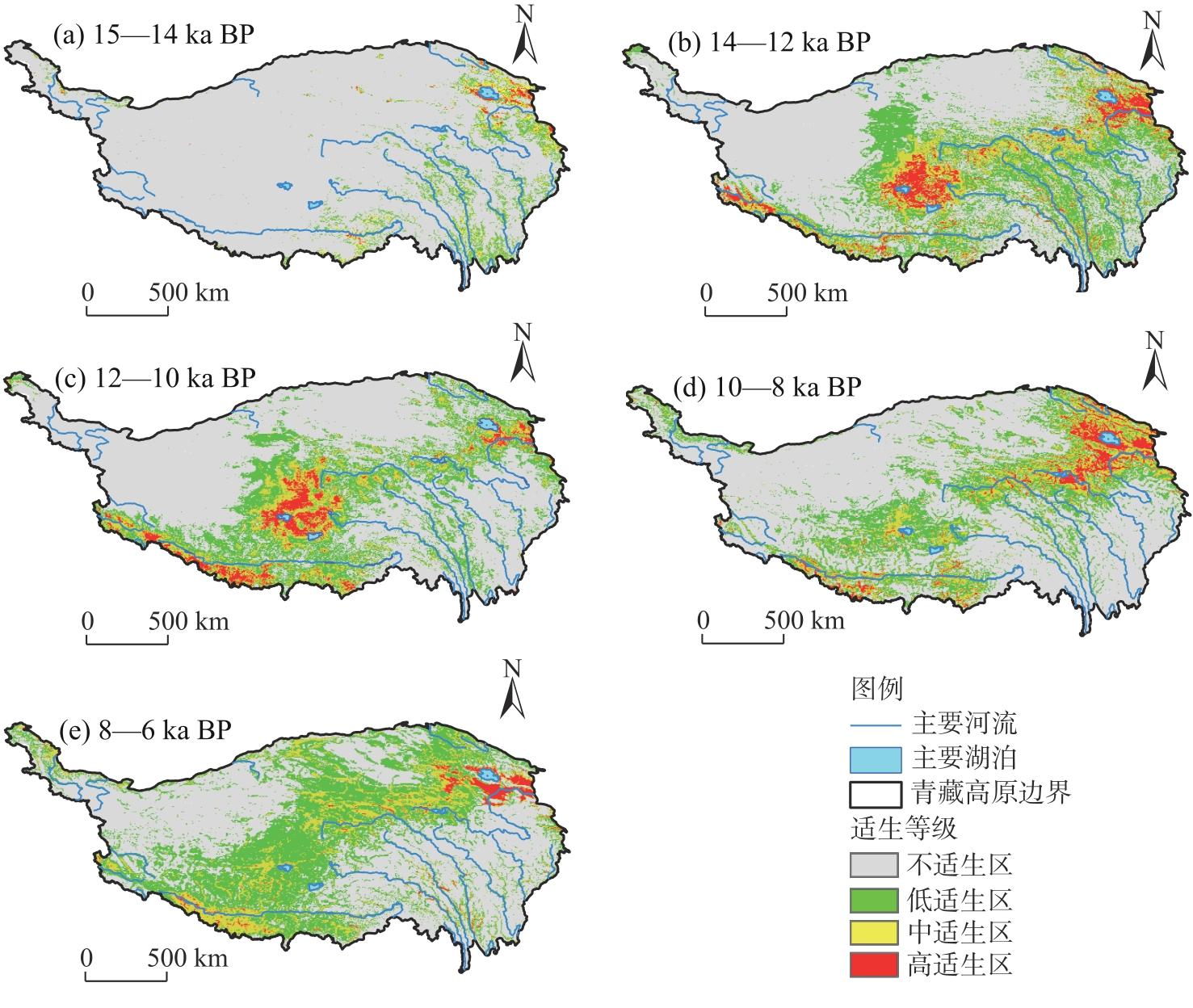
Fig. 3
Potential distribution of microlithic populations under environmental conditions during the 15—6 ka BP"
Tab. 3
Changes in the potential distribution area of microlithic populations during the 15—6 ka BP /104 km2"
| 距今年代/ka BP | 高度适生区 | 中度适生区 | 低度适生区 | 不适生区 |
|---|---|---|---|---|
| 15—14 | 2.021 | 8.994 | 15.725 | 219.419 |
| 14—12 | 15.070 | 30.051 | 62.156 | 138.856 |
| 12—10 | 11.686 | 21.978 | 56.824 | 155.661 |
| 10—8 | 12.325 | 24.268 | 53.241 | 156.293 |
| 8—6 | 6.334 | 28.324 | 81.712 | 129.760 |
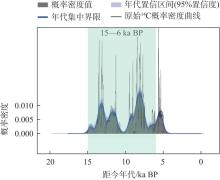
Fig. 4
Analysis of AMS14C age density on the Qinghai-Xizang Plateau"
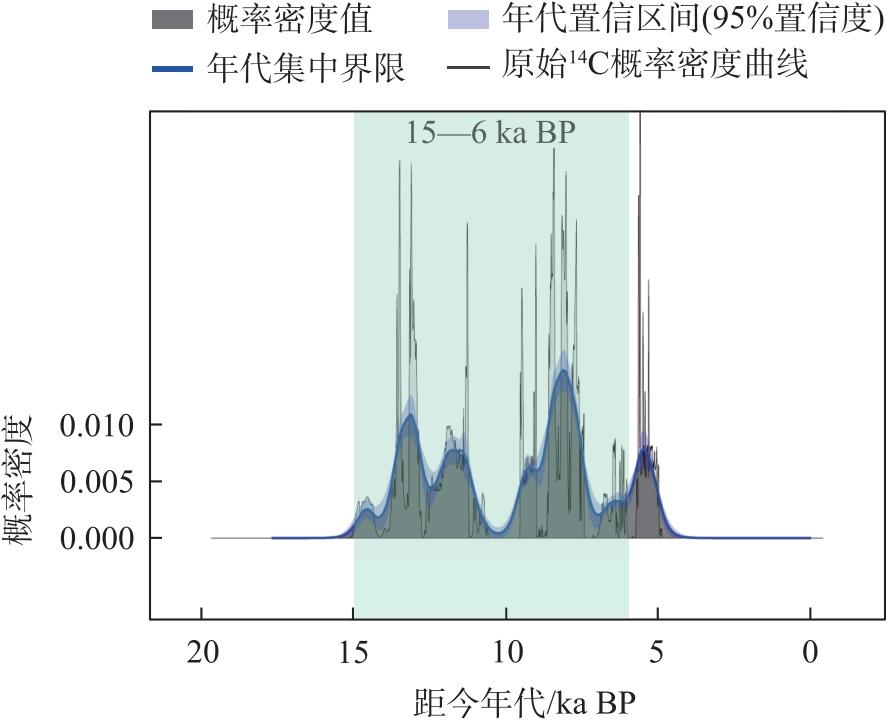
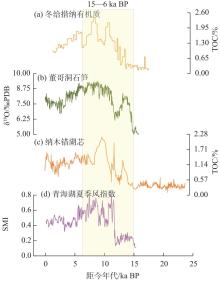
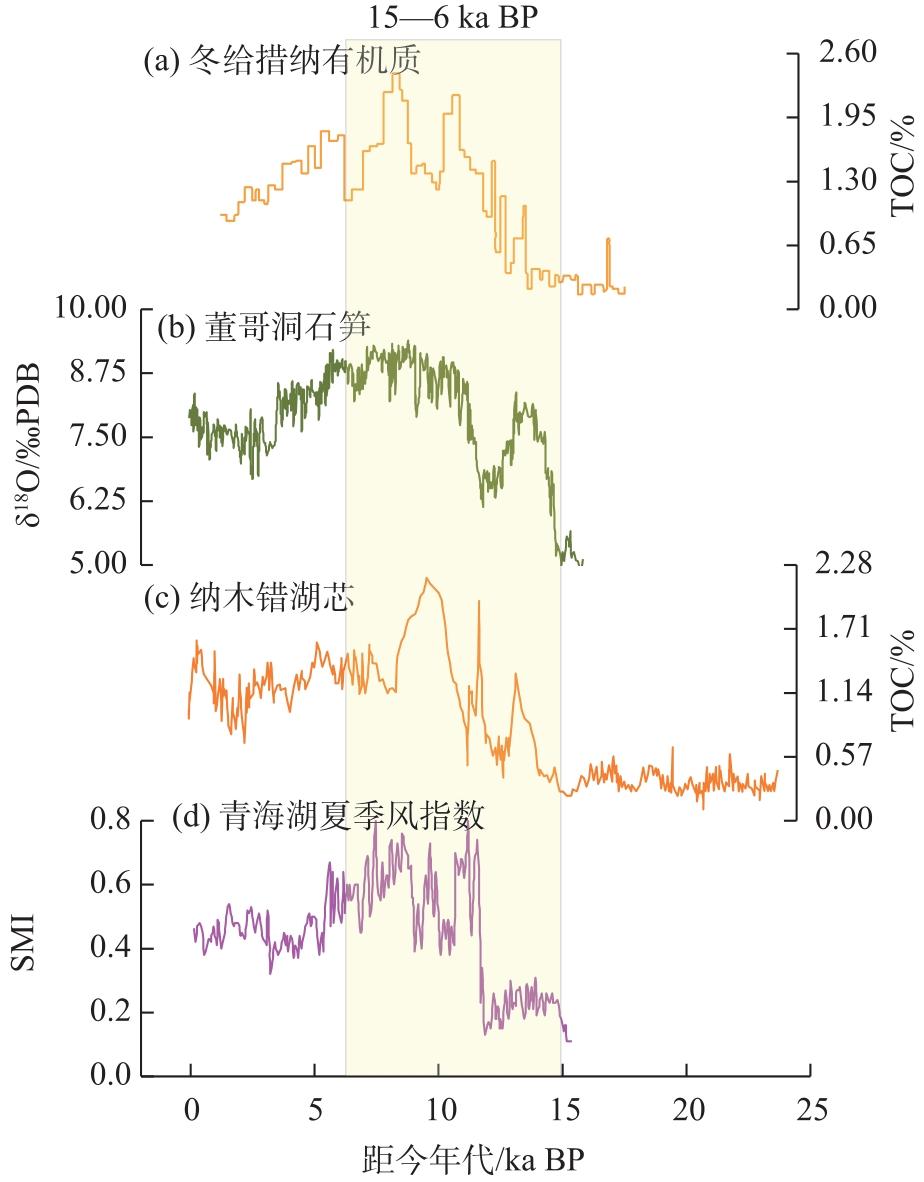
Fig. 5
Integrated curves of climate change on the Qinghai-Xizang Plateau and TOC index since the last glacial period"
| [1] |
靳英帅, 张晓凌, 何伟, 等. 自然地理分区视角下的青藏高原细石叶技术遗存[J]. 地理科学, 2023, 43(6): 961-971.
doi: 10.13249/j.cnki.sgs.2023.06.003 |
|
[Jin Yingshuai, Zhang Xiaoling, He Wei, et al. The microblade technology on the Qinghai-Xizang Plateau from the perspective of geographical regionalization[J]. Scientia Geographica Sinica, 2023, 43(6): 961-971.]
doi: 10.13249/j.cnki.sgs.2023.06.003 |
|
| [2] | 兰措卓玛. 青藏高原旧石器-历史时期交流路线的重建及演变研究[D]. 西宁: 青海师范大学, 2021. |
| [Lancuo Zhuoma. Reconstruction and evolutionary history of communication route on the Qinghai-Xizang Plateau during the palaeolithic to historical time period[D]. Xining: Qinghai Normal University, 2021.] | |
| [3] | 贾兰坡. 中国细石器的特征和它的传统、起源与分布[J]. 古脊椎动物与古人类, 1978(2): 137-143, 159-161. |
| [Jia Lanpo. Characteristics of Chinese microlithic and its tradition, origin and distribution[J]. Vertebrata Palasiatica, 1978(2): 137-143, 159-161.] | |
| [4] | 邱中郎. 青藏高原旧石器的发现[J]. 古脊椎动物学报, 1958, 2(2): 26-27. |
| [Qiu Zhonglang. Discovery of paleolithic in Qinghai-Xizang Plateau[J]. Journal of Vertebrata Palasiatica, 1958, 2(2): 26-27.] | |
| [5] |
Zhang X L, Jin Y S, He W, et al. A consideration of the spatiotemporal distribution of microblade industries on the Tibetan Plateau[J]. Quaternary International, 2020, 559: 165-173.
doi: 10.1016/j.quaint.2020.04.039 |
| [6] | 刘泽纯, 王富葆, 蒋赞初, 等. 西藏高原马法木湖东北岸等三个地点的细石器[J]. 南京大学学报(哲学, 人文科学, 社会科学), 1981(4): 87-90. |
| [Liu Zechun, Wang Fubao, Jiang Zanchu, et al. Microliths from three sites on the northeast bank of Mafamu Lake in Xizang Plateau[J]. Journal of Nanjing University (Philosophy, Humanities, Social Sciences Edition), 1981(4): 87-90.] | |
| [7] | 张森水. 西藏定日新发现的旧石器, 珠穆朗玛峰地区科学考察报告(1966—1968): 第四纪地质[M]. 北京: 科学出版社, 1976: 105-109. |
| [Zhang Senshui. Newly paleolithic discovered in Dingri, Xizang, scientific investigation report of Mount Qomolangma area (1966—1968): Quaternary geology[M]. Beijing: Science Press, 1976: 105-109.] | |
| [8] | 房迎三, 王富葆, 汤惠生. 西藏打制石器的新材料[C]// 中国古生物学会. 第九届中国古脊椎动物学学术年会论文集. 南宁: 海洋出版社, 2004: 221-232. |
| [Fang Yingsan, Wang Fubao, Tang Huisheng. New materials for stone tools in Xizang[C]// Chinese Palaeontological Society. Proceedings of the Ninth Annual Symposium of Chinese Palaevertebrates. Nanning: Ocean Press, 2004: 221-232.] | |
| [9] | Brantingham P J, Gao X, Olsen W H, et al. A short chronology for the peopling of the Tibetan Plateau[J]. Development Quaternary Sciences, 2007, 9(7): 129-150. |
| [10] |
Rhode D, Brantingham P J, Perreault C, et al. Mind the gaps: Testing for hiatuses in regional radiocarbon date sequences[J]. Journal of Archaeological Science, 2014, 52: 567-577.
doi: 10.1016/j.jas.2014.02.022 |
| [11] | 盖培, 王国道. 黄河上游拉乙亥中石器时代遗址发掘报告[J]. 人类学学报, 1983(1): 49-59, 116. |
| [Gai pei, Wang Guodao. Excavation report of the middle stone age site in Layihai, upper Yellow River[J]. Acta Anthropologica Sinica, 1983(1): 49-59, 116.] | |
| [12] | 汤惠生, 周春林, 李一全, 等. 青海昆仑山山口发现的细石器考古新材料[J]. 科学通报, 2013, 58(3): 247-253. |
| [Tang Huisheng, Zhou Chunlin, Li Yiquan, et al. New microlithic archaeological materials found in the Kunlun Mountain pass, Qinghai[J]. Science Bulletin, 2013, 58(3): 247-253.] | |
| [13] | 靳英帅, 张晓凌, 王社江, 等. 青藏高原腹地发现最早细石叶技术遗址[J]. 中国科学: 地球科学, 2024, 54(5): 1588-1601. |
| [Jin Yingshuai, Zhang Xiaoling, Wang Shejiang, et al. The earliest evidence for a microblade adaptation in the remote, high altitude regions of the Tibetan Plateau[J]. Science China Earth Sciences, 2024, 54(5): 1588-1601.] | |
| [14] | 侯光良, 许长军, 曹广超, 等. 青藏高原末次冰消期-全新世中期人类扩张的时空模拟[J]. 第四纪研究, 2017, 37(4): 709-720. |
| [Hou Guangliang, Xu Changjun, Cao Guangchao, et al. The spatial temporal simulation of mankind expansion on the Tibetan Plateau during Last Deglaciation-Middle Holocene[J]. Quaternary Sciences, 2017, 37(4): 709-720.] | |
| [15] | 吴瑞婵, 甘淑, 于丽君, 等. 最大熵模型的巴基斯坦遗址预测分布研究[J]. 测绘科学, 2021, 46(3): 96-103. |
| [Wu Ruichan, Gan Shu, Yu Lijun, et al. The study of predictive distribution of Pakistani sites based on MaxEnt model[J]. Science of Surveying and Mapping, 2021, 46(3): 96-103.] | |
| [16] |
侯光良, 曹广超, 鄂崇毅, 等. 青藏高原海拔4000 m区域人类活动的新证据[J]. 地理学报, 2016, 71(7): 1231-1240.
doi: 10.11821/dlxb201607011 |
|
[Hou Guangliang, Cao Guangchao, E Chongyi, et al. New evidence of human activities at an altitude of 4000 meters area of Qinghai-Xizang Plateau[J]. Acta Geographica Sinica, 2016, 71(7): 1231-1240.]
doi: 10.11821/dlxb201607011 |
|
| [17] |
Madsen D B, Ma H Z, Brantingham P J, et al. The late upper paleolithic occupation of the northern Tibetan Plateau margin[J]. Journal of Archaeological Science, 2006, 33(10): 1433-1444.
doi: 10.1016/j.jas.2006.01.017 |
| [18] | 王国道, 刘国宁. 青海龙羊峡达玉台遗址的打制石器[J]. 考古, 1984(7): 577-581. |
| [Wang Guodao, Liu Guoning. Stone tools from the Dayutai site at Longyangxia, Qinghai[J]. Archaeology, 1984(7): 577-581.] | |
| [19] | 西藏自治区文物局, 四川大学考古系, 陕西省考古研究所. 青藏铁路西藏段田野考古报告[M]. 北京: 科学出版社, 2005: 187-266. |
| [Bureau of Cultural Relics of Xizang Autonomous Region, Department of Archaeology Sichuan University, Shaanxi Provincial Institute of Archaeology. Field archaeological report on the Xizang section of the Qinghai-Xizang railway[M]. Beijing: Science Press, 2005: 187-266.] | |
| [20] | 袁宝印, 黄慰文, 章典. 藏北高原晚更新世人类活动的新证据[J]. 科学通报, 2007(13): 1567-1571. |
| [Yuan Baoyin, Huang Weiwen, Zhang Dian. New evidence of human activities in the Late Pleistocene of the northern Tibetan Plateau[J]. Science Bulletin, 2007(13): 1567-1571.] | |
| [21] | 王永, 王军, 纪占胜, 等. 藏北羌塘中部戈木错盆地石制品的初步研究[J]. 地质通报, 2009, 28(9): 1330-1334. |
| [Wang Yong, Wang Jun, Ji Zhansheng, et al. Preliminary study of stone products in the Gemucuo Basin, central Qiangtang, northern Xizang[J]. Geology Bulletin, 2009, 28(9): 1330-1334.] | |
| [22] | 石硕. 从旧石器晚期文化遗存看黄河流域人群向川西高原的迁徙[J]. 西藏研究, 2003(2): 33-39. |
| [Shi Shuo. From the Late Paleolithic cultural relics, the migration of people from the Yellow River Basin to the western Sichuan Plateau is observed[J]. Tibet Studies, 2003(2): 33-39.] | |
| [23] | 安志敏, 尹泽生, 李炳元. 藏北申扎、双湖的旧石器和细石器[J]. 考古, 1979(6): 481-491, 494, 577-581. |
| [An Zhimin, Yin Zesheng, Li Bingyuan. Paleolithic and microlithic in Shenzha and Shuanghu, northern Xizang[J]. Archaeology, 1979(6): 481-491, 494, 577-581.] | |
| [24] |
Meyer M C, Aldenderfer M S, Wang Z, et al. Permanent human occupation of the central Tibetan Plateau in Early Holocene[J]. Science, 2017, 355(6320): 64-67.
doi: 10.1126/science.aag0357 pmid: 28059763 |
| [25] | 戴尔俭. 西藏聂拉木县发现的石器[J]. 考古, 1972(1): 43-44, 47. |
| [Dai Erjian. Stones found in Nyalam County, Xizang[J]. Archaeology, 1972(1): 43-44, 47.] | |
| [26] | 钱方, 吴锡浩, 黄慰文. 藏北高原各听石器初步观察[J]. 人类学学报, 1988(1): 75-83, 104. |
| [Qian Fang, Wu Xihao, Huang Weiwen. Preliminary observations of various aural stone implements in the northern Tibetan Plateau[J]. Acta Anthropologica Sinica, 1988(1): 75-83, 104.] | |
| [27] | 韩芳, 蔡林海, 杜玮, 等. 青南高原登额曲流域的细石叶工艺[J]. 人类学学报, 2018, 37(1): 53-69. |
| [Han Fang, Cai Linhai, Du Wei, et al. A study on the microblade technology from the Deng’equ valley in south Qinghai Plateau[J]. Acta Anthropologica Sinica, 2018, 37(1): 53-69.] | |
| [28] | 李拓宇, 伍永秋, 杜世松, 等. 青藏高原西南部仲巴地区细石器人类活动的时代探讨[J]. 北京师范大学学报(自然科学版), 2016, 52(1): 91-96. |
| [Li Tuoyu, Wu Yongqiu, Du Shisong, et al. Age of microlith human activities in Zhongba area, southwestern margin of Qinghai-Xizang Plateau[J]. Journal of Beijing Normal University (Natural Science Edition), 2016, 52(1): 91-96.] | |
| [29] |
Hudson A M, Olsen J W, Quade J, et al. A regional record of expanded Holocene wetlands and prehistoric human occupation from paleo wetland deposits of the western Yarlung Tsangpo valley, southern Tibetan Plateau[J]. Quaternary Research, 2016, 86(1): 13-33.
doi: 10.1017/j.yqres.2016.04.001 |
| [30] | 刘泽纯, 王富葆, 蒋赞初, 等. 西藏高原多格则与扎布地点的旧石器——兼论高原古环境对石器文化分布的影响[J]. 考古, 1986(4): 289-299, 384-388. |
| [Liu Zechun, Wang Fubao, Jiang Zanchu, et al. Paleolithic sites at Duogeze and Zhabu on the Xizang Plateau: With a discussion on the influence of plateau paleoenvironment on the distribution of lithic cultures[J]. Archaeology, 1986(4): 289-299, 384-388.] | |
| [31] |
Brantingham P J, Gao X, Madsen D B, et al. Late occupation of the high-elevation northern Tibetan Plateau based on cosmogenic luminescence, and radio carbon ages[J]. Geoarchaeology, 2013, 28(5): 413-431.
doi: 10.1002/gea.2013.28.issue-5 |
| [32] |
Chen F H, Dong G H, Zhang D J, et al. Agriculture facilitated permanent human occupation of the Tibetan Plateau after 3600 BP[J]. Science, 2014, 20: 320-337.
doi: 10.1126/science.20.505.320 |
| [33] | 李永宪, 霍巍. 西藏仲巴县城北石器地点[J]. 考古, 1994(7): 577-586. |
| [Li Yongxian, Huo Wei. Northern stone site of Zhongba County, Xizang[J]. Archaeology, 1994(7): 577-586.] | |
| [34] | 陈宥成, 侯光良, 高靖易, 等. 青藏高原冬给措纳湖畔新发现的细石器及其同周边地区的技术关系[J]. 人类学学报, 2021, 40(1): 28-39. |
| [Chen Youcheng, Hou Guangliang, Gao Jingyi, et al. A new microblade assemblage from Dongjicuona lakeside in the Qinghai-Tibet Plateau and its technological relationship with adjacent areas[J]. Acta Anthropologica Sinica, 2021, 40(1): 28-39.] | |
| [35] | 张森水. 西藏细石器新资料. 西藏古生物[M]. 北京: 科学出版社, 1982: 68-77. |
| [Zhang Senshui. New data of Xizang microlithic. Xizang Paleontology[M]. Beijing: Science Press, 1982: 68-77.] | |
| [36] | Han F, Meng Q, Lü H L, et al. Intensive use of northeastern Qinghai-Xizang Plateau during the Middle Holocene new excavation of a base camp, Dongguotan site[J]. Archaeological Research in Asia, 2024, 39: 129-136. |
| [37] | 国家文物局. 中国文物地图集: 青海分册[M]. 北京: 文物出版社, 1996, 81-90. |
| [State Administration of Cultural Heritage. Atlas of Chinese cultural relics: Qinghai[M]. Beijing: Cultural Relics Press, 1996: 81-90.] | |
| [38] | 秦锋, 赵艳, 曹现勇. 利用机器学习方法重建末次冰盛期以来青藏高原植被变化[J]. 中国科学: 地球科学, 2022, 52(4): 697-713. |
| [Qin Feng, Zhao Yan, Cao Xianyong. Biome reconstruction on the Tibetan Plateau since the Last Glacial Maximum using a machine learning method[J]. Science China Earth Sciences, 2022, 52(4): 697-713.] | |
| [39] |
李文华, 李生宇, 徐新文, 等. 基于 MaxEnt模型预测气候变化下准噶尔沙蒿(Artemisia Songarica)在新疆的潜在分布[J]. 干旱区地理, 2025, 48(9): 1578-1588.
doi: 10.12118/j.issn.1000-6060.2024.657 |
|
[Li Wenhua, Li Shengyu, Xu Xinwen, et al. Predicting the potential distribution of Artemisia Songarica in Xinjiang under climate change based on the MaxEnt model[J]. Arid Land Geography, 2025, 48(9): 1578-1588.
doi: 10.12118/j.issn.1000-6060.2024.657 |
|
| [40] | 杨志红, 姚檀栋, 皇翠兰, 等. 古里雅冰芯中的新仙女木期事件记录[J]. 科学通报, 1997, 42(18): 1975-1978. |
| [Yang Zhihong, Yao Tandong, Huang Cuilan, et al. Records of the Neo-Andromedary events in the Guriya ice core[J]. Science Bulletin, 1997, 42(18): 1975-1978.] | |
| [41] |
陈发虎, 刘峰文, 张东菊, 等. 史前时代人类向青藏高原扩散的过程与动力[J]. 自然杂志, 2016, 38(4): 235-240.
doi: 10.3969/j.issn.0253-9608.2016.04.001 |
|
[Chen Fahu, Liu Fengwen, Zhang Dongju, et al. The process and driving force for peopling the Tibetan Plateau during prehistoric periods[J]. Chinese Journal of Nature, 2016, 38(4): 235-240.]
doi: 10.3969/j.issn.0253-9608.2016.04.001 |
|
| [42] | 侯光良, 赖忠平, 孙永娟, 等. 全新世大暖期对青藏高原东北缘人类活动的影响[J]. 干旱区地理, 2013, 36(6): 971-978. |
| [Hou Guangliang, Lai Zhongping, Sun Yongjuan, et al. Impact of the Holocene climatic optimum on human activities in the northeastern margin of the Qinghai-Tibetan Plateau[J]. Arid Land Geography, 2013, 36(6): 971-978.] | |
| [43] | 葛俊逸, 张晓凌, 王社江, 等. 尼阿底遗址新的测年结果表明过去-45 ka BP古人类间歇地占据青藏高原腹地[J]. 中国科学:地球科学, 2024, 54(2): 550-572. |
|
[Ge Junyi, Zhang Xiaoling, Wang Shejiang, et al. New dating indicates intermittent human occupation of the Nwya Devu paleolithic site on the high-altitude central Tibetan Plateau during the past 45,000 years[J]. Science China Earth Sciences, 2024, 54(2): 550-572.]
doi: 10.1007/s11430-010-4121-x |
|
| [44] | 沈吉. 末次盛冰期以来中国湖泊时空演变及驱动机制研究综述: 来自湖泊沉积的证据[J]. 科学通报, 2012, 57(34): 3228-3242. |
| [Shen Ji. Spatiotemporal variations of Chinese lakes and their driving mechanisms since the Last Glacial Maximum: A review and synthesis of lacustrine sediment archives[J]. Chinese Science Bullin, 2012, 57(34): 3228-3242.] | |
| [45] | 沈志忠. 青藏高原史前农业起源与发展研究[J]. 中国农史, 2011, 30(3): 13-22. |
| [Shen Zhizhong. Studies on the origin and development of agriculture on the Qinghai-Xizang Plateau in the prehistoric period[J]. Agricultural History of China, 2011, 30(3): 13-22.] | |
| [46] |
Alley R, Mayewski P, Sowers T, et al. Holocene climatic instability: A prominent, wide spread event 8200 yr ago[J]. Geology, 1997, 25: 483-486.
doi: 10.1130/0091-7613(1997)025<0483:HCIAPW>2.3.CO;2 |
| [47] | Aichner B Herzschuh, U, Wilkes H, et al. Ecological development of lake Donggi Cona, north-eastern Tibetan Plateau, since the late glacial on basis of organic geochemical proxies and non-pollen palynomorphs[J]. Palaeogeography, Palaeoclimatology, Palaeoecology, 2012, 313: 140-149. |
| [48] | Zhu L P, lü X M, Wang J B, et al. Climate change on the Tibetan Plateau in response to shifting atmospheric circulation since the LGM[J]. Scientific Reports, 2015, 5(1): 313-318. |
| [49] |
Schlutz F, Lehmkuhl F. Holocene climatic change and the nomadic anthropocene in eastern Xizang: Palynological and geomorphological results from the Nianbaoyeze Mountains[J]. Quaternary Science Reviews, 2009, 28: 1449-1471.
doi: 10.1016/j.quascirev.2009.01.009 |
| [50] |
An Z S, Colman S M, Zhou W J, et al. Interplay between the westerlies and Asian monsoon recorded in Lake Qinghai sediments since 32 ka[J]. Scientific Reports, 2012, 2(8): 619-626.
doi: 10.1038/srep00619 |
| [51] | 丛禄. 青藏高原全新世湖泊演化与其湖岸风成沉积物相关性研究[D]. 北京: 中国科学院大学, 2021. |
| [Cong Lu. The research of correlation relationship between evolution of typical lakes and lakeside’s aeolian sediments within Qinghai-Xizang Plateau[D]. Beijing: University of Chinese Academy of Sciences, 2021.] | |
| [52] |
Brantingham P J, Gao X. Peopling of the north Tibetan Plateau[J]. World Archaeology, 2006, 38(3): 387-414.
doi: 10.1080/00438240600813301 |
| [53] | 陈淳. 最佳觅食模式与农业起源研究[J]. 农业考古, 1994(3): 31-38. |
| [Chen Chun. Study on the best foraging pattern and the origin of agriculture[J]. Agricultural Archaeology, 1994(3): 31-38.] | |
| [54] | 施雅风, 李吉均, 李炳元. 青藏高原晚新生代隆升与环境变化[M]. 广州: 广东科技出版社, 1998: 37-45. |
| [Shi Yafeng, Li Jijun, Li Bingyuan. Late Cenozoic uplift and environmental change of Qinghai-Xizang Plateau[M]. Guangzhou: Guangdong Science and Technology Press, 1998: 37-45.] |
|
||

