Arid Land Geography ›› 2026, Vol. 49 ›› Issue (1): 128-139.doi: 10.12118/j.issn.1000-6060.2024.785
• Tourism Geography • Previous Articles Next Articles
ZHU Yiting1,2( ), LIANG Guixian1, ZHOU Chunshan3(), XIN Long4, LI Jinxue1
Received:2024-12-24
Revised:2025-02-05
Online:2026-01-25
Published:2026-01-18
Contact:
ZHOU Chunshan
E-mail:yiting@xju.edu.cn;zhoucs@mail.sysu.edu.cn
ZHU Yiting, LIANG Guixian, ZHOU Chunshan, XIN Long, LI Jinxue. Spatiotemporal evolution characteristics and driving factors of new quality productive forces development of cultural tourism in Xinjiang[J].Arid Land Geography, 2026, 49(1): 128-139.
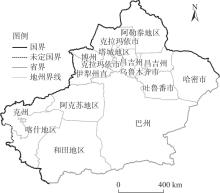
Fig. 1
Schematic diagram of the study area"

Tab. 1
Evaluation index system of new quality productive forces development of cultural tourism"
| 目标层 | 维度层 | 要素层 | 指标层 | 指标说明 | 权重 | 属性 |
|---|---|---|---|---|---|---|
| 文旅新质生 产力 | 文旅劳动者 | 劳动者人才规模 | 中高等院校文旅专业学生规模 | (中高等院校学生总数×含有文旅相关专业的中高等院校数)/中高等院校总数 | 0.128 | 正向 |
| 劳动者结构 | 文旅从业人员数量占比 | 文旅从业人员数量/就业总人数 | 0.036 | 正向 | ||
| 劳动者效能 | 每万人发明文旅专利授 权量 | Innojoy专利搜索引擎以“文化”“旅游”为关键词搜索得到的新疆和各地州专利授权数 | 0.029 | 正向 | ||
| 文旅收入占比 | 文旅收入/GDP比重 | 0.040 | 正向 | |||
| 开放度 | 进出口总额/GDP比重 | 0.049 | 正向 | |||
| 文旅劳动资料 | 文旅设备 | 观光游览设施投入 | (接待游客量×第三产业固定资产投资额)/固定资产总投 资额 | 0.051 | 正向 | |
| 游乐设施投资比重 | (特种设备数量×第三产业固定资产投资额)/总投资额 | 0.035 | 正向 | |||
| 演艺设备投入 | (艺术表演团体和场所演出场次×第三产业固定资产投资额)/总投资额 | 0.034 | 正向 | |||
| 博物馆设备投入 | (博物馆数量×第三产业固定资产投资额)/总投资额 | 0.055 | 正向 | |||
| 文旅数字化 | 信息化基础 | 信息传输、计算机服务和软件业从业人员数与就业人员 比重 | 0.081 | 正向 | ||
| 互联网基础 | 移动互联网终端用户数/常住人口数 | 0.062 | 正向 | |||
| 电子商务交易水平 | 电子商务交易额 | 0.039 | 正向 | |||
| 文旅网络支付水平 | 数字普惠金融指数 | 0.038 | 正向 | |||
| 文旅科技 创新 | 文旅产业R&D人员 | R&D人员全时当量×文旅从业人员数量占地区就业总人数的比值 | 0.045 | 正向 | ||
| 科技创新环境 | 技术合同成交额占GDP比例 | 0.041 | 正向 | |||
| 文旅劳动对象 | 文旅资源 | 3A级及以上景区占比 | 旅游景区名录中的3A级及以上景区数量占总景区数量 比例 | 0.046 | 正向 | |
| 非物质文化遗产占比 | 地区与国家级非物质文化遗产代表性项目总数量比例 | 0.064 | 正向 | |||
| 文旅投资强度 | 文旅项目投资额/第三产业增加值 | 0.023 | 正向 | |||
| 文旅绿色 发展 | 文旅废水排放量 | 废水排放量×文旅收入与工业总产值比值 | 0.023 | 负向 | ||
| 文旅水量消耗 | 用水量×文旅收入与工业总产值比值 | 0.023 | 负向 | |||
| 文旅电力消耗 | 用电量×文旅收入与工业总产值比值 | 0.059 | 负向 |
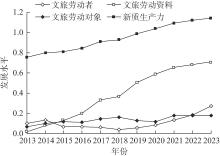
Fig. 2
Evolution of new quality productive forces development level of cultural tourism and each dimension in Xinjiang from 2013 to 2023"
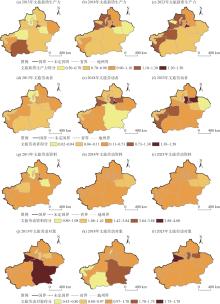
Fig. 3
Development level of new quality productive forces of cultural tourism in each prefecture of Xinjiang in 2013, 2018 and 2023"

Tab. 2
Global Moran’s I of new quality productive forces development level of cultural tourism in Xinjiang"
| 年份 | 全局莫兰指数 | Z值 | P值 |
|---|---|---|---|
| 2013 | 0.830 | 5.041 | 0.001 |
| 2018 | 0.774 | 4.562 | 0.001 |
| 2023 | 0.535 | 4.558 | 0.002 |
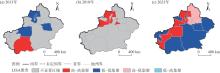
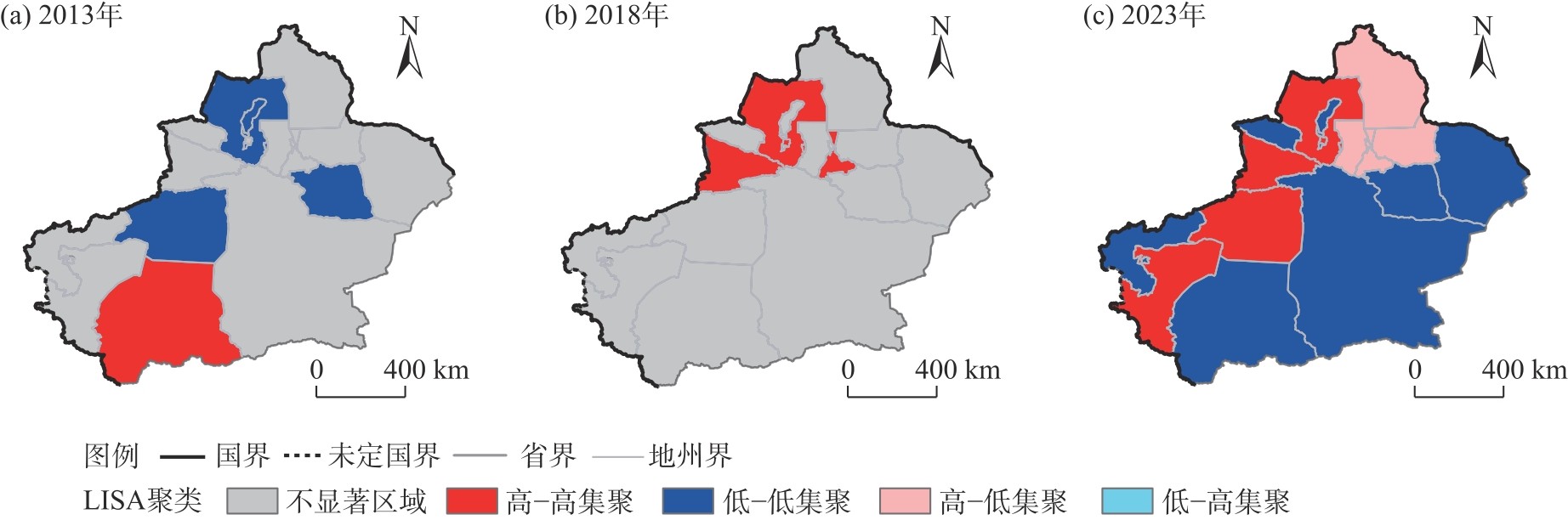
Fig. 4
LISA cluster maps of new quality productive forces development level of cultural tourism in Xinjiang in 2013, 2018 and 2023"
Tab. 3
Detected results of driving factors in new quality productive forces development of cultural tourism in Xinjiang"
| 驱动因子 | 经济发展水平 | 产业发展水平 | 市场需求 | 科技投资强度 | 教育水平 | 交通条件 |
|---|---|---|---|---|---|---|
| q值 | 0.766 | 0.801 | 0.835 | 0.804 | 0.826 | 0.854 |
| P值 | 0.024 | 0.005 | 0.009 | 0.032 | 0.010 | 0.014 |
Tab. 4
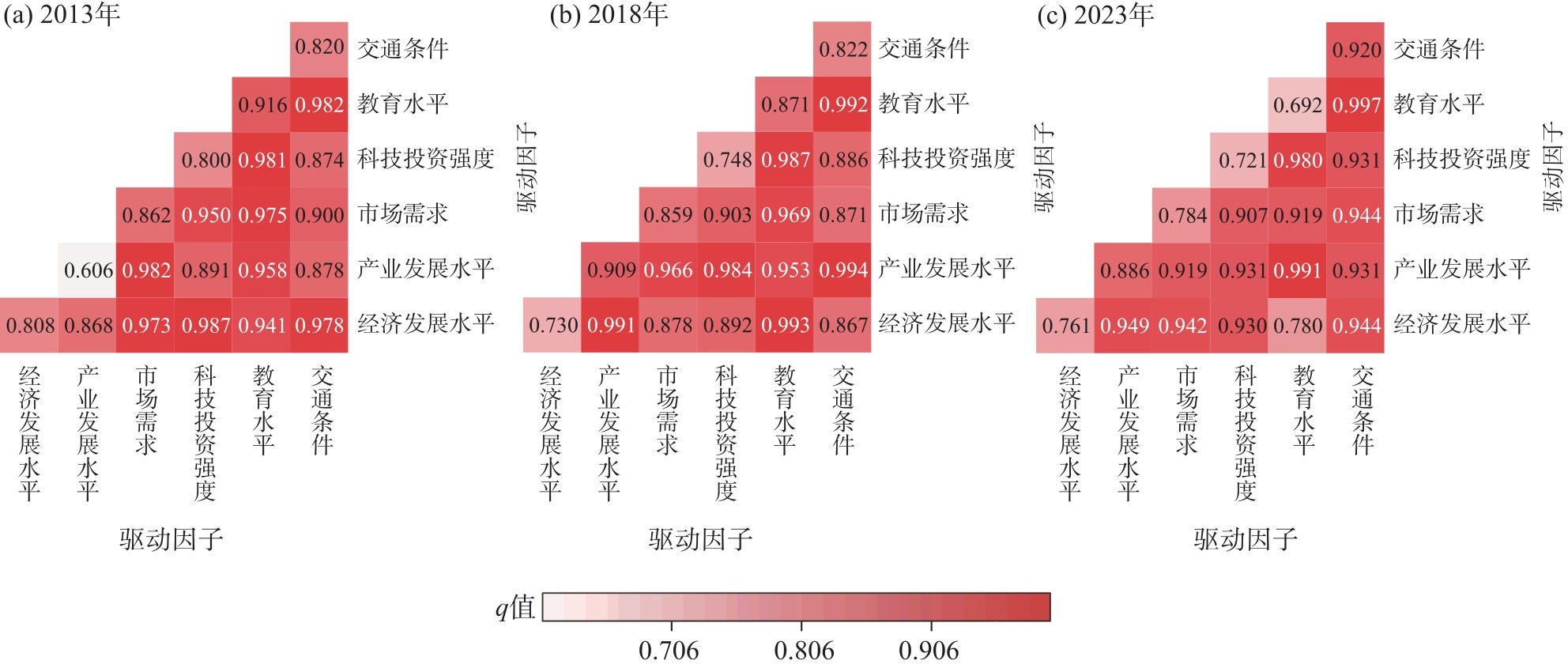
Detected results of driving factors in new quality productive forces development of cultural tourism in Xinjiang by stages"
| 驱动因子 | 2013年 | 2018年 | 2023年 | |||||
|---|---|---|---|---|---|---|---|---|
| q值 | P值 | q值 | P值 | q值 | P值 | |||
| 经济发展水平 | 0.808 | 0.010 | 0.730 | 0.032 | 0.761 | 0.023 | ||
| 产业发展水平 | 0.606 | 0.007 | 0.909 | 0.000 | 0.886 | 0.002 | ||
| 市场需求 | 0.862 | 0.005 | 0.859 | 0.010 | 0.780 | 0.007 | ||
| 科技投资强度 | 0.800 | 0.043 | 0.748 | 0.050 | 0.864 | 0.004 | ||
| 教育水平 | 0.916 | 0.000 | 0.871 | 0.007 | 0.692 | 0.034 | ||
| 交通条件 | 0.820 | 0.030 | 0.823 | 0.010 | 0.919 | 0.000 | ||
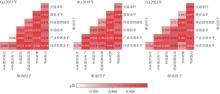
Fig. 5
Interaction of driving factors in new quality productive forces development of cultural tourism in Xinjiang by stages"
| [30] | 孙淑惠, 陈晓楠. 中国数字乡村发展的地区差距测度、结构分解与影响因素识别[J]. 统计与决策, 2024(10): 69-74. |
| [Sun Shuhui, Chen Xiaona. Regional gap measurement, structural decomposition and influencing factors identification of China’s digital rural development[J]. Statistics and Decision, 2024(10): 69-74.] | |
| [31] | 唐健雄, 陈宁, 马梦瑶, 等. 长株潭城市群康养旅游地空间结构及其差异[J]. 陕西师范大学学报(自然科学版), 2019, 47(3): 115-124. |
| [Tang Jianxiong, Chen Ning, Ma Mengyao, et al. The spatial structure and disparities of healthy tourism destinations in Changsha-Zhuzhou-Xiangtan[J]. Journal of Shaanxi Normal University (Natural Science Edition), 2019, 47(3): 115-124.] | |
| [32] |
谷昊鑫, 秦伟山, 赵明明, 等. 黄河流域旅游经济与生态环境协调发展时空演变及影响因素探究[J]. 干旱区地理, 2022, 45(2): 628-638.
doi: 10.12118/j.issn.1000–6060.2021.173 |
|
[Gu Haoxin, Qin Weishan, Zhao Mingming, et al. Spatial and temporal evolution and influencing factors of coordinated development of tourism economy and ecological environment in the Yellow River Basin[J]. Arid Land Geography, 2022, 45(2): 628-638.]
doi: 10.12118/j.issn.1000–6060.2021.173 |
|
| [33] |
胡舒云, 陆玉麒. 甘肃省冷凉区宜农空间识别与开发[J]. 干旱区地理, 2025, 48(2): 257-270.
doi: 10.12118/j.issn.1000-6060.2024.236 |
|
[Hu Shuyun, Lu Yuqi. Identification and development of arable land in cold and cool areas of Gansu Province[J]. Arid Land Geography, 2025, 48(2): 257-270.]
doi: 10.12118/j.issn.1000-6060.2024.236 |
|
| [34] |
付晓, 黄颖敏. 主体功能视角下中国革命老区高质量发展空间格局及影响因素[J]. 干旱区地理, 2025, 48(3): 517-527.
doi: 10.12118/j.issn.1000-6060.2024.291 |
|
[Fu Xiao, Huang Yingmin. Spatial pattern and influencing factors of high-quality development in China’s old revolutionary areas from the perspective of main functions[J]. Arid Land Geography, 2025, 48(3): 517-527.]
doi: 10.12118/j.issn.1000-6060.2024.291 |
|
| [35] |
王劲峰, 徐成东. 地理探测器: 原理与展望[J]. 地理学报, 2017, 72(1): 116-134.
doi: 10.11821/dlxb201701010 |
| [1] |
朱富显, 李瑞雪, 徐晓莉, 等. 中国新质生产力指标构建与时空演进[J]. 工业技术经济, 2024, 43(3): 44-53.
doi: 10.3969/j.issn.1004-910X.2024.03.005 |
| [Zhu Fuxian, Li Ruixue, Xu Xiaoli, et al. Construction and spatiotemporal evolution of new productivity indicators of China[J]. Journal of Industrial Technology and Economy, 2024, 43(3): 44-53.] | |
| [2] | 黄群慧, 盛方富. 新质生产力系统: 要素特质、结构承载与功能取向[J]. 改革, 2024(2): 15-24. |
| [Huang Qunhui, Sheng Fangfu. New productive forces system: Factor characteristics, structural bearing and functional orientation[J]. Reform, 2024(2): 15-24.] | |
| [3] | 李东民, 郭文. 新质生产力的丰富内涵、生成逻辑与当代意蕴[J]. 技术经济与管理研究, 2024(4): 8-13. |
| [Li Dongmin, Guo Wen. The rich connotation, generation logic and contemporary implication of new-quality productivity[J]. Journal of Technical Economics & Management, 2024(4): 8-13.] | |
| [4] | 江成, 聂丽君, 张嘉诚. 复杂系统视角下新质生产力特征及内涵分析框架研究[J]. 技术经济与管理研究, 2024(4): 1-7. |
| [Jiang Cheng, Nie Lijun, Zhang Jiacheng. Research on the characteristics and connotation analysis framework of new qualitative productivity from the perspective of complex systems[J]. Technical Economy and Management Research, 2024(4): 1-7.] | |
| [5] |
曾鹏, 覃意晗, 周联超. 中国城市新质生产力水平的测算及时空格局[J]. 地理科学进展, 2024, 43(6): 1102-1117.
doi: 10.18306/dlkxjz.2024.06.005 |
|
[Zeng Peng, Qin Yihan, Zhou Lianchao. Measurement and spatiotemporal pattern of new quality productive forces level in Chinese cities[J]. Progress in Geography, 2024, 43(6): 1102-1117.]
doi: 10.18306/dlkxjz.2024.06.005 |
|
| [6] | 丁仕潮, 魏引娣, 张飞扬. 中国新质生产力: 发展水平与动态演进特征[J]. 统计与决策, 2024, 40(10): 5-11. |
| [Ding Shichao, Wei Yindi, Zhang Feiyang. China’s new quality productivity: Development level and dynamic evolution characteristics[J]. Statistics and Decision, 2024, 40(10): 5-11.] | |
| [7] | 栗向阳, 王磊, 张宇欣. 长江经济带新质生产力发展的时空演化格局及其影响因素[J]. 长江流域资源与环境, 2024, 33(5): 909-923. |
| [Li Xiangyang, Wang Lei, Zhang Yuxin. Spatiotemporal evolution pattern and influencing factors of new quality productivity development in the Yangtze River Economic Belt[J]. Resources and Environment in the Yangtze Basin, 2024, 33(5): 909-923.] | |
| [8] | 刘建华, 闫静, 王慧扬, 等. 黄河流域新质生产力水平的动态演进及障碍因子诊断[J]. 人民黄河, 2024, 46(4): 1-7, 14. |
| [Liu Jianhua, Yan Jing, Wang Huiyang, et al. The dynamic evolution of new quality productive forces level and diagnosis of obstacle factors in the Yellow River Basint[J]. Yellow River, 2024, 46(4): 1-7, 14.] | |
| [9] | 朱迪, 叶林祥. 中国农业新质生产力: 水平测度与动态演变[J]. 统计与决策, 2024, 40(9): 24-30. |
| [Zhu Di, Ye Linxiang. Agricultural new quality productive force in China: Level measurement and dynamic evolution[J]. Statistics and Decision, 2024, 40(9): 24-30.] | |
| [10] | 傅联英, 蔡煜. 中国市域新质生产力: 时序演变、 组群特征与发展策略[J]. 产业经济评论, 2024(4): 5-22. |
| [Fu Lianying, Cai Yu. New quality productive forces in China’s prefecture-level cities: Chronological evolution, group characteristics and development strategies[J]. Review of Industrial Economics, 2024(4): 5-22.] | |
| [11] | 侯冠宇, 张震宇, 董劭伟. 新质生产力赋能东北农业高质量发展: 理论逻辑、关键问题与现实路径[J]. 湖南社会科学, 2024(1): 69-76. |
| [Hou Guanyu, Zhang Zhenyu, Dong Shaowei. Theoretical logic, key issues, and practical pathways for new quality productivity to empower high-quality development of agriculture in northeast China[J]. Social Sciences in Hunan, 2024(1): 69-76.] | |
| [35] | [Wang Jinfeng, Xu Chengdong. Geodetector: Principle and prospective[J]. Acta Geographic Sinica, 2017, 72(1): 116-134.] |
| [36] |
尹上岗, 孙恬, 朱奕衡, 等. 长三角地区城区面积-绿地面积异速增长关系及协调性研究[J]. 地理科学, 2024, 44(4): 670-680.
doi: 10.13249/j.cnki.sgs.20230136 |
|
[Yin Shanggang, Sun Tian, Zhu Yiheng, et al. Allometric growth relationship and coordination between urban area and green space area in the Yangtze River Delta region[J]. Scientia Geographica Sinica, 2024, 44(4): 670-680.]
doi: 10.13249/j.cnki.sgs.20230136 |
|
| [37] |
王新越, 郭利贞. 中国旅游经济适应性循环演化及影响机理[J]. 地理科学, 2024, 44(2): 297-308.
doi: 10.13249/j.cnki.sgs.20230975 |
|
[Wang Xinyue, Guo Lizhen. Development and evolution of adaptive cycle stage and driving mechanism of China’s tourism economy[J]. Scientia Geographica Sinica, 2024, 44(2): 297-308.]
doi: 10.13249/j.cnki.sgs.20230975 |
|
| [38] | 湛泳, 李胜楠. 新质生产力推进产业链现代化: 逻辑、机制与路径[J]. 改革, 2024(5): 54-63. |
| [Zhan Yong, Li Shengnan. The logic, mechanism and path of promoting the modernization of industrial chain through new quality productivity forces[J]. Reform, 2024(5): 54-63.] | |
| [39] | 钱贵明, 阳镇, 陈劲. 数字平台视角下新质生产力的形成机制与推进策略[J]. 西安交通大学学报(社会科学版), 2024, 44(5): 15-26. |
| [Qian Guiming, Yang Zhen, Chen Jin. The formation mechanism and advancement strategy of new quality productivity from the perspective of digital platforms[J]. Journal of Xi’an Jiaotong University (Social Sciences Edition), 2024, 44(5): 15-26.] | |
| [12] | 孙志远. 数字新质生产力对城乡高质量融合的影响与机制[J]. 中国流通经济, 2024, 38(5): 28-40. |
| [Sun Zhiyuan. The impact of digital new quality productive forces on high-quality urban-rural integration and its mechanism[J]. China Business and Market, 2024, 38(5): 28-40.] | |
| [13] | 夏杰长, 王文凯. 新质生产力赋能服务业高质量发展的着力点与政策建议[J]. 价格理论与实践, 2024(1): 17-21, 47. |
| [Xia Jiechang, Wang Wenkai. Focus points and policy suggestions for the high-quality development of service industry empowered by new quality productive forces[J]. Price: Theory & Practice, 2024(1): 17-21, 47.] | |
| [14] | 梁立启, 陈琦. 体育新质生产力的理论向度与实践进路[J]. 广州体育学院学报, 2024, 44(2): 1-9, 26. |
| [Liang Liqi, Chen Qi. Theoretical dimensions and practical approaches of new quality productive forces in sports[J]. Journal of Guangzhou Sport University, 2024, 44(2): 1-9, 26.] | |
| [15] |
王金伟, 陆林, 王兆峰, 等. 新质生产力赋能旅游业高质量发展: 理论内涵与科学问题[J]. 自然资源学报, 2024, 39(7): 1643-1663.
doi: 10.31497/zrzyxb.20240709 |
|
[Wang Jinwei, Lu Lin, Wang Zhaofeng, et al. Empowering the high-quality development of tourism with new quality productive forces[J]. Journal of Natural Resources, 2024, 39(7): 1643-1663.]
doi: 10.31497/zrzyxb.20240709 |
|
| [16] | 厉新建, 曾博伟, 张辉, 等. 新质生产力与旅游业高质量发展[J]. 旅游学刊, 2024, 39(5): 15-29. |
| [Li Xinjian, Zeng Bowei, Zhang Hui, et al. New quality productive forces and high-quality development in tourism: Problems, cognition and optimization direction[J]. Tourism Tribune, 2024, 39(5): 15-29.] | |
| [17] | 周文, 许凌云. 论新质生产力: 内涵特征与重要着力点[J]. 改革, 2023(10): 1-13. |
| [Zhou Wen, Xu Lingyun. On new quality productivity: Connotative characteristics and important focus[J]. Reform, 2023(10): 1-13.] | |
| [18] |
徐政, 江小鹏. 新质生产力赋能旅游高质量发展的应用场景、 逻辑机理与推进路向[J]. 经济地理, 2024, 44(11): 232-240.
doi: 10.15957/j.cnki.jjdl.2024.11.024 |
|
[Xu Zheng, Jiang Xiaopeng. Application scenario, logical mechanism and propulsion direction of new quality productive forces enabling high-quality tourism development[J]. Economic Geography, 2024, 44(11): 232-240.]
doi: 10.15957/j.cnki.jjdl.2024.11.024 |
|
| [19] | 符芳岳, 高雨晨, 张贝尔. 新质生产力赋能海南国际旅游消费中心高质量发展的逻辑机理、 现实挑战及优化路径[J]. 海南大学学报(人文社会科学版), 2025, 43(4): 133-139. |
| [Fu Fangyue, Gao Yuchen, Zhang Beier. The logical mechanism, practical challenges and optimization paths of new-quality productivity empowering the high-quality development of Hainan International Tourism and Consumption Center[J]. Journal of Hainan University (Social Sciences Edition), 2025, 43(4): 133-139.] | |
| [20] |
张宇丹, 李偲, 陈燕, 等. 新疆旅游流网络社团组织模式和层级性[J]. 地理科学, 2023, 43(9): 1619-1628.
doi: 10.13249/j.cnki.sgs.2023.09.012 |
|
[Zhang Yudan, Li Cai, Chen Yan, et al. The community organization model and hierarchy in Xinjiang’s tourism flow network[J]. Scientia Geographica Sinica, 2023, 43(9): 1619-1628.]
doi: 10.13249/j.cnki.sgs.2023.09.012 |
|
| [21] |
马文江, 白妙琴, 阿迪力·艾合买提, 等. “双碳”目标下新疆粮食绿色全要素生产率的时空分异及驱动因素分析[J]. 干旱区地理, 2023, 46(12): 2029-2041.
doi: 10.12118/j.issn.1000-6060.2023.169 |
|
[Ma Wenjiang, Bai Miaoqin, Aihemait Adili, et al. Spatial-temporal differentiation and driving factors analysis of green total factor productivity of Xinjiang grain under the carbon peaking and carbon neutrality goals[J]. Arid Land Geography, 2023, 46(12): 2029-2041.]
doi: 10.12118/j.issn.1000-6060.2023.169 |
|
| [22] |
方创琳, 孙彪. 新质生产力的地理学内涵及驱动城乡融合发展的重点方向[J]. 地理学报, 2024, 79(6): 1357-1370.
doi: 10.11821/dlxb202406001 |
|
[Fang Chuanglin, Sun Biao. The connotation of new quality productive forces and research priorities for driving urban-rural integrated development from the geographical perspective[J]. Acta Geographica Sinica, 2024, 79(6): 1357-1370.]
doi: 10.11821/dlxb202406001 |
|
| [23] | 周世露, 乔光辉. 习近平总书记关于新质生产力重要论述的整体逻辑[J]. 经济问题, 2024(7): 11-19. |
| [Zhou Shilu, Qiao Guanghui. The overall logic of general secretary Xi Jinping’s important discourses on new quality productive forces[J]. On Economic Problems, 2024(7): 11-19.] | |
| [24] |
刘沛林, 徐硕. 文旅新质生产力: 内涵审视、 支撑向度与实践路径[J]. 旅游导刊, 2024, 8(3): 34-47.
doi: 10.12054/lydk.bisu.274 |
| [Liu Peilin, Xu Shuo. New quality productive forces of cultural tourism: Connotation review, support dimensions, and practical path[J]. Tourism and Hospitality Prospects, 2024, 8(3): 34-47.] | |
| [25] |
周霖, 张旭红, 周成, 等. 黄河流域旅游业高质量发展系统性评价[J]. 中国沙漠, 2023, 43(6): 142-150.
doi: 10.7522/j.issn.1000-694X.2023.00086 |
|
[Zhou Lin, Zhang Xuhong, Zhou Cheng, et al. A systematic evaluation of high-quality tourism development in provinces along the Yellow River[J]. Journal of Desert Research, 2023, 43(6): 142-150.]
doi: 10.7522/j.issn.1000-694X.2023.00086 |
|
| [26] | 齐平, 宋威辉, 高源伯. 数字经济对制造业“四链”融合的影响[J]. 当代财经, 2024(9): 126-138. |
| [Qi Ping, Song Weihui, Gao Yuanbo. The impact of digital economy on the integration of the “four chains” in manufacturing industry[J]. Contemporary Finance and Economics, 2024(9): 126-138.] | |
| [27] | 王树斌, 侯博文, 李彦昭. 新质生产力要素机制、 创新逻辑与路径突破——基于系统论视角[J]. 当代经济科学, 2025, 47(1): 120-133. |
| [Wang Shubin, Hou Bowen, Li Yanzhao. The mechanism of new quality productivity factors, innovation logic, and breakthrough paths: From the perspective of systems theory[J]. Modern Economic Science, 2025, 47(1): 120-133.] | |
| [28] |
舒小林, 闵浙思, 郭向阳, 等. 省域数字经济与旅游业高质量发展耦合协调及驱动因素[J]. 经济地理, 2024, 44(1): 197-208.
doi: 10.15957/j.cnki.jjdl.2024.01.020 |
|
[Shu Xiaolin, Min Zhesi, Guo Xiangyang, et al. Coupling coordination between digital economy and tourism high-quality development at the provincial level and its driving factors[J]. Economic Geography, 2024, 44(1): 197-208.]
doi: 10.15957/j.cnki.jjdl.2024.01.020 |
|
| [29] | 杨扬, 邓飞. 产业数字化赋能国内国际双循环: 理论分析与实证检验[J]. 技术经济与管理研究, 2024(5): 129-134. |
| [Yang Yang, Deng Fei. Industrial digitalization promotes domestic and international double circulation: Theoretical analysis and empirical testing[J]. Journal of Technical Economics & Management, 2024(5): 129-134.] |
|
||

