Arid Land Geography ›› 2025, Vol. 48 ›› Issue (7): 1233-1242.doi: 10.12118/j.issn.1000-6060.2024.523
• Tourism Geography • Previous Articles Next Articles
SHI Zhuoda( ), YANG Hongwei()
Received:2024-09-01
Revised:2024-11-26
Online:2025-07-25
Published:2025-07-04
Contact:
YANG Hongwei
E-mail:shizhuoda@xjshzu.com;yanghongwei5@xjshzu.com
SHI Zhuoda, YANG Hongwei. Measurement and influencing factors of high-quality development of tourism economy: A case of Xinjiang[J].Arid Land Geography, 2025, 48(7): 1233-1242.
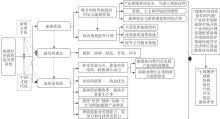
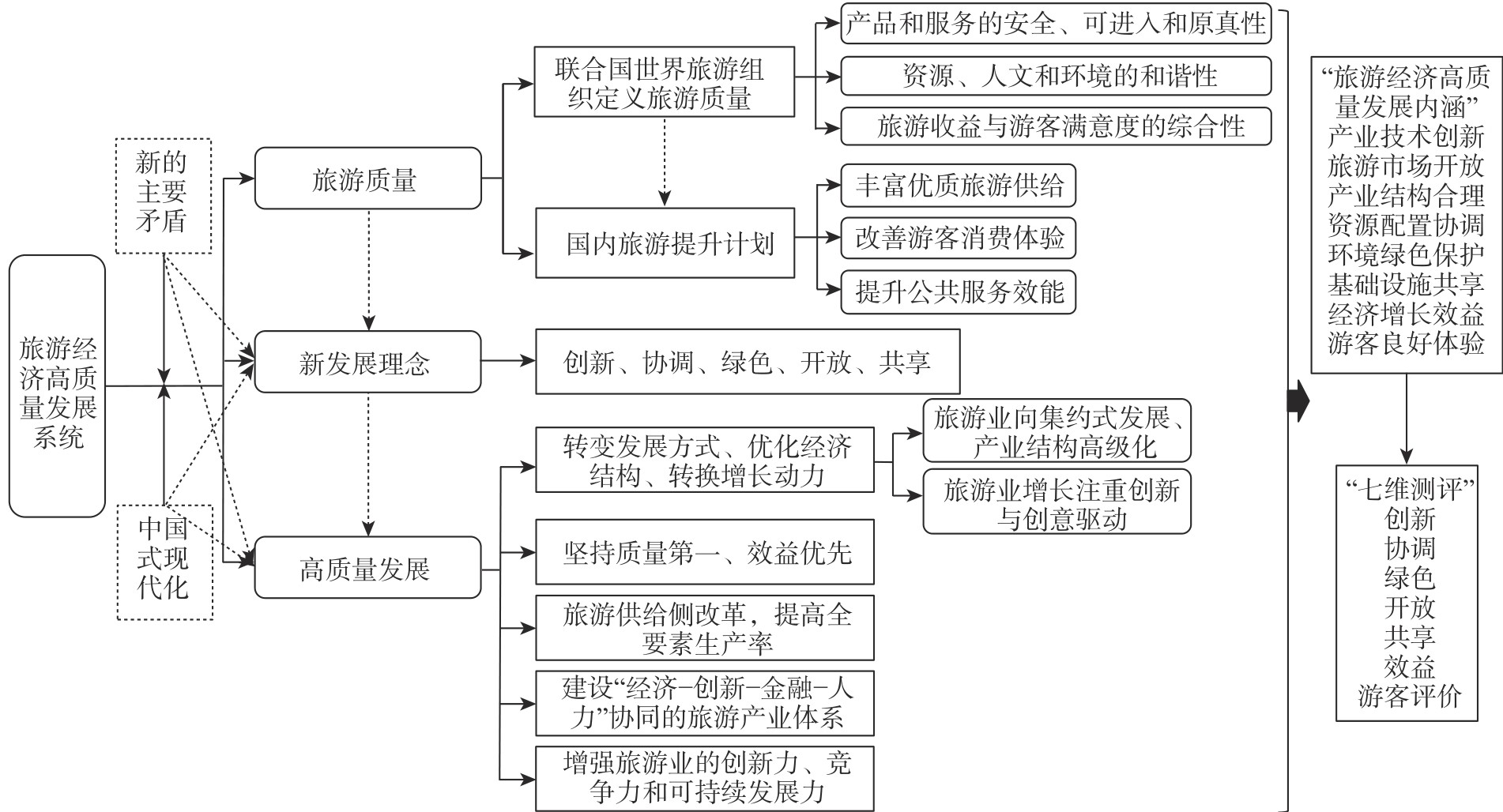
Fig. 1
Structure of the literature review on quality development of the tourism economy"

Tab. 1
Measurement system of high-quality development level of the tourism economy"
| 目标层 | 维度层 | 指标层 | 具体指标 | 指标属性 | 参考依据 |
|---|---|---|---|---|---|
| 旅游经济高质量发展 | 创新 | 创新投资 | 旅游业R&D经费投入 | 正 | [ |
| 创新人才 | 旅游院校在校学生数 | 正 | |||
| 业态创新 | 体育旅游基地数 | 正 | |||
| 康养旅游项目数 | 正 | ||||
| 智慧旅游 | 智慧旅游景区数 | 正 | |||
| 协调 | 区域旅游发展协调 | 地区旅游总收入/全国旅游总收入 | 正 | [ | |
| 旅游经济供需协调 | 旅游总收入/第三产业经济生产总值 | 正 | |||
| 住宿与餐饮业收入/旅游总收入 | 负 | ||||
| 绿色 | 旅游生态环境 | 人均绿化面积 | 正 | [ | |
| 空气质量优良率 | 正 | ||||
| 旅游污染减排 | 废气排放总量×旅游收入/GDP | 负 | |||
| 废水排放总量×旅游收入/GDP | 负 | ||||
| 区域垃圾处理能力 | 生活垃圾处理率 | 正 | |||
| 开放 | 入境旅客 | 入境旅游者人数/总旅游者人数 | 正 | [ | |
| 旅游外汇 | 旅游创汇收入/GDP | 正 | |||
| 入境旅客消费水平 | 入境旅客日均消费额 | 正 | |||
| 外商投资 | 外商投资/GDP | 正 | |||
| 共享 | 文化资源共享 | 美术馆、博物馆和文化馆数量 | 正 | [ | |
| 旅游就业贡献 | 旅游直接从业人员占比 | 正 | |||
| 旅游交通服务 | 水陆空客运总量 | 正 | |||
| 游憩资源共享 | 公园绿地面积/地区人口数 | 正 | |||
| 效益 | 旅游收入 | 旅游总收入/GDP | 正 | [ | |
| 旅游经济增长 | 旅游收入增长率 | 正 | |||
| 旅游市场 | 旅游人次增长率 | 正 | |||
| 旅游业劳动生产率 | 旅游总收入/旅游从业人数 | 正 | |||
| 旅游资本产出率 | 旅游业总收入/旅游业固定资产投资 | 正 | |||
| 游客评价 | 游客游后满意度 | 游客积极情感倾向评论占比 | 正 | [ | |
| 3A级以上旅游景区日均客流量 | 正 | ||||
| 3A级以上旅游景区大众点评评分 | 正 | ||||
| 3A级以上旅游景区去哪儿旅行网评分 | 正 |
Tab. 2
High-quality development levels of tourism economy in Xinjiang from 2008 to 2023"
| 年份 | 创新水平 | 协调水平 | 绿色水平 | 开放水平 | 共享水平 | 效益水平 | 游客评价指数 | 综合水平 |
|---|---|---|---|---|---|---|---|---|
| 2008 | 2.171 | 2.796 | 7.625 | 3.561 | 1.919 | 0.824 | 2.007 | 2.289 |
| 2009 | 1.921 | 3.448 | 7.136 | 4.213 | 1.634 | 1.388 | 1.828 | 2.334 |
| 2010 | 2.641 | 3.079 | 6.699 | 3.851 | 1.972 | 1.918 | 1.983 | 2.556 |
| 2011 | 3.020 | 3.208 | 6.096 | 4.338 | 2.252 | 2.271 | 2.170 | 2.791 |
| 2012 | 2.203 | 4.092 | 5.490 | 4.288 | 1.312 | 2.524 | 2.093 | 2.577 |
| 2013 | 2.534 | 5.617 | 4.324 | 4.304 | 1.895 | 4.623 | 1.927 | 3.103 |
| 2014 | 2.316 | 6.070 | 2.450 | 3.963 | 3.253 | 5.885 | 2.140 | 3.492 |
| 2015 | 1.828 | 3.353 | 3.785 | 3.272 | 2.646 | 6.335 | 1.930 | 3.206 |
| 2016 | 1.850 | 2.525 | 3.707 | 3.872 | 6.663 | 6.206 | 1.911 | 3.804 |
| 2017 | 2.916 | 2.766 | 4.137 | 2.578 | 6.292 | 6.776 | 1.912 | 3.929 |
| 2018 | 5.853 | 3.765 | 4.483 | 3.240 | 7.490 | 6.653 | 2.123 | 4.684 |
| 2019 | 7.017 | 4.460 | 3.973 | 6.218 | 9.342 | 6.040 | 2.057 | 5.254 |
| 2020 | 7.527 | 5.389 | 6.681 | 0.465 | 8.057 | 5.240 | 1.968 | 4.660 |
| 2021 | 6.919 | 5.567 | 5.573 | 1.332 | 8.770 | 5.986 | 2.151 | 4.916 |
| 2022 | 7.696 | 6.154 | 6.648 | 2.316 | 9.172 | 5.349 | 2.107 | 5.125 |
| 2023 | 8.459 | 7.034 | 6.995 | 4.653 | 9.097 | 8.110 | 2.094 | 6.027 |
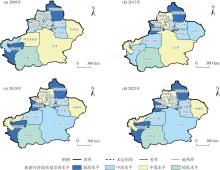
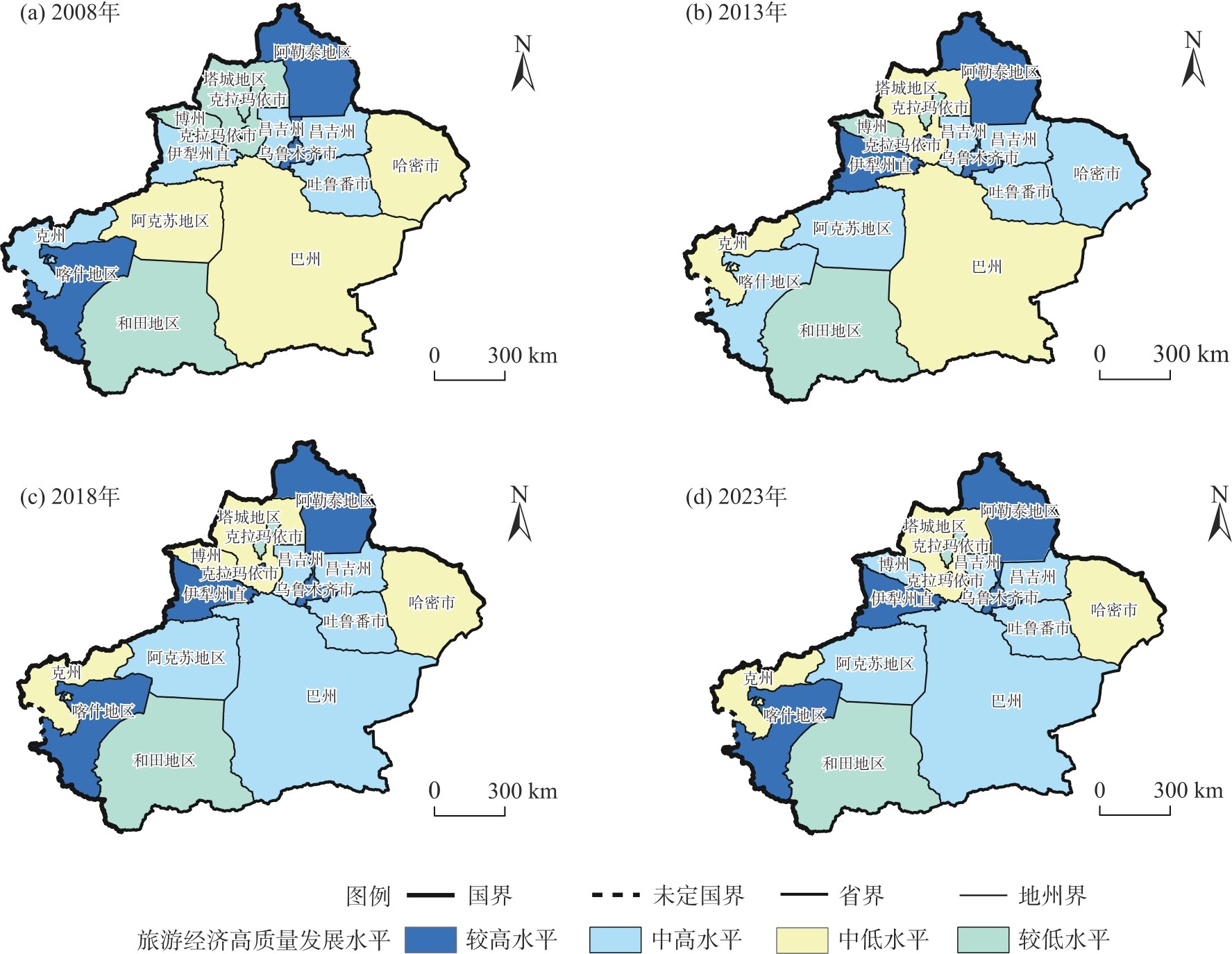
Fig. 2
Spatial distribution patterns of high-quality development of tourism economy in Xinjiang"
Tab. 3
Sources of obstacle factors to high-quality development of tourism economy in Xinjiang"
| 地区 | 主要障碍来源 | 地区 | 主要障碍来源 | ||
|---|---|---|---|---|---|
| 所在维度 | 障碍度/% | 所在维度 | 障碍度/% | ||
| 新疆总体 | 创新 | 10.961 | 阿克苏地区 | 创新 | 12.637 |
| 乌鲁木齐市 | 协调 | 8.077 | 克州 | 绿色 | 9.778 |
| 克拉玛依市 | 效益 | 12.374 | 喀什地区 | 绿色 | 9.239 |
| 吐鲁番市 | 绿色 | 9.235 | 和田地区 | 效益 | 11.247 |
| 哈密市 | 创新 | 11.162 | 伊犁州直 | 协调 | 8.361 |
| 昌吉州 | 协调 | 9.778 | 塔城地区 | 共享 | 10.542 |
| 博州 | 创新 | 10.039 | 阿勒泰地区 | 协调 | 8.971 |
| 巴州 | 协调 | 9.353 | |||
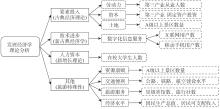
Fig. 3
Impact factor analysis based on development economics"

Tab. 4
Factor loadings after rotation"
| 公因子命名 | 测量项目 | 因子负载 | ||||
|---|---|---|---|---|---|---|
| 公因子1 | 公因子2 | 公因子3 | 公因子4 | 公因子5 | ||
| 旅游交通 | 铁路营业里程 | 0.843 | - | - | - | - |
| 公路里程 | 0.758 | - | - | - | - | |
| 航线航班里程 | 0.639 | - | - | - | - | |
| 旅游服务 | 旅行社数量 | - | 0.695 | - | - | - |
| 星级宾馆数量 | - | 0.765 | - | - | - | |
| 经济支撑 | 国内生产总值 | - | - | 0.729 | - | - |
| 居民可支配收入 | - | - | 0.731 | - | - | |
| 社会固定资产投资 | - | - | 0.799 | - | - | |
| 资源要素 | 在校大学生人数 | - | - | - | 0.830 | - |
| 第三产业从业人数 | - | - | - | 0.695 | - | |
| A级以上景区数量 | - | - | - | 0.793 | - | |
| 信息服务 | 固定互联网宽带接入用户数 | - | - | - | - | 0.885 |
| 移动电话用户 | - | - | - | - | 0.729 | |
Tab. 5
Results of gray correlation analysis of influencing factors"
| 关联目标 | 关联因子 | 关联因素 | |||||
|---|---|---|---|---|---|---|---|
| 因子名称 | 关联度 | 排名 | 因素名称 | 关联度 | 排名 | ||
| 旅游经济高质量发展水平 | 旅游交通 | 0.881 | 3 | 铁路营业里程 | 0.880 | 7 | |
| 公路里程 | 0.895 | 4 | |||||
| 航线航班里程 | 0.868 | 9 | |||||
| 旅游服务 | 0.796 | 5 | 旅行社数量 | 0.730 | 13 | ||
| 星级宾馆数量 | 0.862 | 10 | |||||
| 经济支撑 | 0.897 | 2 | 国内生产总值 | 0.891 | 5 | ||
| 居民可支配收入 | 0.902 | 2 | |||||
| 第三产业固定资产投资 | 0.897 | 3 | |||||
| 资源要素 | 0.842 | 4 | 在校大学生人数 | 0.812 | 12 | ||
| 第三产业从业人数 | 0.840 | 11 | |||||
| A级以上景区数量 | 0.875 | 8 | |||||
| 信息服务 | 0.917 | 1 | 固定互联网宽带接入用户数 | 0.948 | 1 | ||
| 移动电话用户 | 0.886 | 6 | |||||
| [1] | 何建民. 新时代我国旅游业高质量发展系统与战略研究[J]. 旅游学刊, 2018, 33(10): 9-11. |
| [ He Jianmin. Research on the system and strategy of high-quality development of China’s tourism industry in the new era[J]. Tourism Tribune, 2018, 33(10): 9-11. ] | |
| [2] | 张军扩, 侯永志, 刘培林, 等. 高质量发展的目标要求和战略路径[J]. 管理世界, 2019, 35(7): 1-7. |
| [ Zhang Junkuo, Hou Yongzhi, Liu Peilin, et al. The goals and strategy path of high-quality development[J]. Management World, 2019, 35(7): 1-7. ] | |
| [3] | 杨伟民. 贯彻中央经济工作会议精神推动高质量发展[J]. 宏观经济管理, 2018(2): 13-17. |
| [ Yang Weimin. Implementing the spirit of the central economic work conference to promote high-quality development[J]. Macroeconomic Management, 2018(2): 13-17. ] | |
| [4] | 任保平, 李培伟. 黄河流域高质量发展与生态保护耦合协调的现代化治理体系[J]. 人民黄河, 2023, 45(9): 4-11. |
| [ Ren Baoping, Li Peiwei. Modernized governance system for coupling and coordinating high-quality development and ecological protection in the Yellow River Basin[J]. Yellow River, 2023, 45(9): 4-11. ] | |
| [5] | 白洋, 谭李娜, 陈春燕, 等. 城际列车对新疆旅游经济高质量发展的影响效应及驱动机制[J]. 干旱区地理, 2023, 46(4): 658-666. |
| [ Bai Yang, Tan Lina, Chen Chunyan, et al. Influence effect and driving mechanism of intercity trains on high-quality development of tourism economy in Xinjiang[J]. Arid Land Geography, 2023, 46(4): 658-666. ] | |
| [6] | 刘英基, 韩元军. 要素结构变动、制度环境与旅游经济高质量发展[J]. 旅游学刊, 2020, 35(3): 28-38. |
| [ Liu Yingji, Han Yuanjun. Factor structure, institutional environment and high-quality development of the tourism economy in China[J]. Journal Tourism, 2020, 35(3): 28-38. ] | |
| [7] | 许艺芳, 王松茂. 中国旅游经济高质量发展时空特征及影响因素研究[J]. 统计与决策, 2023, 39(2): 88-92. |
| [ Xu Yifang, Wang Songmao. Research on spatial-temporal characteristics and influencing factors of high-quality development of China’s tourism economy[J]. Statistics & Decision, 2023, 39(2): 88-92. ] | |
| [8] | 李书昊, 魏敏. 中国旅游业高质量发展: 核心要求、实现路径与保障机制[J]. 云南民族大学学报(哲学社会科学版), 2023, 40(1): 152-160. |
| [ Li Shuhao, Wei Min. High-quality development of tourism industry in China: Core requirements, realization approaches and guarantee mechanisms[J]. Journal of Yunnan University for Nationalities (Philosophy and Social Science Edition), 2023, 40(1): 152-160. ] | |
| [9] | 徐晓亮, 刘旭义, 关靖云, 等. 中国西部边疆民族地区文旅融合高质量发展时空演化及驱动因素分析[J]. 干旱区地理, 2024, 47(9): 1596-1605. |
| [ Xu Xiaoliang, Liu Xuyi, Guan Jingyun, et al. Spatiotemporal evolution and driving factors of high-quality development of cultural and tourism integration in border ethnic areas in western China[J]. Arid Land Geography, 2024, 47(9): 1596-1605. ] | |
| [10] | 黄子璇, 史达, 马淑花. 中国旅游经济与生态系统服务协调效应及其障碍因素研究[J]. 旅游学刊, 2024, 39(4): 93-108. |
| [ Huang Zixuan, Shi Da, Ma Shuhua. Coordination effect of tourism economy and ecosystem services in China and its obstacle factors[J]. Journal Tourism, 2024, 39(4): 93-108. ] | |
| [11] | Chen J L, Li G, Wu D C, et al. Forecasting seasonal tourism demand using a multiseries structural time series method[J]. Journal of Travel Research, 2019, 58(1): 92-103. |
| [12] | Alomari B, Awawdeh A, Alolayyan M N, et al. Employee performance and quality management in the tourism sector: Case study of human resources management-employee performance[J]. Modern Applied Science, 2017, 11(9): 1844-1852. |
| [13] | Kim N, Shim C. Social capital, knowledge sharing and innovation of small- and medium-sized enterprises in a tourism cluster[J]. International Journal of Contemporary Hospitality Management, 2018, 30(6): 2417-2437. |
| [14] | 谢霞. 丝绸之路经济带核心区旅游经济系统脆弱性评价[J]. 新疆大学学报(哲学·人文社会科学版), 2019, 47(5): 9-16. |
| [ Xie Xia. Vulnerability assessment of tourism economic system in the core area of Silk Road Economic Belt[J]. Journal of Xinjiang University (Philosophy-Humanities and Social Sciences Edition), 2019, 47(5): 9-16. ] | |
| [15] | 人民网. 新疆旅游业迎来发展黄金期[EB/OL]. [2023-06-26]. . |
| [ People’s Daily Online. Xinjiang tourism ushered in the golden period of development[EB/OL]. [2023-06-26]. . ] | |
| [16] | 张建伟, 李国栋, 杨琴. 西藏旅游经济高质量发展: 理论内涵与水平测度[J]. 西藏大学学报(社会科学版), 2022, 37(4): 186-196. |
| [ Zhang Jianwei, Li Guodong, Yang Qin. On theoretical connotation and level measurement of high quality development of tourism economy in Tibet[J]. Journal of Tibet University (Social Science Edition), 2022, 37(4): 186-196. ] | |
| [17] | 厉新建, 曾博伟, 张辉, 等. 新质生产力与旅游业高质量发展[J]. 旅游学刊, 2024, 39(5): 15-29. |
| [ Li Xinjian, Zeng Bowei, Zhang Hui, et al. New quality productive forces and high-quality development in tourism: Problems, cognition and optimization direction[J]. Journal Tourism, 2024, 39(5): 15-29. ] | |
| [18] | 丰晓旭, 夏杰长. 中国全域旅游发展水平评价及其空间特征[J]. 经济地理, 2018, 38(4): 183-192. |
| [ Feng Xiaoxu, Xia Jiechang. Research on the level of all-for-one tourism development and its spatial characteristics in China[J]. Economic Geography, 2018, 38(4): 183-192. ] | |
| [19] | 李文路. 中国式现代化背景下贵州喀斯特地区生态旅游高质量发展研究[J]. 中国软科学, 2024( 增刊1): 163-171. |
| [ Li Wenlu. Research on the high-quality development of ecotourism in karst area under the background of Chinese-type modernization[J]. China Soft Science, 2024(Suppl. 1): 163-171. ] | |
| [20] | 马丽君, 刘聪, 唐盈. 省域旅游业高质量发展促进共同富裕的空间效应分析[J]. 经济地理, 2024, 44(4): 210-219. |
| [ Ma Lijun, Liu Cong, Tang Ying. Spatial effects of high-quality tourism development for common prosperity at the provincial level[J]. Economic Geography, 2024, 44(4): 210-219. ] | |
| [21] | 张鹏杨, 章乐文, 乔花飞, 等. 中国旅游经济高质量发展的时空演化与区域差异——基于新发展理念视角[J]. 华中师范大学学报(自然科学版), 2024, 58(4): 470-480. |
| [ Zhang Pengyang, Zhang Lewen, Qiao Huafei, et al. Spatio-temporal evolution and regional differences of high-quality development of China’s tourism economy: From the perspective of new development concept[J]. Journal of Central China Normal University (Natural Science Edition), 2024, 58(4): 470-480. ] | |
| [22] | 田小波, 胡静, 贾垚焱, 等. 高质量发展阶段旅游业发展水平空间分异成因探测——基于因素分解的黄河流域实证[J]. 干旱区地理, 2023, 46(3): 460-470. |
| [ Tian Xiaobo, Hu Jing, Jia Yaoyan, et al. Exploring thecauses of spatial differentiation of tourism development level in the high-quality development stage: Empirical evidence of Yellow River Basin based on factor decomposition[J]. Arid Land Geography, 2023, 46(3): 460-470. ] | |
| [23] | 李志远, 夏赞才. 长江经济带旅游业高质量发展水平测度及失配度时空格局探究[J]. 南京师大学报(自然科学版), 2021, 44(4): 33-42. |
| [ Li Zhiyuan, Xia Zancai. The measurement of high-quality development level of tourism and the spatial-temporal pattern of mismatch degree in the Yangtze River Economic Belt[J]. Nanjing Normal University Journal (Natural Science Edition), 2021, 44(4): 33-42. ] | |
| [24] | 张越杰, 张昱. 我国东北地区县域农业生态旅游发展质量评价指标体系构建与应用[J/OL]. 经济地理. [2024-03-12]. . |
| [ Zhang Yuejie, Zhang Yu. Research and application of agricultural eco-tourism development quality evaluation system: A case study in northeast China[J/OL]. Economic Geography. [2024-03-12]. . ] | |
| [25] | 龙顺发, 曹开军, 商宁. 旅游促进乡村发展的空间效应——基于新疆83个县市的实证分析[J]. 地理科学, 2024, 44(8): 1387-1395. |
| [ Long Shunfa, Cao Kaijun, Shang Ning. Spatial effect of tourism promoting rural development: An empirical analysis of 83 counties in Xinjiang Uygur Autonomous Region[J]. Scientia Geographica Sinica, 2024, 44(8): 1387-1395. ] |
|
||

