Arid Land Geography ›› 2026, Vol. 49 ›› Issue (8): 1560-1571.doi: 10.12118/j.issn.1000-6060.2025.846
• Climatology and Hydrology • Previous Articles Next Articles
XU Xiao1( ), WANG Ninglian1,2(), SHI Chenlie1,3
Received:2025-12-26
Revised:2026-01-03
Online:2026-08-25
Published:2026-08-21
Contact:
WANG Ninglian
E-mail:13176991095@163.com;nlwang@nwu.edu.cn
XU Xiao, WANG Ninglian, SHI Chenlie. Albedo variation characteristics of the Qiyi Glacier during the ablation season based on Sentinel-2 and MODIS data[J].Arid Land Geography, 2026, 49(8): 1560-1571.
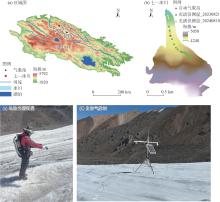
Fig. 1
Schematic diagram of the study area and instruments used for field measurements"
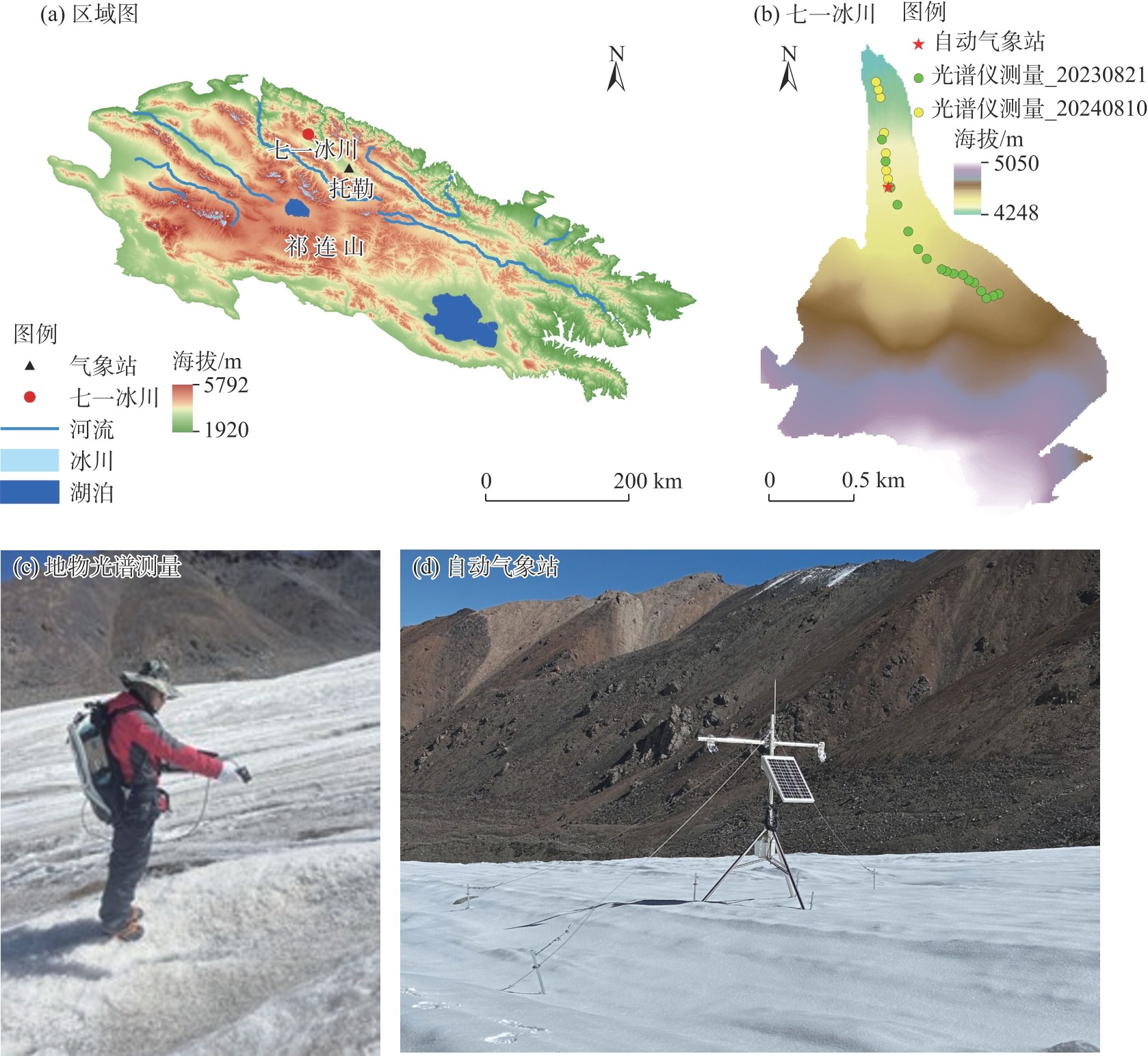
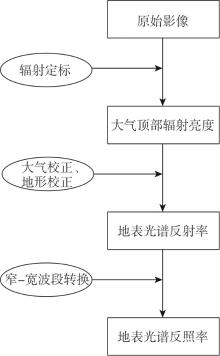
Fig. 2
Workflow of glacier surface albedo retrieval from Sentinel-2 MSI images"
Fig. 3
Validation between the remotely retrieved albedo and the in-situ measured albedo"
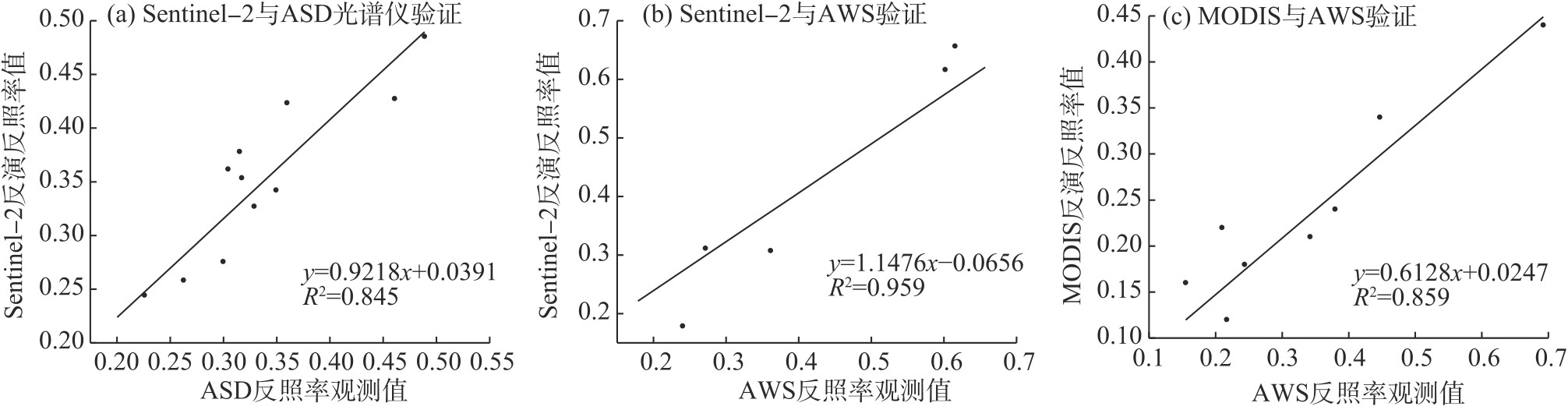
Fig. 4
Spatial distributions of the mean albedo of the Qiyi Glacier from 2016 to 2024"
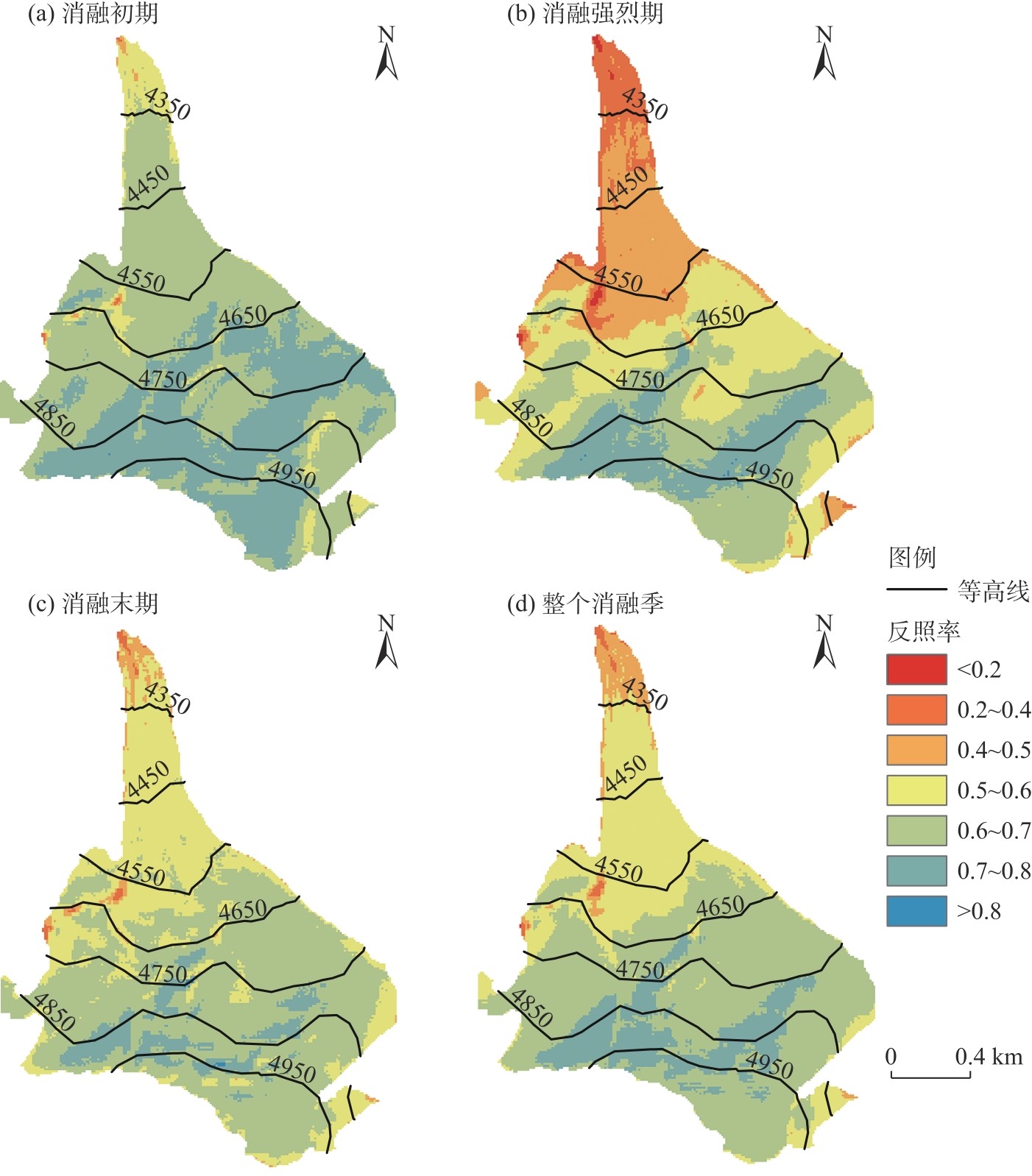
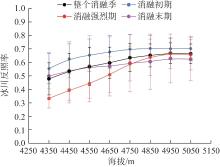
Fig. 5
Relationship between albedo and altitude zones across the Qiyi Glacier in the ablation periods from 2016 to 2024"
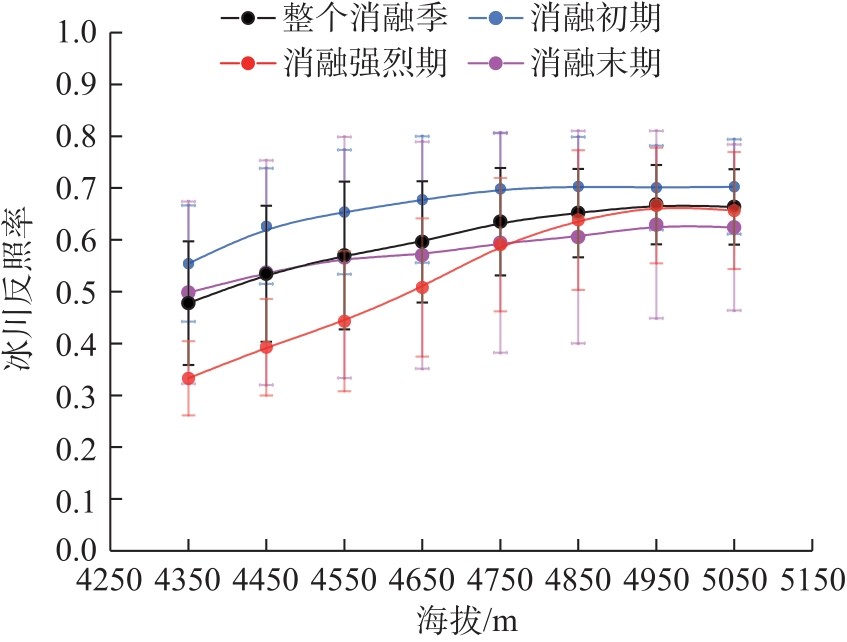
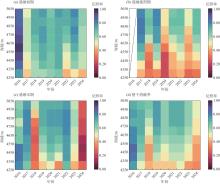
Fig. 6
Heatmap of the mean albedo distribution for the Qiyi Glacier in different periods from 2016 to 2024"
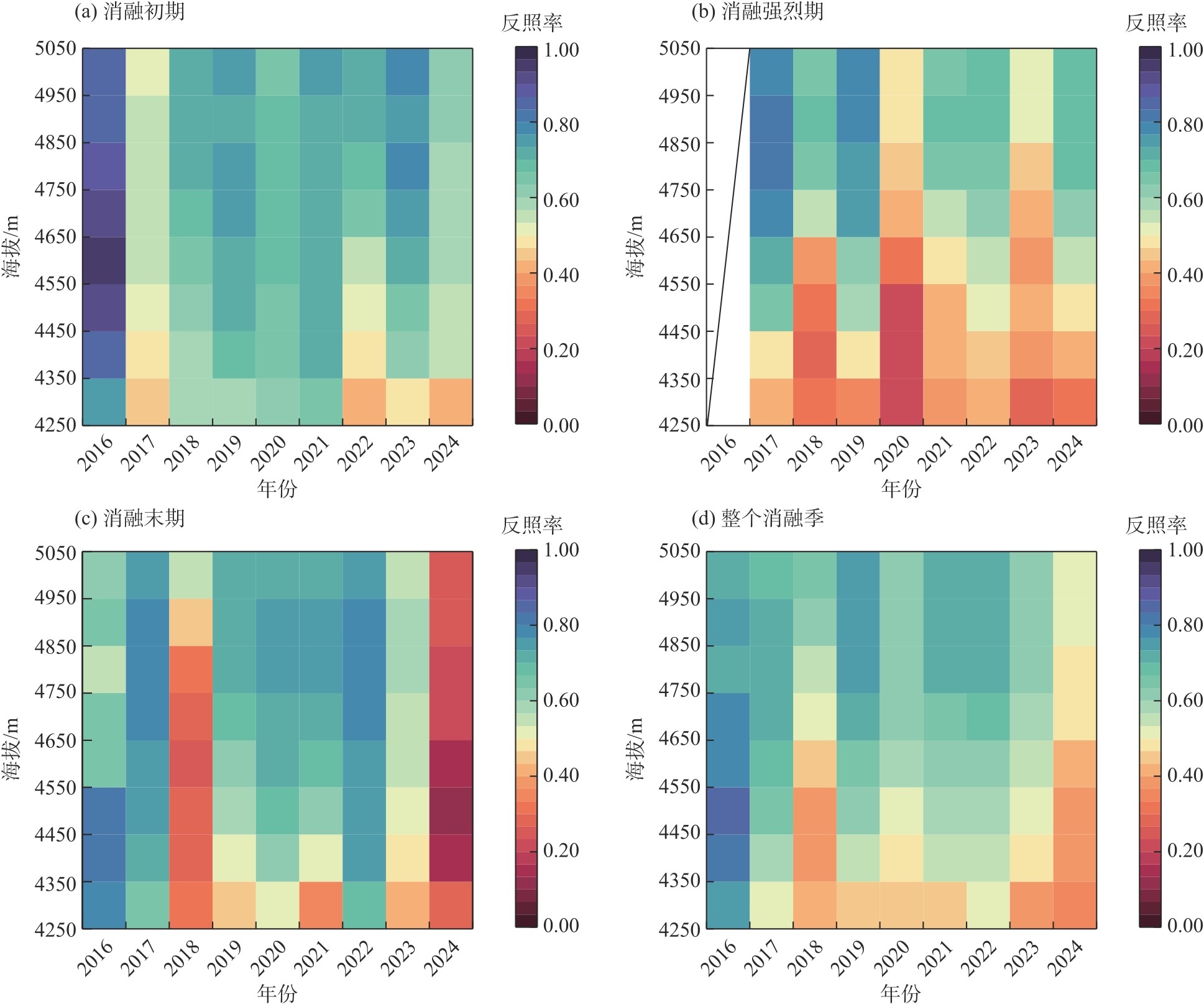
Fig. 7
Relationship between daily albedo variations and temperature/precipitation from 2016 to 2024"
Tab. 1
Correlation coefficients between albedo and meteorological variables for the Qiyi Glacier during different periods"
| 月份 | 日均气温/℃ | 日最高气温/℃ | 日最低气温/℃ | 正积温/℃·d | 降水量/mm | 降水日数/d |
|---|---|---|---|---|---|---|
| 5 | -0.4470* | -0.1773* | 0.0192 | -0.3521* | 0.1263 | 0.1402 |
| 6 | -0.2783* | -0.1078 | 0.1504 | -0.2596* | 0.4261* | 0.4786* |
| 7 | -0.3452* | -0.1154 | -0.0203 | -0.3452* | 0.2485* | 0.2424* |
| 8 | -0.2837* | -0.0816 | 0.1702* | -0.2844* | 0.1709* | 0.1693* |
| 9 | -0.1156 | -0.3764* | 0.0368 | -0.0832* | 0.2649* | 0.0477 |
Fig. 8
Relationship between supraglacial impurity concentration and elevation during the ablation period in 2024"
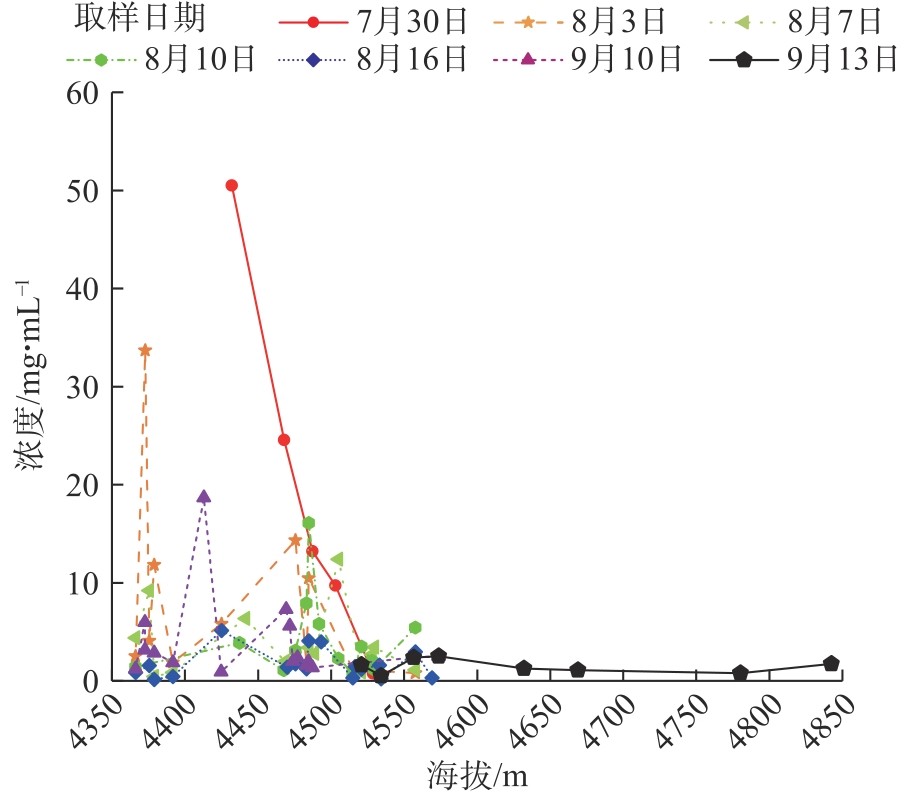
Fig. 9
Natural frequency distribution curve of particle sizes in supraglacial impurity from the Qiyi Glacier"
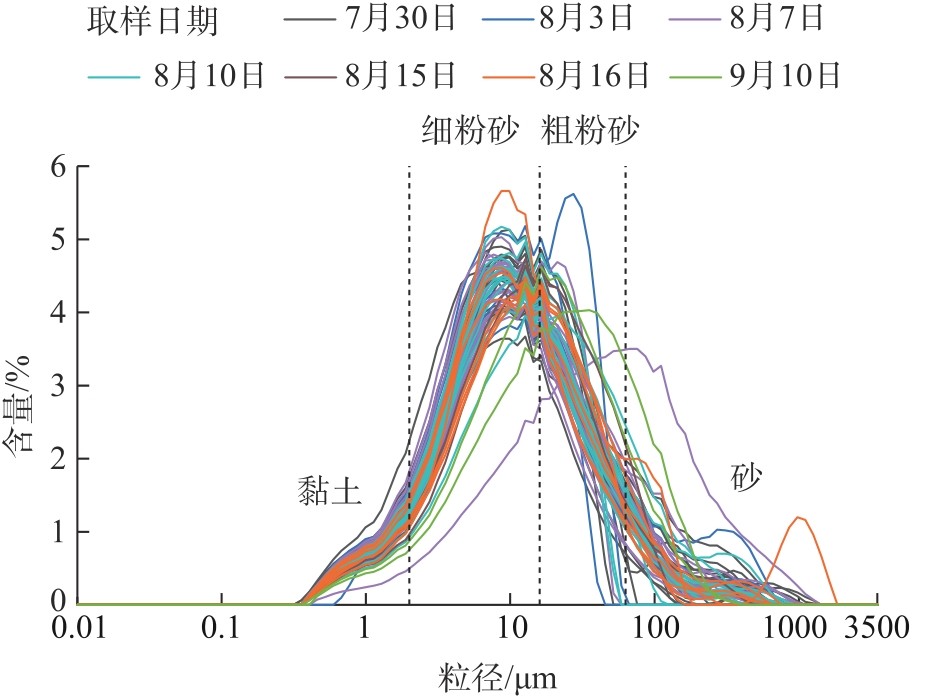
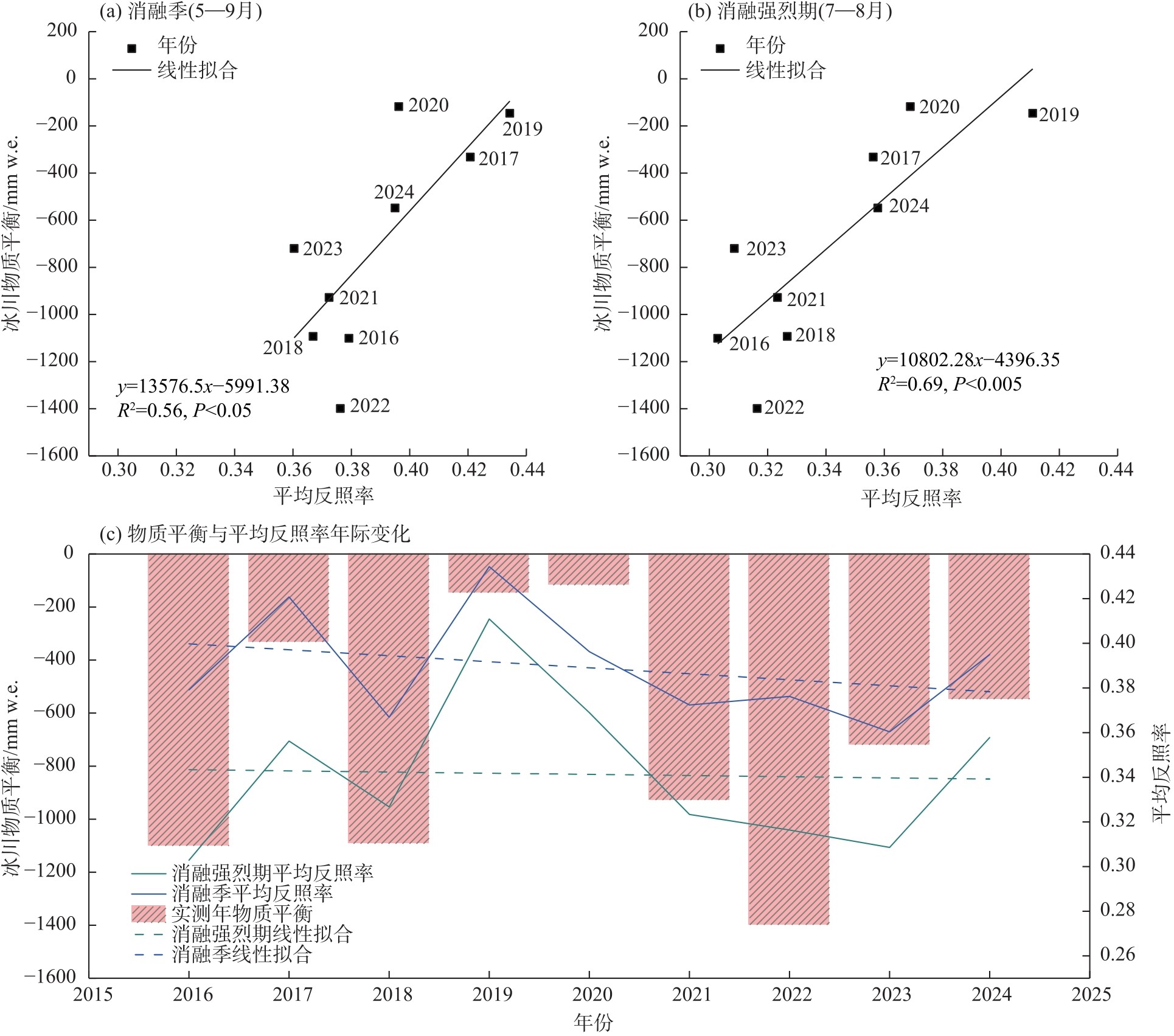
Fig. 10
Correlation between mass balance and mean albedo and their interannual variability of the Qiyi Glacier from 2016 to 2024"
| [1] | Johnson E, Rupper S. An examination of physical processes that trigger the albedo-feedback on glacier surfaces and implications for regional glacier mass balance across High Mountain Asia[J]. Frontiers in Earth Science, 2020, 8: 129, doi: 10.3389/feart.2020.00129. |
| [2] |
Li Y J, Ding Y J, Shangguan D H, et al. Regional differences in global glacier retreat from 1980 to 2015[J]. Advances in Climate Change Research, 2019, 10(4): 203-213.
doi: 10.1016/j.accre.2020.03.003 |
| [3] |
牟建新, 李忠勤, 王璞玉, 等. 萨吾尔山冰川现状及演化过程[J]. 干旱区地理, 2024, 47(8): 1277-1291.
doi: 10.12118/j.issn.1000-6060.2024.112 |
|
[Mu Jianxin, Li Zhongqin, Wang Puyu, et al. Glaciers in Saur Mountains: Current situation and evolutionary process[J]. Arid Land Geography, 2024, 47(8): 1277-1291.]
doi: 10.12118/j.issn.1000-6060.2024.112 |
|
| [4] |
岳晓英, 李忠勤, 王飞腾, 等. 天山乌鲁木齐河源1号冰川消融期反照率特征[J]. 冰川冻土, 2021, 43(5): 1412-1423.
doi: 10.7522/j.issn.1000-0240.2021.0097 |
|
[Yue Xiaoying, Li Zhongqin, Wang Feiteng, et al. The characteristics of surface albedo on the Urumqi Glacier No.1 during the ablation season in eastern Tien Shan[J]. Journal of Glaciology and Geocryology, 2021, 43(5): 1412-1423.]
doi: 10.7522/j.issn.1000-0240.2021.0097 |
|
| [5] | Hock R. Glacier melt: A review of processes and their modeling[J]. Progress in Physical Geography, 2005, 29(3): 362-391. |
| [6] | 王俊瑶, 怀保娟, 王叶堂, 等. 基于MOD10A1的祁连山黑河流域典型冰川反照率时空变化研究[J]. 干旱区研究, 2020, 37(6): 1396-1405. |
|
[Wang Junyao, Huai Baojuan, Wang Yetang, et al. Spatiotemporal variation of albedo of four representative glaciers in the Heihe River Basin based on multi-source data[J]. Arid Zone Research, 2020, 37(6): 1396-1405.]
doi: 10.13866/j.azr.2020.06.04 |
|
| [7] |
毛瑞娟, 吴红波, 贺建桥, 等. 昆仑山木孜塔格冰川反照率变化特征及其与粉尘的关系[J]. 冰川冻土, 2013, 35(5): 1133-1142.
doi: 10.7522/j.issn.1000-0240.2013.0128 |
|
[Mao Ruijuan, Wu Hongbo, He Jianqiao, et al. Spatiotemporal variation of albedo of Muztagh Glacier in the Kunlun Mountains and its relation to dust[J]. Journal of Glaciology and Geocryology, 2013, 35(5): 1133-1142.]
doi: 10.7522/j.issn.1000-0240.2013.0128 |
|
| [8] | 段克勤, 王琼, 姚檀栋, 等. 冰川物理过程模型的建立及其在山地冰川中的应用——以祁连山老虎沟12号冰川为例[J]. 中国科学: 地球科学, 2025, 55(5): 1716-1727. |
| [Duan Keqin, Wang Qiong, Yao Tandong, et al. Glacier evolution model based on physical processes: Application to alpine glacier Laohugou No.12, Qilian Mountains[J]. Scientia Sinica (Terrae), 2025, 55(5): 1716-1727.] | |
| [9] |
Knap W H, Oerlemans J. The surface albedo of the Greenland ice sheet: Satellite-derived and in situ measurements in the Søndre Strømfjord area during the 1991 melt season[J]. Journal of Glaciology, 1996, 42(141): 364-374.
doi: 10.3189/S0022143000004214 |
| [10] | He T, Liang S L, Yu Y Y, et al. Greenland surface albedo changes in July 1981—2012 from satellite observations[J]. Environmental Research Letters, 2013, 8(4): 044043, doi: 10.1088/1748-9326/8/4/044043. |
| [11] |
张玉娇, 怀保娟, 王圣杰, 等. 木孜塔格峰地区冰川反照率时空变化及其影响因素研究[J]. 干旱区地理, 2025, 48(10): 1760-1770.
doi: 10.12118/j.issn.1000-6060.2024.776 |
|
[Zhang Yujiao, Huai Baojuan, Wang Shengjie, et al. Spatio-temporal variation of glacial albedo and its influencing factors in the Muz Tag Peak area[J]. Arid Land Geography, 2025, 48(10): 1760-1770.]
doi: 10.12118/j.issn.1000-6060.2024.776 |
|
| [12] | Tian Y X, Liu Z J. Inversing glacier albedo in High Mountain Asia based on Sentinel-3 satellite data[J]. The International Archives of the Photogrammetry, Remote Sensing and Spatial Information Sciences, 2021, 43: 509-514. |
| [13] |
Guo W Q, Liu S Y, Xu J L, et al. The second Chinese glacier inventory: Data, methods and results[J]. Journal of Glaciology, 2015, 61(226): 357-372.
doi: 10.3189/2015JoG14J209 |
| [14] |
刘时银, 姚晓军, 郭万钦, 等. 基于第二次冰川编目的中国冰川现状[J]. 地理学报, 2015, 70(1): 3-16.
doi: 10.11821/dlxb201501001 |
|
[Liu Shiyin, Yao Xiaojun, Guo Wanqin, et al. The contemporary glaciers in China based on the second Chinese glacier inventory[J]. Acta Geographica Sinica, 2015, 70(1): 3-16.]
doi: 10.11821/dlxb201501001 |
|
| [15] | 王宁练, 贺建桥, 蒋熹, 等. 祁连山中段北坡最大降水高度带观测与研究[J]. 冰川冻土, 2009, 31(3): 395-403. |
| [Wang Ninglian, He Jianqiao, Jiang Xi, et al. Study on the zone of maximum precipitation in the north slopes of the central Qilian Mountains[J]. Journal of Glaciology and Geocryology, 2009, 31(3): 395-403.] | |
| [16] |
Drusch M, Del Bello U, Carlier S, et al. Sentinel-2: ESA’s optical high-resolution mission for GMES operational services[J]. Remote Sensing of Environment, 2012, 120: 25-36.
doi: 10.1016/j.rse.2011.11.026 |
| [17] | 秦春, 王建. CIVCO地形校正模型的改进及其应用[J]. 遥感技术与应用, 2008, 23(1): 82-88. |
| [Qin Chun, Wang Jian. Improved CIVCO topographic correction model and application[J]. Remote Sensing Technology and Application, 2008, 23(1): 82-88.] | |
| [18] |
Li Z, Erb A, Sun Q S, et al. Preliminary assessment of 20-m surface albedo retrievals from sentinel-2A surface reflectance and MODIS/VIIRS surface anisotropy measures[J]. Remote Sensing of Environment, 2018, 217: 352-365.
doi: 10.1016/j.rse.2018.08.025 |
| [19] | Hall D K, Riggs G A. Accuracy assessment of the MODIS snow products[J]. Hydrological Processes: An International Journal, 2007, 21(12): 1534-1547. |
| [20] | 胡安洵, 郝卫峰, 马超, 等. 大高加索山脉冰川反照率时空分布及与物质平衡的关系[J]. 地球物理学报, 2024, 67(4): 1314-1329. |
| [Hu Anxun, Hao Weifeng, Ma Chao, et al. The spatio-temporal distribution of the albedos and its relationship with glacier mass balance in the glaciers of the Greater Caucasus Mountains[J]. Chinese Journal of Geophysics, 2024, 67(4): 1314-1329.] | |
| [21] | Chen J T, Wang N L, Wu Y W, et al. Quantifying Qiyi Glacier surface dirtiness using UAV and Sentinel-2 imagery[J]. Remote Sensing, 2024, 16(17): 3351, doi: 10.3390/rs16173351. |
| [22] |
晋子振, 秦翔, 孙维君, 等. 祁连山西段冰川区与非冰川区气温梯度年内变化特征[J]. 冰川冻土, 2019, 41(2): 282-292.
doi: 10.7522/j.issn.1000-0240.2019.0106 |
|
[Jin Zizhen, Qin Xiang, Sun Weijun, et al. Monthly variations of temperature gradient in glacierized and non-glacierized areas of the western Qilian Mountains[J]. Journal of Glaciology and Geocryology, 2019, 41(2): 282-292.]
doi: 10.7522/j.issn.1000-0240.2019.0106 |
|
| [23] | Chen J Z, Kang S C, Qin X, et al. The mass-balance characteristics and sensitivities to climate variables of Laohugou Glacier No. 12, western Qilian Mountains, China[J]. Sciences in Cold and Arid Regions, 2018, 9(6): 543-553. |
| [24] |
Liang S L, Fang H L, Chen M Z, et al. Validating MODIS land surface reflectance and albedo products: Methods and preliminary results[J]. Remote Sensing of Environment, 2002, 83(1-2): 149-162.
doi: 10.1016/S0034-4257(02)00092-5 |
| [25] | 刘时银, 丁永建, 张勇, 等. 塔里木河流域冰川变化及其对水资源影响[J]. 地理学报, 2006, 61(5): 482-490. |
|
[Liu Shiyin, Ding Yongjian, Zhang Yong, et al. Impact of the glacial change on water resources in the Tarim River Basin[J]. Acta Geographica Sinica, 2006, 61(5): 482-490.]
doi: 10.11821/xb200605004 |
|
| [26] |
Niu H W, Kang S C, Shi X F, et al. In-situ measurements of light-absorbing impurities in snow of glacier on Mt. Yulong and implications for radiative forcing estimates[J]. Science of the Total Environment, 2017, 581-582: 848-856.
doi: 10.1016/j.scitotenv.2017.01.032 |
| [27] |
Hambrey M J, Bennett M R, Dowdeswell J A, et al. Debris entrainment and transfer in polythermal valley glaciers[J]. Journal of Glaciology, 1999, 45(149): 69-86.
doi: 10.3189/S0022143000003051 |
| [28] | Gilardoni S, Mauro B Di, Bonasoni P. Black carbon, organic carbon, and mineral dust in South American tropical glaciers: A review[J]. Global and Planetary Change, 2022, 213: 103837, doi: 10.1016/j.gloplacha.2022.103837. |
| [29] |
Sun W J, Qin X, Wang Y T, et al. The response of surface mass and energy balance of a continental glacier to climate variability, western Qilian Mountains, China[J]. Climate Dynamics, 2018, 50(9): 3557-3570.
doi: 10.1007/s00382-017-3823-6 |
| [30] | 王宁练, 盛煜, 金会军, 等. 祁连山水塔变化及其影响[M]. 北京: 科学出版社, 2023: 44-49. |
| [Wang Ninglian, Sheng Yu, Jin Huijun, et al. Changes and impacts of the Qilian Mountains water tower[M]. Beijing: Science Press, 2023: 44-49.] |
| [1] | WU Rui, SUN Huilan, YE Mao, JIN Xiaoliang, ZHOU Meiling, YANG Han, WU Fang. Analysis on the spatiotemporal variation characteristics and driving forces of fractional vegetation coverage in the Ili River Valley, Xinjiang [J]. Arid Land Geography, 2026, 49(6): 1157-1167. |
| [2] | LI Suyun, ZHU Cunxiong, WANG Jing, CHEN Guoqian, SHI Feifei. Applicability and spatiotemporal variation analysis of SMAP ascending products to soil moisture in Qaidam Basin [J]. Arid Land Geography, 2026, 49(6): 1203-1214. |
| [3] | NING Xiaoju, ZHANG Li, YANG Luyao, MAO Qizheng, LIU Xiaozhuo. Spatiotemporal variations of livability level in the middle and lower reaches of the Yellow River under the impact of extreme climate [J]. Arid Land Geography, 2026, 49(5): 975-986. |
| [4] | LI Ruonan, LI Junli, LIU Shuaiqi, DU Weibing. Glacier changes and topographic factors of the Ulugh Muztagh from 1960 to 2023 [J]. Arid Land Geography, 2026, 49(1): 23-34. |
| [5] | ZHANG Fei, LI Jian, LI Huirong, XIE Tao, ZHANG Xuehong, WANG Chao, BAI Shuying, SONG Zhengshan. Spatiotemporal characteristics of net primary productivity and its response to influencing factors in Xilin Gol League grassland from 2001 to 2024 [J]. Arid Land Geography, 2025, 48(9): 1555-1566. |
| [6] | LU Han, ZENG Yongnian, WANG Pancheng. Spatiotemporal variation of actual evapotranspiration and its influencing factors in the northeast Qinghai-Xizang Plateau [J]. Arid Land Geography, 2025, 48(5): 753-764. |
| [7] | LI Xu, JIANG Hongnan, XU Jianhui. Error analysis of multi-source land surface temperature products in the Heihe River Basin based on in-situ data [J]. Arid Land Geography, 2025, 48(5): 765-777. |
| [8] | YAN Jinye, MA Zhengquan, SUN Xuanxuan, Alim ABBAS, Palida YAHEFU. Spatiotemporal variations and potential sources of PM2.5 and PM10 in the “Urumqi-Changji-Shihezi” urban agglomeration from 2015 to 2023 [J]. Arid Land Geography, 2025, 48(3): 405-420. |
| [9] | GUO Jiali, MA Yonggang, PAN Heng, LI Na, SUN Changning, SUN Qian, ZHOU Wenchang, DANG Yuxuan. Comparative analysis of satellite monitoring of soil salinization in Ebinur Lake during spring and summer [J]. Arid Land Geography, 2025, 48(12): 2143-2157. |
| [10] | ZHANG Yujiao, HUAI Baojuan, WANG Shengjie, CHE Yanjun, ZHANG Mingjun. Spatio-temporal variation of glacial albedo and its influencing factors in the Muz Tag Peak area [J]. Arid Land Geography, 2025, 48(10): 1760-1770. |
| [11] | LI Hongyang, CHEN Tianyu, WANG Shengjie, ZHANG Mingjun. Spatiotemporal variations of potential evapotranspiration on the northern slope of the Kunlun Mountains in Xinjiang from 1979 to 2021 [J]. Arid Land Geography, 2024, 47(9): 1443-1450. |
| [12] | KANG Limin, TENG Xinru, CHE Jiahang, HUAI Baojuan. Spatiotemporal variations of snow cover on the northern slope of Kunlun Mountains [J]. Arid Land Geography, 2024, 47(9): 1462-1471. |
| [13] | ZHANG Shunwei, ZHOU Zixiang, XIONG Xuanchen, ZHOU Jie. Extreme climate characteristics in the Wuding River Basin based on WRF model [J]. Arid Land Geography, 2024, 47(9): 1482-1495. |
| [14] | ZHANG Lu, SUN Meiping, YAN Xin, WANG Weisheng, FAN Ruiyi. Investigation and evaluation of surface solar radiation on the north slope of Kunlun Mountains based on multi-source data [J]. Arid Land Geography, 2024, 47(8): 1304-1313. |
| [15] | WU Caiyun, HE Qing, XIE Xiang. Characteristics of the surface radiation budget of the Akedala atmospheric background station [J]. Arid Land Geography, 2024, 47(6): 942-952. |
|
||