Arid Land Geography ›› 2026, Vol. 49 ›› Issue (8): 1640-1652.doi: 10.12118/j.issn.1000-6060.2025.564
• Ecology and Environment • Previous Articles Next Articles
ZHANG Qing1( ), A Rong1,2,3(), TONG Baoquan1,2,3, LI Xiaocan1, BAO Wenjie1, GE Rileqimuge1, XIE Yuanzhi1
Received:2025-09-18
Revised:2025-10-10
Online:2026-08-25
Published:2026-08-21
Contact:
A Rong
E-mail:20234016030@mails.imnu.edu.cn;20180016@imnu.edu.cn
ZHANG Qing, A Rong, TONG Baoquan, LI Xiaocan, BAO Wenjie, GE Rileqimuge, XIE Yuanzhi. Value of ecosystem services and intra-regional ecological compensation in Inner Mongolia based on the improved value equivalence method[J].Arid Land Geography, 2026, 49(8): 1640-1652.
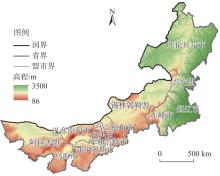
Fig. 1
Schematic diagram of the study area"
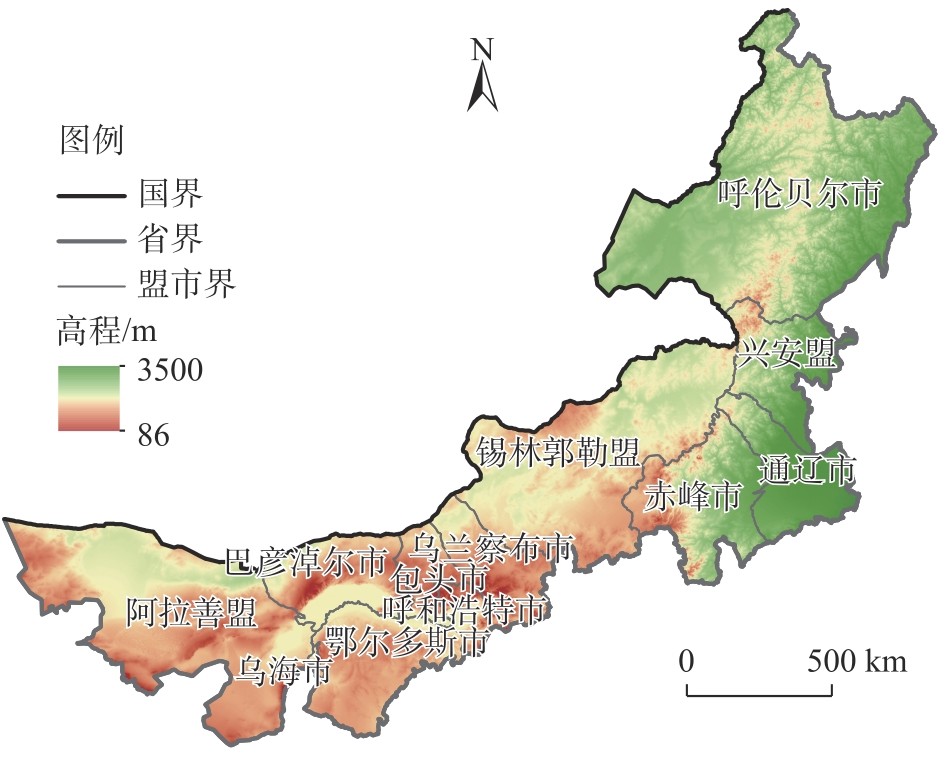
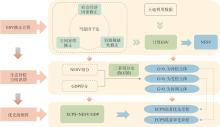
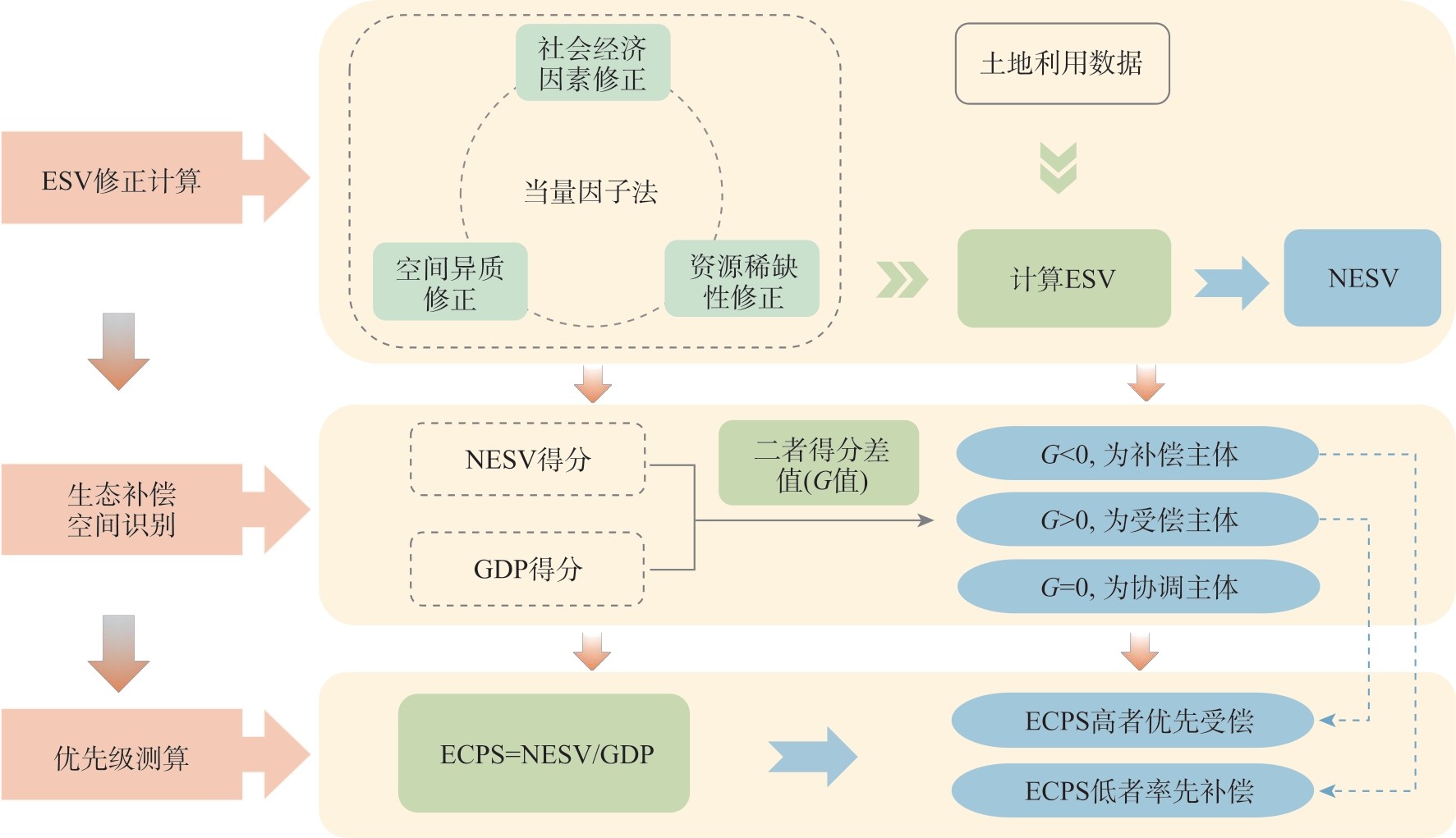
Fig. 2
Research framework"
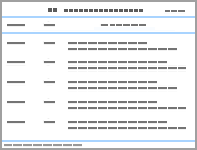
Tab. 1
Ecosystem service value per unit area in Inner Mongolia /元·hm-2"
| 一级分类 | 二级分类 | 农田 | 森林 | 草地 | 湿地 | 荒漠 | 水域 |
|---|---|---|---|---|---|---|---|
| 供给服务 | 食物生产 | 2125.420 | 485.673 | 448.807 | 980.963 | 9.617 | 769.383 |
| 原料生产 | 471.247 | 1115.605 | 660.387 | 961.728 | 28.852 | 221.198 | |
| 水资源供给 | -2510.111 | 577.037 | 365.457 | 4981.753 | 19.235 | 10050.062 | |
| 调节服务 | 气体调节 | 1711.877 | 3668.994 | 2320.971 | 3654.568 | 125.025 | 913.642 |
| 气候调节 | 894.407 | 10978.130 | 6135.827 | 6924.444 | 96.173 | 2721.691 | |
| 净化环境 | 259.667 | 3216.981 | 2026.041 | 6924.444 | 394.309 | 5491.469 | |
| 水文调节 | 2875.568 | 7184.111 | 4494.477 | 46605.358 | 230.815 | 105184.235 | |
| 支持服务 | 土壤保持 | 1000.198 | 4467.228 | 2827.481 | 4443.185 | 144.259 | 894.407 |
| 维持养分循环 | 298.136 | 341.414 | 217.992 | 346.222 | 9.617 | 67.321 | |
| 生物多样性 | 326.988 | 4068.111 | 2571.021 | 15137.605 | 134.642 | 2462.025 | |
| 文化服务 | 美学景观 | 144.259 | 1784.006 | 1134.840 | 9097.951 | 57.704 | 1904.222 |
Tab. 2
Correction factor for the value of ecosystem"
| 修正系数 | 2000年 | 2005年 | 2010年 | 2015年 | 2020年 | 2022年 |
|---|---|---|---|---|---|---|
| 社会经济系数 | 0.96 | 1.11 | 1.15 | 1.18 | 1.08 | 1.28 |
| 资源稀缺性系数 | 0.61 | 0.61 | 0.62 | 0.61 | 0.60 | 0.60 |
| 空间异质性系数 | 0.49 | 0.48 | 0.54 | 0.63 | 0.66 | 0.62 |
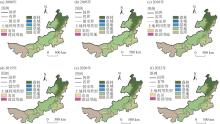
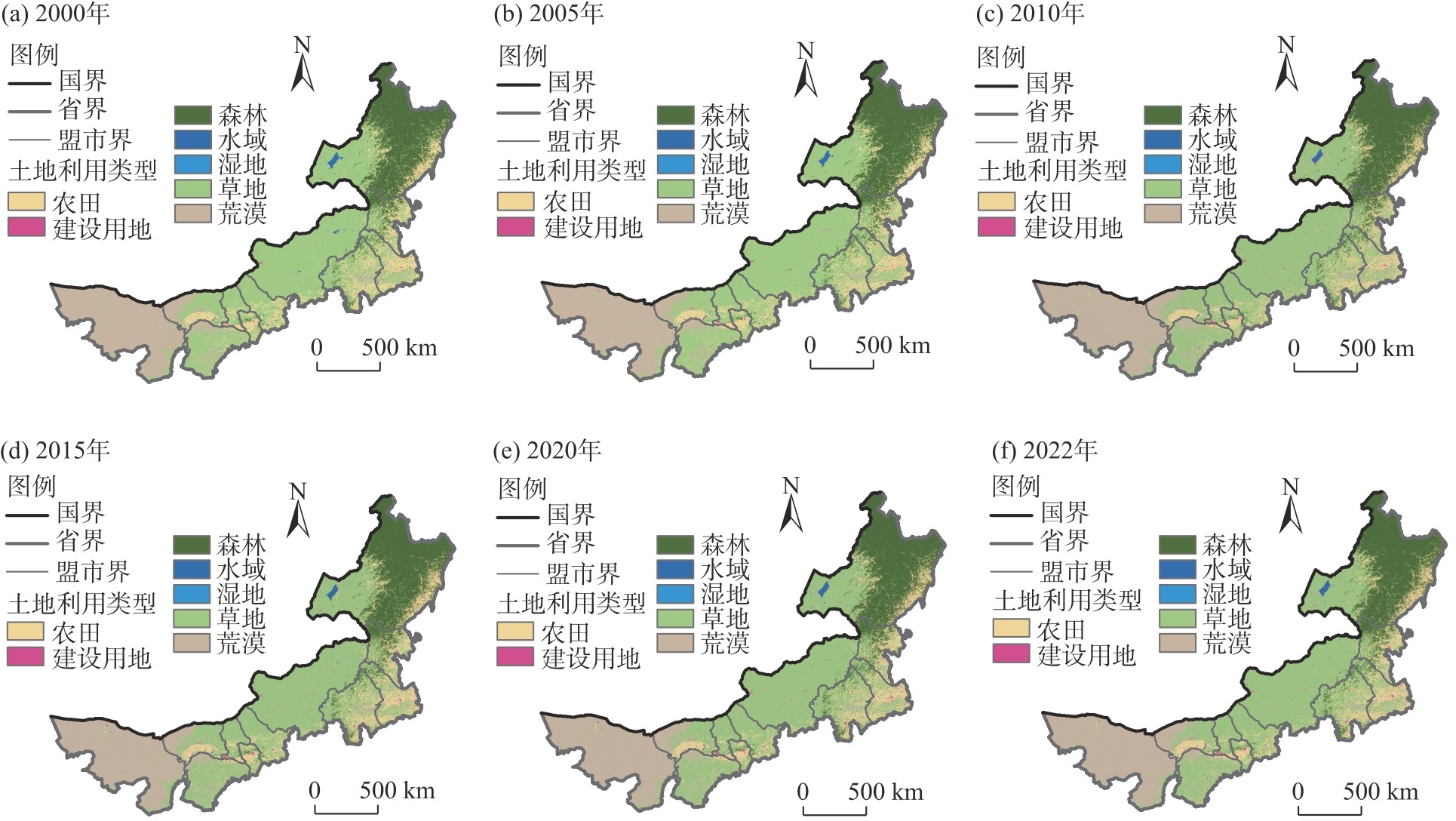
Fig. 3
Land use types in Inner Mongolia from 2000 to 2022"
Tab. 3
Changes in land use area in Inner Mongolia from 2000 to 2022 /102 km2"
| 年份 | 农田 | 森林 | 草地 | 水域 | 荒漠 | 建设用地 | 湿地 |
|---|---|---|---|---|---|---|---|
| 2000 | 1398.32 | 1739.71 | 5457.19 | 60.57 | 2748.72 | 53.18 | 0.98 |
| 2005 | 1323.92 | 1770.89 | 5545.94 | 50.61 | 2704.43 | 62.23 | 0.64 |
| 2010 | 1316.06 | 1783.10 | 5556.96 | 47.28 | 2676.60 | 78.20 | 0.46 |
| 2015 | 1379.30 | 1793.48 | 5483.45 | 52.10 | 2657.61 | 92.20 | 0.51 |
| 2020 | 1340.68 | 1809.92 | 5475.98 | 51.69 | 2674.69 | 105.37 | 0.34 |
| 2022 | 1372.54 | 1805.92 | 5427.39 | 51.84 | 2688.82 | 111.09 | 1.06 |
| 2000—2022 | -25.78 | 66.21 | -29.80 | -8.73 | -59.90 | 57.92 | 0.08 |
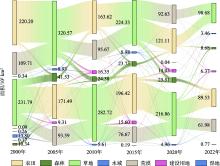
Fig. 4
Land use transition matrix of Inner Mongolia from 2000 to 2022"
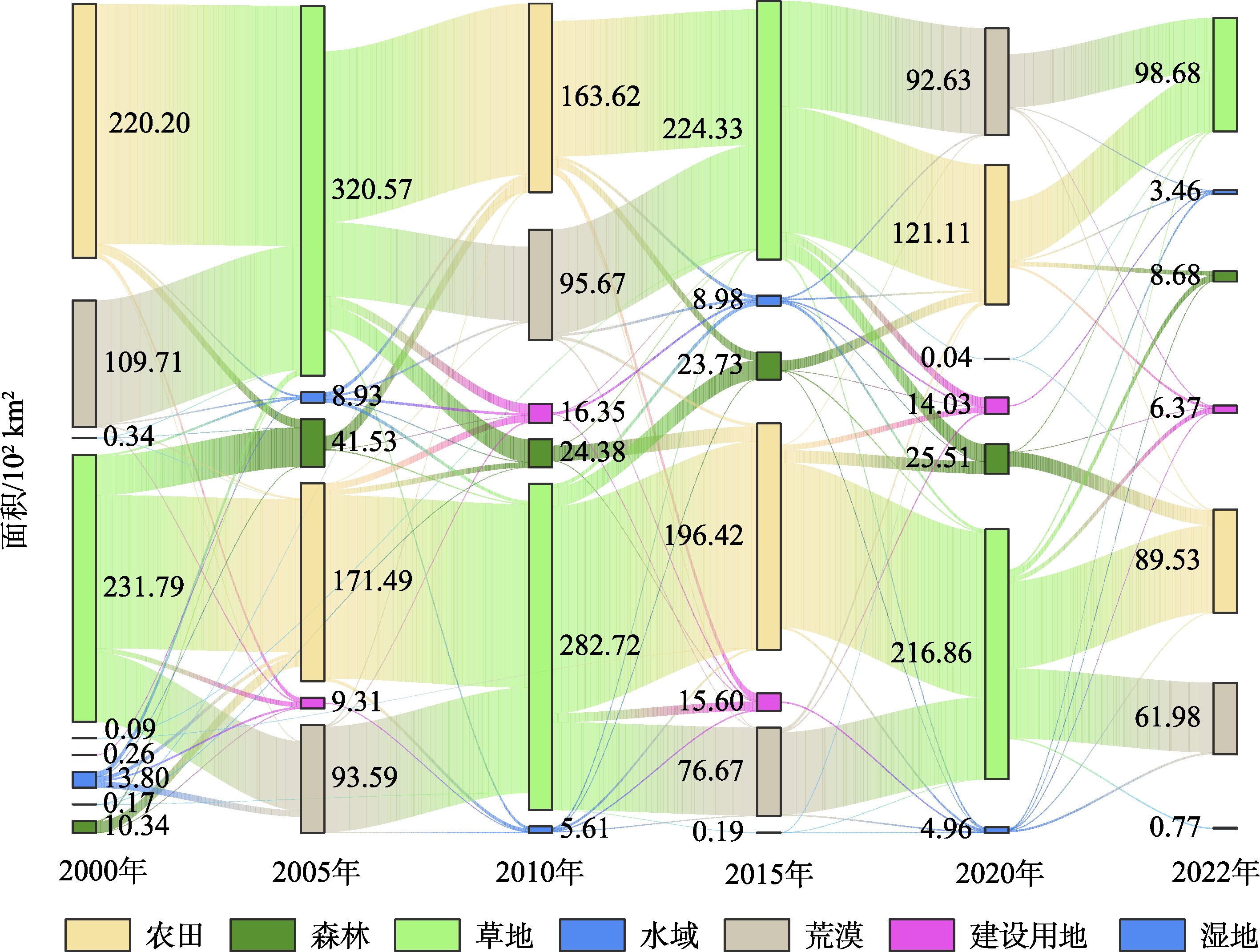
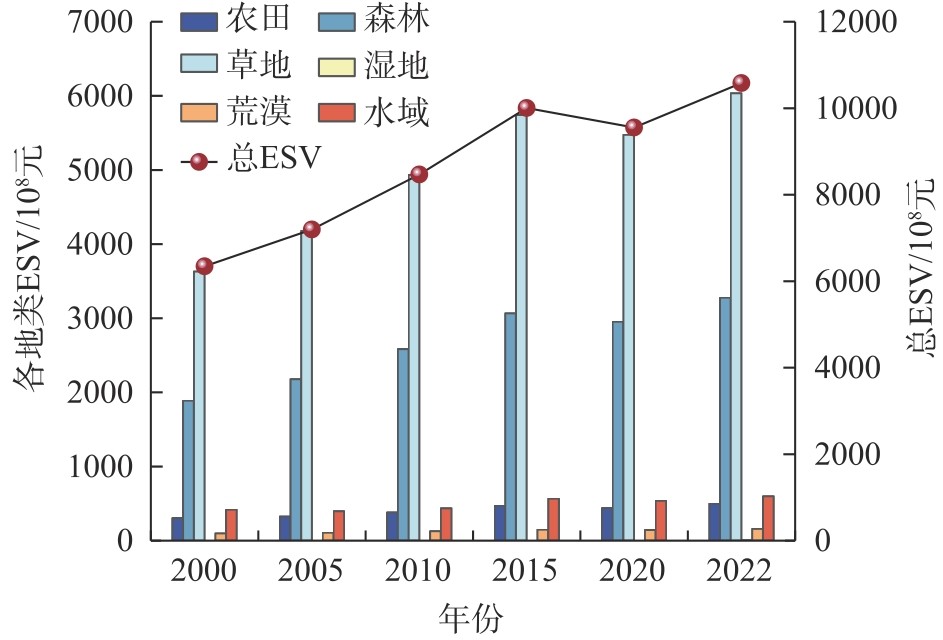
Fig. 5
Ecosystem service value in Inner Mongolia from 2000 to 2022"
Tab. 4
Value of individual ecosystem services in Inner Mongolia from 2000 to 2022"
| 一级分类 | 二级分类 | 2000年 | 2005年 | 2010年 | 2015年 | 2020年 | 2022年 |
|---|---|---|---|---|---|---|---|
| 供给服务 | 食物生产 | 183.123 | 203.582 | 239.395 | 287.523 | 271.187 | 303.740 |
| 原料生产 | 180.942 | 206.685 | 244.051 | 287.630 | 274.454 | 304.238 | |
| 水资源供给 | 14.675 | 19.079 | 21.556 | 20.807 | 24.035 | 22.230 | |
| 调节服务 | 气体调节 | 627.340 | 716.271 | 845.642 | 996.634 | 950.717 | 1053.999 |
| 气候调节 | 1558.962 | 1791.120 | 2116.787 | 2485.157 | 2377.306 | 2629.058 | |
| 净化环境 | 537.703 | 613.518 | 723.205 | 850.625 | 813.499 | 900.318 | |
| 水文调节 | 1537.905 | 1690.930 | 1970.601 | 2364.187 | 2252.774 | 2500.954 | |
| 支持服务 | 土壤保持 | 719.950 | 825.039 | 974.513 | 1145.362 | 1094.326 | 1211.327 |
| 维持养分循环 | 64.094 | 72.803 | 85.899 | 101.634 | 96.727 | 107.470 | |
| 生物多样性 | 637.875 | 731.426 | 863.675 | 1014.082 | 969.746 | 1072.815 | |
| 文化服务 | 美学景观 | 283.457 | 324.490 | 382.948 | 449.971 | 430.241 | 476.077 |
Tab. 5
Changes in the value of individual ecosystem services in Inner Mongolia from 2000 to 2022"
| 一级分类 | 二级分类 | 2000—2005年 | 2005—2010年 | 2010—2015年 | 2015—2020年 | 2020—2022年 |
|---|---|---|---|---|---|---|
| 供给服务 | 食物生产 | 20.459 | 35.813 | 48.128 | -16.336 | 32.553 |
| 原料生产 | 25.743 | 37.367 | 43.578 | -13.175 | 29.784 | |
| 水资源供给 | 4.403 | 2.478 | -0.749 | 3.227 | -1.804 | |
| 调节服务 | 气体调节 | 88.931 | 129.372 | 150.991 | -45.917 | 103.282 |
| 气候调节 | 232.158 | 325.666 | 368.370 | -107.851 | 251.752 | |
| 净化环境 | 75.816 | 109.686 | 127.420 | -37.126 | 86.819 | |
| 水文调节 | 153.024 | 279.671 | 393.587 | -111.413 | 248.180 | |
| 支持服务 | 土壤保持 | 105.089 | 149.474 | 170.850 | -51.036 | 117.001 |
| 维持养分循环 | 8.709 | 13.095 | 15.736 | -4.907 | 10.743 | |
| 生物多样性 | 93.551 | 132.249 | 150.406 | -44.336 | 103.069 | |
| 文化服务 | 美学景观 | 41.033 | 58.458 | 67.023 | -19.730 | 45.836 |
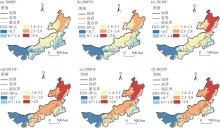
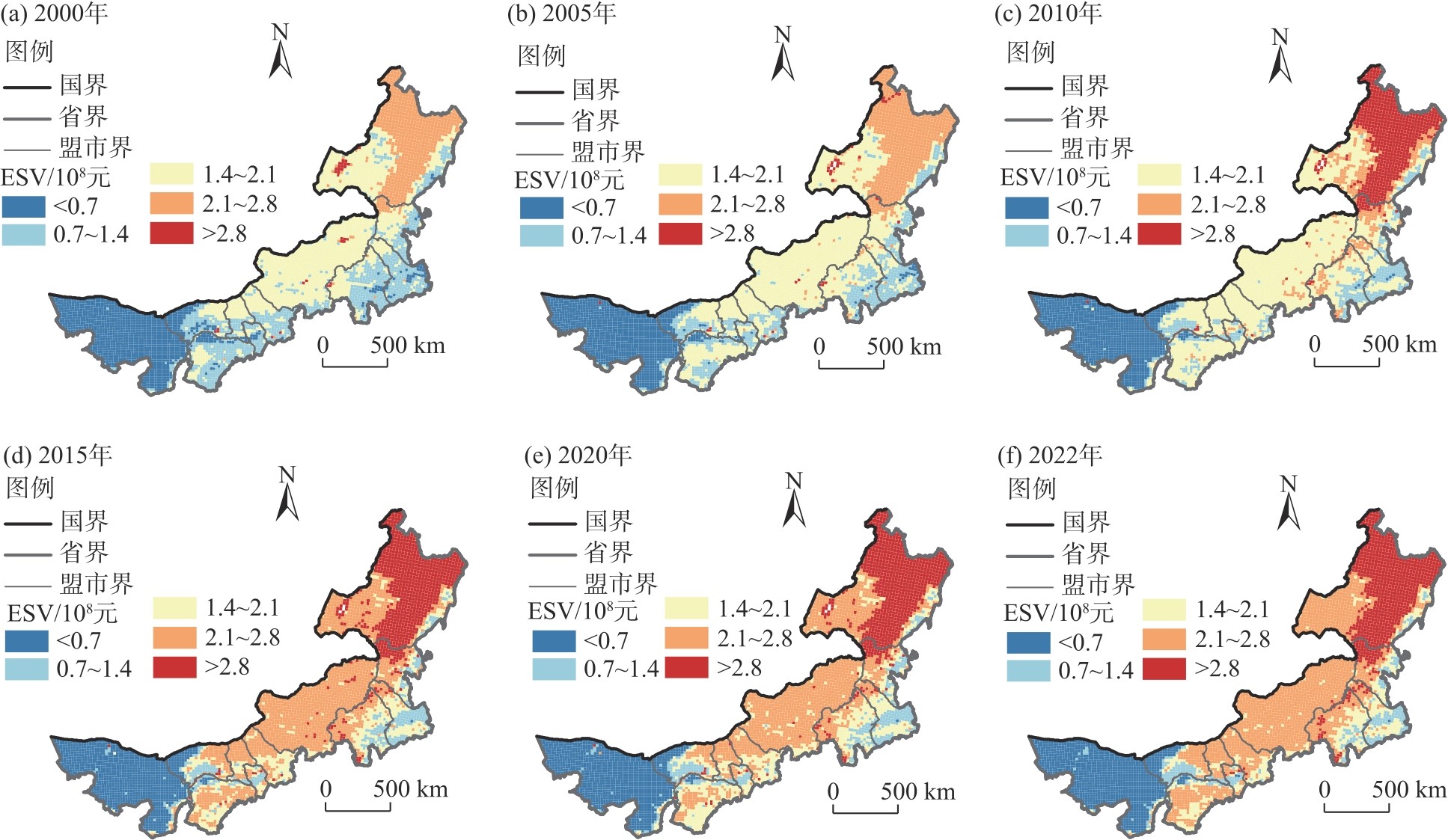
Fig. 6
Spatial distributions of ESV in Inner Mongolia from 2000 to 2022"
Tab. 6
Sensitivity indices for each land type"
| 年份 | 农田 | 森林 | 草地 | 湿地 | 荒漠 | 水域 |
|---|---|---|---|---|---|---|
| 2000 | 0.0480 | 0.2978 | 0.5721 | 0.0004 | 0.0155 | 0.0661 |
| 2005 | 0.0454 | 0.3029 | 0.5810 | 0.0003 | 0.0153 | 0.0552 |
| 2010 | 0.0452 | 0.3053 | 0.5827 | 0.0002 | 0.0151 | 0.0516 |
| 2015 | 0.0473 | 0.3066 | 0.5741 | 0.0002 | 0.0150 | 0.0568 |
| 2020 | 0.0459 | 0.3093 | 0.5732 | 0.0002 | 0.0151 | 0.0563 |
| 2022 | 0.0472 | 0.3099 | 0.5704 | 0.0005 | 0.0152 | 0.0567 |
Tab. 7
Priority index for ecological compensation in each league city"
| 盟市 | GDP/108元 | 排序 | NESV/108元 | 排序 | G | 空间识别 | ECPS | 排序 |
|---|---|---|---|---|---|---|---|---|
| 呼伦贝尔市 | 1536.00 | 6 | 2789.17 | 1 | G>0 | 受偿主体 | 1.82 | 1 |
| 锡林郭勒盟 | 1148.70 | 7 | 1499.00 | 2 | G>0 | 受偿主体 | 1.31 | 2 |
| 兴安盟 | 681.50 | 11 | 417.72 | 5 | G>0 | 受偿主体 | 0.61 | 3 |
| 阿拉善盟 | 407.30 | 12 | 205.81 | 9 | G>0 | 受偿主体 | 0.51 | 4 |
| 乌兰察布市 | 1017.90 | 9 | 369.24 | 6 | G>0 | 受偿主体 | 0.36 | 5 |
| 赤峰市 | 2148.40 | 4 | 594.28 | 3 | G=0 | 协调主体 | 0.28 | - |
| 巴彦淖尔市 | 1084.60 | 8 | 283.99 | 8 | G=0 | 协调主体 | 0.26 | - |
| 乌海市 | 803.30 | 10 | 12.62 | 12 | G=0 | 协调主体 | 0.02 | - |
| 呼和浩特市 | 3329.10 | 3 | 102.39 | 11 | G<0 | 补偿主体 | 0.03 | 1 |
| 包头市 | 3749.90 | 2 | 192.58 | 10 | G<0 | 补偿主体 | 0.05 | 2 |
| 鄂尔多斯市 | 5613.40 | 1 | 560.52 | 4 | G<0 | 补偿主体 | 0.10 | 3 |
| 通辽市 | 1561.80 | 5 | 316.59 | 7 | G<0 | 补偿主体 | 0.20 | 4 |
| [1] |
Ouyang Z Y, Song C S, Zheng H, et al. Using gross ecosystem product (GEP) to value nature in decision making[J]. Proceedings of the National Academy of Sciences, 2020, 117(25): 14593-14601.
doi: 10.1073/pnas.1911439117 |
| [2] |
Börner J, Baylis K, Corbera E, et al. The effectiveness of payments for environmental services[J]. World Development, 2017, 96: 359-374.
doi: 10.1016/j.worlddev.2017.03.020 |
| [3] |
Norgaard R B, Jin L. Trade and the governance of ecosystem services[J]. Ecological Economics, 2008, 66(4): 638-652.
doi: 10.1016/j.ecolecon.2007.10.026 |
| [4] | Xie G D, Zhen L, Lu C X, et al. Applying value transfer method for eco-service valuation in China[J]. Journal of Resources and Ecology, 2010, 1(1): 51-59. |
| [5] | 赵志刚, 余德, 王凯荣, 等. 赣西地区生态系统服务价值与生态补偿策略[J]. 生态学报, 2020, 40(20): 7507-7518. |
| [Zhao Zhigang, Yu De, Wang Kairong, et al. Ecosystem services value evaluation and strategies of payment for ecosystem service in western Jiangxi Province[J]. Acta Ecologica Sinica, 2020, 40(20): 7507-7518.] | |
| [6] | 王女杰, 刘建, 吴大千, 等. 基于生态系统服务价值的区域生态补偿——以山东省为例[J]. 生态学报, 2010, 30(23): 6646-6653. |
| [Wang Nüjie, Liu Jian, Wu Daqian, et al. Regional eco-compensation based on ecosystem service assessment: A case study of Shandong Province[J]. Acta Ecologica Sinica, 2010, 30(23): 6646-6653.] | |
| [7] | 谢高地, 甄霖, 鲁春霞, 等. 一个基于专家知识的生态系统服务价值化方法[J]. 自然资源学报, 2008, 23(5): 911-919. |
|
[Xie Gaodi, Zhen Lin, Lu Chunxia, et al. Expert knowledge based valuation method of ecosystem services in China[J]. Journal of Natural Resources, 2008, 23(5): 911-919.]
doi: 10.11849/zrzyxb.2008.05.019 |
|
| [8] |
Costanza R, d’Arge R, De Groot R, et al. The value of the world’s ecosystem services and natural capital[J]. Nature, 1997, 387(6630): 253-260.
doi: 10.1038/387253a0 |
| [9] |
魏之首, 关燕宁, 蔡丹路, 等. 基于改进型遥感生态指数的生态系统服务价值评估方法[J]. 地球信息科学学报, 2024, 26(7): 1763-1778.
doi: 10.12082/dqxxkx.2024.240111 |
| [Wei Zhishou, Guan Yanning, Cai Danlu, et al. Assessing ecosystem services value with modified remote sensing ecological index[J]. Journal of Geo-Information Science, 2024, 26(7): 1763-1778.] | |
| [10] | 马婷婷, 王希义, 张磊. 基于价值当量因子法的山岳型旅游区生态系统服务价值评估——以山东泰山为例[J]. 泰山学院学报, 2024, 46(2): 14-21. |
| [Ma Tingting, Wang Xiyi, Zhang Lei. Evaluation of ecosystem service value in mountainous tourism areas based on value equivalent factor methods: A case study of Mount Tai in Shandong Province[J]. Journal of Taishan University, 2024, 46(2): 14-21.] | |
| [11] | 周渝, 邓伟, 刘婷, 等. 重庆都市区生态系统服务价值时空演变及其驱动力[J]. 水土保持研究, 2020, 27(1): 249-256. |
| [Zhou Yu, Deng Wei, Liu Ting, et al. Spatio-temporal evolution and driving force of ecosystem service value in Chongqing metropolitan area[J]. Research of Soil and Water Conservation, 2020, 27(1): 249-256.] | |
| [12] | 李红清, 张琳, 覃昕, 等. 内蒙古干旱半干旱草原煤电开发区域生态承载力评价[J]. 生态学杂志, 2024, 43(2): 522-532. |
|
[Li Hongqing, Zhang Lin, Qin Xin, et al. Assessment of regional ecological carrying capacity of the coal-electricity development area in arid and semi-arid grassland of Inner Mongolia[J]. Chinese Journal of Ecology, 2024, 43(2): 522-532.]
doi: 10.13292/j.1000-4890.202402.033 |
|
| [13] | 胡娟娟, 张心灵, 刘宇晨. 内蒙古城镇居民对草原生态补偿支付意愿及其影响因素研究[J]. 中国草地学报, 2024, 46(7): 112-122. |
| [Hu Juanjuan, Zhang Xinling, Liu Yuchen. Urban residents’ willingness to pay for grassland ecological compensation in Inner Mongolia: Exploring influencing factors[J]. Chinese Journal of Grassland, 2024, 46(7): 112-122.] | |
| [14] | 王天雁, 马晓青. 生态保护与牧民生计: 牧区草原生态保护补助奖励政策实施状况调查[J]. 青海民族大学学报(社会科学版), 2022, 48(2): 57-69. |
| [Wang Tianyan, Ma Xiaoqing. Ecological protection and pastoralist livelihoods: Investigation on the implementation of grassland ecological protection subsidy and reward policy in pastoral areas[J]. Journal of Qinghai Nationalities University (Social Science Edition), 2022, 48(2): 57-69.] | |
| [15] | 黄敏云. 基于内蒙古森林碳汇核算的生态补偿机制分析[D]. 呼和浩特: 内蒙古大学, 2022. |
| [Huang Minyun. Analysis of the ecological compensation mechanism based on the forest carbon sink accounting in Inner Mongolia[D]. Hohhot: Inner Mongolia University, 2022.] | |
| [16] | 马文琪. 高质量发展目标下基于内蒙古森林碳汇核算的生态补偿机制研究[D]. 呼和浩特: 内蒙古财经大学, 2024. |
| [Ma Wenqi. Research on the ecological compensation mechanism based on the value of forest carbon sink in Inner Mongolia under the background of high quality[D]. Hohhot: Inner Mongolia University of Finance and Economics, 2024.] | |
| [17] | 刘晨, 田漾帆, 牛先楚. 基于主体功能区的生态补偿与生态功能区发展的机会成本比较研究——基于山西省(2008—2015)的实证分析[J]. 现代城市研究, 2022(3): 14-20. |
| [Liu Chen, Tian Yangfan, Niu Xianchu. A comparative study between the opportunity cost of ecological compensation and the development of ecological functional areas based on major function oriented zoning: An empirical analysis based on Shanxi Province (2008—2015)[J]. Modern Urban Research, 2022(3): 14-20.] | |
| [18] |
安文举, 鱼亦凡, 郝姗姗, 等. 基于土地利用变化的陕北多沙粗沙区生境质量演变及响应分析[J]. 干旱区地理, 2024, 47(3): 474-484.
doi: 10.12118/j.issn.1000-6060.2023.385 |
|
[An Wenju, Yu Yifan, Hao Shanshan, et al. Evolution and response analysis of habitat quality in more sediments and coarse sediments region of northern Shaanxi based on land use change[J]. Arid Land Geography, 2024, 47(3): 474-484.]
doi: 10.12118/j.issn.1000-6060.2023.385 |
|
| [19] | 谢高地, 张彩霞, 张昌顺, 等. 中国生态系统服务的价值[J]. 资源科学, 2015, 37(9): 1740-1746. |
| [Xie Gaodi, Zhang Caixia, Zhang Changshun, et al. The value of ecosystem services in China[J]. Resources Science, 2015, 37(9): 1740-1746.] | |
| [20] | 张志强, 陈鹏飞, 申维. 长武县土地利用/覆被演变规律及其影响下生态服务价值变化研究[J]. 水土保持研究, 2017, 24(4): 219-226, 233. |
| [Zhang Zhiqiang, Chen Pengfei, Shen Wei. Study on land use/cover change and its impact on ecosystem services in Changwu County[J]. Research of Soil and Water Conservation, 2017, 24(4): 219-226, 233.] | |
| [21] | 谢高地, 张彩霞, 张雷明, 等. 基于单位面积价值当量因子的生态系统服务价值化方法改进[J]. 自然资源学报, 2015, 30(8): 1243-1254. |
|
[Xie Gaodi, Zhang Caixia, Zhang Leiming, et al. Improvement of the evaluation method for ecosystem service value based on per unit area[J]. Journal of Natural Resources, 2015, 30(8): 1243-1254.]
doi: 10.11849/zrzyxb.2015.08.001 |
|
| [22] | 刘勇, 李晋昌, 杨永刚. 基于生物量因子的山西省森林生态系统服务功能评估[J]. 生态学报, 2012, 32(9): 2699-2706. |
|
[Liu Yong, Li Jinchang, Yang Yonggang. Evaluation of forest ecosystem services based on biomass in Shanxi Province[J]. Acta Ecologica Sinica, 2012, 32(9): 2699-2706.]
doi: 10.5846/stxb |
|
| [23] | 刘倩, 李葛, 张超, 等. 基于系数修正的青龙县生态系统服务价值动态变化研究[J]. 中国生态农业学报(中英文), 2019, 27(6): 971-980. |
| [Liu Qian, Li Ge, Zhang Chao, et al. Study on dynamic changes in ecosystem service values in Qinglong County based on coefficient correction[J]. Chinese Journal of Eco-Agriculture, 2019, 27(6): 971-980.] | |
| [24] | 罗永忠, 成自勇, 郭小芹. 近40 a甘肃省气候生产潜力时空变化特征[J]. 生态学报, 2011, 31(1): 221-229. |
| [Luo Yongzhong, Cheng Ziyong, Guo Xiaoqin. The changing characteristics of potential climate productivity in Gansu Province during nearly 40 years[J]. Acta Ecologica Sinica, 2011, 31(1): 221-229.] | |
| [25] | 欧名豪, 宗臻铃, 董元华, 等. 区域生态重建的经济补偿办法探讨——以长江上游地区为例[J]. 南京农业大学学报, 2000(4): 109-112. |
| [Ou Minghao, Zong Zhenling, Dong Yuanhua, et al. Economic compensation for regional eco-reconstruction: A case of the upper basin of Yangtze River[J]. Journal of Nanjing Agricultural University, 2000(4): 109-112.] | |
| [26] |
Xing L, Xue M G, Wang X Y. Spatial correction of ecosystem service value and the evaluation of eco-efficiency: A case for China’s provincial level[J]. Ecological Indicators, 2018, 95: 841-850.
doi: 10.1016/j.ecolind.2018.08.033 |
| [27] | 何楠. 基于土地利用变化的湖北省生态系统服务价值评估研究[D]. 武汉: 华中师范大学, 2020. |
| [He Nan. Study on the evaluation of ecosystem service value in Hubei Province based on land use change[D]. Wuhan: Central China Normal University, 2020.] | |
| [28] | 胡喜生, 洪伟, 吴承祯. 土地生态系统服务功能价值动态估算模型的改进与应用——以福州市为例[J]. 资源科学, 2013, 35(1): 30-41. |
| [Hu Xisheng, Hong Wei, Wu Chengzhen. An improved dynamic evaluation model and land ecosystem service values for Fuzhou City[J]. Resources Science, 2013, 35(1): 30-41.] | |
| [29] |
Kreuter U P, Harris H G, Matlock M D, et al. Change in ecosystem service values in the San Antonio area, Texas[J]. Ecological Economics, 2001, 39(3): 333-346.
doi: 10.1016/S0921-8009(01)00250-6 |
|
||