Arid Land Geography ›› 2026, Vol. 49 ›› Issue (8): 1626-1639.doi: 10.12118/j.issn.1000-6060.2026.151
• Ecology and Environment • Previous Articles Next Articles
TONG Yanjun1,2,3( ), YUAN Lu1(), LEI Jun4
Received:2026-03-23
Revised:2026-04-17
Online:2026-08-25
Published:2026-08-21
Contact:
YUAN Lu
E-mail:geo_tyj@163.com;yuanlu200109@163.com
TONG Yanjun, YUAN Lu, LEI Jun. Coupled and coordinated relationships between population, socio-economic, and resource-environment in Xinjiang’s border areas under the background of border security[J].Arid Land Geography, 2026, 49(8): 1626-1639.
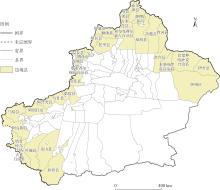
Fig. 1
Schematic diagram of the study area"
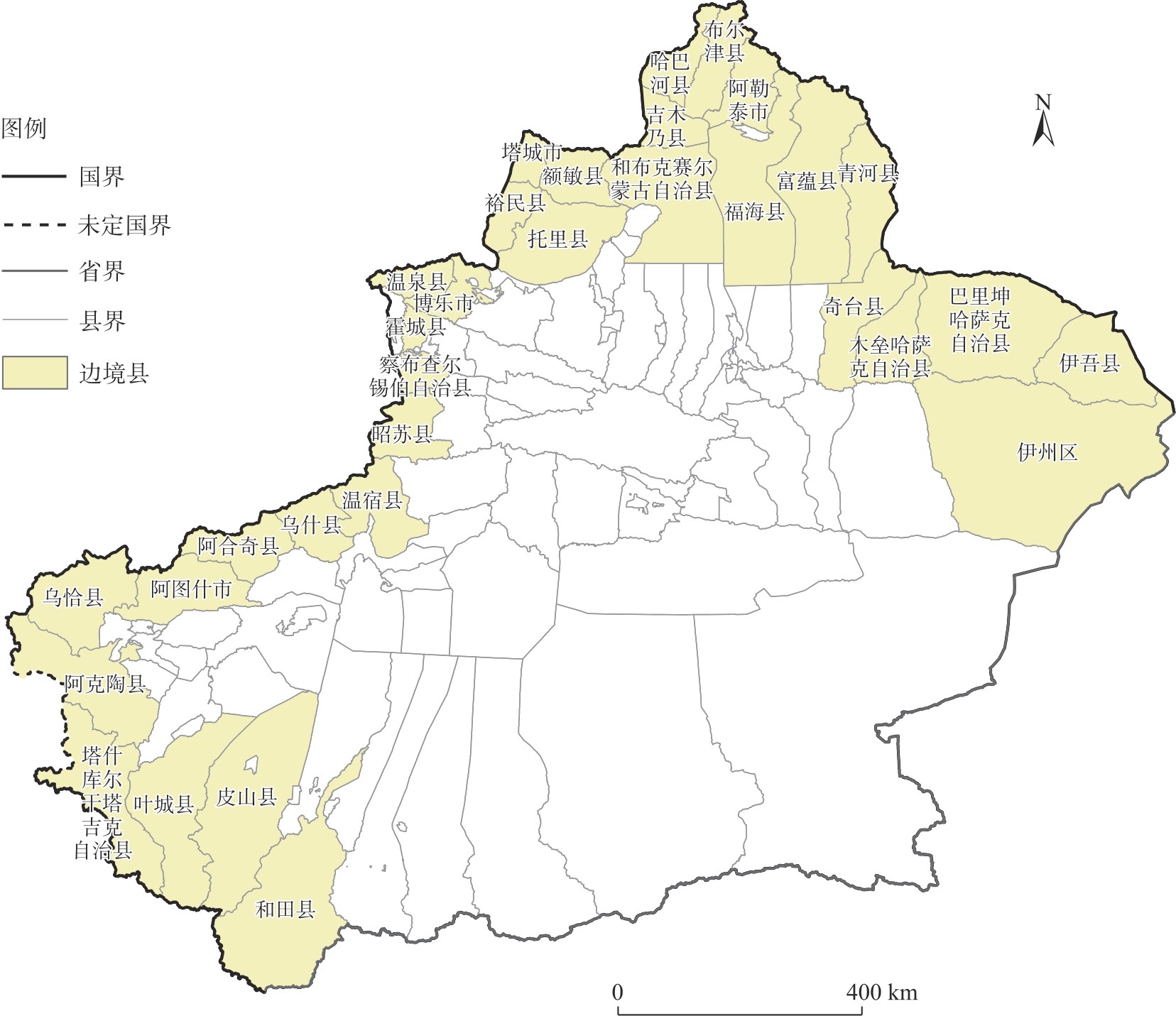
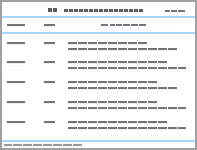
Tab. 1
Evaluation indicators and weights of population, socio-economic, and resource-environment in border counties of Xinjiang"
| 系统层 | 准则层 | 指标层 | 属性 | 单位 | 权重 |
|---|---|---|---|---|---|
| 人口 | 规模结构 | 年末总人口 | + | 104人 | 0.0902 |
| 人口密度 | + | 人·km-2 | 0.0568 | ||
| 65岁及以上人口占比 | - | % | 0.0896 | ||
| 人口自然增长率 | + | % | 0.0721 | ||
| 人口素质 | 普通中学在校学生数 | + | 人 | 0.0396 | |
| 每万人拥有医院床位数 | + | 个 | 0.0295 | ||
| 社会服务机构床位数 | + | 个 | 0.0312 | ||
| 社会经济 | 基础支撑 | 粮食总产量 | + | t | 0.0259 |
| 一般公共预算收入 | + | 104元 | 0.0147 | ||
| 经济发展 | 固定资产投资 | + | 104元 | 0.0181 | |
| 第二产业增加值 | + | 104元 | 0.0217 | ||
| 第三产业增加值 | + | 104元 | 0.0367 | ||
| 社会消费品零售总额 | + | 104元 | 0.0228 | ||
| 人均地区生产总值 | + | 元 | 0.0330 | ||
| 夜间灯光指数 | + | - | 0.0390 | ||
| 社会发展 | 道路密度 | + | km·km-2 | 0.0288 | |
| 边境线边防派出所数量 | + | - | 0.0121 | ||
| 资源环境 | 资源本底 | 植被覆盖度 | + | % | 0.0623 |
| 年末耕地面积 | + | km2 | 0.0450 | ||
| 年均地下水水位 | - | m | 0.1049 | ||
| 环境污染 | 地表SO2质量浓度 | - | μg·m-2 | 0.0637 | |
| PM2.5排放量 | - | μg·m-2 | 0.0627 |
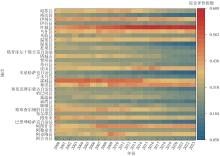
Fig. 2
Comprehensive evaluation index of population from 2000 to 2023"
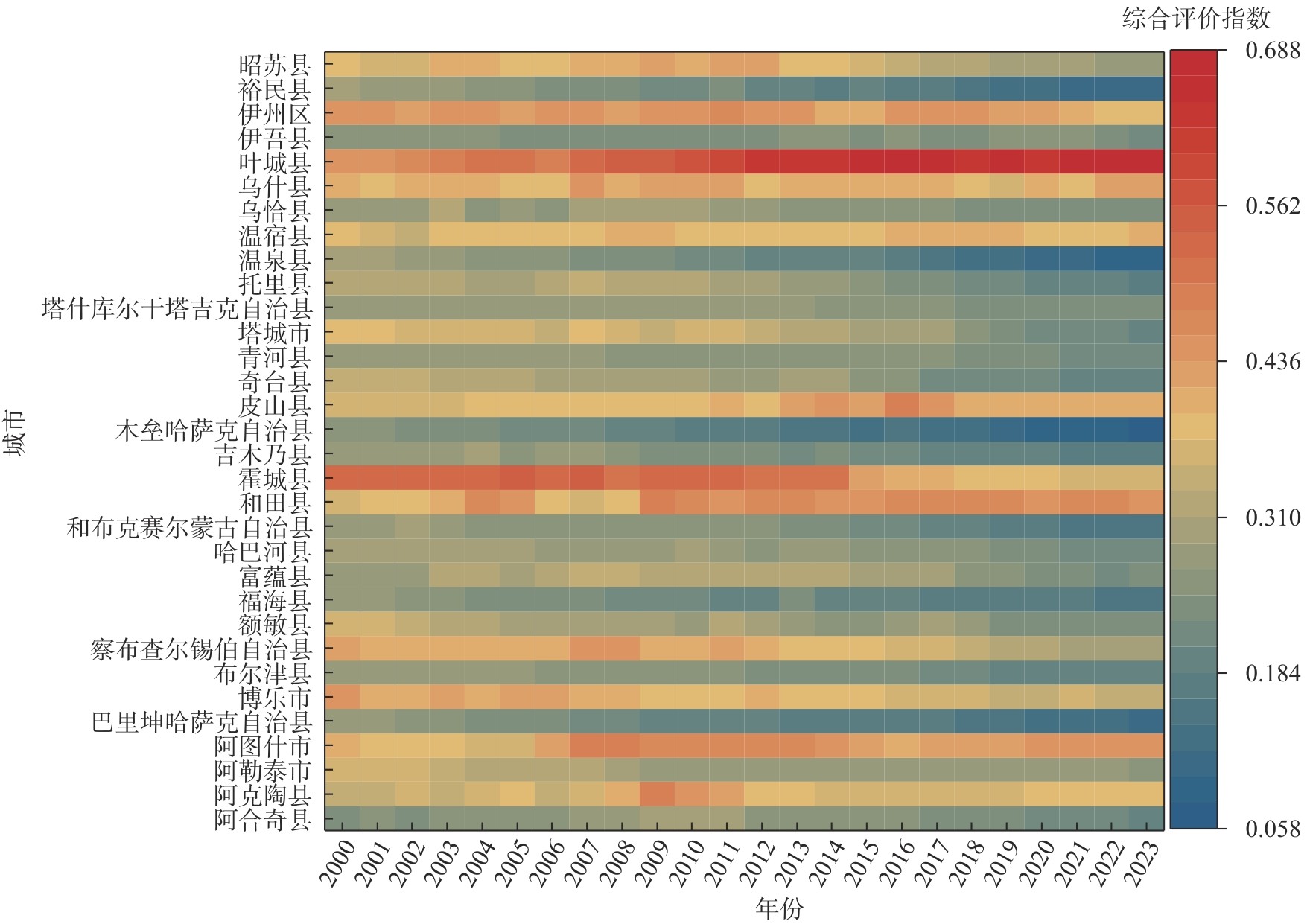
Fig. 3
Comprehensive evaluation index of socio-economic from 2000 to 2023"
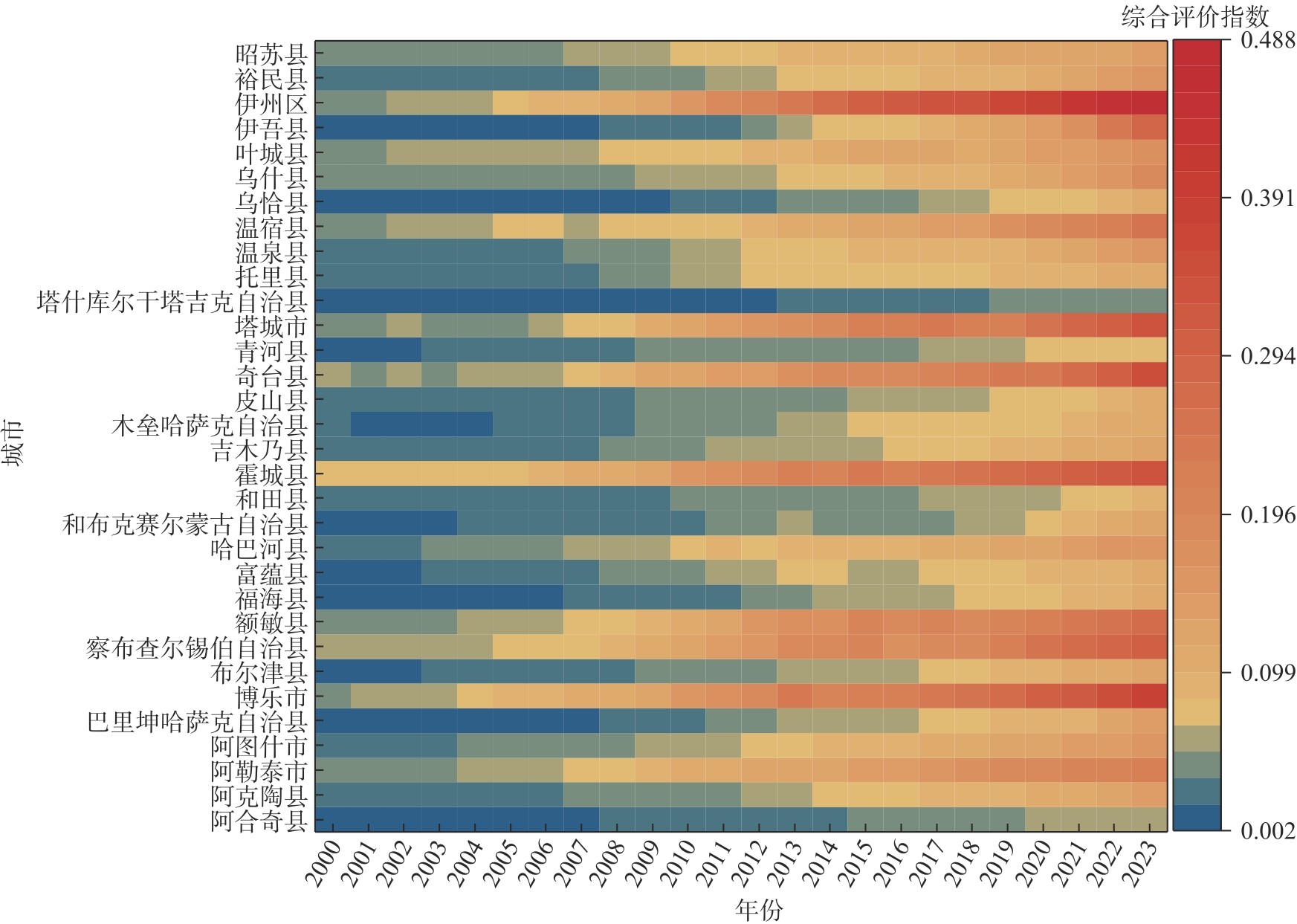
Fig. 4
Comprehensive evaluation index of resource-environment from 2000 to 2023"
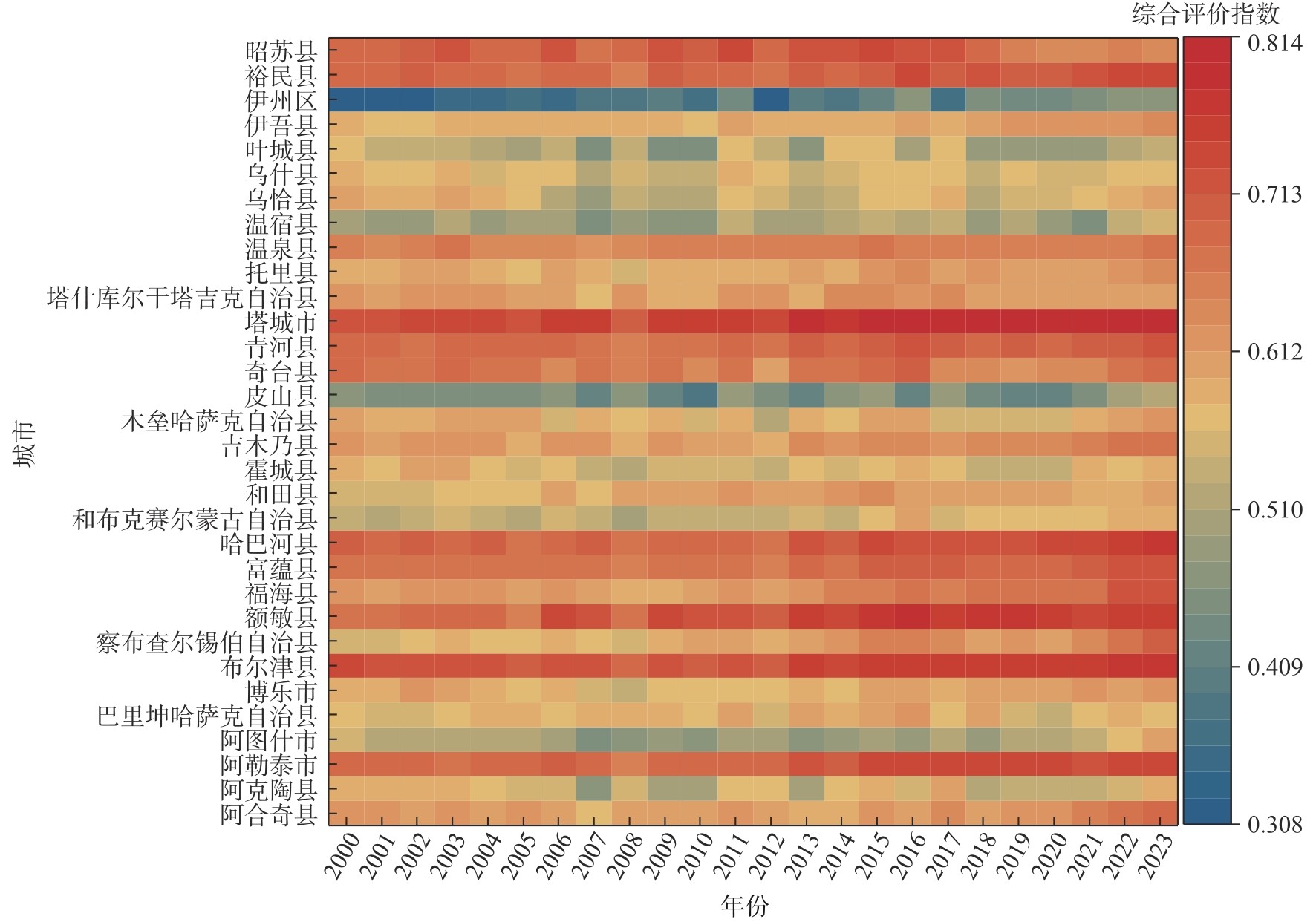
Fig. 5
Comprehensive coupling coordination degree of population, socio-economic, and resource-environment from 2000 to 2023"
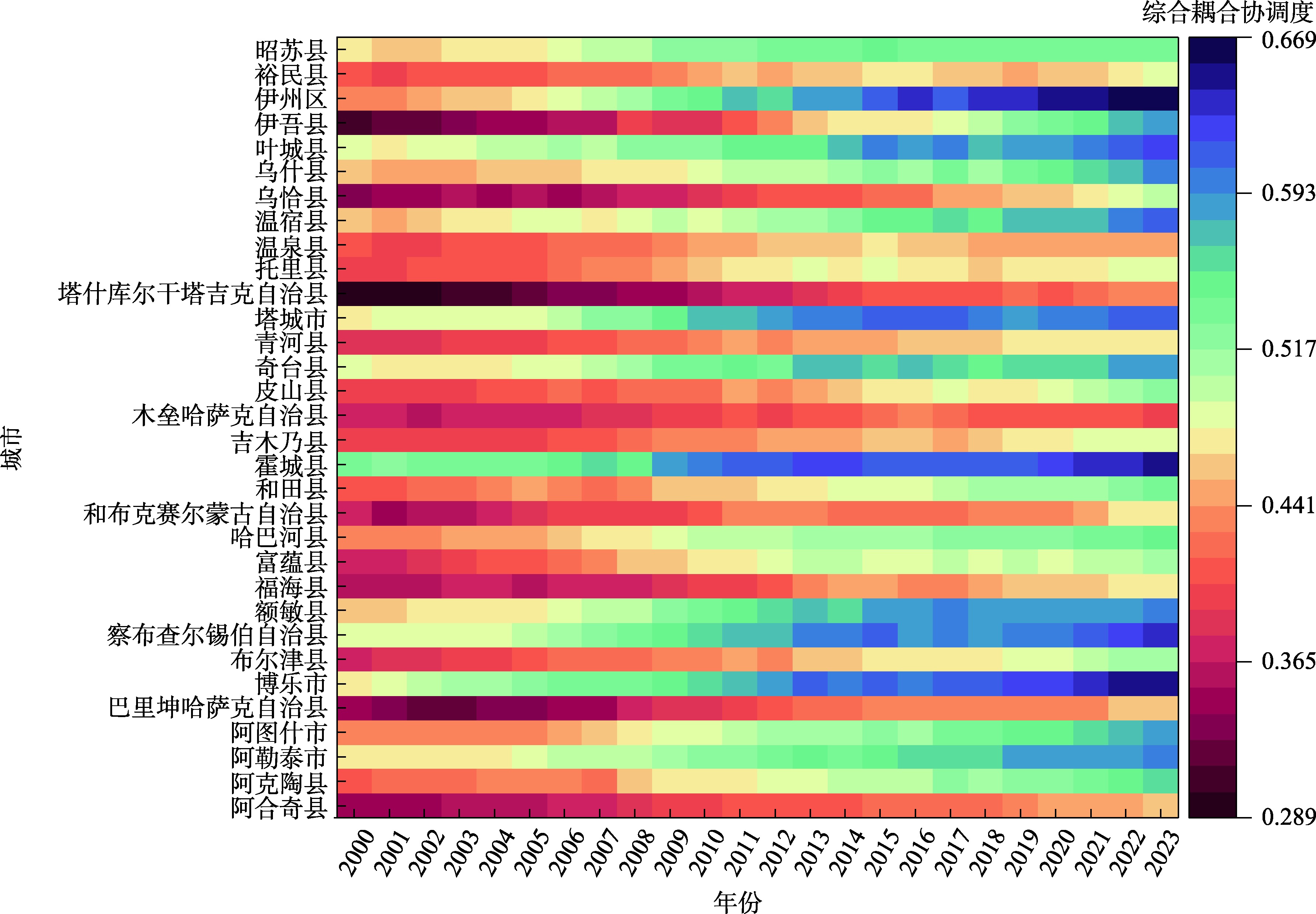
Fig. 6
Spatial distributions of the coupling coordination degree of population, socio-economic, and resource-environment"
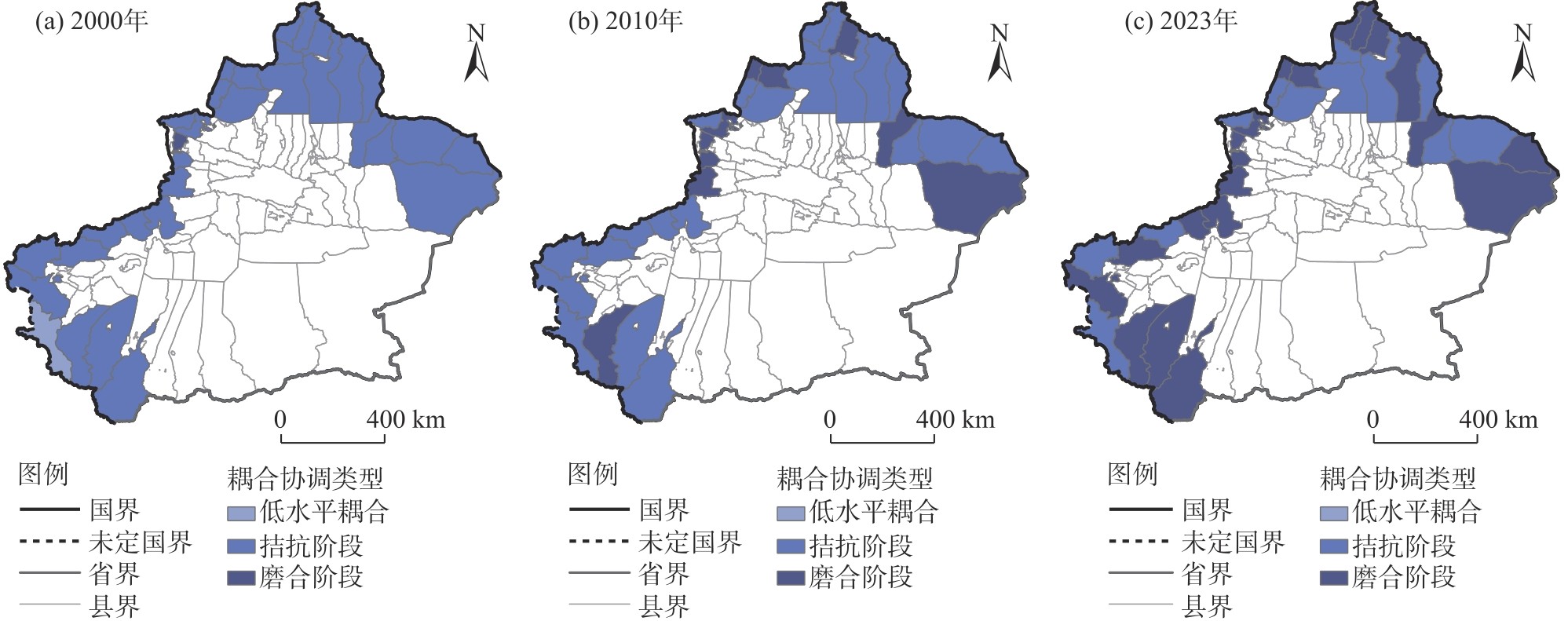
Fig. 7
LISA cluster map of comprehensive coupling coordination degree of population, socio-economic, and resource-environment"
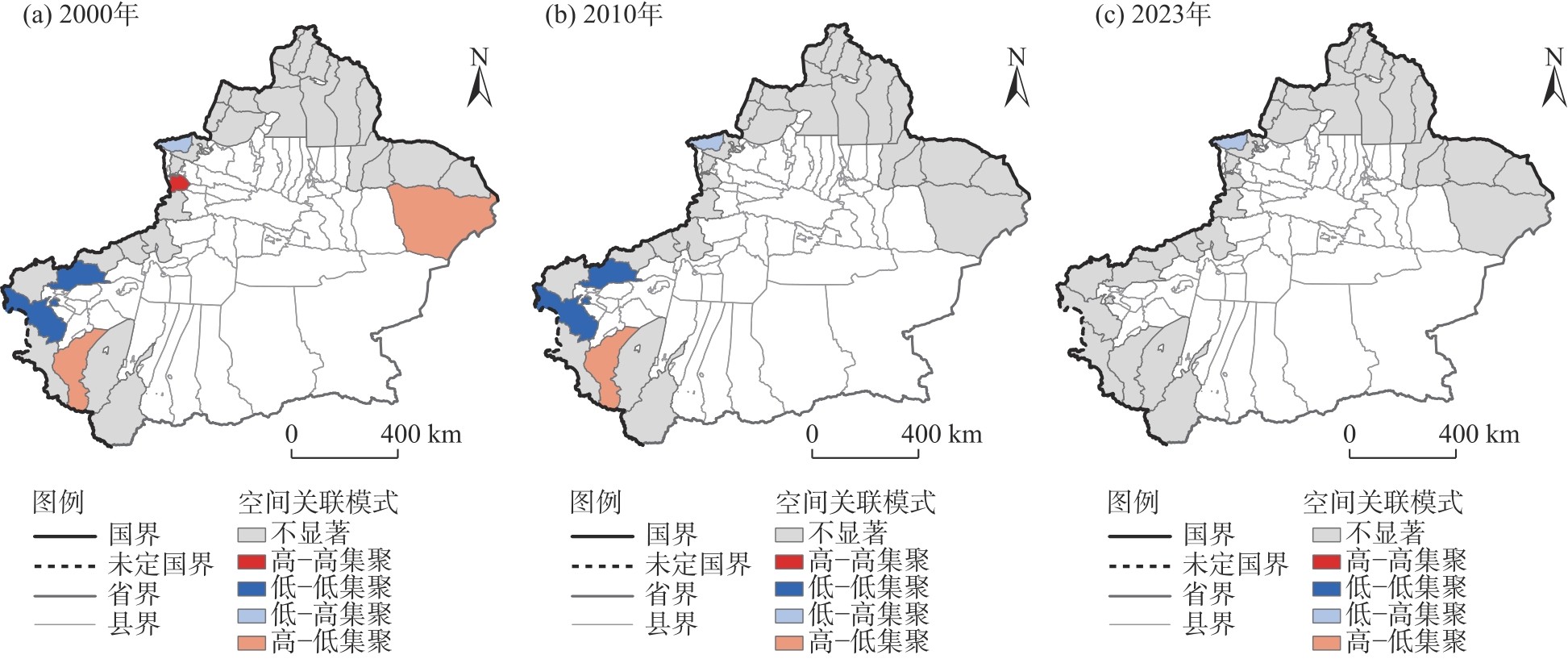
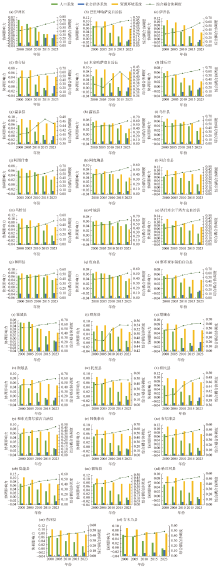
Fig. 8
Impact of population, socio-economic, and resource-environment systems on comprehensive coupling coordination degree"
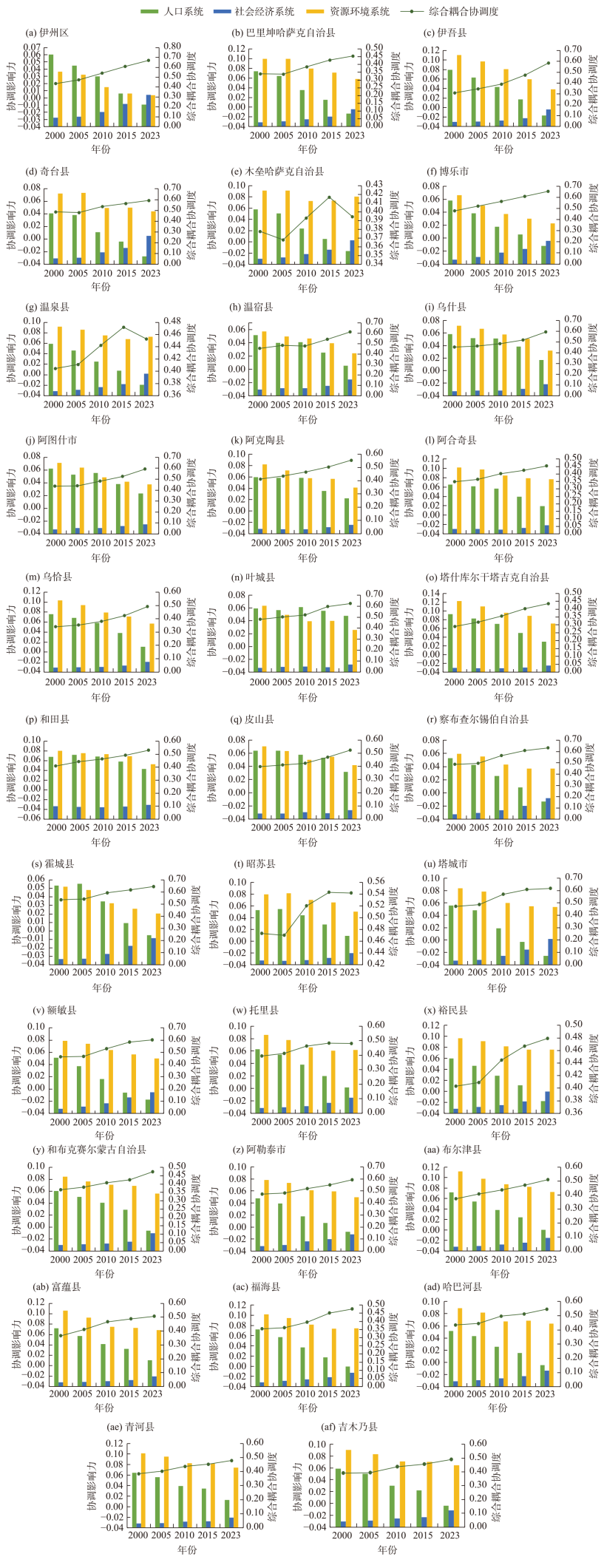
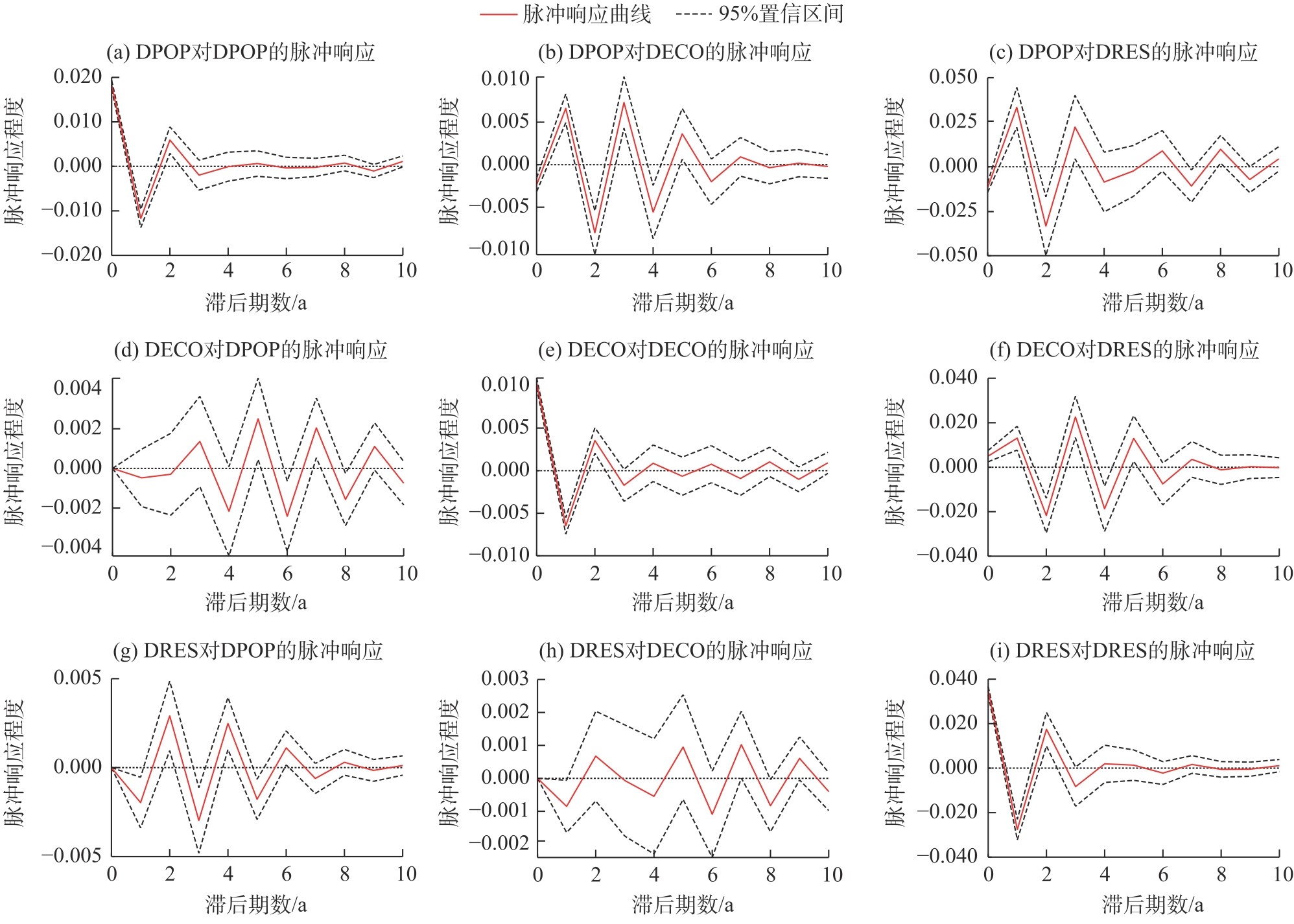
Fig. 9
Impulse response characteristics of population, socio-economic, and resource-environment systems"
Tab. 2
Variance decomposition results"
| 响应变量 | 冲击变量 | |||
|---|---|---|---|---|
| 预测期 | POP | ECO | RES | |
| POP | 1 | 1.000 | 0.000 | 0.000 |
| POP | 4 | 0.956 | 0.004 | 0.008 |
| POP | 7 | 0.910 | 0.034 | 0.056 |
| POP | 10 | 0.897 | 0.047 | 0.056 |
| ECO | 1 | 0.050 | 0.950 | 0.000 |
| ECO | 4 | 0.503 | 0.493 | 0.004 |
| ECO | 7 | 0.560 | 0.431 | 0.009 |
| ECO | 10 | 0.554 | 0.432 | 0.015 |
| RES | 1 | 0.100 | 0.018 | 0.882 |
| RES | 4 | 0.448 | 0.185 | 0.367 |
| RES | 7 | 0.424 | 0.246 | 0.331 |
| RES | 10 | 0.443 | 0.238 | 0.319 |
| [1] | World Commission on Environment and Development. Our common future[R]. Oxford: Oxford University Press, 1987. |
| [2] | 牛文元, 康晓光, 王毅. 中国式持续发展战略的初步构想[J]. 管理世界, 1994(1): 195-203. |
| [Niu Wenyuan, Kang Xiaoguang, Wang Yi. A preliminary conception of sustainable development strategy with Chinese characteristics[J]. Management World, 1994(1): 195-203.] | |
| [3] | 吴传钧. 论地理学的研究核心——人地关系地域系统[J]. 经济地理, 1991, 11(3): 1-6. |
|
[Wu Chuanjun. On the core of geographical research: The regional system of man-land relationship[J]. Economic Geography, 1991, 11(3): 1-6.]
doi: 10.2307/140646 |
|
| [4] | 廖重斌. 环境与经济协调发展的定量评判及其分类体系——以珠江三角洲城市群为例[J]. 热带地理, 1999, 19(2): 76-82. |
| [Liao Chongbin. Quantitative judgement and classification system for coordinated development of environment and economy: A case study of the city group in the Pearl River Delta[J]. Tropical Geography, 1999, 19(2): 76-82.] | |
| [5] | Jiang L L, Wu Y X, He X L, et al. Dynamic simulation and coupling coordination evaluation of water footprint sustainability system in Heilongjiang Province, China: A combined system dynamics and coupled coordination degree model[J]. Journal of Cleaner Production, 2022, 380(1): 135044, doi: 10.1016/j.jclepro.2022.135044. |
| [6] | Han Y P, Jiang Z, Zhao M D, et al. Analysis of coupling coordination development and obstacle factors in the water-energy-carbon-ecological environment nexus across China’s Yellow River Basin[J]. Scientific Reports, 2025, 15: 24106, doi: 10.1038/s41598-025-09234-1. |
| [7] | Zhang Z W, Qi J Y, Wang Q, et al. Analysis and forecast of the coupled development level of socioeconomic ecological environment and tourism in China’s Yellow River Basin[J]. Scientific Reports, 2025, 15: 5446, doi: 10.1038/s41598-025-88875-8. |
| [8] | Zhao Y H, Hou P, Jiang J B, et al. Temporal and spatial analysis of coupling coordination in Beijing-Tianjin-Hebei urban agglomeration: Ecology, environment and economy[J]. Land, 2024, 13(4): 512, doi: 10.3390/land13040512. |
| [9] | Zhang Y, Zhu T X, Guo H Y, et al. Analysis of the coupling coordination degree of the society-economy-resource-environment system in urban areas: Case study of the Jingjinji urban agglomeration, China[J]. Ecological Indicators, 2023, 146: doi: 10.1016/j.ecolind.2022.109851. |
| [10] | He X D, Wu L H, Shen G Q, et al. A spatiotemporal analysis of ecological-economic coupling coordination in the Chengdu-Chongqing urban agglomeration[J]. Land, 2023, 12(7): 1378, doi: 10.3390/land12071378. |
| [11] | 孙通, 游珍, 封志明, 等. 云南省边境地区人口分布适宜度研究[J]. 云南师范大学学报(哲学社会科学版), 2016, 48(3): 101-110. |
| [Sun Tong, You Zhen, Feng Zhiming, et al. On the suitability of the population distribution in the borderlands of Yunnan Province[J]. Journal of Yunnan Normal University (Humanities and Social Sciences Edition), 2016, 48(3): 101-110.] | |
| [12] |
林树高, 诸培新, 陆汝成, 等. 贸易-经济-人口系统对边境地区国土空间格局演变区域差异的影响——以中越边境带为例[J]. 自然资源学报, 2023, 38(6): 1550-1569.
doi: 10.31497/zrzyxb.20230611 |
|
[Lin Shugao, Zhu Peixin, Lu Rucheng, et al. The influence of trade-economy-population system on regional differences of territorial space pattern evolution in border areas: Take the China-Vietnam border zone as a case[J]. Journal of Natural Resources, 2023, 38(6): 1550-1569.]
doi: 10.31497/zrzyxb.20230611 |
|
| [13] | 热孜娅·阿曼, 方创琳. 新疆水资源承载力的系统动力学仿真与情景模拟[J]. 环境科学与技术, 2020, 43(6): 205-215. |
| [Aman Reziya, Fang Chuanglin. System dynamics simulation and scenario analysis of water resources carrying capacity in Xinjiang[J]. Environmental Science & Technology, 2020, 43(6): 205-215.] | |
| [14] | 雷蕾. 新疆边境人口分析[D]. 北京: 中央民族大学, 2019. |
| [Lei Lei. Analysis of the population along the Xinjiang border[D]. Beijing: Minzu University of China, 2019.] | |
| [15] |
周怡静, 张长淦, 尹上岗, 等. 长三角地区生态韧性抵抗-适应-恢复的耦合协调及影响机制[J]. 经济地理, 2025, 45(3): 160-170.
doi: 10.15957/j.cnki.jjdl.2025.03.016 |
|
[Zhou Yijing, Zhang Changgan, Yin Shanggang, et al. Coupling coordination and influence mechanisms of ecological resilience in Yangtze River Delta region: A resistance-adaptation-recovery framework[J]. Economic Geography, 2025, 45(3): 160-170.]
doi: 10.15957/j.cnki.jjdl.2025.03.016 |
|
| [16] |
郭垠宏, 宋涛, 孙曼. 安全、发展与开放关联下的中国边疆地域功能演化及时段划分[J]. 地理研究, 2023, 42(10): 2574-2591.
doi: 10.11821/dlyj020230143 |
| [Guo Yinhong, Song Tao, Sun Man. The territorial function evolution and time segmentation of Chinese border in the context of security, development and opening up nexus[J]. Geographical Research, 2023, 42(10): 2574-2591.] | |
| [17] | 李恒吉, 曲建升, 庞家幸, 等. 甘肃省人口-经济-社会-资源-环境系统耦合协调及可持续发展时空综合测度研究[J]. 干旱区地理, 2020, 43(6): 1622-1634. |
| [Li Hengji, Qu Jiansheng, Pang Jiaxing, et al. Spatial-temporal synthetic measurement of coupling coordination and sustainable development of population-economy-society-resource-environment system in Gansu Province[J]. Arid Land Geography, 2020, 43(6): 1622-1634.] | |
| [18] | 马国斌, 陆汝成, 王鹏程, 等. 中国陆地边疆地区国土空间安全动态评价及预警优化研究[J]. 中国土地科学, 2025, 39(1): 105-117. |
| [Ma Guobin, Lu Rucheng, Wang Pengcheng, et al. Optimization of dynamic early warning for territorial space security in land border areas of China[J]. China Land Science, 2025, 39(1): 105-117.] | |
| [19] | 毕国华, 杨庆媛, 刘苏. 中国省域生态文明建设与城市化的耦合协调发展[J]. 经济地理, 2017, 37(1): 50-58. |
| [Bi Guohua, Yang Qingyuan, Liu Su. Coupling coordination development between ecological civilization construction and urbanization in China[J]. Economic Geography, 2017, 37(1): 50-58.] | |
| [20] | 王玲杰. 人口安全动态评价指标体系及评价模型[J]. 统计与决策, 2009(20): 12-14. |
| [Wang Lingjie. Dynamic evaluation index system and evaluation model of population security[J]. Statistics and Decision, 2009(20): 12-14.] | |
| [21] |
姜磊, 柏玲, 吴玉鸣. 中国省域经济、资源与环境协调分析——兼论三系统耦合公式及其扩展形式[J]. 自然资源学报, 2017, 32(5): 788-799.
doi: 10.11849/zrzyxb.20160512 |
|
[Jiang Lei, Bai Ling, Wu Yuming. Coupling and coordinating degrees of provincial economy, resources and environment in China[J]. Journal of Natural Resources, 2017, 32(5): 788-799.]
doi: 10.11849/zrzyxb.20160512 |
|
| [22] |
王少剑, 崔子恬, 林靖杰, 等. 珠三角地区城镇化与生态韧性的耦合协调研究[J]. 地理学报, 2021, 76(4): 973-991.
doi: 10.11821/dlxb202104013 |
|
[Wang Shaojian, Cui Zitian, Lin Jingjie, et al. Coupling relationship between urbanization and ecological resilience in the Pearl River Delta[J]. Acta Geographica Sinica, 2021, 76(4): 973-991.]
doi: 10.11821/dlxb202104013 |
|
| [23] | 罗万云, 王福博, 戎铭倩. 国家重点生态功能区生态-经济-社会系统耦合协调的动态演化——以新疆阿勒泰地区为例[J]. 生态学报, 2022, 42(12): 4729-4741. |
| [Luo Wanyun, Wang Fubo, Rong Mingqian. Dynamic evolution of ecological-economic-social system coupling coordination in national key ecological function areas: Take the Altay region of Xinjiang as an example[J]. Acta Ecologica Sinica, 2022, 42(12): 4729-4741.] | |
| [24] |
虎海峰, 孙勇, 刘明凯, 等. 民族地区经济-社会-治理系统耦合协调效应评价与系统动力学仿真——以新疆为例[J]. 中国管理科学, 2024, 32(5): 93-102.
doi: 10.16381/j.cnki.issn1003-207x.2022.0311 |
|
[Hu Haifeng, Sun Yong, Liu Mingkai, et al. Evaluation of coupling coordination effect of economic-society-governance system in minority regions: Take Xinjiang as an example[J]. Chinese Journal of Management Science, 2024, 32(5): 93-102.]
doi: 10.16381/j.cnki.issn1003-207x.2022.0311 |
|
| [25] |
吉泽男, 付文婷, 王鹏程, 等. 干旱区数字经济与农业绿色发展耦合协调研究——以新疆为例[J]. 干旱区地理, 2024, 47(11): 1981-1990.
doi: 10.12118/j.issn.1000-6060.2023.637 |
|
[Ji Zenan, Fu Wenting, Wang Pengcheng, et al. Coupling and coordination of digital economy and green development of agriculture in arid zones: A case of Xinjiang[J]. Arid Land Geography, 2024, 47(11): 1981-1990.]
doi: 10.12118/j.issn.1000-6060.2023.637 |
|
| [26] |
杨嘉晖, 刘晓煌, 时鹏, 等. “三生”功能视角下额尔齐斯河流域空间优化调控研究[J]. 干旱区地理, 2026, 49(3): 581-593.
doi: 10.12118/j.issn.1000-6060.2025.297 |
|
[Yang Jiahui, Liu Xiaohuang, Shi Peng, et al. Spatial optimization and regulation in the Irtysh River Basin from the perspective of production-living-ecological function[J]. Arid Land Geography, 2026, 49(3): 581-593.]
doi: 10.12118/j.issn.1000-6060.2025.297 |
| [1] | LU Zhiqiu, LYU Mingyang, LI Zhihui, XU Liping. Multi-dimensional evaluation and temporal evolution of urban-rural integration development in Xinjiang from the perspective of “people-land-industry” [J]. Arid Land Geography, 2026, 49(8): 1750-1763. |
| [2] | WANG Ziyang, XIA Yong, WANG Fuhong, DING Ning, LYU Yi, SU Zechen. Spatiotemporal evolution and driving factors of ecological efficiency of cultivated land use in counties of Xinjiang [J]. Arid Land Geography, 2026, 49(7): 1385-1394. |
| [3] | CHEN Yaning, ZHU Chenggang, LI Zhi, FANG Gonghuan. Unlocking the potential of water resources for high-quality development in Xinjiang [J]. Arid Land Geography, 2026, 49(6): 1101-1107. |
| [4] | LIU Xiao, ZHANG Xinhuan, CHEN Yang, YAN Hailong. Measurement of spatial conditions for urban-rural integration in Xinjiang from the perspective of “township-county-oasis” [J]. Arid Land Geography, 2026, 49(5): 1039-1051. |
| [5] | BAI Yang, ZHAO Ping, LI Yongfeng, CHEN Mingzhu, SUN Yiyue. Spatial synergistic zoning of geotourism in Xinjiang [J]. Arid Land Geography, 2026, 49(5): 1074-1086. |
| [6] | ZHU Yiting, LIANG Guixian, ZHOU Chunshan, XIN Long, LI Jinxue. Spatiotemporal evolution characteristics and driving factors of new quality productive forces development of cultural tourism in Xinjiang [J]. Arid Land Geography, 2026, 49(1): 128-139. |
| [7] | Alim ARKEN, LI Ruqi, Nurzat ABDUKEYUM, Mayra AHAT, Xerinay TILIWALDI. Characteristics of rainfall and extreme rainfall in southern Xinjiang from 1961 to 2022 [J]. Arid Land Geography, 2026, 49(1): 13-22. |
| [8] | YANG Di, ZOU Jin, MA Xiaofei, ZHANG Xun, ZHOU Rui, LIU Yanchun, SHI Jinlian. Spatial distribution characteristics and sustainable development of sports tourism resources: A case of Xinjiang [J]. Arid Land Geography, 2026, 49(1): 140-150. |
| [9] | LIU Quanyu, LIU Xinlu, LI Guizhen, LI Congjuan. Fractal characteristics and driving factors of soil particle size in the surface layer of Xinjiang [J]. Arid Land Geography, 2026, 49(1): 56-68. |
| [10] | LI Liangliang, XIA Yong, WANG Fuhong, GUO Bingxin, ZHAO Lanlan. Muskmelon production pattern and its contributing factors in Xinjiang [J]. Arid Land Geography, 2025, 48(9): 1567-1577. |
| [11] | RUI Dongsheng, MAO Lu, REN Yanxia, GONG Haoxuan, LI Yanping, FU Zhicong. Spatial distribution characteristics and obstacle factors of relative poverty in Xinjiang [J]. Arid Land Geography, 2025, 48(9): 1672-1682. |
| [12] | LIU Haijun, ZHANG Haihong, YAN Junjie, LI Xiang, LI Gaofeng. Spatiotemporal heterogeneity and its influencing factors of agricultural carbon emission efficiency in Xinjiang [J]. Arid Land Geography, 2025, 48(5): 866-878. |
| [13] | LI Songrui, LIN Qiuping, YANG Shangguang. Multi-scale evolution characteristics and influencing factors of spatial layout of logistics enterprises in Xinjiang [J]. Arid Land Geography, 2025, 48(4): 739-752. |
| [14] | WANG Fuhong, XIA Yong. Spatio-temporal pattern evolution and influencing factors of main crops production in arid region: A case of Xinjiang [J]. Arid Land Geography, 2025, 48(3): 444-454. |
| [15] | LI Mengyuan, PANG Jiapeng, LI Huan. Coordinated development of comprehensive accessibility of provincial typical tourism distribution centers and their spatial relationship: A case of Xinjiang [J]. Arid Land Geography, 2025, 48(3): 539-548. |
|
||