Arid Land Geography ›› 2026, Vol. 49 ›› Issue (11): 2282-2292.doi: 10.12118/j.issn.1000-6060.2025.837
• Vegetation and Pedology • Previous Articles Next Articles
LI Yongqing1,2,3( ), LI Junli2,3(), WANG Xiaohua1, DU Weibing1, JIN Jingyu2,3, MA Yubo4
Received:2025-12-20
Revised:2026-02-17
Online:2026-11-25
Published:2026-11-13
Contact:
LI Junli
E-mail:Li_Yongqing@home.hpu.edu.cn;lijl@ms.xjb.ac.cn
LI Yongqing, LI Junli, WANG Xiaohua, DU Weibing, JIN Jingyu, MA Yubo. Changes of fruit planting structure in Aksu Prefecture of Xinjiang from 2004 to 2024[J].Arid Land Geography, 2026, 49(11): 2282-2292.
Fig. 1
Overview of the study area"
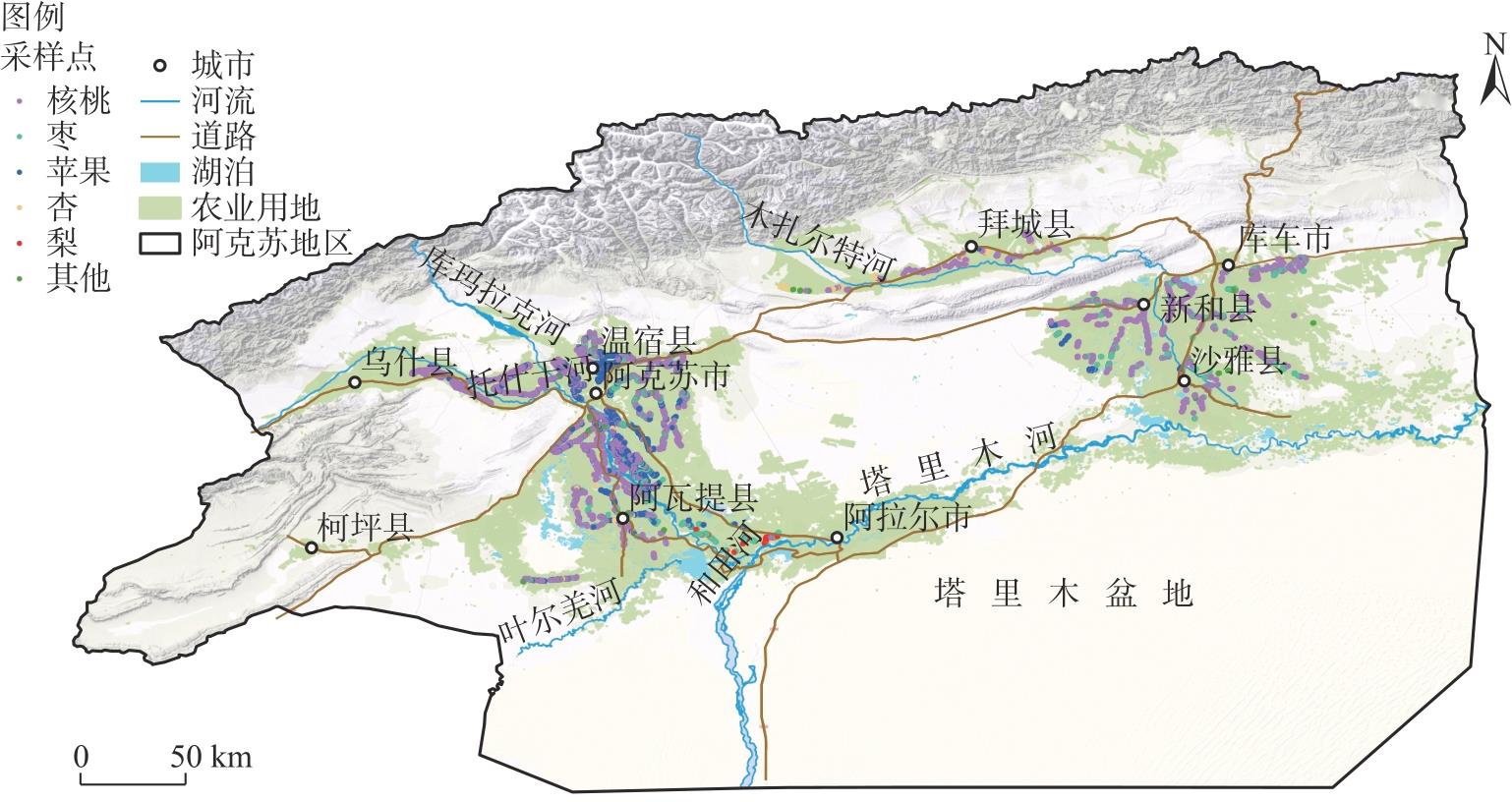
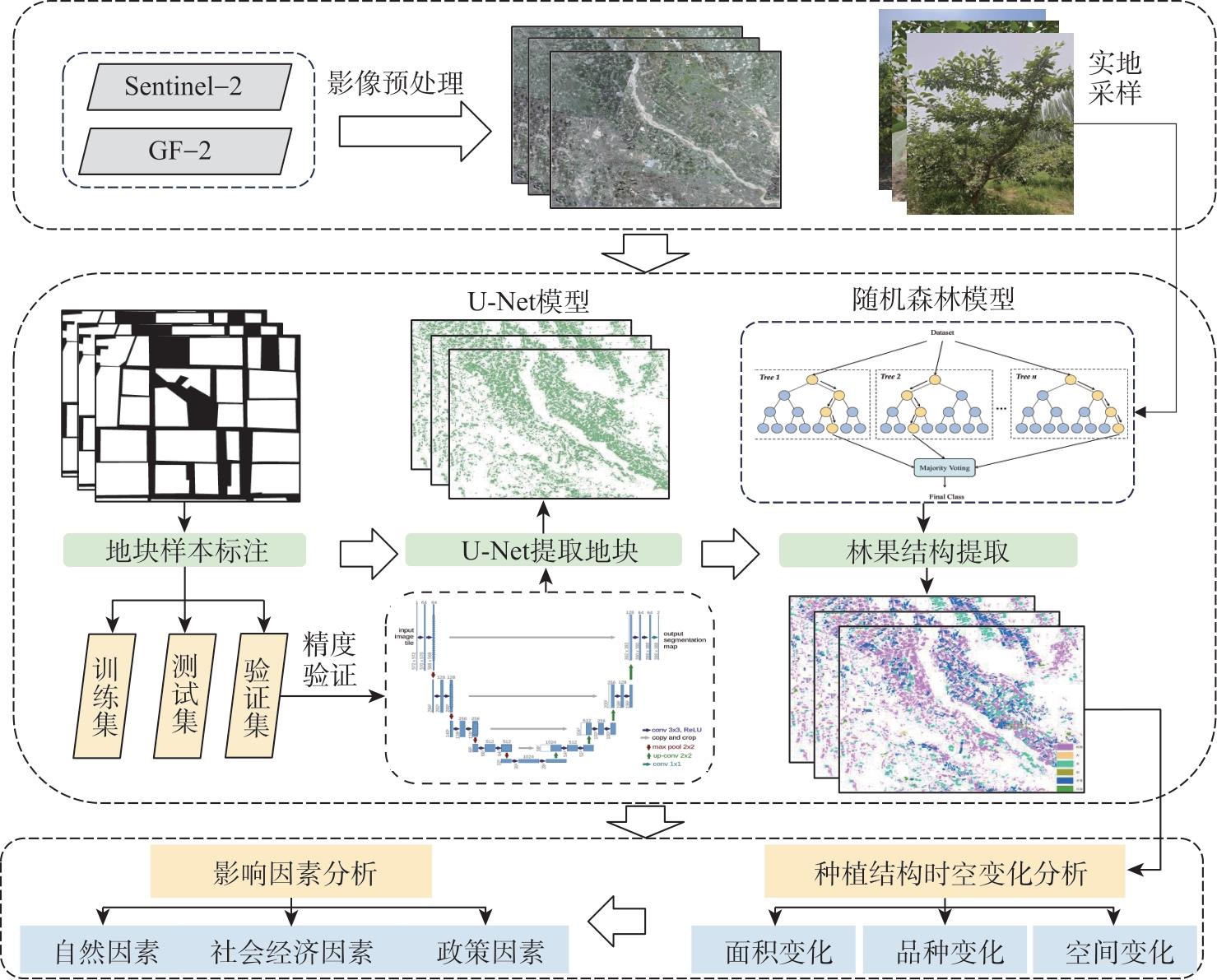
Fig. 2
Technical flowchart"
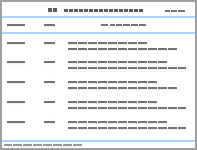
Tab. 1
Classification accuracy of random forest"
| 品种 | 生产者精度/% | 用户精度/% |
|---|---|---|
| 核桃 | 93.76 | 94.88 |
| 枣 | 85.73 | 83.76 |
| 苹果 | 84.36 | 83.65 |
| 杏 | 90.20 | 87.62 |
| 梨 | 92.06 | 89.23 |
Tab. 2
Changes in fruit planting area in Aksu Prefecture from 2004 to 2024"
| 品种 | 2004年 | 2024年 | 2004—2024年 | |||||
|---|---|---|---|---|---|---|---|---|
| 面积/km2 | 面积占比/% | 面积/km2 | 面积占比/% | 面积变化/km2 | 面积变化率/% | |||
| 核桃 | 526.57 | 42.75 | 1657.12 | 63.93 | 1130.55 | 214.70 | ||
| 枣 | 143.20 | 11.63 | 416.48 | 16.07 | 273.28 | 190.84 | ||
| 苹果 | 49.45 | 4.01 | 268.28 | 10.35 | 218.83 | 442.53 | ||
| 杏 | 294.78 | 23.93 | 131.99 | 5.09 | -162.79 | -55.22 | ||
| 梨 | 93.35 | 7.58 | 92.01 | 3.55 | -1.34 | -1.44 | ||
| 其他 | 124.35 | 10.10 | 26.20 | 1.01 | -98.15 | -78.93 | ||
| 总计 | 1231.70 | 100.00 | 2592.08 | 100.00 | 1360.38 | - | ||
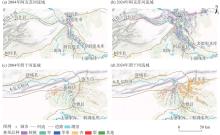
Fig. 3
Fruit planting structures and distributions in Aksu Prefecture from 2004 to 2024"
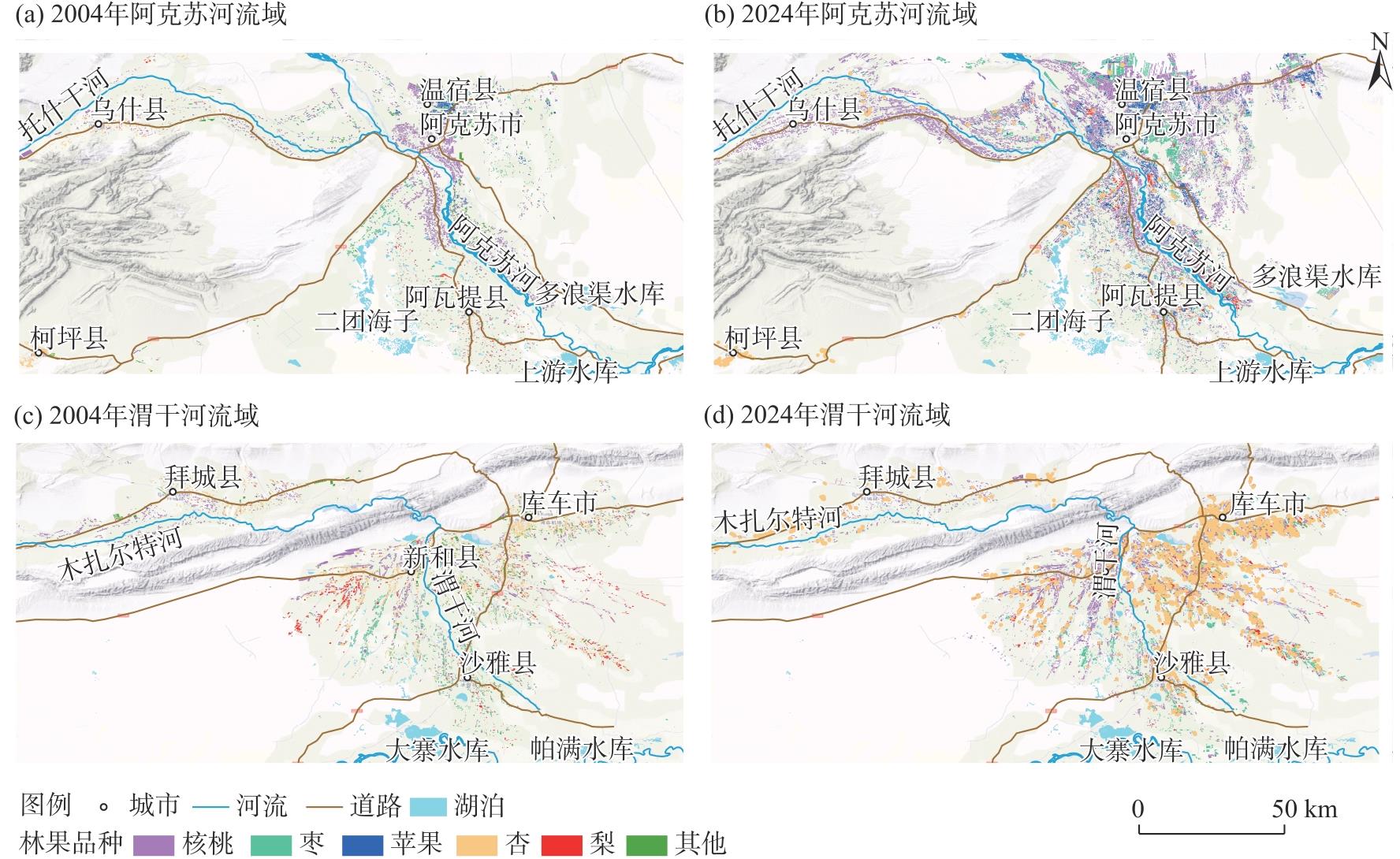
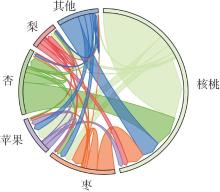
Fig. 4
Transformation of fruit planting area in Aksu Prefecture from 2004 to 2024"
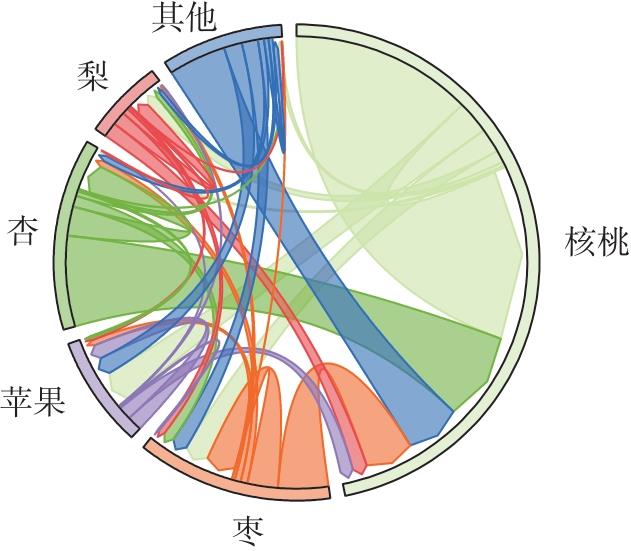
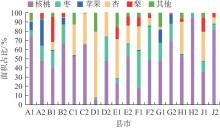
Fig. 5
Proportion of fruit planting area in different counties of Aksu Prefecture"
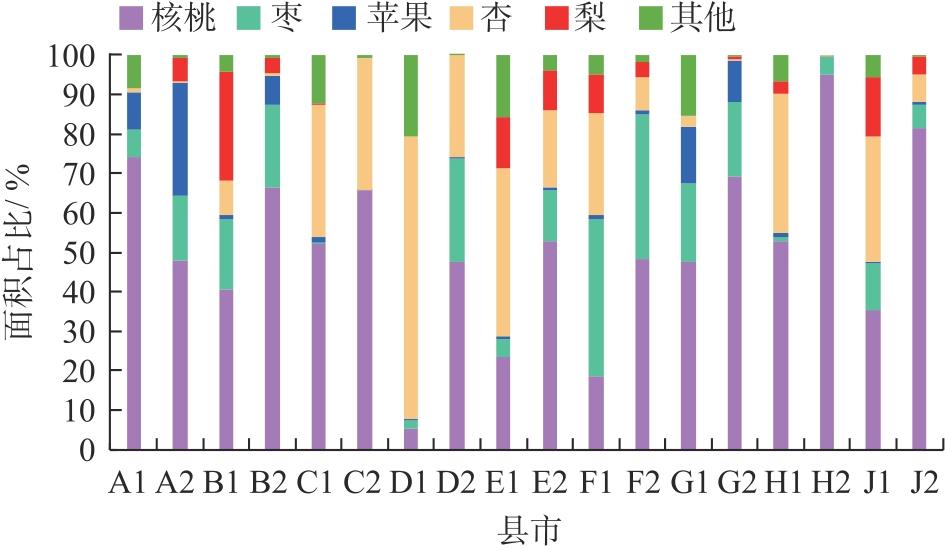
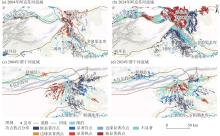
Fig. 6
Distributions of cold and hot spots of fruit in Aksu Prefecture"
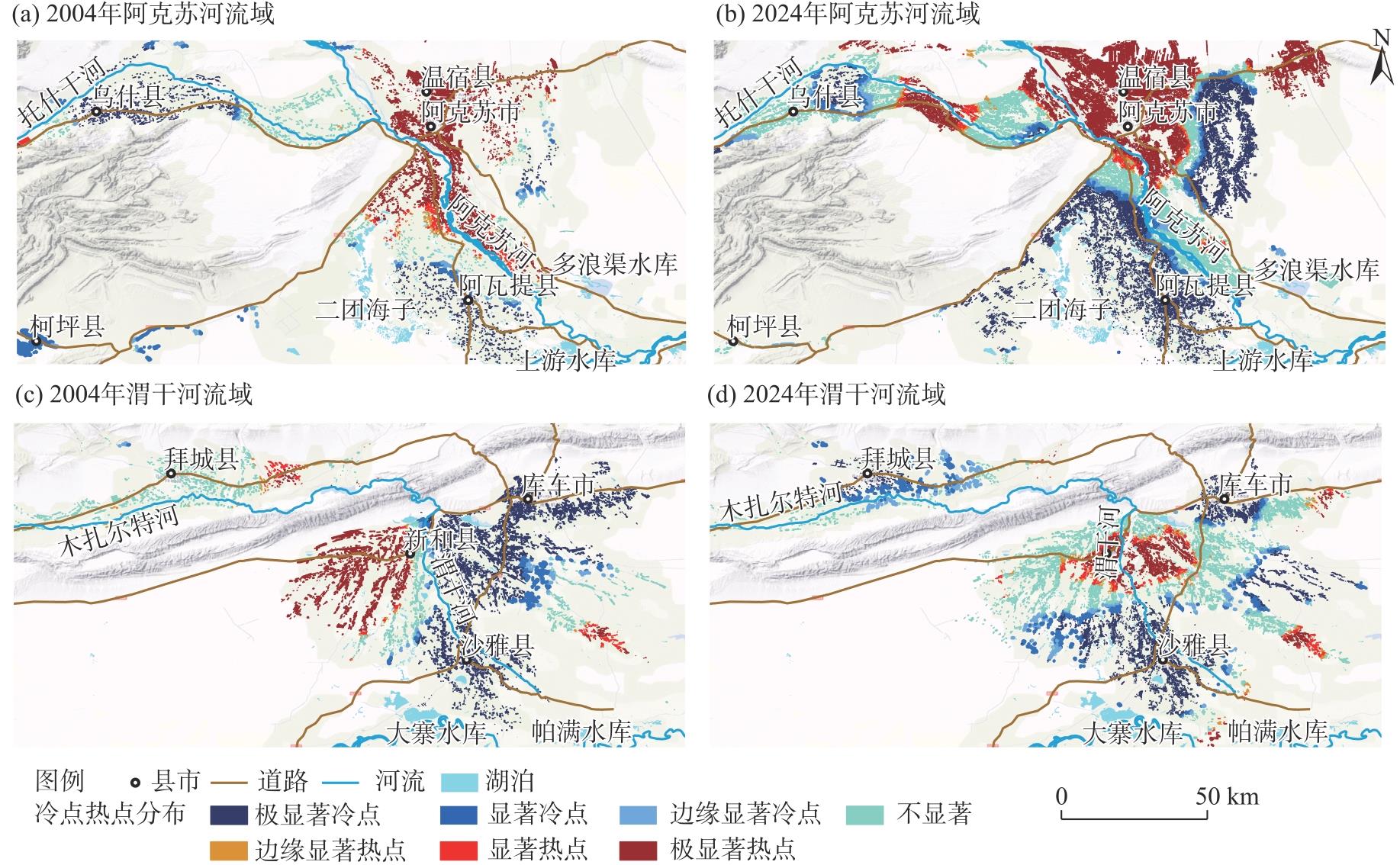
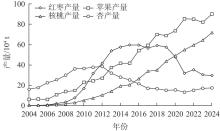
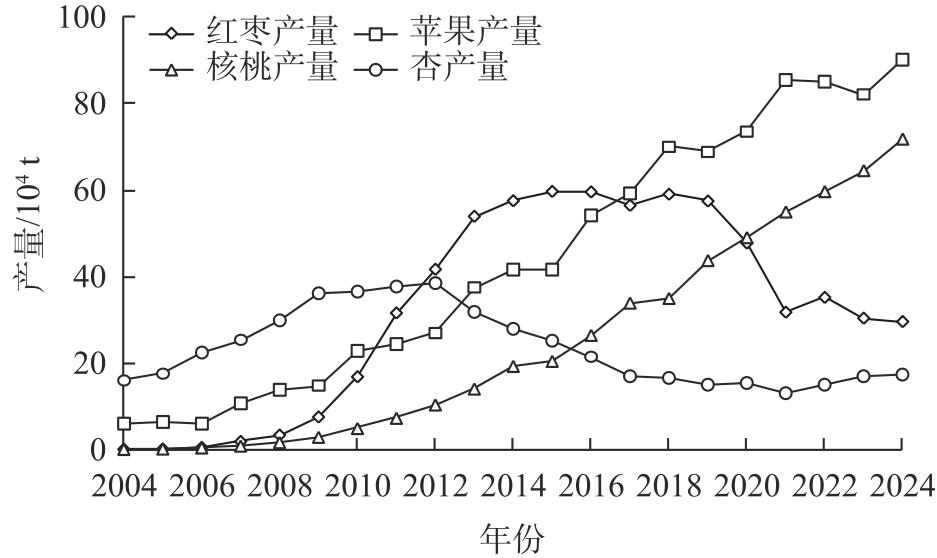
Fig. 7
Changes in fruit production in Aksu Prefecture from 2004 to 2024"
| [1] |
Pretty J, Benton T G, Bharucha Z P, et al. Global assessment of agricultural system redesign for sustainable intensification[J]. Nature Sustainability, 2018, 1: 441-446.
doi: 10.1038/s41893-018-0114-0 |
| [2] | 李宇飞. 阿克苏市农业产业结构与布局优化研究[D]. 乌鲁木齐: 新疆大学, 2022. |
| [Li Yufei. Research on the optimization of agricultural industry structure and layout in Aksu City[D]. Urumqi: Xinjiang University, 2022.] | |
| [3] | 彭刚, 梁刚. 新疆阿克苏地区特色林果产业化发展的问题与思考[J]. 中国林业经济, 2018(2): 34-36. |
| [Peng Gang, Liang Gang. Research and reflection on the development of characteristic forest fruit industrialization in the Aksu Region of Xinjiang[J]. China Forestry Economics, 2018(2): 34-36.] | |
| [4] | 胡东宇, 高健, 黄力平, 等. 南疆四地州核桃产业现状与发展思路[J]. 北方园艺, 2021, 484(13): 148-154. |
| [Hu Dongyu, Gao Jian, Huang Liping, et al. Current situation and development idea of walnut industry in four prefectures of southern Xinjiang[J]. Northern Horticulture, 2021, 484(13): 148-154.] | |
| [5] |
蒋桂容, 覃建雄. 人与自然和谐共生新格局下评估干旱区林果业生产的生态功能价值——以新疆南疆地区为例[J]. 干旱区地理, 2022, 45(5): 1604-1614.
doi: 10.12118/j.issn.1000-6060.2021.512 |
|
[Jiang Guirong, Qin Jianxiong. Assessing the ecological function value of fruit plantation in arid areas under a new pattern of harmonious coexistence between man and nature: A case of southern Xinjiang[J]. Arid Land Geography, 2022, 45(5): 1604-1614.]
doi: 10.12118/j.issn.1000-6060.2021.512 |
|
| [6] | 张谱, 管文轲, 张和钰, 等. 人工绿洲林果产业用地时空变化——以新疆迪那河流域为例[J]. 林业科学, 2020, 56(12): 114-122. |
| [Zhang Pu, Guan Wenke, Zhang Heyu, et al. Spatial-temporal changes of forestry and fruit industry land in artificial oasis: A case study of Dina River Watershed in Xinjiang Uygur Autonomous Region[J]. Scientia Silvae Sinicae, 2020, 56(12): 114-122.] | |
| [7] | 陈仲新, 任建强, 唐华俊, 等. 农业遥感研究应用进展与展望_陈仲新[J]. 遥感学报, 2016, 20(5): 748-767. |
| [Chen Zhongxin, Ren Jianqiang, Tang Huajun, et al. Progress and perspectives on agricultural remote sensing research and applications in China[J]. Journal of Remote Sensing, 2016, 20(5): 748-767.] | |
| [8] | 代佳佳. 基于高分与多时相中分影像的苹果园地提取[J]. 中国农业资源与区划, 2022, 43(8): 140-148. |
| [Dai Jiajia. Apple orchard extraction based on high-resolution images and multi-temporal mid-resolution images[J]. Chinese Journal of Agricultural Resources and Regional Planning, 2022, 43(8): 140-148.] | |
| [9] | 任传帅, 黄文江, 叶回春, 等. 利用高分二号数据提取香蕉林信息及精度分析[J]. 遥感信息, 2017, 32(6): 78-84. |
| [Ren Chuanshuai, Huang Wenjiang, Ye Huichun, et al. Extraction of banana orchards based on GF-2 satellite imagery and its accuracy analysis[J]. Remote Sensing Information, 2017, 32(6): 78-84.] | |
| [10] | Liu P, Chen X. Intercropping classification from GF-1 and GF-2 satellite imagery using a rotation forest based on an SVM[J]. Isprs International Journal of Geo-Information, 2019, 8(2): 86, doi: 10.3390/ijgi8020086. |
| [11] | 靳镜宇, 白洁, 包安明, 等. 林农间作模式下和田绿洲特色林果结构遥感信息提取[J]. 农业工程学报, 2022, 38(3): 146-154. |
| [Jin Jingyu, Bai Jie, Bao Anming, et al. Extraction of the fruit trees based on satellite imagery under the pattern of forest and crops interplanting in Hotan oasis[J]. Transactions of the Chinese Society of Agricultural Engineering, 2022, 38(3): 146-154.] | |
| [12] |
姚金玺, 肖成志, 张志, 等. 基于GEE多源遥感数据的干旱区植被地物类型提取[J]. 干旱区研究, 2024, 41(1): 157-168.
doi: 10.13866/j.azr.2024.01.15 |
|
[Yao Jinxi, Xiao Chengzhi, Zhang Zhi, et al. Vegetation feature type extraction in arid regions based on GEE multi-source remote sensing data[J]. Arid Zone Research, 2024, 41(1): 157-168.]
doi: 10.13866/j.azr.2024.01.15 |
|
| [13] |
周欣兴, 赵林, 张文杰, 等. 基于Sentinel-2多时相影像的果树种植区遥感提取[J]. 浙江农业学报, 2022, 34(12): 2767-2777.
doi: 10.3969/j.issn.1004-1524.2022.12.20 |
|
[Zhou Xinxing, Zhao Lin, Zhang Wenjie, et al. Remote sensing extraction of fruit tree planting area based on Sentinel-2 multi-temporal images[J]. Acta Agriculturae Zhejiangensis, 2022, 34(12): 2767-2777.]
doi: 10.3969/j.issn.1004-1524.2022.12.20 |
|
| [14] | 宋荣杰, 宁纪锋, 常庆瑞, 等. 基于小波纹理和随机森林的猕猴桃果园遥感提取[J]. 农业机械学报, 2018, 49(4): 222-231. |
| [Song Rongjie, Ning Jifeng, Chang Qingrui, et al. Kiwifruit orchard mapping based on wavelet textures and random forest[J]. Transactions of the Chinese Society for Agricultural Machinery, 2018, 49(4): 222-231.] | |
| [15] |
张旭辉, 玉素甫江·如素力, 仇忠丽, 等. 基于Sentinel-2时序数据的新疆焉耆盆地农作物遥感识别与评估[J]. 干旱区地理, 2024, 47(4): 672-683.
doi: 10.12118/j.issn.1000-6060.2023.262 |
|
[Zhang Xuhui, Rusuli Yusufujiang, Qiu Zhongli, et al. Remote sensing identification and assessment of crops in the Yanqi Basin, Xinjiang, China based on Sentinel-2 time series data[J]. Arid Land Geography, 2024, 47(4): 672-683.]
doi: 10.12118/j.issn.1000-6060.2023.262 |
|
| [16] |
Maxwell A E, Warner T A, Fang F. Implementation of machine-learning classification in remote sensing: An applied review[J]. International Journal of Remote Sensing, 2018, 39: 2784-2817.
doi: 10.1080/01431161.2018.1433343 |
| [17] |
Peña M A, Liao R, Brenning A. Using spectrotemporal indices to improve the fruit-tree crop classification accuracy[J]. ISPRS Journal of Photogrammetry and Remote Sensing, 2017, 128: 158-169.
doi: 10.1016/j.isprsjprs.2017.03.019 |
| [18] | 沈江龙, 郑江华, 尼格拉·吐尔逊, 等. 若羌绿洲特色林果种植信息遥感提取方法适用性分析[J]. 中国农业资源与区划, 2022, 43(2): 206-219. |
| [Shen Jianglong, Zheng Jianghua, Tuerxun Nigela, et al. Applicability analysis of remote sensing extraction method of planting information of local fruit crop in Ruoqiang[J]. Chinese Journal of Agricultural Resources and Regional Planning, 2022, 43(2): 206-219.] | |
| [19] | 欧阳玲, 毛德华, 王宗明, 等. 基于GF-1与Landsat8 OLI影像的作物种植结构与产量分析[J]. 农业工程学报, 2017, 33(11): 147-156, 316. |
| [Ouyang Ling, Mao Dehua, Wang Zongming, et al. Analysis crops planting structure and yield based on GF-1 and Landsat8 OLI images[J]. Transactions of the Chinese Society of Agricultural Engineering, 2017, 33(11): 147-156, 316.] | |
| [20] | 张喜成. 开都-孔雀河流域农作物需水量及作物种植结构优化研究[D]. 乌鲁木齐: 新疆大学, 2019. |
| [Zhang Xicheng. Study on crop water requirement and crop planting structure optimization in Kaidu-Kongqi River Basin[D]. Urumqi: Xinjiang University, 2019.] | |
| [21] | 宋伟, 王运涛, 王立波, 等. 基于多源遥感影像的作物信息提取与需水量时空分析[J]. 生态学杂志, 2024, 43(4): 1113-1121. |
| [Song Wei, Wang Yuntao, Wang Libo, et al. Crop information extraction and spatial-temporal analysis of water demand based on multi-source remote sensing images[J]. Chinese Journal of Ecology, 2024, 43(4): 1113-1121.] | |
| [22] | 王翔, 戴俊生. 塔里木河流域林果业结构布局演变及驱动因素分析[J]. 新疆农业科学, 2024, 61(增刊1): 227-231. |
| [Wang Xiang, Dai Junsheng. Analysis and driving factors of structure layout of forest and fruit industry in Tarim River Basin[J]. Xinjiang Agricultural Sciences, 2024, 61(Suppl. 1): 227-231.] | |
| [23] | 肖永丽, 张少华, 库完汗·吾甫尔, 等. 新疆巴音郭楞蒙古自治州特色林果业发展现状及对策[J]. 果树资源学报, 2024, 5(5): 118-122. |
| [Xiao Yongli, Zhang Shaohua, Wufuer Kuwanhan, et al. Development situations and countermeasures of characteristic forest and fruit industry in Bayingol Mongolian Autonomous Prefecture, Xinjiang[J]. Journal of Resources, 2024, 5(5): 118-122.] | |
| [24] |
Ilniyaz O, Du Q, Kurban A, et al. An explanatory spatio-temporal pattern analysis of the fruit industry in Xinjiang, China, between 1988 and 2017[J]. Transactions in GIS, 2022, 26: 2383-2409.
doi: 10.1111/tgis.v26.5 |
| [25] | 李忠新, 杨军, 杨莉玲, 等. 南疆特色林果加工的现状及趋势[J]. 新疆农业科学, 2010, 47(11): 2177-2183. |
| [Li Zhongxin, Yang Jun, Yang Liling, et al. The present status and trends of the processing for the featured forest fruits in southern Xinjiang[J]. Xinjiang Agricultural Sciences, 2010, 47(11): 2177-2183.] | |
| [26] | 周晓雄. 阿克苏地区林果产业发展现状与对策[D]. 阿拉尔: 塔里木大学, 2021. |
| [Zhou Xiaoxiong. Present situation and countermeasures of forest fruit industry development in Aksu Region[D]. Aral: Tarim University, 2021.] | |
| [27] | 张圣微, 杨林, 叶德成, 等. 基于深度学习的内蒙古河套灌区2000—2021年种植结构提取与动态[J]. 农业工程学报, 2023, 39(18): 142-150. |
| [Zhang Shengwei, Yang Lin, Ye Decheng, et al. Extraction and dynamics of planting structure in Hetao Irrigation District of Inner Mongolia from 2000 to 2021 using deep learning[J]. Transactions of the Chinese Society of Agricultural Engineering, 2023, 39(18): 142-150.] | |
| [28] | Wang J J, Ding J L, Ran S, et al. Automatic pear extraction from high-resolution images by a visual attention mechanism network[J]. Remote Sensing, 2023, 15(13): 3283, doi: 10.3390/rs15133283. |
| [29] |
Breiman L. Random forests[J]. Machine Learning, 2001, 45: 5-32.
doi: 10.1023/A:1010933404324 |
| [30] |
Liang J X, Sawut M, Cui J T, et al. Object-oriented multi-scale segmentation and multi-feature fusion-based method for identifying typical fruit trees in arid regions using Sentinel-1/2 satellite images[J]. Scientific Reports, 2024, 14: 18230, doi: 10.21203/rs.3.rs-4191413/v1.
pmid: 39107396 |
| [31] | 邹彬. 西安市植被覆盖度冷热点时空动态变化及其风险分析[J]. 西安理工大学学报, 2020, 36(2): 197-204. |
| [Zou Bin. Temporal and spatial dynamic changes and risk analysis of cold spot and hot spot in vegetation coverage in Xi’an[J]. Journal of Xi’an University of Technology, 2020, 36(2): 197-204.] | |
| [32] | 彭睿. 新疆经济林果业高质量发展驱动力及实现路径研究[D]. 北京: 中国林业科学研究院, 2020. |
| [Peng Rui. Research on driving force and implementation path of high-quality development of economic forest and fruit industry in Xinjiang[D]. Beijing: Chinese Academy of Forestry, 2020.] | |
| [33] | 张少华, 肖永丽, 库完汗·吾甫尔, 等. 新疆杏产业发展现状、存在问题及对策建议[J]. 果农之友, 2024(8): 140-146. |
| [Zhang Shaohua, Xiao Yongli, Wupuer Kuwanhan, et al. Current development status, existing problems, and policy recommendations for the apricot industry in Xinjiang[J]. Fruit Growers’ Friend, 2024(8): 140-146.] | |
| [34] | 玛依拉·米吉提, 李晶, 赵向豪. 新发展格局下阿克苏苹果产业集群发展路径[J]. 北方园艺, 2025(1): 137-143. |
| [Mijiti Mayila, Li Jing, Zhao Xianghao. Development path of Aksu apple industrial cluster under the new development pattern[J]. Northern Horticulture, 2025(1): 137-143.] | |
| [35] |
王福红, 夏咏. 干旱区主要农作物生产时空格局演化及影响因素分析——以新疆地区为例[J]. 干旱区地理, 2025, 48(3): 444-454.
doi: 10.12118/j.issn.1000-6060.2024.201 |
|
[Wang Fuhong, Xia Yong. Spatio-temporal pattern evolution and influencing factors of main crops production in arid region: A case of Xinjiang[J]. Arid Land Geography, 2025, 48(3): 444-454.]
doi: 10.12118/j.issn.1000-6060.2024.201 |
|
| [36] | 杨杰, 高凡, 徐海量, 等. 阿克苏河流域生态系统服务价值时空演变及其驱动因素[J]. 环境科学, 2025, 46(4): 2385-2397. |
| [Yang Jie, Gao Fan, Xu Hailiang, et al. Spatial and temporal evolution of ecosystem service value and its driving factors in the Aksu River Basin[J]. Environmental Science, 2025, 46(4): 2385-2397.] | |
| [37] |
杨琛, 马斌, 何学敏, 等. 阿克苏河流域蒸散量时空变化规律与驱动因素[J]. 干旱区研究, 2025, 42(7): 1211-1221.
doi: 10.13866/j.azr.2025.07.05 |
| [Yang Chen, Ma Bin, He Xuemin, et al. Patterns of spatial and temporal variation of evapotranspiration in Aksu River Basin and factors driving them[J]. Arid Zone Research, 2025, 42(7): 1211-1221.] | |
| [38] | Jin J Y, Bai J, Bao A M, et al. Cost-benefit evaluation of walnut and jujube orchards under fruit tree-crop intercropping conditions in southern Xinjiang[J]. Forests, 2023, 14(11): 2259, doi: 10.3390/f14112259. |
| [39] | 张山清, 吉春容, 普宗朝. 气候变暖对新疆杏种植气候适宜性的影响[J]. 中国农业资源与区划, 2019, 40(9): 131-141. |
| [Zhang Shanqing, Ji Chunrong, Pu Zongchao. Impact of climate warming on apricot planting climatic suitability in Xinjiang[J]. Chinese Journal of Agrometeorology, 2019, 40(9): 131-141.] | |
| [40] | 徐德源, 王健, 任水莲, 等. 新疆杏的气候生态适应性及花期霜冻气候风险区划[J]. 中国生态农业学报(中英文), 2007, 15(2): 18-21. |
| [Xu Deyuan, Wang Jian, Ren Shuilian, et al. Ecological adaptability and venture climatic subarea zoning based on frost in florescence of apricot in Xinjiang[J]. Chinese Journal of Eco-Agriculture, 2007, 15(2): 18-21.] | |
| [41] | 吉春容, 邹陈, 陈丛敏, 等. 新疆特色林果冻害研究概述[J]. 沙漠与绿洲气象, 2011, 5(4): 1-4. |
| [Ji Chunrong, Zou Chen, Chen Congmin, et al. Review on frozen injury of fruit trees in Xinjiang[J]. Desert and Oasis Meteorology, 2011, 5(4): 1-4.] | |
| [42] | 吴顺科, 孙丙寅, 郑涛, 等. ‘树上干杏’果实生长与气象因子的相关性[J]. 西北林学院学报, 2022, 37(5): 111-116. |
| [Wu Shunke, Sun Bingyin, Zheng Tao, et al. Correlation between meteorological factors and fruit growth of ‘shushanggan apricot’[J]. Journal of Northwest Forestry University, 2022, 37(5): 111-116.] | |
| [43] | 阿克苏地区融媒体中心. 阿克苏地区打造产业链铺就“杏”福路[EB/OL]. [2023-06-27]. https://lcj.xinjiang.gov.cn/lcj/lcdt/202306/6df9a2f54e4445d6bb20a3651ec8e9ee.shtml. |
| [Aksu Regional Media Center. Aksu Region builds industrial chain, paving the “apricot” road to happiness[EB/OL]. [2023-06-27]. https://lcj.xinjiang.gov.cn/lcj/lcdt/202306/6df9a2f54e4445d6bb20a3651ec8e9ee.shtml.] | |
| [44] | 中国新闻网. 新疆库车: 低质果园改造助推“杏乡”林果业高质量发展[DB/OL]. [2024-03-22]. https://www.xj.chinanews.com.cn/dizhou/2024-03-22/detail-ihcytixp0494001.shtml. |
| [China News Service. Kuqa, Xinjiang: Upgrading low-quality orchards to promote high-quality development of the “apricot town” fruit industry[DB/OL]. [2024-03-22]. https://www.xj.chinanews.com.cn/dizhou/2024-03-22/detail-ihcytixp0494001.shtml.] |
| [1] | XU Xiao, WANG Ninglian, SHI Chenlie. Albedo variation characteristics of the Qiyi Glacier during the ablation season based on Sentinel-2 and MODIS data [J]. Arid Land Geography, 2026, 49(8): 1560-1571. |
| [2] | WU Rui, SUN Huilan, YE Mao, JIN Xiaoliang, ZHOU Meiling, YANG Han, WU Fang. Analysis on the spatiotemporal variation characteristics and driving forces of fractional vegetation coverage in the Ili River Valley, Xinjiang [J]. Arid Land Geography, 2026, 49(6): 1157-1167. |
| [3] | LI Suyun, ZHU Cunxiong, WANG Jing, CHEN Guoqian, SHI Feifei. Applicability and spatiotemporal variation analysis of SMAP ascending products to soil moisture in Qaidam Basin [J]. Arid Land Geography, 2026, 49(6): 1203-1214. |
| [4] | NING Xiaoju, ZHANG Li, YANG Luyao, MAO Qizheng, LIU Xiaozhuo. Spatiotemporal variations of livability level in the middle and lower reaches of the Yellow River under the impact of extreme climate [J]. Arid Land Geography, 2026, 49(5): 975-986. |
| [5] | HE Yuqing, WANG Cheng, HUANG Wei, SONG Jiaqi, LIU Siyuan, ZONG Shimin. Land space development and functional zoning of Aksu from the perspective of ecological priority [J]. Arid Land Geography, 2026, 49(5): 998-1012. |
| [6] | AN Jiale, WANG Lei, ZHENG Jianghua, LI Jianhao, ZHAO Guobing, Nigela TUERXUN, FU Rong, LUO Lei. Sentinel-1 and Sentinel-2 based change detection in fire trails under multi-feature combination [J]. Arid Land Geography, 2026, 49(4): 791-803. |
| [7] | WANG Shengjie, ZHANG Qinghong, SANG Mingjian. Prediction and application of urban PM2.5 concentration in arid zones based on improved deep learning models [J]. Arid Land Geography, 2026, 49(2): 343-355. |
| [8] | YUAN Weicheng, ZHANG Huilan, GAO Huiru, GU Fangzheng. Spatiotemporal variations and driving forces of vegetation coverage in the Ten Tributaries region [J]. Arid Land Geography, 2026, 49(10): 2094-2106. |
| [9] | LI Jinzhen, WU Tianjun, LUO Jiancheng, HU Xiaodong, ZHOU Zhongfa, CAO Feng. Fine-grained land-use remote-sensing mapping in arid regions using deep learning with “zoning-stratification” [J]. Arid Land Geography, 2026, 49(10): 2122-2133. |
| [10] | LI Ruonan, LI Junli, LIU Shuaiqi, DU Weibing. Glacier changes and topographic factors of the Ulugh Muztagh from 1960 to 2023 [J]. Arid Land Geography, 2026, 49(1): 23-34. |
| [11] | LU Han, ZENG Yongnian, WANG Pancheng. Spatiotemporal variation of actual evapotranspiration and its influencing factors in the northeast Qinghai-Xizang Plateau [J]. Arid Land Geography, 2025, 48(5): 753-764. |
| [12] | YAN Jinye, MA Zhengquan, SUN Xuanxuan, Alim ABBAS, Palida YAHEFU. Spatiotemporal variations and potential sources of PM2.5 and PM10 in the “Urumqi-Changji-Shihezi” urban agglomeration from 2015 to 2023 [J]. Arid Land Geography, 2025, 48(3): 405-420. |
| [13] | GUO Jiali, MA Yonggang, PAN Heng, LI Na, SUN Changning, SUN Qian, ZHOU Wenchang, DANG Yuxuan. Comparative analysis of satellite monitoring of soil salinization in Ebinur Lake during spring and summer [J]. Arid Land Geography, 2025, 48(12): 2143-2157. |
| [14] | LI Hongyang, CHEN Tianyu, WANG Shengjie, ZHANG Mingjun. Spatiotemporal variations of potential evapotranspiration on the northern slope of the Kunlun Mountains in Xinjiang from 1979 to 2021 [J]. Arid Land Geography, 2024, 47(9): 1443-1450. |
| [15] | ZHANG Shunwei, ZHOU Zixiang, XIONG Xuanchen, ZHOU Jie. Extreme climate characteristics in the Wuding River Basin based on WRF model [J]. Arid Land Geography, 2024, 47(9): 1482-1495. |
|
||