Arid Land Geography ›› 2025, Vol. 48 ›› Issue (12): 2099-2110.doi: 10.12118/j.issn.1000-6060.2025.036
• Ecology and Environment • Previous Articles Next Articles
LI Haolin1( ), ZHANG Xuejie2(), ZHANG Hongjuan2, SUN Li’na3, SONG Pengcheng2, LI Ping2
Received:2025-01-16
Revised:2025-04-18
Online:2025-12-25
Published:2025-12-30
Contact:
ZHANG Xuejie
E-mail:teddylhl@gmail.com;15048612668@163.com
LI Haolin, ZHANG Xuejie, ZHANG Hongjuan, SUN Li’na, SONG Pengcheng, LI Ping. Simulation study on water and fertilization coupling optimization scheme of spring maize based on DNDC model[J].Arid Land Geography, 2025, 48(12): 2099-2110.
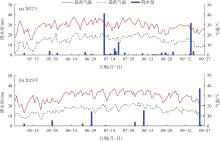
Fig. 1
Changes of meteorologic in study area from 2022 to 2023"
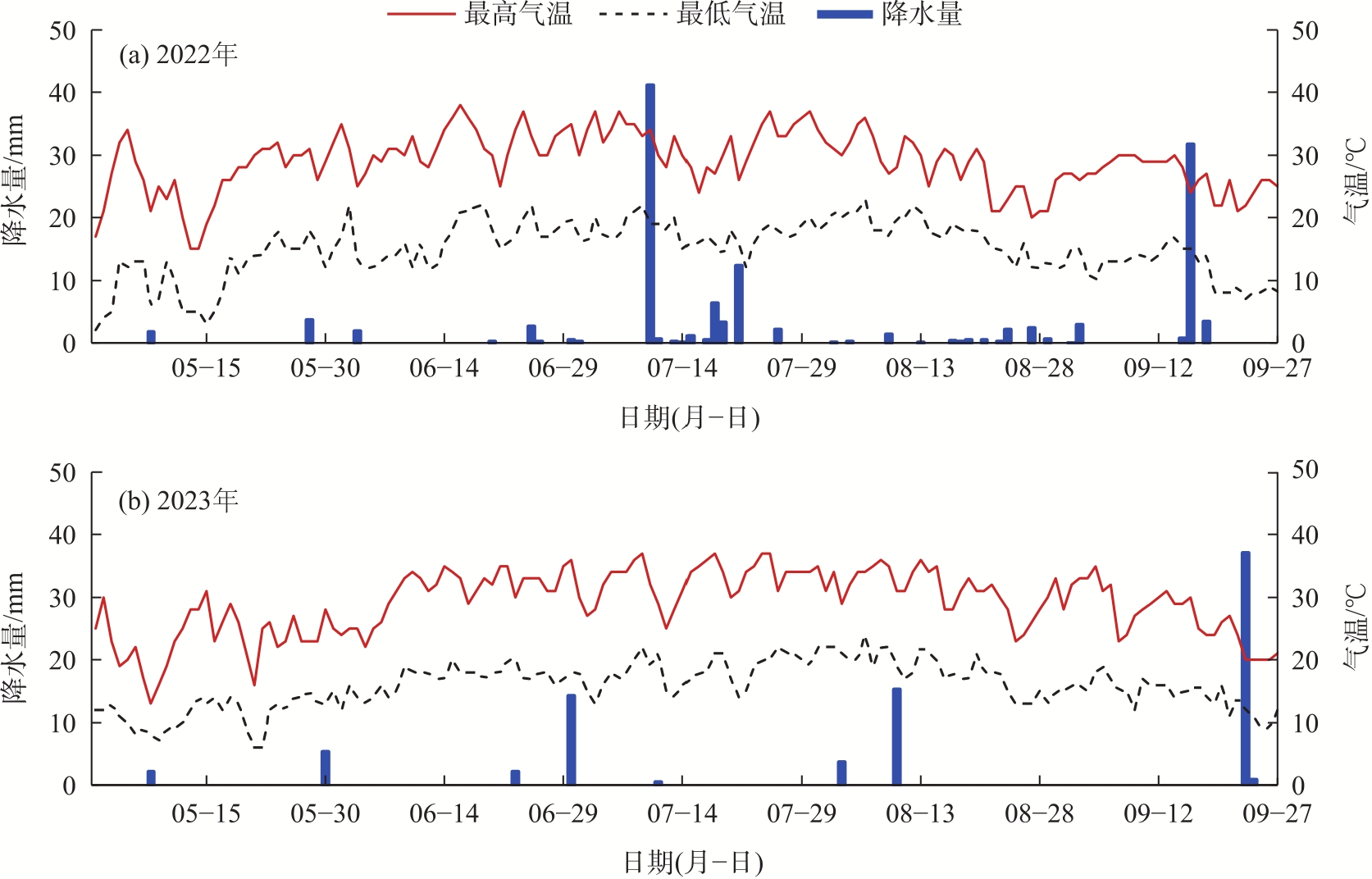
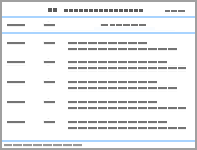
Tab. 1
Experimental design"
| 处理 | 灌溉梯度 | 施肥 | |
|---|---|---|---|
| 施肥类型 | 施肥量/kg·hm-2 | ||
| W1F1 | 充分灌溉75%~95%θf(W1) | 传统肥(F1) | 225 |
| W1F2 | 传统肥减量(F2) | 150 | |
| W1F3 | 传统肥减量+有机肥(F3) | 150+75 | |
| W2F1 | 胁迫灌溉55%~75%θf(W2) | 传统肥(F1) | 225 |
| W2F2 | 传统肥减量(F2) | 150 | |
| W2F3 | 传统肥减量+有机肥(F3) | 150+75 | |
Tab. 2
Soil parameters and crop parameters of model simulation"
| 土壤参数 | 作物参数 | ||
|---|---|---|---|
| 参数类型 | 取值 | 参数类型 | 取值 |
| 土壤质地 | 砂壤土 | 最高产量/kg·hm-2 | 6993.00 |
| 土壤容重/g·cm-3 | 1.37 | 总需氮量/kg·hm-2 | 125.82 |
| 田间持水率/cm3·cm-3 | 0.20 | 生长积温/℃ | 2550.00 |
| 孔隙度 | 0.48 | 需水量/mm | 150.00 |
| pH值 | 9.60 | 最适温度/℃ | 30.00 |
| 表层土壤有机碳/g·kg-1 | 1.00 | 固氮系数 | 1.00 |
Tab. 3
Simulation scenarios of different water and fertilizer coupling of maize"
| 情景处理 | 灌水定额/m3·hm-2 | 施肥类型 | 有机肥施肥量/kg·hm-2 |
|---|---|---|---|
| T300-100% | 300 | 100%有机肥 | 225 |
| T300-80% | 80%有机肥 | 180 | |
| T300-60% | 60%有机肥 | 135 | |
| T300-40% | 40%有机肥 | 90 | |
| T300-20% | 20%有机肥 | 45 | |
| T240-100% | 240 | 100%有机肥 | 225 |
| T240-80% | 80%有机肥 | 180 | |
| T240-60% | 60%有机肥 | 135 | |
| T240-40% | 40%有机肥 | 90 | |
| T240-20% | 20%有机肥 | 45 | |
| T180-100% | 180 | 100%有机肥 | 225 |
| T180-80% | 80%有机肥 | 180 | |
| T180-60% | 60%有机肥 | 135 | |
| T180-40% | 40%有机肥 | 90 | |
| T180-20% | 20%有机肥 | 45 | |
| T120-100% | 120 | 100%有机肥 | 225 |
| T120-80% | 80%有机肥 | 180 | |
| T120-60% | 60%有机肥 | 135 | |
| T120-40% | 40%有机肥 | 90 | |
| T120-20% | 20%有机肥 | 45 |
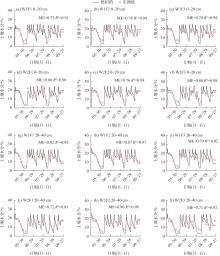
Fig. 2
Simulation analysis of soil water content in different soil layers at calibration in 2022"

Fig. 3
Simulation analysis of soil water content in different soil layers at validation in 2023"
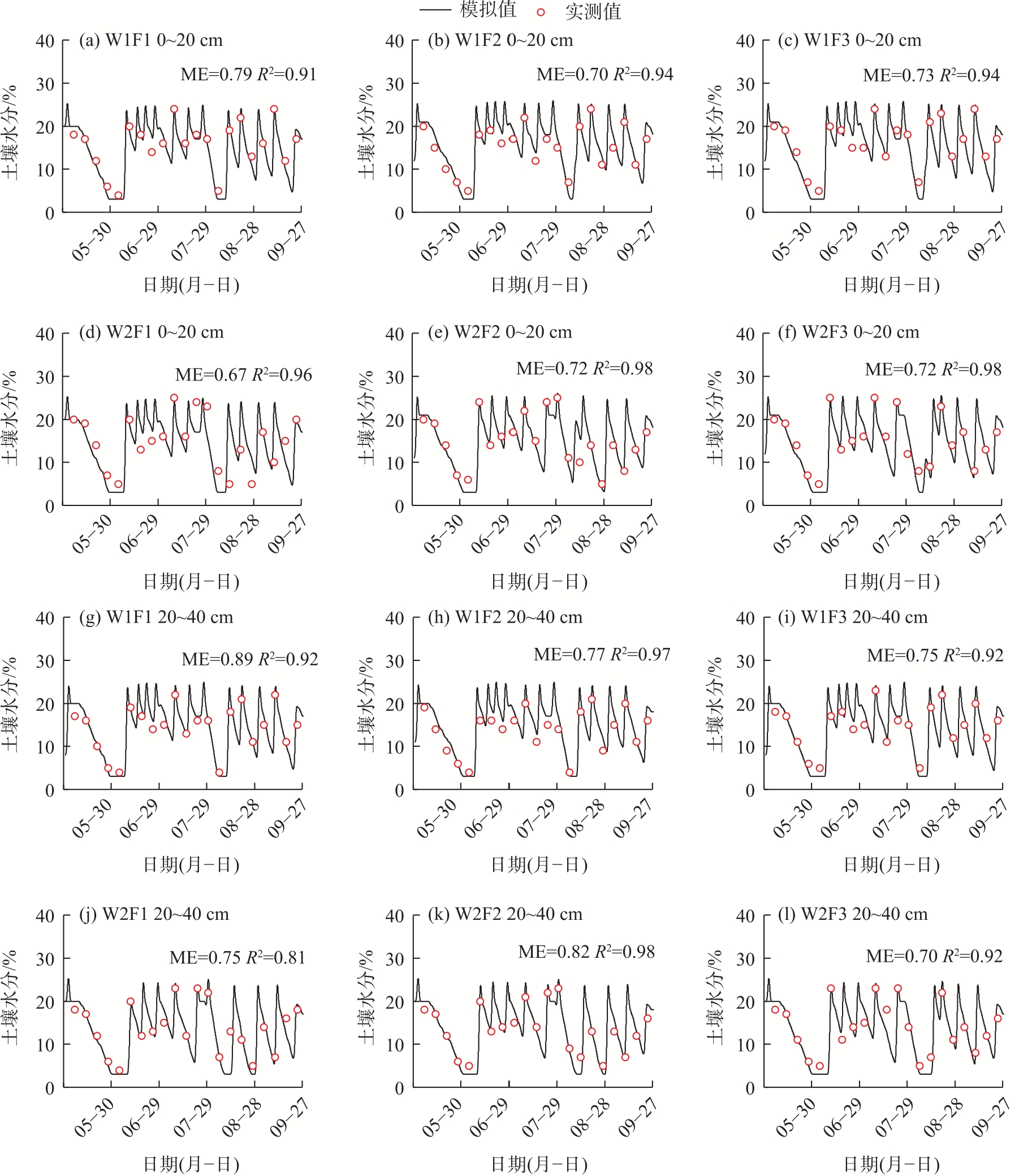
Fig. 4
Calibration and validation period maize yield simulation results in 2022 and 2023"
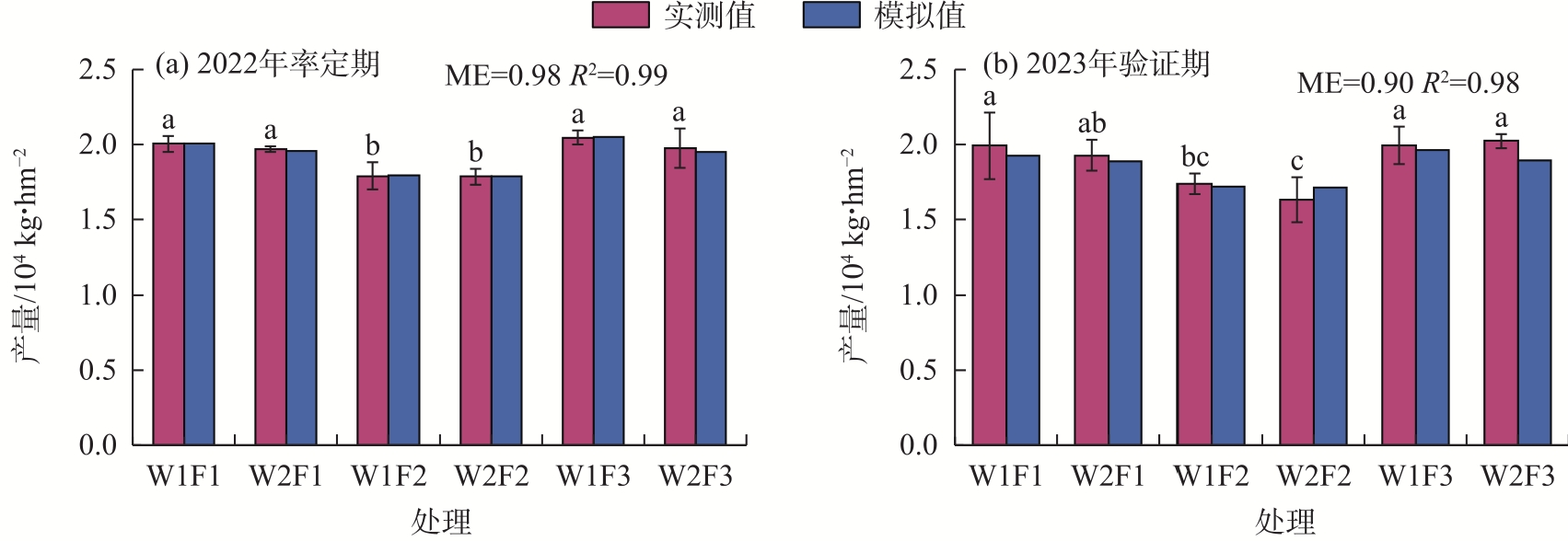
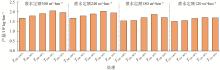
Fig. 5
Maize yield under different water-fertilizer coupling scenarios"
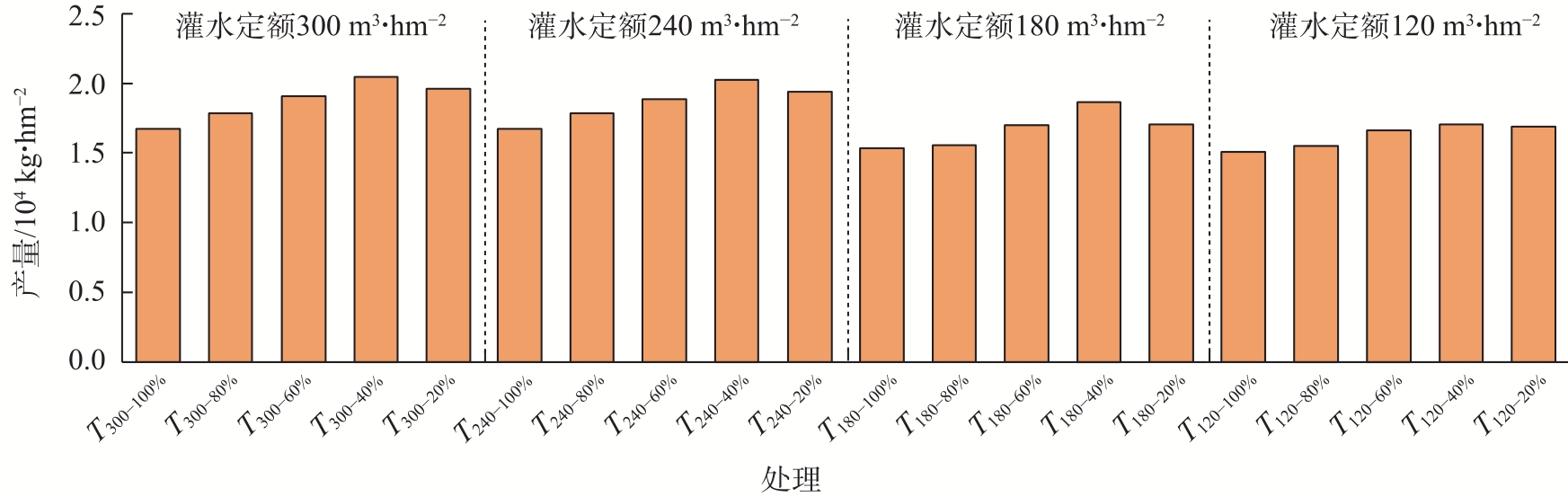

Fig. 6
Water and fertilizer use efficiency under different water-fertilizer coupling scenarios"

| [1] | Shi R C, Wang J T, Tong L, et al. Optimizing planting density and irrigation depth of hybrid maize seed production under limited water availability[J]. Agricultural Water Management, 2022, 271, 107759, doi: 10.1016/j.agwat.2022.107759. |
| [2] |
罗静怡, 东梅. 中国粮食生产用水绿色效率与回弹效应研究——基于三阶段超效率SBM-Malmquist模型[J]. 干旱区地理, 2024, 47(9): 1508-1517.
doi: 10.12118/j.issn.1000-6060.2023.615 |
|
[Luo Jingyi, Dong Mei. Green efficiency and rebound effect of water for grain production in China: Based on the three-stage super-efficiency SBM-Malmquist model[J]. Arid Land Geography, 2024, 47(9): 1508-1517.]
doi: 10.12118/j.issn.1000-6060.2023.615 |
|
| [3] | Zhao Y, Zhang R, Shu H P, et al. Study on optimal allocation of water resources based on uncertain multi-objective fuzzy model: A case of Pingliang City, China[J]. Water, 2024, 16(15): 2099, doi: 10.3390/w16152099. |
| [4] |
吴梦雨, 李冬杰, 韩玉国, 等. 河西走廊农田灌溉面积阈值分析[J]. 干旱区地理, 2024, 47(7): 1165-1174.
doi: 10.12118/j.issn.1000-6060.2023.560 |
|
[Wu Mengyu, Li Dongjie, Han Yuguo, et al. Thresholds of irrigated farmland area in the Hexi Corridor region[J]. Arid Land Geography, 2024, 47(7): 1165-1174.]
doi: 10.12118/j.issn.1000-6060.2023.560 |
|
| [5] | 受娜. 施氮量对陇东旱塬区青贮玉米生产及水氮利用的影响[D]. 兰州: 兰州大学, 2022. |
| [Shou Na. Effect of nitrogen application rate on production, water and nitrogen utilization of forage maize in the Longdong Loess Plateau of China[D]. Lanzhou: Lanzhou University, 2022.] | |
| [6] | Ma J Q, Liu L S, Cui B F, et al. Research on the coupling effect of water and fertilizer on maize under multi-objective conditions and its application scenarios[J]. Sustainability, 2024, 16(13): 5615, doi: 10.3390/su16135615. |
| [7] | 邝雨欣, 张体彬, 程煜, 等. 有机无机肥配施对盐渍化农田无机态氮迁移和玉米生长的影响[J]. 干旱地区农业研究, 2025, 43(2): 105-115, 137. |
| [Kuang Yuxin, Zhang Tibin, Chen Yu, et al. Effects of combined application of organic and inorganic fertilizers on inorganic nitrogen movement and maize growth in salinity soils[J]. Agricultural Research in the Arid Areas, 2025, 43(2): 105-115, 137.] | |
| [8] | 郭喜军, 谢军红, 李玲玲, 等. 氮肥用量及有机无机肥配比对陇中旱农区玉米光合特性及产量的影响[J]. 植物营养与肥料学报, 2020, 26(5): 806-816. |
| [Guo Xijun, Xie Junhong, Li Lingling, et al. Appropriate nitrogen fertilizer rate and organic N ratio for satisfactory photosynthesis and yield of maize in dry farming area of Longzhong, Gansu Province[J]. Journal of Plant Nutrition and Fertilizers, 2020, 26(5): 806-816.] | |
| [9] | 宿顺顺. 有机无机肥配施与亏缺灌溉对夏玉米/冬小麦生长和水氮利用的影响[D]. 西安: 西北农林科技大学, 2020. |
| [Su Shunshun. Effects of organic and inorganic fertilizer application and deficit irrigation on the growth and water and nitrogen utilization of summer maize/winter wheat[D]. Xi’an: Northwest A & F University, 2020.] | |
| [10] | 刘占军. 东北春玉米氮磷增效施肥模式研究[D]. 北京: 中国农业科学院, 2010. |
| [Liu Zhanjun. Evaluation on fertilizer application patterns for improving nitrogen and phosphorus use efficiency in spring maize in northeast China[D]. Beijing: Chinese Academy of Agricultural Sciences, 2010.] | |
| [11] | Oliveira G F D, Correa J C, Hentz P, et al. Soil carbon fractions in response to mineral and organic fertilizer types and rates[J]. Revista Brasileira de Ciência do Solo, 2023, 47, e0220132, doi: 10.36783/18069657rbcs20220132. |
| [12] |
Zhang F, Eidoma I M, Li M, et al. Integrated model and field experiment to determine the optimum planting density in plastic film mulched rainfed agriculture[J]. Agricultural and Forest Meteorology, 2019, 268: 331-340.
doi: 10.1016/j.agrformet.2019.01.040 |
| [13] |
Li C S, Frolking S, Frolking T A. A model of nitrous-oxide evolution from soil driven by rainfall events: Model structure and sensitivity[J]. Journal of Geophysical Research: Atmospheres, 1992, 97(D9): 9759-9776.
doi: 10.1029/92JD00509 |
| [14] |
Giltrap D L, Li C, Saggar S. DNDC: A process-based model of greenhouse gas fluxes from agricultural soils[J]. Agriculture Ecosystems Environment, 2010, 136(3-4): 292-300.
doi: 10.1016/j.agee.2009.06.014 |
| [15] |
Li H, Qiu J, Wang L, et al. Advance in a terrestrial biogeochemical model: DNDC model[J]. Acta Ecologica Sinica, 2011, 31(2): 91-96.
doi: 10.1016/j.chnaes.2010.11.006 |
| [16] | Lu D, Meng X Y, Yu R D, et al. Assessment of the effect of mulch film on crops in the arid agricultural region of China under future climate scenarios[J]. Water, 2019, 11(9): 1819, doi: 10.3390/w11091819. |
| [17] |
Chen H, Ying Z, Hao F, et al. Assessment of climate change impacts on soil organic carbon and crop yield based on long-term fertilization applications in Loess Plateau, China[J]. Plant and Soil, 2015, 390: 401-417.
doi: 10.1007/s11104-014-2332-1 |
| [18] | 李元航, 李广, 王钧, 等. 基于DNDC模型的旱地春玉米产量对不同施氮水平的响应[J]. 甘肃农业大学学报, 2024, 59(5): 65-72. |
| [Li Yuanhang, Li Guang, Wang Jun, et al. Response of spring maize yield in dryland to different nitrogen levels based on the DNDC model[J]. Journal of Gansu Agricultural University, 2024, 59(5): 65-72.] | |
| [19] |
Li Q, Dong B, Qiao Y, et al. Root growth, available soil water, and water-use efficiency of winter wheat under different irrigation regimes applied at different growth stages in north China[J]. Agricultural Water Management, 2010, 97: 1676-1682.
doi: 10.1016/j.agwat.2010.05.025 |
| [20] |
Li Q Q, Chen Y H, Liu M Y, et al. Effect of irrigation to winter wheat on the soil moisture, evapotranspiration, and water use efficiency of summer maize in north China[J]. Transactions of the ASABE, 2007, 50: 2073-2080.
doi: 10.13031/2013.24109 |
| [21] |
Ierana A, Pandino G, Lombardo S, et al. Tuber yield, water and fertilizer productivity in early potato as affected by a combination of irrigation and fertilization[J]. Agricultural Water Management, 2011, 101: 35-41.
doi: 10.1016/j.agwat.2011.08.024 |
| [22] |
Cassman K G, Gines G C, Dizon M A, et al. Nitrogen-use efficiency in tropical lowland rice systems: Contributions from indigenous and applied nitrogen[J]. Field Crops Research, 1996, 47: 1-12.
doi: 10.1016/0378-4290(95)00101-8 |
| [23] | 乔帅帅, 魏征, 张宝忠, 等. 基于DNDC模型的北京市大兴区冬小麦农业用水效率[J]. 排灌机械工程学报, 2018, 36(11): 1087-1091. |
| [Qiao Shuaishuai, Wei Zheng, Zhang Baozhong, et al. Water use efficiency of winter wheat based on DNDC model in Daxing District of Beijing[J]. Journal of Drainage and Irrigation Machinery Engineering, 2018, 36(11): 1087-1091.] | |
| [24] |
Chen Z, Wang J, Deng N, et al. Modeling the effects of farming management practices on soil organic carbon stock at a county-regional scale[J]. Catena, 2018, 160: 76-89.
doi: 10.1016/j.catena.2017.09.006 |
| [25] | 牟云芳. 秸秆配施氮肥对土壤水-肥-盐分布和玉米产量的影响[D]. 呼和浩特: 内蒙古农业大学, 2024. |
| [Mou Yunfang. Effects of straw-nitrogen fertilizer combined application on soil water-fertilizer-salt distribution and maize yield[D]. Hohhot: Inner Mongolia Agricultural University, 2024.] | |
| [26] | 颜学斌, 王俊, 王科锋, 等. 基于DNDC模型模拟的冬小麦田土壤有机碳和作物产量对地表覆盖的响应[J]. 干旱地区农业研究, 2022, 40(1): 42-49. |
| [Yan Xuebin, Wang Jun, Wang Kefeng, et al. Responses of soil organic carbon and crop yield to surface mulching with straw and plastic film in winter wheat field using DNDC model[J]. Agricultural Research in the Arid Areas, 2022, 40(1): 42-49.] | |
| [27] |
张开, 王立为, 高西宁, 等. 基于DNDC模型不同降水年型下氮肥管理对马铃薯田N2O减排及增产潜力影响研究[J]. 生态环境学报, 2021, 30(8): 1672-1682.
doi: 10.16258/j.cnki.1674-5906.2021.08.014 |
| [Zhang Kai, Wang Liwei, Gao Xining, et al. Effects of nitrogen management on the potential of N2O emission reduction and yield increase in potato field under different precipitation patterns based on DNDC model[J]. Ecology and Environmental Sciences, 2021, 30(8): 1672-1682.] | |
| [28] |
高小叶, 袁世力, 吕爱敏, 等. DNDC模型评估苜蓿绿肥对水稻产量和温室气体排放的影响[J]. 草业学报, 2016, 25(12): 14-26.
doi: 10.11686/cyxb2016038 |
|
[Gao Xiaoye, Yuan Shili, Lü Aimin, et al. Effects of alfalfa green manure on rice production and greenhouse gas emissions based on a DNDC model simulation[J]. Acta Prataculturae Sinica, 2016, 25(12): 14-26.]
doi: 10.11686/cyxb2016038 |
|
| [29] | 邱建军, 王立刚, 唐华俊, 等. 东北三省耕地土壤有机碳储量变化的模拟研究[J]. 中国农业科学, 2004, 37(8): 1166-1171. |
| [Qiu Jianjun, Wang Ligang, Tang Huajun, et al. Study on the situation of soil organic carbon storage in arable lands in northeast China[J]. Scientia Agricultura Sinica, 2004, 37(8): 1166-1171.] | |
| [30] |
Zhang F, Zhang W, Li M, et al. Is crop biomass and soil carbon storage sustainable with long-term application of full plastic film mulching under future climate change[J]. Agricultural Systems, 2017, 150: 67-77.
doi: 10.1016/j.agsy.2016.10.011 |
| [31] |
Tan Y, Xu C, Liu D, et al. Effects of optimized N fertilization on greenhouse gas emission and crop production in the North China Plain[J]. Field Crops Research, 2017, 205: 135-146.
doi: 10.1016/j.fcr.2017.01.003 |
| [32] |
Han J, Jia Z, Wu W, et al. Modeling impacts of film mulching on rainfed crop yield in northern China with DNDC[J]. Field Crops Research, 2014, 155: 202-212.
doi: 10.1016/j.fcr.2013.09.004 |
| [33] | 韩碧波. 有机无机配施对潮土夏玉米减氮增效影响研究[D]. 郑州: 河南农业大学, 2022. |
| [Han Bibo. Effect of combined organic and inorganic application on nitrogen reduction and efficiency enhancement of summer maize in fluvo-aquic soil[D]. Zhengzhou: Henan Agricultural University, 2022.] | |
| [34] | 谢丽华, 李玲玲, 谢军红, 等. 有机肥替代化肥对陇中旱区玉米生长及农田碳排放的影响[J]. 植物营养与肥料学报, 2022, 28(6): 1029-1038. |
| [Xie Lihua, Li Lingling, Xie Junhong, et al. Effects of substitution of chemical fertilizer by organic fertilizer on maize growth and field carbon emission in dry farming area of Longzhong, Gansu Province[J]. Journal of Plant Nutrition and Fertilizers, 2022, 28(6): 1029-1038.] | |
| [35] | 李明悦, 金修宽, 高伟, 等. 有机肥替代部分氮化肥对鲜食玉米产量、干物质和氮吸收的影响[J]. 天津农业科学, 2020, 26(9): 56-60. |
| [Li Mingyue, Jin Xiukuan, Gao Wei, et al. Effects of replacing part of nitrogen fertilizer with organic fertilizer on the yield, dry matter and nitrogen absorption of fresh corn[J]. Tianjin Agricultural Sciences, 2020, 26(9): 56-60.] | |
| [36] |
Peng S, Buresh J R, Huang J, et al. Strategies for overcoming low agronomic nitrogen use efficiency in irrigated rice systems in China[J]. Field Crops Research, 2005, 96(1): 37-47.]
doi: 10.1016/j.fcr.2005.05.004 |
| [37] |
汤宏, 曾掌权, 张杨珠, 等. 化学氮肥配施有机肥对烟草品质、氮素吸收及利用率的影响[J]. 华北农学报, 2019, 34(4): 183-191.
doi: 10.7668/hbnxb.201751264 |
| [Tang Hong, Zeng Zhangquan, Zhang Yangzhu, et al. Leaf quality, nitrogen uptake and nitrogen use efficiency of tobacco under combination of chemical nitrogen fertilizer with organic fertilizer[J]. Acta Agriculturae Boreali-Sinica, 2019, 34(4): 183-191.] | |
| [38] | 周慧, 史海滨, 徐昭, 等. 有机无机肥配施对盐渍土供氮特性与作物水氮利用的影响[J]. 农业机械学报, 2020, 51(4): 299-307. |
| [Zhou Hui, Shi Haibin, Xu Zhao, et al. Effects of combined application of organic and inorganic fertilizers on nitrogen supply and crop water and nitrogen utilization in salinized soils[J]. Transactions of the Chinese Society for Agricultural Machinery, 2020, 51(4): 299-307.] | |
| [39] | 赵吉霞, 禹妍彤, 周芸, 等. 有机肥等氮替代化肥对玉米产量和氮素吸收利用效率的影响[J]. 水土保持研究, 2022, 29(5): 374-381. |
| [Zhao Jixia, Yu Yantong, Zhou Yun, et al. Effect of organic manure replacing chemical nitrogenous fertilizer on main yield and nitrogen uptake and utilization efficiency[J]. Research of Soil and Water Conservation, 2022, 29(5): 374-381.] | |
| [40] | 洪瑜, 王芳, 刘汝亮, 等. 长期配施有机肥对灌淤土春玉米产量及氮素利用的影响[J]. 水土保持学报, 2017, 31(2): 248-252, 261. |
| [Hong Yu, Wang Fang, Liu Ruliang, et al. Effects of long-term fertilization on yield and nitrogen utilization of spring maize in irrigation silting soils[J]. Journal of Soil and Water Conservation, 2017, 31(2): 248-252, 261.] |
| [1] | LU Changjin, WANG Zhigang, YANG Hailong, WU Miaochen, YIN Wentian. Impact of W-OH water-blocking layers on rainfall infiltration, runoff and sediment yield processes on coal gangue slopes [J]. Arid Land Geography, 2025, 48(9): 1623-1635. |
| [2] | WANG Shuang, YUAN Ye, YUAN Yuan, LI Qian, ZHAO Jiayu, YANG Rongxin, YANG Yuqing. Water use efficiency of pioneer tree species in reclamation ecosystem of open-pit coal mine in loess hilly region [J]. Arid Land Geography, 2025, 48(7): 1176-1184. |
| [3] | HOU Jinxing, PAN Huanhuan, DU Ziqiang, WU Zhitao, ZHANG Hong. Spatiotemporal analysis of water ecosystem services of the Yellow River Basin in Shanxi Province [J]. Arid Land Geography, 2024, 47(6): 1047-1060. |
| [4] | LI Hui, LIU Tiejun, WANG Shaohui, LIU Dongwei. Spatial and temporal variation of water use efficiency and its influencing factors in desert steppe of Inner Mongolia from 2001 to 2021 [J]. Arid Land Geography, 2024, 47(6): 993-1003. |
| [5] | ZHU Lei, WANG Ke, DING Yimin, SUN Zhenyuan, SUN Boyan. Early identification of rice and corn planting distribution in Qingtongxia irrigation area based on Sentinel-2 [J]. Arid Land Geography, 2024, 47(5): 850-860. |
| [6] | GAO Yanting, ZHANG Rui, DONG Bo, LI Qingqing, LIU Kehan. Effects of ridge mulching and rain harvesting patterns on microbial diversity in maize rhizosphere soil [J]. Arid Land Geography, 2024, 47(3): 413-423. |
| [7] | QIN Gexia, MENG Zhiyuan, LI Ni. Dynamics of water use efficiency and its response to drought and land surface temperature on the Loess Plateau [J]. Arid Land Geography, 2024, 47(11): 1887-1898. |
| [8] | LIU Huancai,SHI Shuqi,LI Man,ZHANG Yanfang,HAN Li. Influencing factors of maize traits and yield per unit area in the middle reaches of Shule River Basin [J]. Arid Land Geography, 2023, 46(9): 1453-1466. |
| [9] | LI Shiyao, CONG Shixiang, WANG Rongrong, YU Hailong, HUANG Juying. Monitoring of maize canopy SPAD value under drought stress based on UAV multi-spectral remote sensing [J]. Arid Land Geography, 2023, 46(7): 1121-1132. |
| [10] | GAO Xiaoyu, HAO Haichao, ZHANG Xueqi, CHEN Yaning. Responses of vegetation water use efficiency to meteorological factors in arid areas of northwest China: A case of Xinjiang [J]. Arid Land Geography, 2023, 46(7): 1111-1120. |
| [11] | KONG Deming, HAO Lisha, XIA Siyou, LI Hongbo. Food security in the argo-pastoral ecotone of northern China from the perspective of grain yield [J]. Arid Land Geography, 2023, 46(5): 782-792. |
| [12] | HE Xugang, Mamat SAWUT, SHENG Yanfang, LI Rongpeng. Remote sensing estimation of cotton water productivity in Ugan-Kuqa River Oasis based on Google Earth Engine [J]. Arid Land Geography, 2023, 46(10): 1632-1642. |
| [13] | LUO Xinlan,SUN Yue,LIU Limin,WANG Liwei,YANG Litao,GAO Xining. Simulation of response of potato growth and yield to drought stress in the single-cropping region in northern China: A case of Wuchuan County [J]. Arid Land Geography, 2022, 45(3): 867-878. |
| [14] | WANG Tieying,WANG Yangren,CHAI Junfang,GUO Wenjun. Effect of root water stress response function on soil water, crop growth dynamics and yield simulation [J]. Arid Land Geography, 2022, 45(2): 566-577. |
| [15] | YIN Hanmin,Guli JIAPAER,YU Tao,Jeanine UMUHOZA,LI Xu. Wheat yield estimation with remote sensing in northern Kazakhstan [J]. Arid Land Geography, 2022, 45(2): 488-498. |
|
||

