Arid Land Geography ›› 2026, Vol. 49 ›› Issue (11): 2318-2330.doi: 10.12118/j.issn.1000-6060.2025.865
• Urban Geography • Previous Articles Next Articles
SI Rijimoleng1( ), LI Dongliang1(), CAO Minglei1,2
Received:2025-12-30
Revised:2026-03-11
Online:2026-11-25
Published:2026-11-13
Contact:
LI Dongliang
E-mail:13011806337@126.com;15054368601@163.com
SI Rijimoleng, LI Dongliang, CAO Minglei. Mechanism of new quality productive forces promoting high-quality development of resource-based cities in China[J].Arid Land Geography, 2026, 49(11): 2318-2330.

Tab. 1
Indicator system of high-quality development level evaluation for resource-based cities"
| 目标层 | 准则层 | 指标层 | 指标说明 | 单位 | 属性 |
|---|---|---|---|---|---|
| 资源型城市高质量发展 | 资源 | 资源产业 | 规模以上工业总产值/地区生产总值 | % | 负 |
| 资源利用 | 规模以上工业总产值/工业用电量 | 104元·(104 kWh)-1 | 正 | ||
| 资源依赖 | 采掘业从业人员/总就业人口 | % | 负 | ||
| 创新 | 人才创新素养 | 高等学校在校生人数/年末总人口 | % | 正 | |
| 创新培养环境 | 教育支出/财政支出 | % | 正 | ||
| 开放 | 交通基础设施 | 公路里程数/年末总人口数 | km·(104人)-1 | 正 | |
| 对外开放环境 | 市场化指数 | - | 正 | ||
| 协调 | 产业结构高级化 | 第三产业增加值/第二产业增加值 | - | 正 | |
| 城乡收入差距 | 城镇居民人均可支配收入/农村居民人均可支配收入 | - | 负 | ||
| 经济增长率 | GDP增长率 | % | 正 | ||
| 绿色 | 单位工业二氧化硫排放产出 | 规模以上工业总产值/工业二氧化硫排放量 | 104元·t-1 | 正 | |
| 单位工业废水排放产出 | 规模以上工业总产值/工业废水排放量 | 104元·t-1 | 正 | ||
| 单位工业粉尘排放产出 | 规模以上工业总产值/工业粉尘排放量 | 104元·t-1 | 正 | ||
| 共享 | 人均教育支出 | 教育总支出/年末总人口数 | 104元·(104人)-1 | 正 | |
| 人均医疗资源 | 医院、卫生院床位/年末总人口数 | 张·(104人)-1 | 正 | ||
| 人均产出 | 人均GDP | 元·人-1 | 正 |
Tab. 2
Indicator system of new quality productive forces measurement for resource-based cities"
| 目标层 | 准则层 | 指标层 | 指标说明 | 单位 | 属性 |
|---|---|---|---|---|---|
| 新质生产力 | 新质劳动力 | 新兴产业员工数量 | 战略新兴行业从业人数 | 人 | 正 |
| 员工个人能力 | 职工平均工资 | 元 | 正 | ||
| 员工高素质水平 | 普通高等学校数 | 个 | 正 | ||
| 新质劳动资料 | 新生产工具 | 机器人安装密度 | - | 正 | |
| 新基础设施 | 互联网宽带接入用户 | 103户 | 正 | ||
| 电信业务总量 | 108元 | 正 | |||
| 新质劳动对象 | 环境改善 | 碳交易、用能权交易和排污权交易 | 108元 | 正 | |
| 生活垃圾无害化处理率 | % | 正 | |||
| 新技术 | 科学技术支出 | 科学支出/财政支出 | % | 正 | |
| 创新产出 | 当年申请的发明专利数量 | 个 | 正 | ||
| 当年申请的实用新型专利数量 | 个 | 正 | |||
| 生产组织 | 智能化 | 人工智能企业数量 | 个 | 正 | |
| 绿色化 | 当年申请的绿色发明专利数量 | 个 | 正 | ||
| 当年申请的绿色实用新型专利数量 | 个 | 正 | |||
| 环境污染治理投资 | 108元 | 正 | |||
| 数据要素 | 大数据利用 | 上市公司数据资产相关词频数+1取对数 | - | 正 | |
| 大数据交易 | 有无数据交易平台(有=1,无=0) | - | 正 |
Tab. 3
Descriptive analysis of variables"
| 变量类型 | 变量 | 样本数 | 均值 | 标准差 | 最小值 | 最大值 |
|---|---|---|---|---|---|---|
| 被解释变量 | 资源型城市高质量发展(HQDL) | 1545 | 0.071 | 0.038 | 0.029 | 0.524 |
| 解释变量 | 新质生产力(NQP) | 1545 | 0.056 | 0.068 | 0.004 | 0.620 |
| 控制变量 | 财政分权度(FINADP) | 1545 | 0.397 | 0.179 | 0.055 | 1.116 |
| 开放水平(OPEN) | 1545 | 0.079 | 0.118 | 0.000 | 1.458 | |
| 金融发展水平(FINANCE) | 1545 | 2.195 | 0.789 | 0.588 | 8.777 | |
| 城镇化水平(URBAN) | 1545 | 0.345 | 0.201 | 0.075 | 1.000 | |
| 中介变量 | 环境规制(ER) | 180 | 0.030 | 0.011 | 0.000 | 0.071 |
| 产业结构转型升级(UIS) | 855 | 0.389 | 0.088 | 0.098 | 0.595 | |
| 创业活力(EN) | 315 | 110.099 | 58.284 | 27.267 | 473.848 | |
| 数字技术(DIG) | 195 | 1.991 | 2.137 | 0.008 | 10.189 |
Fig. 1
Spatial evolution of the development level of new quality productive forces in resource-based cities"
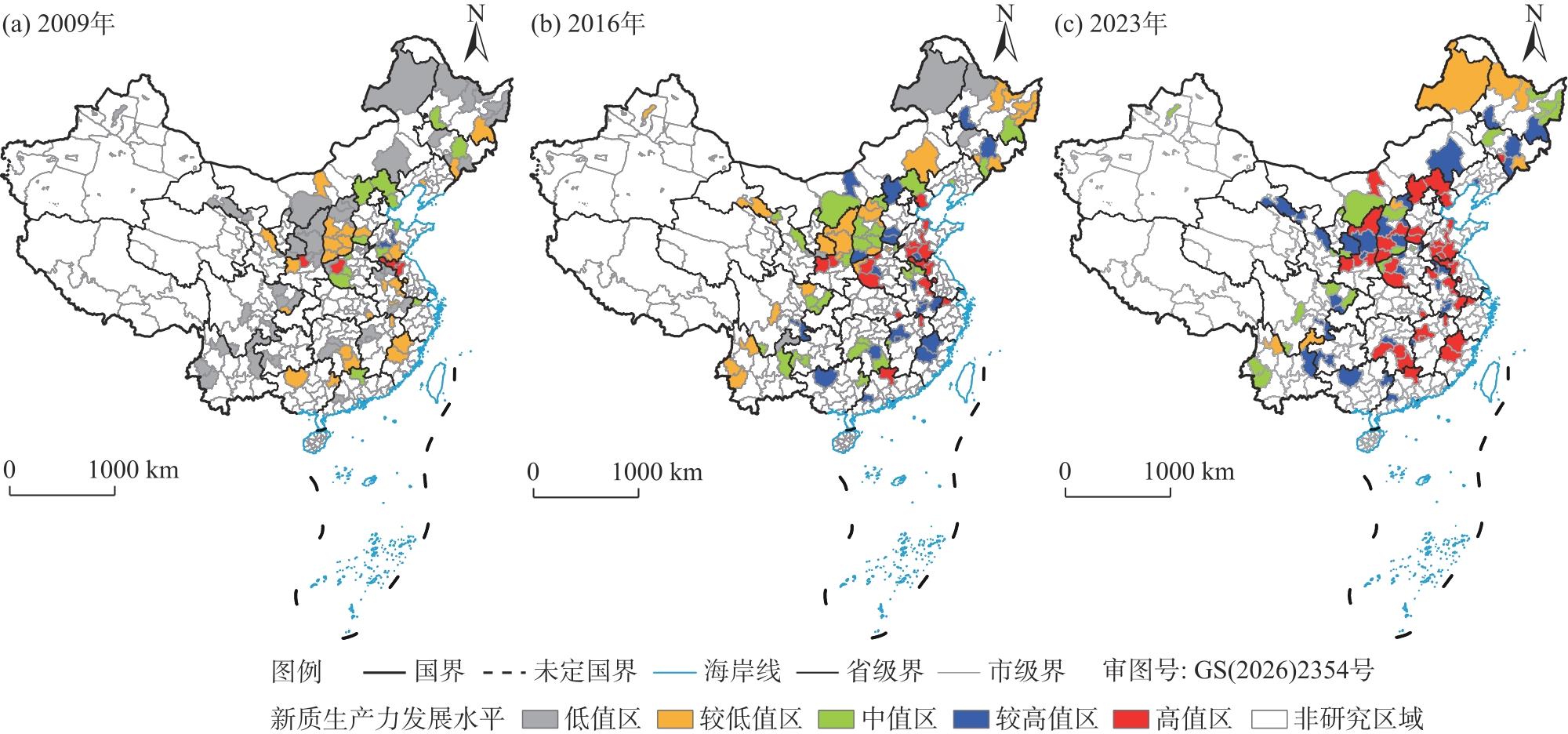
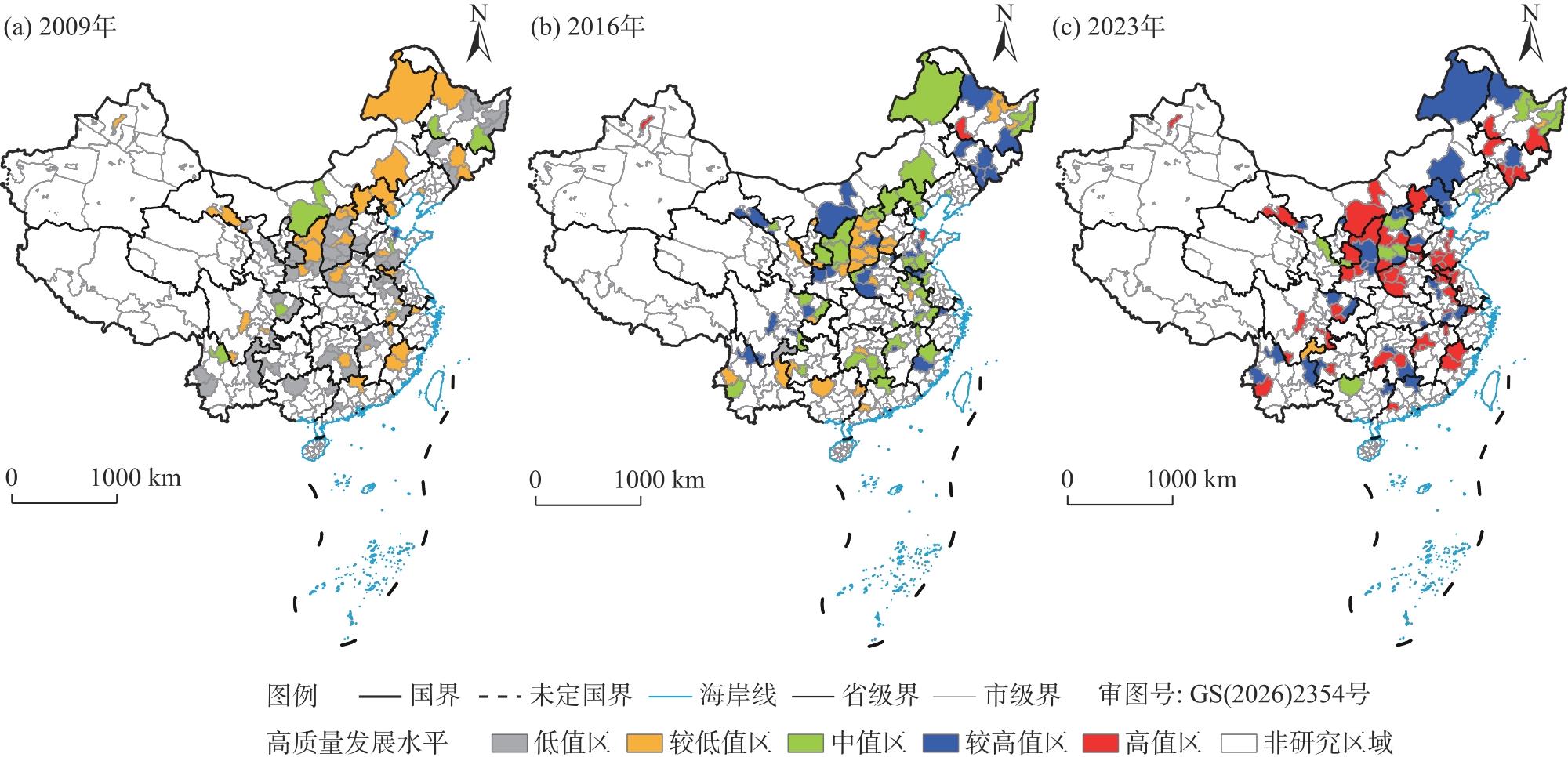
Fig. 2
Spatial evolution of high-quality development level in resource-based cities"
Tab. 4
Benchmark regression results"
| 变量 | 无控制变量的HQDL | 有控制变量的HQDL |
|---|---|---|
| NQP | 0.201***(5.493) | 0.200***(5.461) |
| FINADP | - | 0.055***(4.973) |
| OPEN | - | 0.020**(1.964) |
| URBAN | - | -0.021*(-1.928) |
| FINANCE | - | 0.003*(2.034) |
| 常数项 | 0.036***(14.065) | 0.014**(2.052) |
| 个体固定 | 是 | 是 |
| 时间固定 | 是 | 是 |
| 样本量 | 1545 | 1545 |
| R2 | 0.514 | 0.526 |
Tab. 5
Endogeneity test results"
| 变量 | NQP | HQDL |
|---|---|---|
| L.NQP | 0.785***(14.820) | - |
| NQP | - | 0.295***(2.963) |
| 控制变量 | 是 | 是 |
| 不可识别检验 | 10.738(0.001) | |
| 弱工具变量 | 219.631(16.38) | |
| 个体固定 | 是 | 是 |
| 时间固定 | 是 | 是 |
| 样本量 | 1442 | 1442 |
Tab. 6
Robustness test results"
| 变量 | 双边缩尾 | 更换解释变量测算方法 | 子样本回归 |
|---|---|---|---|
| NQP | 0.166***(5.037) | 0.008***(3.365) | 0.171***(4.995) |
| 常数项 | 0.019***(3.496) | 0.026***(3.538) | 0.025***(3.632) |
| 控制变量 | 是 | 是 | 是 |
| 个体固定 | 是 | 是 | 是 |
| 时间固定 | 是 | 是 | 是 |
| 样本量 | 1545 | 1545 | 1133 |
| R2 | 0.630 | 0.520 | 0.509 |
Tab. 7
Heterogeneity analysis of resource-based cities across different life cycles"
| 变量 | 成长型 | 成熟型 | 衰退型 | 再生型 |
|---|---|---|---|---|
| NQP | 0.475***(5.105) | 0.101*(1.808) | -0.081(-0.446) | 0.378***(8.896) |
| 常数项 | 0.001(0.057) | 0.022***(2.993) | 0.027(0.919) | -0.013(-0.923) |
| 控制变量 | 是 | 是 | 是 | 是 |
| 个体固定 | 是 | 是 | 是 | 是 |
| 时间固定 | 是 | 是 | 是 | 是 |
| 样本量 | 180 | 855 | 315 | 195 |
| R2 | 0.763 | 0.611 | 0.386 | 0.813 |
Tab. 8
Mechanism analysis of resource-based cities across different life cycles"
| 变量 | ER | UIS | EN | DIG |
|---|---|---|---|---|
| NQP | 0.133*(1.903) | 0.307**(2.560) | 347.788*(1.844) | 14.130***(5.472) |
| 常数项 | 0.035***(3.777) | 2.106***(134.446) | -43.285(-1.426) | 2.017**(2.426) |
| 控制变量 | 是 | 是 | 是 | 是 |
| 个体固定 | 是 | 是 | 是 | 是 |
| 时间固定 | 是 | 是 | 是 | 是 |
| 样本量 | 180 | 855 | 315 | 195 |
| R2 | 0.132 | 0.739 | 0.494 | 0.748 |
Tab. 9
Heterogeneity analysis of resource-based cities across different regions"
| 变量 | 东部地区 | 中部地区 | 西部地区 | 东北地区 |
|---|---|---|---|---|
| NQP | 0.155***(5.095) | 0.037(0.294) | 0.247***(3.091) | 0.022(0.140) |
| 常数项 | 0.026**(2.239) | 0.004(0.264) | -0.001(-0.136) | 0.088***(2.712) |
| 控制变量 | 是 | 是 | 是 | 是 |
| 个体固定 | 是 | 是 | 是 | 是 |
| 时间固定 | 是 | 是 | 是 | 是 |
| 样本量 | 270 | 540 | 525 | 210 |
| R2 | 0.869 | 0.514 | 0.653 | 0.360 |
Tab. 10
Spatial Durbin model results"
| 变量 | 直接效应 | 间接效应 | 总效应 |
|---|---|---|---|
| NQP | 0.215*** (5.922) | 0.624* (1.720) | 0.839**(2.258) |
| FINADP | 0.048*** (4.699) | -0.209** (-2.156) | -0.161 (-1.633) |
| OPEN | 0.013 (1.383) | -0.426*** (-3.910) | -0.413*** (-3.750) |
| URBAN | -0.024** (-2.347) | -0.114 (-1.404) | -0.138* (-1.709) |
| FINANCE | 0.003* (1.954) | 0.000 (0.032) | 0.003 (0.298) |
| 个体固定 | 是 | 是 | 是 |
| 时间固定 | 是 | 是 | 是 |
| 样本量 | 1545 | ||
| R2 | 0.155 | ||
| [1] | 习近平经济思想研究中心. 新质生产力的内涵特征和发展重点[N]. 人民日报, 2024-03-01(009). |
| [Xi Jinping Economic Thought Research Center. The connotation and characteristics of new quality productive forces and development priorities[N]. People’s Daily, 2024-03-01(009).] | |
| [2] | 韩文龙. 新质生产力的政治经济学阐释[J]. 马克思主义研究, 2024(3): 100-115. |
| [Han Wenlong. A political economy explanation of the new quality productivity[J]. Studies on Marxism, 2024(3): 100-115.] | |
| [3] | 钞小静, 王清. 新质生产力驱动高质量发展的逻辑与路径[J]. 西安财经大学学报, 2024, 37(1): 12-20. |
| [Chao Xiaojing, Wang Qing. The logic and path of high-quality development driven by new quality productivity[J]. Journal of Xi’an University of Finance and Economics, 2024, 37(1): 12-20.] | |
| [4] | 张林, 蒲清平. 新质生产力的内涵特征、理论创新与价值意蕴[J]. 重庆大学学报(社会科学版), 2023, 29(6): 137-148. |
| [Zhang Lin, Pu Qingping. The connotation characteristic, theoretical innovation and value implication of new quality productivity[J]. Journal of Chongqing University (Social Science Edition), 2023, 29(6): 137-148.] | |
| [5] | 余东华, 马路萌. 数字化转型、平台化变革与企业创新绩效——基于“技术-组织-创新”范式的分析[J]. 改革, 2024(2): 55-74. |
| [Yu Donghua, Ma Lumeng. Digital transformation, platformization transformation and enterprise innovation performance: Analysis based on the paradigm of “technology-organization-innovation”[J]. Reform, 2024(2): 55-74.] | |
| [6] | 宋冬林, 丁文龙. 以新质生产力为抓手实现东北振兴新突破[J]. 学术交流, 2023(12): 105-122. |
| [Song Donglin, Ding Wenlong. Using new quality productivity as a lever to achieve new breakthroughs in revitalizing northeast China[J]. Academic Exchange, 2023(12): 105-122.] | |
| [7] | 张军扩, 侯永志, 刘培林, 等. 高质量发展的目标要求和战略路径[J]. 管理世界, 2019, 35(7): 1-7. |
| [Zhang Junkuo, Hou Yongzhi, Liu Peilin, et al. The goals and strategy path of high-quality development[J]. Journal of Management World, 2019, 35(7): 1-7.] | |
| [8] |
王珏. 中国资源型城市绿色转型的动力源泉及其驱动因素[J]. 经济地理, 2024, 44(4): 75-83, 99.
doi: 10.15957/j.cnki.jjdl.2024.04.008 |
|
[Wang Jue. Power source and driving factors of green transformation of resource-based cities in China[J]. Economic Geography, 2024, 44(4): 75-83, 99.]
doi: 10.15957/j.cnki.jjdl.2024.04.008 |
|
| [9] |
杨巨星, 孙慧, 周晋楠, 等. 中国资源型城市转型脱碳时空演进及路径选择[J]. 干旱区地理, 2026, 49(1): 151-163.
doi: 10.12118/j.issn.1000-6060.2024.743 |
|
[Yang Juxing, Sun Hui, Zhou Jinnan, et al. Spatiotemporal evolution and pathway selection of transformation decarbonization in resource-based cities of China[J]. Arid Land Geography, 2026, 49(1): 151-163.]
doi: 10.12118/j.issn.1000-6060.2024.743 |
|
| [10] | 姜雨, 王亚平, 程钰. 数字化发展对中国资源型城市经济韧性的影响[J]. 湖南师范大学自然科学学报, 2024, 47(6): 1-9. |
| [Jiang Yu, Wang Yaping, Cheng Yu. Influence of digital development on economic resilience of resource-based cities in China[J]. Journal of Natural Science of Hunan Normal University, 2024, 47(6): 1-9.] | |
| [11] |
杨贺, 薛东前, 宋永永. 中国资源型城市的收缩与转型关系研究[J]. 资源科学, 2025, 47(6): 1248-1262.
doi: 10.18402/resci.2025.06.07 |
|
[Yang He, Xue Dongqian, Song Yongyong. Study on relationship between shrinkage and transformation of resource-based cities in China[J]. Resources Science, 2025, 47(6): 1248-1262.]
doi: 10.18402/resci.2025.06.07 |
|
| [12] |
徐英启, 程钰, 王晶晶. 中国资源型城市碳排放效率时空演变与绿色技术创新影响[J]. 地理研究, 2023, 42(3): 878-894.
doi: 10.11821/dlyj020220256 |
| [Xu Yingqi, Cheng Yu, Wang Jingjing. The impact of green technological innovation on the spatiotemporal evolution of carbon emission efficiency of resource-based cities in China[J]. Geographical Research, 2023, 42(3): 878-894.] | |
| [13] |
赵明亮, 冯健康, 孙威. 环境规制影响资源型城市绿色全要素生产率的途径与政策建议[J]. 自然资源学报, 2023, 38(1): 186-204.
doi: 10.31497/zrzyxb.20230112 |
|
[Zhao Mingliang, Feng Jiankang, Sun Wei. Ways and policy suggestions of environmental regulation on green total factor productivity in resource-based cities[J]. Journal of Natural Resources, 2023, 38(1): 186-204.]
doi: 10.31497/zrzyxb.20230112 |
|
| [14] |
张文忠, 余建辉. 中国资源型城市转型发展的政策演变与效果分析[J]. 自然资源学报, 2023, 38(1): 22-38.
doi: 10.31497/zrzyxb.20230102 |
|
[Zhang Wenzhong, Yu Jianhui. Policy evolution and transformation effect analysis of sustainable development of resource-based cities in China[J]. Journal of Natural Resources, 2023, 38(1): 22-38.]
doi: 10.31497/zrzyxb.20230102 |
|
| [15] |
狄乾斌, 梁晨露, 陈小龙. 新质生产力赋能东北地区资源型城市高质量发展的机制与效应[J]. 地理科学进展, 2025, 44(8): 1578-1595.
doi: 10.18306/dlkxjz.2025.08.003 |
|
[Di Qianbin, Liang Chenlu, Chen Xiaolong. Mechanism and effects of new quality productivity empowering the high-quality development of resource-based cities in northeast China[J]. Progress in Geography, 2025, 44(8): 1578-1595.]
doi: 10.18306/dlkxjz.2025.08.003 |
|
| [16] |
王琦, 马丽. 新质要素驱动资源型城市产业转型的机制与路径研究[J]. 自然资源学报, 2026, 41(1): 308-326.
doi: 10.31497/zrzyxb.20260117 |
|
[Wang Qi, Ma Li. Mechanisms and pathways of industrial transformation in resource-based cities driven by new quality factors[J]. Journal of Natural Resources, 2026, 41(1): 308-326.]
doi: 10.31497/zrzyxb.20260117 |
|
| [17] |
李博, 梁铎瀚, 余建辉. 新质生产力视角下公共数据开放对资源型城市转型的影响[J]. 资源科学, 2024, 46(10): 1895-1911.
doi: 10.18402/resci.2024.10.01 |
|
[Li Bo, Liang Duohan, Yu Jianhui. The impact of public data access on the transformation of resource-based cities from the perspective of new quality productive forces[J]. Resources Science, 2024, 46(10): 1895-1911.]
doi: 10.18402/resci.2024.10.01 |
|
| [18] | 韩喜平, 马丽娟. 发展新质生产力与推动高质量发展[J]. 思想理论教育, 2024(4): 4-11. |
| [Han Xiping, Ma Lijuan. Developing new quality productive forces and promoting high-quality development[J]. Ideological & Theoretical Education, 2024(4): 4-11.] | |
| [19] | 任保平, 王子月. 数字新质生产力推动经济高质量发展的逻辑与路径[J]. 湘潭大学学报(哲学社会科学版), 2023, 47(6): 23-30. |
| [Ren Baoping, Wang Ziyue. The logic and path of digital new quality productivity promoting high quality economic development[J]. Journal of Xiangtan University (Philosophy and Social Sciences Edition), 2023, 47(6): 23-30.] | |
| [20] | 王艳华. 新质生产力驱动资源型城市高质量发展的理论逻辑与实践路径[J]. 河南大学学报(社会科学版), 2025, 65(2): 22-30, 152-153. |
| [Wang Yanhua. Research on mechanisms and pathways for driving high-quality development in resource-based cities through new quality productivity[J]. Journal of Henan University (Social Sciences Edition), 2025, 65(2): 22-30, 152-153.] | |
| [21] | 杜传忠, 疏爽, 李泽浩. 新质生产力促进经济高质量发展的机制分析与实现路径[J]. 经济纵横, 2023(12): 20-28. |
| [Du Chuanzhong, Shu Shuang, Li Zehao. Mechanism and path of new quality productivity in promoting high-quality economic development[J]. Economic Review Journal, 2023(12): 20-28.] | |
| [22] | 刘柳邑, 程钰, 赵鸿潇, 等. 黄河流域资源型城市绿色技术创新对碳排放效率的影响研究[J]. 干旱区资源与环境, 2025, 39(12): 12-25. |
| [Liu Liuyi, Cheng Yu, Zhao Hongxiao, et al. Impact of green technology innovation on carbon emission efficiency in resource-based cities along the Yellow River Basin[J]. Journal of Arid Land Resources and Environment, 2025, 39(12): 12-25.] | |
| [23] | 李海霞, 杜金柱. 新质生产力赋能产业结构升级——影响机制与空间溢出效应[J]. 山西财经大学学报, 2025, 47(4): 71-83. |
| [Li Haixia, Du Jinzhu. New quality productive forces empowering industrial structure upgrading: Influencing mechanism and spatial spillover effect[J]. Journal of Shanxi University of Finance and Economics, 2025, 47(4): 71-83.] | |
| [24] | 王珏, 吕德胜. 数字经济能否促进黄河流域高质量发展——基于产业结构升级视角[J]. 西北大学学报(哲学社会科学版), 2022, 52(6): 120-136. |
| [Wang Jue, Lü Desheng. Can digital economy promote high-quality development of the Yellow River Basin: A study from the perspective of industrial structure upgrading[J]. Journal of Northwest University (Philosophy and Social Sciences Edition), 2022, 52(6): 120-136.] | |
| [25] | 昌敦虎, 李明奎, 原佳倩, 等. 中国资源型城市可持续转型对促进就业和环境治理的影响——基于“人与自然和谐共生”视角的分析[J]. 人口研究, 2023, 47(3): 63-77. |
| [Chang Dunhu, Li Mingkui, Yuan Jiaqian, et al. The employment promotion and environment improvement through sustainable transformation in China’s resource-based cities: The perspective of harmonious co-existence between humanity and nature[J]. Population Research, 2023, 47(3): 63-77.] | |
| [26] |
阳杨, 郭佳钦, 王少国. 新质生产力、创业活跃度与城市高质量发展[J]. 科技进步与对策, 2024, 41(22): 1-12.
doi: 10.6049/kjjbydc.L2024XZ645 |
| [Yang Yang, Guo Jiaqin, Wang Shaoguo. New quality productive forces, entrepreneurial activity and high-quality urban development[J]. Science & Technology Progress and Policy, 2024, 41(22): 1-12.] | |
| [27] | 汤龙, 陈享光, 赵妍妍. 返乡创业能提高农村居民收入吗——基于返乡创业试点政策的考察[J]. 农业技术经济, 2024(7): 111-128. |
| [Tang Long, Chen Xiangguang, Zhao Yanyan. Can returning home for entrepreneurship improve the income of rural residents: Investigation based on the pilot policy of returning home for entrepreneurship[J]. Journal of Agrotechnical Economics, 2024(7): 111-128.] | |
| [28] | 朱高立, 圣莉, 杨清可, 等. 数字化转型对减污降碳协同的影响机制及门槛效应: 基于110个地级资源型城市的调查[J]. 环境科学, 2025, 46(12): 7513-7523. |
| [Zhu Gaoli, Sheng Li, Yang Qingke, et al. Impact mechanism and threshold effect of digital transformation on coordinated pollution and carbon reduction: An investigation based on 110 prefecture-level resource-based cities[J]. Environmental Science, 2025, 46(12): 7513-7523.] | |
| [29] | 孔祥忠. 数字新质生产力对产业链绿色转型的影响[J]. 中国流通经济, 2024, 38(10): 59-70. |
| [Kong Xiangzhong. The impact of digital new quality productive forces on the green transformation of industrial chain[J]. China Business and Market, 2024, 38(10): 59-70.] | |
| [30] | 韩文龙, 张瑞生, 赵峰. 新质生产力水平测算与中国经济增长新动能[J]. 数量经济技术经济研究, 2024, 41(6): 5-25. |
| [Han Wenlong, Zhang Ruisheng, Zhao Feng. The measurement of new quality productivity and new driving force of the Chinese economy[J]. Journal of Quantitative & Technological Economics, 2024, 41(6): 5-25.] | |
| [31] | 李小康, 鲍玮珺, 韦润. 新质生产力对长江经济带经济高质量发展的影响研究[J]. 水利经济, 2025, 43(6): 45-55, 109. |
| [Li Xiaokang, Bao Weijun, Wei Run. The impact of new quality productive forces on the high-quality economic development of the Yangtze River Economic Belt[J]. Journal of Economics of Water Resources, 2025, 43(6): 45-55, 109.] | |
| [32] |
曹婧博, 康琛宇. 数字经济驱动中国资源型城市高质量发展的门槛效应[J]. 资源科学, 2023, 45(11): 2234-2247.
doi: 10.18402/resci.2023.11.11 |
|
[Cao Jingbo, Kang Chenyu. The threshold effect of digital economy to promote the high-quality development of resource-based cities in China[J]. Resources Science, 2023, 45(11): 2234-2247.]
doi: 10.18402/resci.2023.11.11 |
|
| [33] | 江艇. 因果推断经验研究中的中介效应与调节效应[J]. 中国工业经济, 2022(5): 100-120. |
| [Jiang Ting. Mediating effects and moderating effects in causal inference[J]. China Industrial Economics, 2022(5): 100-120.] | |
| [34] | 许磊, 刘永团, 刘硕, 等. 新质生产力、资源配置效率对资源型城市产业结构升级的影响[J]. 中国矿业, 2025, 34(3): 33-42. |
| [Xu Lei, Liu Yongtuan, Liu Shuo, et al. Impact of new quality productive forces and resource allocation efficiency on industrial structure upgrading in resource-based cities[J]. China Mining Magazine, 2025, 34(3): 33-42.] | |
| [35] |
魏建飞, 袁悠燃, 李强, 等. 核心-边缘视角下黄河流域新质生产力空间关联网络结构及影响因素[J]. 经济地理, 2025, 45(11): 59-69.
doi: 10.15957/j.cnki.jjdl.2025.11.006 |
|
[Wei Jianfei, Yuan Youran, Li Qiang, et al. Spatial correlation network and influencing factors of new quality productive forces in the Yellow River Basin from the core-edge perspective[J]. Economic Geography, 2025, 45(11): 59-69.]
doi: 10.15957/j.cnki.jjdl.2025.11.006 |
|
| [36] |
高帅, 张务伟. 中国新质生产力与新型城镇化的协同演化研究[J]. 干旱区地理, 2025, 48(8): 1445-1456.
doi: 10.12118/j.issn.1000-6060.2025.150 |
|
[Gao Shuai, Zhang Wuwei. Synergistic evolution of new quality productivity and new urbanization in China’s provinces[J]. Arid Land Geography, 2025, 48(8): 1445-1456.]
doi: 10.12118/j.issn.1000-6060.2025.150 |
|
||