Arid Land Geography ›› 2026, Vol. 49 ›› Issue (3): 451-461.doi: 10.12118/j.issn.1000-6060.2025.305
• New Quality Productive Forces Driving High-Quality Development of Tourism • Previous Articles Next Articles
LU Zhaodong1,2( ), QIN Lu1,2(), MA Yan1,2
Received:2025-05-27
Revised:2025-07-04
Online:2026-03-25
Published:2026-03-24
Contact:
QIN Lu
E-mail:15530473862@163.com;ql198588@163.com
LU Zhaodong, QIN Lu, MA Yan. Impact of new quality productive forces on the high-quality development of tourism economy in China[J].Arid Land Geography, 2026, 49(3): 451-461.
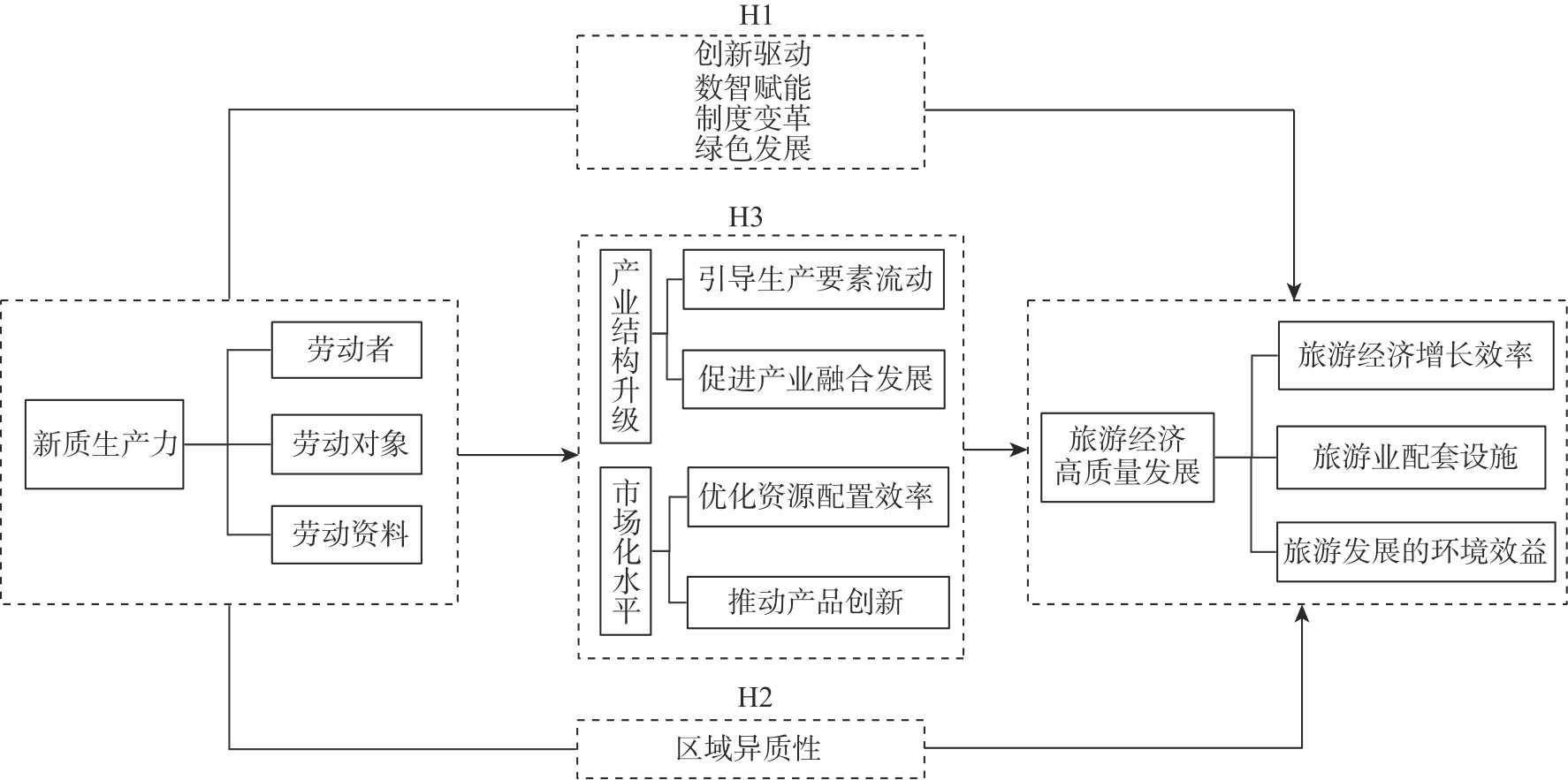
Fig. 1
Influence pathways of new quality productive forces on the high-quality development of tourism economy"

Tab. 1
Index system of high-quality development level of tourism economy"
| 一级指标 | 二级指标 | 计算方法 | 权重 |
|---|---|---|---|
| 旅游经济增长效率 | 旅游经济增长率 | - | 0.027 |
| 游客接待增长率 | - | 0.012 | |
| 旅游总产值占第三产业的比重 | 旅游总收入/第三产业GDP | 0.065 | |
| 人均旅游消费额 | 旅游总收入/旅游总接待人次 | 0.057 | |
| 旅游劳动生产率 | 旅游总收入/旅游业就业人数 | 0.073 | |
| 旅游行业配套设施 | 住宿业与餐饮业比重 | 住宿业总收入/餐饮业总收入 | 0.184 |
| 旅游业就业人数增长率 | - | 0.022 | |
| 每万人旅行社数量 | 旅行社数量/区域人口数量 | 0.152 | |
| 人均旅游固定资产投资额 | 旅游固定资产投资额/区域人口数量 | 0.238 | |
| 资源丰度 | A级景区赋权/区域人口数量 | 0.122 | |
| 旅游发展环境效益 | 人均公园绿地面积 | 公园绿地面积/区域人口数量 | 0.035 |
| 生活垃圾处理率 | - | 0.014 |
Tab. 2
Index system of new quality productive forces development level"
| 一级指标 | 二级指标 | 三级指标 | 权重 | 属性 | 数据来源 |
|---|---|---|---|---|---|
| 新质劳动者 | 劳动者技能 | 教育经费强度 | 0.014 | 正 | 《中国统计年鉴》 |
| 人均受教育年限 | 0.016 | 正 | 《中国统计年鉴》 | ||
| 创新能力 | R&D投入强度 | 0.029 | 正 | 《中国科技统计年鉴》 | |
| 每万人R&D全时人员当量 | 0.096 | 正 | 《中国科技统计年鉴》 | ||
| 人力结构 | 高等教育人数比例 | 0.035 | 正 | 《中国教育统计年鉴》 | |
| 第三产业就业人员占总就业人员比重 | 0.017 | 正 | 《中国统计年鉴》 | ||
| 创业活力 | 每百人创新企业数 | 0.033 | 正 | 《中国工业统计年鉴》 | |
| 人力资本水平 | 0.014 | 正 | 《中国教育统计年鉴》 | ||
| 新质劳动资料 | 绿色生产质量 | 化学需氧量排放/GDP | 0.006 | 负 | 《中国环境统计年鉴》 |
| SO2排放/GDP | 0.003 | 负 | 《中国环境统计年鉴》 | ||
| 环境保护支出/一般财政支出 | 0.018 | 正 | 《中国环境统计年鉴》 | ||
| 能源消耗量/GDP | 0.006 | 负 | 《中国能源统计年鉴》 | ||
| 建成区绿化覆盖率 | 0.009 | 正 | 《中国城市建设统计年鉴》 | ||
| 经济数字化转型 | 电信业务收入/GDP | 0.082 | 正 | 《中国统计年鉴》 | |
| 软件业务收入/GDP | 0.096 | 正 | 《中国统计年鉴》 | ||
| 电子商务收入/GDP | 0.143 | 正 | 《中国统计年鉴》 | ||
| 机器人数量/总人口 | 0.114 | 正 | 《中国统计年鉴》 | ||
| 创新成果转化 | 绿色专利申请数/专利申请总数 | 0.009 | 正 | 《中国科技统计年鉴》 | |
| 新质劳动对象 | 交通基础设施 | 铁路里程/行政区划面积 | 0.039 | 正 | 《中国统计年鉴》 |
| 公路里程/行政区划面积 | 0.028 | 正 | 《中国统计年鉴》 | ||
| 信息基础设施 | 人均宽带接入端口数 | 0.019 | 正 | 国家统计局 | |
| 光缆长度/行政区划面积 | 0.091 | 正 | 国家统计局 | ||
| 移动电话普及率 | 0.018 | 正 | 《中国统计年鉴》 | ||
| 数字化水平 | 企业每百人使用计算机数 | 0.027 | 正 | 《中国统计年鉴》 | |
| 每百家企业拥有网站数 | 0.008 | 正 | 《中国统计年鉴》 | ||
| 地区数字化水平 | 0.014 | 正 | 北大数字普惠金融指数 | ||
| 数字普惠金融指数 | 0.017 | 正 | 北大数字普惠金融指数 |
Tab. 3
Descriptive statistics of variables"
| 变量类别 | 变量名称 | 变量符号 | 平均值 | 标准差 | 最小值 | 最大值 | 观测值 |
|---|---|---|---|---|---|---|---|
| 被解释变量 | 旅游经济高质量发展水平 | HQTE | 0.148 | 0.079 | 0.067 | 0.595 | 330 |
| 旅游全要素生产率 | TTFP | 0.595 | 0.273 | 0.102 | 10.418 | 330 | |
| 解释变量 | 新质生产力发展水平 | NQP | 0.164 | 0.076 | 0.063 | 0.442 | 330 |
| 中介变量 | 产业结构升级 | UIS | 0.145 | 0.089 | 0.007 | 0.428 | 330 |
| 市场化水平 | APM | 8.250 | 1.915 | 3.359 | 12.864 | 330 | |
| 控制变量 | 经济发展水平 | GDP | 6.065 | 3.080 | 1.895 | 18.999 | 330 |
| 对外开放水平 | OPEN | 0.265 | 0.268 | 0.008 | 1.354 | 330 | |
| 技术市场发展水平 | TML | 0.019 | 0.030 | 0.000 | 0.191 | 330 | |
| 社会消费水平 | SOC | 0.389 | 0.059 | 0.180 | 0.504 | 330 |
Tab. 4
Baseline regression results"
| 变量 | (1) | (2) | (3) |
|---|---|---|---|
| NQP | 0.261***(4.68) | 0.260***(4.06) | 0.305***(4.52) |
| GDP | - | - | -0.000(-1.08) |
| OPEN | - | - | 0.047(1.24) |
| TML | - | - | -0.177(-0.74) |
| SOC | - | - | 0.040(0.57) |
| 常数项 | 0.105***(10.46) | 0.073***(3.78) | 0.068(0.96) |
| 年份 | 不控制 | 控制 | 控制 |
| 省份 | 不控制 | 控制 | 控制 |
| 观测值 | 330 | 330 | 330 |
| F | 22*** | 40*** | 37*** |
| R2 | 0.063 | 0.848 | 0.852 |
Tab. 5
Regional heterogeneity analysis"
| 变量 | 东部地区 | 中部地区 | 西部地区 | 东北地区 |
|---|---|---|---|---|
| NQP | 0.266***(3.54) | 0.372(1.03) | 0.607**(2.40) | 0.941(1.39) |
| GDP | 0.000(1.08) | 0.000(0.25) | -0.000(-1.24) | 0.000(0.17) |
| OPEN | 0.029(0.78) | 1.805***(3.95) | 0.070(0.71) | -0.277(-1.28) |
| TML | 0.100(0.26) | -0.226(-0.35) | -1.017**(-2.25) | 0.807(1.36) |
| SOC | -0.012(-0.15) | -0.177*(-1.94) | 0.177(1.53) | -0.049(-0.13) |
| 常数项 | -0.001(-0.01) | -0.030(-0.46) | 0.071(1.11) | 0.097(0.29) |
| 省份 | 控制 | 控制 | 控制 | 控制 |
| 年份 | 控制 | 控制 | 控制 | 控制 |
| 观测值 | 110 | 66 | 121 | 33 |
| R2 | 0.849 | 0.940 | 0.876 | 0.892 |
Tab. 6
Robustness test results"
| 变量 | (1) NQP | (2) HQTE | (3) TTFP | (4) HQTE | (5) HQTE |
|---|---|---|---|---|---|
| NQP | - | 0.400***(4.17) | 0.453**(1.99) | 0.444***(2.81) | 0.403***(5.39) |
| L.NQP | 0.724***(13.96) | - | - | - | - |
| 常数项 | -0.082(0.059) | 0.068(0.078) | 1.386***(5.78) | -0.052(-0.39) | 0.005(0.16) |
| 控制变量 | 控制 | 控制 | 控制 | 控制 | 控制 |
| 省份 | 控制 | 控制 | 控制 | 控制 | 控制 |
| 年份 | 控制 | 控制 | 控制 | 控制 | 控制 |
| 观测值 | 300 | 300 | 330 | 240 | 286 |
| R2 | 0.930 | 0.871 | 0.859 | 0.856 | 0.862 |
Tab. 7
Mediation effect analysis"
| 变量 | (1) HQTE | (2) UIS | (3) HQTE | (4) APM | (5) HQTE |
|---|---|---|---|---|---|
| NQP | 0.305***(4.52) | -0.141***(-3.11) | 0.373***(4.99) | 4.243***(4.25) | 0.363***(4.71) |
| UIS | - | - | -0.427***(-5.02) | - | - |
| APM | - | - | - | - | 0.010**(2.01) |
| 常数项 | 0.068(0.96) | 0.065(1.36) | 0.096(1.40) | 6.277***(13.70) | -0.054(-1.20) |
| 控制变量 | 控制 | 控制 | 控制 | 控制 | 控制 |
| 省份 | 控制 | 控制 | 控制 | 控制 | 控制 |
| 年份 | 控制 | 控制 | 控制 | 控制 | 控制 |
| 观测值 | 330 | 330 | 330 | 330 | 330 |
| R2 | 0.852 | 0.948 | 0.864 | 0.952 | 0.864 |
| Sobel检验 | - | - | 0.060*** | - | 0.040* |
| 直接效应 | - | - | 0.245*** | - | 0.296*** |
| 间接效应占比/% | - | - | 19.7 | - | 11.8 |
| [1] | 习近平经济思想研究中心. 新质生产力的内涵特征和发展重点[N]. 人民日报, 2024-03-01(009). |
| [Xi Jinping Economic Thought Research Center. The connotation and characteristics of new quality productive forces and development priorities[N]. People’s Daily, 2024-03-01(009).] | |
| [2] | 王晓晖, 黄强. 以发展新质生产力为重要着力点推进高质量发展[N]. 人民日报, 2024-03-12(009). |
| [Wang Xiaohui, Huang Qiang. Taking the development of new productivity as an important focus to promote high-quality development[N]. People’s Daily, 2024-03-12(009).] | |
| [3] | 任保平, 豆渊博. 新质生产力: 文献综述与研究展望[J]. 经济与管理评论, 2024, 40(3): 5-16. |
| [Ren Baoping, Dou Yuanbo. New quality productivity: Literature review and research outlook[J]. Review of Economy and Management, 2024, 40(3): 5-16.] | |
| [4] |
王金伟, 陆林, 王兆峰, 等. 新质生产力赋能旅游业高质量发展: 理论内涵与科学问题[J]. 自然资源学报, 2024, 39(7): 1643-1663.
doi: 10.31497/zrzyxb.20240709 |
|
[Wang Jinwei, Lu Lin, Wang Zhaofeng, et al. Empowering the high-quality development of tourism with new quality productive forces[J]. Journal of Natural Resources, 2024, 39(7): 1643-1663.]
doi: 10.31497/zrzyxb.20240709 |
|
| [5] | 冯学钢, 李志远. 新质生产力与旅游业高质量发展: 动力机制、关键问题及创新实践[J]. 上海经济研究, 2024(9): 38-48, 59. |
| [Feng Xuegang, Li Zhiyuan. New quality productivity and high-quality development of tourism: Driving mechanism, key issues and innovative practice[J]. Shanghai Economic Research, 2024(9): 38-48, 59.] | |
| [6] | 厉新建, 曾博伟, 张辉, 等. 新质生产力与旅游业高质量发展[J]. 旅游学刊, 2024, 39(5): 15-29. |
| [Li Xinjian, Zeng Bowei, Zhang Hui, et al. New quality productive forces and high-quality development in tourism: Problems, cognition and optimization direction[J]. Tourism Tribune, 2024, 39(5): 15-29.] | |
| [7] | 杨建春, 李开潮. 新质生产力赋能旅游业高质量发展: 理论逻辑与实践路径[J]. 云南民族大学学报(哲学社会科学版), 2024, 41(6): 139-146. |
| [Yang Jianchun, Li Kaichao. New-quality productivity empowering the high-quality development of tourism: Theoretical logic and practical approaches[J]. Journal of Yunnan Minzu University (Philosophy and Social Sciences Edition), 2024, 41(6): 139-146.] | |
| [8] |
李光勤, 李梦娇. 中国省域新质生产力水平评价、空间格局及其演化特征[J]. 经济地理, 2024, 44(8): 116-125.
doi: 10.15957/j.cnki.jjdl.2024.08.014 |
|
[Li Guangqin, Li Mengjiao. Provincial-level new quality productive forces in China: Evaluation, spatial pattern and evolution characteristics[J]. Economic Geography, 2024, 44(8): 116-125.]
doi: 10.15957/j.cnki.jjdl.2024.08.014 |
|
| [9] | 丁任重, 李溪铭. 新质生产力的理论基础、时代逻辑与实践路径[J]. 经济纵横, 2024(4): 1-11. |
| [Ding Renzhong, Li Ximing. Theoretical foundation, time logic, and practical paths of new quality productive forces[J]. Economic Review Journal, 2024(4): 1-11.] | |
| [10] |
徐政, 江小鹏. 新质生产力赋能旅游高质量发展的应用场景、逻辑机理与推进路向[J]. 经济地理, 2024, 44(11): 232-240.
doi: 10.15957/j.cnki.jjdl.2024.11.024 |
|
[Xu Zheng, Jiang Xiaopeng. Application scenario, logical mechanism and propulsion direction of new quality productive forces enabling high-quality tourism development[J]. Economic Geography, 2024, 44(11): 232-240.]
doi: 10.15957/j.cnki.jjdl.2024.11.024 |
|
| [11] | 齐承水. 如何理解“新质生产力本身就是绿色生产力”[J]. 经济学家, 2024(7): 15-23. |
| [Qi Chengshui. How to understand that “new quality productivity itself is green productivity”[J]. Economist, 2024(7): 15-23.] | |
| [12] |
朱怡婷, 梁桂仙, 周春山, 等. 新疆文旅新质生产力发展时空演变特征与驱动因素[J]. 干旱区地理, 2026, 49(1): 128-139.
doi: 10.12118/j.issn.1000-6060.2024.785 |
|
[Zhu Yiting, Liang Guixian, Zhou Chunshan, et al. Spatio-temporal evolution characteristics and driving factors of new quality productive forces development of cultural tourism in Xinjiang[J]. Arid Land Geography, 2026, 49(1): 128-139.
doi: 10.12118/j.issn.1000-6060.2024.785 |
|
| [13] | 蔡红, 韩兆洲, 孙瑞峰. 人力资源与经济高质量发展的耦合协调关系研究[J]. 统计与决策, 2022, 38(21): 174-178. |
| [Cai Hong, Han Zhaozhou, Sun Ruifeng. Research on the coupling and coordination relationship between human resources and high-quality economic development[J]. Statistics & Decision, 2022, 38(21): 174-178.] | |
| [14] | 李子成, 王珏, 王恒. 新质生产力与产业结构升级——基于政府与市场双视角的研究[J]. 西安财经大学学报, 2025, 38(2): 16-29. |
| [Li Zicheng, Wang Jue, Wang Heng. The new quality productivity and industrial structure upgrading: A study based on the dual perspective of government and market[J]. Journal of Xi’an University of Finance and Economics, 2025, 38(2): 16-29.] | |
| [15] | 刘荣增, 李雪, 何春. 城市数智化转型赋能经济高质量发展的机制与检验[J]. 城市发展研究, 2025, 31(1): 6-11. |
| [Liu Rongzeng, Li Xue, He Chun. Mechanism and verification of empowering high-quality economic development through urban digitization transformation[J]. Urban Development Studies, 2025, 31(1): 6-11.] | |
| [16] | Zhao X G, Zhu J. Industrial restructuring, energy consumption and economic growth: Evidence from China[J]. Journal of Cleaner Production, 2022, 335: 130242, doi: 10.1016/j.jclepro.2021.130242. |
| [17] | 刘明洋. 科技创新、产业结构升级与经济高质量发展——基于长江经济带108个城市样本[J]. 哈尔滨工业大学学报(社会科学版), 2023, 25(5): 151-160. |
| [Liu Mingyang. Technological innovation; industrial structure upgrading and high-quality economic development: Based on a sample of 108 cities in the Yangtze River Economic Belt[J]. Journal of Harbin Institute of Technology (Social Sciences Edition), 2023, 25(5): 151-160.] | |
| [18] | 刘殿国, 张又嘉. 市场化进程、对外开放与省域经济增长要素效率——基于多层统计模型的分析[J]. 经济问题, 2024(10): 112-121. |
| [Liu Dianguo, Zhang Youjia. Marketization process, opening up and the factors efficiency of provincial economic growth: Based on multi-layer statistical model[J]. On Economic Problems, 2024(10): 112-121.] | |
| [19] |
Liu C Y, Dou X T, Li J F, et al. Analyzing government role in rural tourism development: An empirical investigation from China[J]. Journal of Rural Studies, 2020, 79: 177-188.
doi: 10.1016/j.jrurstud.2020.08.046 |
| [20] | Zhang W Z, Ren S Q, Zhang Y C, et al. Government investment, level of marketization and high-quality tourism development[J]. International Review of Economics & Finance, 2024, 96: 103536, doi: 10.1016/j.iref.2024.103536. |
| [21] | 王兆峰, 李静怡. 黄河流域旅游发展与生态环境耦合协调时空演变及交互胁迫关系验证[J]. 长江流域资源与环境, 2022, 31(2): 447-460. |
| [Wang Zhaofeng, Li Jingyi. Verify and study the coupling coordination development and the interactive stress between tourism and eco-environment in the Yellow River Basin[J]. Resources and Environment in the Yangtze Basin, 2022, 31(2): 447-460.] | |
| [22] | 刘英基, 韩元军. 要素结构变动、制度环境与旅游经济高质量发展[J]. 旅游学刊, 2020, 35(3): 28-38. |
| [Liu Yingji, Han Yuanjun. Factor structure, institutional environment and high-quality development of the tourism economy in China[J]. Tourism Tribune, 2020, 35(3): 28-38.] | |
| [23] |
石卓达, 杨宏伟. 旅游经济高质量发展测度及影响因素分析——以新疆为例[J]. 干旱区地理, 2025, 48(7): 1233-1242.
doi: 10.12118/j.issn.1000-6060.2024.523 |
|
[Shi Zhuoda, Yang Hongwei. Measurement and influencing factors of high-quality development of tourism economy: A case of Xinjiang[J]. Arid Land Geography, 2025, 48(7): 1233-1242.
doi: 10.12118/j.issn.1000-6060.2024.523 |
|
| [24] | 王珏, 王荣基. 新质生产力: 指标构建与时空演进[J]. 西安财经大学学报, 2024, 37(1): 31-47. |
| [Wang Jue, Wang Rongji. New quality productivity: Index construction and spatiotemporal evolution[J]. Journal of Xi’an University of Finance and Economics, 2024, 37(1): 31-47.] | |
| [25] | 张夏恒, 马妍. 新质生产力驱动数字经济高质量发展的机理、困境与路径[J]. 西北工业大学学报(社会科学版), 2024(3): 115-122. |
| [Zhang Xiaheng, Ma Yan. Mechanism, predicaments and paths of the high-quality development of digital economy driven by new quality productive forces[J]. Journal of Northwestern Polytechnical University (Social Sciences Edition), 2024(3): 115-122.] | |
| [26] | 袁航, 朱承亮. 国家高新区推动了中国产业结构转型升级吗[J]. 中国工业经济, 2018(8): 60-77. |
| [Yuan Hang, Zhu Chengliang. Do national high-tech zones promote the transformation and upgrading of China’s industrial structure[J]. China Industrial Economics, 2018(8): 60-77.] | |
| [27] | 樊纲, 王小鲁, 张立文, 等. 中国各地区市场化相对进程报告[J]. 经济研究, 2003, 38(3): 9-18, 89. |
| [Fan Gang, Wang Xiaolu, Zhang Liwen, et al. Marketization index for China’s provinces[J]. Economic Research, 2003, 38(3): 9-18, 89.] | |
| [28] |
温忠麟, 叶宝娟. 中介效应分析: 方法和模型发展[J]. 心理科学进展, 2014, 22(5): 731-745.
doi: 10.3724/SP.J.1042.2014.00731 |
|
[Wen Zhonglin, Ye Baojuan. Analyses of mediating effects: The development of methods and models[J]. Advances in Psychological Science, 2014, 22(5): 731-745.]
doi: 10.3724/SP.J.1042.2014.00731 |
|
| [29] | 郭家堂, 骆品亮. 互联网对中国全要素生产率有促进作用吗?[J]. 管理世界, 2016(10): 34-49. |
| [Guo Jiatang, Luo Pinliang. Does the Internet promote China’s total factor productivity?[J]. Journal of Management World, 2016(10): 34-49.] | |
| [30] | 左冰, 保继刚. 1992—2005年中国旅游业全要素生产率及省际差异[J]. 地理学报, 2008, 63(4): 417-427. |
| [Zuo Bing, Bao Jigang. Tourism total factor productivity and its regional variation in China from 1992 to 2005[J]. Acta Geographica Sinica, 2008, 63(4): 417-427.] | |
| [31] | 蒋瑛, 刘琳, 刘寒绮. 智慧旅游建设促进了旅游经济高质量发展吗?——全要素生产率视角下的准自然实验[J]. 旅游科学, 2022, 36(2): 44-62. |
| [Jiang Ying, Liu Lin, Liu Hanqi. Has smart tourism construction promoted the high-quality development of tourism economy? Quasi-natural experiment from the perspective of total factor productivity[J]. Tourism Science, 2022, 36(2): 44-62.] | |
| [32] | 童昀, 马勇, 刘军. 入境旅游提升了城市绿色全要素生产率吗?——基于非线性视角[J]. 旅游学刊, 2021, 36(9): 120-133. |
| [Tong Yun, Ma Yong, Liu Jun. Does the inbound tourism increase the city’s green total factor productivity? Based on nonlinear perspective[J]. Tourism Tribune, 2021, 36(9): 120-133.] | |
| [33] | 余超, 李泉宏, 刘英基. 新质生产力、消费结构与旅游业高质量发展[J]. 河南师范大学学报(自然科学版), 2024, 52(5): 19-29, 2. |
| [Yu Chao, Li Quanhong, Liu Yingji. New quality productivity, consumption structure and high-quality development of tourism[J]. Journal of Henan Normal University (Natural Science Edition), 2024, 52(5): 19-29, 2.] | |
| [34] | 刘志华, 徐军委, 吴福生. 新质生产力赋能碳中和绩效: 作用机制与实证检验[J]. 环境科学, 2025, 46(11): 6709-6721. |
| [Liu Zhihua, Xu Junwei, Wu Fusheng. New productivity empowers carbon neutralization performance: Mechanism and empirical test[J]. Environmental Science, 2025, 46(11): 6709-6721. |
|
||