Arid Land Geography ›› 2026, Vol. 49 ›› Issue (4): 669-682.doi: 10.12118/j.issn.1000-6060.2025.478
• New Quality Productive Forces Driving High-Quality Development of Tourism • Previous Articles Next Articles
WU Peilong1,2( ), XIE Xuemei1(), BAI Kai3
Received:2025-08-08
Revised:2025-09-04
Online:2026-04-25
Published:2026-04-28
Contact:
XIE Xuemei
E-mail:andywu0219@163.com;xxm02192024@163.com
WU Peilong, XIE Xuemei, BAI Kai. Impact of new quality productive forces on the total factor productivity of provincial tourism in China[J].Arid Land Geography, 2026, 49(4): 669-682.

Tab. 1
Indicators system and explanations of new quality productive forces in Chinese provinces"
| 维度 | 一级指标 | 二级指标 | 指标释义 | 单位 | 权重 |
|---|---|---|---|---|---|
| 新劳动者 | 新劳动者素质 | 新产业员工数 | 数字信息服务产业从业人数 | 104人 | 0.0368 |
| 教育结构 | 本科及以上学历的占比 | % | 0.0159 | ||
| 新劳动者生产率 | 新产业人均产值 | 人均GDP | 元·人-1 | 0.0211 | |
| 人均收入 | 在岗职工平均工资 | 元 | 0.0223 | ||
| 新劳动者意识 | 第三产业从业比 | 第三产业从业人员/从业人员数 | % | 0.0108 | |
| 创业活跃度 | 每百人新创企业数 | 个 | 0.0209 | ||
| 新劳动 对象 | 新质产业发展 | 技术产业规模 | 技术产业业务收入 | 108元 | 0.0520 |
| 技术市场交易额 | 108元 | 0.0731 | |||
| 高技术产业发展潜力 | 规上工业企业R&D人员全时当量 | 人年 | 0.0574 | ||
| 技术合同成交总额 | 108元 | 0.0731 | |||
| 信息化发展 | 信息化企业数 | 个 | 0.0748 | ||
| 每百家企业拥有网站数 | 个 | 0.0047 | |||
| 智能导览平台 | 电子商务交易额 | 108元 | 0.0588 | ||
| 有电子商务交易活动企业比重 | % | 0.0134 | |||
| 生态环境保护 | 植被覆盖度 | 森林覆盖率 | % | 0.0197 | |
| 环境保护力 | 环境保护支出/政府公共财政支出 | % | 0.0119 | ||
| 污染治理度 | 废气治理设施处理能力 | t·a-1 | 0.0329 | ||
| 生活垃圾无害化处理率 | % | 0.0021 | |||
| 新劳动 资料 | 物质劳动资料 | 传统基础设施 | 等级公路里程/土地面积 | km·(104km2)-1 | 0.0187 |
| 铁路营业里程/土地面积 | km·(104km2)-1 | 0.0187 | |||
| 数字基础设施 | 光缆长度/地区面积 | km·(104km2)-1 | 0.0517 | ||
| 互联网接入端口数 | 个 | 0.0268 | |||
| 移动基站密度 | 个·(104km)-2 | 0.0606 | |||
| 无形劳动资料 | 科技创新成果 | 专利授权数量 | 个 | 0.0582 | |
| 科技创新投入 | 规上工业企业产业创新经费 | 108元 | 0.0529 | ||
| 数字经济支持 | 省政府“新生”相关词频/词频总数 | % | 0.0139 | ||
| 数字化水平 | 企业数字化水平 | - | 0.0858 | ||
| 数字普惠金融指数 | - | 0.0110 |
Tab. 2
Indicators system and explanations of tourism total factor productivity"
| 准则层 | 要素层 | 具体指标 | 指标衡量 |
|---|---|---|---|
| 投入指标 | 旅游服务设施要素 | 星级酒店数量 | A级以上星级酒店数量 |
| 旅行社数量 | 旅行社数量 | ||
| 旅游业资源禀赋 | 旅游景点数量 | A级以上旅游景区数量 | |
| 旅游业资本投入 | 旅游资本要素投入量 | 用第三产业固定资产投资额代替 | |
| 旅游业劳动力投入 | 旅游业从业人数 | 住宿业和餐饮业从业人员 | |
| 产出指标 | 旅游经济效益 | 旅游总收入 | 国内旅游收入和按照当年平均汇率折算成人民币的入境旅游收入之和 |
| 旅游社会效益 | 旅游接待总量 | 国内旅游接待人次与国际旅游接待人次之和 |
Tab. 3
Explanation of main variables in Tobit model"
| 变量类型 | 变量 | 指标衡量方式 |
|---|---|---|
| 被解释变量 | 旅游全要素生产率 | DEA-Malmquist模型测算结果累乘所得 |
| 核心解释变量 | 新质生产力水平 | 熵权-Topsis法测算所得 |
| 控制变量 | 人力资本水平 | 高等学校在校学生人数/总人口 |
| 科技创新水平 | R&D经费内部支出/地区生产总值 | |
| 社会消费水平 | 地区社会消费品零售总额/地区生产总值 | |
| 对外开放程度 | (货物进出口总额×美元对人民币汇率)/地区生产总值 | |
| 产业结构水平 | 第三产业产值/第二产业产值 |
Fig. 1
Development level of new quality productive forces in China from 2012 to 2022"
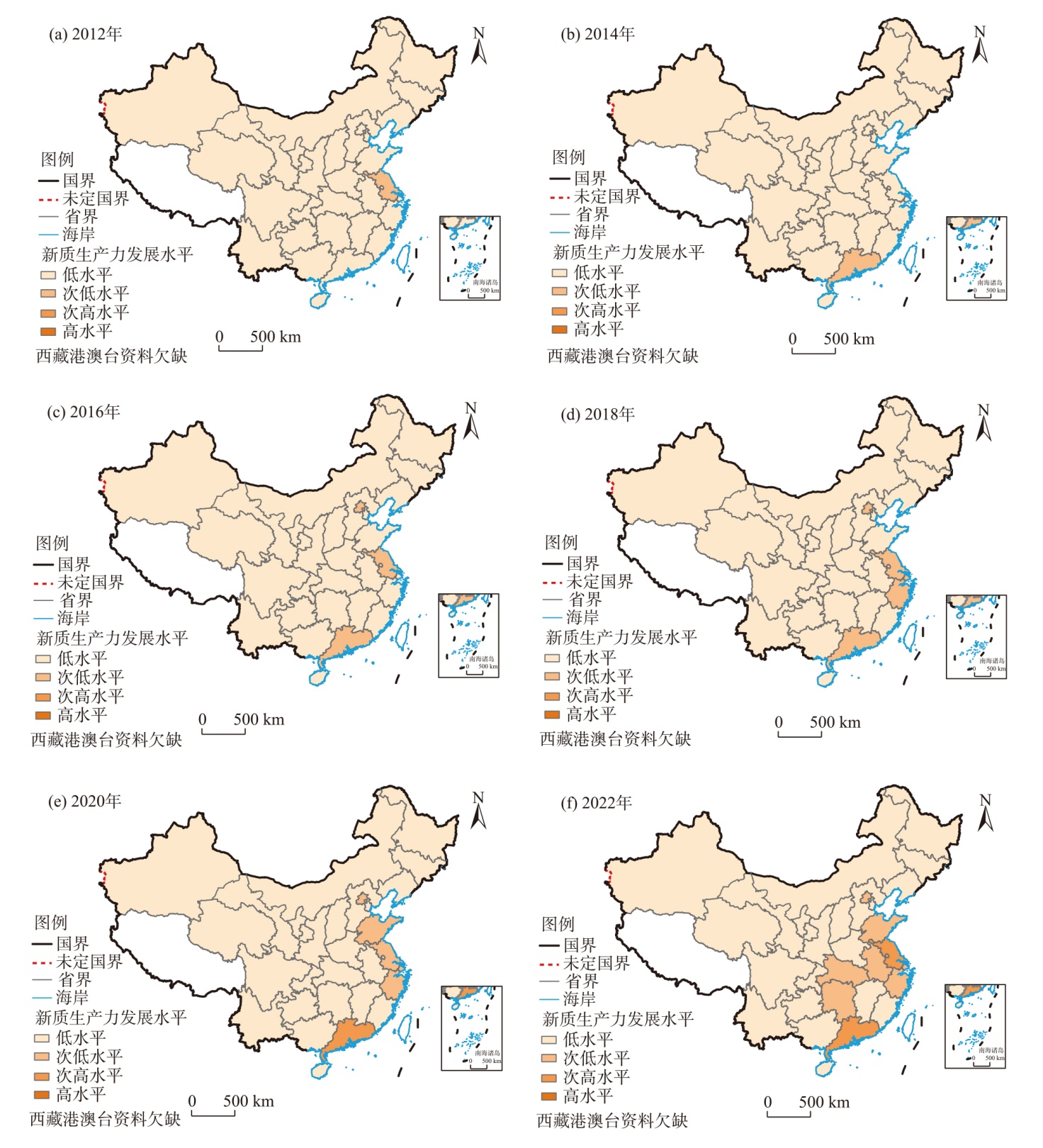
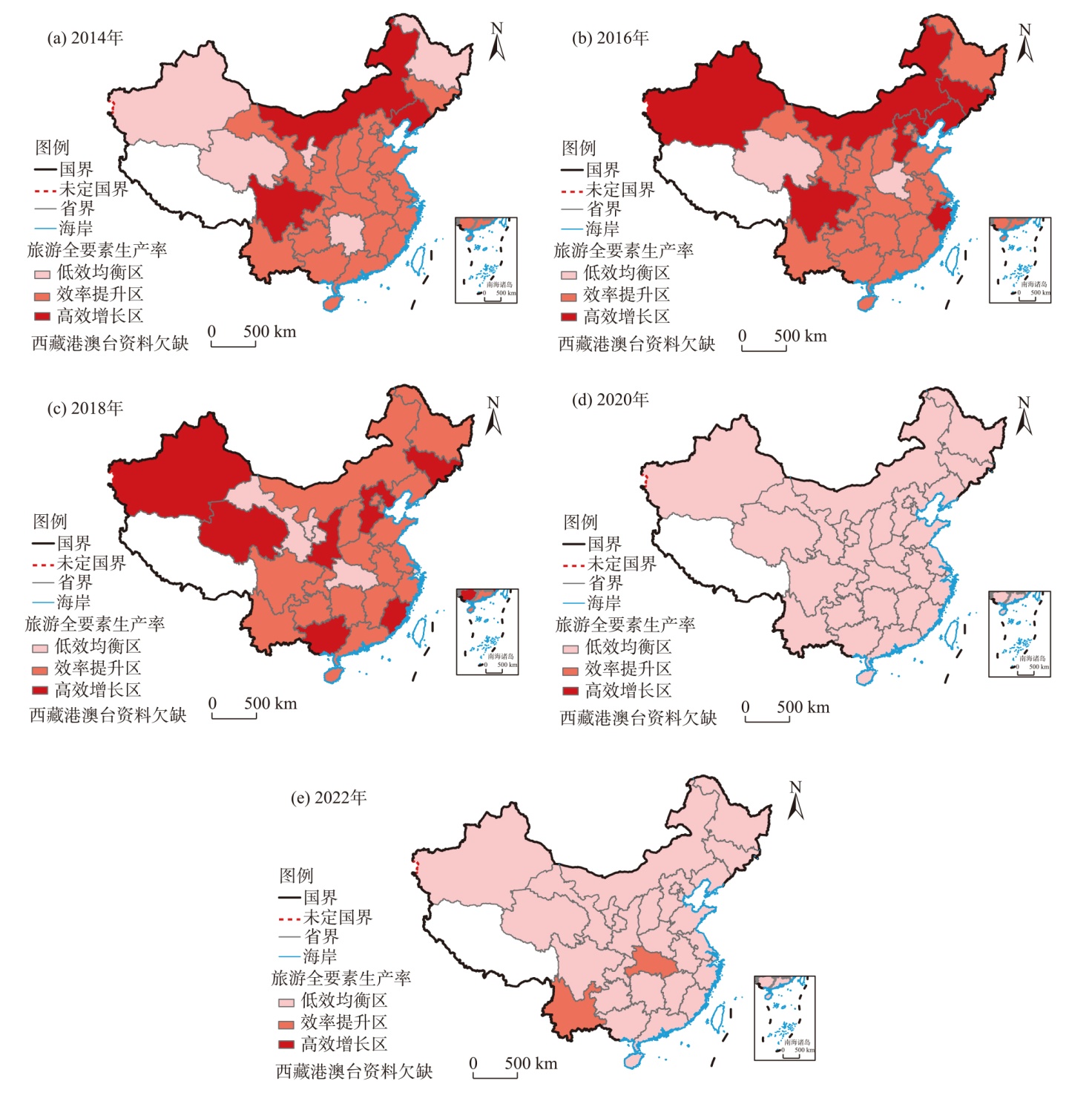
Fig. 2
Total factor productivity of tourism in China from 2012 to 2022"
Tab. 4
Regression results of the Tobit model for 30 provincial regions in China"
| 变量 | 回归系数 | 标准误 | z值 | P值 |
|---|---|---|---|---|
| 截距 | 1.419 | 0.288 | 4.927 | 0.000 |
| 新质生产力 | 0.149 | 0.061 | 2.444 | 0.015 |
| 人力资本水平 | 0.506 | 0.083 | 6.111 | 0.000 |
| 科技创新水平 | -0.293 | 0.039 | -7.487 | 0.000 |
| 社会消费水平 | 0.252 | 0.101 | 2.493 | 0.013 |
| 对外开放程度 | -0.063 | 0.018 | -3.426 | 0.001 |
| 产业结构水平 | 0.027 | 0.045 | 0.597 | 0.550 |
| log(Sigma) | -1.112 | 0.039 | -28.558 | 0.000 |
Tab. 5
Tobit regression results for regional heterogeneity"
| 变量 | 东部地区 | 中部地区 | 西部地区 | 高水平地区 | 中等水平地区 | 低水平地区 |
|---|---|---|---|---|---|---|
| 截距 | 1.810** (2.580) | 3.568** (3.491) | 0.839** (2.168) | 1.212 (1.512) | 1.299*** (2.639) | 0.953** (2.057) |
| 新质生产力 | 0.007 (0.090) | 0.433** (2.374) | 0.267** (2.069) | -0.028 (-0.277) | 0.447*** (4.146) | 0.737*** (3.982) |
| 人力资本水平 | 0.554*** (3.374) | 0.898*** (3.240) | 0.353** (2.345) | 0.250 (1.175) | 0.249 (1.627) | 0.112 (0.566) |
| 科技创新水平 | -0.200*** (-3.411) | -0.289*** (-2.811) | -0.359*** (-6.155) | -0.207*** (-2.643) | -0.234*** (-3.914) | -0.313*** (-3.614) |
| 社会消费水平 | 0.381* (1.771) | -0.082 (-0.280) | 0.277* (1.888) | 1.097*** (2.878) | 0.095 (0.611) | -0.052 (-0.311) |
| 对外开放程度 | -0.091** (-2.243) | 0.081 (0.819) | -0.059** (-2.266) | -0.052 (-0.838) | 0.009 (0.212) | -0.024 (-0.584) |
| 产业结构水平 | -0.144** (-1.988) | 0.424*** (4.180) | -0.059 (-0.912) | -0.170** (-2.086) | 0.216*** (3.073) | 0.045 (0.624) |
| log(Sigma) | -1.227** (-19.091) | -1.059** (-14.048) | -1.261** (-19.612) | -1.336*** (-15.348) | -1.327*** (-21.554) | -1.039*** (-16.875) |
| 似然比检验 | χ2(6)=40.224, P=0.000 | χ2(6)=31.332, P=0.000 | χ2(6)=40.715, P=0.000 | χ2(6)=26.211, P=0.000 | χ2(6)=33.452, P=0.000 | χ2(6)=36.104, P=0.000 |
| McFadden R2 | 0.464 | 0.331 | 0.515 | 0.705 | 0.578 | 0.264 |
Tab. 6
Estimation results of robustness test"
| 变量 | 结果(1) | 结果(2) | 结果(3) | 结果(4) |
|---|---|---|---|---|
| 截距 | 1.359*** (4.084) | 2.005*** (6.885) | 1.460*** (3.968) | 2.741*** (3.976) |
| 新质生产力 | - | 0.597*** (8.503) | 0.152** (2.403) | 0.188*** (3.167) |
| 滞后一期的新质生产力 | 0.388*** (4.830) | - | - | - |
| 人力资本水平 | 0.562*** (5.513) | 0.702*** (7.872) | 0.506*** (6.112) | 0.468*** (5.607) |
| 科技创新水平 | -0.399*** (-5.301) | -0.476*** (-7.222) | -0.291*** (-7.279) | -0.257*** (-6.041) |
| 社会消费水平 | -0.061 (-0.494) | -0.035 (-0.321) | 0.255** (2.486) | - |
| 对外开放程度 | -0.110*** (-3.560) | -0.132*** (-4.873) | -0.061*** (-3.107) | -0.023 (-1.017) |
| 产业结构水平 | 0.134*** (2.626) | 0.151*** (3.389) | 0.024 (0.523) | 0.037 (0.836) |
| 政府财政支持 | - | - | 0.014 (0.179) | - |
| 经济发展水平 | - | - | - | -0.152** (-2.458) |
| log(Sigma) | -1.156*** (-25.327) | -1.290*** (-28.254) | -1.112*** (-28.560) | -1.111** (-28.552) |
| 样本量 | 300 | 240 | 330 | 330 |
| 似然比检验 | χ2(6)=60.900, P=0.000 | χ2(6)=105.492, P=0.000 | χ2(7)=75.751, P=0.000 | χ2(6)=75.551, P=0.000 |
| McFadden R2 | 0.325 | 0.630 | 0.272 | 0.271 |
| [1] | 人民日报. 加快形成新质生产力[EB/OL]. [2023-11-09].http://www.qstheory.cn/qshyjx/2023-11/09/c_1129965644.htm. |
| [People’s Daily. Accelerating the formation of new quality productivity[EB/OL]. [2023-11-09]. http://www.qstheory.cn/qshyjx/2023-11/09/c_1129965644.htm.] | |
| [2] | 张可云, 李甜, 冯晟. 中国新质生产力政策端与要素端的耦合及空间分异[J]. 地理学报, 2025, 80(8): 2016-2035. |
| [Zhang Keyun, Li Tian, Feng Sheng. The coupling and spatial differentiation between policy-side and factor-side of China’s new quality productive forces[J]. Acta Geographica Sinica, 2025, 80(8): 2016-2035.] | |
| [3] | 冯学钢, 李志远. 新质生产力与旅游业高质量发展: 动力机制、关键问题及创新实践[J]. 上海经济研究, 2024(9): 38-48, 59. |
| [Feng Xuegang, Li Zhiyuan. New quality productivity and high-quality development of tourism: Driving mechanisms, key issues, and innovative practices[J]. Shanghai Journal of Economics, 2024(9): 38-48, 59.] | |
| [4] | 厉新建, 曾博伟, 张辉, 等. 新质生产力与旅游业高质量发展[J]. 旅游学刊, 2024, 39(5): 15-29. |
| [Li Xinjian, Zeng Bowei, Zhang Hui, et al. New quality productive forces and high-quality development in tourism: Problems, cognition and optimization direction[J]. Tourism Tribune, 2024, 39(5): 15-29.] | |
| [5] |
白洋, 陈明珠, 周春山, 等. 中国旅游新质生产力的演化测度与障碍识别[J]. 干旱区地理, 2026, 49(2): 211-223.
doi: 10.12118/j.issn.1000-6060.2024.730 |
|
[Bai Yang, Chen Mingzhu, Zhou Chunshan, et al. Evolutionary measurement and obstacle identification of new quality productive forces in tourism in China[J]. Arid Land Geography, 2026, 49(2): 211-223.]
doi: 10.12118/j.issn.1000-6060.2024.730 |
|
| [6] | 王琼, 杨德才. 新质生产力赋能文化和旅游产业高质量发展的逻辑机理、现实挑战与实践路径[J]. 南京社会科学, 2024(7): 152-160. |
| [Wang Qiong, Yang Decai. The theoretical mechanism, practical challenge and practical path of new quality productive forces enabling high-quality development of culture and tourism[J]. Nanjing Journal of Social Sciences, 2024(7): 152-160.] | |
| [7] | 吴丹丹, 冯学钢, 马仁锋, 等. 数字经济发展对旅游业全要素生产率的非线性效应[J]. 旅游学刊, 2023, 38(2): 47-65. |
| [Wu Dandan, Feng Xuegang, Ma Renfeng, et al. Nonlinear effects of digital economy development on tourism total factor productivity[J]. Tourism Tribune, 2023, 38(2): 47-65.] | |
| [8] | 胡佳霖, 徐俊. 中国新质生产力: 区域差距、动态演进与跃迁趋势[J]. 统计与决策, 2024, 40(21): 5-11. |
| [Hu Jialin, Xu Jun. China’s new quality productivity: Regional disparity, dynamic evolution and transition trend[J]. Statistics & Decision, 2024, 40(21): 5-11.] | |
| [9] | 冀雁龙, 李金叶. 数字技术与中国旅游全要素生产率——基于非线性与异质性的考量[J]. 技术经济与管理研究, 2022(11): 107-112. |
| [Ji Yanlong, Li Jinye. Digital technology and tourism total factor productivity in China: A nonlinear studywith heterogeneous consideration[J]. Journal of Technical Economics & Management, 2022(11): 107-112.] | |
| [10] | 樊玲玲, 侯志强, 曹咪, 等. 空间视角下城市旅游全要素生产率的收敛性分析[J]. 地理与地理信息科学, 2022, 38(2): 121-128. |
| [Fan Lingling, Hou Zhiqiang, Cao Mi, et al. Convergence analysis on tourism total factor productivity in cities from a spatial perspective[J]. Geography and Geo-Information Science, 2022, 38(2): 121-128.] | |
| [11] | 张琴悦. 新质生产力对旅游业全要素生产率的影响: 基于技术进步和技术效率视角[J]. 社会科学家, 2025(4): 130-139. |
| [Zhang Qinyue. The impact of new quality productivity on total factor productivity in the tourism industry: A perspective based on technological progress and technical efficiency[J]. Social Scientist, 2025(4): 130-139.] | |
| [12] | 马福运, 李嘉玮. 习近平总书记关于新质生产力的重要论述对马克思主义生产力理论的原创性贡献[J]. 河南社会科学, 2025, 33(2): 1-8. |
| [Ma Fuyun, Li Jiawei. The original contributions of general secretary Xi Jinping’s important discourse on new quality productive forces to Marxist Productivity Theory[J]. Henan Social Sciences, 2025, 33(2): 1-8.] | |
| [13] | 刘辉, 李诗. 新质生产力赋能农田水利高质量发展的机理与路径[J]. 社会科学辑刊, 2025(2): 141-149. |
| [Liu Hui, Li Shi. The mechanism and path for new-quality productive forces to empower the high-quality development of farmland water conservancy[J]. Social Science Journal, 2025(2): 141-149.] | |
| [14] | 高金岭, 海颖. 我国高等教育、人力资本、科技创新与区域经济耦合协调的时序演变及空间集聚性分析[J]. 黑龙江高教研究, 2024, 42(9): 49-57. |
| [Gao Jinling, Hai Ying. Analysis on the time-series evolution and spatial agglomeration of the coupling and coordunation between higher education, human capital, technology innovation, and regional economy in China[J]. Heilongjiang Higher Education Research, 2024, 42(9): 49-57.] | |
| [15] | 吴传清, 黄磊, 文传浩. 长江经济带技术创新效率及其影响因素研究[J]. 中国软科学, 2017(5): 160-170. |
| [Wu Chuanqing, Huang Lei, Wen Chuanhao. Research on technical innovation efficiency and its influencing factors of the Yangtze River Economic Belt[J]. China Soft Science, 2017(5): 160-170.] | |
| [16] | 程惠芳, 陆嘉俊. 知识资本对工业企业全要素生产率影响的实证分析[J]. 经济研究, 2014, 49(5): 174-187. |
| [Cheng Huifang, Lu Jiajun. The empirical analysis of knowledge capital impact on total factor productivity of industrial enterprises[J]. Economic Research Journal, 2014, 49(5): 174-187.] | |
| [17] | 游丽, 孔庆鹏. “双一流”背景下我国高等教育资源配置效率测评及影响因素研究——基于超效率DEA-Malmquist方法和Tobit模型[J]. 教育与经济, 2021, 37(6): 30-37. |
| [You Li, Kong Qingpeng. Research on evaluation and influencing factors of higher education resource allocation efficiency: Based on super efficiency DEA-Malmquist method and Tobit model[J]. Education & Economy, 2021, 37(6): 30-37.] | |
| [18] | 蒲清平, 向往. 论习近平总书记关于新质生产力的重要论述的科学体系[J]. 西南大学学报(社会科学版), 2025, 51(3): 18-32, 329. |
| [Pu Qingping, Xiang Wang. The scientific system of general secretary Xi Jinping’s important discourses on new quality productive forces[J]. Journal of Southwest University (Social Sciences Edition), 2025, 51(3): 18-32, 329.] | |
| [19] | 王珏, 王荣基. 新质生产力: 指标构建与时空演进[J]. 西安财经大学学报, 2024, 37(1): 31-47. |
| [Wang Yu, Wang Rongji. New quality productivity: Index construction and spatiotemporal evolution[J]. Journal of Xi’an University of Finance and Economics, 2024, 37(1): 31-47.] | |
| [20] | 韩文龙, 张瑞生, 赵峰. 新质生产力水平测算与中国经济增长新动能[J]. 数量经济技术经济研究, 2024, 41(6): 5-25. |
| [Han Wenlong, Zhang Ruisheng, Zhao Feng. Measurement of new productivity level and new kinetic energy of China’s economic growth[J]. Journal of Quantitative & Technological Economics, 2024, 41(6): 5-25.] | |
| [21] | 鲁延召, 赵钰莹. 南水北调沿线旅游生态效率评估及空间分异研究[J]. 生态经济, 2023, 39(6): 136-142. |
| [Lu Yanzhao, Zhao Yuying. Evaluation and spatial differentiation of tourism ecological efficiency along the south-to-north Water Transfer Project[J]. Ecological Economy, 2023, 39(6): 136-142.] | |
| [22] | 王兆峰, 邹佳. 数字经济发展对旅游产业效率的影响机制及效应——基于省级面板数据的实证分析[J]. 陕西师范大学学报(自然科学版), 2025, 53(2): 48-60. |
| [Wang Zhaofeng, Zou Jia. The influence mechanism and effect of digital economy development on tourism industry efficiency: Empirical analysis based on provincial panel data[J]. Journal of Shaanxi Normal University (Natural Science Edition), 2025, 53(2): 48-60.] | |
| [23] | 赵磊. 旅游发展与经济增长——来自中国的经验证据[J]. 旅游学刊, 2015, 30(4): 33-49. |
| [Zhao Lei. Tourism development and economic growth: Empirical evidence from China[J]. Tourism Tribune, 2015, 30(4): 33-49.] | |
| [24] |
徐雨利, 龙花楼, 屠爽爽, 等. “一带一路”倡议对我国沿线重点省份入境旅游效率的影响[J]. 经济地理, 2022, 42(9): 201-210.
doi: 10.15957/j.cnki.jjdl.2022.09.023 |
|
[Xu Yuli, Long Hualou, Tu Shuangshuang, et al. The impact of the Belt and Road Initiative on the efficiency of inbound tourism in key provinces along the route of China[J]. Economic Geography, 2022, 42(9): 201-210.]
doi: 10.15957/j.cnki.jjdl.2022.09.023 |
|
| [25] | 刘民坤, 邓小桂. 旅游驱动乡村治理——城乡要素流动视角的动力学机制分析[J]. 旅游学刊, 2025, 40(2): 15-29. |
| [Liu Minkun, Deng Xiaogui. Tourism-driven rural governance: An analysis of the dynamic mechanisms from the perspective of urban and rural element flow[J]. Tourism Tribune, 2025, 40(2): 15-29.] | |
| [26] |
杨昕, 赵守国. 数字经济与区域创新效率的“索洛悖论”——基于研发要素投入偏向视角[J]. 科技进步与对策, 2025, 42(18): 53-64.
doi: 10.6049/kjjbydc.Q202407082B |
| [Yang Xin, Zhao Shouguo. The “Solow Paradox” of digital economy and regional innovation efficiency: A perspective from the input bias of R&D elements[J]. Science & Technology Progress and Policy, 2025, 42(18): 53-64.] | |
| [27] | 欧阳峣. 中国式创新的逻辑: 概念、优势、类型与机制[J]. 经济学家, 2025(3): 5-14. |
| [Ou Yangyao. The logic of Chinese innovation: Concept, advantage, type and mechanism[J]. Economist, 2025(3): 5-14.] | |
| [28] | 许文仪, 王冰冰, 金平斌. 信息化对旅游全要素生产率的影响研究[J]. 浙江大学学报(理学版), 2024, 51(2): 220-233. |
| [Xu Wenyi, Wang Bingbing, Jin Pingbin. Research on the influence of informatization level on tourism total factor productivity in China[J]. Journal of Zhejiang University (Science Edition), 2024, 51(2): 220-233.] | |
| [29] | 石岩, 杨世鹏, 陈薇伟, 等. 中国水利新质生产力发展水平及时空演化和驱动因素分析[J]. 水资源保护, 2024, 40(6): 121-126, 138. |
| [Shi Yan, Yang Shipeng, Chen Weiwei, et al. Evaluation of development level of new quality productivity of water conservancy in China and analysis of its spatial and temporal evolution and driving factors[J]. Water Resources Protection, 2024, 40(6): 121-126, 138.] | |
| [30] | 方叶林, 朱志刚, 陆海云. 城市群旅游生态效率时空演化及影响因素比较研究——以长三角与珠三角城市群为例[J]. 地理与地理信息科学, 2025, 41(1): 134-141. |
| [Fang Yeling, Zhu Zhigang, Lu Haiyun. A comparative study on the spatiotemporal evolution and influencing factors of tourism eco-efficiency in urban agglomerations: A case study of the Yangtze River Delta and the Pearl River urban agglomerations[J]. Geography and Geo-Information Science, 2025, 41(1): 134-141.] | |
| [31] | 魏敏, 李书昊. 新时代中国经济高质量发展水平的测度研究[J]. 数量经济技术经济研究, 2018, 35(11): 3-20. |
| [Wei Min, Li Shuhao. Study on measurement of economic high-quality development level in China in the New Era[J]. Journal of Quantitative & Technological Economics, 2018, 35(11): 3-20.] | |
| [32] |
赵建春. 产业结构优化升级与旅游效率——基于2003—2022年省际面板数据[J]. 地域研究与开发, 2024, 43(1): 67-73.
doi: 10.3969/j.issn.10032363.2024.01.010 |
|
[Zhao Jianchun. Industrial structure upgrading and tourism efficiency: Based on inter-provincial panel data from 2003 to 2022[J]. Areal Research and Development, 2024, 43(1): 67-73.]
doi: 10.3969/j.issn.10032363.2024.01.010 |
|
| [33] |
雷学. 中国新质生产力水平测度、区域差异分解及动态演进[J]. 工业技术经济, 2024, 43(6): 30-39.
doi: 10.3969/j.issn.1004-910X.2024.06.004 |
| [Lei Xue. Measuring the level of new quality productivity, decomposing regional differences, and dynamic evolution in China[J]. Journal of Industrial Technology and Economy, 2024, 43(6): 30-39.] | |
| [34] | 王慧, 王晓川, 邓学龙. 沿海城市群旅游效率测度及评价——以北部湾城市群为例[J]. 社会科学家, 2023(2): 45-52. |
| [Wang Hui, Wang Xiaochuan, Deng Xuelong. Measuring and evaluating tourism efficiency in coastal urban agglomerations: The case of the Beibu Gulf urban agglomeration[J]. Social Scientist, 2023(2): 45-52.] | |
| [35] |
马丽君, 敖烨. 数字经济对旅游业高质量发展的影响及空间溢出效应[J]. 地理科学进展, 2023, 42(12): 2296-2308.
doi: 10.18306/dlkxjz.2023.12.002 |
|
[Ma Lijun, Ao Ye. Influence and spatial spillover effects of the digital economy on the high-quality development of the tourism industry[J]. Progress in Geography, 2023, 42(12): 2296-2308.]
doi: 10.18306/dlkxjz.2023.12.002 |
|
| [36] |
杨晓琰, 宋瑞. 数字经济对旅游产业发展的影响机理[J]. 地理科学进展, 2024, 43(10): 1943-1955.
doi: 10.18306/dlkxjz.2024.10.004 |
|
[Yang Xiaoyan, Song Rui. Mechanism of influence of the digital economy on tourism industry development[J]. Progress in Geography, 2024, 43(10): 1943-1955.]
doi: 10.18306/dlkxjz.2024.10.004 |
|
||