Arid Land Geography ›› 2025, Vol. 48 ›› Issue (9): 1660-1671.doi: 10.12118/j.issn.1000-6060.2024.103
• Regional Development • Previous Articles Next Articles
TIAN Xiaobo1,2( )
)
Received:2024-02-21
Revised:2024-05-27
Online:2025-09-25
Published:2025-09-17
TIAN Xiaobo. Measurement and spatial pattern characteristics of tourism high-quality development level of urbans in the Yellow River Basin[J].Arid Land Geography, 2025, 48(9): 1660-1671.

Fig. 1
Schematic diagram of the study area"

Tab. 1
Evaluation index system of tourism high-quality development"
| 评价维度 | 准则层 | 指标层(代码) | 指标属性 | 指标计算 |
|---|---|---|---|---|
| 稳定高效 | 稳定性 | 近5 a旅游收入增长波动(X1) | 负向 | 旅游总收入增长率变动的绝对值 |
| 效率水平 | 旅游业全员劳动生产率(X2) | 正向 | 旅游业总收入与旅游业从业人员的比值 | |
| 公平共享 | 公平发展 | 居民旅游收入弹性(X3) | 正向 | 当地居民收入增长率与当地旅游收入增长率的比值 |
| 社会效益 | 免费开放的博物馆数量(X4) | 正向 | 直接获取 | |
| 建成区公园绿地面积(X5) | 正向 | 直接获取 | ||
| 绿色持续 | 资源消耗 | 单位旅游收入能耗(X6) | 负向 | 能源消费总量与地区旅游综合收入的比值 |
| 环境治理 | 空气优良天数(X7) | 正向 | 直接获取 | |
| 生态保护 | 建成区绿化覆盖率(X8) | 正向 | 直接获取 | |
| 创新驱动 | 创新投入 | 旅游业研发经费投入(X9) | 正向 | 全社会研发经费数额乘以旅游业产值占经济生产总值的比值 |
| 旅游业研发人员数量(X10) | 正向 | 全社会研发人员数乘以旅游业从业人员占地区就业总 人数的比值 | ||
| 创新产出 | 旅游业科技专利发明数量(X11) | 正向 | 通过Innojoy专利搜索引擎检索整理 | |
| 旅游学术论文发表(X12) | 正向 | 在CNKI以“旅游”为主题,“地区”为作者机构检索获取 | ||
| 协调发展 | 产业结构协调度 | 旅游产业结构合理化(X13) | 正向 | K=(eij/ej)/(Ei/E) |
| 文旅融合 | 文旅产业融合发展水平 | 文旅产业耦合协调度(X14) | 正向 | 耦合协调度模型 |
Tab. 2
Measurement results of tourism high-quality development level of urbans in the Yellow River Basin"
| 市(州/盟) | 稳定高效水平 | 公平共享水平 | 绿色持续水平 | 创新驱动水平 | 协调发展水平 | 文旅融合水平 | 旅游业高质量发展水平 |
|---|---|---|---|---|---|---|---|
| 西宁市 | 4.70 | 7.44 | 21.12 | 1.42 | 4.38 | 5.65 | 44.71 |
| 海东市 | 6.37 | 2.46 | 17.59 | 0.37 | 1.93 | 3.40 | 32.13 |
| 海北州 | 17.74 | 2.68 | 14.61 | 0.11 | 7.76 | 1.87 | 44.77 |
| 黄南州 | 8.40 | 5.39 | 15.58 | 0.03 | 3.49 | 0.85 | 33.74 |
| 海南州 | 16.76 | 0.16 | 17.35 | 0.08 | 3.18 | 1.53 | 39.06 |
| 果洛州 | 5.08 | 6.08 | 18.35 | 0.02 | 0.29 | 0.16 | 29.98 |
| 玉树州 | 6.45 | 3.46 | 25.91 | 0.04 | 2.08 | 0.70 | 38.64 |
| 阿坝州 | 5.62 | 2.39 | 25.33 | 0.83 | 13.08 | 5.43 | 52.67 |
| 兰州市 | 9.41 | 7.51 | 19.49 | 17.84 | 2.25 | 8.56 | 65.06 |
| 白银市 | 13.46 | 3.50 | 24.04 | 0.76 | 1.68 | 3.78 | 47.23 |
| 天水市 | 10.61 | 5.57 | 25.46 | 2.63 | 4.64 | 6.16 | 55.07 |
| 平凉市 | 11.01 | 3.04 | 25.11 | 0.40 | 3.51 | 4.82 | 47.89 |
| 庆阳市 | 7.77 | 2.99 | 22.63 | 0.36 | 0.27 | 4.51 | 38.53 |
| 定西市 | 10.09 | 2.75 | 21.86 | 0.23 | 0.56 | 4.53 | 40.03 |
| 临夏州 | 16.04 | 1.83 | 22.24 | 0.33 | 4.18 | 5.09 | 49.70 |
| 甘南州 | 8.66 | 6.70 | 25.24 | 0.23 | 3.05 | 4.96 | 48.83 |
| 银川市 | 4.99 | 10.61 | 29.49 | 2.58 | 2.39 | 8.99 | 59.05 |
| 石嘴山市 | 2.70 | 15.25 | 37.23 | 0.62 | 0.63 | 3.83 | 60.25 |
| 吴忠市 | 8.99 | 3.67 | 26.70 | 0.52 | 2.84 | 4.58 | 47.30 |
| 固原市 | 12.36 | 8.45 | 25.80 | 0.57 | 4.57 | 4.47 | 56.23 |
| 中卫市 | 9.69 | 8.74 | 29.42 | 0.56 | 3.86 | 4.29 | 56.56 |
| 呼和浩特市 | 9.04 | 13.01 | 21.61 | 3.56 | 4.01 | 8.61 | 59.83 |
| 包头市 | 9.48 | 6.45 | 25.83 | 1.01 | 2.14 | 6.27 | 51.16 |
| 乌海市 | 11.09 | 4.76 | 24.31 | 0.12 | 1.08 | 3.12 | 44.49 |
| 鄂尔多斯市 | 9.79 | 5.16 | 26.32 | 0.69 | 0.99 | 8.67 | 51.61 |
| 巴彦淖尔市 | 9.52 | 7.27 | 22.06 | 0.17 | 0.33 | 4.47 | 43.83 |
| 阿拉善盟 | 20.87 | 4.19 | 22.87 | 0.35 | 8.43 | 4.01 | 60.72 |
| 太原市 | 6.32 | 13.37 | 16.91 | 6.93 | 1.34 | 10.03 | 54.90 |
| 长治市 | 7.91 | 8.03 | 19.56 | 1.56 | 2.30 | 7.75 | 47.10 |
| 晋城市 | 8.67 | 6.59 | 15.10 | 0.94 | 2.84 | 6.31 | 40.46 |
| 朔州市 | 9.16 | 5.77 | 20.05 | 0.37 | 1.39 | 4.88 | 41.62 |
| 晋中市 | 10.16 | 9.42 | 14.82 | 1.91 | 5.29 | 8.22 | 49.81 |
| 运城市 | 10.22 | 9.06 | 13.62 | 2.33 | 3.15 | 7.79 | 46.17 |
| 忻州市 | 9.15 | 6.05 | 18.06 | 1.35 | 3.78 | 6.65 | 45.05 |
| 临汾市 | 10.75 | 7.24 | 11.70 | 1.22 | 3.12 | 7.64 | 41.67 |
| 吕梁市 | 10.20 | 6.35 | 20.84 | 0.74 | 2.12 | 6.61 | 46.84 |
| 西安市 | 12.44 | 29.84 | 15.59 | 30.76 | 3.41 | 14.48 | 106.52 |
| 铜川市 | 7.00 | 5.04 | 18.87 | 1.22 | 4.94 | 3.74 | 40.81 |
| 宝鸡市 | 10.26 | 8.99 | 19.98 | 3.76 | 4.46 | 7.67 | 55.11 |
| 咸阳市 | 4.56 | 7.45 | 11.43 | 2.62 | 1.88 | 6.51 | 34.45 |
| 渭南市 | 6.17 | 17.22 | 13.93 | 4.73 | 3.40 | 5.20 | 50.66 |
| 延安市 | 9.76 | 6.73 | 24.04 | 3.49 | 2.90 | 6.91 | 53.84 |
| 榆林市 | 8.45 | 17.11 | 21.83 | 1.61 | 0.12 | 6.02 | 55.14 |
| 商洛市 | 7.97 | 8.35 | 22.68 | 3.06 | 4.88 | 4.78 | 51.72 |
| 郑州市 | 4.39 | 25.85 | 14.13 | 33.84 | 6.16 | 13.29 | 97.66 |
| 开封市 | 14.59 | 11.03 | 15.51 | 5.66 | 14.48 | 7.95 | 69.22 |
| 洛阳市 | 9.11 | 21.12 | 11.85 | 19.07 | 12.48 | 11.97 | 85.61 |
| 新乡市 | 7.61 | 6.79 | 14.34 | 5.48 | 5.50 | 7.02 | 46.75 |
| 焦作市 | 8.50 | 13.14 | 12.73 | 5.18 | 7.99 | 6.48 | 54.01 |
| 濮阳市 | 12.98 | 4.08 | 16.34 | 0.71 | 0.43 | 5.29 | 39.83 |
| 三门峡市 | 11.00 | 7.43 | 15.39 | 4.14 | 14.38 | 5.87 | 58.20 |
| 济南市 | 5.01 | 24.61 | 15.23 | 46.08 | 2.23 | 11.21 | 104.38 |
| 淄博市 | 6.15 | 20.82 | 15.07 | 13.73 | 3.98 | 9.05 | 68.79 |
| 东营市 | 4.66 | 12.27 | 16.52 | 4.37 | 0.75 | 5.73 | 44.30 |
| 济宁市 | 6.74 | 19.04 | 13.35 | 10.02 | 3.67 | 9.48 | 62.30 |
| 泰安市 | 9.12 | 16.77 | 15.08 | 13.33 | 6.74 | 8.20 | 69.24 |
| 德州市 | 4.23 | 12.53 | 14.25 | 5.56 | 0.85 | 6.08 | 43.49 |
| 聊城市 | 6.27 | 11.93 | 13.89 | 4.82 | 1.57 | 5.65 | 44.13 |
| 滨州市 | 5.60 | 12.20 | 18.01 | 4.37 | 0.96 | 6.04 | 47.17 |
| 菏泽市 | 6.97 | 14.11 | 14.28 | 2.14 | 0.62 | 6.07 | 44.18 |

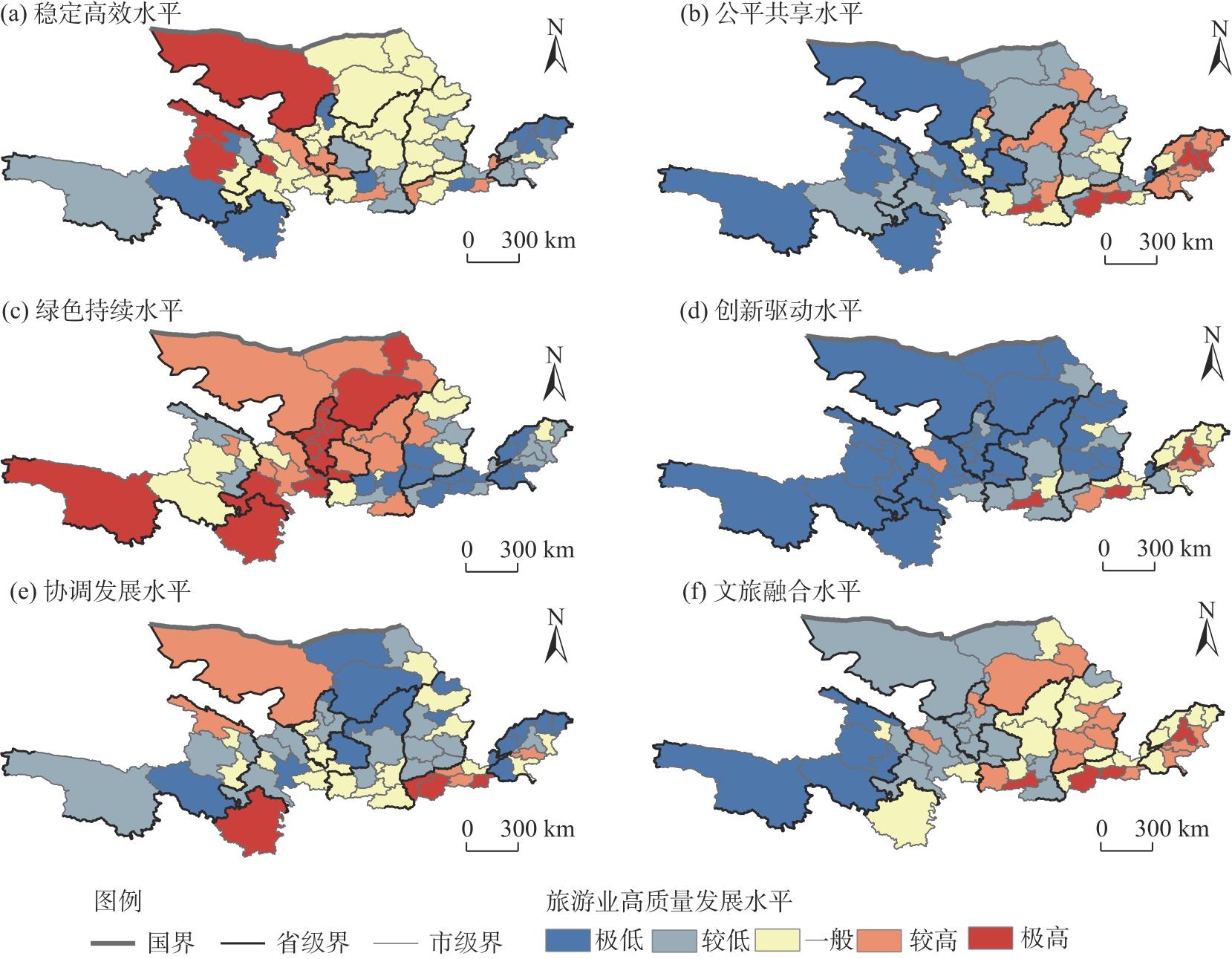
Fig. 2
Spatial pattern of sub-dimensional tourism high-quality development level"
Tab. 3
Global Moran’s I scores for tourism high-quality development in different dimensions"
| 评价维度 | 全局Moran’s I | P值 | Z值 | 分布状态 | |
|---|---|---|---|---|---|
| 分维度 | 稳定高效 | 0.0922 | 0.0005 | 3.4602 | 集聚 |
| 公平共享 | 0.0330 | 0.1227 | 1.5432 | 随机 | |
| 绿色持续 | 0.4595 | 0.0000 | 13.7576 | 集聚 | |
| 创新驱动 | -0.0157 | 0.9625 | 0.0470 | 随机 | |
| 协调发展 | 0.0844 | 0.0042 | 2.8591 | 集聚 | |
| 文旅融合 | 0.1872 | 0.0000 | 5.4028 | 集聚 | |
| 综合维度 | 0.1096 | 0.0006 | 3.3976 | 集聚 | |

Fig. 3
LISA cluster of sub-dimensional tourism high-quality development"
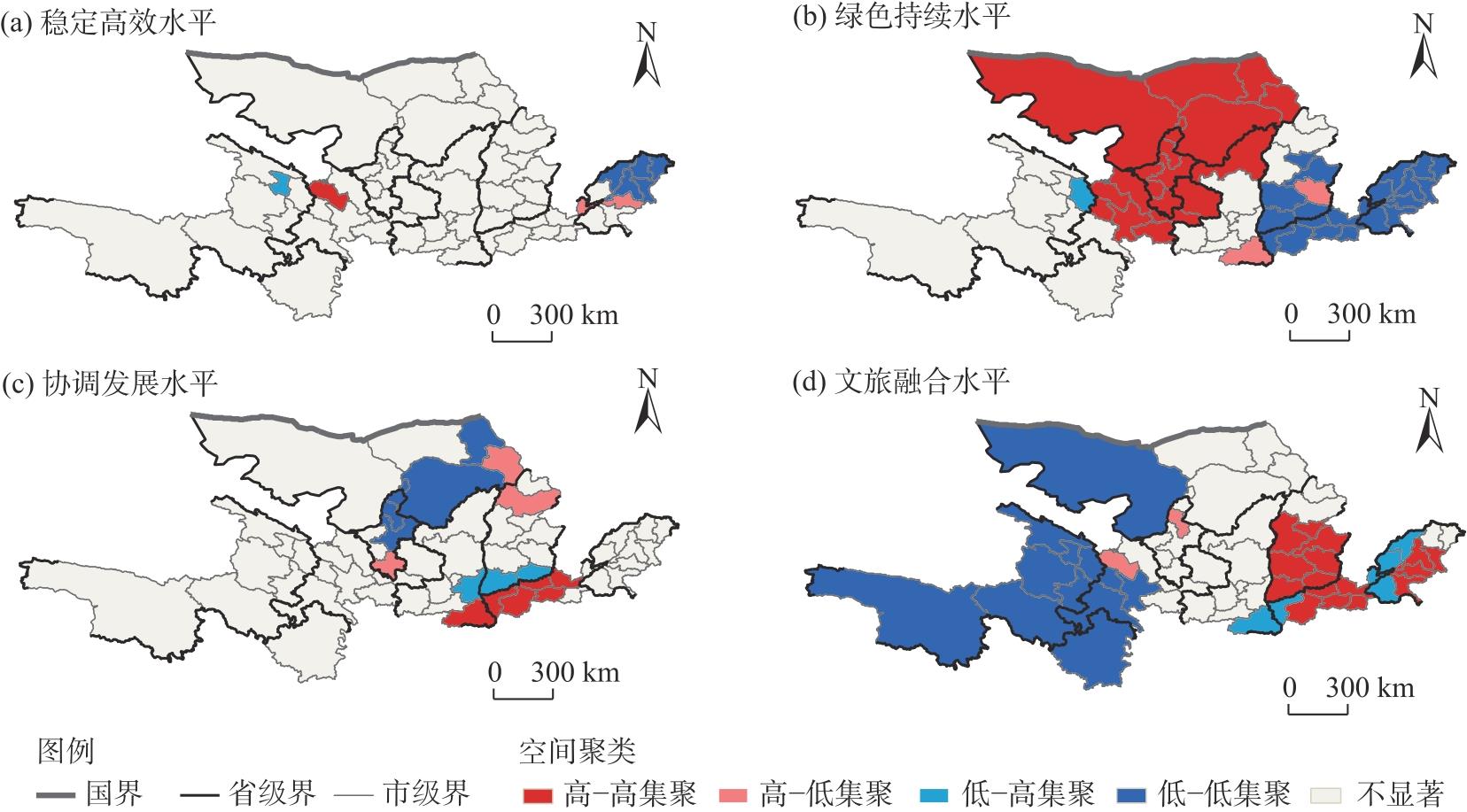

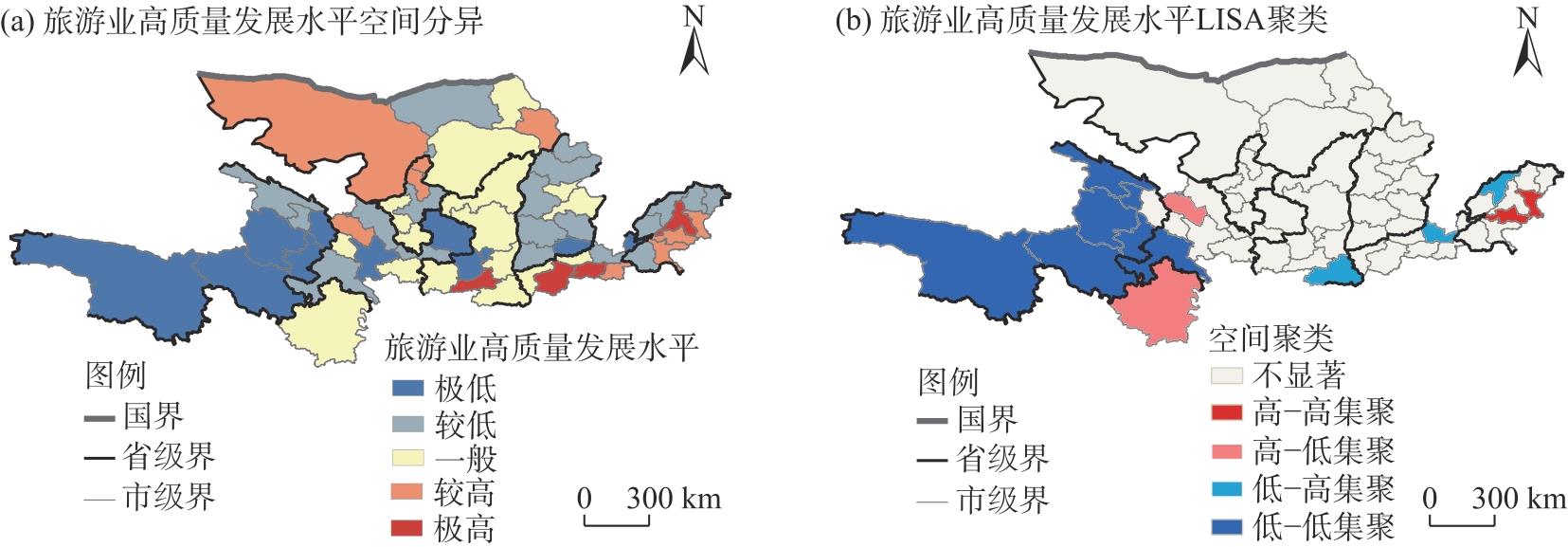
Fig. 4
Spatial pattern of tourism high-quality development level"
| [1] |
杨永春, 穆焱杰, 张薇. 黄河流域高质量发展的基本条件与核心策略[J]. 资源科学, 2020, 42(3): 409-423.
doi: 10.18402/resci.2020.03.01 |
|
[Yang Yongchun, Mu Yanjie, Zhang Wei. Basic conditions core strategies of high-quality development in the Yellow River Basin[J]. Resources Science, 2020, 42(3): 409-423.]
doi: 10.18402/resci.2020.03.01 |
|
| [2] |
方创琳. 黄河流域城市群形成发育的空间组织格局与高质量发展[J]. 经济地理, 2020, 40(6): 1-8.
doi: 10.15957/j.cnki.jjdl.2020.06.001 |
|
[Fang Chuanglin. Spatial organization pattern and high-quality development of urban agglomeration in the Yellow River Basin[J]. Economic Geography, 2020, 40(6): 1-8.]
doi: 10.15957/j.cnki.jjdl.2020.06.001 |
|
| [3] |
马海涛, 徐楦钫. 黄河流域城市群高质量发展评估与空间格局分异[J]. 经济地理, 2020, 40(4): 11-18.
doi: 10.15957/j.cnki.jjdl.2020.04.002 |
|
[Ma Haitao, Xu Xuanfang. High-quality development assessment and spatial heterogeneity of urban agglomeration in the Yellow River Basin[J]. Economic Geography, 2020, 40(4): 11-18.]
doi: 10.15957/j.cnki.jjdl.2020.04.002 |
|
| [4] |
陆大道, 孙东琪. 黄河流域的综合治理与可持续发展[J]. 地理学报, 2019, 74(12): 2431-2436.
doi: 10.11821/dlxb201912001 |
|
[Lu Dadao, Sun Dongqi. Development and management tasks of the Yellow River Basin: A preliminary understanding and suggestion[J]. Acta Geographica Sinica, 2019, 74(12): 2431-2436.]
doi: 10.11821/dlxb201912001 |
|
| [5] |
李小建, 文玉钊, 李元征, 等. 黄河流域高质量发展:人地协调与空间协调[J]. 经济地理, 2020, 40(4): 1-10.
doi: 10.15957/j.cnki.jjdl.2020.04.001 |
|
[Li Xiaojian, Wen Yuzhao, Li Yuanzheng, et al. High-quality development of the Yellow River Basin from a perspective of economic geography: Man-land and spatial coordination[J]. Economic Geography, 2020, 40(4): 1-10.]
doi: 10.15957/j.cnki.jjdl.2020.04.001 |
|
| [6] | 李达, 林龙圳, 林震, 等. 黄河流域生态保护和高质量发展的EKC检验[J]. 生态学报, 2021, 41(10): 3965-3974. |
| [Li Da, Lin Longzhen, Lin Zhen, et al. EKC test of ecological protection and high-quality development in the Yellow River Basin[J]. Acta Ecologica Sinica, 2021, 41(10): 3965-3974.] | |
| [7] | 石培华, 翟燕霞. 文旅融合视野下文物保护利用与创新路径研究——以黄河流域为例[J]. 广西师范大学学报(哲学社会科学版), 2021, 57(4): 114-128. |
| [Shi Peihua, Zhai Yanxia. Research on the innovative path of cultural relics protection and utilization from the perspective of an integration of culture and tourism: A case study of the Yellow River Basin[J]. Journal of Guangxi Normal University (Philosophy and Social Sciences Edition), 2021, 57(4): 114-128.] | |
| [8] |
樊杰, 王亚飞, 王怡轩. 基于地理单元的区域高质量发展研究——兼论黄河流域同长江流域发展的条件差异及重点[J]. 经济地理, 2020, 40(1): 1-11.
doi: 10.15957/j.cnki.jjdl.2020.01.001 |
|
[Fan Jie, Wang Yafei, Wang Yixuan. High quality regional development research based on geographical units: Discuss on the difference in development conditions and priorities of the Yellow River Basin compared to the Yangtze River Basin[J]. Economic Geography, 2020, 40(1): 1-11.]
doi: 10.15957/j.cnki.jjdl.2020.01.001 |
|
| [9] | 张朝枝, 杨继荣. 基于可持续发展理论的旅游高质量发展分析框架[J]. 华中师范大学学报(自然科学版), 2022, 56(1): 43-50. |
| [Zhang Chaozhi, Yang Jirong. An analysis framework of high-quality tourism development based on sustainable theory[J]. Journal of Central China Normal University (Natural Sciences Edition), 2022, 56(1): 43-50.] | |
| [10] | 于法稳, 黄鑫, 岳会. 乡村旅游高质量发展:内涵特征、关键问题及对策建议[J]. 中国农村经济, 2020(8): 27-39. |
| [Yu Fawen, Huang Xin, Yue Hui. The high-quality development of rural tourism: Connotative features, key issues and countermeasures[J]. Chinese Rural Economy, 2020(8): 27-39.] | |
| [11] | 何建民. 新时代我国旅游业高质量发展系统与战略研究[J]. 旅游学刊, 2018, 33(10): 9-11. |
| [He Jianmin. Research on the system and strategy of high-quality development of China’s tourism industry in the new era[J]. Tourism Tribune, 2018, 33(10): 9-11.] | |
| [12] | 阎友兵, 胡欢欢. 中国旅游业高质量发展水平的测度及时空演化分析[J]. 湖南财政经济学院学报, 2021, 37(1): 5-18. |
| [Yan Youbing, Hu Huanhuan. Analysis on the measurement of China’s inter-provincial high-quality development tourism level and spatial-temporal evolution[J]. Journal of Hunan University of Finance and Economics, 2021, 37(1): 5-18.] | |
| [13] |
马慧强, 燕明琪, 李岚, 等. 我国旅游公共服务质量时空演化及形成机理分析[J]. 经济地理, 2018, 38(3): 190-199.
doi: 10.15957/j.cnki.jjdl.2018.03.024 |
|
[Ma Huiqiang, Yan Mingqi, Li Lan, et al. The spatio-temporal evolution and formation mechanism of tourism public service in China[J]. Economic Geography, 2018, 38(3): 190-199.]
doi: 10.15957/j.cnki.jjdl.2018.03.024 |
|
| [14] |
刘雨婧, 唐健雄. 长江经济带旅游业发展质量评价及其时空演变[J]. 经济地理, 2022, 42(4): 209-219.
doi: 10.15957/j.cnki.jjdl.2022.04.023 |
|
[Liu Yujing, Tang Jianxiong. Evaluation and spatial-temporal evolution of the quality of tourism development in the Yangtze River Economic Belt[J]. Economic Geography, 2022, 42(4): 209-219.]
doi: 10.15957/j.cnki.jjdl.2022.04.023 |
|
| [15] |
田小波, 胡静, 贾垚焱, 等. 高质量发展阶段旅游业发展水平空间分异成因探测——基于因素分解的黄河流域实证[J]. 干旱区地理, 2023, 46(3): 460-470.
doi: 10.12118/j.issn.1000-6060.2022.293 |
|
[Tian Xiaobo, Hu Jing, Jia Yaoyan, et al. Exploring the causes of spatial differentiation of tourism development level in the high-quality development stage: Empirical evidence of Yellow River Basin based on factor decomposition[J]. Arid Land Geography, 2023, 46(3): 460-470.]
doi: 10.12118/j.issn.1000-6060.2022.293 |
|
| [16] |
时朋飞, 曹钰晗, 龙荟冰, 等. 我国旅游业高质量发展水平测度、空间分异及障碍因子诊断[J]. 经济地理, 2023, 43(2): 201-210.
doi: 10.15957/j.cnki.jjdl.2023.02.021 |
|
[Shi Pengfei, Cao Yuhan, Long Huibing, et al. Level measurement, spatial variation and obstacle factor diagnosis of tourism high-quality development in China[J]. Economic Geography, 2023, 43(2): 201-210.]
doi: 10.15957/j.cnki.jjdl.2023.02.021 |
|
| [17] | 张洪昌. 新时代旅游业高质量发展的治理逻辑与制度创新[J]. 当代经济管理, 2019, 41(9): 60-66. |
| [Zhang Hongchang. The governance logic and system innovation for the high-quality development of tourism in the new era[J]. Contemporary Economic Management, 2019, 41(9): 60-66.] | |
| [18] | 唐任伍, 徐道明. 新时代高质量旅游业发展的动力和路径[J]. 旅游学刊, 2018, 33(10): 11-13. |
| [Tang Renwu, Xu Daoming. Dynamics and paths of high-quality tourism development in the new era[J]. Tourism Tribune, 2018, 33(10): 11-13.] | |
| [19] | 王雄青, 胡长生. 文旅融合背景下红色文化旅游高质量发展路径研究——基于江西的视角[J]. 企业经济, 2020, 39(11): 100-107. |
| [Wang Xiongqing, Hu Changsheng. Research on the path of high-quality development of red cultural tourism in the context of cultural and tourism integration: Based on the perspective of Jiangxi[J]. Enterprise Economy, 2020, 39(11): 100-107.] | |
| [20] | 宋子千. 科技引领“十四五”旅游业高质量发展[J]. 旅游学刊, 2020, 35(6): 10-12. |
| [Song Ziqian. Science and technology lead the high-quality development of tourism in the 14th five-year plan[J]. Tourism Tribune, 2020, 35(6): 10-12.] | |
| [21] | 张新成, 梁学成, 宋晓, 等. 黄河流域旅游产业高质量发展的失配度时空格局及成因分析[J]. 干旱区资源与环境, 2020, 34(12): 201-208. |
| [Zhang Xincheng, Liang Xuecheng, Song Xiao, et al. Spatial pattern of the mismatch degrees of the high-quality development of tourism industry in the Yellow River Basin[J]. Journal of Arid Land Resources and Environment, 2020, 34(12): 201-208.] | |
| [22] |
李冬花, 张晓瑶, 陆林, 等. 黄河流域高级别旅游景区空间分布特征及影响因素[J]. 经济地理, 2020, 40(5): 70-80.
doi: 10.15957/j.cnki.jjdl.2020.05.008 |
|
[Li Donghua, Zhang Xiaoyao, Lu Lin, et al. Spatial distribution characteristics and influencing factors of high-level tourist attractions in the Yellow River Basin[J]. Economic Geography, 2020, 40(5): 70-80.]
doi: 10.15957/j.cnki.jjdl.2020.05.008 |
|
| [23] |
王胜鹏, 乔花芳, 冯娟, 等. 黄河流域旅游生态效率时空演化及其与旅游经济互动响应[J]. 经济地理, 2020, 40(5): 81-89.
doi: 10.15957/j.cnki.jjdl.2020.05.009 |
|
[Wang Shengpeng, Qiao Huafang, Feng Juan, et al. The spatio-temporal evolution of tourism eco-efficiency in the Yellow River Basin and its interactive response with tourism economy development level[J]. Economic Geography, 2020, 40(5): 81-89.]
doi: 10.15957/j.cnki.jjdl.2020.05.009 |
|
| [24] | 李丽, 徐佳. 中国文旅产业融合发展水平测度及其驱动因素分析[J]. 统计与决策, 2020, 36(20): 49-52. |
| [Li Li, Xu Jia. Measurement of the integration development level of China’s culture and tourism industry and analysis of its driving factors[J]. Statistics & Decision, 2020, 36(20): 49-52.] | |
| [25] |
殷为华, 刘楠楠, 鲁飞宇. 长江经济带文旅产业融合发展水平测度及空间演化研究[J]. 世界地理研究, 2022, 31(5): 1009-1020.
doi: 10.3969/j.issn.1004-9479.2022.05.2020691 |
|
[Yin Weihua, Liu Nannan, Lu Feiyu. Cultural industry and tourism’s integrated development and its spatial evolution in the Yangtze River Economic Belt[J]. World Regional Studies, 2022, 31(5): 1009-1020.]
doi: 10.3969/j.issn.1004-9479.2022.05.2020691 |
|
| [26] | 曹诗图, 郑宇飞, 黄其新. 基于旅游属性与本质的中国旅游起源探析[J]. 地理与地理信息科学, 2013, 29(6): 95-99. |
| [Cao Shitu, Zheng Yufei, Huang Qixin. Discussion on origin of Chinese tourism based on property and essence of tour[J]. Geography and Geo-information Science, 2013, 29(6): 95-99.] | |
| [27] | 李天元. 旅游学概论[M]. 第七版. 天津: 南开大学出版社, 2014. |
| [Li Tianyuan. Introduction to tourism[M]. 7th ed. Tianjin: Nankai University Press, 2014.] | |
| [28] |
马慧强, 廉倩文, 论宇超, 等. 基于BP神经网络的旅游经济系统脆弱性省际空间分异[J]. 资源科学, 2019, 41(12): 2248-2261.
doi: 10.18402/resci.2019.12.09 |
|
[Ma Huiqiang, Lian Qianwen, Long Yuchao, et al. Spatial differentiation of tourism economic system vulnerability based on BP neural network in different provinces of China[J]. Resources Science, 2019, 41(12): 2248-2261.]
doi: 10.18402/resci.2019.12.09 |
|
| [29] | 胡静, 贾垚焱, 谢鸿璟. 旅游业高质量发展的核心要义与推进方向[J]. 华中师范大学学报(自然科学版), 2019, 9(4): 1-11. |
| [Hu Jing, Jia Yaoyan, Xie Hongjing. Coreessentials of high-quality development of tourism industry and its promotion direction[J]. Journal of Central China Normal University (Natural Science Edition), 2019, 9(4): 1-11.] | |
| [30] | 宋志伟, 刘鲁, 郭秋琪, 等. 中国旅游高质量发展与社会福祉——2020《旅游学刊》中国旅游研究年会会议综述[J]. 旅游学刊, 2020, 35(12): 136-141. |
| [Song Zhiwei, Liu Lu, Guo Qiuqi, et al. High-quality tourism development and social well-being in China: Conference overview of the 2020 tourism tribune annual conference on tourism research in China[J]. Tourism Tribune, 2020, 35(12): 136-141.] | |
| [31] | 石燕, 詹国辉. 文旅融合高质量发展的指数建构、影响因素与提升策略——以江苏为例[J]. 南京社会科学, 2021(7): 165-172. |
| [Shi Yan, Zhan Guohui. Index construction, influencing factors and promotion strategies of high-quality development of cultural and tourism industry’s integration: A case study of Jiangsu Province[J]. Nanjing Journal of Social Science, 2021(7): 165-172.] | |
| [32] | 任保平, 文丰安. 新时代中国高质量发展的判断标准、决定因素与实现途径[J]. 改革, 2018(4): 5-16. |
| [Ren Baoping, Wen Feng’an. The criteria, determinants and ways to achieve high quality development in China in the new era[J]. Reform, 2018(4): 5-16.] | |
| [33] | 刘晓静, 梁留科. 旅游社会公平及其评价指标体系研究[J]. 武汉科技大学学报(社会科学版), 2015, 17(4): 438-443. |
| [Liu Xiaojing, Liang Liuke. Research on tourism social equity and its evaluation index system[J]. Journal of Wuhan University of Science and Technology (Social Science Edition), 2015, 17(4): 438-443.] |
|
||

