Arid Land Geography ›› 2026, Vol. 49 ›› Issue (7): 1481-1492.doi: 10.12118/j.issn.1000-6060.2025.543
• Regional Development • Previous Articles Next Articles
LI Wenjun1( ), ZHANG Weimei2()
Received:2025-09-09
Revised:2025-09-29
Online:2026-07-25
Published:2026-07-07
Contact:
ZHANG Weimei
E-mail:liwenjun016w@163.com;zwmlygl@126.com
LI Wenjun, ZHANG Weimei. Coupling coordination relationship and spatiotemporal evolution trend between digital economy and common prosperity in China[J].Arid Land Geography, 2026, 49(7): 1481-1492.
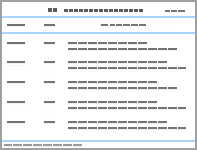
Tab. 1
Construction of index system for digital economy and common prosperity"
| 系统 | 子系统 | 评价要素 | 测算方法 | 单位 | 属性 | 指标权重 |
|---|---|---|---|---|---|---|
| 数字经济 | 数字经济要素投入 | 数字基础设施 | 每平方公里光缆线路长度 | km·km-2 | 正 | 0.075 |
| 移动电话普及率 | 部·(100人)-1 | 正 | 0.018 | |||
| 互联网宽带接入端口 | 104个 | 正 | 0.036 | |||
| 数字发展环境 | 信息传输、软件及信息服务业就业人员 | 104人 | 正 | 0.075 | ||
| 信息传输、软件及服务业固定资产投资额 | 104元 | 正 | 0.041 | |||
| 数字金融覆盖广度 | - | 正 | 0.019 | |||
| 数字经济发展水平 | 数字产业化规模 | 软件业务收入 | 104元 | 正 | 0.108 | |
| 信息技术服务收入 | 104元 | 正 | 0.110 | |||
| 数字金融数字化程度 | - | 正 | 0.018 | |||
| 产业数字化程度 | 每百家企业拥有网站数 | 个·(100家)-1 | 正 | 0.061 | ||
| 有电子商务交易活动的企业数比重 | % | 正 | 0.018 | |||
| 电子商务销售额占GDP的比重 | % | 正 | 0.042 | |||
| 数字金融使用深度 | - | 正 | 0.021 | |||
| 共同富裕 | 富裕度 | 物质富裕 | 居民人均消费支出 | 元·人-1 | 正 | 0.031 |
| 居民人均可支配收入 | 元·人-1 | 正 | 0.027 | |||
| 精神富裕 | 人均文化娱乐消费支出 | 元·人-1 | 正 | 0.023 | ||
| 人均拥有公共图书馆藏量 | 册·人-1 | 正 | 0.042 | |||
| 共享度 | 公共服务 | 公共财政教育经费支出占比 | % | 正 | 0.014 | |
| 每万人医疗卫生机构床位数 | 张·(104人)-1 | 正 | 0.014 | |||
| 每万人拥有公共交通车辆 | 标台·(104人)-1 | 正 | 0.016 | |||
| 城乡差距 | 城乡居民恩格尔系数比值 | - | 负 | 0.008 | ||
| 城乡居民人均可支配收入的绝对数比值 | - | 负 | 0.009 | |||
| 城乡居民人均消费支出的绝对数比值 | - | 负 | 0.009 | |||
| 可持续性 | 经济增长 | 人均GDP | 元·人-1 | 正 | 0.033 | |
| 城镇失业登记率 | % | 负 | 0.015 | |||
| 创新驱动 | R&D经费投入强度 | % | 正 | 0.041 | ||
| 每万人专利授权数 | 件·(104人)-1 | 正 | 0.065 | |||
| 绿色发展 | 建成区绿化覆盖率 | % | 正 | 0.008 | ||
| 单位GDP能耗 | tce·(104元)-1 | 负 | 0.001 |
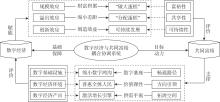
Fig. 1
Coupling coordination mechanism of the digital economy and common prosperity"
Tab. 2
Stage division of the coupling coordination degree"
| 范围 | 阶段 | 范围 | 阶段 |
|---|---|---|---|
| [0.0, 0.1) | 极度失调 | [0.5, 0.6) | 勉强协调 |
| [0.1, 0.2) | 严重失调 | [0.6, 0.7) | 初级协调 |
| [0.2, 0.3) | 中度失调 | [0.7, 0.8) | 中级协调 |
| [0.3, 0.4) | 轻度失调 | [0.8, 0.9) | 良好协调 |
| [0.4, 0.5) | 濒临失调 | [0.9, 1.0) | 优质协调 |
Tab. 3
Digital economy and common prosperity composite indices in China"
| 子系统 | 2013年 | 2014年 | 2015年 | 2016年 | 2017年 | 2018年 | 2019年 | 2020年 | 2021年 | 2022年 | 2023年 |
|---|---|---|---|---|---|---|---|---|---|---|---|
| 数字经济 | 0.089 | 0.106 | 0.139 | 0.148 | 0.164 | 0.185 | 0.199 | 0.215 | 0.239 | 0.252 | 0.273 |
| 共同富裕 | 0.199 | 0.215 | 0.232 | 0.248 | 0.264 | 0.290 | 0.309 | 0.328 | 0.372 | 0.368 | 0.393 |
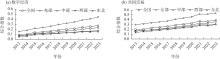
Fig. 2
Composite indices of digital economy and common prosperity in the four major regions"
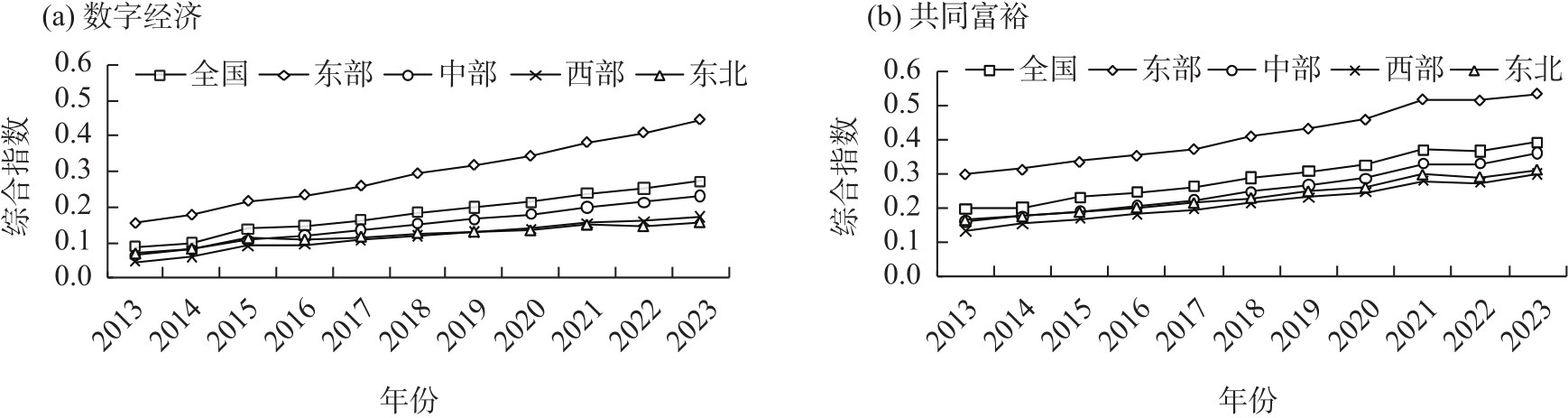
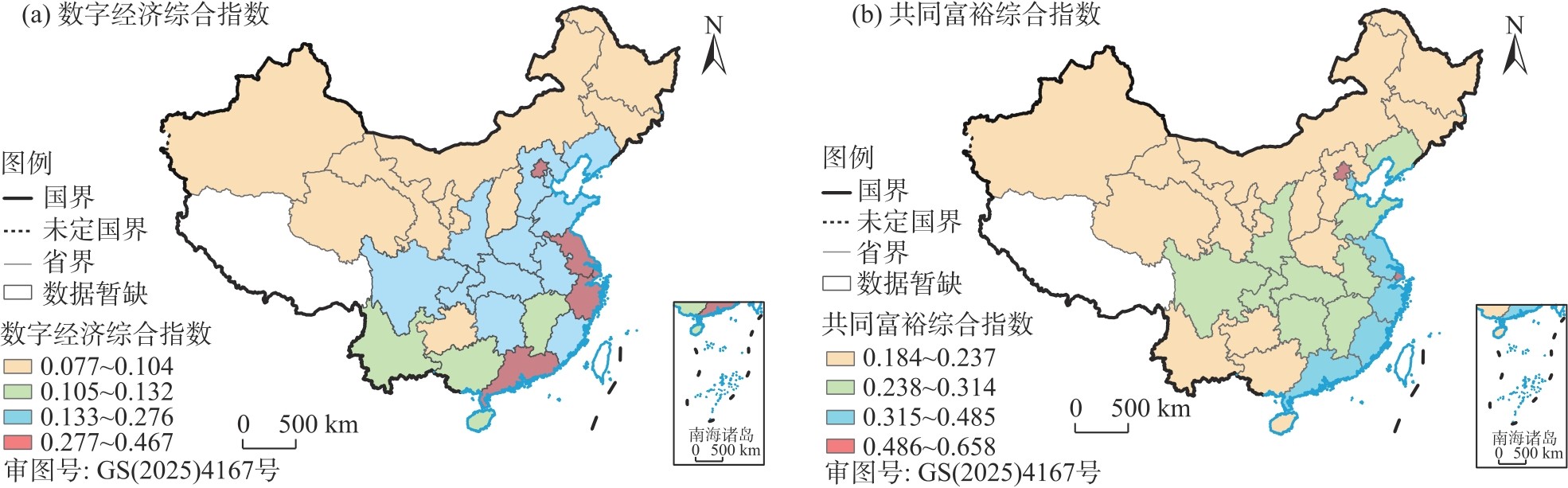
Fig. 3
Spatial distributions of digital economy and common prosperity composite indices"
Tab. 4
Coupling coordination degree between digital economy and common prosperity"
| 地区 | 2013年 | 2014年 | 2015年 | 2016年 | 2017年 | 2018年 | 2019年 | 2020年 | 2021年 | 2022年 | 2023年 |
|---|---|---|---|---|---|---|---|---|---|---|---|
| 全国 | 0.320 | 0.357 | 0.406 | 0.424 | 0.450 | 0.482 | 0.504 | 0.526 | 0.565 | 0.571 | 0.597 |
| 东部 | 0.464 | 0.493 | 0.536 | 0.557 | 0.583 | 0.622 | 0.646 | 0.672 | 0.717 | 0.729 | 0.754 |
| 中部 | 0.284 | 0.319 | 0.363 | 0.389 | 0.415 | 0.449 | 0.471 | 0.495 | 0.536 | 0.545 | 0.574 |
| 西部 | 0.215 | 0.265 | 0.322 | 0.338 | 0.364 | 0.392 | 0.413 | 0.432 | 0.467 | 0.468 | 0.495 |
| 东北 | 0.291 | 0.320 | 0.363 | 0.373 | 0.392 | 0.413 | 0.431 | 0.442 | 0.479 | 0.470 | 0.493 |
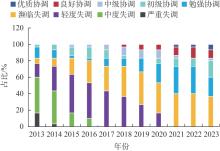
Fig. 4
Proportion of coupling coordination degree types"
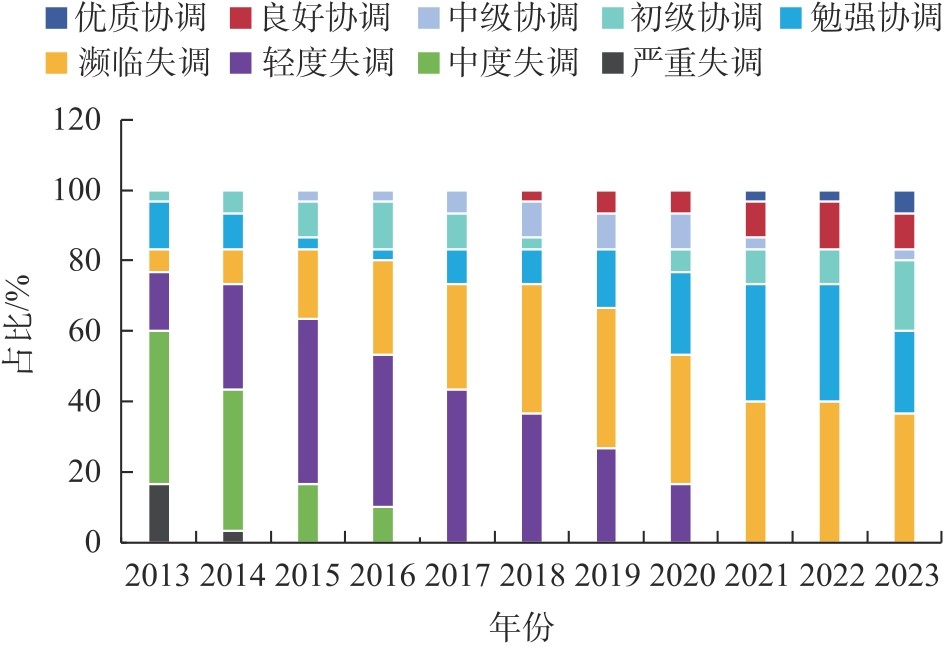
Fig. 5
Spatial distributions of coupling coordination degree between digital economy and common prosperity"
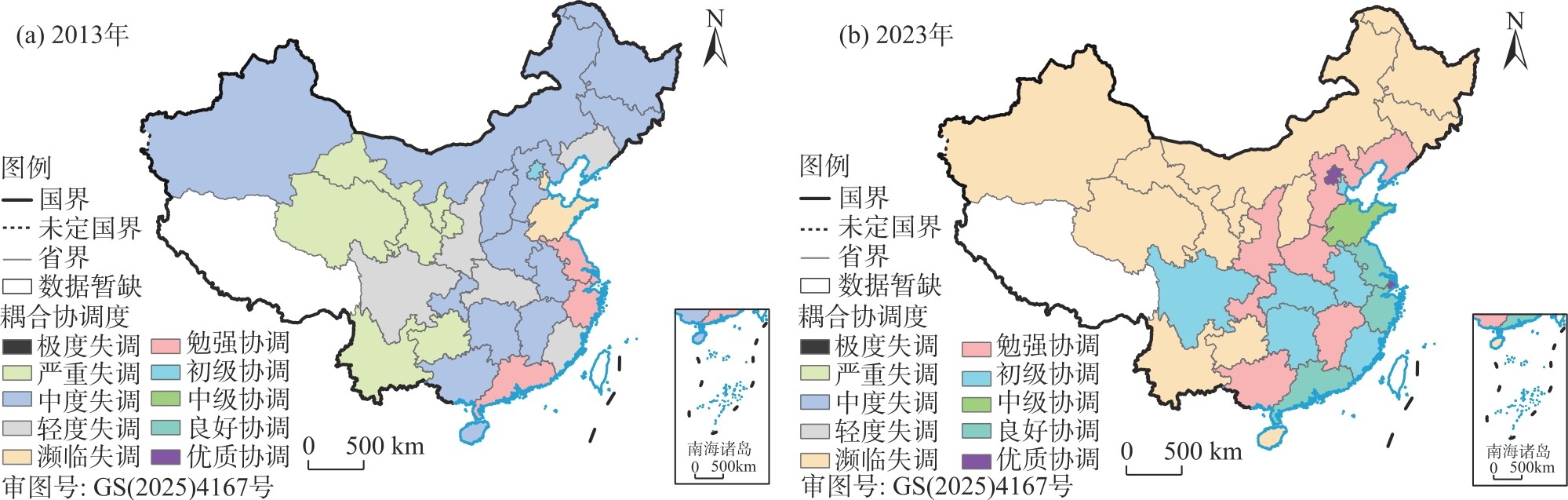
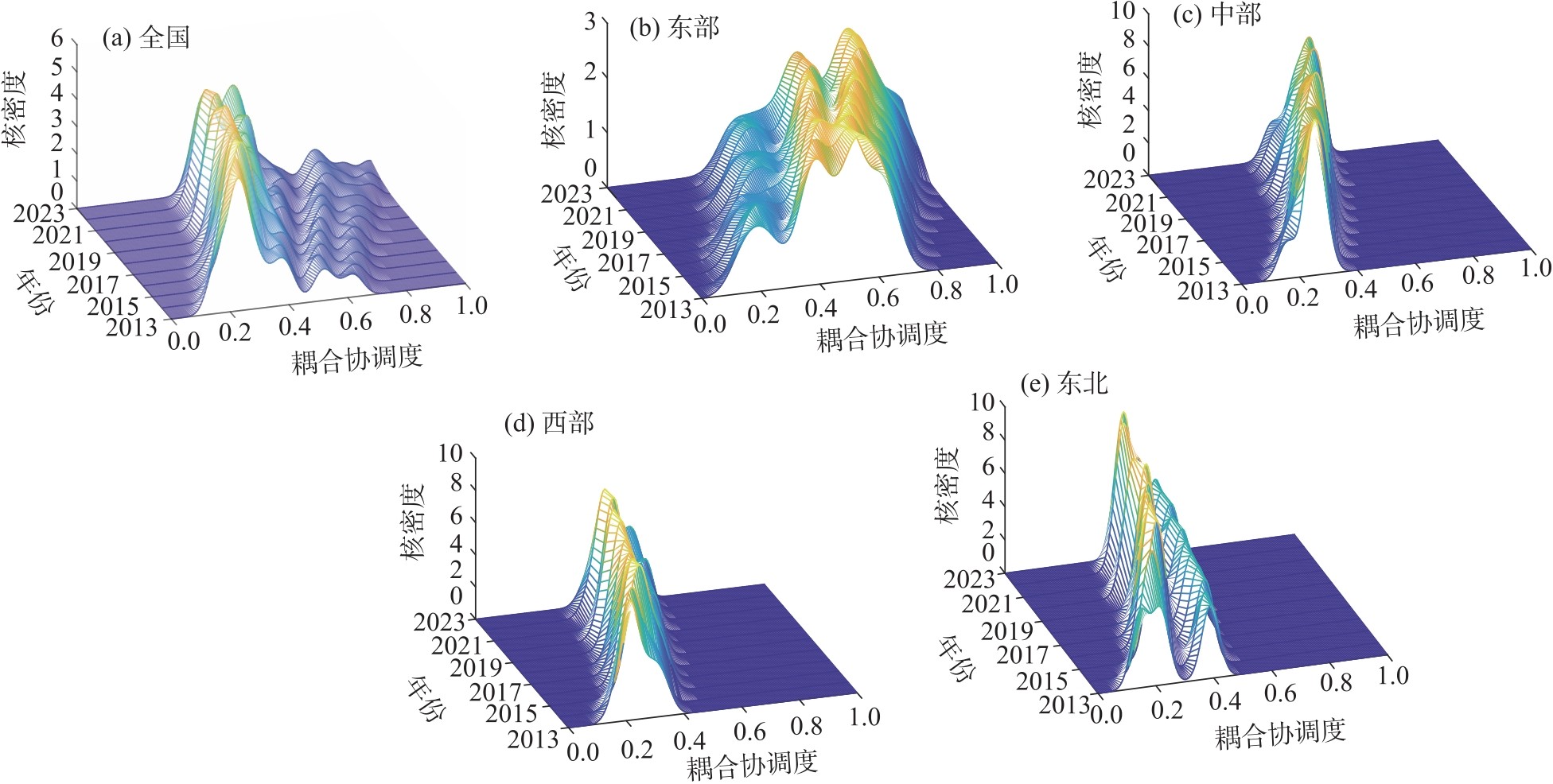
Fig. 6
Kernel density maps of national and four regional coupling coordination degree"
Tab. 5
Dagum’s Gini coefficient and decomposition of coupling coordination degree"
| 年份 | 总体基尼 系数 | 组内 差异 | 组内基尼系数 | 组间 差异 | 组间基尼系数 | 超变 密度 | ||||||||
|---|---|---|---|---|---|---|---|---|---|---|---|---|---|---|
| 东北 | 东部 | 中部 | 西部 | 东部与 东北 | 东部与 中部 | 东部与 西部 | 中部与 东北 | 中部与 西部 | 西部与 东北 | |||||
| 2013 | 0.235 | 0.047 | 0.217 | 0.195 | 0.083 | 0.112 | 0.142 | 0.317 | 0.323 | 0.321 | 0.195 | 0.109 | 0.193 | 0.142 |
| 2014 | 0.206 | 0.042 | 0.161 | 0.183 | 0.078 | 0.090 | 0.128 | 0.279 | 0.294 | 0.287 | 0.151 | 0.088 | 0.149 | 0.128 |
| 2015 | 0.176 | 0.035 | 0.122 | 0.170 | 0.060 | 0.067 | 0.108 | 0.253 | 0.264 | 0.247 | 0.114 | 0.068 | 0.117 | 0.108 |
| 2016 | 0.172 | 0.035 | 0.117 | 0.163 | 0.059 | 0.070 | 0.103 | 0.256 | 0.245 | 0.243 | 0.114 | 0.070 | 0.115 | 0.103 |
| 2017 | 0.161 | 0.032 | 0.101 | 0.155 | 0.052 | 0.065 | 0.102 | 0.250 | 0.224 | 0.234 | 0.103 | 0.062 | 0.101 | 0.102 |
| 2018 | 0.155 | 0.030 | 0.084 | 0.142 | 0.044 | 0.065 | 0.105 | 0.241 | 0.210 | 0.232 | 0.086 | 0.065 | 0.082 | 0.105 |
| 2019 | 0.151 | 0.029 | 0.073 | 0.138 | 0.047 | 0.063 | 0.104 | 0.231 | 0.204 | 0.230 | 0.077 | 0.068 | 0.074 | 0.104 |
| 2020 | 0.159 | 0.031 | 0.082 | 0.140 | 0.053 | 0.069 | 0.111 | 0.254 | 0.206 | 0.239 | 0.093 | 0.076 | 0.083 | 0.111 |
| 2021 | 0.152 | 0.029 | 0.068 | 0.136 | 0.047 | 0.065 | 0.108 | 0.239 | 0.196 | 0.233 | 0.079 | 0.076 | 0.070 | 0.108 |
| 2022 | 0.159 | 0.030 | 0.070 | 0.136 | 0.054 | 0.073 | 0.114 | 0.256 | 0.195 | 0.240 | 0.099 | 0.085 | 0.081 | 0.114 |
| 2023 | 0.147 | 0.029 | 0.057 | 0.132 | 0.052 | 0.068 | 0.106 | 0.242 | 0.182 | 0.222 | 0.091 | 0.076 | 0.072 | 0.106 |
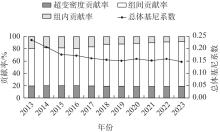
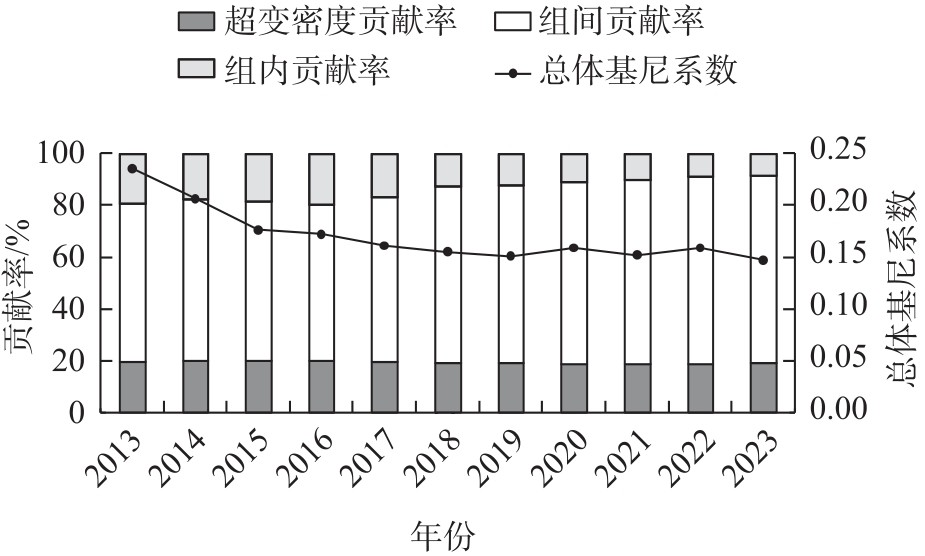
Fig. 7
Regional differences and sources of coupling coordination degree"
| [1] | 周月华, 时文龙, 丁红艳. 数字经济赋能共同富裕研究的知识图谱分析[J]. 管理现代化, 2023, 43(6): 176-185. |
| [Zhou Yuehua, Shi Wenlong, Ding Hongyan. Knowledge graph analysis of digital economy enabling common prosperity research[J]. Modernization of Management, 2023, 43(6): 176-185.] | |
| [2] | 欧阳日辉. 数字经济中经济增长的新动力与新范式[J]. 广东社会科学, 2024(1): 15-26, 284. |
| [Ouyang Rihui. The new momentum and new paradigm of economic growth in the digital economy[J]. Social Sciences in Guangdong, 2024(1): 15-26, 284.] | |
| [3] | 张菀洺, 代伟. 中国特色数字经济治理体系构建[J]. 社会科学战线, 2023(4): 250-254. |
| [Zhang Wanming, Dai Wei. Building a digital economy governance system with Chinese characteristics[J]. Social Science Front, 2023(4): 250-254.] | |
| [4] | 马万里. 新型城镇化、技术溢出与数字经济发展[J]. 科学学研究, 2025, 43(9): 1833-1844. |
| [Ma Wangli. New urbanization, technology spillover and digital economy development[J]. Studies in Science of Science, 2025, 43(9): 1833-1844.] | |
| [5] | 余长林, 沈兵. 数字经济发展对中国要素市场扭曲的影响研究[J]. 科研管理, 2024, 45(6): 62-71. |
| [Yu Changlin, Shen Bing. Research on the impact of digital economy development on China’s factor market distortion[J]. Science Research Management, 2024, 45(6): 62-71.] | |
| [6] | 李文君. 数字经济发展对创新能力的空间溢出效应分析——基于省际面板数据的实证研究[J]. 大连理工大学学报(社会科学版), 2023, 44(6): 23-32. |
| [Li Wenjun. Analysis of spatial spillover effects of innovation capability in digital economy: An empirical study based on interprovincial panel data: An empirical study based on interprovincial panel data[J]. Journal of Dalian University of Technology (Social Sciences Edition), 2023, 44(6): 23-32.] | |
| [7] | 高志刚, 胡时豪. 数字经济对区域经济韧性影响的测度研究[J]. 价格理论与实践, 2024(1): 140-144. |
| [Gao Zhigang, Hu Shihao. Measuring the impact of digital rconomy on regional economic resilience[J]. Price: Theory & Practice, 2024(1): 140-144.] | |
| [8] | 方明月, 林佳妮, 聂辉华. 数字化转型是否促进了企业内共同富裕?——来自中国A股上市公司的证据[J]. 数量经济技术经济研究, 2022, 39(11): 50-70. |
| [Fang Mingyue, Lin Jiani, Nie Huihua. Does gigital transformation promote common prosperity within girms? Evidence from Chinese A-share listed firms[J]. Journal of Quantitative & Technological Economics, 2022, 39(11): 50-70.] | |
| [9] | 丁晓钦, 崔泽鹏. 《资本论》及其手稿共同富裕思想探析[J]. 政治经济学评论, 2025, 16(4): 120-134. |
| [Ding Xiaoqin, Cui Zepeng. An analysis of the thought of common prosperity in capital and its manuscripts[J]. China Review of Political Economy, 2025, 16(4): 120-134.] | |
| [10] | 顾海良. 共同富裕是社会主义的本质要求[J]. 红旗文稿, 2021(20): 4-11. |
| [Gu Hailiang. Common prosperity is an essential requirement of socialism[J]. Red Flag Manuscript, 2021(20): 4-11.] | |
| [11] | 柳毅, 赵轩, 毛峰. 数字经济驱动共同富裕的发展动力与空间溢出效应研究——基于长三角面板数据和空间杜宾模型[J]. 中国软科学, 2023(4): 98-108. |
| [Liu Yi, Zhao Xuan, Mao Feng. Research on the driving force, mechanism and spatial spillover effects of digital economy bolstering common prosperity in the Yangtze River Delta[J]. China Soft Science, 2023(4): 98-108.] | |
| [12] |
王鑫, 郑芳, 何铃瑶, 等. 宁夏县域共同富裕水平时空分异格局及驱动因素研究[J]. 干旱区地理, 2025, 48(7): 1293-1303.
doi: 10.12118/j.issn.1000-6060.2024.443 |
|
[Wang Xin, Zheng Fang, He Lingyao, et al. Spatiotemporal differentiation pattern and driving factors of common prosperity level in Ningxia county areas[J]. Arid Land Geography, 2025, 48(7): 1293-1303.]
doi: 10.12118/j.issn.1000-6060.2024.443 |
|
| [13] | 祝嘉良, 纪洋, 陈少华, 等. 数字经济与共同富裕[J]. 中国经济问题, 2022(2): 1-13. |
| [Zhu Jialiang, Ji Yang, Chen Shaohua, et al. Digital economy and common prosperity[J]. China Economic Studies, 2022(2): 1-13.] | |
| [14] | 陈梦根, 周元任. 数字经济、分享发展与共同富裕[J]. 数量经济技术经济研究, 2023, 40(10): 5-26. |
| [Chen Menggen, Zhou Yuanren. Digital economy, shared development and common prosperity[J]. Journal of Quantitative & Technological Economics, 2023, 40(10): 5-26.] | |
| [15] | 王军, 朱彤, 郭俏妤. 数字经济、搜寻摩擦与非农就业[J]. 经济学动态, 2025(8): 76-94. |
| [Wang Jun, Zhu Tong, Guo Qiaoyu. Digital economy, search frictions and non-agricultural employment[J]. Economic Perspectives, 2025(8): 76-94.] | |
| [16] | 冀福俊. 数字经济对城乡收入差距的影响——基于产业结构高级化的调节效应分析[J]. 经济问题, 2023(2): 35-41. |
| [Ji Fujun. The impact of digital economy on urban-rural income gap: Analysis of the moderating effect based on the industrial structure upgrading[J]. On Economic Problems, 2023(2): 35-41.] | |
| [17] | 戚聿东, 褚席. 数字经济发展、经济结构转型与跨越中等收入陷阱[J]. 财经研究, 2021, 47(7): 18-32, 168. |
| [Qi Yudong, Chu Xi. Development of the digital economy, transformation of the economic structure and leaping of the middle-income trap[J]. Journal of Finance and Economics, 2021, 47(7): 18-32, 168.] | |
| [18] | 郑月明, 梅澳裕, 陈家帅. 数字经济与共同富裕的耦合协调及驱动机制——基于湖北省地级市的探讨[J]. 调研世界, 2023(2): 77-88. |
| [Zheng Yueming, Mei Aoyu, Chen Jiashuai. The coupling coordination and driving mechanism between the digital economy and common prosperity: Based on the discussion of prefecture-level cities in Hubei Province[J]. The World of Survey and Research, 2023(2): 77-88.] | |
| [19] | 赵涛, 张智, 梁上坤. 数字经济、创业活跃度与高质量发展——来自中国城市的经验证据[J]. 管理世界, 2020, 36(10): 65-76. |
| [Zhao Tao, Zhang Zhi, Liang Shangkun. Digital economy, entrepreneurship, and high quality economic development: Empirical evidence from urban China[J]. Journal of Management World, 2020, 36(10): 65-76.] | |
| [20] |
刘法建, 梁婉欣, 黄超群, 等. 中国旅游新质生产力发展时空演化特征与驱动因素[J]. 干旱区地理, 2026, 49(3): 429-439.
doi: 10.12118/j.issn.1000-6060.2025.291 |
|
[Liu Fajian, Liang Wanxin, Huang Chaoqun, et al. Spatio-temporal evolution characteristics and driving factors of tourism new quality productivity in China[J]. Arid Land Geography, 2026, 49(3): 429-439.]
doi: 10.12118/j.issn.1000-6060.2025.291 |
|
| [21] |
楚文溪, 杨新军, 李润阳. 关中平原城市群城市韧性与生态系统服务耦合协调关系及影响因素[J]. 干旱区地理, 2025, 48(11): 2005-2018.
doi: 10.12118/j.issn.1000-6060.2024.751 |
|
[Chu Wenxi, Yang Xinjun, Li Runyang. Coupling coordination relationship and influencing factors between urban resilience and ecosystem services in the Guanzhong Plain urban agglomeration[J]. Arid Land Geography, 2025, 48(11): 2005-2018.]
doi: 10.12118/j.issn.1000-6060.2024.751 |
|
| [22] |
王金伟, 王启翔, 陆大道. 数字经济、旅游经济与新型城镇化时空耦合格局及影响因素——以长三角地区为例[J]. 地理研究, 2024, 43(12): 3301-3326.
doi: 10.11821/dlyj020231126 |
| [Wang Jinwei, Wang Qixiang, Lu Dadao. Spatio-temporal coupling pattern and its influencing factors of digital economy, tourism economy and new urbanization: A case study of Yangtze River Delta region[J]. Geographical Research, 2024, 43(12): 3301-3326.] | |
| [23] | 李怡旻, 宋长青, 王翔宇, 等. 基于熵值法与耦合协调度的鄂尔多斯市各旗区高质量发展评估与分析[J]. 首都师范大学学报(自然科学版), 2025, 46(4): 11-21. |
| [Li Yimin, Song Changqing, Wang Xiangyu, et al. Evaluation and analysis of high quality development of each county in Ordos City based on entropy method and coupling coordination degree[J]. Journal of Capital Normal University (Natural Science Edition), 2025, 46(4): 11-21.] | |
| [24] | 徐中春, 苏广见, 刘燕华, 等. 山东省新质生产力综合评价: 发展指数测度、动态演进及其障碍因子[J]. 中国人口·资源与环境, 2025, 35(2): 195-204. |
| [Xu Zhongchun, Su Guangjian, Liu Yanhua, et al. Development index measurement, dynamic evolution, and obstacle factors of new quality productive forces in Shandong Province[J]. China Population, Resources and Environment, 2025, 35(2): 195-204.] | |
| [25] |
吉泽男, 付文婷, 王鹏程, 等. 干旱区数字经济与农业绿色发展耦合协调研究——以新疆为例[J]. 干旱区地理, 2024, 47(11): 1981-1990.
doi: 10.12118/j.issn.1000-6060.2023.637 |
|
[Ji Zenan, Fu Wenting, Wang Pengcheng, et al. Coupling and coordination of digital economy and green development of agriculture in arid zones: A case of Xinjiang[J]. Arid Land Geography, 2024, 47(11): 1981-1990.]
doi: 10.12118/j.issn.1000-6060.2023.637 |
|
| [26] | 张利霞. 我国数字经济与共同富裕的耦合协调机理与测度研究[J]. 经济与社会发展, 2025, 23(2): 45-55. |
| [Zhang Lixia. Coupling coordination mechanisms and measurement between China’s digital economy and common prosperity[J]. Economic and Social Development, 2025, 23(2): 45-55.] |
|
||

