Arid Land Geography ›› 2026, Vol. 49 ›› Issue (9): 1924-1939.doi: 10.12118/j.issn.1000-6060.2026.001
• Regional Development • Previous Articles Next Articles
GUO Jinzhong( ), LIU Yajie, LIU Xiaoling
Received:2026-01-04
Revised:2026-02-20
Online:2026-09-25
Published:2026-09-07
GUO Jinzhong, LIU Yajie, LIU Xiaoling. Coupling coordination evolution and constraint mechanisms of the WEFE system in China: Based on the provincial scale and the perspective of arid and semi-arid regions[J].Arid Land Geography, 2026, 49(9): 1924-1939.
Tab. 1
Comprehensive evaluation index system of the WEFE system"
| 子系统层 | 准则层 | 评价指标 | 单位 | 熵权法比重 | 性质 |
|---|---|---|---|---|---|
| 水资源子系统 | 总量指标 | 人均水资源总量(W1) | m3·人-1 | 0.2500 | 正 |
| 人均用水量(W2) | m3·人-1 | 0.0130 | 负 | ||
| 产水模数(W3) | m3·km-2 | 0.3043 | 正 | ||
| 结构指标 | 农业用水量占比(W4) | % | 0.0631 | 负 | |
| 工业用水量占比(W5) | % | 0.0243 | 负 | ||
| 生活用水量占比(W6) | % | 0.0198 | 负 | ||
| 生态用水量占比(W7) | % | 0.3100 | 正 | ||
| 效益指标 | 万元GDP用水量(W8) | m3·(104元)-1 | 0.0047 | 负 | |
| 万元工业增加值用水量(W9) | m3·(104元)-1 | 0.0110 | 负 | ||
| 能源子系统 | 总量指标 | 一次性能源生产总量(E1) | 104 tce | 0.3679 | 正 |
| 发电量(E2) | 108 kWh | 0.1517 | 正 | ||
| 人均能源生产量(E3) | tce·人-1 | 0.4356 | 正 | ||
| 能源消耗总量(E4) | 104 tce | 0.0225 | 负 | ||
| 效益指标 | 万元GDP能耗(E5) | tce·(104元)-1 | 0.0120 | 负 | |
| 万元GDP电耗(E6) | kWh·(104元)-1 | 0.0103 | 负 | ||
| 粮食子系统 | 总量指标 | 人均粮食产量(F1) | kg·人-1 | 0.1552 | 正 |
| 粮食总产值(F2) | 104 t | 0.1875 | 正 | ||
| 农用机械总动力(F3) | 104 kWh | 0.1871 | 正 | ||
| 粮食播种面积(F4) | hm2 | 0.1413 | 正 | ||
| 效益指标 | 城镇居民家庭恩格尔系数(F5) | % | 0.0333 | 负 | |
| 农村居民家庭恩格尔系数(F6) | % | 0.0335 | 负 | ||
| 农产品生产价格指数(F7) | 点 | 0.0364 | 正 | ||
| 单位面积产量(F8) | kg·hm-2 | 0.0570 | 正 | ||
| 有效灌溉面积(F9) | 103 hm2 | 0.1687 | 正 | ||
| 生态子系统 | 生态基础 | 森林覆盖率(Ec1) | % | 0.1159 | 正 |
| 城市绿地面积(Ec2) | 104 hm2 | 0.2110 | 正 | ||
| 建成区绿化覆盖率(Ec3) | % | 0.0258 | 正 | ||
| 生态压力 | SO2排放量(Ec4) | 104 t | 0.0291 | 负 | |
| 农用化肥施用折纯量(Ec5) | 104 t | 0.0244 | 负 | ||
| 治理废水项目完成投资(Ec6) | 104元 | 0.2792 | 正 | ||
| 治理废气项目完成投资(Ec7) | 104元 | 0.2599 | 正 | ||
| 生态效率 | 生活垃圾无害化处理率(Ec8) | % | 0.0271 | 正 | |
| 城镇生活污水处理率(Ec9) | % | 0.0276 | 正 |
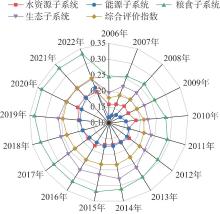
Fig. 1
Comprehensive evaluation index of the WEFE system in China from 2006 to 2022"
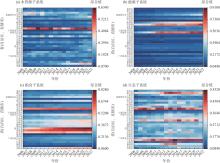
Fig. 2
Distribution characteristics of the comprehensive index of the WEFE system in China from 2006 to 2022"
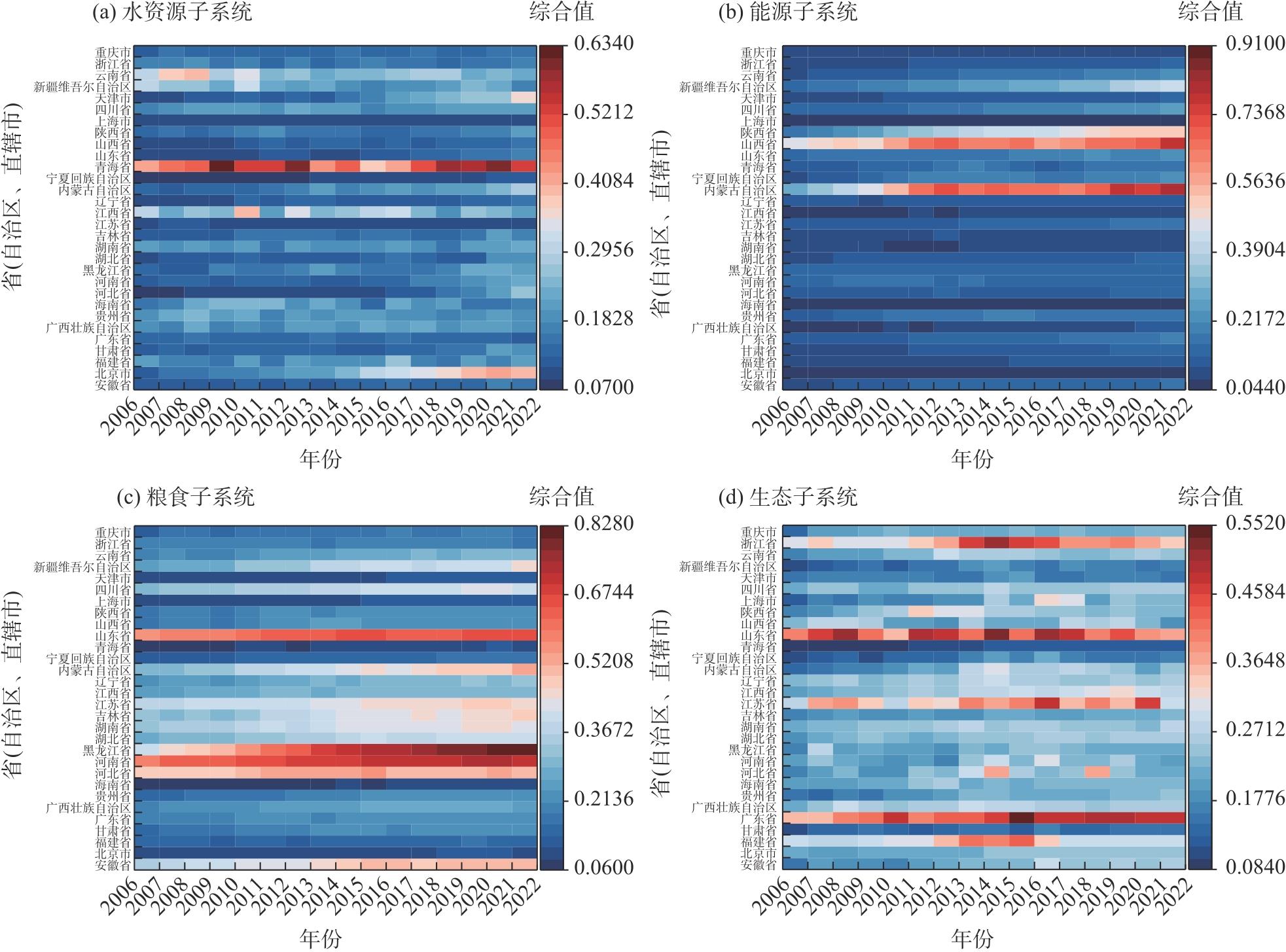
Fig. 3
Coupling degree of the WEFE system in China from 2006 to 2022"
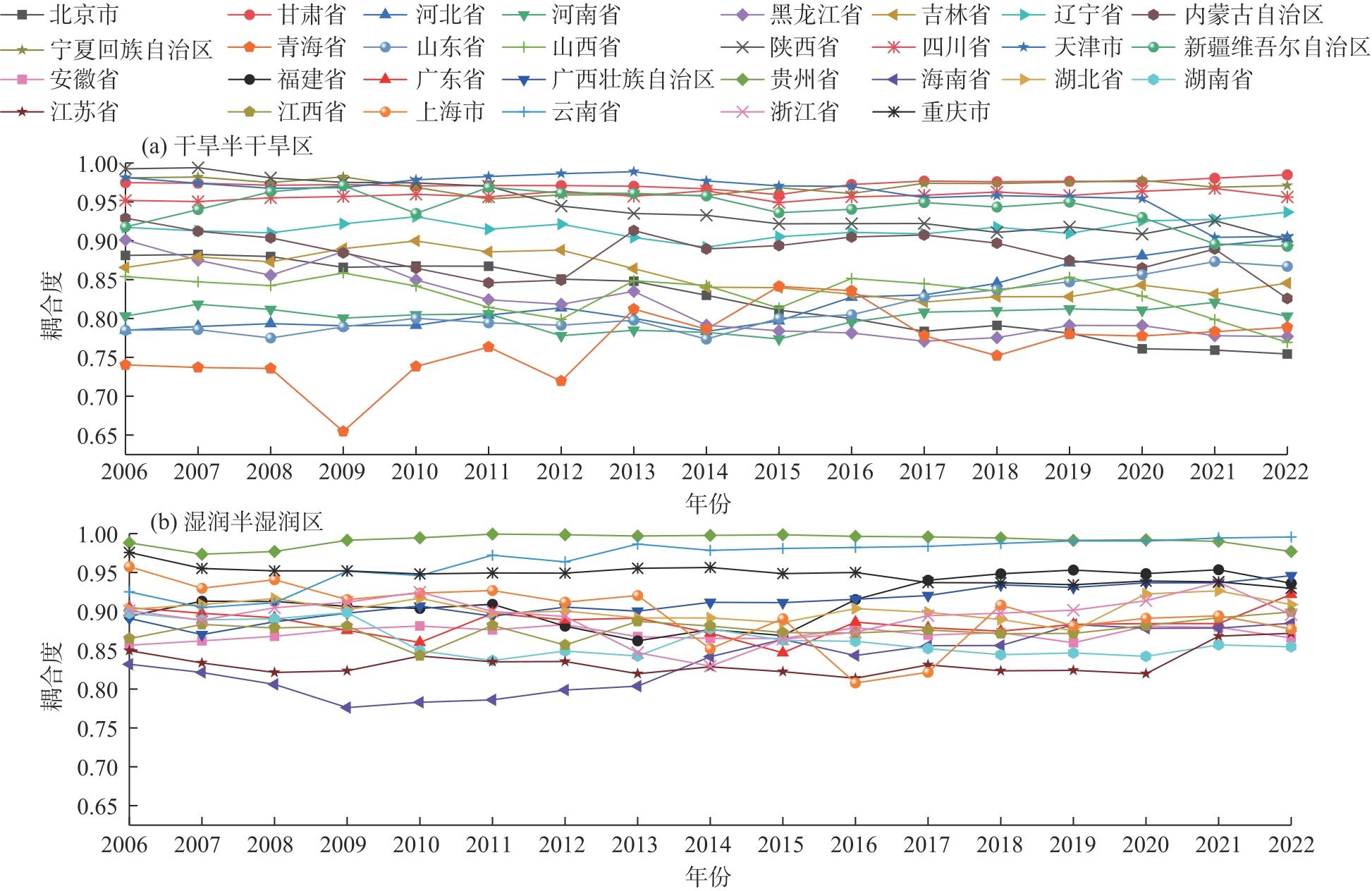
Fig. 4
Coupling coordination of the WEFE system in China from 2006 to 2022"
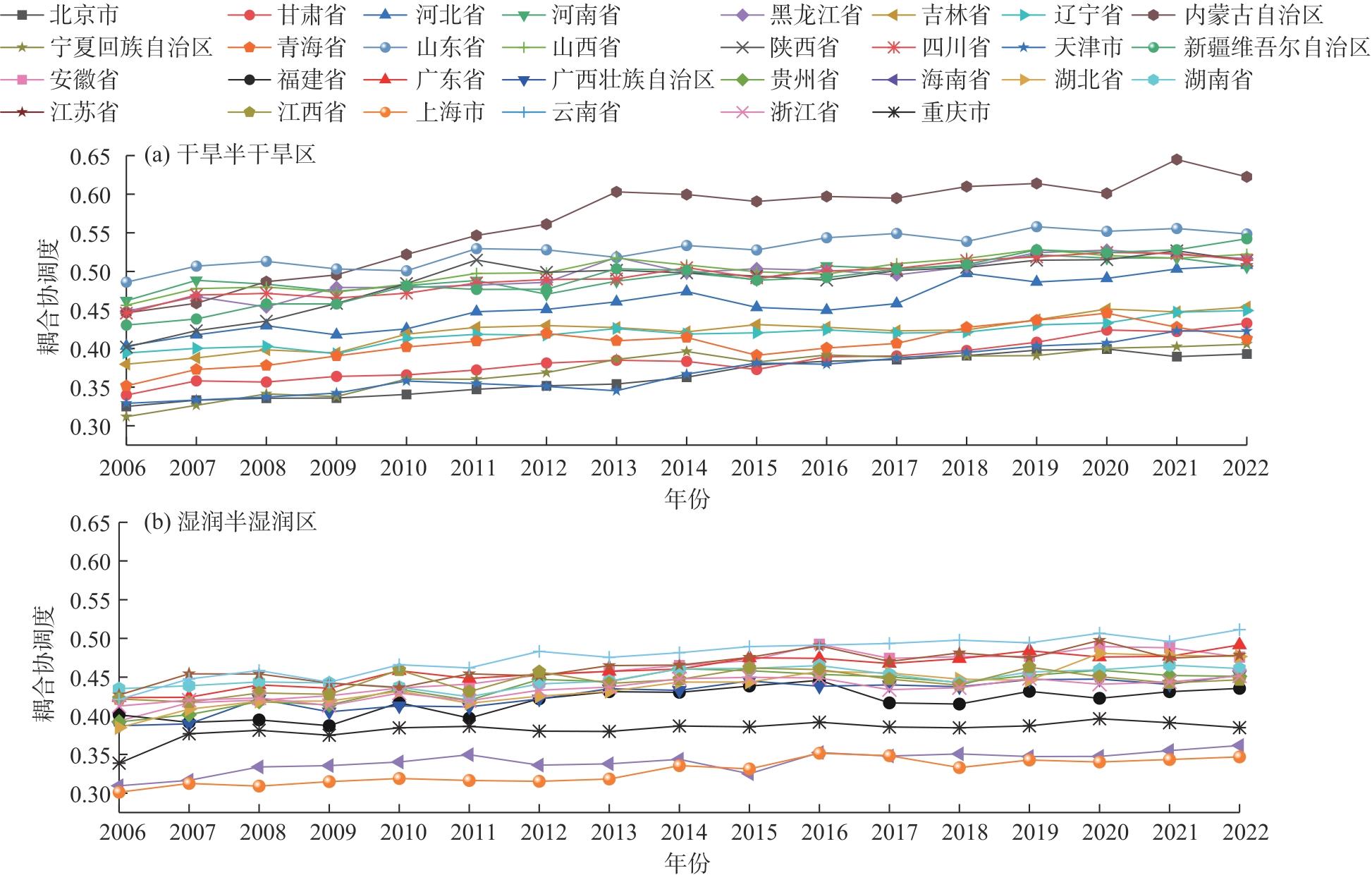
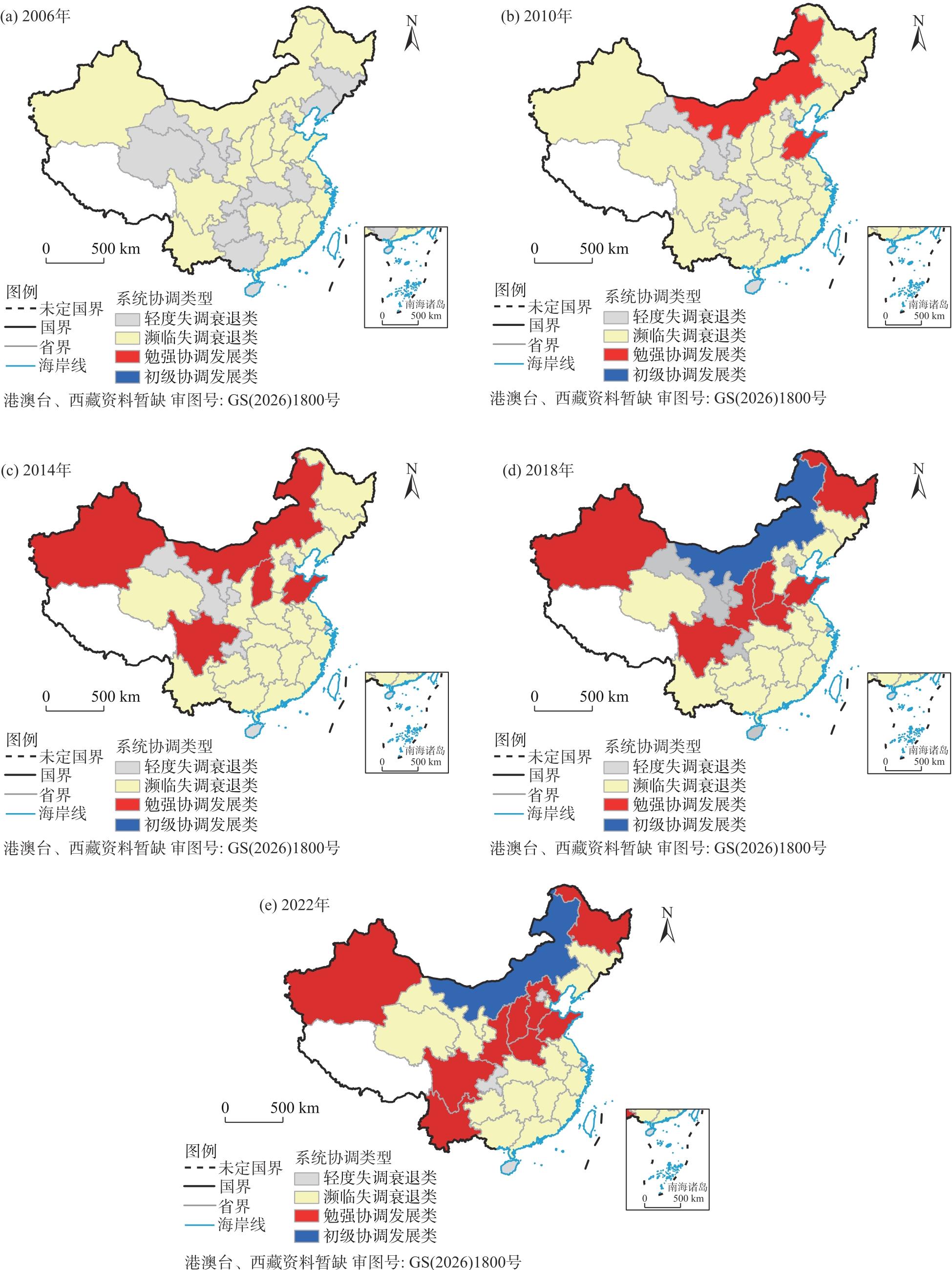
Fig. 5
Spatial distribution patterns of coupling coordination of the WEFE system in China from 2006 to 2022"
Tab. 2
Global Moran’s I of coupling coordination of the WEFE system in China from 2006 to 2022"
| 年份 | 全局莫兰指数 | P | 年份 | 全局莫兰指数 | P |
|---|---|---|---|---|---|
| 2006 | 0.397 | 0.006 | 2015 | 0.331 | 0.015 |
| 2007 | 0.390 | 0.006 | 2016 | 0.338 | 0.013 |
| 2008 | 0.403 | 0.005 | 2017 | 0.333 | 0.014 |
| 2009 | 0.412 | 0.004 | 2018 | 0.306 | 0.021 |
| 2010 | 0.447 | 0.002 | 2019 | 0.352 | 0.011 |
| 2011 | 0.411 | 0.004 | 2020 | 0.327 | 0.016 |
| 2012 | 0.422 | 0.003 | 2021 | 0.319 | 0.016 |
| 2013 | 0.347 | 0.011 | 2022 | 0.293 | 0.025 |
| 2014 | 0.335 | 0.014 |
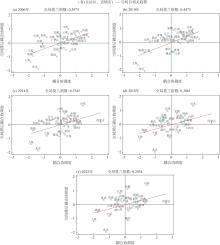
Fig. 6
Moran scatter plots of coupling coordination of the WEFE system in China from 2006 to 2022"
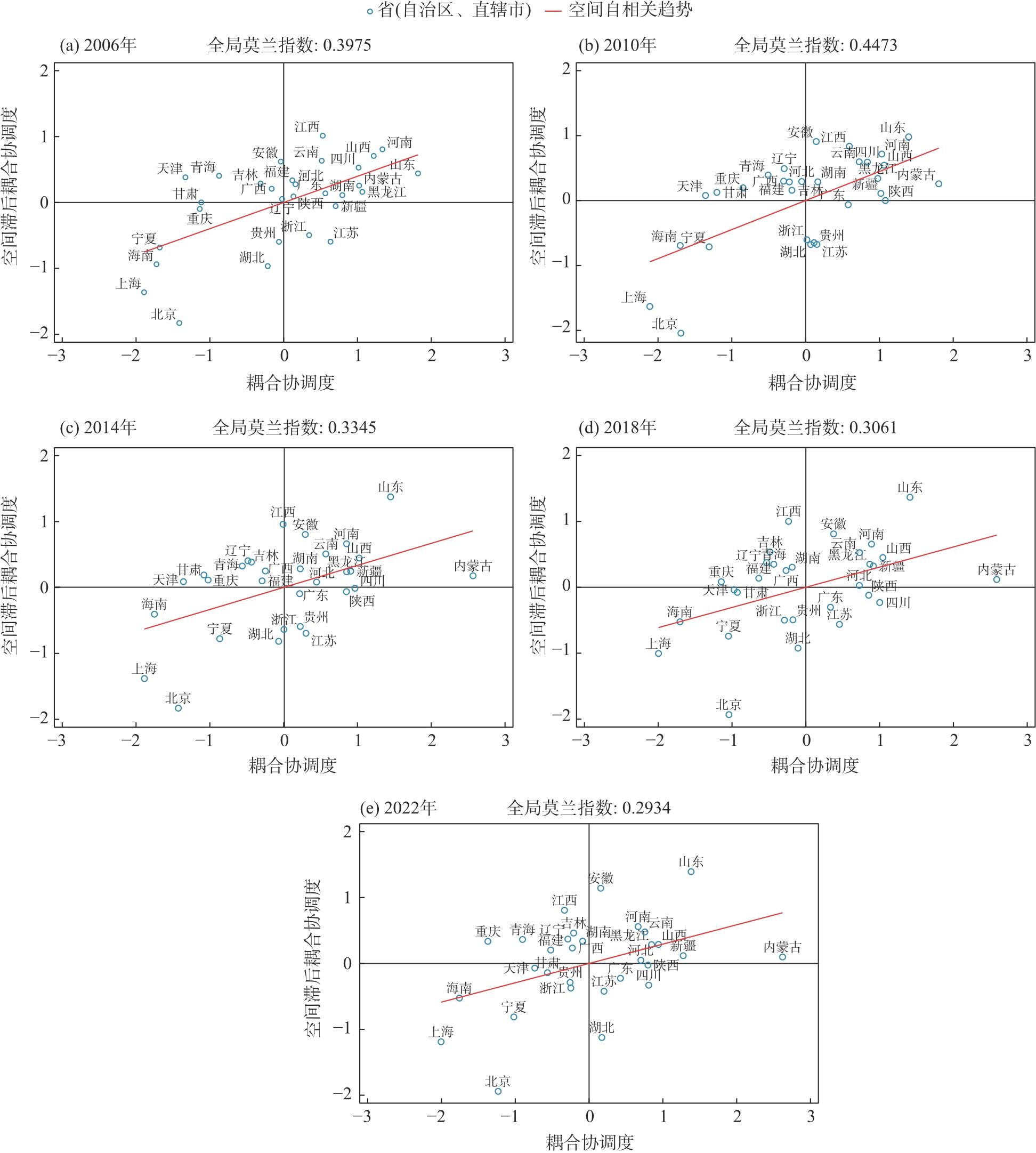
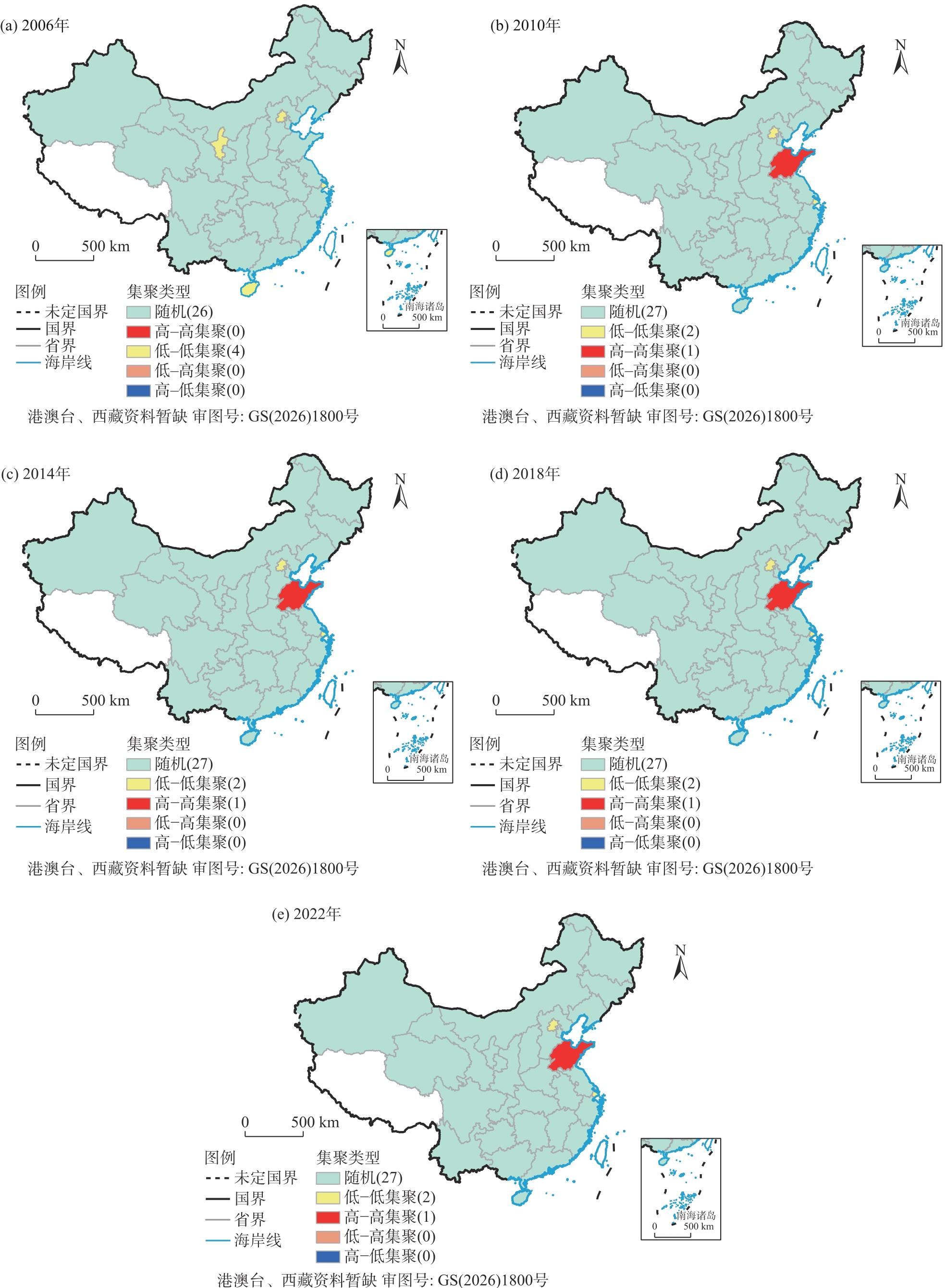
Fig. 7
Spatial agglomeration diagrams of coupling coordination of the WEFE system in China from 2006 to 2022"
Tab. 3
Grey relation of coupling coordination development between subsystems and the WEFE system"
| 子系统 | 北京市 | 天津市 | 河北省 | 山西省 | 辽宁省 | |||||||||
|---|---|---|---|---|---|---|---|---|---|---|---|---|---|---|
| 关联度 | 排名 | 关联度 | 排名 | 关联度 | 排名 | 关联度 | 排名 | 关联度 | 排名 | |||||
| 水资源 | 0.578 | 4 | 0.697 | 4 | 0.780 | 4 | 0.650 | 3 | 0.655 | 4 | ||||
| 能源 | 0.892 | 3 | 0.926 | 2 | 0.936 | 2 | 0.626 | 4 | 0.916 | 1 | ||||
| 粮食 | 0.956 | 1 | 0.958 | 1 | 0.950 | 1 | 0.804 | 1 | 0.690 | 3 | ||||
| 生态 | 0.954 | 2 | 0.922 | 3 | 0.789 | 3 | 0.732 | 2 | 0.876 | 2 | ||||
| 子系统 | 吉林省 | 黑龙江省 | 上海市 | 浙江省 | 安徽省 | |||||||||
| 关联度 | 排名 | 关联度 | 排名 | 关联度 | 排名 | 关联度 | 排名 | 关联度 | 排名 | |||||
| 水资源 | 0.663 | 4 | 0.752 | 2 | 0.883 | 3 | 0.760 | 2 | 0.818 | 1 | ||||
| 能源 | 0.815 | 1 | 0.736 | 3 | 0.950 | 1 | 0.620 | 4 | 0.514 | 4 | ||||
| 粮食 | 0.669 | 3 | 0.509 | 4 | 0.927 | 2 | 0.846 | 1 | 0.757 | 2 | ||||
| 生态 | 0.705 | 2 | 0.786 | 1 | 0.582 | 4 | 0.698 | 3 | 0.615 | 3 | ||||
| 子系统 | 福建省 | 江西省 | 河南省 | 湖北省 | 湖南省 | |||||||||
| 关联度 | 排名 | 关联度 | 排名 | 关联度 | 排名 | 关联度 | 排名 | 关联度 | 排名 | |||||
| 水资源 | 0.676 | 3 | 0.581 | 3 | 0.705 | 4 | 0.723 | 1 | 0.696 | 2 | ||||
| 能源 | 0.568 | 4 | 0.769 | 1 | 0.859 | 1 | 0.652 | 4 | 0.709 | 1 | ||||
| 粮食 | 0.834 | 1 | 0.677 | 2 | 0.859 | 2 | 0.686 | 3 | 0.512 | 4 | ||||
| 生态 | 0.779 | 2 | 0.519 | 4 | 0.803 | 3 | 0.722 | 2 | 0.585 | 3 | ||||
| 子系统 | 广东省 | 海南省 | 重庆市 | 四川省 | 贵州省 | |||||||||
| 关联度 | 排名 | 关联度 | 排名 | 关联度 | 排名 | 关联度 | 排名 | 关联度 | 排名 | |||||
| 水资源 | 0.581 | 3 | 0.628 | 3 | 0.856 | 1 | 0.865 | 1 | 0.736 | 1 | ||||
| 能源 | 0.769 | 1 | 0.805 | 2 | 0.847 | 2 | 0.612 | 4 | 0.659 | 2 | ||||
| 粮食 | 0.677 | 2 | 0.627 | 4 | 0.493 | 3 | 0.810 | 3 | 0.624 | 4 | ||||
| 生态 | 0.519 | 4 | 0.892 | 1 | 0.440 | 4 | 0.862 | 2 | 0.625 | 3 | ||||
| 子系统 | 陕西省 | 甘肃省 | 青海省 | 宁夏回族自治区 | 内蒙古自治区 | |||||||||
| 关联度 | 排名 | 关联度 | 排名 | 关联度 | 排名 | 关联度 | 排名 | 关联度 | 排名 | |||||
| 水资源 | 0.918 | 2 | 0.777 | 1 | 0.756 | 1 | 0.826 | 2 | 0.828 | 2 | ||||
| 能源 | 0.526 | 4 | 0.614 | 4 | 0.548 | 4 | 0.525 | 4 | 0.527 | 4 | ||||
| 粮食 | 0.970 | 1 | 0.641 | 4 | 0.658 | 3 | 0.897 | 1 | 0.893 | 1 | ||||
| 生态 | 0.819 | 3 | 0.666 | 2 | 0.720 | 2 | 0.761 | 3 | 0.777 | 3 | ||||
| 子系统 | 江苏省 | 山东省 | 广西壮族自治区 | 云南省 | 新疆维吾尔自治区 | |||||||||
| 关联度 | 排名 | 关联度 | 排名 | 关联度 | 排名 | 关联度 | 排名 | 关联度 | 排名 | |||||
| 水资源 | 0.755 | 2 | 0.694 | 4 | 0.850 | 1 | 0.717 | 2 | 0.751 | 2 | ||||
| 能源 | 0.628 | 4 | 0.756 | 3 | 0.571 | 4 | 0.579 | 4 | 0.642 | 4 | ||||
| 粮食 | 0.872 | 1 | 0.915 | 1 | 0.800 | 2 | 0.794 | 1 | 0.807 | 1 | ||||
| 生态 | 0.630 | 3 | 0.780 | 2 | 0.737 | 3 | 0.689 | 3 | 0.748 | 3 | ||||
Tab. 4
Grey relation of coupling coordination development between each indicator of the subsystem and the WEFE system"
| 类型 | 省(自治区、直辖市) | 指标(灰色关联度) | |||
|---|---|---|---|---|---|
| 水资源 | 能源 | 粮食 | 生态 | ||
| 干旱半干旱区 | 青海省 | W4(0.9865) | E6(0.9898) | F8(0.8263) | Ec3(0.9980) |
| 黑龙江省 | W4(0.8964) | E4(0.9653) | F4(0.8964) | Ec1(0.9905) | |
| 内蒙古自治区 | W2(0.9000) | E6(0.9843) | F8(0.8914) | Ec3(0.9419) | |
| 四川省 | W2(0.9496) | E2(0.9902) | F9(0.9376) | Ec1(0.9473) | |
| 山西省 | W2(0.9903) | E4(0.9763) | F4(0.8231) | Ec5(0.9649) | |
| 宁夏回族自治区 | W5(0.9500) | E6(0.9666) | F9(0.8976) | Ec1(0.9936) | |
| 新疆维吾尔自治区 | W5(0.8293) | E6(0.9863) | F8(0.9267) | Ec1(0.9959) | |
| 陕西省 | W5(0.9736) | E6(0.9730) | F8(0.8503) | Ec1(0.9884) | |
| 甘肃省 | W6(0.9462) | E1(0.9830) | F9(0.8182) | Ec3(0.9720) | |
| 河南省 | W6(0.9855) | E1(0.9631) | F9(0.9148) | Ec1(0.9627) | |
| 北京市 | W6(0.9851) | E4(0.9938) | F8(0.9159) | Ec9(0.9216) | |
| 天津市 | W6(0.9880) | E2(0.9515) | F8(0.8932) | Ec8(0.9283) | |
| 河北省 | W6(0.9971) | E1(0.9755) | F1(0.8727) | Ec4(0.9857) | |
| 山东省 | W6(0.9792) | E1(0.9632) | F8(0.8967) | Ec3(0.9866) | |
| 吉林省 | W9(0.9563) | E4(0.9843) | F9(0.9563) | Ec3(0.9974) | |
| 辽宁省 | W9(0.8600) | E1(0.9643) | F9(0.8600) | Ec3(0.9855) | |
| 湿润半湿润区 | 安徽省 | W6(0.9740) | E1(0.9758) | F8(0.8850) | Ec3(0.9944) |
| 云南省 | W6(0.9796) | E4(0.9758) | F4(0.9489) | Ec1(0.9840) | |
| 江西省 | W6(0.9601) | E1(0.9843) | F4(0.9645) | Ec1(0.9893) | |
| 湖南省 | W6(0.9700) | E4(0.9622) | F8(0.9449) | Ec1(0.9799) | |
| 广西壮族自治区 | W5(0.8343) | E6(0.9784) | F4(0.9190) | Ec1(0.9949) | |
| 重庆市 | W2(0.9393) | E1(0.9920) | F9(0.9128) | Ec5(0.9768) | |
| 贵州省 | W2(0.9017) | E2(0.9883) | F4(0.9168) | Ec5(0.9396) | |
| 湖北省 | W2(0.9994) | E2(0.9759) | F4(0.9368) | Ec1(0.9366) | |
| 海南省 | W4(0.9742) | E6(0.9844) | F8(0.8899) | Ec1(0.9958) | |
| 浙江省 | W4(0.8173) | E6(0.9617) | F9(0.8223) | Ec1(0.9730) | |
| 福建省 | W4(0.9809) | E2(0.9935) | F8(0.7890) | Ec1(0.9796) | |
| 广东省 | W4(0.9369) | E2(0.9814) | F8(0.9151) | Ec3(0.9799) | |
| 上海市 | W8(0.8785) | E3(0.9624) | F8(0.8093) | Ec3(0.9921) | |
| 江苏省 | W8(0.8777) | E2(0.9688) | F8(0.8777) | Ec8(0.9297) | |
| [1] | 常远, 夏朋, 王建平. 水-能源-粮食纽带关系概述及对我国的启示[J]. 水利发展研究, 2016, 16(5): 67-70. |
| [Chang Yuan, Xia Peng, Wang Jianping. Overview of the water-energy-food linkage and its implications for China[J]. Water Resources Development Research, 2016, 16(5): 67-70.] | |
| [2] |
Bazilian M, Rogner H, Howells M, et al. Considering the energy, water and food nexus: Towards an integrated modelling approach[J]. Energy Policy, 2011, 39(12): 7896-7906.
doi: 10.1016/j.enpol.2011.09.039 |
| [3] |
Jesus M N, Eusiel R C, Jose M P. Involving resilience in optimizing the water-energy-food nexus at macroscopic level[J]. Process Safety and Environmental Protection, 2021, 147: 259-273.
doi: 10.1016/j.psep.2020.09.037 |
| [4] | Yuan M H, Lo S L. Ecosystem services and sustainable development: Perspectives from the food-energy-water nexus[J]. Ecosystem Services, 2020, 46: 101217, doi: 10.1016/j.ecoser.2020.101217. |
| [5] |
Hanes R J, Gopalakrishnan V, Bakshi B R. Including nature in the food-energy-water nexus can improve sustainability across multiple ecosystem services[J]. Resources, Conservation and Recycling, 2018, 137: 214-228.
doi: 10.1016/j.resconrec.2018.06.003 |
| [6] | Song S, Chen X, Liu T, et al. Indicator-based assessments of the coupling coordination degree and correlations of water-energy-food-ecology nexus in Uzbekistan[J]. Journal of Environmental Management, 2023, 345: 118674, doi: 10.1016/j.jenvman.2023.118674. |
| [7] |
de Andrade Guerra J B S O, Berchin I I, Garcia J, et al. A literature-based study on the water-energy-food nexus for sustainable development[J]. Stochastic Environmental Research and Risk Assessment, 2021, 35(1): 95-116.
doi: 10.1007/s00477-020-01772-6 |
| [8] |
Martinez-Hernandez E, Leach M, Yang A. Understanding water-energy-food and ecosystem interactions using the nexus simulation tool nexsym[J]. Applied Energy, 2017, 206: 1009-1021.
doi: 10.1016/j.apenergy.2017.09.022 |
| [9] |
杨昊凡, 黄维东, 牛最荣. 陇中地区干旱特征及其与降水量和潜在蒸散发的关系[J]. 干旱区地理, 2026, 49(7): 1336-1346.
doi: 10.12118/j.issn.1000-6060.2025.683 |
|
[Yang Haofan, Huang Weidong, Niu Zuirong. Drought characteristics in the Longzhong region and their relationship with precipitation and potential evapotranspiration[J]. Arid Land Geography, 2026, 49(7): 1336-1346.]
doi: 10.12118/j.issn.1000-6060.2025.683 |
|
| [10] | 王浩, 孟现勇, 丁建丽, 等. 数字孪生驱动的水-能-粮-生耦合系统协同治理新范式[J]. 中国水利, 2025(18): 1-11. |
| [Wang Hao, Meng Xianyong, Ding Jianli, et al. A new paradigm for digital twin-driven water-energy-food-ecosystem (WEFE) nexus collaborative governance[J]. China Water Resources, 2025(18): 1-11.] | |
| [11] |
王玉宝, 刘显, 史利洁, 等. 西北地区水资源与食物安全可持续发展研究[J]. 中国工程科学, 2019, 21(5): 38-44.
doi: 10.15302/J-SSCAE-2019.05.017 |
|
[Wang Yubao, Liu Xian, Shi Lijie, et al. Sustainable development of water resources and food security in northwest China[J]. Strategic Study of CAE, 2019, 21(5): 38-44.]
doi: 10.15302/J-SSCAE-2019.05.017 |
|
| [12] | 赖玉珮. 中国水-能源-粮食协同需求的区域特征研究[J]. 北京规划建设, 2019(1): 74-77. |
| [Lai Yupei. Research on the regional characteristics of the synergistic demand for water-energy-food in China[J]. Beijing Planning Review, 2019(1): 74-77.] | |
| [13] |
Cui D, Chen X, Xue Y L, et al. An integrated approach to investigate the relationship of coupling coordination between social economy and water environment on urban scale: A case study of Kunming[J]. Journal of Environmental Management, 2019, 234: 189-199.
doi: 10.1016/j.jenvman.2018.12.091 |
| [14] | 嵇娟, 陈军飞, 邓梦华, 等. 绿色发展下长三角地区水-能源-粮食-生态系统仿真和优化研究[J]. 软科学, 2023, 37(5): 105-114. |
| [Ji Juan, Chen Junfei, Deng Menghua, et al. Simulation and optimization of water-energy-food-ecology system for green development in the Yangtze River Delta[J]. Soft Science, 2023, 37(5): 105-114.] | |
| [15] | 覃湘, 周浩, 杨扬. 衡邵干旱走廊“水-能-粮-生”系统仿真及优化研究[J]. 水土保持研究, 2025, 32(4): 405-417. |
| [Qin Xiang, Zhou Hao, Yang Yang. Study on the simulation and optimization of ‘water-energy-food-ecology’ system in the Heng Shao arid corridor[J]. Research of Soil and Water Conservation, 2025, 32(4): 405-417.] | |
| [16] | 赵英凯. 灌区水-粮-碳-生耦合系统分析及水资源优化配置[D]. 大庆: 黑龙江八一农垦大学, 2025. |
| [Zhao Yingkai. Analysis of the water-grain-carbon-life coupled system in irrigation districts and optimization of water resources allocation[D]. Daqing: Heilongjiang Bayi Agricultural University, 2025.] | |
| [17] | 王晶, 高紫妍, 陈文辉, 等. 京津冀水-能-粮-生态系统安全和经济韧性耦合网络研究[J]. 中国农村水利水电, 2026(1): 1-7. |
| [Wang Jing, Gao Ziyan, Chen Wenhui, et al. Research on the coupling network of water-energy-food-ecology system security and economic resilience in Beijing-Tianjin-Hebei[J]. China Rural Water and Hydropower, 2026(1): 1-7.] | |
| [18] |
吴玥葶, 郭利丹, 井沛然, 等. 中亚五国水-能源-粮食-生态耦合关系及时空分异[J]. 干旱区研究, 2023, 40(4): 573-582.
doi: 10.13866/j.azr.2023.04.06 |
|
[Wu Yueting, Guo Lidan, Jing Peiran, et al. Coupling relationship and spatiotemporal differentiation of the water-energy-food-ecology nexus in five Central Asian countries[J]. Arid Zone Research, 2023, 40(4): 573-582.]
doi: 10.13866/j.azr.2023.04.06 |
|
| [19] | 潘悦. 长江经济带“水-能源-粮食-生态”关联系统脆弱性评价与预测研究[D]. 南京: 南京林业大学, 2023. |
| [Pan Yue. Study on vulnerability of the water-energy-food-ecology nexus in the Yangtze River Economic Belt[D]. Nanjing: Nanjing Forestry University, 2023.] | |
| [20] | 刘黎明, 陈军飞, 王春宝. 长江经济带水-能源-粮食-生态脆弱性时空特征及影响机制[J]. 长江流域资源与环境, 2023, 32(8): 1628-1640. |
| [Liu Liming, Chen Junfei, Wang Chunbao. Spatiotemporal evolution and influencing mechanism of water-energy-food-ecology vulnerability: A case study of Yangtze River Economic Belt, China[J]. Resources and Environment in the Yangtze Basin, 2023, 32(8): 1628-1640.] | |
| [21] | 李占斌, 邓铭江, 李鹏, 等. 黄河几字弯水土流失区水-能-粮-生融合发展研究[J]. 中国水利, 2025(11): 20-27. |
| [Li Zhanbin, Deng Mingjiang, Li Peng, et al. Studies on integrated development of water-energy-food-ecosystem in soil erosion areas of the Ω Bend of the Yellow River[J]. China Water Resources, 2025(11): 20-27.] | |
| [22] | 徐凯, 高建刚. 黄河流域水-能源-粮食-生态系统协同发展及驱动因素分析[J]. 河北环境工程学院学报, 2025, 35(4): 45-53. |
| [Xu Kai, Gao Jiangang. Analysis of the synergistic development and driving factors of water-energy-food-ecology system in the Yellow River Basin[J]. Journal of Hebei University of Environmental Engineering, 2025, 35(4): 45-53.] | |
| [23] | 杨正. 西北五省水-能-粮-生态系统耦合协调分析及仿真优化模拟[D]. 银川: 宁夏大学, 2024. |
| [Yang Zheng. Analysis of water-energy-grain-ecosystem coupling coordination in five northwestern provinces and simulation optimization simulation[D]. Yinchuan: Ningxia University, 2024.] | |
| [24] | 张紫晴. 河南省水-能源-粮食-生态系统耦合协调发展及影响因素研究[D]. 郑州: 河南财经政法大学, 2024. |
| [Zhang Ziqing. Study on coordinated development of the WEFE (water-energy-food-ecology) system and its influencing factors in Henan Province[D]. Zhengzhou: Henan University of Economics and Law, 2024.] | |
| [25] | 檀汉泽, 张泽中, 冯凯, 等. 基于耦合协调度模型的十大孔兑流域水-能源-粮食-生态耦合系统协调及驱动机制[J]. 人民珠江, 2025, 46(4): 101-112. |
| [Tan Hanze, Zhang Zezhong, Feng Kai, et al. Coordination and driving mechanism of water-energy-food-ecology coupling system in Inner-Mongolia reaches of Yellow River Based on coupling coordination degree model[J]. Pearl River, 2025, 46(4): 101-112.] | |
| [26] | 何一帆. 区域水-生态-能源-粮食协同发展的水权配置研究[D]. 郑州: 郑州大学, 2022. |
| [He Yifan. Research on water rights allocation of coordinated development on water-ecology-energy-food[D]. Zhengzhou: Zhengzhou University, 2022.] | |
| [27] | Zhang W, Liu T, Wang X, et al. Relationships between ecosystem services and human well-being from a water-energy-food nexus perspective: A case study of Jiziwan, Yellow River Basin, China[J]. Ecosystem Services, 2025, 76: 101773, doi: 10.1016/J.ECOSER.2025.101773. |
| [28] |
马荣乐, 薛亚永, 陈静霖, 等. 中国干旱半干旱区植被“碳-水”耦合权衡协同作用[J]. 干旱区研究, 2025, 42(12): 2231-2244.
doi: 10.13866/j.azr.2025.12.07 |
|
[Ma Rongle, Xue Yayong, Chen Jinglin, et al. Tradeoffs and synergies in carbon-water coupling of vegetation across China’s arid and semi-arid regions[J]. Arid Zone Research, 2025, 42(12): 2231-2244.]
doi: 10.13866/j.azr.2025.12.07 |
|
| [29] |
王晶, 叶宁杰. 水-能源-粮食系统耦合协调的动态演化与空间特征分析——以河北省为例[J]. 中国农村水利水电, 2022(12): 66-71.
doi: 10.12396/znsd.220269 |
| [Wang Jing, Ye Ningjie. Dynamic evolution and spatial characteristics analysis of water-energy-food system coupling and coordination: A case study of Hebei Province[J]. Chinese Rural Water and Hydropower, 2022(12): 66-71.] | |
| [30] | 李成宇, 张士强. 中国省际水-能源-粮食耦合协调度及影响因素研究[J]. 中国人口·资源与环境, 2020, 30(1): 120-128. |
| [Li Chengyu, Zhang Shiqiang. Chinese provincial water-energy-food coupling coordination degree and influencing factors research[J]. China Population, Resources and Environment, 2020, 30(1): 120-128.] | |
| [31] | 赵金辉, 田林, 李思源, 等. 黄河流域能源与环境-经济-生态耦合协调发展研究[J]. 人民黄河, 2022, 44(11): 13-19. |
| [Zhao Jinhui, Tian Lin, Li Siyuan, et al. Research on the coupling and coordination development of energy and environment-economy-ecology in the Yellow River Basin[J]. Yellow River, 2022, 44(11): 13-19.] | |
| [32] | 王锐, 祝笑笑, 彭艳艳, 等. 2000-2020年黄河流域水-能源-粮食系统耦合协调时空演变特征[J]. 水土保持研究, 2024, 31(1): 354-362. |
| [Wang Rui, Zhu Xiaoxiao, Peng Yanyan, et al. Spatiotemporal characteristics of water-energy-food coupling coordination in the Yellow River Basin in the period from 2000 to 2020[J]. Research of Soil and Water Conservation, 2024, 31(1): 354-362.] | |
| [33] |
孙宇, 刘维忠, 盛洋. 基于PSR模型的新疆水资源经济生态韧性时空差异及影响因素分析[J]. 干旱区地理, 2023, 46(12): 2017-2028.
doi: 10.12118/j.issn.1000-6060.2023.155 |
|
[Sun Yu, Liu Weizhong, Sheng Yang. Spatiotemporal differences and influencing factors of economic and ecological resilience of water resources in Xinjiang based on the PSR model[J]. Arid Land Geography, 2023, 46(12): 2017-2028.]
doi: 10.12118/j.issn.1000-6060.2023.155 |
|
| [34] |
王勇, 孙瑞欣. 土地利用变化对区域水-能源-粮食系统耦合协调度的影响——以京津冀城市群为研究对象[J]. 自然资源学报, 2022, 37(3): 582-599.
doi: 10.31497/zrzyxb.20220303 |
|
[Wang Yong, Sun Ruixin. Impact of land use change on coupling coordination degree of regional water-energy-food system: A case study of Beijing-Tianjin-Hebei urban agglomeration[J]. Journal of Natural Resources, 2022, 37(3): 582-599.]
doi: 10.31497/zrzyxb.20220303 |
|
| [35] | 崔草草, 王韵, 王文彬. 中国水-能源-粮食-生态系统协调发展时空格局及驱动因素研究[J]. 华北水利水电大学学报(社会科学版), 2024, 40(4): 12-26. |
| [Cui Caocao, Wang Yun, Wang Wenbin. Research on the spatio-temporal pattern and driving factors of coordinated development of china’s water-energy-food-ecosystem[J]. Journal of North China University of Water Resources and Electric Power (Social Science Edition), 2024, 40(4): 12-26.] | |
| [36] | 白雪梅, 赵松山. 由指标相关性引出的确定权重的方法[J]. 江苏统计, 1998(4): 14-16. |
| [Bai Xuemei, Zhao Songshan. A method for determining weights based on correlation of indicators[J]. Jiangsu Statistics, 1998(4): 14-16.] | |
| [37] |
王淑佳, 孔伟, 任亮, 等. 国内耦合协调度模型的误区及修正[J]. 自然资源学报, 2021, 36(3): 793-810.
doi: 10.31497/zrzyxb.20210319 |
|
[Wang Shujia, Kong Wei, Ren Liang, et al. Research on misuses and modification of coupling coordination degree model in China[J]. Journal of Natural Resources, 2021, 36(3): 793-810.]
doi: 10.31497/zrzyxb.20210319 |
|
| [38] | 翁钢民, 李凌雁. 中国旅游与文化产业融合发展的耦合协调度及空间相关分析[J]. 经济地理, 2016, 36(1): 178-185. |
| [Weng Gangmin, Li Lingyan. The coupling coordination degree and spatial correlation analysis on integrational development of tourism industry and cultural industry in China[J]. Economic Geography, 2016, 36(1): 178-185.] | |
| [39] | 刘耀彬, 李仁东, 宋学锋. 中国区域城市化与生态环境耦合的关联分析[J]. 地理学报, 2005, 60(2): 237-247. |
|
[Liu Yaobin, Li Rendong, Song Xuefeng. Grey associative analysis of regional urbanization and eco-environment coupling in China[J]. Acta Geographica Sinica, 2005, 60(2): 237-247.]
doi: 10.11821/xb200502007 |
|
| [40] | 葛世帅, 李婉琪, 刘建华, 等. 黄河流域数字经济-生态保护-文旅融合协调发展评价及障碍因子[J]. 西北大学学报(自然科学版), 2025, 55(4): 808-821. |
| [Ge Shishuai, Li Wanqi, Liu Jianhua, et al. The evaluation of coordinated development of digital economy, ecological protection, and cultural tourism integration in the Yellow River Basin and its obstacle factors[J]. Journal of Northwest University (Natural Science Edition), 2025, 55(4): 808-821.] | |
| [41] | 刘思峰. 灰色系统理论及其应用[M]. 北京: 科学出版社, 2021: 2-9. |
| [Liu Sifeng. Grey system theory and its applications[M]. Beijing: Science Press, 2021: 2-9.] | |
| [42] | 杨建仁, 刘卫东. 基于灰色关联分析和层次分析法的新型工业化水平综合评价——以中部六省为例[J]. 数学的实践与认识, 2011, 41(2): 122-132. |
| [Yang Jianren, Liu Weidong. Comprehensive evaluation of the new-type industrialization based on grey relational analysis and analytic hierarchy process: A case study of the six provinces in central China[J]. Mathematics in Practice and Theory, 2011, 41(2): 122-132.] |
|
||

