Arid Land Geography ›› 2026, Vol. 49 ›› Issue (4): 727-739.doi: 10.12118/j.issn.1000-6060.2025.194
• “Dual Carbon”Research • Previous Articles Next Articles
CHEN Lei( ), CAO Yixiao, JIAO Liang
Received:2025-04-09
Revised:2025-05-30
Online:2026-04-25
Published:2026-04-28
CHEN Lei, CAO Yixiao, JIAO Liang. Spatiotemporal dynamics of carbon storage and future multi-scenario prediction in Jinchang City from 2000 to 2020[J].Arid Land Geography, 2026, 49(4): 727-739.
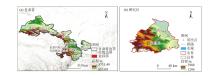
Fig. 1
Schematic diagram of the study area"
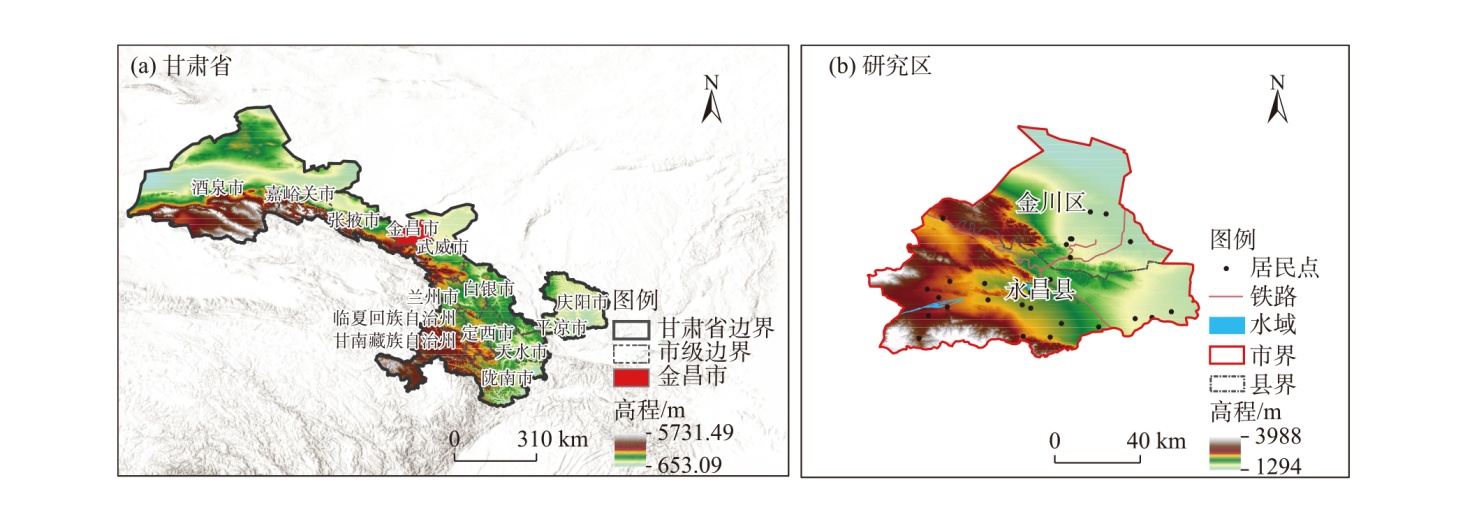
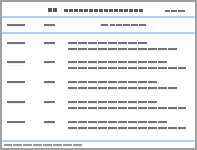
Tab. 1
Land driving factors and data sources"
| 数据类型 | 数据名称 | 分辨率 | 数据来源 |
|---|---|---|---|
| 土地利用变化数据 | 2000、2010、2020年土地利用数据 | 30 m | 中国科学院资源环境科学与数据中心( |
| 气象数据 | 年平均气温 | 1 km | 地球资源数据云( |
| 年平均降水量 | 1 km | 地球资源数据云( | |
| 高程数据 | 高程 | 30 m | 地理空间数据云( |
| 坡度 | 30 m | 由ArcGIS计算生成 | |
| 社会经济数据 | 人口密度 | 1 km | 地球资源数据云( |
| GDP | 1 km | 地球资源数据云( | |
| 距主要公路的距离 | 1 km | 全国地理基础信息目录系统( | |
| 距主要铁路的距离 | 1 km | 全国地理基础信息目录系统( | |
| 距水域的距离 | 1 km | 全国地理基础信息目录系统( | |
| 距居民点的距离 | 1 km | 全国地理基础信息目录系统( |
Tab. 2
Summary of carbon density by land use types /t·hm-2"
| 土地利用 类型 | 地上生物量碳密度 | 地下生物量碳密度 | 土壤碳密度 | ||||||||
|---|---|---|---|---|---|---|---|---|---|---|---|
| 碳密度 | 参考文献 | 研究范围 | 碳密度 | 参考文献 | 研究范围 | 碳密度 | 参考文献 | 研究范围 | |||
| 耕地 | 5.7 | 李克让等[ | 全国 | 80.7 | 解宪丽等[ | 全国 | 79.5 | 张杰等[ | 西北干旱区 | ||
| 林地 | 42.4 | 解宪丽等[ | 全国 | 115.9 | 解宪丽等[ | 全国 | 158.8 | 张杰等[ | 西北干旱区 | ||
| 草地 | 35.3 | 解宪丽等[ | 全国 | 86.5 | 解宪丽等[ | 全国 | 99.9 | 李克让等[ | 全国 | ||
| 水域 | 3.0 | 陈利军等[ | 全国 | 0.0 | 李克让等[ | 全国 | 0.0 | 张杰等[ | 西北干旱区 | ||
| 建设用地 | 2.5 | 陈利军等[ | 全国 | 0.0 | 包玉斌[ | 西北干旱区 | 0.0 | 张杰等[ | 西北干旱区 | ||
| 未利用地 | 1.3 | 陈利军等[ | 全国 | 0.0 | 包玉斌[ | 西北干旱区 | 21.6 | 张杰等[ | 西北干旱区 | ||
Tab. 3
Corrected carbon density data of Jinchang City /t·hm-2"
| 土地利用类型 | 植被碳密度 | 根系碳密度 | 土壤碳密度 | 总碳密度 |
|---|---|---|---|---|
| 耕地 | 1.94 | 27.50 | 79.50 | 108.95 |
| 林地 | 14.45 | 39.50 | 158.80 | 212.75 |
| 草地 | 12.03 | 29.48 | 86.62 | 128.13 |
| 水域 | 1.02 | 0.00 | 0.00 | 1.02 |
| 建设用地 | 0.85 | 0.00 | 0.00 | 0.85 |
| 未利用地 | 0.44 | 0.00 | 21.60 | 22.04 |
Tab. 4
Multi-scenario prediction matrix of Jinchang City in 2030"
| 土地利用类型 | 自然发展情景 | 生态保护情景 | 城镇发展情景 | |||||||||||||||
|---|---|---|---|---|---|---|---|---|---|---|---|---|---|---|---|---|---|---|
| 耕地 | 1 | 1 | 1 | 1 | 1 | 1 | 1 | 1 | 1 | 1 | 1 | 1 | 1 | 1 | 1 | 0 | 1 | 1 |
| 林地 | 1 | 1 | 1 | 1 | 1 | 1 | 1 | 1 | 1 | 1 | 0 | 0 | 1 | 1 | 1 | 0 | 1 | 1 |
| 草地 | 1 | 1 | 1 | 1 | 1 | 1 | 1 | 1 | 1 | 1 | 0 | 0 | 1 | 1 | 1 | 1 | 1 | 1 |
| 水域 | 0 | 0 | 0 | 1 | 0 | 0 | 1 | 1 | 1 | 1 | 0 | 0 | 0 | 1 | 1 | 1 | 1 | 0 |
| 建设用地 | 1 | 1 | 1 | 1 | 1 | 1 | 1 | 1 | 1 | 1 | 1 | 1 | 0 | 0 | 0 | 0 | 1 | 0 |
| 未利用地 | 1 | 1 | 1 | 1 | 1 | 1 | 1 | 1 | 1 | 1 | 1 | 1 | 1 | 1 | 1 | 1 | 1 | 1 |
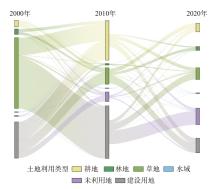
Fig. 2
Sanji map of land use transfer in Jinchang City from 2000 to 2020"
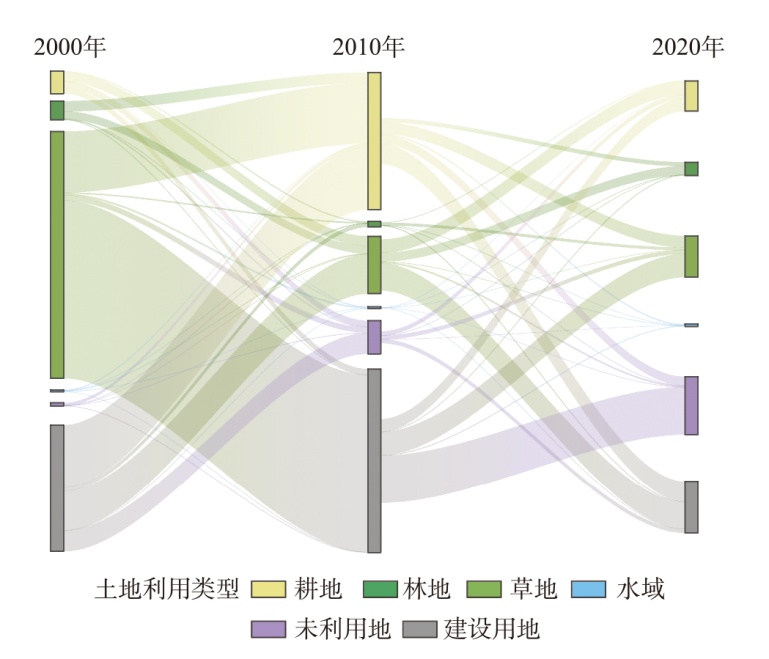
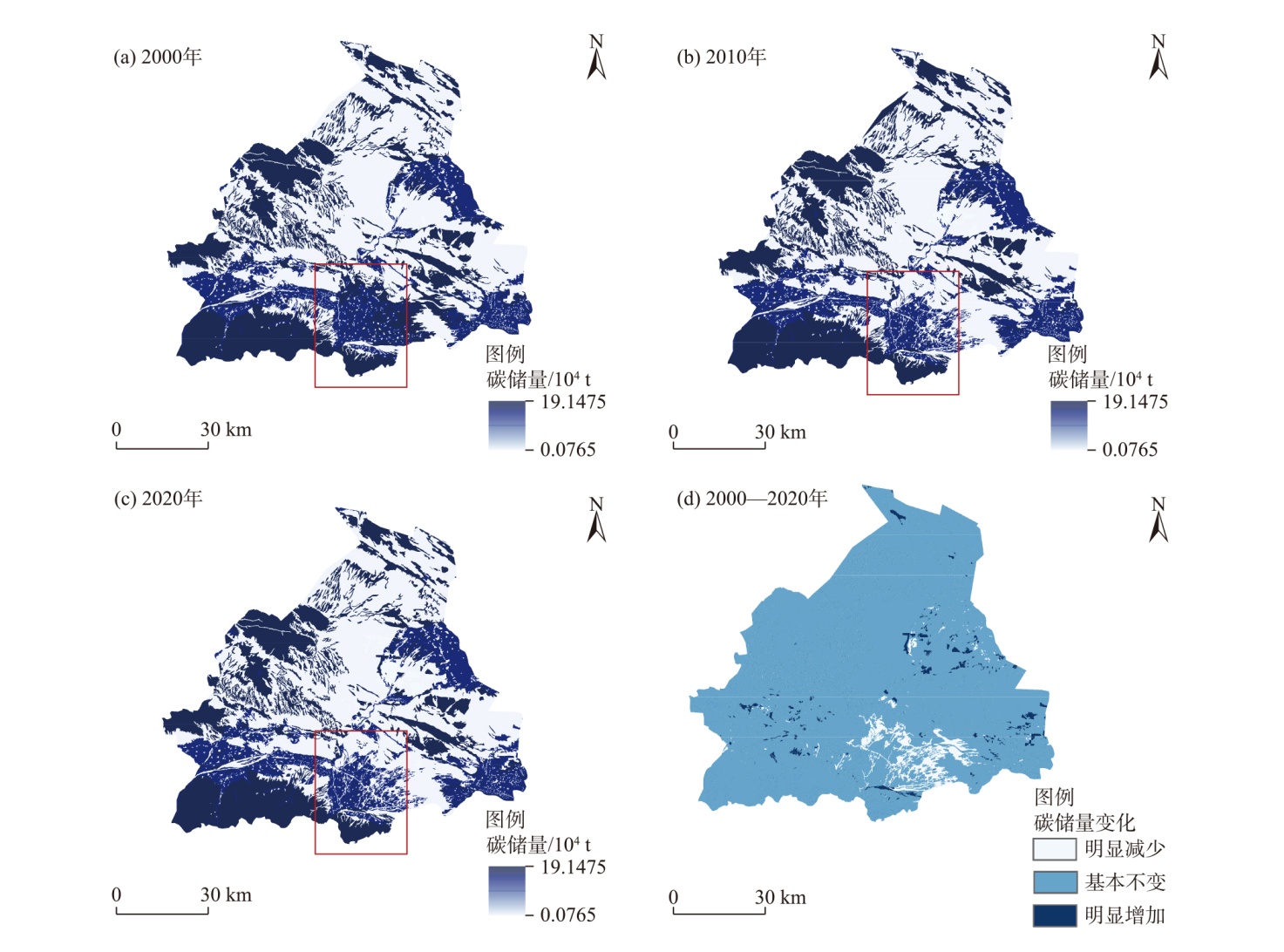
Fig. 3
Distribution and changes of carbon storage in Jinchang City from 2000 to 2020"
Tab. 5
Land use change and carbon storage change in Jinchang City from 2000 to 2020"
| 土地利用变化 | 变化面积/hm2 | 变化面积比例/% | 碳储量变化/104 t | 碳储量小计/104 t | ||
|---|---|---|---|---|---|---|
| 转出 | 转入 | 增加 | 减少 | |||
| 耕地 | 耕地 | 116744.94 | 5.66 | 0.00 | - | -23.35 |
| 林地 | 147.78 | 1.53 | - | |||
| 草地 | 854.64 | 1.64 | - | |||
| 水域 | 88.74 | - | -0.96 | |||
| 建设用地 | 1638.90 | - | -17.72 | |||
| 未利用地 | 903.24 | - | -7.85 | |||
| 林地 | 耕地 | 928.17 | 2.30 | - | -9.64 | -15.73 |
| 林地 | 22474.98 | 0.00 | - | |||
| 草地 | 433.26 | - | -3.67 | |||
| 水域 | 0.90 | - | -0.02 | |||
| 建设用地 | 83.97 | - | -1.78 | |||
| 未利用地 | 33.21 | - | -0.63 | |||
| 草地 | 耕地 | 7913.25 | 54.89 | - | -15.19 | -301.01 |
| 林地 | 406.26 | 3.44 | - | |||
| 草地 | 206308.98 | 0.00 | - | |||
| 水域 | 299.34 | - | -3.81 | |||
| 建设用地 | 1367.01 | - | -17.40 | |||
| 未利用地 | 25266.60 | - | -268.05 | |||
| 水域 | 耕地 | 55.26 | 0.44 | 0.60 | - | 2.12 |
| 林地 | 0.45 | 0.01 | - | |||
| 草地 | 111.24 | 1.41 | - | |||
| 水域 | 5027.13 | 0.00 | - | |||
| 建设用地 | 63.81 | - | -0.001 | |||
| 未利用地 | 49.41 | 0.10 | - | |||
| 建设用地 | 耕地 | 457.47 | 1.15 | 4.95 | - | 7.62 |
| 林地 | 3.60 | 0.08 | - | |||
| 草地 | 189.36 | 2.41 | - | |||
| 水域 | 2.43 | 0.00 | - | |||
| 建设用地 | 13327.29 | 0.00 | - | |||
| 未利用地 | 86.76 | 0.18 | - | |||
| 未利用地 | 耕地 | 8142.12 | 35.57 | 70.76 | - | 124.97 |
| 林地 | 449.91 | 8.58 | - | |||
| 草地 | 5958.09 | 63.21 | - | |||
| 水域 | 84.24 | - | -0.18 | |||
| 建设用地 | 8210.07 | - | -17.40 | |||
| 未利用地 | 333359.01 | 0.00 | - | |||
Fig. 4
Effect diagram of driving factors in Jinchang City"
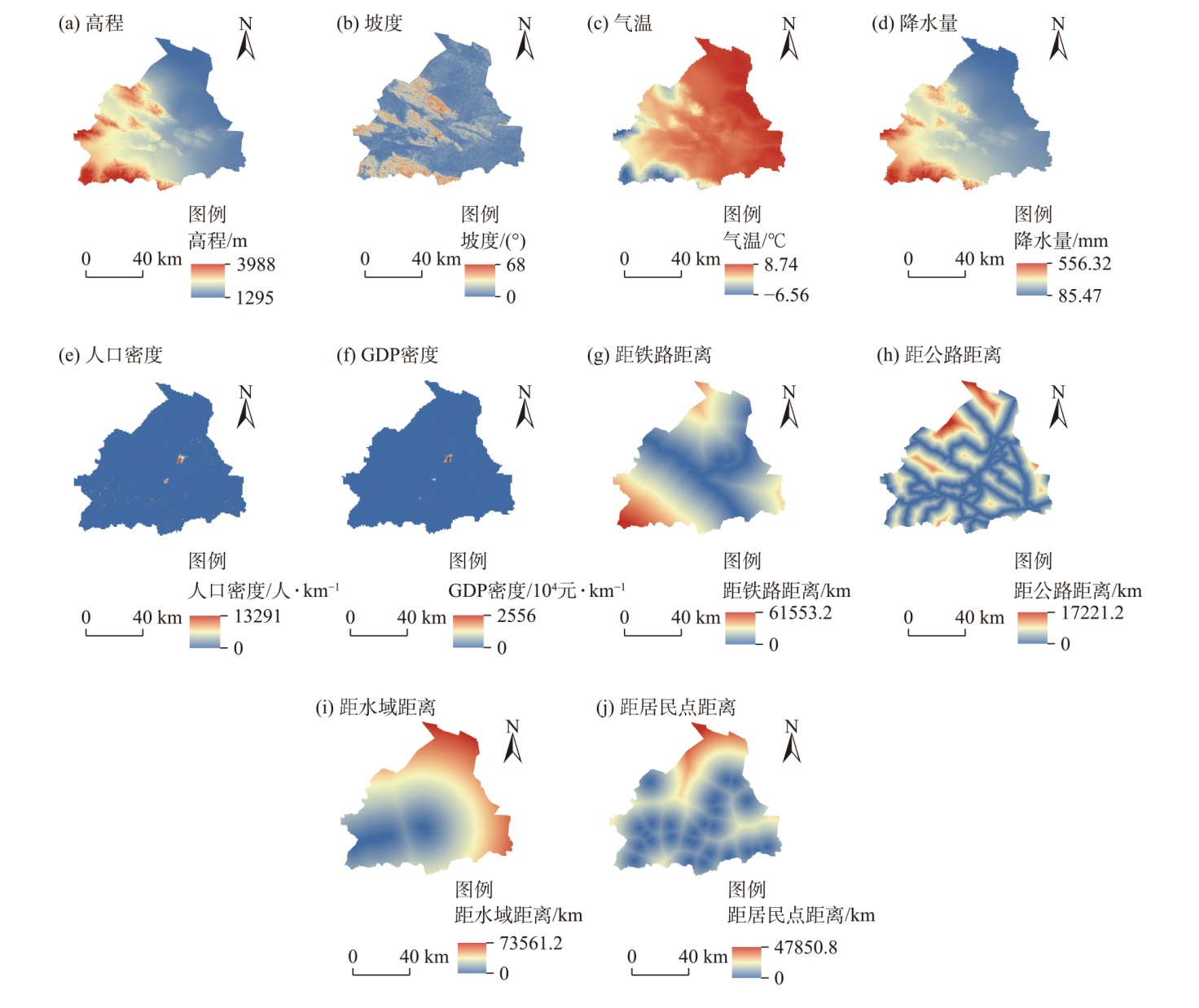
Fig. 5
Land use types of Jinchang City in 2030 under three scenarios"
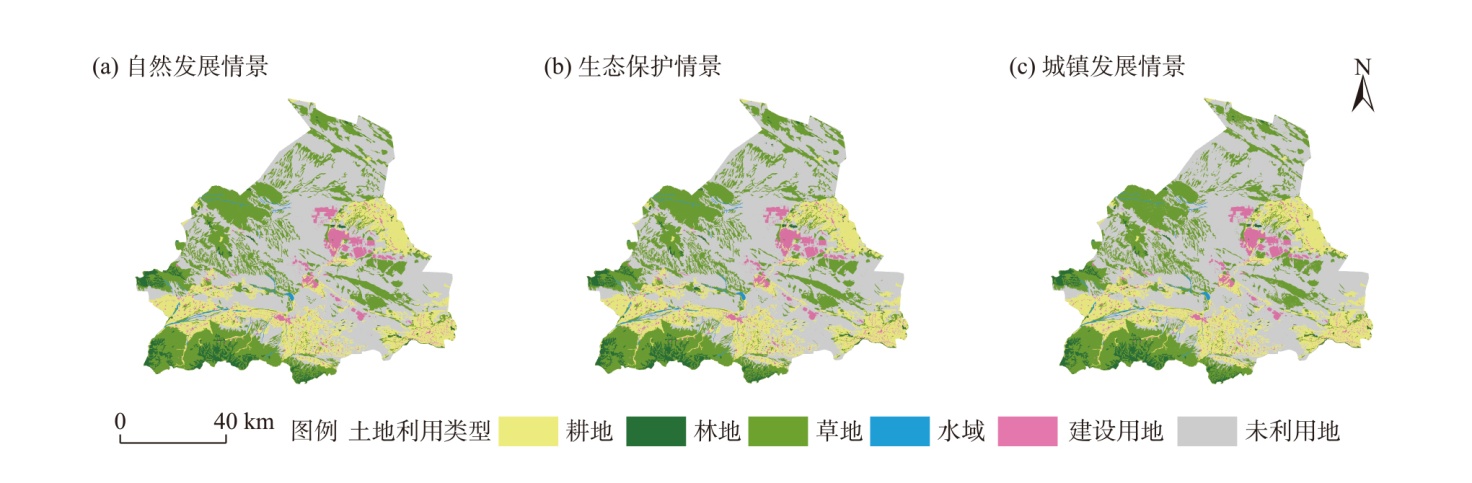
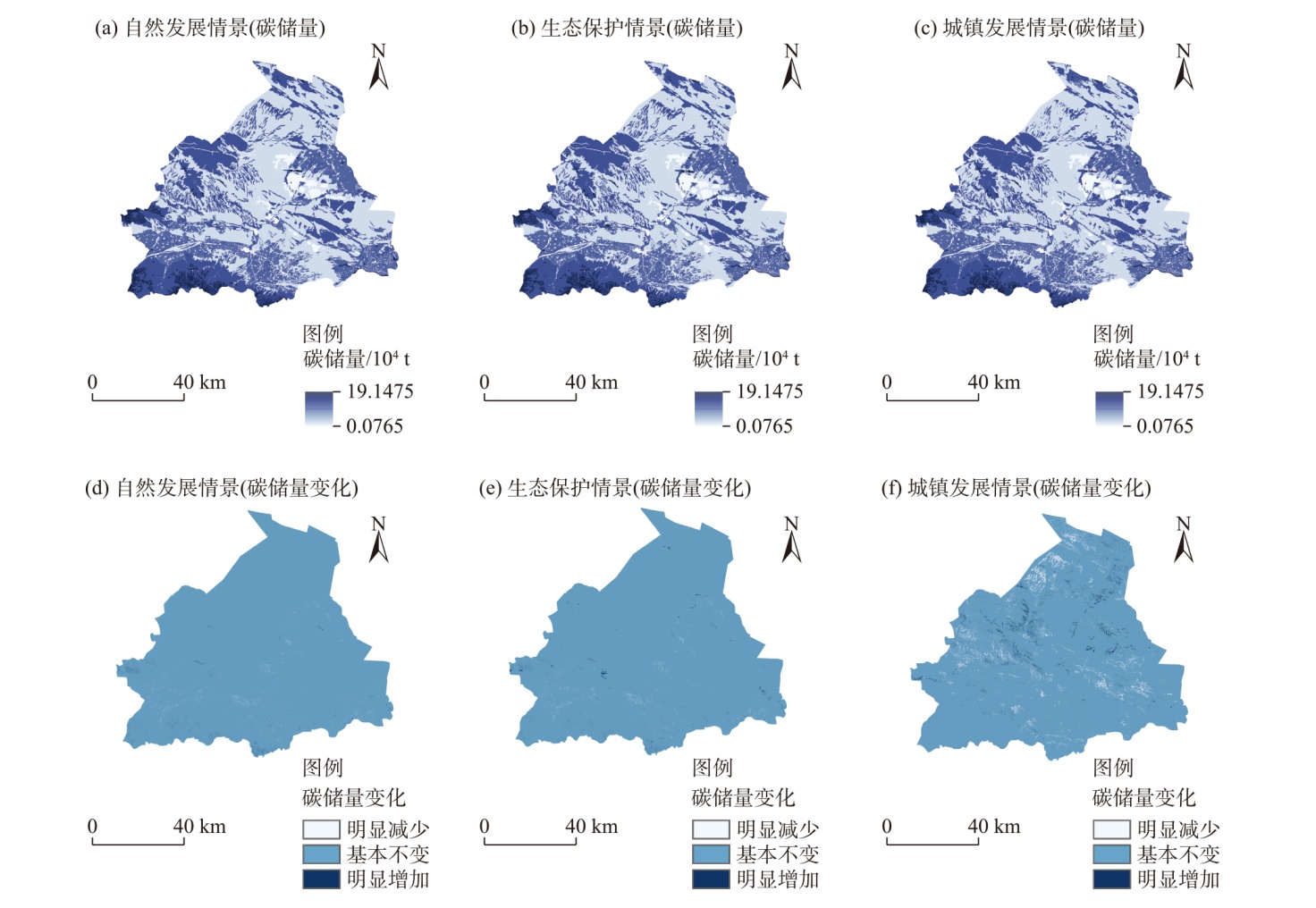
Fig. 6
Distribution and changes of carbon storage in Jinchang City in 2030 under multiple scenarios"
Tab. 6
Carbon storage of various land types under multiple scenarios in Jinchang City /105 t"
| 土地利用类型 | 2020年碳储量 | 2035年碳储量 | ||
|---|---|---|---|---|
| 自然发展 情景 | 生态保护情景 | 城镇发展情景 | ||
| 耕地 | 146.26 | 144.32 | 143.52 | 145.83 |
| 林地 | 50.05 | 52.75 | 54.02 | 49.37 |
| 草地 | 274.10 | 272.79 | 273.37 | 265.93 |
| 水域 | 0.06 | 0.06 | 0.06 | 0.06 |
| 建设用地 | 0.21 | 0.26 | 0.26 | 0.24 |
| 未利用地 | 79.29 | 78.44 | 78.43 | 80.19 |
| [1] | 石晶, 石培基, 王梓洋, 等. 基于PLUS-InVEST模型的酒泉市生态系统碳储量时空演变与预测[J]. 环境科学, 2024, 45(1): 300-313. |
|
[Shi Jing, Shi Peiji, Wang Ziyang, et al. Spatial-temporal evolution and prediction of carbon storage in Jiuquan City ecosystem based on PLUS-InVEST model[J]. Environmental Science, 2024, 45(1): 300-313.]
doi: 10.1021/es101840s |
|
| [2] | 胡鞍钢. 中国实现2030年前碳达峰目标及主要途径[J]. 北京工业大学学报(社会科学版), 2021, 21(3): 1-15. |
| [Hu Angang. China’s goal of achieving carbon peak by 2030 and its main approaches[J]. Journal of Beijing University of Technology (Social Sciences Edition), 2021, 21(3): 1-15.] | |
| [3] | 刘剑平. 我国资源型城市转型与可持续发展研究[D]. 长沙: 中南大学, 2007. |
| [Liu Jianping. Research on resource-based cities’ transition and sustainable development in China[D]. Changsha: Central South University, 2007.] | |
| [4] | 冯起, 白光祖, 李宗省, 等. 加快构建西北地区生态保护新格局[J]. 中国科学院院刊, 2022, 37(10): 1457-1470. |
| [Feng Qi, Bai Guangzu, Li Zongxing, et al. Accelerate construction of new pattern of ecological protection in northwest China[J]. Bulletin of Chinese Academy of Sciences, 2022, 37(10): 1457-1470.] | |
| [5] |
Wang D, Liu Y, Wu G L, et al. Effect of rest-grazing management on soil water and carbon storage in an arid grassland (China)[J]. Journal of Hydrology, 2015, 527: 754-760.
doi: 10.1016/j.jhydrol.2015.05.036 |
| [6] | Kong J Q, Chen L F. The changes in cropland pattern enhanced carbon storage in northwest China[J]. Agronomy, 2023, 13(11): 2736, doi: 10.3390/agronomy13112736. |
| [7] | 张友国, 白羽洁. 区域差异化“双碳”目标的实现路径[J]. 改革, 2021(11): 1-18. |
| [Zhang Youguo, Bai Yujie. Regional differentiated paths for realizing “double carbon” targets[J]. Reform, 2021(11): 1-18.] | |
| [8] |
张晓明, 宿星, 张军, 等. 基于PLUS-InVEST模型的甘肃通渭滑坡区生境质量时空变化及预测[J]. 干旱区地理, 2025, 48(7): 1220-1232.
doi: 10.12118/j.issn.1000-6060.2024.425 |
|
[Zhang Xiaoming, Su Xing, Zhang Jun, et al. Spatiotemporal variation and prediction of habitat quality in Tongwei landslide area of Gansu Province based on PLUS-InVEST model[J]. Arid Land Geography, 2025, 48(7): 1220-1232.]
doi: 10.12118/j.issn.1000-6060.2024.425 |
|
| [9] |
Yang Y H, Li W H, Zhu C G, et al. Impact of land use/cover changes on carbon storage in a river valley in arid areas of northwest China[J]. Journal of Arid Land, 2017, 9(6): 879-887.
doi: 10.1007/s40333-017-0106-3 |
| [10] |
朱文博, 张静静, 崔耀平, 等. 基于土地利用变化情景的生态系统碳储量评估——以太行山淇河流域为例[J]. 地理学报, 2019, 74(3): 446-459.
doi: 10.11821/dlxb201903004 |
|
[Zhu Wenbo, Zhang Jingjing, Cui Yaoping, et al. Assessment of territorial ecosystem carbon storage based on land use change scenario: A case study in Qihe River Basin[J]. Acta Geographica Sinica, 2019, 74(3): 446-459.]
doi: 10.11821/dlxb201903004 |
|
| [11] | Nelson E, Sander H, Hawthorne P, et al. Projecting global land-use change and its effect on ecosystem service provision and biodiversity with simple models[J]. PloS One, 2010, 5(12): e14327, doi: 10.1371/journal.pone.0014327. |
| [12] | Zhu G F, Qiu D D, Zhang Z X, et al. Land-use changes lead to a decrease in carbon storage in arid region, China[J]. Ecological Indicators, 2021, 127: 107770, doi: 10.1016/j.ecolind.2021.107770. |
| [13] | 郑海岳, 王磊, 魏涛, 等. 基于FLUS-InVEST模型的淮南市土地覆盖模拟与碳储量评估[J/OL]. 环境科学. [2025-03-19]. https://doi.org/10.13227/j.hjkx.202409033. |
| [Zheng Haiyue, Wang Lei, Wei Tao, et al. Land cover simulation and carbon stock assessment in Huainan City based on FLUS-InVEST model[J/OL]. Environmental Science. [2025-03-19]. https://doi.org/10.13227/j.hjkx.202409033.] | |
| [14] | 史名杰, 武红旗, 贾宏涛, 等. 基于MCE-CA-Markov和InVEST模型的伊犁谷地碳储量时空演变及预测[J]. 农业资源与环境学报, 2021, 38(6): 1010-1019. |
| [Shi Mingjie, Wu Hongqi, Jia Hongtao, et al. Temporal and spatial evolution and prediction of carbon stocks in Yili Valley based on MCE-CA-Markov and InVEST models[J]. Journal of Agricultural Resources and Environment, 2021, 38(6): 1010-1019.] | |
| [15] | Wang Z, Zhong A Y, Wei E H, et al. Carbon storage simulation and land use optimization for high-water-table resource-based cities based on the coupled GMOP-PLUS-InVEST model[J]. Remote Sensing, 2024, 16(23): 4480, doi: 10.3390/rs16234480. |
| [16] | 朱志强, 马晓双, 胡洪. 基于耦合FLUS-InVEST模型的广州市生态系统碳储量时空演变与预测[J]. 水土保持通报, 2021, 41(2): 222-229, 239. |
| [Zhu Zhiqiang, Ma Xiaoshuang, Hu Hong. Spatio-temporal evolution and prediction of ecosystem carbon stocks in Guangzhou City by coupling FLUS-InVEST models[J]. Bulletin of Soil and Water Conservation, 2021, 41(2): 222-229, 239.] | |
| [17] | 靳含, 杨爱民, 夏鑫鑫, 等. 基于CA-Markov模型的多时间跨度土地利用变化模拟[J]. 干旱区地理, 2019, 42(6): 1415-1426. |
| [Jin Han, Yang Aimin, Xia Xinxin, et al. Simulation of land use change at different time spans based on CA-Markov model[J]. Arid Land Geography, 2019, 42(6): 1415-1426.] | |
| [18] | 高宇, 刘欢, 鲍立佳, 等. 基于格网和PLUS模型的大西安地区碳排放量估算与模拟[J]. 中国生态农业学报(中英文), 2023, 31(10): 1553-1564. |
| [Gao Yu, Liu Huan, Bao Lijia, et al. Estimation and simulation of carbon emissions in Great Xi’an based on grid and patch-generated land-use simulation models[J]. Chinese Journal of Eco-Agriculture, 2023, 31(10): 1553-1564.] | |
| [19] | 张凯琪, 陈建军, 侯建坤, 等. 耦合InVEST与GeoSOS-FLUS模型的桂林市碳储量可持续发展研究[J]. 中国环境科学, 2022, 42(6): 2799-2809. |
| [Zhang Kaiqi, Chen Jianjun, Hou Jiankun, et al. Study on sustainable development of carbon storage in Guilin coupled with InVEST and GeoSOS-FLUS model[J]. China Environmental Science, 2022, 42(6): 2799-2809.] | |
| [20] | 李建强, 张飞云, 李倩, 等. 基于 PLUS-InVEST模型的新疆土地利用碳排放与碳储量时空演变分析及模拟[J/OL]. 农业资源与环境学报. [2025-03-23]. https://doi.org/10.13254/j.jare.2024.0732. |
| [Li Jianqiang, Zhang Feiyun, Li Qian, et al. Analysis and simulation of the spatial-temporal evolution of carbon emission/storage of land use in Xinjiang based on PLUS-InVEST model[J/OL]. Journal of Agricultural Resources and Environment. [2025-03-23]. https://doi.org/10.13254/j.jare.2024.0732.] | |
| [21] |
李语诗, 夏志业, 张蕾. 基于SSPs多情景目标的2030年成渝经济圈土地利用碳排放预测及其空间优化[J]. 生态环境学报, 2023, 32(3): 535-544.
doi: 10.16258/j.cnki.1674-5906.2023.03.011 |
| [Li Yushi, Xia Zhiye, Zhang Lei. Carbon emission prediction and spatial optimization of land use in Chengdu-Chongqing economic circle in 2030 based on SSPs multi-scenarios[J]. Ecology and Environmental Sciences, 2023, 32(3): 535-544.] | |
| [22] |
付玮, 夏文浩, 樊童生, 等. 塔里木河流域生态系统碳储量的情景预测分析[J]. 干旱区地理, 2024, 47(4): 634-647.
doi: 10.12118/j.issn.1000-6060.2023.274 |
|
[Fu Wei, Xia Wenhao, Fan Tongsheng, et al. Scenario projection analysis of ecosystem carbon stocks in the Tarim River Basin[J]. Arid Land Geography, 2024, 47(4): 634-647.]
doi: 10.12118/j.issn.1000-6060.2023.274 |
|
| [23] | 智菲, 周振宏, 赵铭, 等. 基于PLUS和InVEST模型的合肥市生态系统碳储量时空演变特征[J]. 水土保持学报, 2024, 38(2): 205-215. |
| [Zhi Fei, Zhou Zhenhong, Zhao Ming, et al. Temporal and spatial evolution characteristics of carbon storage in Hefei ecosystem based on PLUS and InVEST models[J]. Journal of Soil and Water Conservation, 2024, 38(2): 205-215.] | |
| [24] | 鲍超, 方创琳. 干旱区水资源对城市化约束强度的时空变化分析[J]. 地理学报, 2008, 63(11): 1140-1150. |
|
[Bao Chao, Fang Chuanglin. Temporal and spatial variations of water resources constraint intensity on urbanization in arid area[J]. Acta Geographica Sinica, 2008, 63(11): 1140-1150.]
doi: 10.11821/xb200811003 |
|
| [25] | Chang G, Liu H, Yin Z, et al. Agricultural production can be a carbon sink: A case study of Jinchang City[J]. Sustainability, 2023, 15(17): 12872, doi: 10.3390/su151712872. |
| [26] | 丛自立. 金昌市尾矿沙漠化土地的综合治理[J]. 中国沙漠, 1997(3): 99-103. |
| [Cong Zili. The control of desertified land with tailings from excavating minerals in Jinchang City[J]. Journal of Desert Research, 1997(3): 99-103.] | |
| [27] | 杲立涛. 河西走廊不同灌溉模式的苜蓿生产效率与效益分析[D]. 兰州: 兰州大学, 2023. |
| [Gao Litao. Analysis of the production efficiency and effectiveness for different irrigation patterns of Alfalfa in Hexi Corridor[D]. Lanzhou: Lanzhou University, 2023.] | |
| [28] | 李克让, 王绍强, 曹明奎. 中国植被和土壤碳贮量[J]. 中国科学(D辑: 地球科学), 2003(1): 72-80. |
| [Li Kerang, Wang Shaoqiang, Cao Mingkui. Vegetation and soil carbon storage in China[J]. Scientia Sinica (Terrae), 2003(1): 72-80.] | |
| [29] | 解宪丽, 孙波, 周慧珍, 等. 中国土壤有机碳密度和储量的估算与空间分布分析[J]. 土壤学报, 2004, 41(1): 35-43. |
| [Xie Xianli, Sun Bo, Zhou Huizhen, et al. Organic carbon density and storage in soils of China and spatial analysis[J]. Acta Pedologica Sinica, 2004, 41(1): 35-43.] | |
| [30] | 陈利军, 刘高焕, 励惠国. 中国植被净第一性生产力遥感动态监测[J]. 遥感学报, 2002, 6(2): 129-135. |
| [Chen Lijun, Liu Gaohuan, Li Huiguo. Estimating net primary productivity of terrestrial vegetation in China using remote sensing[J]. Journal of Remote Sensing, 2002, 6(2): 129-135.] | |
| [31] | 包玉斌. 基于InVEST模型的陕北黄土高原生态服务功能时空变化研究[D]. 西安: 西北大学, 2015. |
| [Bao Yubin. Temporal and spatial changes of ecological services on Loess Plateau of Shaanxi by InVEST model[D]. Xi’an: Northwestern University, 2015.] | |
| [32] | 张杰, 李敏, 敖子强, 等. 中国西部干旱区土壤有机碳储量估算[J]. 干旱区资源与环境, 2018, 32(9): 132-137. |
| [Zhang Jie, Li Min, Ao Ziqiang, et al. Estimation of soil organic carbon storage of terrestrial ecosystem in arid western China[J]. Journal of Arid Land Resources and Environment, 2018, 32(9): 132-137.] | |
| [33] | Zhou J J, Zhao Y R, Huang P, et al. Impacts of ecological restoration projects on the ecosystem carbon storage of inland river basin in arid area, China[J]. Ecological Indicators, 2020, 118: 106803, doi: 10.1016/j.ecolind.2020.106803. |
| [34] |
Tang X L, Zhao X, Bai Y F, et al. Carbon pools in China’s terrestrial ecosystems: New estimates based on an intensive field survey[J]. Proceedings of the National Academy of Sciences, 2018, 115(16): 4021-4026.
doi: 10.1073/pnas.1700291115 |
| [35] | 王保盛, 廖江福, 祝薇, 等. 基于历史情景的FLUS模型邻域权重设置——以闽三角城市群2030年土地利用模拟为例[J]. 生态学报, 2019, 39(12): 4284-4298. |
| [Wang Baosheng, Liao Jiangfu, Zhu Wei, et al. The weight of neighborhood setting of the FLUS model based on a historical scenario: A case study of land use simulation of urban agglomeration of the Golden Triangle of southern Fujian in 2030[J]. Acta Ecologica Sinica, 2019, 39(12): 4284-4298.] | |
| [36] | 黄韬, 刘素红. 基于PLUS-InVEST模型的福建省土地利用变化与碳储量评估[J]. 水土保持学报, 2024, 38(2): 246-257. |
|
[Huang Tao, Liu Suhong. Evaluation of land use change and carbon storage in Fujian Province based on PLUS-InVEST model[J]. Journal of Soil and Water Conservation, 2024, 38(2): 246-257.]
doi: 10.1080/00224561.1983.12436295 |
|
| [37] |
雷馨, 海新权. 耦合PLUS-InVEST模型的兰州市土地利用变化及碳储量经济价值估算[J]. 地理科学, 2025, 45(2): 339-348.
doi: 10.13249/j.cnki.sgs.20230741 |
|
[Lei Xin, Hai Xinquan. Assessing economic value of carbon storage and land use changes based on the coupled PLUS-InVEST model in Lanzhou City[J]. Scientia Geographica Sinica, 2025, 45(2): 339-348.]
doi: 10.13249/j.cnki.sgs.20230741 |
|
| [38] | 张斌, 李璐, 夏秋月, 等. “三线”约束下土地利用变化及其对碳储量的影响——以武汉城市圈为例[J]. 生态学报, 2022, 42(6): 2265-2280. |
| [Zhang Bin, Li Lu, Xia Qiuyue, et al. Land use change and its impact on carbon storage under the constraints of “three lines”: A case study of Wuhan City circle[J]. Acta Ecologica Sinica, 2022, 42(6): 2265-2280.] | |
| [39] | 岑学华. 基于土地利用变化的兰州市生态系统服务时空变化及多情景模拟[D]. 兰州: 西北师范大学, 2024. |
| [Cen Xuehua. Spatial and temporal changes of ecosystem services and multi-scenario simulation in Lanzhou based on land use change[D]. Lanzhou: Northwest Normal University, 2024.] | |
| [40] | 司马文妮. 中国城市化进程中的土地利用问题研究[D]. 咸阳: 西北农林科技大学, 2011. |
| [Sima Wenni. Study on land use during urbanization: A case study of Gansu Province[D]. Xianyang: Northwest A & F University, 2011.] | |
| [41] | 董建红, 张志斌, 笪晓军, 等. “三生”空间视角下土地利用转型的生态环境效应及驱动力——以甘肃省为例[J]. 生态学报, 2021, 41(15): 5919-5928. |
| [Dong Jianhong, Zhang Zhibin, Da Xiaojun, et al. Eco-environmental effects of land use transformation and its driving forces from the perspective of “production-living-ecological” spaces: A case study of Gansu Province[J]. Acta Ecologica Sinica, 2021, 41(15): 5919-5928.] | |
| [42] | 刘梦园. 基于InVEST模型的河西地区碳储量与生境质量评价[D]. 兰州: 兰州大学, 2023. |
| [Liu Mengyuan. Assessment of carbon storage and habitat quality in Hexi region based on InVEST model[D]. Lanzhou: Lanzhou University, 2023.] | |
| [43] | 任玺锦, 裴婷婷, 陈英, 等. 基于碳密度修正的甘肃省土地利用变化对碳储量的影响[J]. 生态科学, 2021, 40(4): 66-74. |
| [Ren Xijin, Pei Tingting, Chen Ying, et al. Impact of land use change on carbon storage in Gansu Province based on carbon density correction[J]. Ecological Sciences, 2021, 40(4): 66-74.] | |
| [44] | 陈宁, 辛存林, 唐道斌, 等. 中国西北地区多情景土地利用优化与碳储量评估[J]. 环境科学, 2023, 44(8): 4655-4665. |
| [Chen Ning, Xin Cunlin, Tang Daobin, et al. Multi-scenario land use optimization and carbon storage assessment in northwest China[J]. Environmental Science, 2023, 44(8): 4655-4665.] |
| [1] | WU Shuangmei, ZHOU Dongmei, MA Jing, ZHU Xiaoyan, ZHANG Jun, JIANG Jing, DONG Qinghan. Characteristics of Caragana korshinskii distribution and soil carbon storage in Huan County under different climate scenarios [J]. Arid Land Geography, 2025, 48(5): 812-824. |
| [2] | NIU Feifei, GUO Jing, LUO Jie, GOU Xueping, LIU Xuewei, ZHANG Renping. Simulation of land use change and prediction of carbon storage in Xinjiang based on GeoSOS-FLUS and InVEST models [J]. Arid Land Geography, 2025, 48(12): 2169-2182. |
| [3] | SHI Ying, BIE Qiang, SU Xiaojie, LI Xinzhang. Spatiotemporal variation of water conservation function evaluation based on InVEST model: A case of Lanzhou City [J]. Arid Land Geography, 2024, 47(9): 1518-1529. |
| [4] | HAN Chuqiao, ZHENG Jianghua, WANG Zhe, YU Wenjie. Spatiotemporal variation and multiscenario simulation of carbon storage in terrestrial ecosystems in the Turpan-Hami Basin based on PLUS-InVEST model [J]. Arid Land Geography, 2024, 47(2): 260-269. |
| [5] | MA Li’na, ZHANG Feiyun, ZHAI Yuxin, TENG Lun, KANG Jianguo. Temporal and spatial evolution of ecosystem service value under land use change in Xinjiang from 1980 to 2020 [J]. Arid Land Geography, 2023, 46(2): 253-263. |
| [6] | LYU Ye,YANG Han,HUANG Yue,BAO Anming,ZAN Chanjuan,LI Wenjing. Spatiotemporal variation of terrestrial water storage in Aral Sea Basin [J]. Arid Land Geography, 2021, 44(4): 943-952. |
| [7] | WANG Shaona,SONG Xiaoyu,LI Lanjun,LI Huaiyou,LI Yaolin. Changing trend of green water and its driving factors in the gully region of the Loess Plateau [J]. Arid Land Geography, 2021, 44(3): 796-806. |
| [8] |
MA Xin-ping, HAN Shen-shan, WANG Lei, WANG Jian-xing, XU Xiao-ting.
Spatial and temporal evolution of land use types in the greater Xi’an area [J]. Arid Land Geography, 2020, 43(2): 499-507. |
| [9] | WANG Yingying, ZHANG Yijing, LI Fei, LYU Yan. Regional difference in crop production potential change:A case study of Shaanxi Province [J]. Arid Land Geography, 2019, 42(3): 615-624. |
| [10] | HAN Qiang, XUE Lian-qing, LIU Yuan-hong, REN Lei. Hydrological responses to land use change in upper-middle reaches of the Tarim River Basin [J]. , 2017, 40(6): 1165-1170. |
| [11] | WANG Dan, WU Shi-xin, ZHANG Shou-yu. Expansion of both cultivated and construction land in Xinjiang since the late 1980s [J]. , 2017, 40(1): 188-196. |
| [12] | SONG Liang-ping, CHU Xin-zheng, YANG Jing. Carbon sequestration capacity of typical plants in marginal zone of the Ebinur Lake Wetland [J]. , 2016, 39(1): 136-143. |
| [13] | WANG Yu-gang,WANG Zhong-yuan,LI Yan. Distribution of inorganic carbon composition in arid saline-alkali soil profiles [J]. , 2013, 36(4): 631-636. |
| [14] | TAO Ye,ZHANG Yuan-ming. [J]. , 2013, 36(4): 615-622. |
| [15] | MA An-qing, WANG Yan-li, CHEN Dong-jing, WANG Jian-hua. STUDY ON THE DYNAMIC CHANGE OF LAND USE IN THE LONGDONG REGION IN THE LOESS PLATEAU [J]. Arid Land Geography, 2002, 25(2): 183-188. |
|
||

