Arid Land Geography ›› 2026, Vol. 49 ›› Issue (4): 713-726.doi: 10.12118/j.issn.1000-6060.2025.240
• “Dual Carbon”Research • Previous Articles Next Articles
CHEN Wenxuan1( ), CHEN Yu1(), WANG Shenglong2
Received:2025-05-06
Revised:2025-06-16
Online:2026-04-25
Published:2026-04-28
Contact:
CHEN Yu
E-mail:1073325120056@st.gsau.edu.cn;cy@gsau.edu.cn
CHEN Wenxuan, CHEN Yu, WANG Shenglong. Characteristics of spatial and temporal evolution of agricultural carbon emissions in the Yellow River Basin and analysis of its influencing factors[J].Arid Land Geography, 2026, 49(4): 713-726.
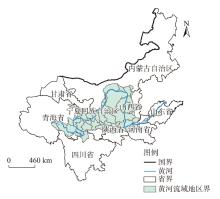
Fig. 1
Schematic diagram of the study area"
Tab. 1
Planting industry carbon emission factors and reference sources"
| 碳源指标 | 碳排放系数 | 参考来源 |
|---|---|---|
| 化肥/kg·kg-1 | 0.8956 | 美国橡树岭国家实验室[ |
| 农药/kg·kg-1 | 4.9341 | 美国橡树岭国家实验室[ |
| 农用薄膜/kg·kg-1 | 5.1800 | 南京农业大学农业资源 与环境研究所[ |
| 农用柴油/kg·kg-1 | 0.5927 | 政府间气候变化专门委员会[ |
| 农业播种面积/kg·hm-2 | 3.1260 | 中国农业大学生物与技术学院[ |
| 农业灌溉面积/kg·hm-2 | 25.0000 | 政府间气候变化专门委员会[ |
Tab. 2
Animal husbandry carbon emission factors and reference sources"
| 碳源指标/kg·头·a-1 | CH4排放系数 | N2O排放系数 | 参考来源 | |
|---|---|---|---|---|
| 肠胃发酵 | 粪便发酵 | |||
| 猪 | 1 | 3.50 | 0.53 | [ |
| 牛 | 51.4 | 1.50 | 1.39 | [ |
| 马 | 18 | 1.64 | 1.39 | [ |
| 驴 | 10 | 0.90 | 1.39 | [ |
| 骡 | 10 | 0.90 | 0.33 | [ |
| 山羊 | 5 | 0.17 | 0.33 | [ |
| 绵羊 | 5 | 0.15 | 0.33 | [ |
| 骆驼 | 46 | 1.92 | 1.39 | [ |
Tab. 3
Carbon emissions of animal husbandry and cultivation in the nine provinces (autonomous regions) of the Yellow River Basin from 2013 to 2023 /104 t"
| 年份 | 碳源类型 | 青海 | 甘肃 | 四川 | 宁夏 | 内蒙古 | 山西 | 陕西 | 河南 | 山东 |
|---|---|---|---|---|---|---|---|---|---|---|
| 2013 | 种植业 | 17.62 | 233.84 | 357.66 | 60.88 | 288.02 | 170.34 | 302.33 | 858.98 | 782.27 |
| 畜牧业 | 1175.06 | 1434.61 | 3471.31 | 322.09 | 2602.20 | 1171.44 | 647.53 | 3208.48 | 2162.11 | |
| 2014 | 种植业 | 17.83 | 244.33 | 358.09 | 59.47 | 315.08 | 170.28 | 292.35 | 866.93 | 769.98 |
| 畜牧业 | 1175.21 | 1507.10 | 3272.89 | 343.33 | 2708.24 | 1290.98 | 669.73 | 3237.93 | 2152.94 | |
| 2015 | 种植业 | 18.42 | 251.19 | 358.85 | 60.06 | 327.34 | 168.73 | 295.58 | 874.41 | 760.09 |
| 畜牧业 | 1173.02 | 1489.88 | 3338.68 | 342.35 | 2825.23 | 1259.46 | 654.13 | 3259.38 | 2164.02 | |
| 2016 | 种植业 | 17.37 | 240.62 | 357.96 | 60.55 | 334.26 | 167.45 | 297.29 | 872.01 | 749.22 |
| 畜牧业 | 1212.94 | 1462.58 | 3429.76 | 350.57 | 2724.78 | 1184.21 | 637.88 | 3133.79 | 2118.10 | |
| 2017 | 种植业 | 17.55 | 221.40 | 349.94 | 60.27 | 331.29 | 162.21 | 297.05 | 856.25 | 722.12 |
| 畜牧业 | 1298.66 | 1350.08 | 3107.37 | 345.72 | 2806.74 | 1344.22 | 693.48 | 2219.99 | 1926.75 | |
| 2018 | 种植业 | 16.78 | 207.57 | 336.36 | 57.78 | 320.40 | 157.93 | 294.09 | 835.12 | 687.97 |
| 畜牧业 | 1230.54 | 1385.44 | 2992.52 | 360.69 | 2707.25 | 1340.85 | 686.54 | 2219.01 | 1884.53 | |
| 2019 | 种植业 | 14.88 | 199.67 | 324.47 | 58.04 | 314.55 | 155.27 | 270.69 | 805.35 | 649.94 |
| 畜牧业 | 1183.50 | 1419.56 | 2675.19 | 396.05 | 2700.21 | 1171.44 | 663.67 | 1960.92 | 1644.22 | |
| 2020 | 种植业 | 14.03 | 197.85 | 309.60 | 58.04 | 302.50 | 153.49 | 270.88 | 784.76 | 627.47 |
| 畜牧业 | 1471.29 | 1543.07 | 2998.60 | 470.77 | 2825.57 | 1421.10 | 693.17 | 2622.94 | 1622.45 | |
| 2021 | 种植业 | 13.46 | 197.00 | 304.40 | 58.23 | 339.18 | 150.15 | 269.75 | 753.40 | 606.15 |
| 畜牧业 | 1464.99 | 1670.05 | 3009.79 | 538.74 | 2947.54 | 1421.10 | 701.57 | 2798.56 | 1674.73 | |
| 2022 | 种植业 | 13.24 | 199.41 | 301.01 | 58.41 | 329.29 | 146.51 | 264.12 | 714.97 | 586.54 |
| 畜牧业 | 1458.73 | 1742.42 | 3043.93 | 585.43 | 3107.02 | 1927.73 | 708.46 | 2840.39 | 1639.12 | |
| 2023 | 种植业 | 13.02 | 198.13 | 297.64 | 58.94 | 327.63 | 144.55 | 264.04 | 696.10 | 568.13 |
| 畜牧业 | 1431.97 | 1833.69 | 3162.77 | 614.18 | 3339.66 | 1955.51 | 716.16 | 2700.07 | 1534.57 |
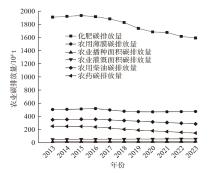
Fig. 2
Temporal characteristics of carbon sources and emissions in crop cultivation across the Yellow River Basin from 2013 to 2023"
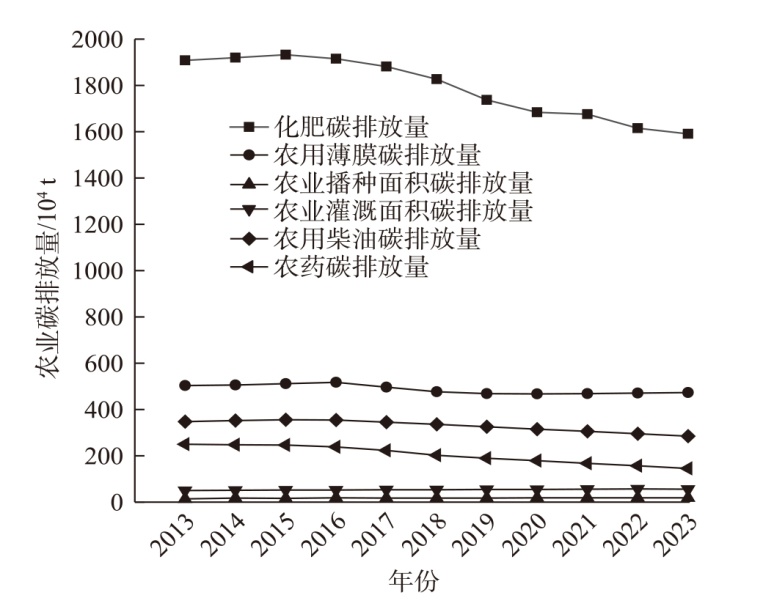
Fig. 3
Line graph of total agricultural carbon emissions in nine provinces (autonomous regions) of the Yellow River Basin from 2013 to 2023"
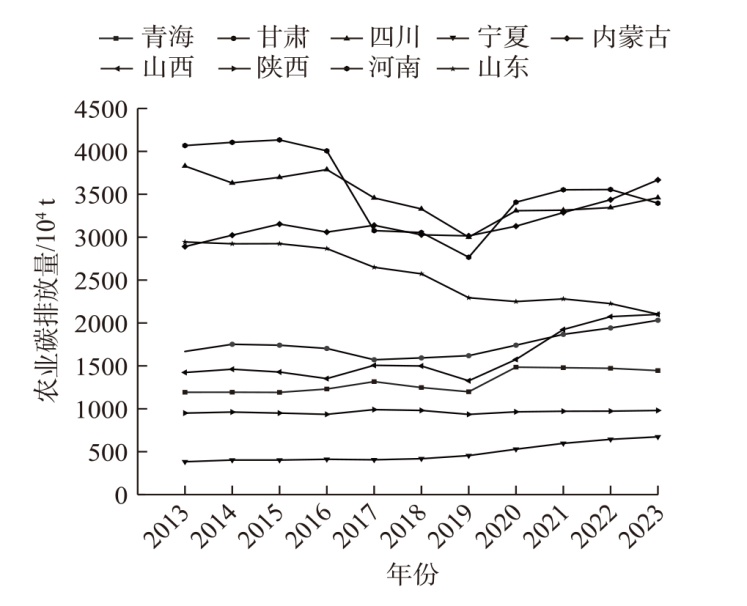
Fig. 4
Agricultural carbon emission intensity in nine provinces (autonomous regions) of the Yellow River Basin from 2013 to 2023"
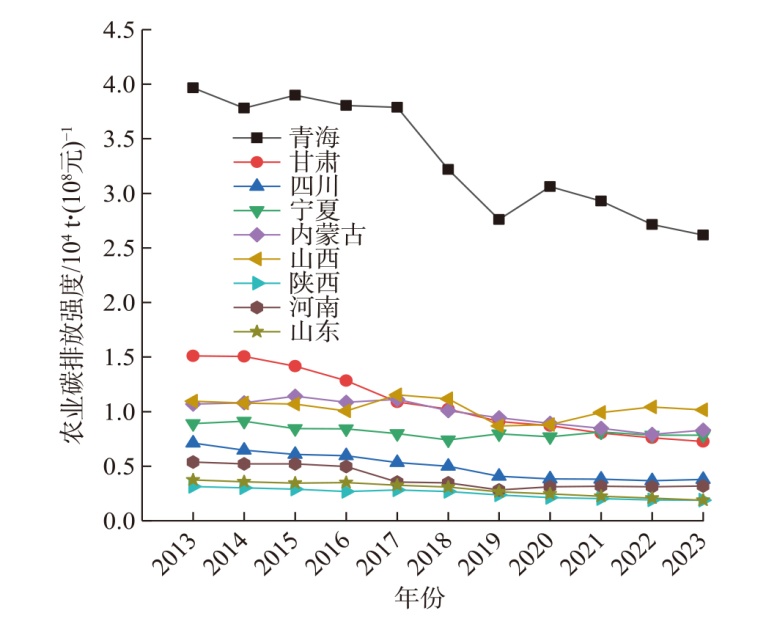
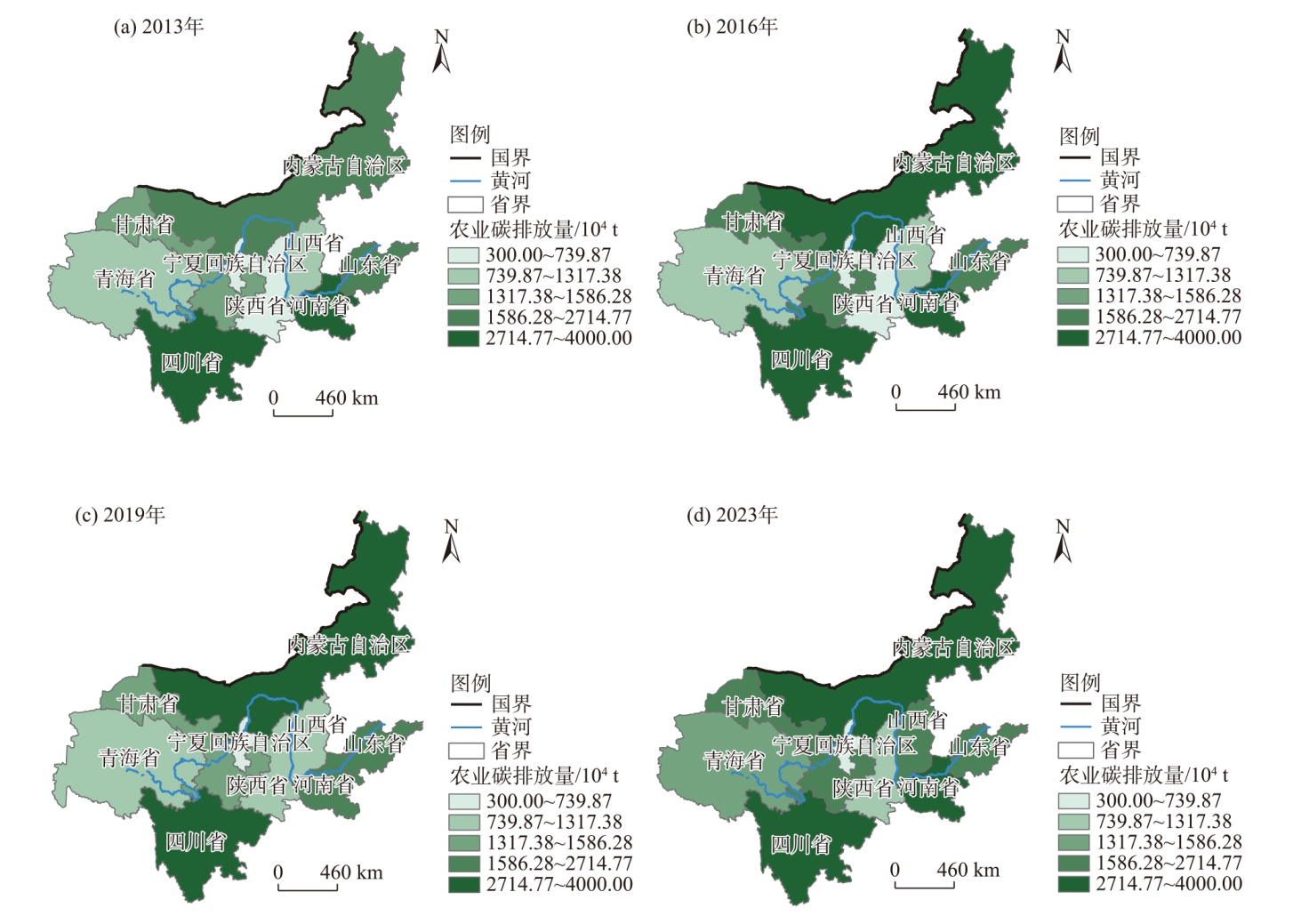
Fig. 5
Characteristics of spatial differentiation of agricultural carbon emissions in nine provinces (autonomous regions) of the Yellow River Basin from 2013 to 2023"
Tab. 4
Results of global Moran’s I of agricultural carbon emission intensity in the Yellow River Basin from 2013 to 2023"
| 年份 | 全局Moran’s I | Z值 |
|---|---|---|
| 2013 | 0.011*** | 2.814 |
| 2014 | 0.019*** | 2.838 |
| 2015 | 0.000*** | 2.580 |
| 2016 | -0.011*** | 2.466 |
| 2017 | -0.042** | 1.477 |
| 2018 | 0.004** | 1.754 |
| 2019 | 0.091* | 1.466 |
| 2020 | 0.047* | 1.316 |
| 2021 | 0.083* | 1.483 |
| 2022 | 0.094* | 1.460 |
| 2023 | 0.103* | 1.484 |
Fig. 6
Moran scatter plots of agricultural carbon emission intensity in nine provinces (autonomous regions) of the Yellow River Basin"
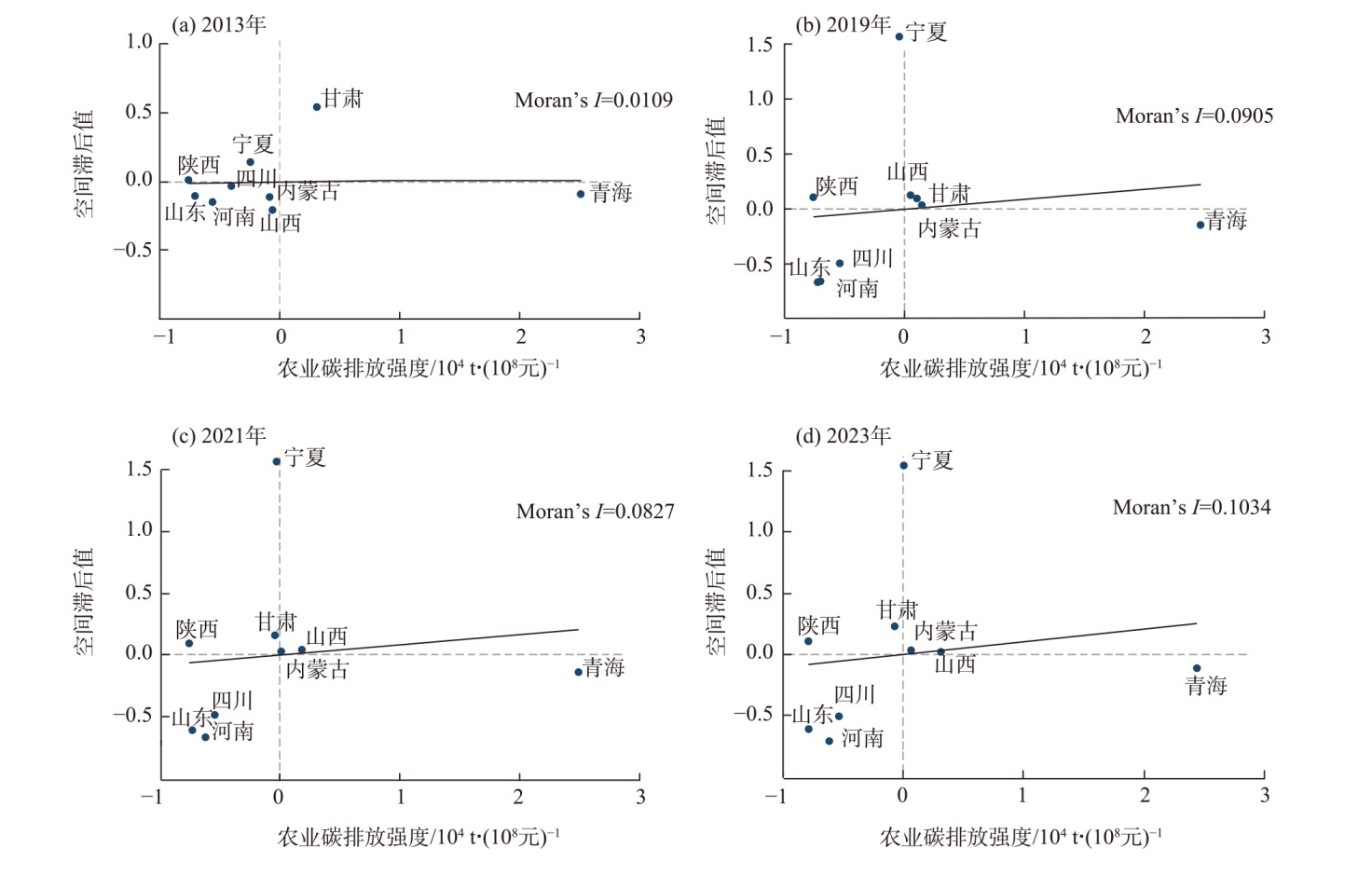
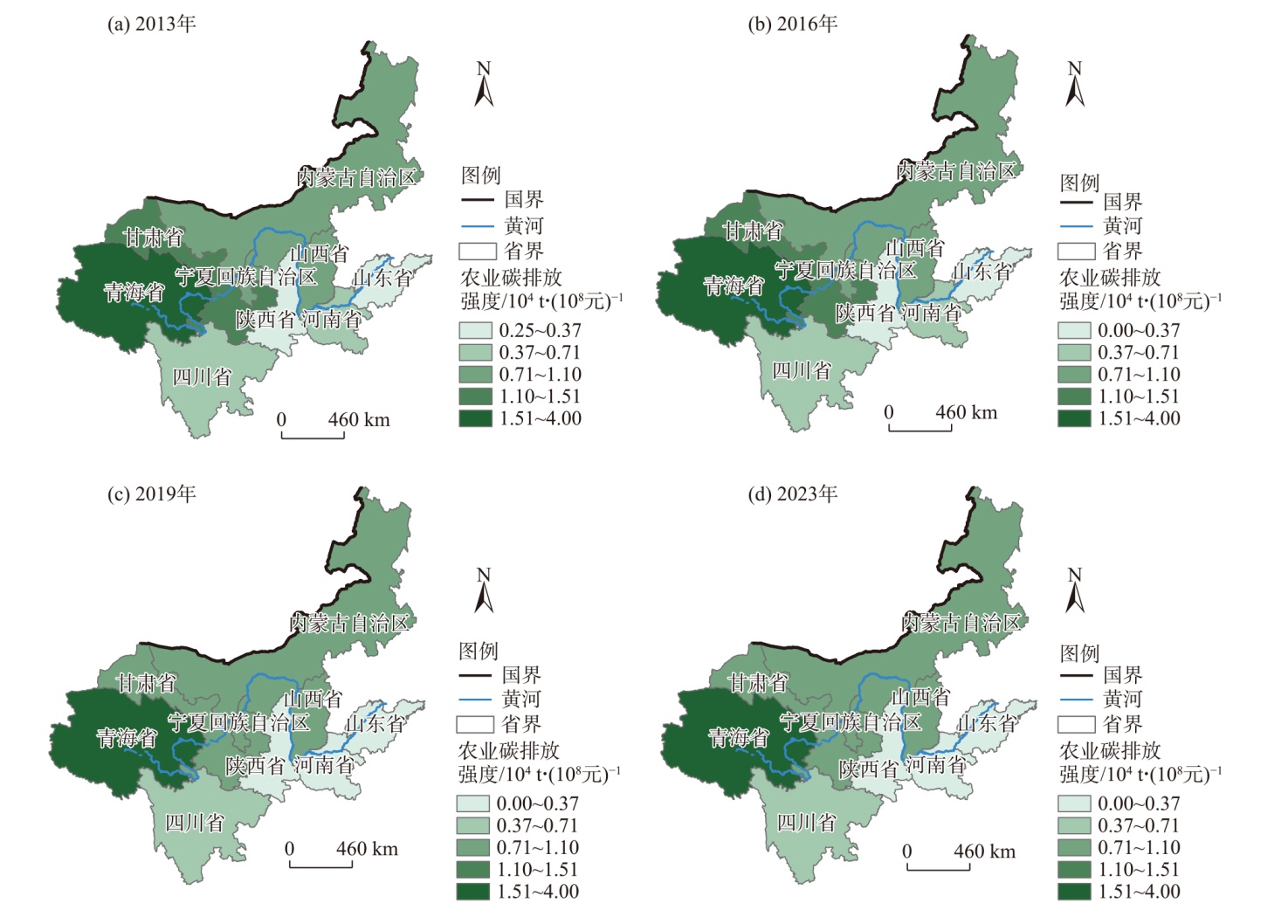
Fig. 7
Characteristics of spatial differentiation of agricultural carbon emission intensity in nine provinces (autonomous regions) of the Yellow River Basin from 2013 to 2023"
Tab. 5
Contribution of each effect in the Yellow River Basin from 2014 to 2023 /104 t"
| 年份 | 农业碳排放变化量 | 人口效应 | 经济效应 | 产业效应 | 结构效应 | 技术效应 |
|---|---|---|---|---|---|---|
| 2014 | 104.46 | -620.33 | 2051.37 | -547.89 | -58.56 | -720.11 |
| 2015 | 168.14 | -866.50 | 1901.86 | -678.55 | 95.57 | -284.24 |
| 2016 | -269.50 | -938.67 | 2305.93 | -833.45 | -85.63 | -717.67 |
| 2017 | -1240.22 | -856.05 | 2811.66 | -1536.59 | -101.71 | -1557.53 |
| 2018 | -389.74 | -640.18 | 2372.28 | -833.80 | -72.57 | -1215.47 |
| 2019 | -1113.74 | -610.45 | 1786.57 | 213.33 | 73.09 | -2576.30 |
| 2020 | 1779.97 | -848.12 | 1288.47 | 1717.00 | 130.11 | -507.48 |
| 2021 | 883.57 | -652.24 | 3264.75 | -1389.37 | 145.89 | -485.46 |
| 2022 | 395.55 | 778.05 | 477.07 | 34.54 | -24.23 | -869.88 |
| 2023 | 190.05 | -125.97 | 937.91 | -620.17 | 38.34 | -40.04 |
| 总效应 | 508.55 | -5380.50 | 19197.92 | -4474.96 | 140.29 | -8974.20 |
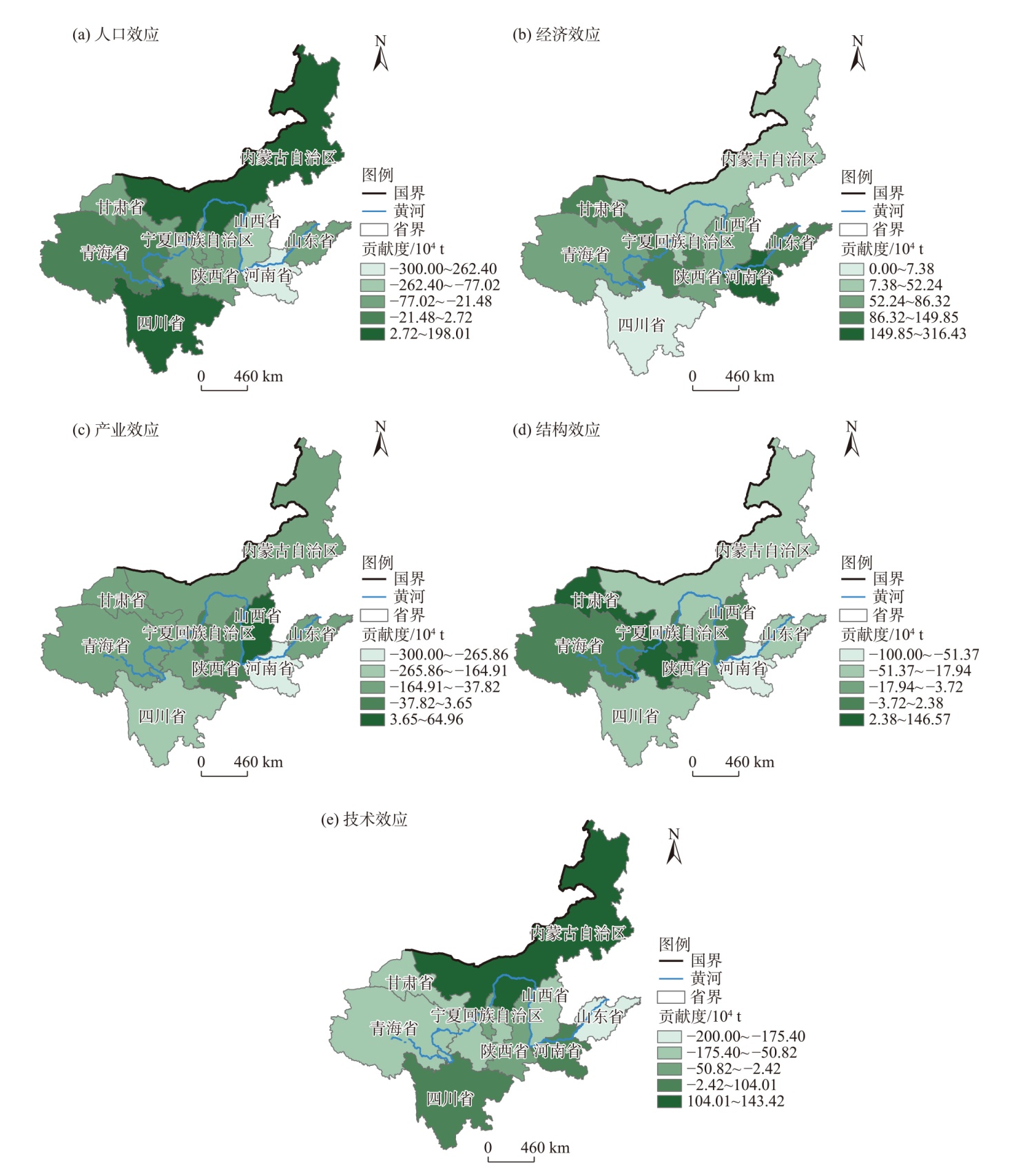
Fig. 8
Contribution of each decomposition effect in nine provinces (autonomous regions) of the Yellow River Basin in 2023"
| [1] |
马海清, 陈强强. 甘肃省农业碳排放时空分异特征及影响因素[J]. 干旱区地理, 2025, 48(5): 879-892.
doi: 10.12118/j.issn.1000-6060.2024.329 |
|
[Ma Haiqing, Chen Qiangqiang. Spatial-temporal differentiation characteristics and influencing factors of agricultural carbon emissions in Gansu Province[J]. Arid Land Geography, 2025, 48(5): 879-892.]
doi: 10.12118/j.issn.1000-6060.2024.329 |
|
| [2] | Quan T S, Zhang H, Quan T L, China’s agricultural land transfer: Carbon emissions driver or opportunity? The pivotal role of rural human capital revealed[J]. Frontiers in Sustainable Food Systems, 2024, 8: 1480636, doi: 10.3389/fsufs.2024.1480636. |
| [3] | 唐菁, 易露, 曾庆均. 长江经济带农业碳补偿率的时空演进特征及碳补偿潜力预测[J]. 环境科学, 2024, 45(11): 6378-6391. |
| [Tang Jing, Yi Lu, Zeng Qingjun. Spatial and temporal evolution characteristics of agricultural carbon offset rate and prediction of carbon offset potential in the Yangtze River economic belt[J]. Environmental Science, 2024, 45(11): 6378-6391.] | |
| [4] |
何艳秋, 戴小文. 中国农业碳排放驱动因素的时空特征研究[J]. 资源科学, 2016, 38(9): 1780-1790.
doi: 10.18402/resci.2016.09.15 |
|
[He Yanqiu, Dai Xiaowen. Phase characteristics and regional differences in agriculture carbon emissions in China[J]. Resources Science, 2016, 38(9): 1780-1790.]
doi: 10.18402/resci.2016.09.15 |
|
| [5] | 索瑞霞, 王琪, 张帆, 等. 黄河流域种植业碳排放的脱钩效应及影响因素分析[J]. 环境科学研究, 2025, 38(2): 220-230. |
| [Suo Ruixia, Wang Qi, Zhang Fan, et al. Study on the decoupling effect and drivers of carbon emissions from plantations in the Yellow River Basin[J]. Research of Environmental Sciences, 2025, 38(2): 220-230.] | |
| [6] | Zhang W X, Shen Y. Toward low-carbon agriculture: Measurement and driver analysis of agricultural carbon emissions in Sichuan Province, China[J]. Frontiers in Sustainable Food Systems, 2025, 9: 1565776, doi: 10.3389/fsufs.2025.1565776. |
| [7] | 徐丽杰, 董珍溪. 黄河流域农业碳排放时空特征及空间效应分析[J]. 华北水利水电大学学报(社会科学版), 2023, 39(2): 9-18. |
| [Xu Lijie, Dong Zhenxi. Spatio-temporal characteristics and spatial effects of agricultural carbon emissions in the Yellow River Basin[J]. Journal of North China University of Water Resources and Electric Power (Social Sciences Edition), 2023, 39(2): 9-18.] | |
| [8] | 庞洪伟, 刘鑫雨, 巩艳红, 等. 物联网发展、科技创新与农业碳排放强度[J]. 经济问题, 2024(2): 77-83. |
| [Pang Hongwei, Liu Xinyu, Gong Yanhong, et al. Internet of things development, technological innovation and agricultural carbon intensity[J]. On Economic Problems, 2024(2): 77-83.] | |
| [9] |
刘敏, 陈银蓉, 王珏, 等. 中国土地利用碳排放效率的空间关联网络及其驱动因素——基于国家重大战略区域的考察[J]. 资源科学, 2024, 46(12): 2462-2476.
doi: 10.18402/resci.2024.12.09 |
|
[Liu Min, Chen Yinrong, Wang Jue, et al. The spatial association network and driving factors of land use carbon emission efficiency in China: An investigation in the national major strategic regions[J]. Resources Science, 2024, 46(12): 2462-2476.]
doi: 10.18402/resci.2024.12.09 |
|
| [10] | 章楠楠, 徐皓帆, 李志文, 等. 基于机器学习的广东省县域农业碳排放时空演变及驱动因素研究[J]. 中国生态农业学报(中英文), 2024, 32(12): 1994-2007. |
| [Zhang Nannan, Xu Haofan, Li Zhiwen, et al. Spatiotemporal evolution and driving factors of agricultural carbon emissions at county level in Guangdong Province based on machine learning[J]. Chinese Journal of Eco-Agriculture, 2024, 32(12): 1994-2007.] | |
| [11] | 姚澜, 陈嘉涛, 徐霄, 等. 农业系统碳排放构成及演变——以衢州市为例[J]. 中国农业大学学报, 2024, 29(12): 82-98. |
| [Yao Lan, Chen Jiatao, Xu Xiao, et al. Carbon emission composition and evolution in agricultural systems: A case study of Quzhou City[J]. Journal of China Agricultural University, 2024, 29(12): 82-98.] | |
| [12] | 蓝艳, 花瑞祥, 景宜然, 等. 东盟国家碳排放动态演变及环境库兹涅茨曲线实证检验分析[J]. 生态与农村环境学报, 2024, 40(3): 303-312. |
| [Lan Yan, Hua Ruixiang, Jing Yiran, et al. Dynamic change of carbon emissions and environmental Kuznets curve empirical test analysis in the ASEAN[J]. Journal of Ecology and Rural Environmental, 2024, 40(3): 303-312.] | |
| [13] | 马志超. 黄河流域农业碳排放与经济增长时空耦合关系研究[J]. 中国农业资源与区划, 2024, 45(12): 15-26. |
| [Ma Zhichao. Spatio-temporal coupling relationship between agricultural carbon emissions and economic growth in the Yellow River Basin[J]. Chinese Journal of Agricultural Resources and Regional Planning, 2024, 45(12): 15-26.] | |
| [14] | 张俊, 黄煦旸, 彭宇琦. “双碳”目标下黄河流域种植业碳足迹的时空异质效应[J]. 河南农业大学学报, 2023, 57(5): 884-896. |
| [Zhang Jun, Huang Xuyang, Peng Yuqi. Spatiotemporal heterogeneity effects of carbon footprint in crop cultivation in the Yellow River Basin under the dual carbon goals[J]. Journal of Henan Agricultural University, 2023, 57(5): 884-896.] | |
| [15] | 刘建华, 闫静, 王慧扬, 等. 黄河流域农业科技创新对农业碳排放强度影响研究[J]. 生态经济, 2024, 40(12): 118-127. |
| [Liu Jianhua, Yan Jing, Wang Huiyang, et al. The influence of agricultural technological innovation on agricultural carbon emission intensity in the Yellow River Basin[J]. Ecological Economics, 2024, 40(12): 118-127.] | |
| [16] | 任世鑫, 李二玲, 赵金彩, 等. 黄河流域耕地利用碳排放时空特征及影响因素研究[J]. 中国土地科学, 2023, 37(10): 102-113. |
| [Ren Shixin, Li Erling, Zhao Jincai, et al. Spatial-temporal characteristics of carbon emissions from cultivated land use in the Yellow River Basin and the influencing factors[J]. Chinese Journal of Land Science, 2023, 37(10): 102-113.] | |
| [17] | 陈锋, 张晶, 任娇, 等. 基于LMDI模型的黄河流域碳排放时空差异及影响因素研究[J]. 地球环境学报, 2022, 13(4): 418-427. |
| [Chen Feng, Zhang Jing, Ren Jiao, et al. Spatiotemporal variations and influencing factors of carbon emissions in the Yellow River Basin based on the LMDI model[J]. Journal of Earth Environmental, 2022, 13(4): 418-427.] | |
| [18] | 刘顺翊, 李松青. 湖南省农业碳排放脱钩弹性及驱动因素——基于Tapio脱钩模型与LMDI分析[J]. 四川农业大学学报, 2023, 41(5): 952-960. |
| [Liu Shunyi, Li Songqing. Decoupling elasticity and drivers of agricultural carbon emissions in Hunan Province: Based on Tapio decoupling model and LMDI analysis[J]. Journal of Sichuan Agricultural University, 2023, 41(5): 952-960.] | |
| [19] | 刘波涛, 曲睿婷, 乔林, 等. 基于LMDI模型的辽宁省农业碳排放影响因素研究[J]. 农业工程, 2024, 14(10): 58-63. |
| [Liu Botao, Qu Ruiting, Qiao Lin, et al. Influencing factors of agricultural carbon emission in Liaoning Province based on LMDI model[J]. Agricultural Engineering, 2024, 14(10): 58-63.] | |
| [20] | 李慧, 李玮, 姚西龙. 基于GWR模型的农业碳排放影响因素时空分异研究[J]. 科技管理研究, 2019, 39(18): 238-245. |
| [Li Hui, Li Wei, Yao Xilong. Study on spatial and temporal variation of impacting factors of agricultural carbon emissions based on the GWR model[J]. Science and Technology Management Research, 2019, 39(18): 238-245.] | |
| [21] | 吴沣槭, 黄伟斌, 陈家乐, 等. 中国棉花生产碳排放核算与碳达峰预测[J]. 农业环境科学学报, 2023, 42(3): 692-704. |
| [Wu Fengqi, Huang Weibin, Chen Jiale, et al. Carbon emissions accounting and carbon peak prediction for cotton production in China[J]. Journal of Agro-Environment Sciences, 2023, 42(3): 692-704.] | |
| [22] | 马涛. 上海农业碳源碳汇现状评估及增加碳汇潜力分析[J]. 农业环境与发展, 2011, 28(5): 38-41. |
| [Ma Tao. Assessment of current status and analysis of potential for increasing carbon sinks in agricultural carbon sources and sinks in Shanghai[J]. Agro-Environment and Development, 2011, 28(5): 38-41.] | |
| [23] | 崔涵, 王丙参, 周明生. 中国农业碳排放时空演进及驱动因素[J]. 中国生态农业学报(中英文), 2024, 32(7): 1097-1108. |
| [Cui Han, Wang Bingcan, Zhou Mingsheng. Spatiotemporal evolution and driving factors of China’s agricultural carbon emissions[J]. Chinese Journal of Eco-Agriculture, 2024, 32(7): 1097-1108.] | |
| [24] | IPCC (Intergovernmental Panel on Climate Change). Climate change 2013: The physical science basis[R]. Batumi: IPCC Working Paper, 2013. |
| [25] | 邓宣凯. 武汉市土地利用碳排放的影响因素研究——基于扩展的Kaya等式和LMDI分解方法[J]. 农业与技术, 2021, 41(20): 104-109. |
| [Deng Xuankai. Factors influencing land use carbon emissions in Wuhan: An analysis based on the extended Kaya equation and LMDI decomposition method[J]. Agriculture and Technology, 2021, 41(20): 104-109.] | |
| [26] | 宁静, 李亚洁, 王震, 等. 中国粮食主产省区农业碳排放特征及影响因素[J]. 水土保持研究, 2024, 31(1): 450-459. |
| [Ning Jing, Li Yajie, Wang Zhen, et al. Characteristics and influencing factors of agricultural carbon emissions in major grain producing provinces in China[J]. Research on Soil and Water Conservation, 2024, 31(1): 450-459.] | |
| [27] | 姚石, 张秋泽, 刘俊娟, 等. 粮食安全与“双碳”视角下黄河流域农田生态补偿额度[J]. 水土保持通报, 2024, 44(3): 399-407. |
| [Yao Shi, Zhang Qiuzhe, Liu Junjuan, et al. Farmland ecological compensation amount in Yellow Rriver Basin from food security and “dual carbon” perspectives[J]. Bulletin of Soil and Water Conservation, 2024, 44(3): 399-407.] | |
| [28] | 陈申奥, 景晓栋, 陈洁. 生态价值视角下黄河流域农业生态效率时空演变及提升路径研究[J]. 江西农业学报, 2023, 35(5): 197-203. |
| [Chen Shen’ao, Jing Xiaodong, Chen Jie. Spatiotemporal evolution and enhancement pathways of agricultural ecological efficiency in the Yellow River Basin from an ecological value perspective[J]. Journal of Jiangxi Agricultural Sciences, 2023, 35(5): 197-203.] | |
| [29] | 张军涛, 韩祁祺. 黄河流域农业碳排放时空演变特征及影响因素研究[J]. 环境科学研究, 2025, 38(4): 754-766. |
| [Zhang Juntao, Han Qiqi. Spatiotemporal evolution characteristics and influencing factors of agricultural carbon emissions in the Yellow River Basin[J]. Research on Environmental Sciences, 2025, 38(4): 754-766.] | |
| [30] | 聂雷, 包雪丽, 孙权. 黄河流域农业碳排放的时空特征及驱动因素研究[J]. 资源与生态学报, 2025, 16(2): 457-471. |
|
[Nie Lei, Bao Xueli, Sun Quan. The spatiotemporal characteristics and driving factors of agricultural carbon emissions in the Yellow River Basin[J]. Journal of Resources and Ecology, 2025, 16(2): 457-471.]
doi: 10.5814/j.issn.1674-764x.2025.02.015 |
|
| [31] |
李梦冉, 徐小任, 王梁, 等. 黄河流域农业碳排放时空变化特征及影响因素分析[J]. 干旱区地理, 2025, 48(5): 854-865.
doi: 10.12118/j.issn.1000-6060.2024.401 |
|
[Li Mengran, Xu Xiaoren, Wang Liang, et al. Spatial-temporal characteristics and influencing factors of agricultural carbon emissions in the Yellow River Basin[J]. Arid Land Geography, 2025, 48(5): 854-865.]
doi: 10.12118/j.issn.1000-6060.2024.401 |
|
| [32] | 周航, 赵先超. 县域尺度下湖南省碳排放空间分异特征与影响因素[J]. 地球科学与环境学报, 2024, 46(2): 196-210. |
| [Zhou Hang, Zhao Xianchao. Spatial differentiation characteristics of carbon emission and its influencing factors in Hunan Province, China at the county scale[J]. Journal of Earth Sciences and Environmental, 2024, 46(2): 196-210.] |
|
||