Arid Land Geography ›› 2025, Vol. 48 ›› Issue (12): 2197-2209.doi: 10.12118/j.issn.1000-6060.2025.212
• Land Use and Carbon Cycle • Previous Articles Next Articles
WANG Zuo1,2( ), NIE Jiajing1,2, WANG Mengxue1,2, WEI Ziran1,2, LI Hu1,2, YOU Yuanhong1,2
Received:2025-04-17
Revised:2025-05-27
Online:2025-12-25
Published:2025-12-30
WANG Zuo, NIE Jiajing, WANG Mengxue, WEI Ziran, LI Hu, YOU Yuanhong. Spatiotemporal characteristics and driving factors of vegetation carbon sequestration in Xinjiang, China[J].Arid Land Geography, 2025, 48(12): 2197-2209.
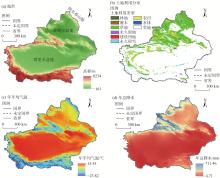
Fig. 1
Distributions of topography, land use (in 2018), and climate characteristics in Xinjiang"

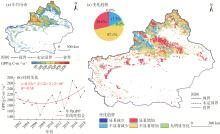
Fig. 2
Distribution and spatiotemporal changes of vegetation GPP in Xinjiang from 2001 to 2018"
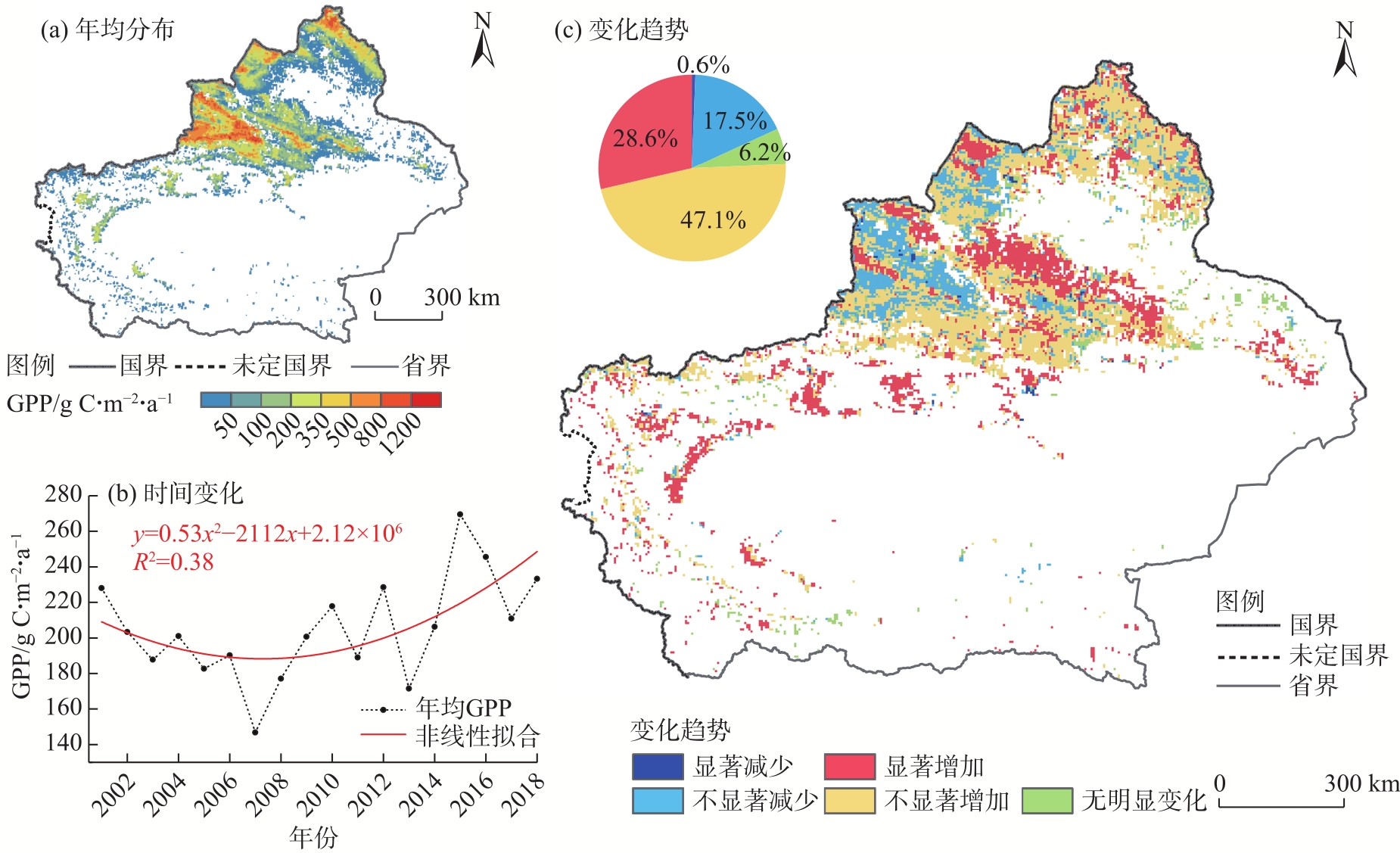
Fig. 3
Distribution and spatiotemporal changes of vegetation NPP in Xinjiang from 2001 to 2018"

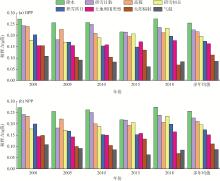
Fig. 4
Factor detection results for the spatial heterogeneity of vegetation GPP/NPP in Xinjiang"
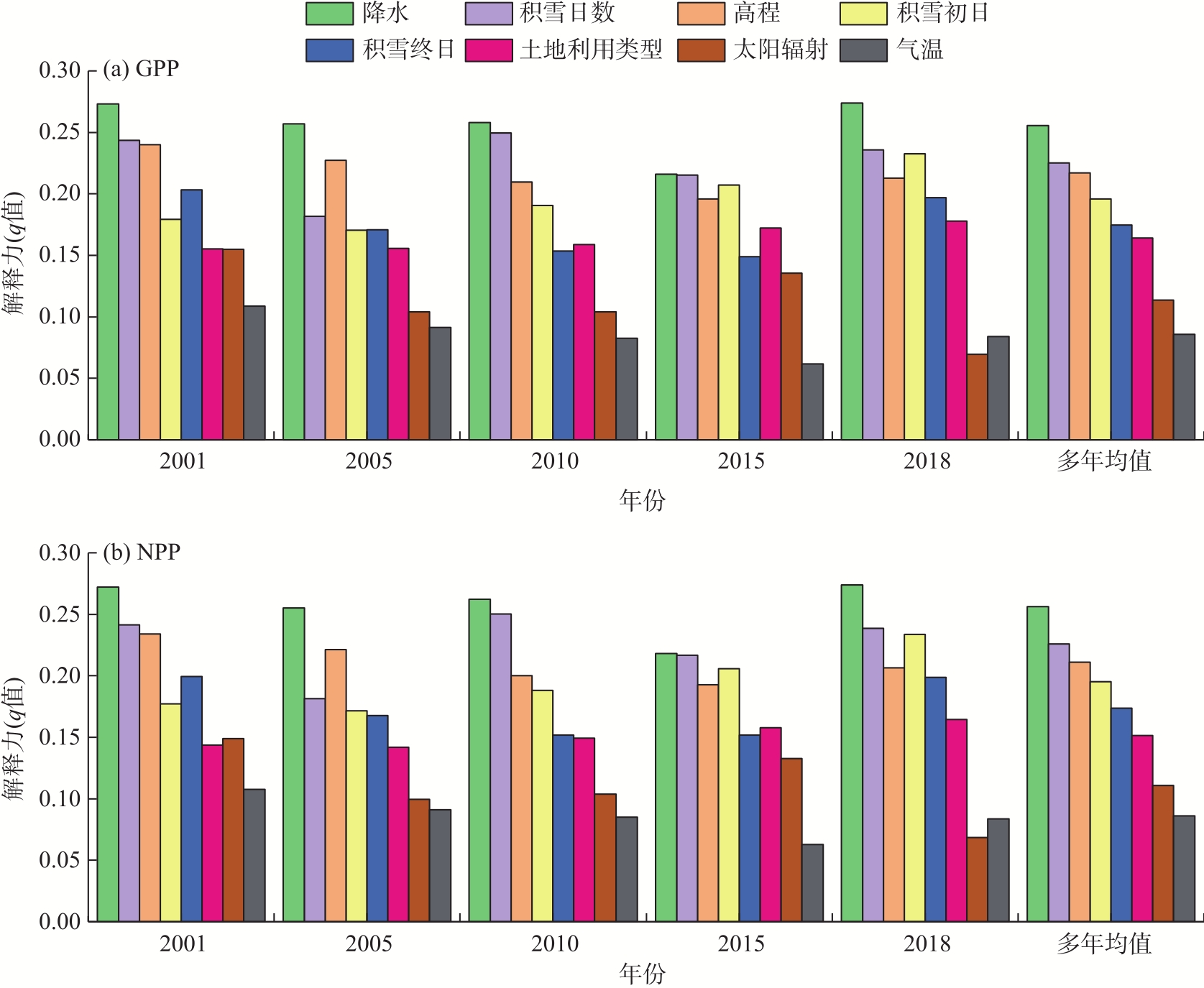
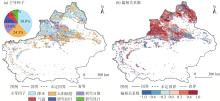
Fig. 5
Distributions of dominant driving factors and their partial correlation coefficients for GPP change in Xinjiang"
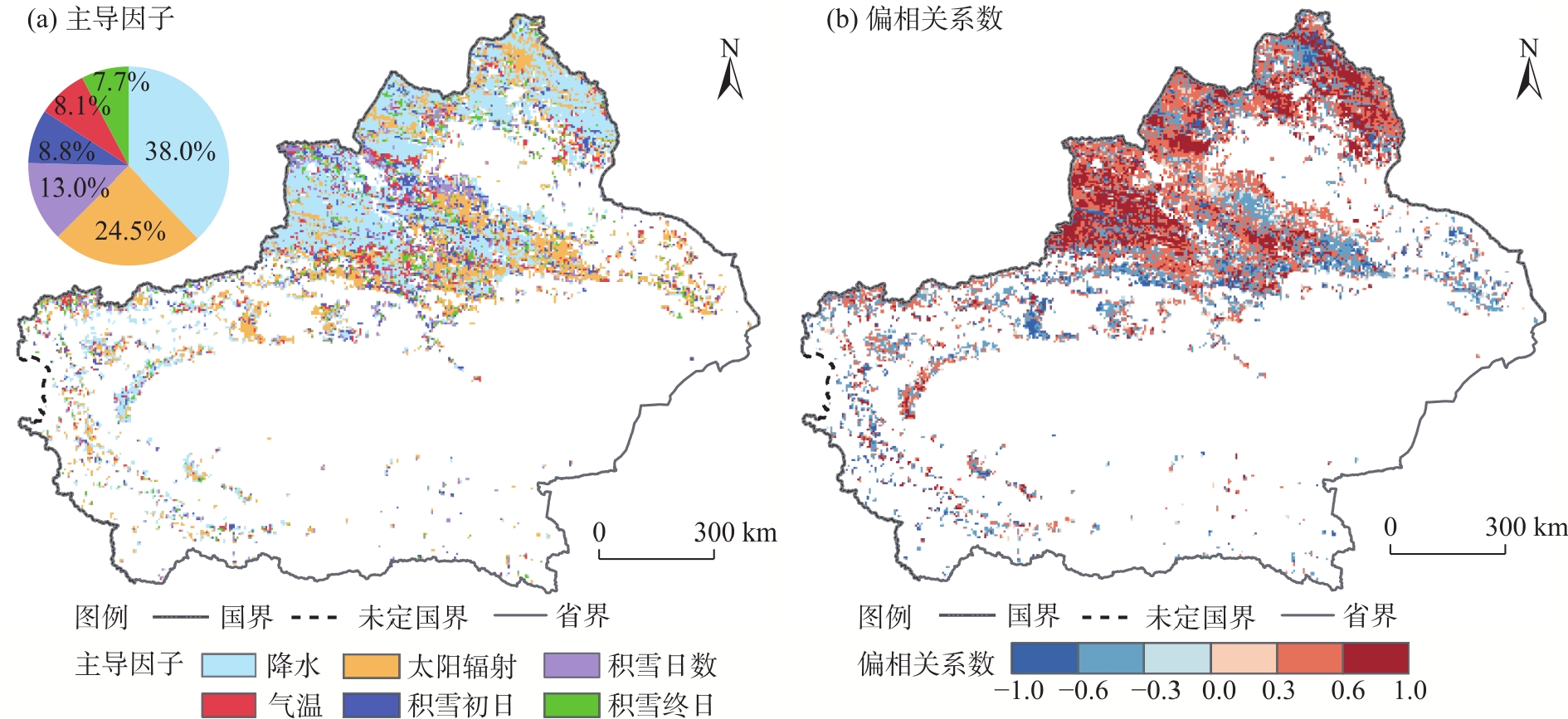
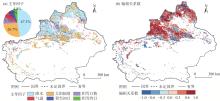
Fig. 6
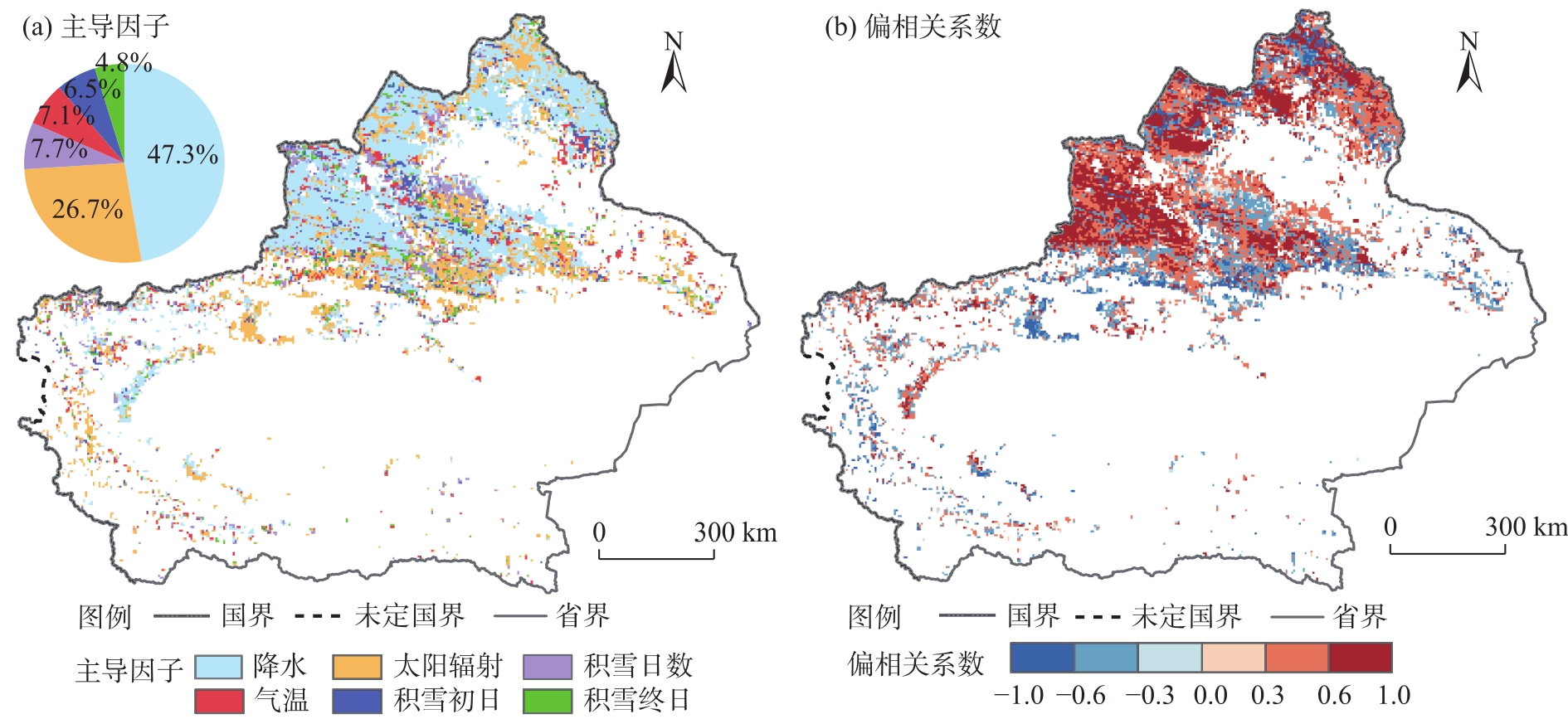
Distributions of dominant driving factors and their partial correlation coefficients for NPP change in Xinjiang"

Tab. 1
Area proportions of dominant driving factors and P/N correlations for GPP/NPP changes in Xinjiang /%"
| 植被固碳能力 | 占比项 | 驱动因子 | |||||
|---|---|---|---|---|---|---|---|
| 降水 | 太阳辐射 | 积雪日数 | 积雪初日 | 气温 | 积雪终日 | ||
| GPP | 面积占比 | 38.0 | 24.5 | 13.0 | 8.8 | 8.1 | 7.7 |
| 正相关占比 | 93.0 | 5.9 | 79.0 | 41.8 | 75.7 | 72.7 | |
| 负相关占比 | 7.0 | 94.1 | 21.0 | 58.2 | 24.3 | 27.3 | |
| NPP | 面积占比 | 47.3 | 26.7 | 7.7 | 6.5 | 7.1 | 4.8 |
| 正相关占比 | 98.5 | 4.4 | 79.4 | 32.1 | 71.7 | 70.5 | |
| 负相关占比 | 1.5 | 95.7 | 20.6 | 67.9 | 28.3 | 29.5 | |
Tab. 2
Transfer matrix of land use types in Xinjiang from 2001 to 2018 /km2"
| 2001年土地利用类型 | 2018年土地利用类型 | |||||
|---|---|---|---|---|---|---|
| 草地 | 灌木 | 荒地 | 建设用地 | 林地 | 农田 | |
| 草地 | 238950 | 75 | 6900 | 500 | 1025 | 22725 |
| 灌木 | - | - | 25 | - | - | - |
| 荒地 | 12200 | 25 | 57300 | 50 | - | 650 |
| 建设用地 | 275 | - | - | 1750 | - | 400 |
| 林地 | 1200 | - | - | - | 625 | - |
| 农田 | 3650 | - | 75 | 225 | - | 36775 |
Tab. 3
Mean GPP changes under land use transfers in Xinjiang from 2001 to 2018 /g C·m-2·a-1"
| 2001年土地利用类型 | 2018年土地利用类型 | |||||
|---|---|---|---|---|---|---|
| 草地 | 灌木 | 荒地 | 建设用地 | 林地 | 农田 | |
| 草地 | -4.1 | 3.2 | 5.7 | 3.0 | 8.0 | 52.5 |
| 灌木 | - | - | 0.4 | - | - | - |
| 荒地 | 6.6 | 12.4 | 0.8 | 34.6 | - | 63.1 |
| 建设用地 | 33.5 | - | - | 15.7 | - | -2.9 |
| 林地 | 14.8 | - | - | - | -16.8 | - |
| 农田 | -2.9 | - | -87.5 | 51.0 | - | 41.2 |
Tab. 4
Mean NPP changes under land use transfers in Xinjiang from 2001 to 2018 /g C·m-2·a-1"
| 2001年土地利用类型 | 2018年土地利用类型 | |||||
|---|---|---|---|---|---|---|
| 草地 | 灌木 | 荒地 | 建设用地 | 林地 | 农田 | |
| 草地 | -3.3 | 2.9 | 2.1 | 0.3 | 4.8 | 23.8 |
| 灌木 | - | - | 0.3 | - | - | - |
| 荒地 | 2.6 | 7.9 | 0.0 | 12.1 | - | 25.9 |
| 建设用地 | 15.9 | - | - | 5.7 | - | -5.3 |
| 林地 | 7.4 | - | - | - | -10.9 | - |
| 农田 | -5.3 | - | -52.1 | 22.4 | - | 17.2 |
Tab. 5
Changes in annual carbon sequestration under land use transfers in Xinjiang from 2001 to 2018 /t C"
| 2001年土地利用类型 | 2018年土地利用类型 | ||||||
|---|---|---|---|---|---|---|---|
| 草地 | 灌木 | 荒地 | 建设用地 | 林地 | 农田 | 累计 | |
| 草地 | -753970 | 214 | 14285 | 125 | 4751 | 523532 | -211063 |
| 灌木 | - | - | 7 | - | - | - | 7 |
| 荒地 | 31276 | 191 | 942 | 585 | - | 16289 | 49283 |
| 建设用地 | 4240 | - | - | 13077 | - | -2048 | 15269 |
| 林地 | 8646 | - | - | - | -6609 | - | 2037 |
| 农田 | -18794 | - | -3785 | 4876 | - | 613991 | 596289 |
| 累计 | -728602 | 405 | 11450 | 18664 | -1858 | 1151763 | 451822 |
| [1] |
袁文平, 蔡文文, 刘丹, 等. 陆地生态系统植被生产力遥感模型研究进展[J]. 地球科学进展, 2014, 29(5): 541-550.
doi: 10.11867/j.issn.1001-8166.2014.05.0541 |
|
[Yuan Wenping, Cai Wenwen, Liu Dan, et al. Satellite-based vegetation production models of terrestrial ecosystem: An overview[J]. Advances in Earth Science, 2014, 29(5): 541-550.]
doi: 10.11867/j.issn.1001-8166.2014.05.0541 |
|
| [2] | Yan M, Xue M, Zhang L, et al. A decade’s change in vegetation productivity and its response to climate change over northeast China[J]. Plants, 2021, 10(5): 821, doi: 10.3390/plants10050821. |
| [3] |
Anav A, Friedlingstein P, Beer C, et al. Spatiotemporal patterns of terrestrial gross primary production: A review[J]. Reviews of Geophysics, 2015, 53(3): 785-818.
doi: 10.1002/rog.v53.3 |
| [4] |
Field C B, Behrenfeld M J, Randerson J T, et al. Primary production of the biosphere: Integrating terrestrial and oceanic components[J]. Science, 1998, 281(5374): 237-240.
doi: 10.1126/science.281.5374.237 pmid: 9657713 |
| [5] |
Running S W, Nemani R R, Heinsch F A, et al. A continuous satellite-derived measure of global terrestrial primary production[J]. Bioscience, 2004, 54(6): 547-560.
doi: 10.1641/0006-3568(2004)054[0547:ACSMOG]2.0.CO;2 |
| [6] |
Zhao M S, Running S W. Drought-induced reduction in global terrestrial net primary production from 2000 through 2009[J]. Science, 2010, 329(5994): 940-943.
doi: 10.1126/science.1192666 pmid: 20724633 |
| [7] | Zhang Y, Zhang C B, Wang Z Q, et al. Vegetation dynamics and its driving forces from climate change and human activities in the Three-River Source Region, China from 1982 to 2012[J]. Science of the Total Environment, 2016, 563: 210-220. |
| [8] | 冯婉, 谢世友. 长江流域片2001—2015年植被NPP时空特征及影响因子探测[J]. 水土保持研究, 2022, 29(1): 176-183. |
| [Feng Wan, Xie Shiyou. Spatiotemporal characteristics and influencing factors of vegetation NPP in the Yangtze River Basin from 2000 to 2015[J]. Research of Soil and Water Conservation, 2022, 29(1): 176-183.] | |
| [9] | Liu H, Xiao P F, Zhang X L, et al. Increased snow cover enhances gross primary productivity in cold and dry regions of the Tibetan Plateau[J]. Ecosphere, 2023, 14(9): e4656, doi: 10.1002/ecs2.4656. |
| [10] | 刘旻霞, 焦骄, 潘竟虎, 等. 青海省植被净初级生产力(NPP)时空格局变化及其驱动因素[J]. 生态学报, 2020, 40(15): 5306-5317. |
| [Liu Minxia, Jiao Jiao, Pan Jinghu, et al. Spatial and temporal patterns of planting NPP and its driving factors in Qinghai Province[J]. Acta Ecologica Sinica, 2020, 40(15): 5306-5317.] | |
| [11] | 高振翔, 叶剑, 丁仁惠, 等. 中国植被总初级生产力对气候变化的响应[J]. 水土保持研究, 2022, 29(4): 394-399. |
| [Gao Zhenxiang, Ye Jian, Ding Renhui, et al. Response of vegetation gross primary productivity to climate change in China[J]. Research of Soil and Water Conservation, 2022, 29(4): 394-399.] | |
| [12] | Wang X, Tan K, Chen B Z, et al. Assessing the spatiotemporal variation and impact factors of net primary productivity in China[J]. Scientific Reports, 2017, 7(1): 44415, doi: 10.1038/srep44415. |
| [13] | 毕晓丽, 王辉, 葛剑平. 植被归一化指数(NDVI)及气候因子相关起伏型时间序列变化分析[J]. 应用生态学报, 2005, 16(2): 284-288. |
|
[Bi Xiaoli, Wang Hui, Ge Jianping. Wave-type time series variation of the correlation between NDVI and climatic factors[J]. Chinese Journal of Applied Ecology, 2005, 16(2): 284-288.]
pmid: 15852924 |
|
| [14] |
陈亚宁, 李稚, 范煜婷, 等. 西北干旱区气候变化对水文水资源影响研究进展[J]. 地理学报, 2014, 69(9): 1295-1304.
doi: 10.11821/dlxb201409005 |
| [Chen Yaning, Li Zhi, Fan Yuting, et al. Research progress on the impact of climate change on water resources in the arid region of northwest China[J]. Acta Geogrephica Sinica, 2014, 69(9): 1295-1304.] | |
| [15] | 车涛, 李新. 1993—2002年中国积雪水资源时空分布与变化特征[J]. 冰川冻土, 2005, 27(1): 64-67. |
| [Che Tao, Li Xin. Spatial distribution and temporal variation of snow water resources in China during 1993—2002[J]. Journal of Glaciology and Geocryology, 2005, 27(1): 64-67.] | |
| [16] |
Niu L N, Shao Q Q, Ning J, et al. Ecological changes and the tradeoff and synergy of ecosystem services in western China[J]. Journal of Geographical Sciences, 2022, 32(6): 1059-1075.
doi: 10.1007/s11442-022-1985-6 |
| [17] |
姚俊强, 李漠岩, 迪丽努尔·托列吾别克, 等. 不同时间尺度下新疆气候“暖湿化”特征[J]. 干旱区研究, 2022, 39(2): 333-346.
doi: 10.13866/j.azr.2022.02.01 |
|
[Yao Junqiang, Li Moyan, Tuoliewubieke Dilinuer, et al. The assessment on “warming-wetting” trend in Xinjiang at multi-scale during 1961—2019[J]. Arid Zone Research, 2022, 39(2): 333-346.]
doi: 10.13866/j.azr.2022.02.01 |
|
| [18] |
Wang H J, Chen Y N, Xun S, et al. Changes in daily climate extremes in the arid area of northwestern China[J]. Theoretical and Applied Climatology, 2013, 112(1-2): 15-28.
doi: 10.1007/s00704-012-0698-7 |
| [19] | 杨静, 黄秉光, 黄玫, 等. 近55 a新疆净生态系统生产力对气候变化的响应[J]. 干旱区地理, 2017, 40(5): 1054-1060. |
| [Yang Jing, Huang Bingguang, Huang Mei, et al. Responses of net ecosystem productivity to climate change in Xinjiang in recent 55 years[J]. Arid Land Geography, 2017, 40(5): 1054-1060.] | |
| [20] |
Yang H F, Mu S J, Li J L. Effects of ecological restoration projects on land use and land cover change and its influences on territorial NPP in Xinjiang, China[J]. Catena, 2014, 115: 85-95.
doi: 10.1016/j.catena.2013.11.020 |
| [21] | 秦景秀, 郝兴明, 张颖, 等. 气候变化和人类活动对干旱区植被生产力的影响[J]. 干旱区地理, 2020, 43(1): 117-125. |
|
[Qin Jingxiu, Hao Xingming, Zhang Ying, et al. Effects of climate change and human activities on vegetation productivity in arid areas[J]. Arid Land Geography, 2020, 43(1): 117-125.]
doi: 10.12118/j.issn.1000-6060.2020.01.14 |
|
| [22] | 张山清, 普宗朝, 伏晓慧, 等. 气候变化对新疆自然植被净第一性生产力的影响[J]. 干旱区研究, 2010, 27(6): 905-914. |
| [Zhang Shanqing, Pu Zongchao, Fu Xiaohui, et al. Effect of climate change on NPP of natural vegetation in Xinjiang[J]. Arid Zone Research, 2010, 27(6): 905-914.] | |
| [23] |
姜萍, 袁野. 新疆植被总初级生产力对大气水分亏缺的响应[J]. 干旱区地理, 2024, 47(3): 403-412.
doi: 10.12118/j.issn.1000-6060.2023.413 |
|
[Jiang Ping, Yuan Ye. Responses of vegetation gross primary production to vapor pressure deficit in Xinjiang[J]. Arid Land Geography, 2024, 47(3): 403-412.]
doi: 10.12118/j.issn.1000-6060.2023.413 |
|
| [24] | 姚宏达, 顾玉丽, 罗青红, 等. 典型荒漠绿化工程区净生态系统生产力的时空变化特征[J]. 气候与环境研究, 2025, 30(3): 322-334. |
| [Yao Hongda, Gu Yuli, Luo Qinghong, et al. Characteristics of spatial and temporal changes in net ecosystem productivity across the typical desert greening project areas[J]. Climatic and Environmental Research, 2025, 30(3): 322-334.] | |
| [25] |
赵晓涵, 张方敏, 韩典辰, 等. 内蒙古半干旱区蒸散特征及归因分析[J]. 干旱区研究, 2021, 38(6): 1614-1623.
doi: 10.13866/j.azr.2021.06.13 |
|
[Zhao Xiaohan, Zhang Fangmin, Han Dianchen, et al. Evapotranspiration changes and its attribution in semi-arid regions of Inner Mongolia[J]. Arid Zone Research, 2021, 38(6): 1614-1623.]
doi: 10.13866/j.azr.2021.06.13 |
|
| [26] | He Q, Ju W, Dai S, et al. Drought risk of global terrestrial gross primary productivity over the last 40 years detected by a remote sensing-driven process model[J]. Journal of Geophysical Research: Biogeosciences, 2021, 126(6): e2020JG005944, doi: 10.1029/2020JG-005944. |
| [27] | Gong H B, Cao L, Duan Y F, et al. Multiple effects of climate changes and human activities on NPP increase in the Three-north Shelter Forest Program area[J]. Forest Ecology and Management, 2023, 529: 120732, doi: 10.1016/j.foreco.2022.120732. |
| [28] | Li J H, Han W Q, Zheng J H, et al. Grassland productivity in arid Central Asia depends on the greening rate rather than the growing season length[J]. Science of the Total Environment, 2024, 933: 173155, doi: 10.1016/j.scitotenv.2024.173155. |
| [29] | Gong H X, Wang G Y, Fan C Q, et al. Temporal accumulation and lag effects of precipitation on carbon fluxes in terrestrial ecosystems across semi-arid regions in China[J]. Agricultural and Forest Meteorology, 2024, 356: 110189, doi: 10.1016/j.agrformet.2024.110189. |
| [30] | Liu H H, Liu Y, Chen Y, et al. Dynamics of global dryland vegetation were more sensitive to soil moisture: Evidence from multiple vegetation indices[J]. Agricultural and Forest Meteorology, 2023, 331: 109327, doi: 10.1016/j.agrformet.2023.109327. |
| [31] | 郝晓华, 赵琴, 纪文政, 等. 1980—2020年AVHRR中国积雪物候数据集[J]. 中国科学数据, 2022, 7(3): 1-10. |
| [Hao Xiaohua, Zhao Qin, Ji Wenzheng, et al. A dataset of snow cover phenology in China based on AVHRR from 1980 to 2020[J]. China Scientific Data, 2022, 7(3): 1-10.] | |
| [32] |
Peng S Z, Ding Y X, Wen Z M, et al. Spatiotemporal change and trend analysis of potential evapotranspiration over the Loess Plateau of China during 2011—2100[J]. Agricultural and Forest Meteorology, 2017, 233: 183-194.
doi: 10.1016/j.agrformet.2016.11.129 |
| [33] |
Abatzoglou J T, Dobrowski S Z, Parks S A, et al. TerraClimate, a high-resolution global dataset of monthly climate and climatic water balance from 1958—2015[J]. Scientific Data, 2018, 5(1): 1-12.
doi: 10.1038/s41597-018-0002-5 |
| [34] |
Hamed K H, Rao A R. A modified Mann-Kendall trend test for autocorrelated data[J]. Journal of Hydrology, 1998, 204(1-4): 182-196.
doi: 10.1016/S0022-1694(97)00125-X |
| [35] |
王劲峰, 徐成东. 地理探测器: 原理与展望[J]. 地理学报, 2017, 72(1): 116-134.
doi: 10.11821/dlxb201701010 |
| [Wang Jinfeng, Xu Chengdong. Geodetector: Principle and prospective[J]. Acta Geologica Sinica, 2017, 72(1): 116-134.] | |
| [36] | 张磊, 罗平平, 王小珲, 等. 1960—2019年关中平原极端降水时空变化及非平稳性分析[J]. 水利水电技术, 2023, 54(3): 35-46. |
| [Zhang Lei, Luo Pingping, Wang Xiaohui, et al. Spatial and temporal variation and non-stationary analysis of extreme precipitation in Guanzhong Plain from 1960 to 2019[J]. Water Resources and Hydropower Engineering, 2023, 54(3): 35-46.] | |
| [37] | 温宥越, 孙强, 燕玉超, 等. 粤港澳大湾区陆地生态系统演变对固碳释氧服务的影响[J]. 生态学报, 2020, 40(23): 8482-8493. |
| [Wen Youyue, Sun Qiang, Yan Yuchao, et al. Impacts of the terrestrial ecosystem changes on the carbon fixation and oxygen release services in the Guangdong-Hong Kong-Macao Greater Bay Area[J]. Acta Ecologica Sinica, 2020, 40(23): 8482-8493.] | |
| [38] |
高晓宇, 郝海超, 张雪琪, 等. 中国西北干旱区植被水分利用效率变化对气象要素的响应——以新疆为例[J]. 干旱区地理, 2023, 46(7): 1111-1120.
doi: 10.12118/j.issn.1000-6060.2022.545 |
|
[Gao Xiaoyu, Hao Haichao, Zhang Xueqi, et al. Responses of vegetation water use efficiency to meteorological factors in arid areas of northwest China: A case of Xinjiang[J]. Arid Land Geography, 2023, 46(7): 1111-1120.]
doi: 10.12118/j.issn.1000-6060.2022.545 |
|
| [39] |
韩炳宏, 周秉荣, 颜玉倩, 等. 2000—2018年间青藏高原植被覆盖变化及其与气候因素的关系分析[J]. 草地学报, 2019, 27(6): 1651-1658.
doi: 10.11733/j.issn.1007-0435.2019.06.023 |
|
[Han Binghong, Zhou Bingrong, Yan Yuqian, et al. Analysis of vegetation coverage change and its driving factors over Tibetan Plateau from 2000 to 2008[J]. Acta Agrestia Sinica, 2019, 27(6): 1651-1658.]
doi: 10.11733/j.issn.1007-0435.2019.06.023 |
|
| [40] | 姚俊强, 杨青, 陈亚宁, 等. 西北干旱区气候变化及其对生态环境影响[J]. 生态学杂志, 2013, 32(5): 1283-1291. |
| [Yao Junqiang, Yang Qing, Chen Yaning, et al. Climate change in arid areas of northwest China in past 50 years and its effects on the local ecological environment[J]. Chinese Journal of Ecology, 2013, 32(5): 1283-1291.] | |
| [41] | 同琳静, 刘洋洋, 王倩, 等. 西北植被净初级生产力时空变化及其驱动因素[J]. 水土保持研究, 2019, 26(4): 367-374. |
| [Tong Linjing, Liu Yangyang, Wang Qian, et al. Spatial and temporal dynamics of net primary productivity and its driving factors in northwest China[J]. Research of Soil and Water Conservation, 2019, 26(4): 367-374.] | |
| [42] |
孔冬冬, 张强, 黄文琳, 等. 1982—2013年青藏高原植被物候变化及气象因素影响[J]. 地理学报, 2017, 72(1): 39-52.
doi: 10.11821/dlxb201701004 |
|
[Kong Dongdong, Zhang Qiang, Huang Wenlin, et al. Vegetation phenology change in Tibetan Plateau from 1982 to 2013 and its related meteorological factors[J]. Acta Geographica Sinica, 2017, 72(1): 39-52.]
doi: 10.11821/dlxb201701004 |
|
| [43] | 姬盼盼, 高敏华, 杨晓东. 中国西北部干旱区NPP驱动力分析——以新疆伊犁河谷和天山山脉部分区域为例[J]. 生态学报, 2019, 39(8): 2995-3006. |
| [Ji Panpan, Gao Minhua, Yang Xiaodong. Analysis of NPP driving force in an arid region of northwest China: A case study in Yili Valley and parts of Tianshan Mountains, Xinjiang, China[J]. Acta Ecologica Sinica, 2019, 39(8): 2995-3006.] | |
| [44] |
Chen S L, Huang Y F, Wang G Q. Response of vegetation carbon uptake to snow-induced phenological and physiological changes across temperate China[J]. Science of the Total Environment, 2019, 692: 188-200.
doi: 10.1016/j.scitotenv.2019.07.222 |
| [45] |
Yu Z, Liu S R, Wang J X, et al. Effects of seasonal snow on the growing season of temperate vegetation in China[J]. Global Change Biology, 2013, 19(7): 2182-2195.
doi: 10.1111/gcb.12206 pmid: 23532953 |
| [46] |
吴瀚, 白洁, 李均力, 等. 新疆地区植被覆盖度时空变化及其影响因素分析[J]. 植物生态学报, 2024, 48(1): 41-55.
doi: 10.17521/cjpe.2022.0397 |
|
[Wu Han, Bai Jie, Li Junli, et al. Study of spatio-temporal variation in fractional vegetation cover and its influencing factors in Xinjiang, China[J]. Chinese Journal of Plant Ecology, 2024, 48(1): 41-55.]
doi: 10.17521/cjpe.2022.0397 |
|
||