Arid Land Geography ›› 2026, Vol. 49 ›› Issue (9): 1901-1913.doi: 10.12118/j.issn.1000-6060.2025.825
• Urban Geography • Previous Articles Next Articles
ZHOU Yuntian1,2( ), DU Hongru1,2(), Ranna HAZIHAN1,2, GUO Jiali1,2
Received:2025-12-16
Revised:2026-02-14
Online:2026-09-25
Published:2026-09-07
Contact:
DU Hongru
E-mail:zhouyuntian23@mails.ucas.ac.cn;duhongru@sina.cn
ZHOU Yuntian, DU Hongru, Ranna HAZIHAN, GUO Jiali. Differential analysis of influencing factors in jobs-housing relationships incorporating workers’ perception: A case of Urumqi City[J].Arid Land Geography, 2026, 49(9): 1901-1913.
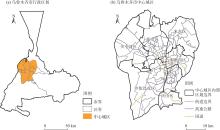
Fig. 1
Schematic diagram of the study area"
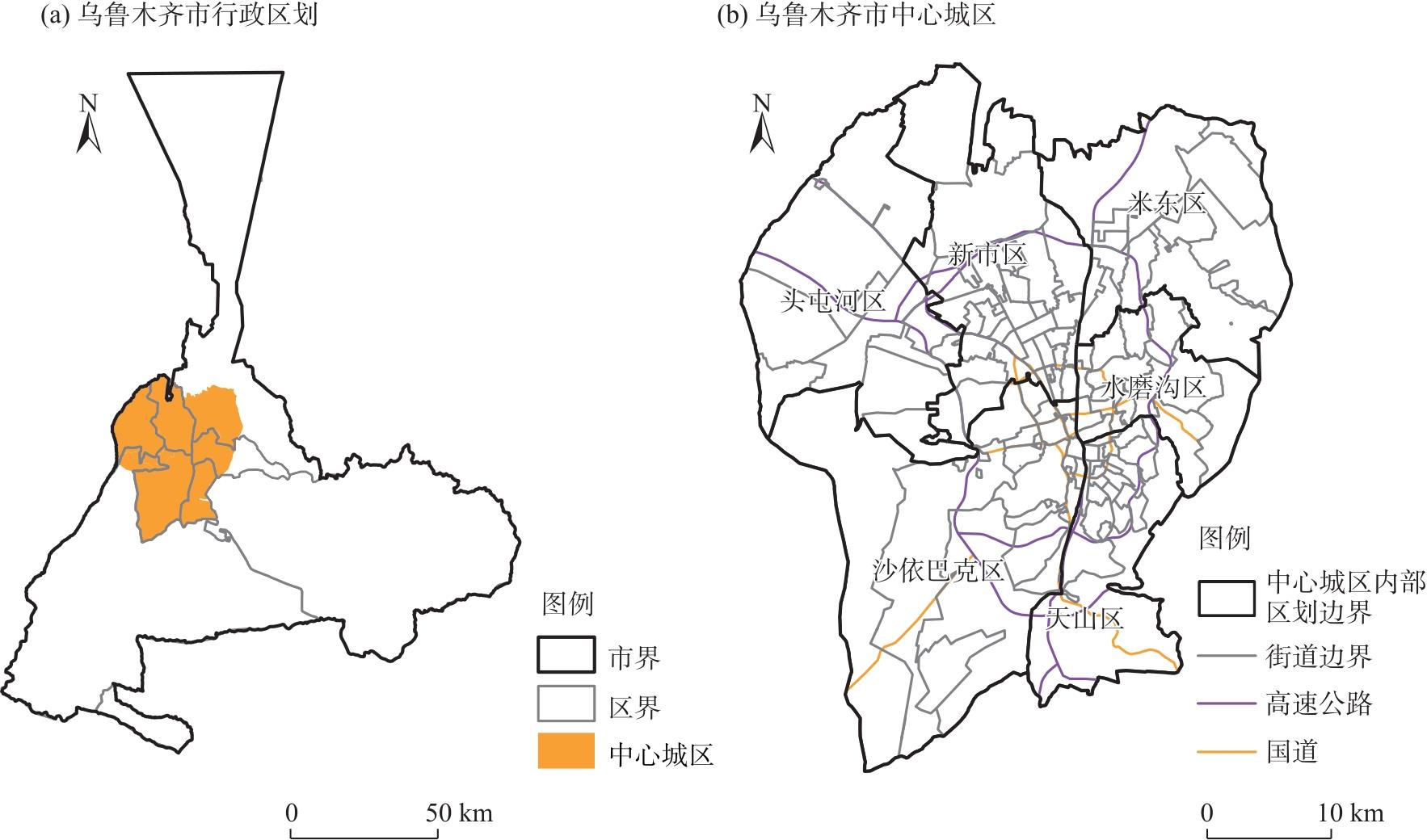
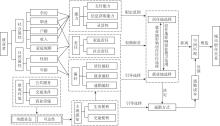
Fig. 2
Influencing factors and mechanisms of jobs-housing relationship"

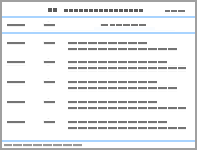
Tab. 1
Data source and processing"
| 数据类型 | 数据处理 |
|---|---|
| 百度热力图 | 2024年5—6月以1 h为最小单位的研究区内工作日热力图数据。在ArcGIS Pro平台上,通过核密度分析,获取各时段的热力图栅格数据 |
| 百度POI | 2024年研究区内商业、餐饮、交通、游憩、教育、医疗6类设施POI数据,共85210个点,用于分析客观建成环境对职住平衡的影响 |
| 高德路网 | 2024年研究区内涵盖主干道、次干道、支路等各级道路网络数据。运用ArcGIS Pro网络分析工具提取道路交叉口节点,以街道为单元计算交叉口密度,衡量路网连通性对职住空间分布的影响 |
| 调查问卷 | 2024年城市居民社会满意度调查中18~60岁之间的就业者进行问卷统计。调查时间为2024年5—8月,由各街道办事处组织开展。经数据清洗与编码筛选,得到有效问卷25234份,有效率为81.3%。对问卷中主观感知类变量进行信度效度检验,Cronbach’s α系数为0.818,KMO值为0.783,Bartlett球形检验显著(P<0.01),信度效度良好,可用于后续分析 |
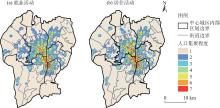
Fig. 3
Spatial distributions of employment and housing spaces in the central urban area of Urumqi City"
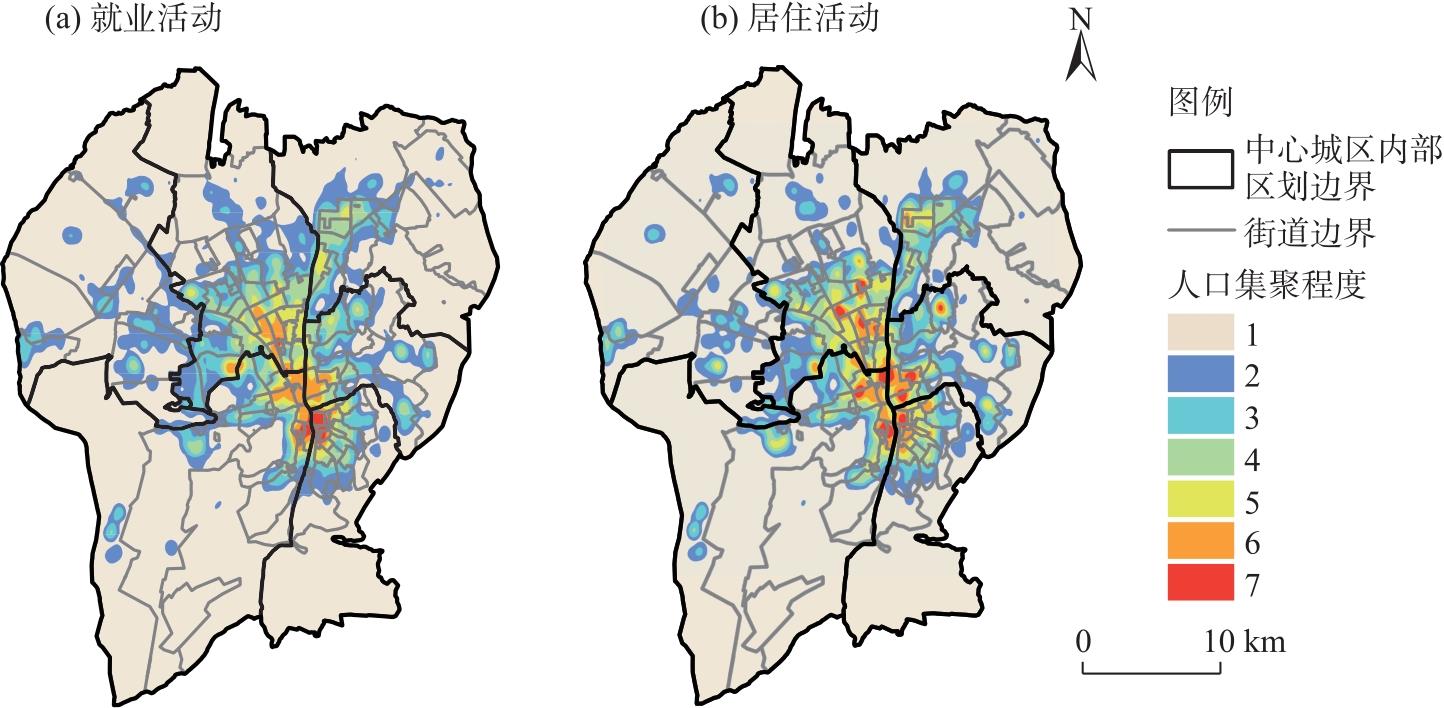
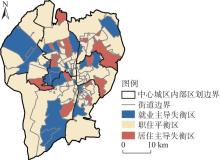
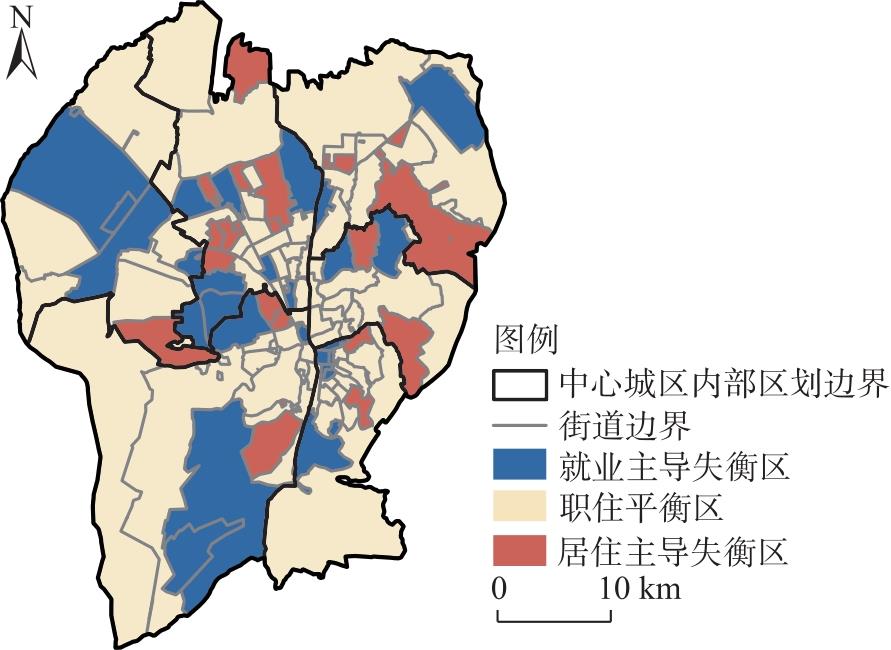
Fig. 4
Spatial zoning of jobs-housing balance levels in the central urban area of Urumqi City"
Tab. 2
Model validation for individual characteristics"
| 模型 | -2对数似然值 | 似然比检验 | ||
|---|---|---|---|---|
| 卡方 | 自由度 | 显著性 | ||
| 就业主导失衡型街道 | 5687.421 | 822.711 | 120 | 0.000 |
| 职住平衡型街道 | 34435.466 | 4274.519 | 120 | 0.000 |
| 居住主导失衡型街道 | 7113.865 | 892.208 | 120 | 0.000 |
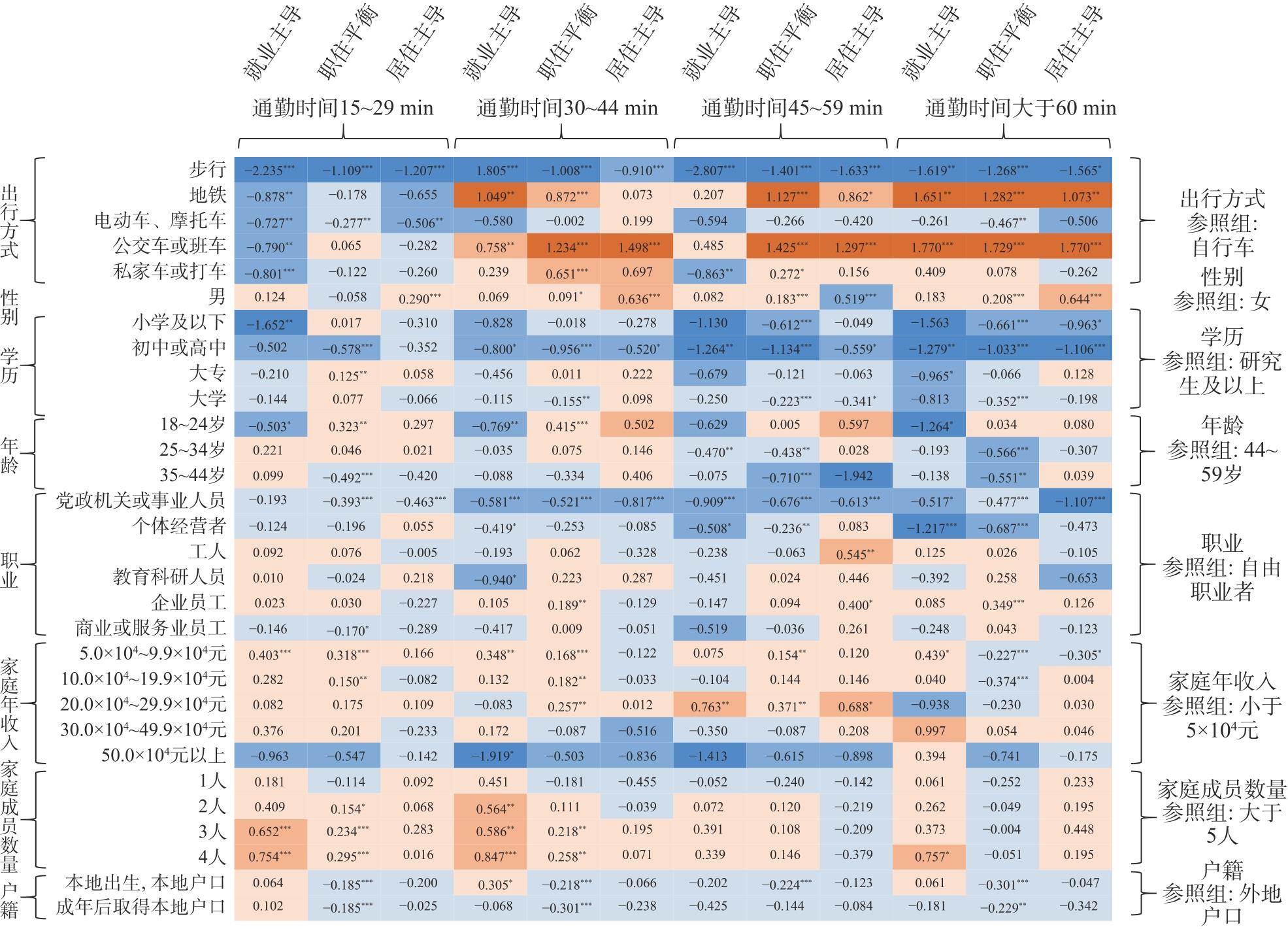
Fig. 5
Results of multinomial logistics regression on individual characteristics"
Tab. 3
Regression results for objective built environment"
| 因子 | 变量 | 系数 |
|---|---|---|
| 公共服务设施 | 医疗设施密度 | 0.014*** |
| 商业零售设施密度 | 0.001*** | |
| 学校密度 | -0.124*** | |
| 餐饮服务设施密度 | -0.001 | |
| 交通可达性 | 道路交叉口密度 | -0.007 |
| 公交站点密度 | 0.031 | |
| BRT站点密度 | 0.175*** |
Tab. 4
Model validation for workers’ perception"
| 模型 | -2对数似然值 | 似然比检验 | ||
|---|---|---|---|---|
| 卡方 | 自由度 | 显著性 | ||
| 就业主导失衡型街道 | 1458.912 | 241.922 | 56 | 0.000 |
| 职住平衡型街道 | 3435.711 | 1470.769 | 56 | 0.000 |
| 居住主导失衡型街道 | 1733.541 | 283.585 | 56 | 0.000 |
Tab. 5
Regression results for workers’ perception across different commuting times in jobs-housing balance areas"
| 因子 | 变量 | 15~29 min | 30~44 min | 45~59 min | 大于60 min |
|---|---|---|---|---|---|
| 您认为城市就业者的通勤距离远吗? | 很近 | -0.498*** | -0.635*** | -0.463*** | -0.523*** |
| 比较近 | -0.181*** | -0.223*** | -0.286*** | -0.315*** | |
| 比较远 | 0.033 | 0.345*** | 0.850*** | 1.016*** | |
| 很远 | -0.126 | 0.114 | 0.717*** | 1.492*** | |
| 您认为城市平时道路通畅吗? | 非常拥堵 | 0.146 | 0.281** | 0.477*** | 0.675*** |
| 比较拥堵 | 0.180** | 0.400*** | 0.310*** | 0.429*** | |
| 比较通畅 | 0.116 | -0.058 | -0.042 | -0.190 | |
| 很通畅 | -0.142 | -0.173 | -0.434*** | -0.485*** | |
| 您认为公共交通站点设置是否方便? | 很不方便 | 0.162 | 0.168 | 0.010 | 0.457** |
| 不太方便 | 0.228** | 0.062 | 0.141 | 0.192 | |
| 比较方便 | 0.108 | 0.062 | 0.000 | -0.140 | |
| 很方便 | -0.038 | -0.003 | -0.192 | -0.136 | |
| 您认为当前街区的商业类型? | 较差,种类单一,无法满足生活购物需求 | -0.101 | -0.133 | 0.021 | -0.126 |
| 较多,种类齐全,完全满足生活购物需求 | -0.164*** | -0.138*** | -0.190*** | -0.162** |
| [1] | 柯茂. 职住平衡理念及测度方法的再思考——基于文献的评论[J]. 智能建筑与智慧城市, 2025, 32(5): 27-29. |
| [Ke Mao. Rethinking on the theory and measurement methods of job-housing balance--The review based on literature[J]. Intelligent Building & Smart City, 2025, 32(5): 27-29.] | |
| [2] | 刘望保, 闫小培, 方远平, 等. 广州市过剩通勤的相关特征及其形成机制[J]. 地理学报, 2008, 63(10): 1085-1096. |
|
[Liu Wangbao, Yan Xiaopei, Fang Yuanping, et al. Related characteristics and mechanisms for excess commuting in Guangzhou[J]. Acta Geographica Sinica, 2008, 63(10): 1085-1096.]
doi: 10.11821/xb200810008 |
|
| [3] | 中共中央、国务院关于推动城市高质量发展的意见[N]. 人民日报, 2025-08-29(001). |
| [Opinions of the Central Committee of the Communist Party of China and the State Council on promoting high-quality urban development[N]. People’s Daily, 2025-08-29(001).] | |
| [4] | 颜冉, 刘冰, 李超骕, 等. 合肥中心城区职住空间特征及其影响因素[J]. 地域研究与开发, 2022, 41(5): 63-69. |
| [Yan Ran, Liu Bing, Li Chaoxiao, et al. Study on job-housing characteristics and influencing factors in central urban area of Hefei City[J]. Areal Research and Development, 2022, 41(5): 63-69.] | |
| [5] | 康雷, 张文忠, 杨兆萍, 等. 北京城市建成环境对居民宜居满意度的影响[J]. 人文地理, 2020, 35(5): 52-60. |
| [Kang Lei, Zhang Wenzhong, Yang Zhaoping, et al. The influence of Beijing’s built environment on residents’ livability satisfaction[J]. Human Geography, 2020, 35(5): 52-60.] | |
| [6] | 郭亮, 毕瑜菲, 黄建中, 等. 大城市职住空间特征的多尺度比较与分析——以武汉为例[J]. 城市规划学刊, 2018, 25(5): 88-97. |
| [Guo Liang, Bi Yufei, Huang Jianzhong, et al. Multi-scale comparison and analysis of jobs-housing spatial characteristics in big cities: Taking Wuhan as an example[J]. Urban Planning Forum, 2018, 25(5): 88-97.] | |
| [7] |
林勋媛, 王广兴, 胡月明. 基于开放大数据的广州市中心城区职住平衡特征研究[J]. 热带地理, 2020, 40(2): 254-265.
doi: 10.13284/j.cnki.rddl.003218 |
|
[Lin Xunyuan, Wang Guangxing, Hu Yueming. Characteristics of the jobs-housing balance in central Guangzhou based on open big data[J]. Tropical Geography, 2020, 40(2): 254-265.]
doi: 10.13284/j.cnki.rddl.003218 |
|
| [8] |
王蓓, 王良, 刘艳华, 等. 基于手机信令数据的北京市职住空间分布格局及匹配特征[J]. 地理科学进展, 2020, 39(12): 2028-2042.
doi: 10.18306/dlkxjz.2020.12.006 |
|
[Wang Bei, Wang Liang, Liu Yanhua, et al. Characteristics of jobs-housing spatial distribution in Beijing based on mobile phone signaling data[J]. Progress in Geography, 2020, 39(12): 2028-2042.]
doi: 10.18306/dlkxjz.2020.12.006 |
|
| [9] |
Pan H X, Shen Q, Zhang M. Influence of urban form on travel behaviour in four neighbourhoods of Shanghai[J]. Urban Studies, 2009, 46(2): 275-294.
doi: 10.1177/0042098008099355 |
| [10] | 王录仓, 常飞. 基于百度热力图的银川市中心城区职住关系研究[J]. 干旱区地理, 2019, 42(4): 923-932. |
| [Wang Lucang, Chang Fei. Jobbing-housing relationship in central urban area of Yinchuan City based on Baidu heat map[J]. Arid Land Geography, 2019, 42(4): 923-932.] | |
| [11] | 陈春, 梁行. 基于手机信令数据的重庆中心城区职住关系变化研究[J]. 西部人居环境学刊, 2023, 38(5): 133-138. |
| [Chen Chun, Liang Xing. Research on the changes of job-housing relationship in the central urban area of Chongqing based on mobile signaling data[J]. Journal of Human Settlements in West China, 2023, 38(5): 133-138.] | |
| [12] | 贺慧, 张庆昊, 郭亮, 等. 街道建成环境对短距离通勤方式选择的影响——以武汉市主城区为例[J]. 现代城市研究, 2024, 31(7): 17-23. |
| [He Hui, Zhang Qinghao, Guo Liang, et al. The influence of street level built environment on the selection of short-distance commuting modes: A case study of the central areas in Wuhan[J]. Modern Urban Research, 2024, 31(7): 17-23.] | |
| [13] |
任鹏, 彭建东, 杨红, 等. 武汉市轨道交通站点周边地区职住平衡与建成环境的关系研究[J]. 地球信息科学学报, 2021, 23(7): 1231-1245.
doi: 10.12082/dqxxkx.2021.200662 |
| [Ren Peng, Peng Jiandong, Yang Hong, et al. Relationship between jobs-housing balance and built environment in areas around urban rail transit stations of Wuhan[J]. Journal of Geo-Information Science, 2021, 23(7): 1231-1245.] | |
| [14] | 仝德, 高静, 龚咏喜. 城中村对深圳市职住空间融合的影响——基于手机信令数据的研究[J]. 北京大学学报(自然科学版), 2020, 56(6): 1091-1101. |
| [Tong De, Gao Jing, Gong Yongxi. Impact of urban village on job-housing balance in Shenzhen: A study using mobile phone signaling data[J]. Acta Scientiarum Naturalium Universitatis Pekinensis, 2020, 56(6): 1091-1101.] | |
| [15] | 张艳, 李春江, 黄建毅, 等. 基于多源数据融合的北京市职住空间特征研究[J]. 城市发展研究, 2019, 26(12): 37-45. |
| [Zhang Yan, Li Chunjiang, Huang Jianyi, et al. Spatial characteristics of jobs-housing relationship of Beijing City based on multi-source data integration[J]. Urban Development Studies, 2019, 26(12): 37-45.] | |
| [16] |
岳丽莹, 李开明, 吴瑞君. 上海市不同学历群体过剩通勤空间分异及影响因素[J]. 地理科学, 2023, 43(8): 1382-1391.
doi: 10.13249/j.cnki.sgs.2023.08.007 |
| [Yue Liying, Li Kaiming, Wu Ruijun. Intraurban variations and determinants of excess commuting for different educational groups in Shanghai[J]. Geographical Science, 2023, 43(8): 1382-1391.] | |
| [17] |
Zhang F Y, Loo B P Y, Lan H, et al. Jobs-housing balance and travel patterns among different occupations as revealed by hidden markov mixture models: The case of Hong Kong[J]. Transportation, 2024, 51: 1857-1877.
doi: 10.1007/s11116-023-10390-4 |
| [18] | 丁亮, 陶安然, 周骏, 等. 杭州职住结构失配的识别与影响机理[J/OL]. 地理学报. [2025-10-15]. https://link.cnki.net/urlid/11.1856.P.20250828.1044.004. |
| [Ding Liang, Tao Anran, Zhou Jun, et al. Identification and influence mechanism of jobs-housing structure mismatch in Hangzhou[J/OL]. Acta Geographica Sinica. [2025-10-15]. https://link.cnki.net/urlid/11.1856.P.20250828.1044.004.] | |
| [19] | 柴彦威, 张艳, 刘志林. 职住分离的空间差异性及其影响因素研究[J]. 地理学报, 2011, 66(2): 157-166. |
| [Chai Yanwei, Zhang Yan, Liu Zhilin. Spatial differences of home-work separation and the impacts of housing policy and urban sprawl: Evidence from household survey data in Beijing[J]. Acta Geographica Sinica, 2011, 66(2): 157-166.] | |
| [20] | 仇璟, 秦萧, 甄峰. 基于大小数据结合的城市职住平衡影响因素研究: 以常州主城区为例[J]. 现代城市研究, 2020, 27(6): 56-63. |
| [Qiu Jing, Qin Xiao, Zhen Feng. Research on job-housing balance based on combination of big and small data: A case study in Changzhou, China[J]. Modern Urban Research, 2020, 27(6): 56-63.] | |
| [21] | 毕硕本, 王璐烨, 刘少丽, 等. 成都市职住空间分布特征及影响因素研究[J]. 地理与地理信息科学, 2024, 40(1): 81-88. |
| [Bi Shuoben, Wang Luye, Liu Shaoli, et al. Distribution characteristics and influencing factors of jobs-housing space in Chengdu City[J]. Geography and Geo-Information Science, 2024, 40(1): 81-88.] | |
| [22] |
英成龙, 雷军, 段祖亮, 等. 乌鲁木齐市职住空间组织特征及影响因素[J]. 地理科学进展, 2016, 35(4): 462-475.
doi: 10.18306/dlkxjz.2016.04.007 |
|
[Ying Chenglong, Lei Jun, Duan Zuliang, et al. Characteristics of jobs-housing spatial organization in Urumqi City and influencing factors[J]. Progress in Geography, 2016, 35(4): 462-475.]
doi: 10.18306/dlkxjz.2016.04.007 |
|
| [23] | 熊黑钢, 邹桂红, 崔建勇. 城市化过程中地形因素对城市空间结构演变的影响——以乌鲁木齐市为例[J]. 地域研究与开发, 2012, 31(1): 55-59. |
| [Xiong Heigang, Zou Guihong, Cui Jianyong. Influences of topographic factors on change of urban spatial structure in the process of urbanization: A case study of Urumqi City[J]. Areal Research and Development, 2012, 31(1): 55-59.] | |
| [24] |
唐钰婷, 杜宏茹. 社区生活圈划分及建设水平综合测度方法——以乌鲁木齐市为例[J]. 干旱区地理, 2024, 47(2): 332-342.
doi: 10.12118/j.issn.1000-6060.2023.148 |
|
[Tang Yuting, Du Hongru. Spatial scope of community living circle and comprehensive measurement method of construction level: Urumqi City as an example[J]. Arid Land Geography, 2024, 47(2): 332-342.]
doi: 10.12118/j.issn.1000-6060.2023.148 |
|
| [25] | 张天然, 王波, 訾海波, 等. 上海五个新城职住空间特征对比研究[J]. 上海城市规划, 2021, 25(4): 44-52. |
| [Zhang Tianran, Wang Bo, Zi Haibo, et al. A comparative study on the spatial characteristics of job-housing in five new towns in Shanghai[J]. Shanghai Urban Planning Review, 2021, 25(4): 44-52.] | |
| [26] |
Cervero R. Jobs-housing balancing and regional mobility[J]. Journal of the American Planning Association, 1989, 55(2): 136-150.
doi: 10.1080/01944368908976014 |
| [27] |
张佩, 王姣娥, 孙勇, 等. 中国省域创新基础设施与创新产出水平的耦合协调发展及其影响因素[J]. 经济地理, 2022, 42(9): 11-21.
doi: 10.15957/j.cnki.jjdl.2022.09.002 |
|
[Zhang Pei, Wang Jiao’e, Sun Yong, et al. Coupling coordinative degree of innovation infrastructure and innovation output at provincial level in China and its influencing factors[J]. Economic Geography, 2022, 42(9): 11-21.]
doi: 10.15957/j.cnki.jjdl.2022.09.002 |
|
| [28] |
赵雪纯, 菊春燕. 公园绿地与城市功能空间耦合协调关系及影响因素分析——以乌鲁木齐市为例[J]. 干旱区地理, 2024, 47(5): 898-908.
doi: 10.12118/j.issn.1000-6060.2023.452 |
|
[Zhao Xuechun, Ju Chunyan. Coupling coordination relationship between park green spaces and urban functional spaces and its influencing factors: A case of Urumqi City[J]. Arid Land Geography, 2024, 47(5): 898-908.]
doi: 10.12118/j.issn.1000-6060.2023.452 |
|
| [29] |
岳丽莹, 朱宇, 李开明. 双视角、双维度下超大城市的通勤效率——以上海市为例[J]. 地理研究, 2024, 43(2): 429-445.
doi: 10.11821/dlyj020230532 |
|
[Yue Liying, Zhu Yu, Li Kaiming. Commuting efficiency in dual dimensions of education and travel mode in Shanghai from the perspectives of average distance and spatial organization[J]. Geographical Research, 2024, 43(2): 429-445.]
doi: 10.1111/ages.2005.43.issue-4 |
|
| [30] |
刘凯, 徐媛, 周晶, 等. 基于生活方式视角的城市青年居民交通出行与居住区位选择行为——以南京市为例[J]. 地理科学, 2024, 44(1): 99-108.
doi: 10.13249/j.cnki.sgs.20221352 |
| [Liu Kai, Xu Yuan, Zhou Jing, et al. Travel mode choice and residential location choice behavior of urban youth residents based on the concept of lifestyle: A case of Nanjing[J]. Geographical Science, 2024, 44(1): 99-108.] | |
| [31] |
宋伟轩, 涂唐奇, 尹上岗, 等. 南京义务教育资源的社会-空间可达性差异及效应研究[J]. 地理研究, 2019, 38(8): 2008-2026.
doi: 10.11821/dlyj020180575 |
| [Song Weixuan, Tu Tangqi, Yin Shanggang, et al. The differentiation and effects of social-spatial accessibility in compulsory education resources in Nanjing[J]. Geographical Research, 2019, 38(8): 2008-2026.] | |
| [32] | 王丰龙, 蔡春燕, 武文杰. 中国大城市居民通勤满意度的影响因素研究——以广州为例[J]. 人文地理, 2024, 39(5): 53-63. |
| [Wang Fenglong, Cai Chunyan, Wu Wenjie. Determinants of commute satisfaction in Chinese large cities: A study of Guangzhou[J]. Human Geography, 2024, 39(5): 53-63.] | |
| [33] | 罗仁泽, 杨高, 周春山. 快速移民城市的就业空间特征及影响因素——以深圳市为例[J]. 华南师范大学学报(自然科学版), 2020, 52(5): 106-117. |
| [Luo Renze, Yang Gao, Zhou Chunshan. The characteristics and mechanisms of employment space in fast-migrating cities: A case study of Shenzhen[J]. Journal of South China Normal University (Natural Science Edition), 2020, 52(5): 106-117.] |
|
||