Arid Land Geography ›› 2026, Vol. 49 ›› Issue (11): 2401-2415.doi: 10.12118/j.issn.1000-6060.2025.793
• Regional Development • Previous Articles Next Articles
JIANG Yuekun1( ), ZHAO Ling1,2(), ZHANG Qinghao1
Received:2025-12-04
Revised:2026-04-16
Online:2026-11-25
Published:2026-11-13
Contact:
ZHAO Ling
E-mail:jiangyk2019@163.com;2010990013@qhu.edu.cn
JIANG Yuekun, ZHAO Ling, ZHANG Qinghao. Spatiotemporal evolution, spatial association network structure, and influencing factors of tourism development scale at the municipal level in China[J].Arid Land Geography, 2026, 49(11): 2401-2415.

Tab. 1
Evaluation indicator system of tourism development scale"
| 一级指标 | 二级指标 | 单位 | 属性 |
|---|---|---|---|
| 旅游经济规模 | 旅游总收入 | 108元 | + |
| 旅游接待总人数 | 104人 | + | |
| 旅游资源禀赋 | A级旅游景区加权指数 | - | + |
| 旅游服务供给 | 旅行社数量 | 个 | + |
| 旅游星级饭店数量 | 个 | + |
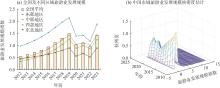
Fig. 1
Temporal evolution characteristics of tourism development scale in China"
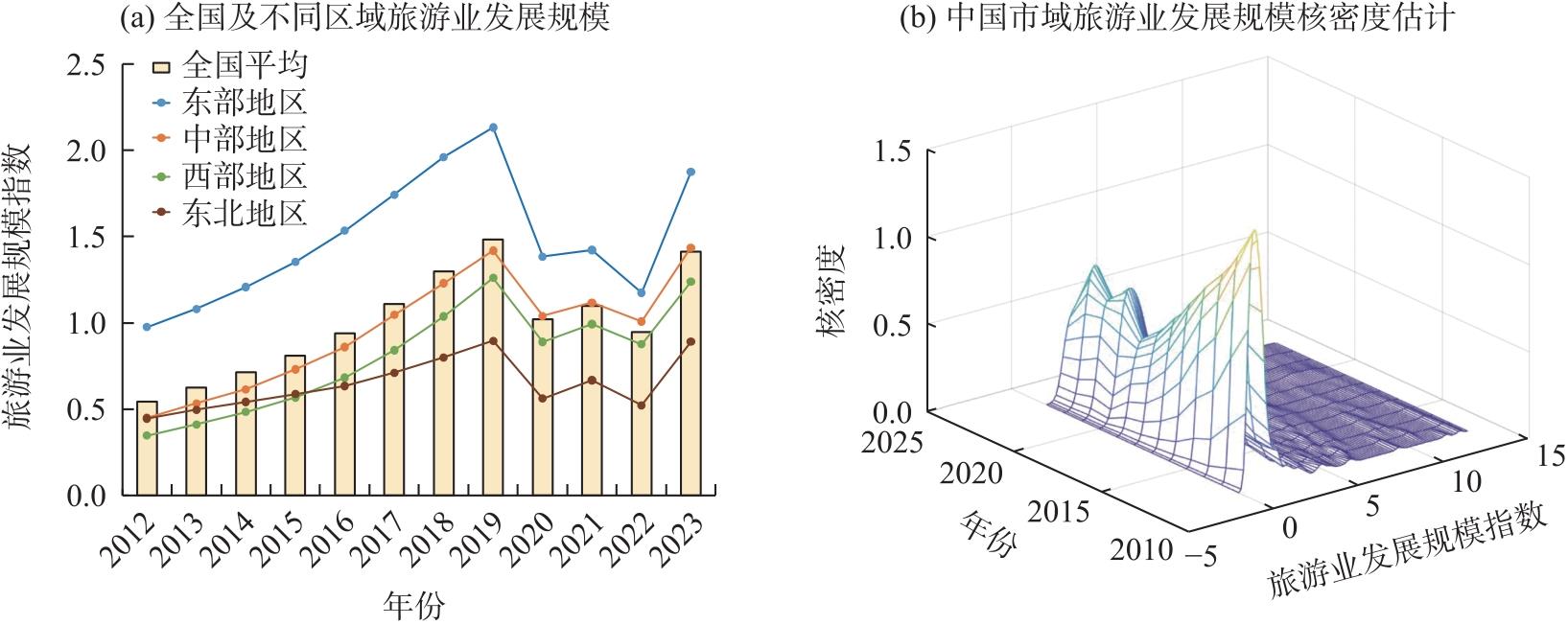
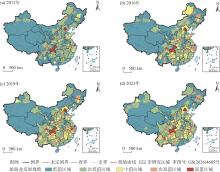
Fig. 2
Spatial distribution patterns of tourism development scale at the municipal level in China"
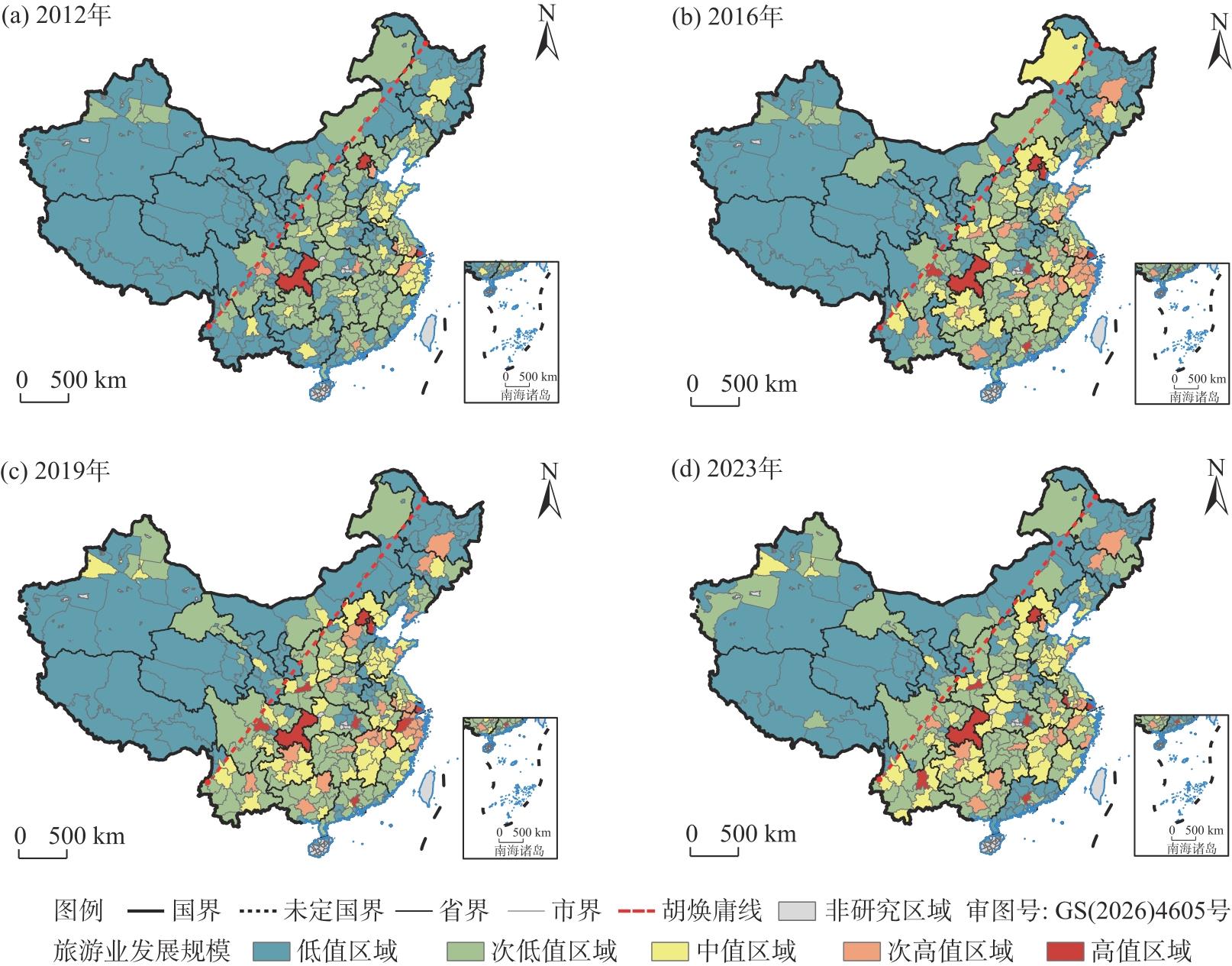
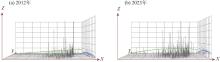
Fig. 3
Three-dimensional macro trends of tourism development scale at the municipal level in China"
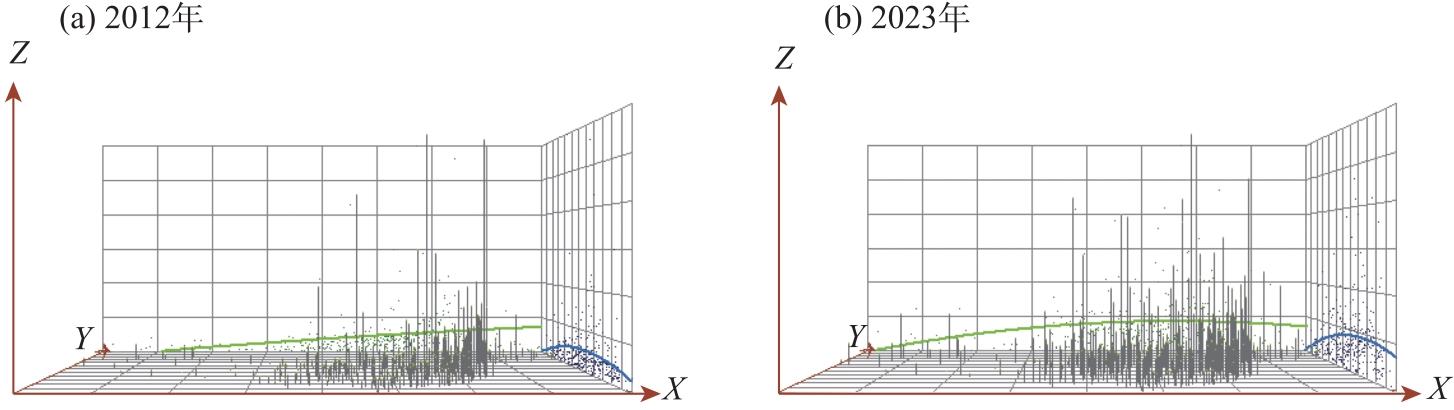
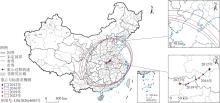
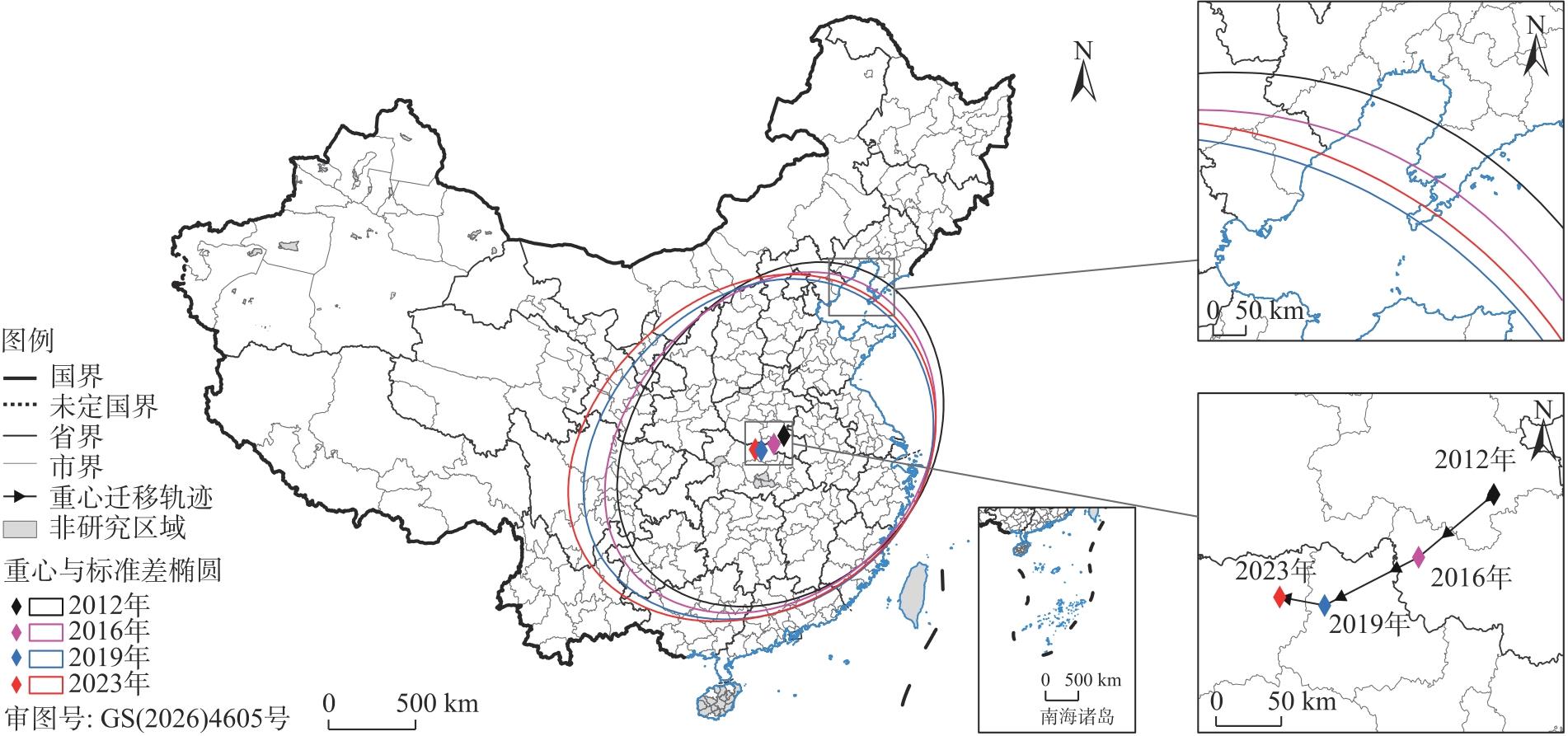
Fig. 4
Standard deviation ellipse and centroid migration trajectory of tourism development scale at the municipal level in China from 2012 to 2023"
Tab. 2
Parameters of the standard deviation ellipse of tourism development scale at the municipal level in China from 2012 to 2023"
| 年份 | 重心经度/°E | 重心纬度/°N | 方位角/(°) | 平均形状指数/% | 年份 | 重心经度/°E | 重心纬度/°N | 方位角/(°) | 平均形状指数/% |
|---|---|---|---|---|---|---|---|---|---|
| 2012 | 114.61 | 32.65 | 63.39 | 72.95 | 2018 | 113.46 | 32.04 | 67.52 | 73.12 |
| 2013 | 114.43 | 32.65 | 64.18 | 72.87 | 2019 | 113.14 | 32.00 | 71.14 | 73.36 |
| 2014 | 114.32 | 32.56 | 63.16 | 72.20 | 2020 | 112.97 | 31.71 | 77.83 | 70.95 |
| 2015 | 114.12 | 32.40 | 64.57 | 72.82 | 2021 | 112.76 | 31.91 | 73.62 | 71.38 |
| 2016 | 113.95 | 32.27 | 64.76 | 72.51 | 2022 | 112.55 | 31.60 | 73.55 | 69.83 |
| 2017 | 113.73 | 32.12 | 64.84 | 72.44 | 2023 | 112.78 | 32.08 | 72.20 | 71.05 |
Fig. 5
Urban tourism gravity and tourism primacy in China"
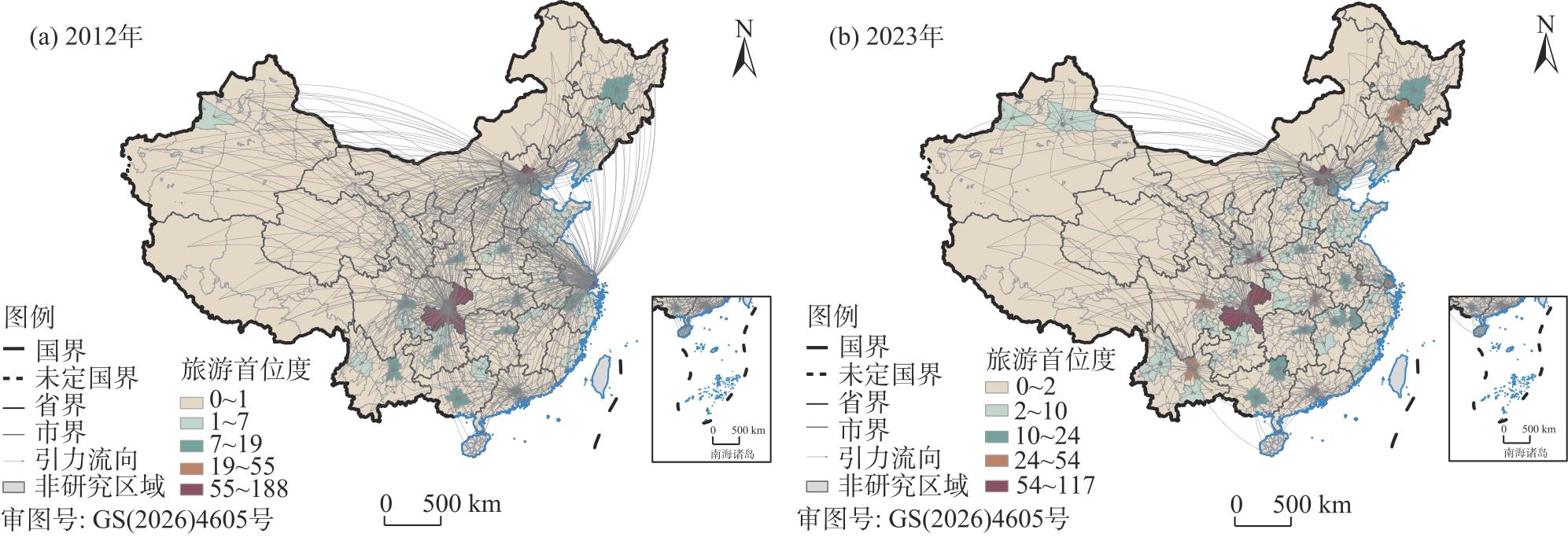
Fig. 6
Overall network structure characteristics"
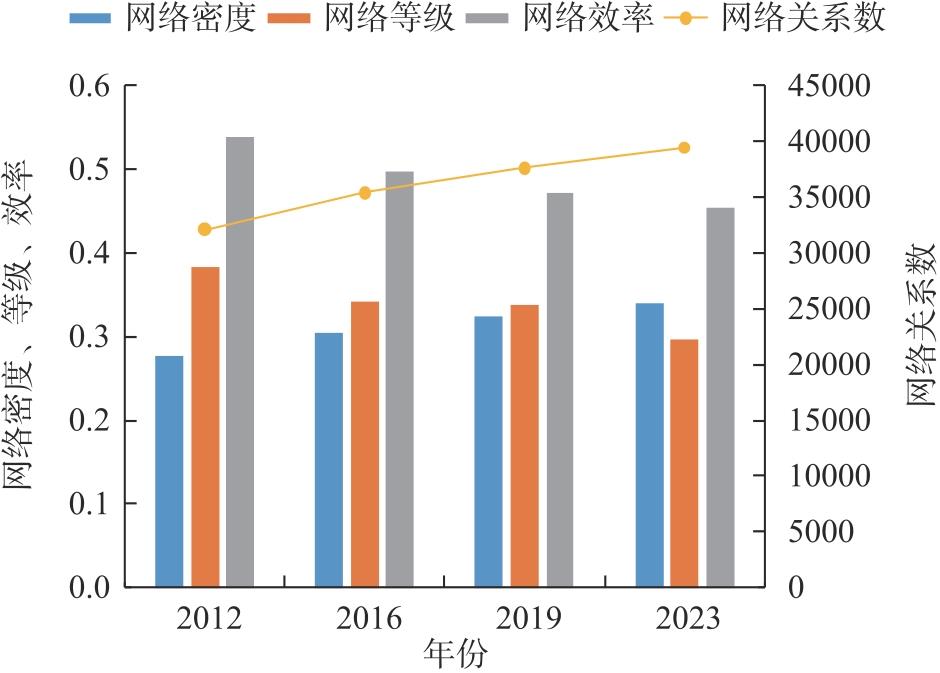
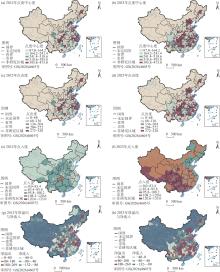
Fig. 7
Degree centrality of the spatial association network of tourism development scale at the municipal level in China"

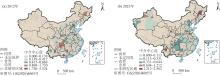
Fig. 8
Betweenness centrality of the spatial association network of tourism development scale at the municipal level in China"
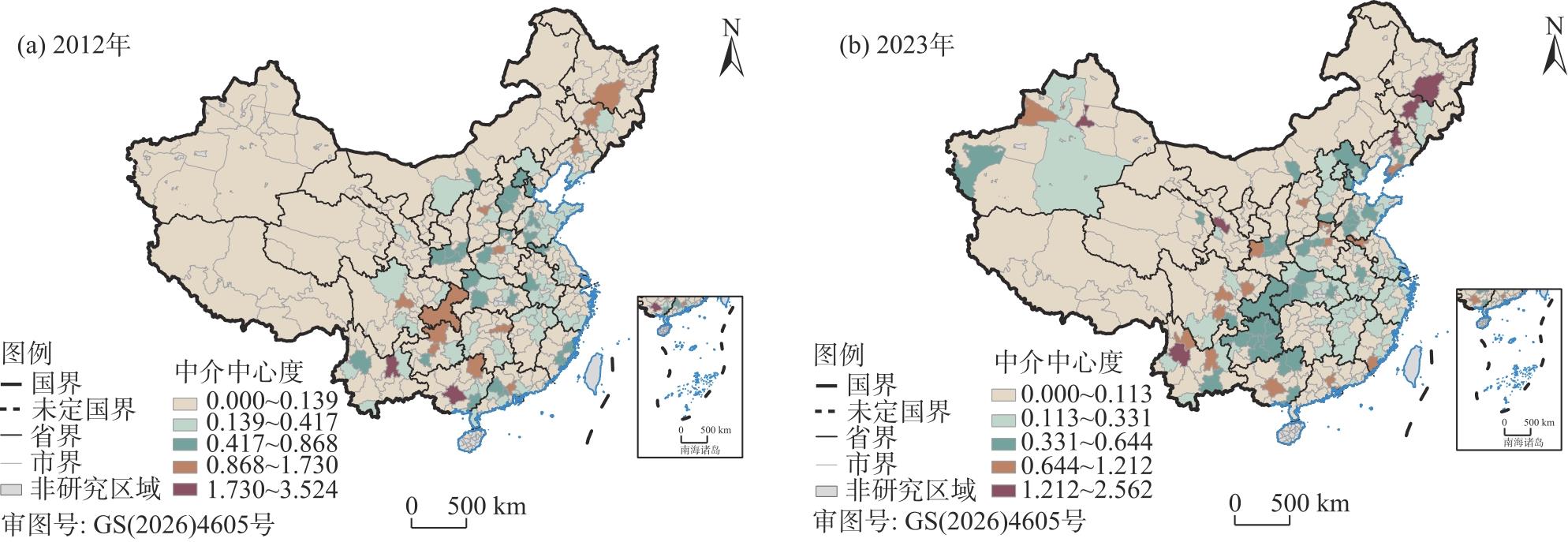
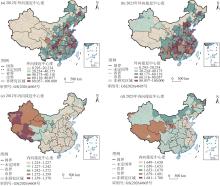
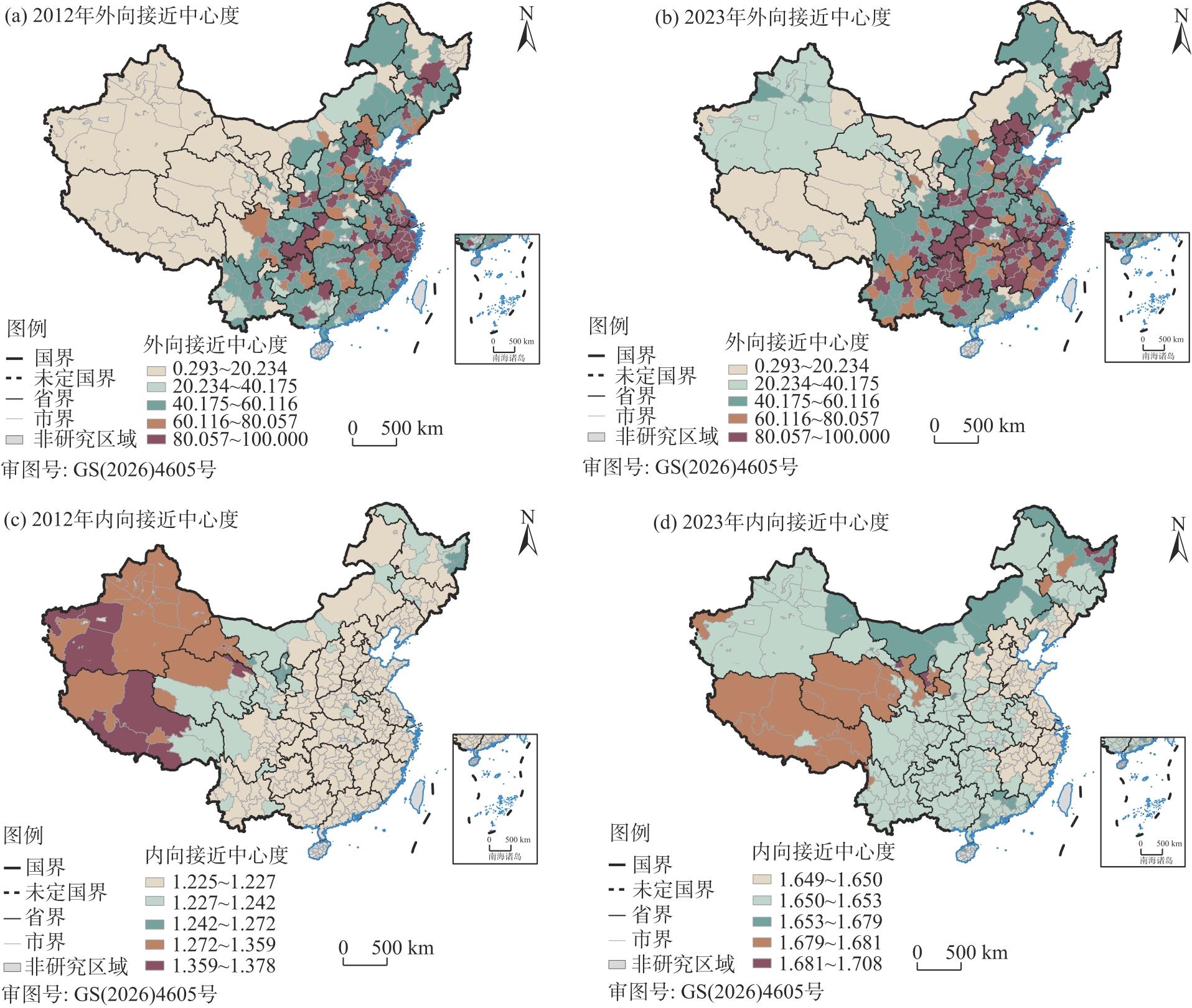
Fig. 9
Closeness centrality of the spatial association network of tourism development scale at the municipal level in China"
Tab. 3
Comparison between GWR and OLS model results"
| 模型参数 | GWR模型 | OLS模型 |
|---|---|---|
| AICc | 743.307 | 752.163 |
| R2 | 0.755 | 0.713 |
| 调整后R2 | 0.727 | 0.697 |
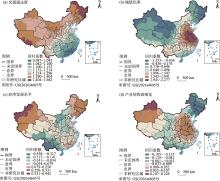
Fig. 10
Spatial distributions of regression coefficients of influencing factors"

| [1] |
胡森林, 焦世泰, 张晓奇. 中国城市旅游发展的时空演化及影响因素——基于动态空间马尔科夫链模型的分析[J]. 自然资源学报, 2021, 36(4): 854-865.
doi: 10.31497/zrzyxb.20210404 |
|
[Hu Senlin, Jiao Shitai, Zhang Xiaoqi. Spatio-temporal evolution and influencing factors of China’s tourism development: Based on the non-static spatial Markov chain model[J]. Journal of Natural Resources, 2021, 36(4): 854-865.]
doi: 10.31497/zrzyxb.20210404 |
|
| [2] | 张翱, 孙久文. 旅游业与区域经济发展: 影响机制及理论启示[J]. 经济与管理评论, 2025, 41(3): 18-29. |
| [Zhang Ao, Sun Jiuwen. Tourism and regional economic development: Influence mechanisms and theoretical implications[J]. Review of Economy and Management, 2025, 41(3): 18-29.] | |
| [3] | 王佳莹, 张辉. 旅游业发展有利于优化要素收入分配结构吗?[J]. 经济管理, 2023, 45(6): 193-208. |
| [Wang Jiaying, Zhang Hui. Whether tourism development is in favor of optimization of income distribution structure?[J]. Economic and Management, 2023, 45(6): 193-208.] | |
| [4] | Wang Y, Huang Z Y, Fan A. Tourism and new rurality: Gentrified space versus co-created place[J]. Annals of Tourism Research, 2025, 113: 103979, doi: 10.1016/j.annals.2025.103979. |
| [5] |
王金伟, 王启翔, 冯凌. 旅游业发展对共同富裕的直接影响及空间溢出效应[J]. 地理学报, 2024, 79(4): 1045-1067.
doi: 10.11821/dlxb202404013 |
|
[Wang Jinwei, Wang Qixiang, Feng Ling. Direct and spillover effects of tourism development on common prosperity[J]. Acta Geographica Sinica, 2024, 79(4): 1045-1067.]
doi: 10.11821/dlxb202404013 |
|
| [6] | 王兆峰, 张先甜. 中国省域旅游发展与民生福祉的动态响应及协调效应研究[J]. 旅游科学, 2023, 37(3): 1-19. |
| [Wang Zhaofeng, Zhang Xiantian. A research on the dynamic response and coordination effect of provincial tourism development and the residents’ well-being in China[J]. Tourism Science, 2023, 37(3): 1-19.] | |
| [7] | 容贤标, 胡振华, 熊曦. 旅游业发展与生态文明建设耦合度的地区间差异[J]. 经济地理, 2016, 36(8): 189-194. |
|
[Rong Xianbiao, Hu Zhenhua, Xiong Xi. Regional differences in the coupling relationship between tourism development and ecological civilization construction[J]. Economic Geography, 2016, 36(8): 189-194.]
doi: 10.2307/141815 |
|
| [8] | 赵磊, 张文杰, 吴以衡. 低碳城市试点是否影响旅游业发展?[J]. 旅游学刊, 2025, 40(7): 122-140. |
| [Zhao Lei, Zhang Wenjie, Wu Yiheng. Does the pilot project of low-carbon cities affect tourism development?[J]. Tourism Tribune, 2025, 40(7): 122-140.] | |
| [9] |
杨晓琰, 宋瑞. 数字经济对旅游产业发展的影响机理[J]. 地理科学进展, 2024, 43(10): 1943-1955.
doi: 10.18306/dlkxjz.2024.10.004 |
|
[Yang Xiaoyan, Song Rui. The mechanism of the impact of digital economy on tourism industry development[J]. Progress in Geography, 2024, 43(10): 1943-1955.]
doi: 10.18306/dlkxjz.2024.10.004 |
|
| [10] | 王静, 杨勇, 黄鑫. “新质”还是“传统”: 新质生产力影响旅游发展的机制及效应研究[J]. 旅游科学, 2025, 39(6): 46-65. |
| [Wang Jing, Yang Yong, Huang Xin. “New quality” or “traditional”? Research on the mechanism and effects of new quality productivity on tourism development[J]. Tourism Science, 2025, 39(6): 46-65.] | |
| [11] | 谢晓如, 朱竑, 黄剑. 中国旅游业绿色发展的挑战与出路[J]. 旅游学刊, 2023, 38(11): 5-8. |
| [Xie Xiaoru, Zhu Hong, Huang Jian. Challenges and solutions for the green development of China’s tourism industry[J]. Tourism Tribune, 2023, 38(11): 5-8.] | |
| [12] |
时朋飞, 曹钰晗, 龙荟冰, 等. 我国旅游业高质量发展水平测度、空间分异及障碍因子诊断[J]. 经济地理, 2023, 43(2): 201-210.
doi: 10.15957/j.cnki.jjdl.2023.02.021 |
|
[Shi Pengfei, Cao Yuhan, Long Huibing, et al. Measurement of the level of high-quality development in China’s tourism industry, spatial differentiation, and diagnosis of obstacle factors[J]. Economic Geography, 2023, 43(2): 201-210.]
doi: 10.15957/j.cnki.jjdl.2023.02.021 |
|
| [13] | 史亚莉. 智慧旅游视角下我国乡村旅游发展新路径研究[J]. 农业经济问题, 2023(4): 145. |
| [Shi Yali. Research on new development paths for rural tourism in China from the perspective of smart tourism[J]. Issues in Agricultural Economy, 2023(4): 145.] | |
| [14] | Jin Y, Xi H, Wang X. Evaluation of the integration policy in China: Does the integration of culture and tourism promote tourism development?[J]. Annals of Tourism Research, 2022, 97(11): 103491, doi: 10.1016/j.annals.2022.103491. |
| [15] |
岳菊, 戴湘毅. 区域文化遗产与旅游发展耦合机制及协调效应——基于京津冀地区的实证分析[J]. 经济地理, 2024, 44(1): 230-240.
doi: 10.15957/j.cnki.jjdl.2024.01.023 |
| [Yue Ju, Dai Xiangyi. Coupling mechanism and coordination effect of regional cultural heritage and tourism development: An empirical analysis based on the Beijing-Tianjin-Hebei region[J]. Economic Geography, 2024, 44(1): 230-240.] | |
| [16] |
纪晓萌, 秦伟山, 李世泰, 等. 中国地级单元旅游业发展效率格局及影响因素[J]. 资源科学, 2021, 43(1): 185-196.
doi: 10.18402/resci.2021.01.15 |
|
[Ji Xiaomeng, Qin Weishan, Li Shitai, et al. The development efficiency pattern and influencing factors of tourism in China’s prefecture-level administrative units[J]. Resources Science, 2021, 43(1): 185-196.]
doi: 10.18402/resci.2021.01.15 |
|
| [17] | 余升国, 杨鹏辉. 离岛免税政策是否促进了旅游业发展? ——基于政策历史演进的视角[J]. 旅游科学, 2024, 38(8): 1-25. |
| [Yu Shengguo, Yang Penghui. Has the offshore duty-free policy facilitated tourism development? From the perspective of policy historical evolution[J]. Tourism Science, 2024, 38(8): 1-25.] | |
| [18] |
张伟, 殷瑞阳, 战莹, 等. 西部地区民航运输与旅游业发展的互动关系[J]. 地理科学, 2023, 43(10): 1774-1782.
doi: 10.13249/j.cnki.sgs.2023.10.009 |
| [Zhang Wei, Yin Ruiyang, Zhan Ying, et al. The interactive relationship between civil aviation transportation and tourism development in the western region[J]. Geographical Science, 2023, 43(10): 1774-1782.] | |
| [19] |
蔡超岳, 唐健雄, 李志远. 黄河流域旅游业发展与生态文明建设的协同演化研究[J]. 自然资源学报, 2025, 40(11): 3048-3072.
doi: 10.31497/zrzyxb.20251110 |
|
[Cai Chaoyue, Tang Jianxiong, Li Zhiyuan. Research on the co-evolution of tourism development and ecological civilization construction in the Yellow River Basin[J]. Journal of Natural Resources, 2025, 40(11): 3048-3072.]
doi: 10.31497/zrzyxb.20251110 |
|
| [20] |
李龙, 王朝辉, 乔浩浩, 等. 长三角城市群旅游经济一体化形成机制与协同发展模式——基于联系网络视角[J]. 经济地理, 2025, 45(5): 181-190.
doi: 10.15957/j.cnki.jjdl.2025.05.019 |
|
[Li Long, Wang Chaohui, Qiao Haohao, et al. The formation mechanism and coordinated development model of tourism economy integration in the Yangtze River Delta urban agglomeration: A perspective based on network connections[J]. Economic Geography, 2025, 45(5): 181-190.]
doi: 10.15957/j.cnki.jjdl.2025.05.019 |
|
| [21] | 郑涛, 杨如雪. 中国高技术制造业韧性测度与影响效应研究[J]. 统计与决策, 2023, 39(23): 101-106. |
| [Zheng Tao, Yang Ruxue. Research on resilience measurement and impact effects of China’s high-tech manufacturing industry[J]. Statistics & Decision, 2023, 39(23): 101-106.] | |
| [22] |
江岳坤, 石鹏娟. 中国市域城乡收入差距时空演化及影响因素[J]. 干旱区地理, 2024, 47(1): 147-157.
doi: 10.12118/j.issn.1000-6060.2023.257 |
|
[Jiang Yuekun, Shi Pengjuan. Spatiotemporal evolution and its affecting factors of urban-rural income gap at the city-level scale in China[J]. Arid Land Geography, 2024, 47(1): 147-157.]
doi: 10.12118/j.issn.1000-6060.2023.257 |
|
| [23] |
Lefever D W. Measuring geographic concentration by means of the standard deviational ellipse[J]. The American Journal of Sociology, 1926, 32(1): 88-94.
doi: 10.1086/214027 |
| [24] |
白冰, 赵作权, 张佩. 中国南北区域经济空间融合发展的趋势与布局[J]. 经济地理, 2021, 41(2): 1-10.
doi: 10.15957/j.cnki.jjdl.2021.02.001 |
|
[Bai Bing, Zhao Zuoquan, Zhang Pei. The trend and layout of spatial integration and development of regional economies in the north and south of China[J]. Economic Geography, 2021, 41(2): 1-10.]
doi: 10.15957/j.cnki.jjdl.2021.02.001 |
|
| [25] |
周慧玲, 王甫园. 基于修正引力模型的中国省际旅游者流空间网络结构特征[J]. 地理研究, 2020, 39(3): 669-681.
doi: 10.11821/dlyj020190021 |
| [Zhou Huiling, Wang Fuyuan. Spatial network structure characteristics of inter-provincial tourist flows in China based on the modified gravity model[J]. Geographical Research, 2020, 39(3): 669-681.] | |
| [26] |
Morley C, Rosselló J, Santana-Gallego M. Gravity models for tourism demand: Theory and use[J]. Annals of Tourism Research, 2014, 48: 1-10.
doi: 10.1016/j.annals.2014.05.008 |
| [27] | 王俊, 夏杰长. 中国省域旅游经济空间网络结构及其影响因素研究——基于QAP方法的考察[J]. 旅游学刊, 2018, 33(9): 13-25. |
| [Wang Jun, Xia Jiechang. Research on the spatial network structure of China’s provincial tourism economy and its influencing factors: An investigation based on the QAP method[J]. Tourism Tribune, 2018, 33(9): 13-25.] | |
| [28] |
王凯, 刘美伦. 中国省际共同富裕空间关联网络结构及驱动机制[J]. 经济地理, 2024, 44(7): 1-12.
doi: 10.15957/j.cnki.jjdl.2024.07.001 |
|
[Wang Kai, Liu Meilun. Spatial correlation network and driving mechanism of provincial common prosperity in China[J]. Economic Geography, 2024, 44(7): 1-12.]
doi: 10.15957/j.cnki.jjdl.2024.07.001 |
|
| [29] | 陈梦根, 侯园园. 中国经济增长动力结构变迁: 2000—2019[J]. 经济研究, 2024, 59(1): 53-71. |
| [Chen Menggen, Hou Yuanyuan. Evolution of drivers of China’s economic growth: 2000—2019[J]. Economic Research Journal, 2024, 59(1): 53-71.] | |
| [30] |
白洋, 谭李娜, 刘晓燕, 等. 高铁开通对西北地区旅游经济的影响效应及其融合路径[J]. 干旱区地理, 2024, 47(12): 2124-2134.
doi: 10.12118/j.issn.1000-6060.2024.238 |
|
[Bai Yang, Tan Lina, Liu Xiaoyan, et al. Integration path and influence effect of tourism economy in northwest China[J]. Arid Land Geography, 2024, 47(12): 2124-2134.]
doi: 10.12118/j.issn.1000-6060.2024.238 |
|
| [31] |
林玉英, 靳一东, 张发梓, 等. 中国优秀旅游城市旅游经济空间格局演变特征及影响因素[J]. 地理科学, 2024, 44(6): 973-983.
doi: 10.13249/j.cnki.sgs.20230579 |
| [Lin Yuying, Jin Yidong, Zhang Fazi, et al. Evolution characteristics and influencing factors of tourism economic spatial pattern of China’s outstanding tourist cities[J]. Geographical Science, 2024, 44(6): 973-983.] | |
| [32] |
马丽君, 欧阳旻. 文旅产业双向共聚对区域经济发展的影响——以东北三省为例[J]. 经济地理, 2025, 45(10): 245-255.
doi: 10.15957/j.cnki.jjdl.2025.10.025 |
|
[Ma Lijun, Ouyang Min. Impact of bidirectional coagglomeration of cultural and tourism industries on regional economic development: A case study of the three northeastern provinces[J]. Economic Geography, 2025, 45(10): 245-255.]
doi: 10.15957/j.cnki.jjdl.2025.10.025 |
|
||