Arid Land Geography ›› 2026, Vol. 49 ›› Issue (9): 1840-1854.doi: 10.12118/j.issn.1000-6060.2025.743
• Ecology and Environment • Previous Articles Next Articles
JIAO Shitang1( ), YAN Yang1, ZHENG Jianghua1,2(), HE Ying1, Babierjiang DILIXIATI1,3, WEI Jianxin3, LIU Junhao1, SHE Yongrui1
Received:2025-11-17
Revised:2026-02-02
Online:2026-09-25
Published:2026-09-07
Contact:
ZHENG Jianghua
E-mail:107552401162@stu.xju.edu.cn;zheng.jianghua@xju.edu.cn
JIAO Shitang, YAN Yang, ZHENG Jianghua, HE Ying, Babierjiang DILIXIATI, WEI Jianxin, LIU Junhao, SHE Yongrui. Impact characteristics and driving factors of wind farms on the ecological environment in Xinjiang[J].Arid Land Geography, 2026, 49(9): 1840-1854.
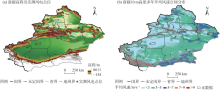
Fig. 1
Schematic diagram of the study area"
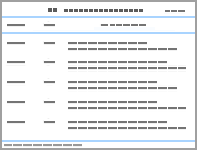
Tab. 1
Main data sources"
| 数据 | 名称 | 年份 | 时间 分辨率 | 原始空间 分辨率 | 来源 |
|---|---|---|---|---|---|
| 地表温度 | 地表温度8 d合成产品(MOD11A2) | 2000—2025 | 8 d合成 | 1 km | 谷歌地球引擎(GEE) ( |
| 植被指数 | 植被指数16 d合成产品(MOD13A1) | 2000—2025 | 16 d合成 | 500 m | 美国国家航空航天局(NASA) ( |
| 短波红外波段 | 地表反射率8 d合成产品(MOD09A1) | 2000—2025 | 8 d合成 | 500 m | 美国国家航空航天局(NASA) ( |
| 气温 | 中国1 km分辨率逐月平均气温数据集 | 1901—2024 | 逐月 | 1 km | 国家青藏高原科学数据中心 ( |
| 降水 | 中国1 km分辨率逐月降水量数据集 | 1901—2024 | 逐月 | 1 km | 国家青藏高原科学数据中心 ( |
| 风速 | 多源数据融合的中国高分辨多要素气象驱动产品(ChinaMet) | 1980—2024 | 逐月 | 0.1° | 国家冰川冻土沙漠科学数据中心 ( |
| 海拔、坡度、 地形起伏度 | 航天飞机雷达地形测绘任务数字高程模型(SRTM DEM) | - | - | 30 m | 美国国家航空航天局(NASA) ( |
| 土地利用类型 | 30 m全球土地覆盖动态数据集 (GLC_FCS30D) | - | - | 30 m | Zenodo( |
| Sentinel-2 | 哥白尼Sentinel-2地表反射率产品(COPERNICUS_S2_SR_HARMONIZED) | 2023 | a | 10 m | 谷歌地球引擎(GEE) ( |
| 10 m风速 | 多年平均风速产品 | - | - | 10 m | 全球风能地图 ( |
Tab. 2
Impact modes of interaction detectors"
| 判断依据 | 交互作用类型 |
|---|---|
| q(x1∩x2)<Min[q(x1),q(x2)] | 非线性减弱 |
| Min[q(x1),q(x2)]<q(x1∩x2)<Max[q(x1),q(x2)] | 单因子非线性减弱 |
| q(x1∩x2)>Max[q(x1),q(x2)] | 双因子增强 |
| q(x1∩x2)=q(x1)+q(x2) | 独立 |
| q(x1∩x2)>q(x1)+q(x2) | 非线性增强 |
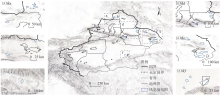
Fig. 2
Spatial distributions of wind farms in Xinjiang"

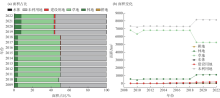
Fig. 3
Proportion and change trend of land use types in wind farm regions of Xinjiang from 2009 to 2022"

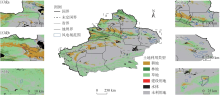
Fig. 4
Spatial distributions of wind farms in Xinjiang under different land use types"
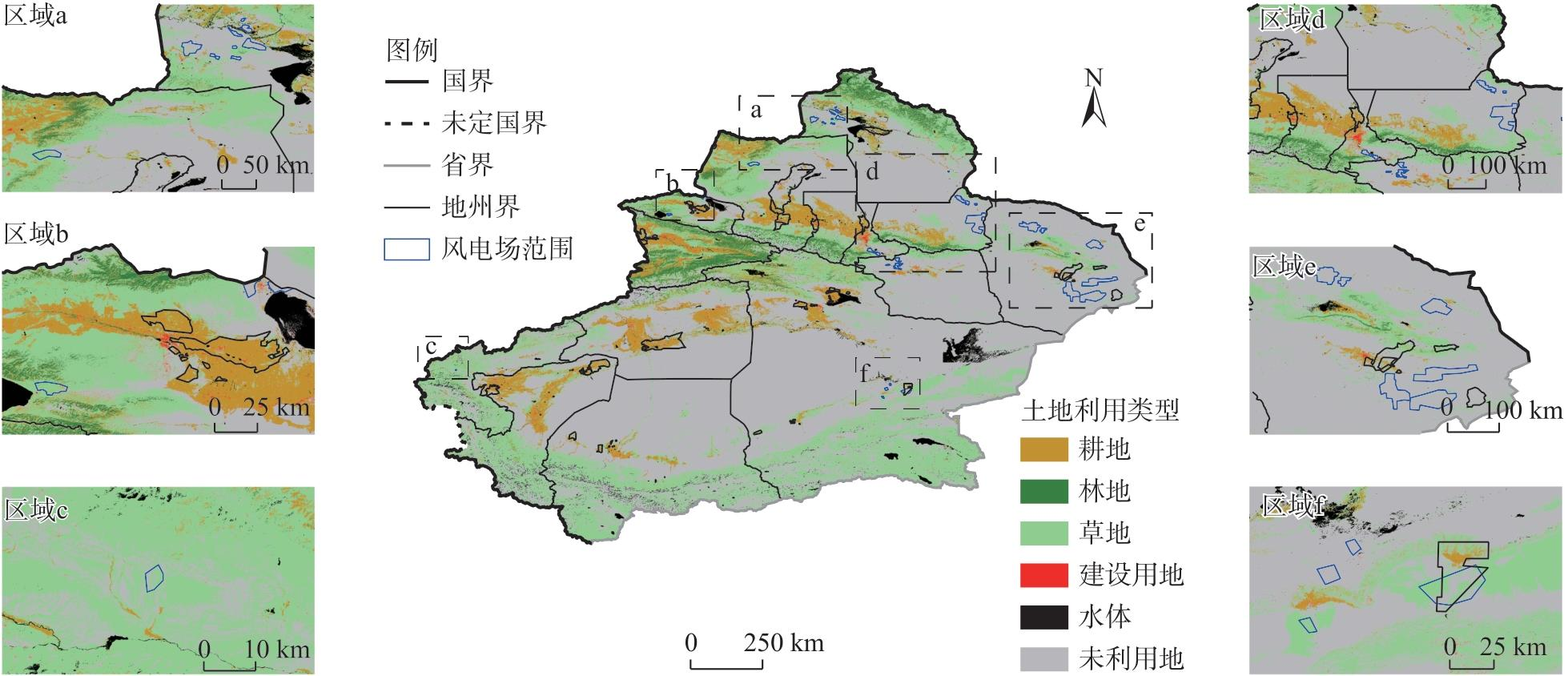
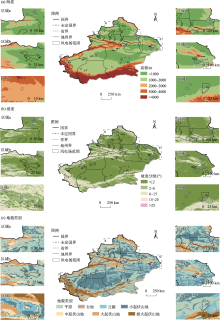
Fig. 5
Spatial distributions of wind farms in Xinjiang at different altitudes, slopes, and landform types"

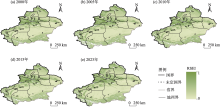
Fig. 6
Spatial distributions of RSEI in Xinjiang from 2000 to 2023"

Tab. 3
Statistical results of RSEI change types in wind farm regions of Xinjiang from 2000 to 2023"
| 类别 | ΔRSEI范围 | 数量占比/% |
|---|---|---|
| 严重退化 | ΔRSEI<-0.05 | 3.0 |
| 轻微退化 | -0.05<ΔRSEI<0.00 | 78.8 |
| 基本稳定 | ΔRSEI=0 | 0.0 |
| 轻微改善 | 0.00<ΔRSEI<0.05 | 18.2 |
| 显著改善 | ΔRSEI>0.05 | 0.0 |
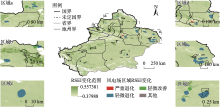
Fig. 7
Spatial distributions of RSEI changes in wind farm regions of Xinjiang"

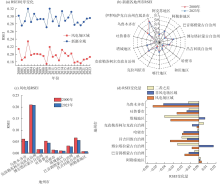
Fig. 8
RSEI of various prefectures and wind farm regions in Xinjiang in 2000 and 2023"
Fig. 9
Results of single driving factor detection"
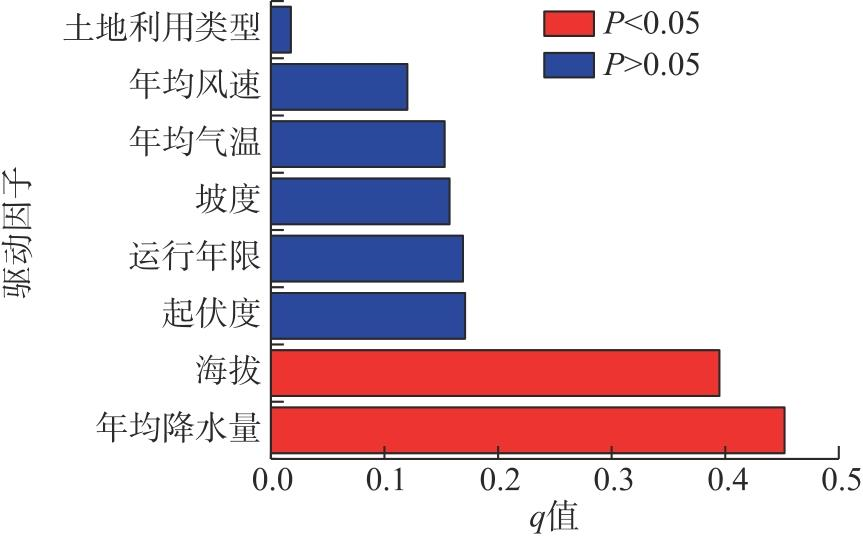
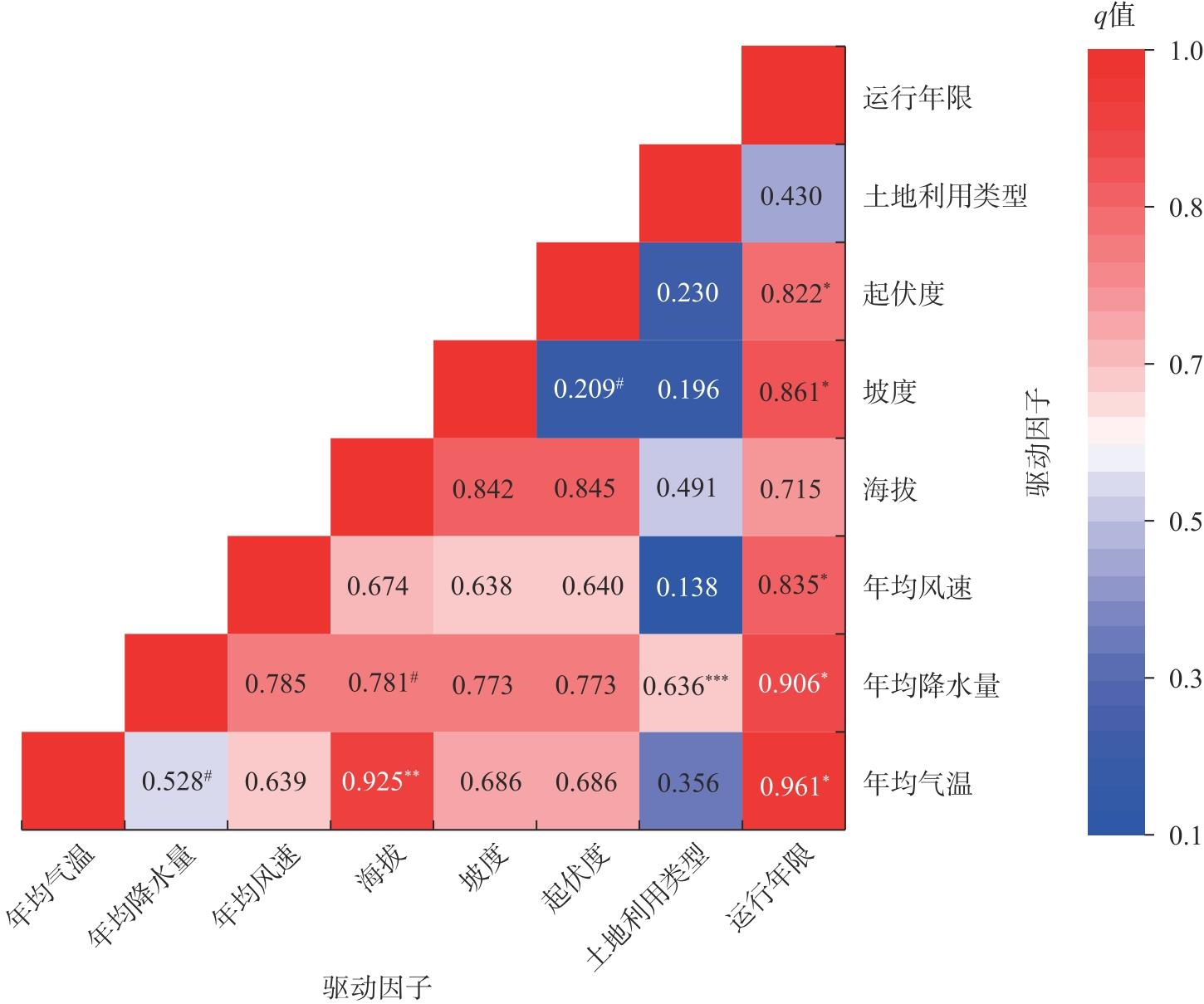
Fig. 10
Results of interaction effects among factors"
| [1] | Kemp L, Xu C, Depledge J, et al. Climate endgame: Exploring catastrophic climate change scenarios[J]. Proceedings of the National Academy of Sciences, 2022, 119(34): e2108146119, doi: 10.1073/pnas.2108146119. |
| [2] |
Xie C L, Sun Z F. Wind energy in China: Current scenario and future perspectives[J]. Renewable and Sustainable Energy Reviews, 2009, 13(8): 1966-1974.
doi: 10.1016/j.rser.2009.01.004 |
| [3] |
Howland M F, Lele S K, Dabiri J O. Wind farm power optimization through wake steering[J]. Proceedings of the National Academy of Sciences, 2019, 116(29): 14495-14500.
doi: 10.1073/pnas.1903680116 |
| [4] |
Liu L Y, Liu P T, Yu J W, et al. Wind farms increase land surface temperature and reduce vegetation productivity in the Inner Mongolia[J]. Geography and Sustainability, 2024, 5(3): 319-328.
doi: 10.1016/j.geosus.2024.01.007 |
| [5] |
Baidya R S, Traiteur J J. Impacts of wind farms on surface air temperatures[J]. Proceedings of the National Academy of Sciences, 2010, 107(42): 17899-17904.
doi: 10.1073/pnas.1000493107 |
| [6] | 刘朋涛. 内蒙古风电场景观格局演变及生态效应[D]. 呼和浩特: 内蒙古大学, 2021. |
| [Liu Pengtao. Evolution of landscape pattern and ecological effects of wind farms in Inner Mongolia[D]. Hohhot: Inner Mongolia University, 2021.] | |
| [7] |
蒋俊霞, 杨丽薇, 李振朝, 等. 风电场对气候环境的影响研究进展[J]. 地球科学进展, 2019, 34(10): 1038-1049.
doi: 10.11867/j.issn.1001-8166.2019.10.1038 |
|
[Jiang Junxia, Yang Liwei, Li Zhenchao, et al. Research progress on the impacts of wind farms on climatic environment[J]. Advances in Earth Science, 2019, 34(10): 1038-1049.]
doi: 10.11867/j.issn.1001-8166.2019.10.1038 |
|
| [8] | 李薇, 龚奂彰, 臧宏宽, 等. 风电场对区域及全球气候的影响研究进展[J]. 环境保护, 2018, 46(3): 69-73. |
| [Li Wei, Gong Huanzhang, Zang Hongkuan, et al. Research progress on the impacts of wind farms on regional and global climate[J]. Environmental Protection, 2018, 46(3): 69-73.] | |
| [9] | 王刚, 赵玉梅, 董丽, 等. 风力发电机对荒漠草原地表温度及蒸散发的影响[J]. 地理信息世界, 2021, 28(2): 74-81. |
| [Wang Gang, Zhao Yumei, Dong Li, et al. Impacts of wind turbines on land surface temperature and evapotranspiration in desert grasslands[J]. World of Geographical Information, 2021, 28(2): 74-81.] | |
| [10] | 马兴悦. 基于卫星遥感资料的河北坝上风电场对地表温度和植被的影响研究[D]. 兰州: 兰州大学, 2022. |
| [Ma Xingyue. Study on the impacts of wind farms on land surface temperature and vegetation in Bashang area of Hebei based on satellite remote sensing data[D]. Lanzhou: Lanzhou University, 2022.] | |
| [11] |
贾馨, 李国庆, 王刚, 等. 风电场对草地土壤湿度的影响[J]. 干旱区地理, 2021, 44(4): 1125-1134.
doi: 10.12118/j.issn.1000–6060.2021.04.24 |
|
[Jia Xin, Li Guoqing, Wang Gang, et al. Impacts of wind farms on soil moisture in grasslands[J]. Arid Land Geography, 2021, 44(4): 1125-1134.]
doi: 10.12118/j.issn.1000–6060.2021.04.24 |
|
| [12] |
Zhou L M, Tian Y H, Baidya R S, et al. Impacts of wind farms on land surface temperature[J]. Nature Climate Change, 2012, 2(7): 539-543.
doi: 10.1038/nclimate1505 |
| [13] | Qin Y Z, Li Y, Xu R, et al. Impacts of 319 wind farms on surface temperature and vegetation in the United States[J]. Environmental Research Letters, 2022, 17(2): 024026, doi: 10.1088/1748-9326/ac49ba. |
| [14] | Liu N J, Zhao X, Zhang X, et al. Remotely sensed evidence of the divergent climate impacts of wind farms on croplands and grasslands[J]. Science of the Total Environment, 2023, 905: 167203, doi: 10.1016/j.scitotenv.2023.167203. |
| [15] |
Slawsky L M, Zhou L, Baidya Roy S, et al. Observed thermal impacts of wind farms over northern Illinois[J]. Sensors, 2015, 15(7): 14981-15005.
doi: 10.3390/s150714981 pmid: 26121613 |
| [16] | Xia G, Zhou L M. Detecting wind farm impacts on local vegetation growth in Texas and Illinois using MODIS vegetation greenness measurements[J]. Remote Sensing, 2017, 9(7): 698, doi: 10.3390/rs9070698. |
| [17] | Han X H, Lu C, Wang J. Long-term impacts of 250 wind farms on surface temperature and vegetation in China: A remote sensing analysis[J]. Remote Sensing, 2024, 17(1): 10, doi: 10.3390/rs17010010. |
| [18] | Xu K, He L C, Hu H J, et al. Positive ecological effects of wind farms on vegetation in China’s gobi desert[J]. Scientific Reports, 2019, 9(1): 6341, doi: 10.1038/s41598-019-42569-0. |
| [19] |
Fei T T, Lu D G, Li Y, et al. The impact of the wind farm on the vegetation and the microclimate via remote sensing: A case study in Hebei Province, China[J]. Energy, Ecology and Environment, 2026, 11(2): 215-232.
doi: 10.1007/s40974-025-00386-4 |
| [20] | Wang G, Li G Q, Liu Z. Wind farms dry surface soil in temporal and spatial variation[J]. Science of the Total Environment, 2023, 857: 159293, doi: 10.1016/j.scitotenv.2022.159293. |
| [21] |
孙桂丽, 陆海燕, 郑佳翔, 等. 新疆生态脆弱性时空演变及驱动力分析[J]. 干旱区研究, 2022, 39(1): 258-269.
doi: 10.13866/j.azr.2022.01.25 |
|
[Sun Guili, Lu Haiyan, Zheng Jiaxiang, et al. Spatio-temporal evolution and driving force analysis of ecological vulnerability in Xinjiang[J]. Arid Zone Research, 2022, 39(1): 258-269.]
doi: 10.13866/j.azr.2022.01.25 |
|
| [22] | Xu H Q. A remote sensing index for assessment of regional ecological changes[J]. China Environmental Science, 2013, 33(5): 889-897. |
| [23] | Aizizi Y, Kasimu A, Liang H W, et al. Evaluation of ecological quality status and changing trend in arid land based on the remote sensing ecological index: A case study in Xinjiang, China[J]. Forests, 2023, 14(9): 1830, doi: 10.3390/f14091830. |
| [24] |
Yao K X, Halike A, Chen L M, et al. Spatiotemporal changes of eco-environmental quality based on remote sensing-based ecological index in the Hotan Oasis, Xinjiang[J]. Journal of Arid Land, 2022, 14(3): 262-283.
doi: 10.1007/s40333-022-0011-2 |
| [25] | Shi M, Lin F, Jing X, et al. Ecological environment quality assessment of arid areas based on improved remote sensing ecological index: A case study of the Loess Plateau[J]. Sustainability, 2023, 15(18): 13881, doi: 10.3390/su151813881. |
| [26] | Duo L H, Wang J Q, Zhang F Q, et al. Assessing the spatiotemporal evolution and drivers of ecological environment quality using an enhanced remote sensing ecological index in Lanzhou City, China[J]. Remote Sensing, 2023, 15(19): 4704, doi: 10.3390/rs15194704. |
| [27] | 杜文杰, 关梦茜, 江源, 等. 新疆风力发电减碳效益全生命周期评估[J]. 生态学报, 2024, 44(8): 3293-3302. |
| [Du Wenjie, Guan Mengxi, Jiang Yuan, et al. Life cycle assessment of carbon reduction benefits of wind power generation in Xinjiang[J]. Acta Ecologica Sinica, 2024, 44(8): 3293-3302.] | |
| [28] | Jiang H N, Xie M Y, Li X, et al. Wind farms impacts on land surface temperature and its driving factors in an arid area of Xinjiang, China[J]. Sustainability, 2025, 17(21): 9445, doi: 10.3390/su17219445. |
| [29] | 谢彦峰. 干旱区风力发电建设区域水土流失量测评[J]. 水土保持, 2024, 12(4): 50-55. |
|
[Xie Yanfeng. Assessment of soil erosion in wind power construction areas in arid regions[J]. Open Journal of Soil and Water Conservation, 2024, 12(4): 50-55.]
doi: 10.12677/ojswc.2024.124007 |
|
| [30] | 艾丽菲热·吾马尔. 气候变化背景下新疆生态系统服务功能评估与模拟[D]. 南京: 南京信息工程大学, 2025. |
| [Wumar Alifire. Assessment and simulation of ecosystem service functions in Xinjiang under the background of climate change[D]. Nanjing: Nanjing University of Information Science and Technology, 2025.] | |
| [31] | Dilixiati B, Wang H W, Gong L C, et al. Land use dynamics and ecological effects of photovoltaic development in Xinjiang: A remote sensing and geospatial analysis[J]. Land, 2025, 14(6): 1294, doi: 10.3390/land14061294. |
| [32] | Han W Q, Guan J Y, Zheng J H, et al. Probabilistic assessment of drought stress vulnerability in grasslands of Xinjiang, China[J]. Frontiers in Plant Science, 2023, 14: 1143863, doi: 10.3389/fpls.2023.1143863. |
| [33] | 肖杨. 新疆不同区域风电场风能资源对比分析[J]. 中国水能及电气化, 2021(1): 48-51. |
| [Xiao Yang. Comparative analysis of wind energy resources of wind farms in different regions of Xinjiang[J]. China Water Power & Electrification, 2021(1): 48-51.] | |
| [34] | 贾杰斌, 李钢, 阎肃, 等. 新疆九大风区再认识及三个新风区划定[J]. 风能, 2023(2): 54-60. |
| [Jia Jiebin, Li Gang, Yan Su, et al. New understanding of nine major wind zones and delineation of three new wind areas in Xinjiang[J]. Wind Energy, 2023(2): 54-60.] | |
| [35] | 彭守璋. 中国1 km分辨率逐月平均气温数据集(1901-2024)[DB/OL]. 国家青藏高原科学数据中心. [2025-07-02]. https://doi.org/10.11888/Meteoro.tpdc.270961. |
| [Peng Shouzhang. 1-km mon-thly mean temperature dataset for China (1901-2024)[DB/OL]. National Tibetan Plateau/Third Pole Environment Data Center. [2025-07-02]. https://doi.org/10.11888/Meteoro.tpdc.270961.] | |
| [36] | 彭守璋. 中国1 km 分辨率逐月降水量数据集(1901-2024)[DB/OL]. 国家青藏高原科学数据中心. [2025-07-02]. https://doi.org/10.5281/zenodo.3114194. |
| [Peng Shouzhang. 1-km monthly precipitation dataset for China (1901-2024)[DB/OL]. National Tibetan Plateau/Third Pole Environment Data Center. [2025-07-02]. https://doi.org/10.5281/zenodo.3114194.] | |
| [37] | 张凌, 胡英屹, 赵彦博, 等. 多源数据融合的中国高分辨多要素气象驱动产品(ChinaMet)[DB/OL]. 国家冰川冻土沙漠科学数据中心. [2025-09-02]. https://cstr.cn/CSTR:11738.11.NCDC.NIEER.DB-6722.2025. |
| [Zhang Ling, Hu Yingyi, Zhao Yanbo, et al. China high-resolution multi-factor meteorological driving product (ChinaMet) based on multi-source data fusion[DB/OL]. National Glacial, Permafrost and Desert Data Center. [2025-09-02]. https://cstr.cn/CSTR:11738.11.NCDC.NIEER.DB6722.2025.] | |
| [38] |
Zhang X, Liu L Y, Chen X D, et al. GLC_FCS30: Global land-cover product with fine classification system at 30 m using time-series Landsat imagery[J]. Earth System Science Data, 2021, 13(6): 2753-2776.
doi: 10.5194/essd-13-2753-2021 |
| [39] | 李国庆, 刘志锋, 常学礼, 等. 风电场对草地蒸散发影响分析[J]. 生态科学, 2016, 35(6): 146-151. |
| [Li Guoqing, Liu Zhifeng, Chang Xueli, et al. Analysis of the impact of wind farms on grassland evapotranspiration[J]. Ecological Science, 2016, 35(6): 146-151.] | |
| [40] | Xu H Q, Wang Y F, Guan H D, et al. Detecting ecological changes with a remote sensing based ecological index (RSEI) produced time series and change vector analysis[J]. Remote Sensing, 2019, 11(20): 2345, doi: 10.3390/rs11202345. |
| [41] |
Chander G, Markham B L, Helder D L. Summary of current radiometric calibration coefficients for Landsat MSS, TM, ETM+, and EO-1 ALI sensors[J]. Remote Sensing of Environment, 2009, 113(5): 893-903.
doi: 10.1016/j.rse.2009.01.007 |
| [42] | Xu H Q. Creation and application of urban remote sensing ecological index[J]. Acta Ecologica Sinica, 2013, 33(24): 7853-7862. |
| [43] |
孙瑞, 金晓斌, 蒋宇超, 等. 热带海岛规模性土地整治项目区生态质量变化过程与特征分析[J]. 地理研究, 2021, 40(8): 2331-2346.
doi: 10.11821/dlyj020200851 |
| [Sun Rui, Jin Xiaobin, Jiang Yuchao, et al. Process and characteristics of ecological quality changes in large-scale land consolidation project areas on tropical islands[J]. Geographical Research, 2021, 40(8): 2331-2346.] | |
| [44] |
王劲峰, 徐成东. 地理探测器: 原理与展望[J]. 地理学报, 2017, 72(1): 116-134.
doi: 10.11821/dlxb201701010 |
|
[Wang Jinfeng, Xu Chengdong. Geodetector: Principle and prospects[J]. Acta Geographica Sinica, 2017, 72(1): 116-134.]
doi: 10.11821/dlxb201701010 |
|
| [45] | 吕泳洁, 丁文广, 邓喆, 等. 基于地理探测器的甘肃省植被覆盖时空变化及驱动力分析[J]. 地球环境学报, 2022, 13(2): 185-195. |
| [Lü Yongjie, Ding Wenguang, Deng Zhe, et al. Spatiotemporal variation and driving force analysis of vegetation coverage in Gansu Province based on the geographical detector[J]. Journal of Earth Environment, 2022, 13(2): 185-195.] | |
| [46] | Zhu L J, Meng J J, Zhu L K. Applying geodetector to disentangle the contributions of natural and anthropogenic factors to NDVI variations in the middle reaches of the Heihe River Basin[J]. Ecological Indicators, 2020, 117: 106545, doi: 10.1016/j.ecolind.2020.106545. |
| [47] | Zhang S H, Zhou Y K, Yu Y, et al. Using the geodetector method to characterize the spatiotemporal dynamics of vegetation and its interaction with environmental factors in the Qinba Mountains, China[J]. Remote Sensing, 2022, 14(22): 5794, doi: 10.3390/rs1-4225794. |
| [48] | 罗清, 张靖, 鲍雅静, 等. 基于RSEI的辽河流域生态环境动态变化,归因及分区研究[J]. 水土保持通报, 2025, 45(2): 360-370. |
| [Luo Qing, Zhang Jing, Bao Yajing, et al. Dynamic change, attribution, and regionalization of the ecological environment in the Liaohe River Basin based on RSEI[J]. Bulletin of Soil & Water Conservation, 2025, 45(2): 360-370.] | |
| [49] | 高焕霖, 张廷龙, 樊华烨, 等. 基于地理探测器的杨凌示范区生态环境质量影响因素定量分析[J]. 西北林学院学报, 2020, 35(5): 185-194. |
| [Gao Huanlin, Zhang Tinglong, Fan Huaye, et al. Quantitative analysis of factors influencing ecological environment quality in the Yangling demonstration zone based on the geographical detector[J]. Journal of Northwest Forestry University, 2020, 35(5): 185-194.] | |
| [50] |
于昊辰, 尹登玉, 宫攀, 等. 干旱区山水林田湖草沙冰一体化保护与系统治理——基于土地退化平衡视角[J]. 自然资源学报, 2024, 39(9): 2066-2086.
doi: 10.31497/zrzyxb.20240904 |
|
[Yu Haochen, Yin Dengyu, Gong Pan, et al. Integrated protection and systematic management of mountain-water-forest-field-lake-grass-desert-ice systems in arid regions: From the perspective of land degradation neutrality[J]. Journal of Natural Resources, 2024, 39(9): 2066-2086.]
doi: 10.31497/zrzyxb.20240904 |
|
| [51] | 汤恒睿, 叶恩童, 娄星驰, 等. 干旱区植被对水分胁迫的响应特征分析[J]. 地球与环境, 2026, 54(3): 486-500. |
|
[Tang Hengrui, Ye Entong, Lou Xingchi, et al. Analysis of vegetation response characteristics to water stress in arid regions[J]. Earth and Environment, 2026, 54(3): 486-500.]
doi: 10.3724/EE.1672-9250.2025.53.086 |
|
| [52] | 张文佳, 张永战. 中国风电的时空分布特征和发展趋势[J]. 自然资源学报, 2007, 22(4): 585-595. |
| [Zhang Wenjia, Zhang Yongzhan. Spatiotemporal distribution characteristics and development trends of wind power in China[J]. Journal of Natural Resources, 2007, 22(4): 585-595.] | |
| [53] | Wu J W, Xiao J Y, Hou J M, et al. Development potential assessment for wind and photovoltaic power energy resources in the main desert-gobi-wilderness areas of China[J]. Energies, 2023, 16(12): 4559, doi: 10.3390/en16124559. |
| [54] | Su N, Li X B, Lü X, et al. Comprehensive assessment of the climatic and vegetation impacts of wind farms on grasslands: A case study in Inner Mongolia, China[J]. Journal of Environmental Management, 2024, 370: 122430, doi: 10.1016/j.jenvman.2024.122-430. |
| [55] | 何则, 赵勇强, 袁婧婷. 生态环境友好型风电场规划管理的国际经验与政策启示[J]. 中国能源, 2021, 43(12): 74-82. |
| [He Ze, Zhao Yongqiang, Yuan Jingting. International experience and policy implications of eco-friendly wind farm planning and management[J]. China Energy, 2021, 43(12): 74-82.] | |
| [56] | 刘玉佳. 库鲁斯台草原生态保护修复效果评估与变化驱动分析[D]. 乌鲁木齐: 新疆大学, 2023. |
| [Liu Yujia. Evaluation of ecological protection and restoration effects and analysis of change drivers in the Kurustai grassland[D]. Urumqi: Xinjiang University, 2023.] | |
| [57] |
张秀霞, 韩丽莎, 党星海, 等. 西北干旱区近30 a植被覆盖的时空变化及其对气候因子的响应[J]. 干旱区研究, 2025, 42(6): 1067-1079.
doi: 10.13866/j.azr.2025.06.10 |
|
[Zhang Xiuxia, Han Lisha, Dang Xinghai, et al. Spatiotemporal variation of vegetation coverage and its response to climatic factors in arid regions of northwest China over the past 30 years[J]. Arid Zone Research, 2025, 42(6): 1067-1079.]
doi: 10.13866/j.azr.2025.06.10 |
|
| [58] | 吴建国, 巩倩, 王阳. 风电场对生态系统、生物多样性及环境的影响[J]. 生态经济, 2023, 39(9): 167-178, 229. |
|
[Wu Jianguo, Gong Qian, Wang Yang. Impacts of wind farms on ecosystems, biodiversity, and the environment[J]. Ecological Economy, 2023, 39(9): 167-178, 229.]
doi: 10.1016/S0921-8009(01)00225-7 |
|
| [59] | 王志科, 张嘉宸, 李廷山, 等. 高海拔地区风电场建设对环境的影响及水土保持对策探讨——以共和县切吉乡1000 MW风电项目为例[J]. 绿色科技, 2020(20): 140-142. |
| [Wang Zhike, Zhang Jiachen, Li Tingshan, et al. Environmental impacts of wind farm construction in high-altitude areas and soil and water conservation countermeasures: A case study of the 1000 MW wind power project in Qieji Township, Gonghe County[J]. Green Technology, 2020(20): 140-142.] | |
| [60] | Zhang W J, Zhang Y Z. Studies on characteristics of the spatial-temporal distribution and development trend for wind farms in China[J]. Journal of Natural Resources, 2007, 22(4): 585-595. |
| [61] | Zhang Y L, Long A H, Lü T B, et al. Trends, cycles, and spatial distribution of the precipitation, potential evapotranspiration and aridity index in Xinjiang, China[J]. Water, 2022, 15(1): 62, doi: 10.3390/w15010062. |
| [62] | Sui X R, Xu Q L, Tao H, et al. Vegetation dynamics and recovery potential in arid and semi-arid northwest China[J]. Plants, 2024, 13(23): 3412, doi: 10.3390/plants13233412. |
| [63] | Seifert L, Graae B J, Hagen D, et al. The emerging need for ecosystem restoration to mitigate the impacts of onshore wind energy[J]. Sustainable Environment, 2025, 11(1): 2567100, doi: 10.1080/27658511.2025.2567100. |
| [64] | Zhang J, Zhang P, Deng X Y, et al. Study on the spatial and temporal trends of ecological environment quality and influencing factors in Xinjiang oasis[J]. Remote Sensing, 2024, 16(11): 1980, doi: 10.3390/rs16111980. |
| [65] | Wang H Q, Sun B P, Yu X X, et al. The driver-pattern-effect connection of vegetation dynamics in the transition area between semi-arid and semi-humid northern China[J]. Catena, 2020, 194: 104-713, doi: 10.1016/j.catena.2020.104713. |
| [66] | Li Y, Xie W Q, Zhang J D, et al. Spatiotemporal changes and driving factors of ecological environmental quality in the Yongding-Luan River Basin based on RSEI[J]. Frontiers in Environmental Science, 2024, 12: 1494098, doi: 10.3389/fenvs.2024.1494098. |
| [67] | Bai X Y, Fan Z M, Yue T X. Dynamic pattern-effect relationships between precipitation and vegetation in the semi-arid and semi-humid area of China[J]. Catena, 2023, 232: 107425, doi: 10.1016/j.catena.2023.107425. |
|
||

