Arid Land Geography ›› 2026, Vol. 49 ›› Issue (6): 1226-1237.doi: 10.12118/j.issn.1000-6060.2025.518
• New Quality Productive Forces • Previous Articles Next Articles
YANG An( )
)
Received:2025-08-29
Revised:2025-10-30
Online:2026-06-25
Published:2026-06-29
YANG An. Measurement, spatiotemporal evolution and obstacle factors analysis of the development level of agricultural new quality productivity in China[J].Arid Land Geography, 2026, 49(6): 1226-1237.
Fig. 1
Connotative mechanism of agricultural new quality productivity development"
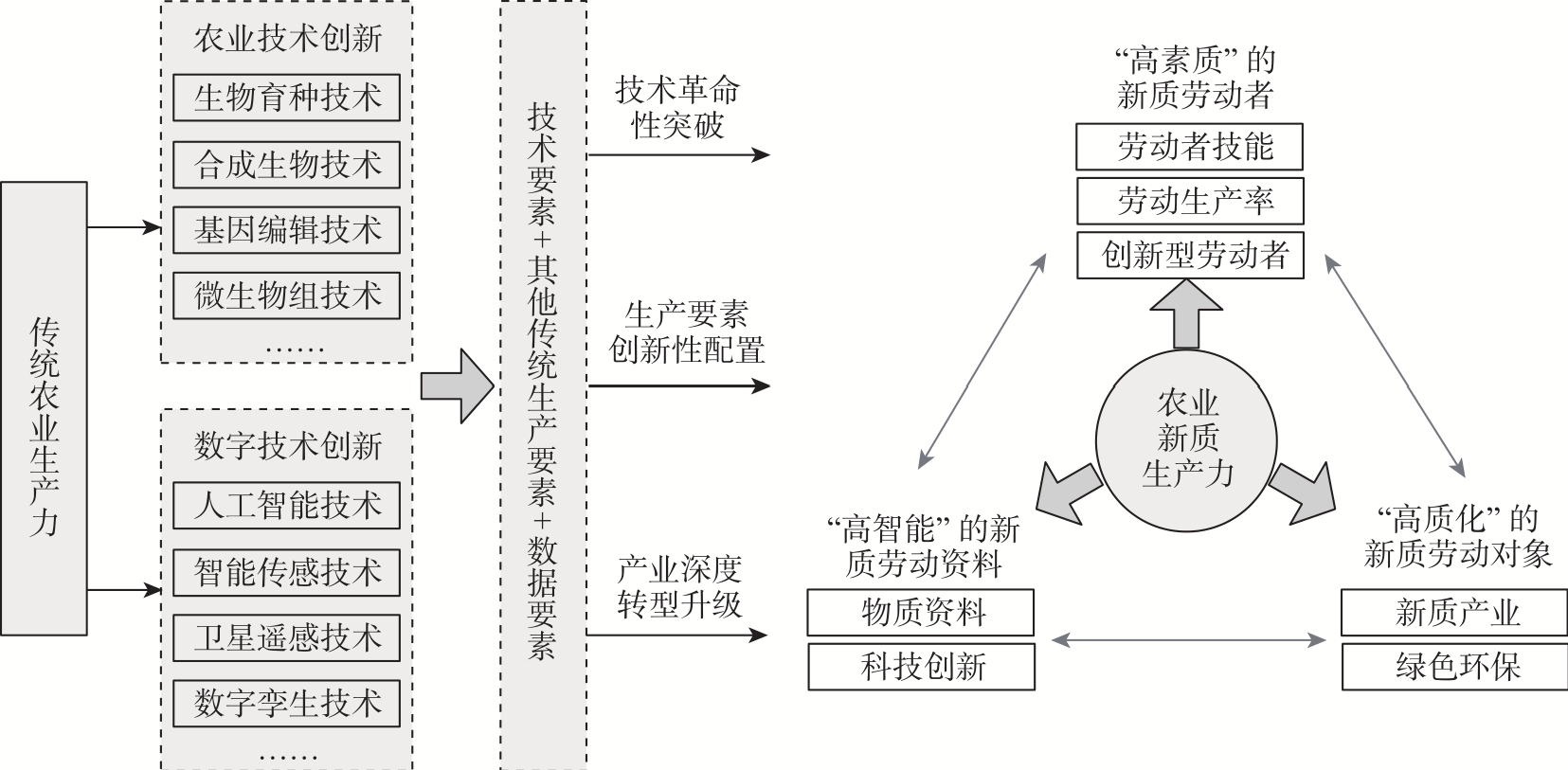
Tab. 1
Evaluation index system for the development level of agricultural new quality productivity"
| 准则层 | 一级指标 | 二级指标(权重/属性) | 计算方法 | 单位 |
|---|---|---|---|---|
| 新质劳动者 | 劳动者技能 | 受教育程度X1(0.854%/+)[ | 农村劳动力人均受教育年限 | a |
| 农村人力资本X2(2.346%/+)[ | 农村实际劳动力人均人力资本 | 元 | ||
| 劳动生产率 | 人均农业生产总值X3(2.721%/+)[ | 农林牧渔业总产值/第一产业从业人员人数 | 元·人-1 | |
| 农村居民人均收入X4(2.908%/+)[ | 农村居民人均可支配收入 | 元 | ||
| 创新型劳动者 | 农业科技活动人员比重X5(4.983%/+)[ | 农业科技活动人员数量/第一产业从业人员人数 | % | |
| 农户创业活跃度X6(10.254%/+)[ | (农村私营企业就业人数+个体就业人数)/农村人口总数 | % | ||
| 新质劳动对象 | 新质产业 | 农业产业结构X7(3.375%/+)[ | 农林牧渔服务业总产值/农林牧渔业总产值 | % |
| 农村互联网普及率X8(5.186%/+)[ | 农村互联网宽带接入用户/该地区农村人口数 | 户·人-1 | ||
| 淘宝村数量占比X9(20.461%/+)[ | 省份的淘宝村数量/省份的行政村总数 | % | ||
| 农村网络支付数量及规模X10(1.714%/+)[ | 北京大学普惠金融县域指数 | |||
| 绿色环保 | 森林覆盖率X11(3.275%/+)[ | 森林面积/土地总面积 | % | |
| 单位面积化肥使用量X12(0.967%/-)[ | 化肥使用量/农作物总播种面积 | kg·hm-2 | ||
| 单位面积农药使用量X13(0.386%/-)[ | 农药使用量/农作物总播种面积 | kg·hm-2 | ||
| 农业碳排放强度X14(0.904%/-)[ | 农业碳排放量总和/农林牧渔业总产值 | kg·元-1 | ||
| 新质劳动资料 | 物质资料 | 农业机械化水平X15(2.577%/+)[ | 农业机械总动力/第一产业从业人员人数 | kW·人-1 |
| 农业生产电气化程度X16(3.856%/+)[ | 农林牧渔业增加值/农村用电量 | 元·kW-1 | ||
| 农村移动电话普及率X17(1.158%/+)[ | 每百户农村住户移动电话拥有量 | 部·人-1 | ||
| 农村物流基础设施X18(3.482%/+)[ | 单位行政村农村投递线路长度 | km | ||
| 科技创新 | 涉农专利数量X19(13.372%/+)[ | 农林牧渔业专利总和/第一产业从业人员人数 | 件·人-1 | |
| 农业研发投入强度X20(2.136%/+)[ | 农业研发经费内部支出/GDP | % | ||
| 农产品标准化水平X21(11.177%/+)[ | 绿色食品获证产品数量/耕地面积 | 个·hm-2 | ||
| 财政投入力度X22(1.908%/+)[ | 农林水事务支出/财政支出 | % |
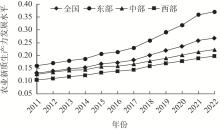
Fig. 2
Temporal evolution of the development level of agricultural new quality productivity in China and three major regions"
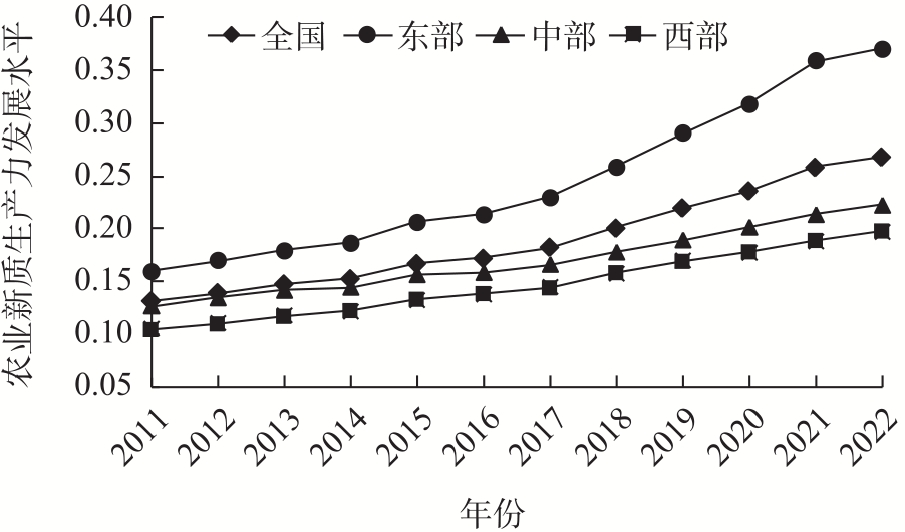
Fig. 3
Spatial distributions of the development level of agricultural new quality productivity in China"
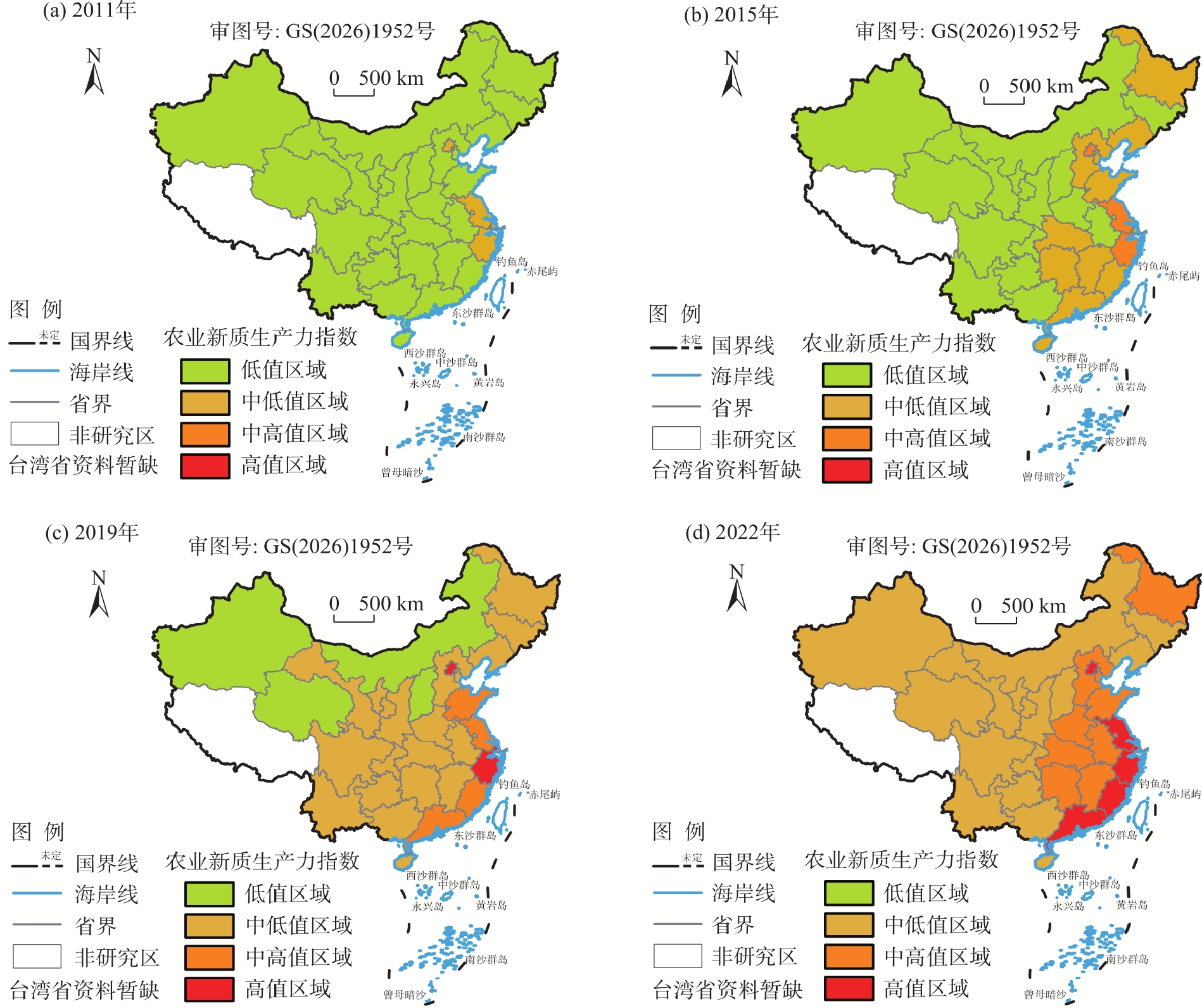
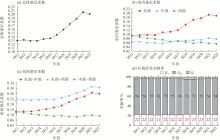
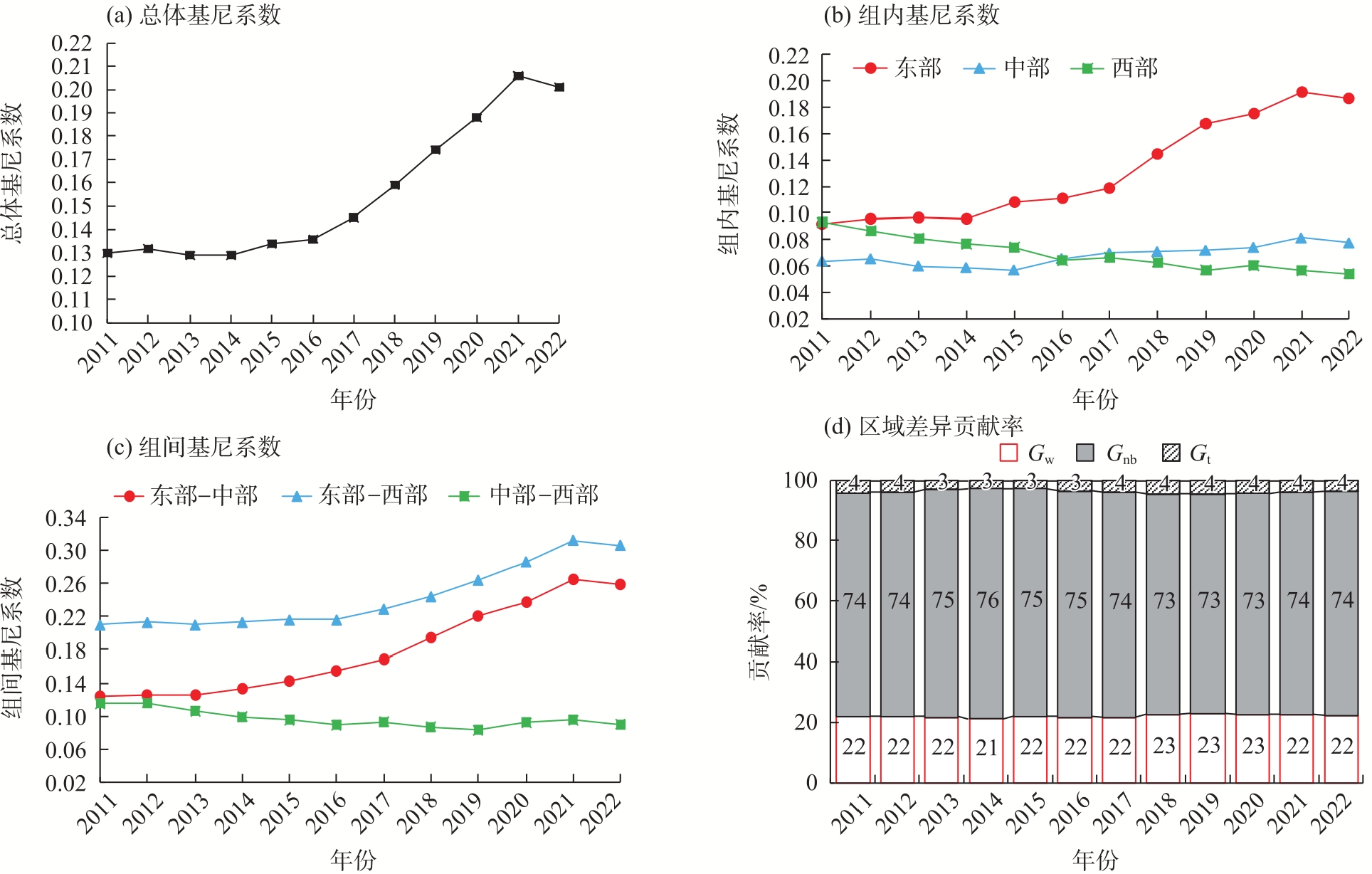
Fig. 4
Regional differences and source decomposition of the development level of agricultural new quality productivity"
Tab. 2
Global Moran’s I of the development level of agricultural new quality productivity in China"
| 年份 | 2011年 | 2012年 | 2013年 | 2014年 | 2015年 | 2016年 | 2017年 | 2018年 | 2019年 | 2020年 | 2021年 | 2022年 |
|---|---|---|---|---|---|---|---|---|---|---|---|---|
| 全局Moran’s I | 0.405*** | 0.388*** | 0.389*** | 0.404*** | 0.423*** | 0.478*** | 0.498*** | 0.503*** | 0.506*** | 0.541*** | 0.531*** | 0.565*** |
| Z | 3.586 | 3.445 | 3.458 | 3.577 | 3.728 | 4.183 | 4.347 | 4.385 | 4.409 | 4.690 | 4.615 | 4.890 |
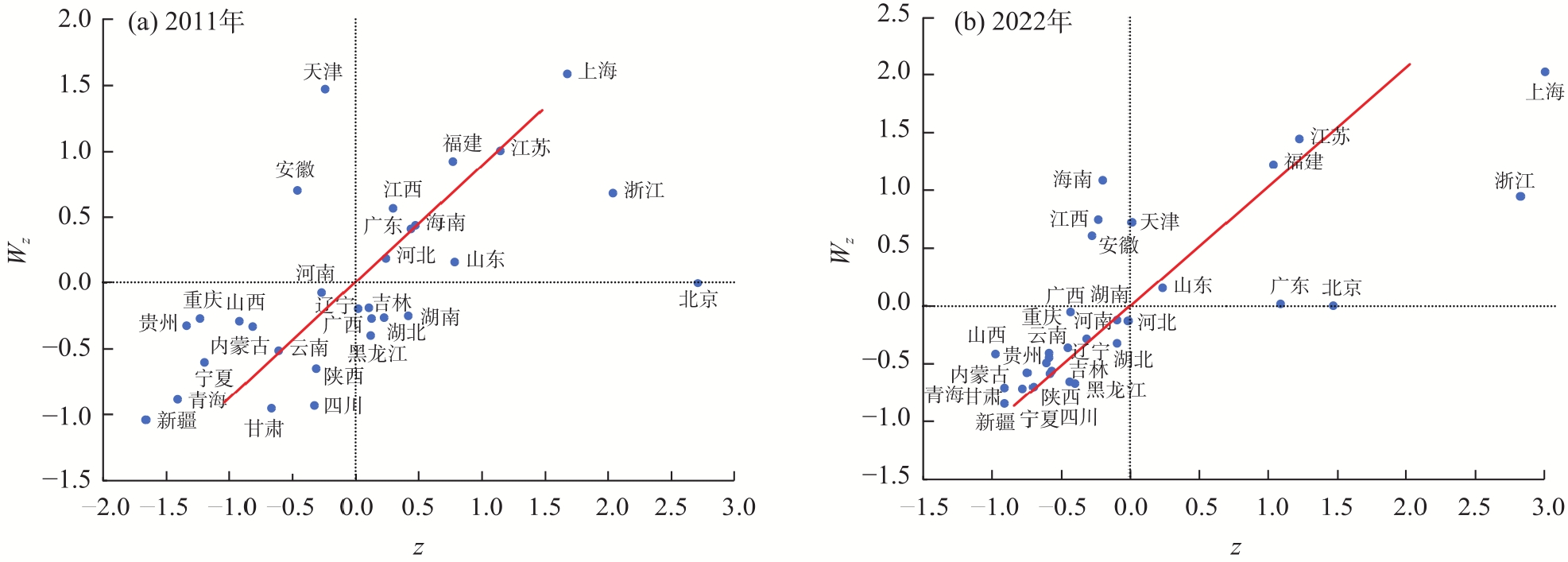
Fig. 5
Global Moran’s I scatter chart of the development level of agricultural new quality productivity"
Tab. 3
Traditional Markov transfer probability matrix of the development level of agricultural new quality productivity"
| t/t+1 | 低 | 中低 | 中高 | 高 |
|---|---|---|---|---|
| 低 | 0.7253 | 0.2747 | 0.0000 | 0.0000 |
| 中低 | 0.0116 | 0.6860 | 0.3023 | 0.0000 |
| 中高 | 0.0000 | 0.0241 | 0.7590 | 0.2169 |
| 高 | 0.0000 | 0.0000 | 0.0000 | 1.0000 |
Tab. 4
Spatial Markov transfer probability matrix of the development level of agricultural new quality productivity"
| 领域类型 | t/t+1 | 低 | 中低 | 中高 | 高 |
|---|---|---|---|---|---|
| 低 | 低 | 0.8382 | 0.1618 | 0.0000 | 0.0000 |
| 中低 | 0.0769 | 0.8462 | 0.0769 | 0.0000 | |
| 中高 | - | - | - | - | |
| 高 | 0.0000 | 0.0000 | 0.0000 | 1.0000 | |
| 中低 | 低 | 0.3810 | 0.6190 | 0.0000 | 0.0000 |
| 中低 | 0.0000 | 0.7692 | 0.2308 | 0.0000 | |
| 中高 | 0.0000 | 0.0000 | 0.8000 | 0.2000 | |
| 高 | 0.0000 | 0.0000 | 0.0000 | 1.0000 | |
| 中高 | 低 | 0.5000 | 0.5000 | 0.0000 | 0.0000 |
| 中低 | 0.0000 | 0.3684 | 0.6316 | 0.0000 | |
| 中高 | 0.0000 | 0.0385 | 0.8269 | 0.1346 | |
| 高 | 0.0000 | 0.0000 | 0.0000 | 1.0000 | |
| 高 | 低 | - | - | - | - |
| 中低 | 0.0000 | 0.5000 | 0.5000 | 0.0000 | |
| 中高 | 0.0000 | 0.0000 | 0.5714 | 0.4286 | |
| 高 | 0.0000 | 0.0000 | 0.0000 | 1.0000 |
Tab. 5
Criteria layer obstacles of the development level of agricultural new quality productivity in China"
| 准则层 | 2011年 | 2012年 | 2013年 | 2014年 | 2015年 | 2016年 | 2017年 | 2018年 | 2019年 | 2020年 | 2021年 | 2022年 |
|---|---|---|---|---|---|---|---|---|---|---|---|---|
| 新质劳动者 | 0.243 | 0.241 | 0.239 | 0.236 | 0.236 | 0.233 | 0.231 | 0.231 | 0.228 | 0.224 | 0.222 | 0.219 |
| 新质劳动对象 | 0.362 | 0.365 | 0.366 | 0.367 | 0.365 | 0.365 | 0.362 | 0.359 | 0.357 | 0.356 | 0.350 | 0.344 |
| 新质劳动资料 | 0.394 | 0.394 | 0.395 | 0.397 | 0.400 | 0.402 | 0.406 | 0.410 | 0.414 | 0.420 | 0.428 | 0.437 |
Tab. 6
Main obstacle factors and obstacle degree of the development level of agricultural new quality productivity in China"
| 障碍因子 | 2011年 | 2012年 | 2013年 | 2014年 | 2015年 | 2016年 | 2017年 | 2018年 | 2019年 | 2020年 | 2021年 | 2022年 |
|---|---|---|---|---|---|---|---|---|---|---|---|---|
| 第一障碍因子 | X9(0.233) | X9(0.235) | X9(0.237) | X9(0.238) | X9(0.241) | X9(0.240) | X9(0.241) | X9(0.242) | X9(0.243) | X9(0.242) | X9(0.237) | X9(0.235) |
| 第二障碍因子 | X19(0.150) | X19(0.151) | X19(0.151) | X19(0.152) | X19(0.153) | X19(0.153) | X19(0.153) | X19(0.154) | X19(0.158) | X19(0.156) | X19(0.155) | X19(0.164) |
| 第三障碍因子 | X21(0.125) | X21(0.127) | X21(0.128) | X21(0.129) | X21(0.131) | X21(0.131) | X21(0.133) | X21(0.134) | X21(0.133) | X21(0.138) | X21(0.139) | X21(0.139) |
| 第四障碍因子 | X6(0.111) | X6(0.112) | X6(0.112) | X6(0.112) | X6(0.113) | X6(0.112) | X6(0.111) | X6(0.112) | X6(0.113) | X6(0.115) | X6(0.118) | X6(0.120) |
| 第五障碍因子 | X8(0.055) | X8(0.054) | X8(0.054) | X8(0.054) | X8(0.053) | X8(0.051) | X5(0.050) | X5(0.051) | X5(0.049) | X5(0.046) | X5(0.045) | X5(0.044) |
| [1] | 罗必良. 新质生产力: 颠覆性创新与基要性变革——兼论农业高质量发展的本质规定和努力方向[J]. 中国农村经济, 2024(8): 2-26. |
| [Luo Biliang. New quality productive forces,disruptive innovation, and fundamental change: The essential requirements and striving direction for high-quality development of agriculture[J]. Chinese Rural Economy, 2024(8): 2-26. ] | |
| [2] | 高帆. “新质生产力”的提出逻辑、多维内涵及时代意义[J]. 政治经济学评论, 2023, 14(6): 127-145. |
| [Gao Fan. The logic, multidimensional connotation and current significance of “new quality productivity”[J]. China Political Economy Review, 2023, 14(6): 127-145. ] | |
| [3] | 周文, 许凌云. 论新质生产力: 内涵特征与重要着力点[J]. 改革, 2023(10): 1-13. |
| [Zhou Wen, Xu Lingyun. On new quality productivity: Connotative characteristics and important focus[J]. Reform, 2023(10): 1-13. ] | |
| [4] | 李晓华. 新质生产力的主要特征与形成机制[J]. 人民论坛, 2023(21): 15-17. |
| [Li Xiaohua. Major characteristics and formation mechanisms of new quality productive forces[J]. People’s Tribune, 2023(21): 15-17. ] | |
| [5] | 王世泰, 曹劲松. 新质生产力的缘起、生成动力与培育机理——基于马克思主义政治经济学视角[J]. 南京社会科学, 2024(3): 10-22. |
| [Wang Shitai, Cao Jinsong. The origins, formation and cultivation mechanism of China’s new quality productivity: Based on the perspective of Marxist political economy[J]. Nanjing Social Sciences, 2024(3): 10-22. ] | |
| [6] |
石卓达, 杨宏伟. 新质生产力对中国生态旅游高质量发展的影响[J]. 干旱区地理, 2026, 49(3): 440-450.
doi: 10.12118/j.issn.1000-6060.2025.375 |
|
[Shi Zhuoda, Yang Hongwei. Impact of new quality productive forces on the high-quality development of ecotourism in China[J]. Arid Land Geography, 2026, 49(3): 440-450. ]
doi: 10.12118/j.issn.1000-6060.2025.375 |
|
| [7] | 张林, 蒲清平. 新质生产力的内涵特征、理论创新与价值意蕴[J]. 重庆大学学报(社会科学版), 2023, 29(6): 137-148. |
| [Zhang Lin, Pu Qingping. The connotation characteristic, theoretical innovation and value implication of new quality productivity[J]. Journal of Chongqing University (Social Sciences Edition), 2023, 29(6): 137-148. ] | |
| [8] | 石建勋, 徐玲. 加快形成新质生产力的重大战略意义及实现路径研究[J]. 财经问题研究, 2024(1): 3-12. |
| [Shi Jianxun, Xu Ling. Major strategic significance and implementation path of accelerating the formation of new quality productivity[J]. Research on Financial and Economic Issues, 2024(1): 3-12. ] | |
| [9] | 蒋永穆, 乔张媛. 新质生产力: 逻辑、内涵及路径[J]. 社会科学研究, 2024(1): 10-18, 211. |
| [Jiang Yongmu, Qiao Zhangyuan. New quality productivity: Logic, connotation and path[J]. Social Science Research, 2024(1): 10-18, 211. ] | |
| [10] |
卢昭东, 秦璐, 马燕. 新质生产力对中国旅游经济高质量发展的影响[J]. 干旱区地理, 2026, 49(3): 451-461.
doi: 10.12118/j.issn.1000-6060.2025.305 |
|
[Lu Zhaodong, Qin Lu, Ma Yan. Impact of new quality productive forces on the high-quality development of tourism economy in China[J]. Arid Land Geography, 2026, 49(3): 451-461. ]
doi: 10.12118/j.issn.1000-6060.2025.305 |
|
| [11] | 王琴梅, 杨军鸽. 数字新质生产力与我国农业的高质量发展研究[J]. 陕西师范大学学报(哲学社会科学版), 2023, 52(6): 61-72. |
| [Wang Qinmei, Yang Junge. Research on digital new quality productivity and high-quality development of Chinese agriculture[J]. Journal of Shaanxi Normal University (Philosophy and Social Sciences Edition), 2023, 52(6): 61-72. ] | |
| [12] | 朱红根, 陈晖. 中国数字乡村发展的水平测度、时空演变及推进路径[J]. 农业经济问题, 2023(3): 21-33. |
| [Zhu Honggen, Chen Hui. Measurement, spatial-temporal evolution and promotion path of digital village development in China[J]. Agricultural Economic Issues, 2023(3): 21-33. ] | |
| [13] | 彭宸, 贾俊松, 余清项, 等. 中国农业碳排放的时空演化及影响因素分析[J]. 环境科学研究, 2024, 37(6): 1181-1192. |
| [Peng Chen, Jia Junsong, Yu Qingxiang, et al. Analysis of spatio-temporal evolution and influencing factors of agricultural carbon emission in China[J]. Research of Environmental Sciences, 2024, 37(6): 1181-1192. ] | |
| [14] | 郑建. 以新质生产力推动农业现代化: 理论逻辑与发展路径[J]. 价格理论与实践, 2023(11): 31-35. |
| [Zheng Jian. Promoting agricultural modernization with new quality productivity: Logicand development path[J]. Price Theory and Practice, 2023(11): 31-35. ] | |
| [15] | 罗必良, 耿鹏鹏. 农业新质生产力: 理论脉络、基本内核与提升路径[J]. 农业经济问题, 2024(4): 13-26. |
| [Luo Biliang, Geng Pengpeng. New quality agricultural productivity: Theoretical framework, core concepts, and enhancement pathways[J]. Agricultural Economic Issues, 2024(4): 13-26. ] | |
| [16] | 高原, 马九杰. 农业新质生产力: 一个政治经济学的视角[J]. 农业经济问题, 2024(4): 81-94. |
| [Gao Yuan, Ma Jiujie. New quality agricultural productivity: A political economy perspective[J]. Agricultural Economic Issues, 2024(4): 81-94. ] | |
| [17] | 朱迪, 叶林祥. 中国农业新质生产力: 水平测度与动态演变[J]. 统计与决策, 2024, 40(9): 24-30. |
| [Zhu Di, Ye Linxiang. Agricultural new quality productive force in China: Level measurement and dynamic evolution[J]. Statistics & Decision, 2024, 40(9): 24-30. ] | |
| [18] | 宋振江, 冷明妮, 周波, 等. 中国农业新质生产力: 评价体系构建、动态演进及政策启示[J]. 农林经济管理学报, 2024, 23(4): 425-434. |
| [Song Zhenjiang, Leng Mingni, Zhou Bo, et al. New quality agricultural productive forces in China: Evaluation system construction, dynamic evolution and policy implications[J]. Journal of Agricultural and Forestry Economics and Management, 2024, 23(4): 425-434. ] | |
| [19] | 黄敦平, 尹凯. 数字普惠金融发展能否提升农村创业活跃度[J]. 金融与经济, 2023(8): 43-53. |
| [Huang Dunping, Yin Kai. Can the development of digital inclusive finance increase the activity of rural entrepreneurship?[J]. Finance and Economy, 2023(8): 43-53. ] | |
| [20] | 马玉婷, 高强, 杨旭丹. 农村劳动力老龄化与农业产业结构升级: 理论机制与实证检验[J]. 华中农业大学学报(社会科学版), 2023(2): 69-79. |
| [Ma Yuting, Gao Qiang, Yang Xudan. Aging of rural labor force and the upgrading of agricultural industrial structure: Theoretical mechanism and empirical test[J]. Journal of Huazhong Agricultural University (Social Sciences Edition), 2023(2): 69-79. ] | |
| [21] | 王丽双, 傅新红, 蒋浩, 等. 农业新质生产力测度、区域差异及耦合协调研究[J]. 农林经济管理学报, 2025, 24(1): 55-64. |
| [Wang Lishuang, Fu Xinhong, Jiang Hao, et al. Development level measurement, regional differences and coupling coordination of agricultural new quality productivity[J]. Journal of Agricultural and Forestry Economics and Management, 2025, 24(1): 55-64. ] | |
| [22] | 罗光强, 宋新宇. 中国农业新质生产力: 生成机理、时空特征与区域差异[J]. 中国农业资源与区划, 2025, 46(6): 138-150. |
| [Luo Guangqiang, Song Xinyu. The production mechanisms, spatial and temporal characteristics, and regional differences of agricultural new quality productivity in China[J]. Chinese Journal of Agricultural Resources and Regional Planning, 2025, 46(6): 138-150. ] | |
| [23] | 慕娟, 马立平. 中国农业农村数字经济发展指数测度与区域差异[J]. 华南农业大学学报(社会科学版), 2021, 20(4): 90-98. |
| [Mu Juan, Ma Liping. Measurement of China’s rural digital economy development index and regional disparities[J]. Journal of South China Agricultural University (Social Sciences Edition), 2021, 20(4): 90-98. ] | |
| [24] | 赵丹玉, 崔建军. 中国农业农村高质量发展的时空特征、区域差异及影响因素[J]. 华中农业大学学报(社会科学版), 2024(3): 10-24. |
| [Zhao Danyu, Cui Jianjun. The spatial-temporal characteristics, regional disparities, and influencing factors of high-quality agricultural and rural development in China[J]. Journal of Huazhong Agricultural University (Social Sciences Edition), 2024(3): 10-24. ] | |
| [25] | 杨军鸽, 王琴梅. 数字技术与农业高质量发展——基于数字生产力的视角[J]. 山西财经大学学报, 2023, 45(4): 47-63. |
| [Yang Junge, Wang Qinmei. Digital technology and high-quality agricultural development: From the perspective of digital productivity[J]. Journal of Shanxi University of Finance and Economics, 2023, 45(4): 47-63. ] | |
| [26] | 黄修杰, 蔡勋, 储霞玲, 等. 我国农业高质量发展评价指标体系构建与评估[J]. 中国农业资源与区划, 2020, 41(4): 124-133. |
| [Huang Xiujie, Cai Xun, Chu Xialing, et al. Index construction and evaluation of high-quality development of agriculture in China[J]. Chinese Journal of Agricultural Resources and Regional Planning, 2020, 41(4): 124-133. ] | |
| [27] | 钟晓华. 乡村产业高质量发展与共同富裕的耦合协调测度与时空特征分析[J]. 统计与决策, 2023, 39(7): 67-72. |
| [Zhong Xiaohua. Coupling synergy measure and spatial-temporal characteristic analysis of high-quality development of rural industries and common affluence[J]. Statistics & Decision, 2023, 39(7): 67-72. ] | |
| [28] | 陈明华, 刘玉鑫, 刘文斐, 等. 中国城市民生发展的区域差异测度、来源分解与形成机理[J]. 统计研究, 2020, 37(5): 54-67. |
| [Chen Minghua, Liu Yuxin, Liu Wenfei, et al. Measurement, source decomposition and formation mechanism of regional differences in urban livelihood development in China[J]. Statistical Research, 2020, 37(5): 54-67. ] | |
| [29] |
韩建雨, 胡登月, 李平星, 等. 中国新质生产力水平时空格局及其影响因素[J]. 经济地理, 2025, 45(7): 1-12.
doi: 10.15957/j.cnki.jjdl.2025.07.001 |
|
[Han Jianyu, Hu Dengyue, Li Pingxing, et al. Spatio-temporal pattern and influencing factors of new quality productive forces in China[J]. Economic Geography, 2025, 45(7): 1-12. ]
doi: 10.15957/j.cnki.jjdl.2025.07.001 |
|
| [30] |
李艳丰. 省域跨境人民币结算的区域差异变化及影响因素[J]. 经济地理, 2023, 43(7): 139-150.
doi: 10.15957/j.cnki.jjdl.2023.07.014 |
|
[Li Yanfeng. Regional differences and influencing factors of provincial cross-border RMB settlement in provinces[J]. Economic Geography, 2023, 43(7): 139-150. ]
doi: 10.15957/j.cnki.jjdl.2023.07.014 |
|
| [31] | 李晓燕, 王倩, 张桐. 长江经济带农业高质量发展水平测度、地区差异与空间相关性研究[J]. 农村经济, 2024(7): 89-99. |
| [Li Xiaoyan, Wang Qian, Zhang Tong. Measurement of high-quality agricultural development level, regional differences and spatial correlation in the Yangtze River Economic Belt[J]. Rural Economy, 2024(7): 89-99. ] | |
| [32] |
杨川, 卢新海, 许进龙. 基于“大食物观”的中国粮食安全水平评价与动态演进[J]. 经济地理, 2024, 44(2): 166-174.
doi: 10.15957/j.cnki.jjdl.2024.02.017 |
|
[Yang Chuan, Lu Xinhai, Xu Jinlong. Evaluation and dynamic evolution of food security level based on big food concept[J]. Economic Geography, 2024, 44(2): 166-174. ]
doi: 10.15957/j.cnki.jjdl.2024.02.017 |
|
| [33] | 卢江, 郭子昂, 王煜萍. 新质生产力发展水平、区域差异与提升路径[J]. 重庆大学学报(社会科学版), 2024, 30(3): 1-17. |
| [Lu Jiang, Guo Zi’ang, Wang Yuping. Levels of development of new quality productivity, regional differences and paths to enhancement[J]. Journal of Chongqing University (Social Sciences Edition), 2024, 30(3): 1-17. ] | |
| [34] | 周迪, 程慧平. 中国农业现代化发展水平时空格局及趋同演变[J]. 华南农业大学学报(社会科学版), 2015, 14(1): 25-35. |
| [Zhou Di, Cheng Huiping. Evolvement of convergence and spatial patterns of agricultural modernization in China[J]. Journal of South China Agricultural University (Social Sciences Edition), 2015, 14(1): 25-35. ] |
|
||

