Arid Land Geography ›› 2026, Vol. 49 ›› Issue (8): 1545-1559.doi: 10.12118/j.issn.1000-6060.2025.616
• Climatology and Hydrology • Previous Articles Next Articles
ZHAI Yongjian1,2( ), YAO Junqiang2,3,4(), QIN Yan1
Received:2025-10-04
Revised:2025-10-30
Online:2026-08-25
Published:2026-08-21
Contact:
YAO Junqiang
E-mail:17622707206@163.com;yaojq1987@126.com
ZHAI Yongjian, YAO Junqiang, QIN Yan. Progress on climate change and its impacts in the arid Central Asia: A bibliometric analysis[J].Arid Land Geography, 2026, 49(8): 1545-1559.
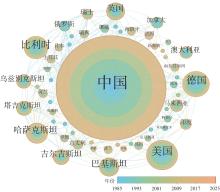
Fig. 1
National cooperation network on climate change research in arid Central Asia"
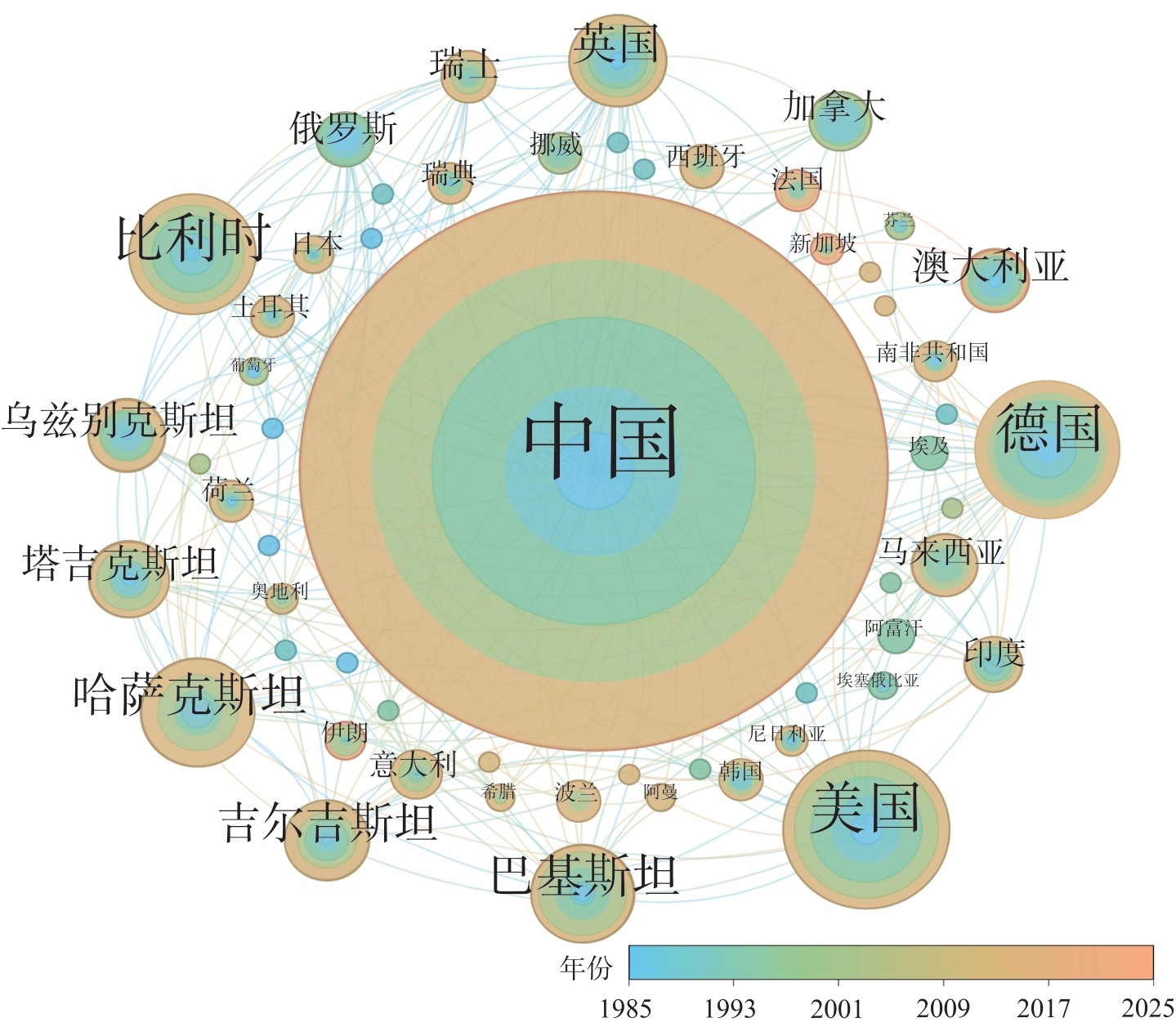
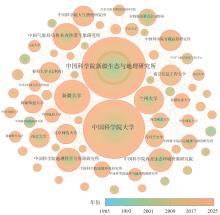
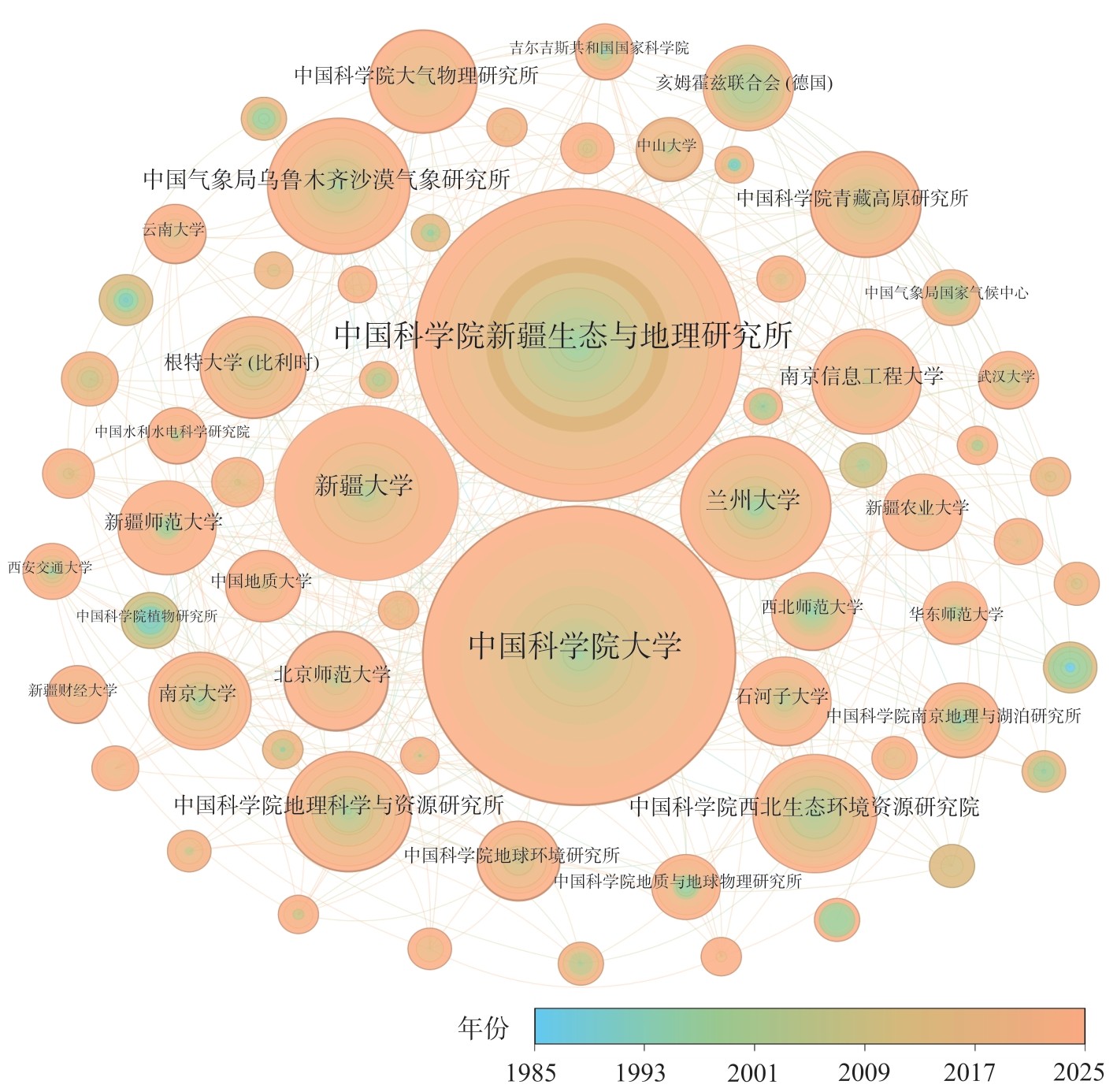
Fig. 2
Collaborative network of research institutions on climate change in arid Central Asia based on the Web of Science database"

Tab. 1
Top 10 research institutions by publication output based on the Web of Science database"
| 机构名称 | 发文量/篇 |
|---|---|
| 中国科学院新疆生态与地理研究所 | 453 |
| 中国科学院大学 | 406 |
| 新疆大学 | 144 |
| 兰州大学 | 110 |
| 中国气象局乌鲁木齐沙漠气象研究所 | 86 |
| 中国科学院西北生态环境资源研究院 | 69 |
| 中国科学院地理科学与资源研究所 | 68 |
| 南京信息工程大学 | 54 |
| 中国科学院青藏高原研究所 | 54 |
| 中国科学院大气物理研究所 | 53 |
Fig. 3
Co-authorship network of studies on climate change in arid Central Asia based on the CNKI database"
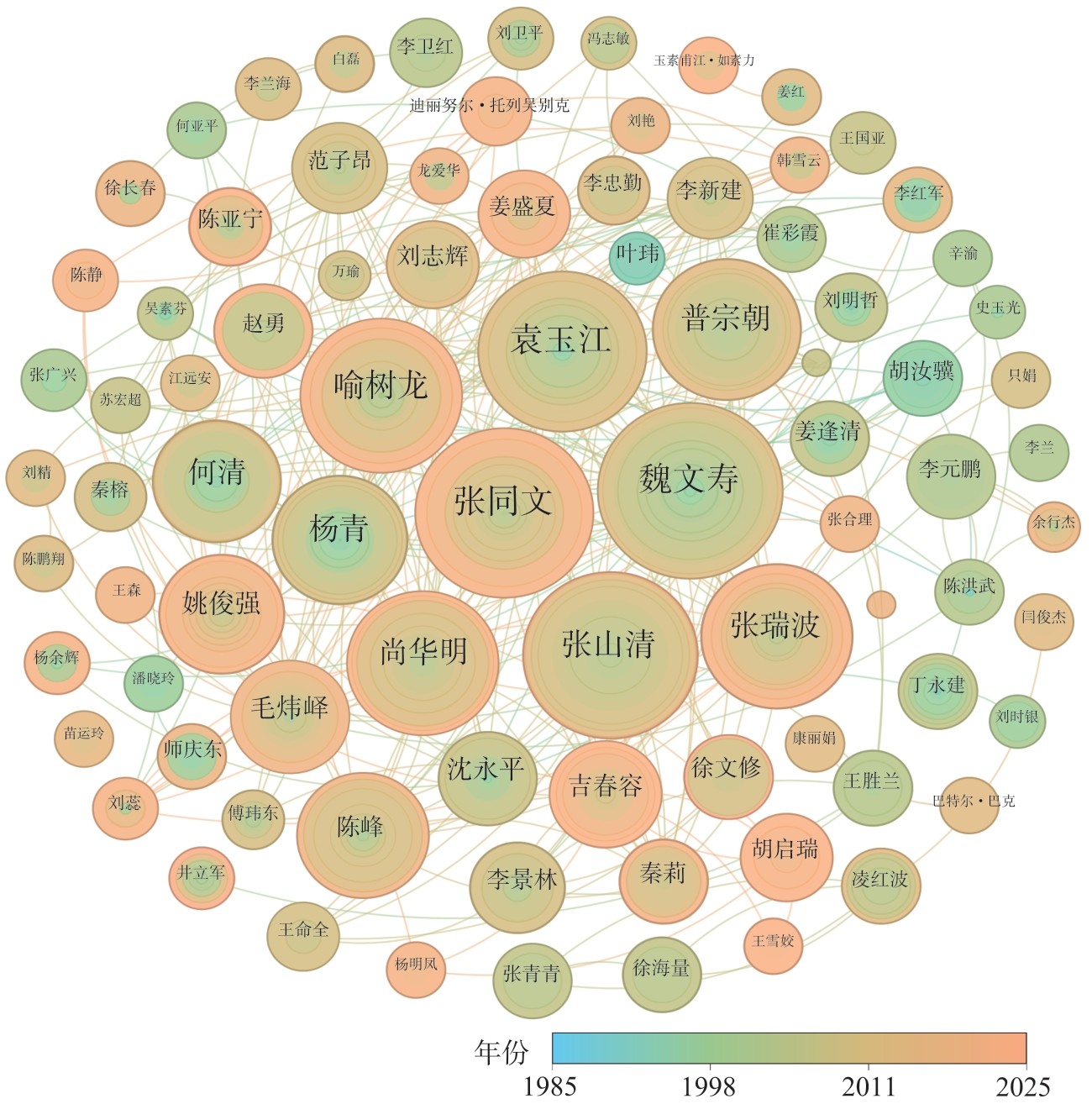
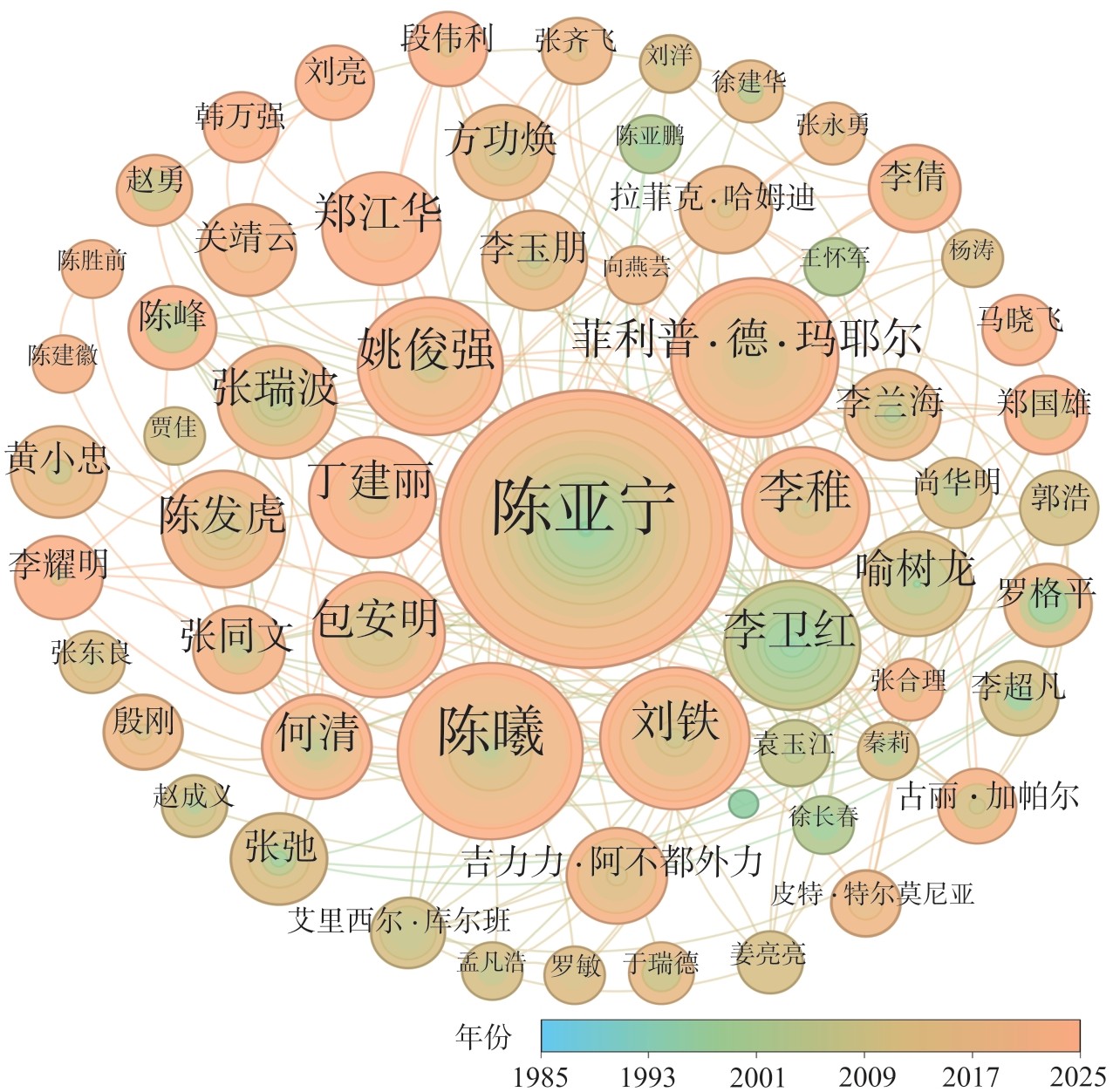
Fig. 4
Co-authorship network of studies on climate change in arid Central Asia based on the Web of Science database"
Tab. 2
Top 10 journals by publication output in the Web of Science and CNKI databases"
| Web of Science | 发文量/篇 | 被引量 | CNKI | 发文量/篇 | 被引量 |
|---|---|---|---|---|---|
| Remote Sensing | 72 | 1499 | 干旱区研究 | 107 | 2766 |
| Journal of Arid Land | 56 | 1114 | 沙漠与绿洲气象 | 88 | 1088 |
| Science of the Total Environment | 47 | 3257 | 干旱区地理 | 87 | 3128 |
| Water | 45 | 562 | 冰川冻土 | 73 | 5809 |
| International Journal of Climatology | 43 | 1851 | 干旱区资源与环境 | 54 | 1162 |
| Ecological Indicators | 37 | 1377 | 中国沙漠 | 49 | 2545 |
| Theoretical and Applied Climatology | 35 | 889 | 生态学报 | 35 | 1382 |
| Journal of Hydrology | 33 | 2305 | 中国农学通报 | 24 | 277 |
| Global and Planetary Change | 31 | 2094 | 现代农业科技 | 24 | 73 |
| Quaternary International | 31 | 1076 | 干旱气象 | 24 | 529 |
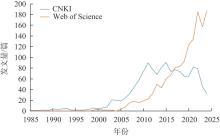
Fig. 5
Publication trends of studies on climate change in arid Central Asia from 1985 to 2024"
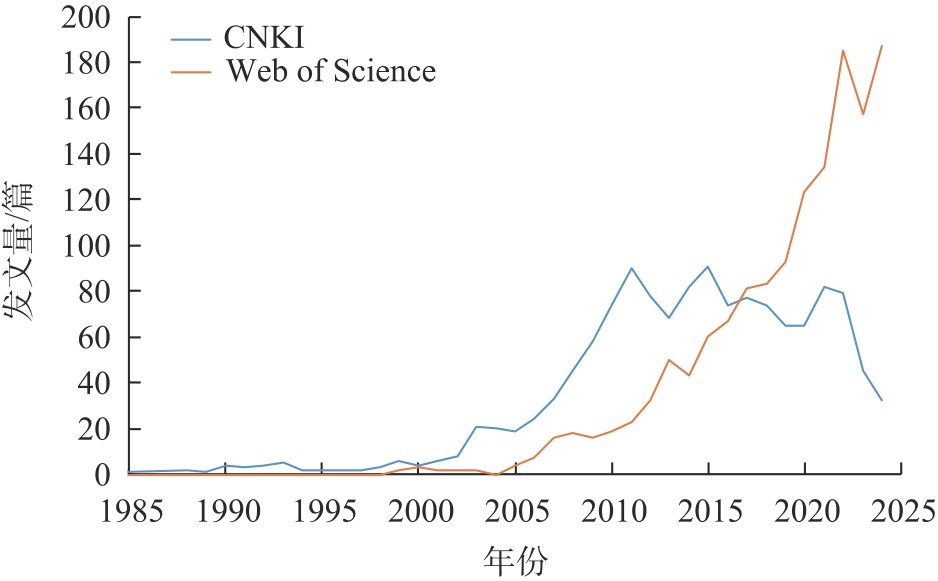
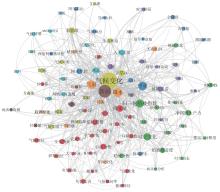
Fig. 6
Keywords and their co-occurrence relationships of studies on climate change in arid Central Asia based on the CNKI database"
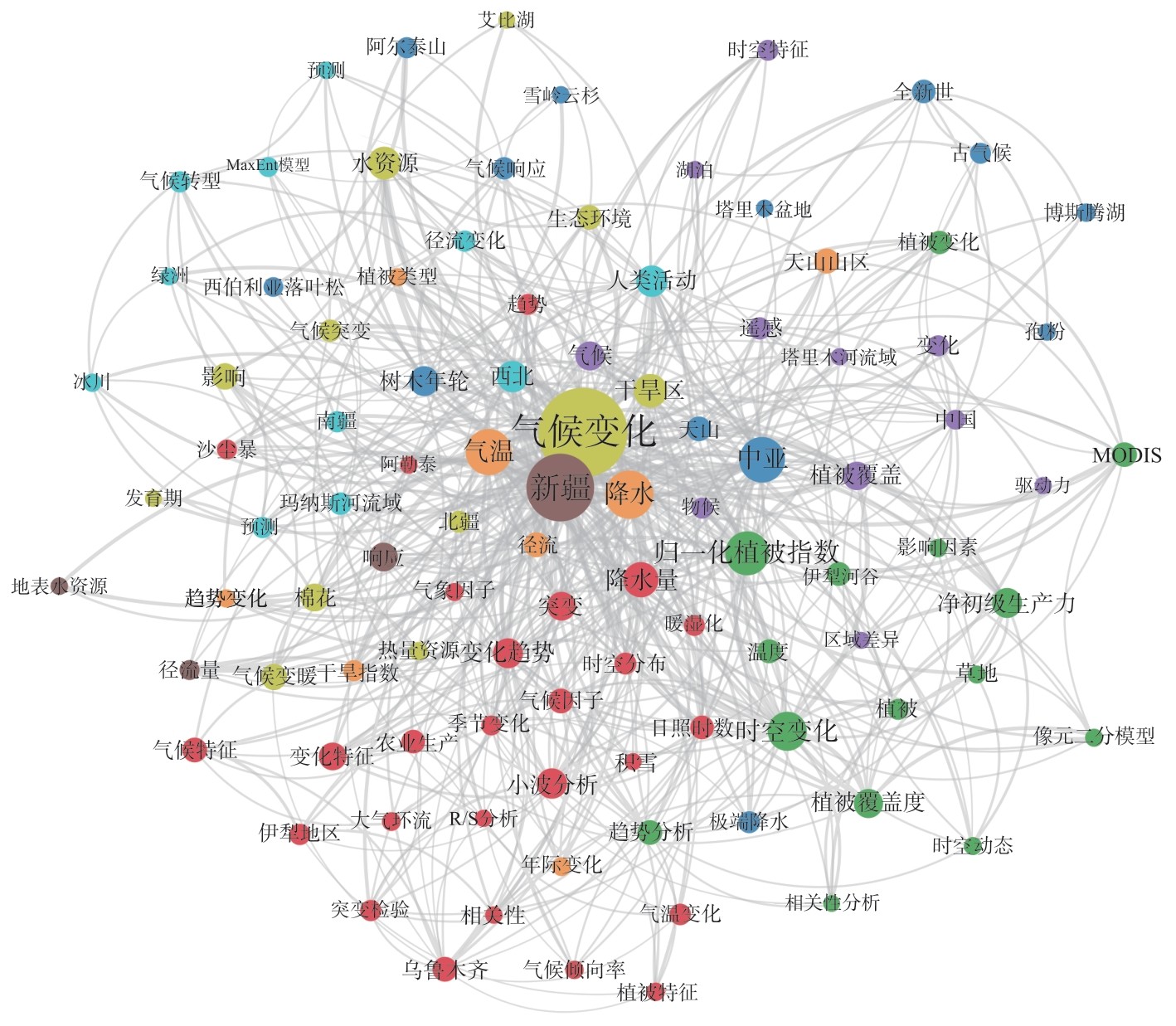
Fig. 7
Keywords and their co-occurrence relationships of studies on climate change in arid Central Asia based on the Web of Science database"
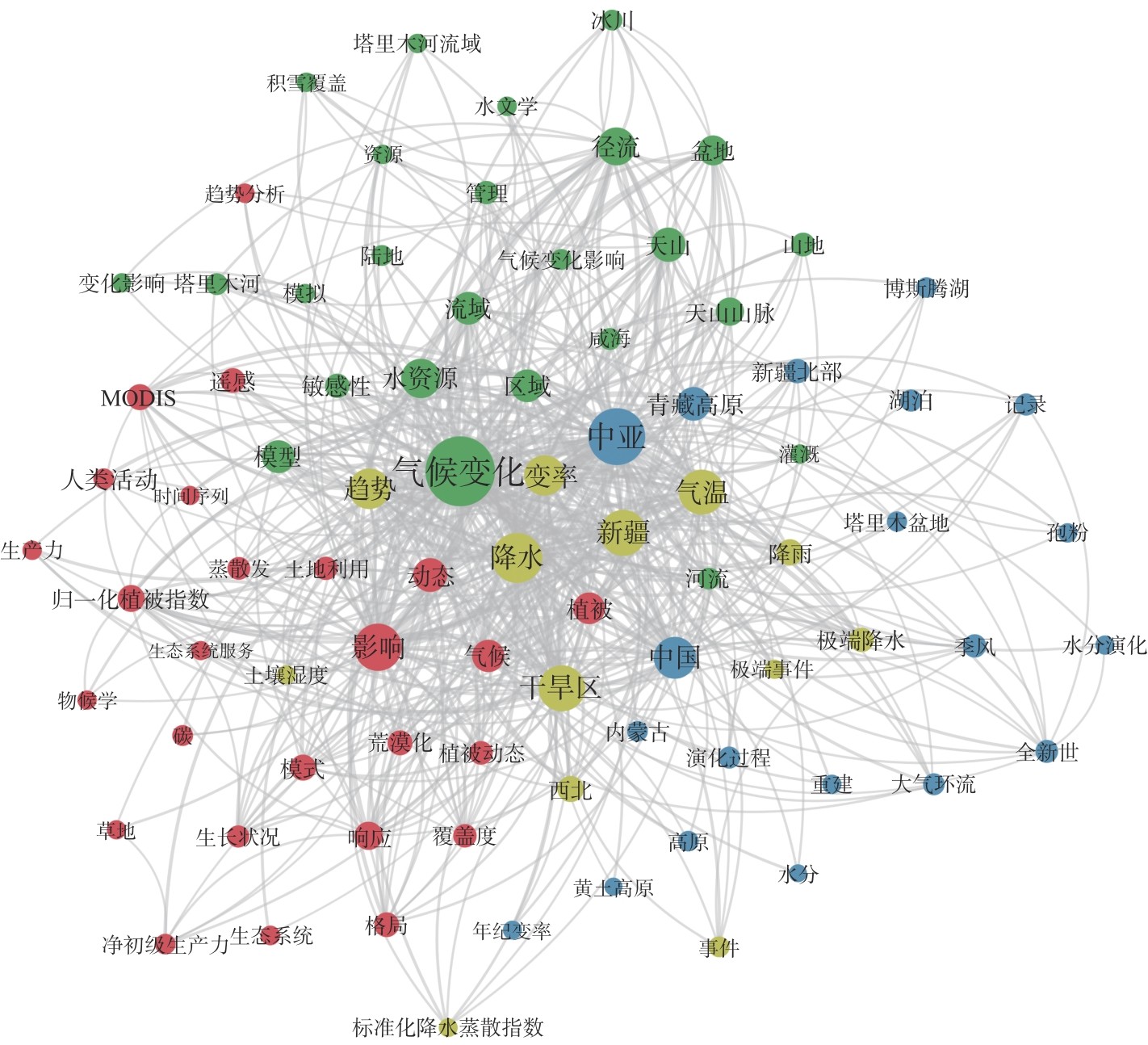
Fig. 8
Temporal network of keywords in studies on climate change and its impacts in arid Central Asia based on the CNKI database"
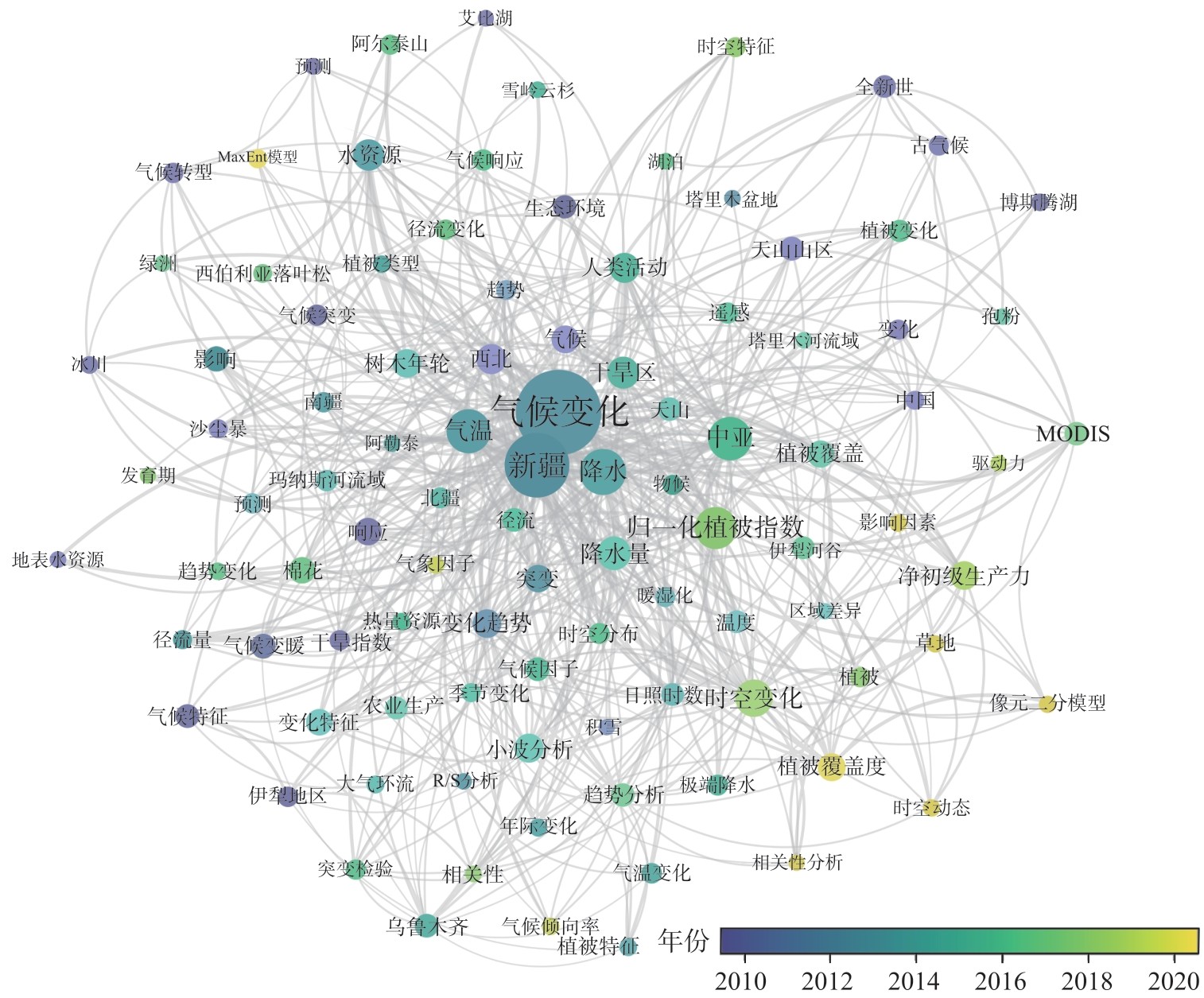
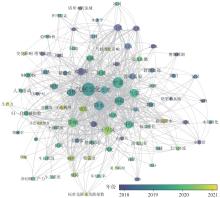
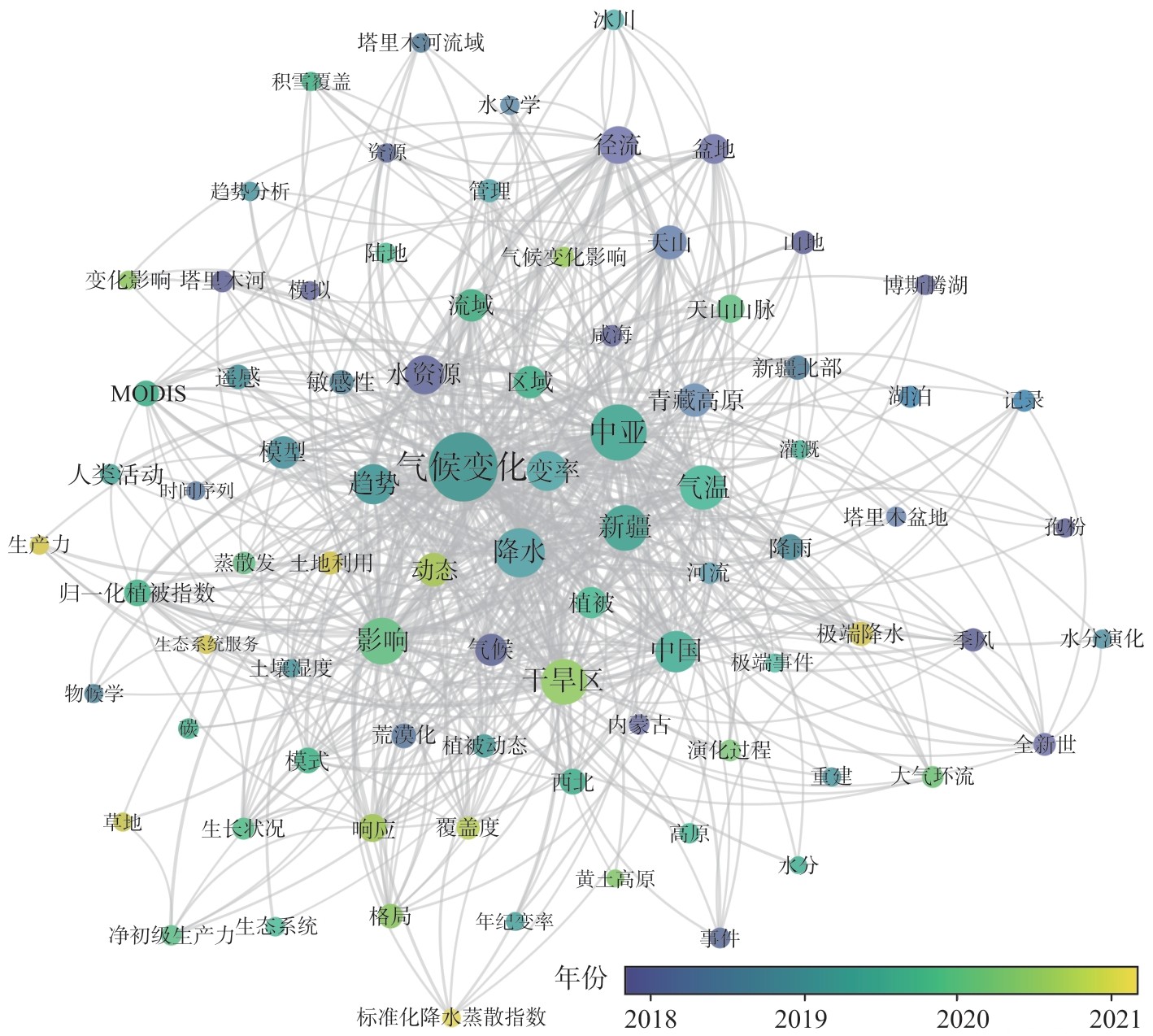
Fig. 9
Temporal network of keywords in studies on climate change and its impacts in arid Central Asia based on the Web of Science database"
| [1] | 秦大河, 陈振林, 罗勇, 等. 气候变化科学的最新认知[J]. 气候变化研究进展, 2007, 3(2): 63-73. |
| [Qin Dahe, Chen Zhenlin, Luo Yong, et al. Updated understanding of climate change sciences[J]. Advances in Climate Change Research, 2007, 3(2): 63-73.] | |
| [2] | 任国玉, 郭军, 徐铭志, 等. 近50年中国地面气候变化基本特征[J]. 气象学报, 2005, 63(6): 942-956. |
| [Ren Guoyu, Guo Jun, Xu Mingzhi, et al. Climate changes of China’s mainland over the past half century[J]. Acta Meteorologica Sinica, 2005, 63(6): 942-956.] | |
| [3] | 陈亚宁, 徐长春, 杨余辉, 等. 新疆水文水资源变化及对区域气候变化的响应[J]. 地理学报, 2009, 64(11): 1331-1341. |
|
[Chen Yaning, Xu Changchun, Yang Yuhui, et al. Hydrology and water resources variation and its responses to regional climate change in Xinjiang[J]. Acta Geographica Sinica, 2009, 64(11): 1331-1341.]
doi: 10.11821/xb200911005 |
|
| [4] | 陈发虎, 黄伟, 靳立亚, 等. 全球变暖背景下中亚干旱区降水变化特征及其空间差异[J]. 中国科学: 地球科学, 2011, 41(11): 1647-1657. |
| [Chen Fahu, Huang Wei, Jin Liya, et al. Characteristics and spatial differences of precipitation variation in the arid region of Central Asia under global warming[J]. Scientia Sinica (Terrae), 2011, 41(11): 1647-1657.] | |
| [5] | 吴俣, 杜剑卿, 刘强, 等. 基于文献计量的青藏高原土壤呼吸研究进展[J]. 生态学报, 2023, 43(7): 2968-2977. |
| [Wu Yu, Du Jianqing, Liu Qiang, et al. Research progress on soil respiration in the Tibetan Plateau based on bibliometrics[J]. Acta Ecologica Sinica, 2023, 43(7): 2968-2977.] | |
| [6] | 房俊民, 罗小英. 基于文献计量的森林生态学学科发展态势研究[J]. 生态学报, 2023, 43(1): 449-461. |
| [Fang Junmin, Luo Xiaoying. Research on the development trend of forest ecology based on bibliometrics[J]. Acta Ecologica Sinica, 2023, 43(1): 449-461.] | |
| [7] | 张定媛, 郑秋红, 王卫丹. 基于Nature和Science论文的大气科学创新态势研究[J]. 气象科技进展, 2025, 15(2): 45-51. |
| [Zhang Dingyuan, Zheng Qiuhong, Wang Weidan. A study on the research trends in atmospheric science based on papers from Nature and Science[J]. Advances in Meteorological Science and Technology, 2025, 15(2): 45-51.] | |
| [8] | 王新平, 魏秋实, 苏畅, 等. 基于WoS数据库与文献计量学的食品质量安全管理研究热点及演进分析[J]. 食品科学, 2021, 42(23): 325-332. |
|
[Wang Xinping, Wei Qiushi, Su Chang, et al. Research hotspots and evolution of food quality and safety management: A bibliometric analysis based on Web of Science database[J]. Food Science, 2021, 42(23): 325-332.]
doi: 10.7506/spkx1002-6630-20200730-394 |
|
| [9] | 施雅风, 沈永平, 胡汝骥. 西北气候由暖干向暖湿转型的信号、影响和前景初步探讨[J]. 冰川冻土, 2002, 24(3): 219-226. |
| [Shi Yafeng, Shen Yongping, Hu Ruji. Preliminary discussion on the signal, impact and prospect of climate shift from warm-dry to warm-wet in northwest China[J]. Journal of Glaciology and Geocryology, 2002, 24(3): 219-226.] | |
| [10] |
Chen F H, Yu Z C, Yang M L, et al. Holocene moisture evolution in arid Central Asia and its out-of-phase relationship with Asian monsoon history[J]. Quaternary Science Reviews, 2008, 27(3-4): 351-364.
doi: 10.1016/j.quascirev.2007.10.017 |
| [11] |
任宜勇, 季元中. 最近十年新疆气候变暖的主要特征[J]. 干旱区地理, 1991, 14(4): 42-47.
doi: 10.13826/j.cnki.cn65-1103/x.1991.04.008 |
|
[Ren Yiyong, Ji Yuanzhong. Climatic warming in the recent 10 years and its effects in Xinjiang[J]. Arid Land Geography, 1991, 14(4): 42-47.]
doi: 10.13826/j.cnki.cn65-1103/x.1991.04.008 |
|
| [12] | 杨舵. 近31年新疆气候变化的时空分布特征[J]. 新疆气象, 1992, 13(6): 15-19. |
| [Yang Duo. Spatial temporal characteristics of climate change in Xinjiang over the past 31 years[J]. Xinjiang Meteorology, 1992, 13(6): 15-19.] | |
| [13] | 叶佰生, 丁永建, 康尔泗, 等. 近40 a来新疆地区冰雪径流对气候变暖的响应[J]. 中国科学(D辑: 地球科学), 1999, 29(增刊1): 40-46. |
| [Ye Baisheng, Ding Yongjian, Kang Ersi, et al. Response of glacier and snowmelt runoff to climate warming in Xinjiang over the past 40 years[J]. Science in China (Series D: Earth Sciences), 1999, 29(Suppl. 1): 40-46.] | |
| [14] |
袁玉江, 叶玮. 新疆伊犁地区近40年来的干湿变化[J]. 干旱区地理, 1999, 22(4): 1-7.
doi: 10.13826/j.cnki.cn65-1103/x.1999.04.001 |
|
[Yuan Yujiang, Ye Wei. The dry-humid climate change in the Yili region of Xinjiang over the past 40 years[J]. Arid Land Geography, 1999, 22(4): 1-7.]
doi: 10.13826/j.cnki.cn65-1103/x.1999.04.001 |
|
| [15] | 杨青. 近10年新疆气候变化特征[J]. 新疆气象, 1998, 19(2): 9-12. |
| [Yang Qing. Climate change characteristics in Xinjiang over the past 10 years[J]. Xinjiang Meteorology, 1998, 19(2): 9-12.] | |
| [16] | 姜逢清, 马虹, 胡汝骥, 等. 新疆地表水资源对亚洲中部未来气候变化的响应[J]. 干旱区地理, 1997, 19(4): 40-46. |
| [Jiang Fengqing, Ma Hong, Hu Ruji, et al. Response of water resources in Xinjiang to future climate changes in Central Asia[J]. Arid Land Geography, 1997, 19(4): 40-46.] | |
| [17] | 何新林, 郭生练. 气候变化对新疆玛纳斯河流域水文水资源的影响[J]. 水科学进展, 1998, 9(1): 78-84. |
| [He Xinlin, Guo Shenglian. Impacts of climate change on hydrology and water resources in the Manas River Basin[J]. Advances in Water Science, 1998, 9(1): 78-84.] | |
| [18] | 徐德源, 徐广玲, 任水莲. 80年代新疆气候变化对农业生产的影响[J]. 新疆气象, 1992, 15(6): 26-31. |
| [Xu Deyuan, Xu Guangling, Ren Shuilian. Effects of climate change on agricultural production in Xinjiang during the 1980s[J]. Xinjiang Meteorology, 1992, 15(6): 26-31.] | |
| [19] | 赵木森, 郑英武, 孙建新, 等. 哈密垦区20年来气候变化与农业浅析[J]. 农村科技, 2001, 17(1): 8. |
| [Zhao Musen, Zheng Yingwu, Sun Jianxin, et al. A brief analysis of climate change and agriculture in the Hami Reclamation Area over the past 20 years[J]. Rural Science & Technology, 2001, 17(1): 8.] | |
| [20] | 陈荣毅, 张伟. 新疆阿拉尔垦区40年来气候变化对绿洲生态环境建设的启示[J]. 新疆农业科学, 2002, 39(2): 73-76. |
| [Chen Rongyi, Zhang Wei. Implications of 40 years of climate change for oasis ecological construction in the Alar Reclamation Area, Xinjiang[J]. Xinjiang Agricultural Sciences, 2002, 39(2): 73-76.] | |
| [21] | 何清, 杨青, 李红军. 新疆40 a来气温、降水和沙尘天气变化[J]. 冰川冻土, 2003, 25(4): 423-427. |
| [He Qing, Yang Qing, Li Hongjun. Variations of air temperature, precipitation and sand-dust weather in Xinjiang in the past 40 years[J]. Journal of Glaciology and Geocryology, 2003, 25(4): 423-427.] | |
| [22] | 张强, 赵映东, 张存杰, 等. 西北干旱区水循环与水资源问题[J]. 干旱气象, 2008, 26(2): 1-8. |
| [Zhang Qiang, Zhao Yingdong, Zhang Cunjie, et al. Issues about hydrological cycle and water resources in the arid region of northwest China[J]. Journal of Arid Meteorology, 2008, 26(2): 1-8.] | |
| [23] | 左洪超, 吕世华, 胡隐樵. 中国近50年气温及降水量的变化趋势分析[J]. 高原气象, 2004, 23(2): 238-244. |
| [Zuo Hongchao, Lü Shihua, Hu Yinqiao. Issues about hydrological cycle and water resources in the arid region of northwest China[J]. Plateau Meteorology, 2004, 23(2): 238-244.] | |
| [24] | 于淑秋, 林学椿, 徐祥德. 我国西北地区近50年降水和温度的变化[J]. 气候与环境研究, 2003, 8(1): 9-18. |
| [Yu Shuqiu, Lin Xuechun, Xu Xiangde. The climatic change in northwest China in recent 50 years[J]. Climatic and Environmental Research, 2003, 8(1): 9-18.] | |
| [25] | 李栋梁, 魏丽, 蔡英, 等. 中国西北现代气候变化事实与未来趋势展望[J]. 冰川冻土, 2003, 25(2): 135-142. |
| [Li Dongliang, Wei Li, Cai Ying, et al. The present facts and the future tendency of the climate change in northwest China[J]. Journal of Glaciology and Geocryology, 2003, 25(2): 135-142.] | |
| [26] | 张存杰, 高学杰, 赵红岩. 全球气候变暖对西北地区秋季降水的影响[J]. 冰川冻土, 2003, 25(2): 157-164. |
| [Zhang Cunjie, Gao Xuejie, Zhao Hongyan. Impact of global warming on autumn precipitation in northwest China[J]. Journal of Glaciology and Geocryology, 2003, 25(2): 157-164.] | |
| [27] | 陈亚宁, 徐宗学. 全球气候变化对新疆塔里木河流域水资源的可能性影响[J]. 中国科学(D辑: 地球科学), 2004, 34(11): 1047-1053. |
| [Chen Yaning, Xu Zongxue. Potential impacts of global climate change on water resources in Xinjiang’s Tarim River Basin[J]. Science in China (Series D: Earth Sciences), 2004, 34(11): 1047-1053.] | |
| [28] |
王建, 丁永建, 刘时银, 等. 新疆阿克苏地区近40 a气候、水文变化特征分析[J]. 干旱区研究, 2005, 22(3): 336-340.
doi: 10.13866/j.azr.2005.03.012 |
| [Wang Jian, Ding Yongjian, Liu Shiyin, et al. Analysis on the change characteristics of climate and hydrological conditions in Aksu Prefecture, Xinjiang, over the past 40 years[J]. Arid Zone Research, 2005, 22(3): 336-340.] | |
| [29] | 师庆东, 陈利军, 潘晓玲, 等. 利用20年遥感影像分析西部干旱区植被演变特征[J]. 资源科学, 2003, 25(5): 84-88. |
| [Shi Qingdong, Chen Lijun, Pan Xiaoling, et al. Characteristics of vegetation evolution in the arid land of western China using remote sensing images from 1982 to 1990[J]. Resources Science, 2003, 25(5): 84-88.] | |
| [30] | 潘晓玲, 马映军, 高炜, 等. 中国西部干旱区生态环境演变过程[J]. 中国沙漠, 2004, 24(6): 3-13. |
| [Pan Xiaoling, Ma Yingjun, Gao Wei, et al. Eco-environmental evolution in the arid area of west China[J]. Journal of Desert Research, 2004, 24(6): 3-13.] | |
| [31] |
徐贵青, 魏文寿. 新疆气候变化及其对生态环境的影响[J]. 干旱区地理, 2004, 27(1): 14-18.
doi: 10.13826/j.cnki.cn65-1103/x.2004.01.003 |
| [Xu Guiqing, Wei Wenshou. Climate change of Xinjiang and its impact on the eco-environment[J]. Arid Land Geography, 2004, 27(1): 14-18.] | |
| [32] | 马楠, 蔡朝朝, 白涛. 基于机器学习的新疆植被覆盖变化及其影响因子之间的关系[J]. 湖北农业科学, 2024, 63(8): 216-222. |
| [Ma Nan, Cai Chaochao, Bai Tao. The relationship between vegetation cover change and its influencing factors in Xinjiang based on machine learning[J]. Hubei Agricultural Sciences, 2024, 63(8): 216-222.] | |
| [33] | 王伟, 阿里木·赛买提, 吉力力·阿不都外力. 基于地理探测器模型的中亚NDVI时空变化特征及其驱动因子分析[J]. 国土资源遥感, 2019, 31(4): 32-40. |
| [Wang Wei, Samat Alim, Abuduwaili Jilili. Geo-detector based spatio-temporal variation characteristics and driving factors analysis of NDVI in Central Asia[J]. Remote Sensing for Land & Resources, 2019, 31(4): 32-40.] | |
| [34] | 陈世雪, 玉素甫江·如素力, 张发, 等. 基于SWAT模型的开都河上游气候变化和人类活动对径流的影响[J]. 湖北农业科学, 2022, 61(5): 171-176. |
| [Chen Shixue, Rusuli Yusufujiang, Zhang Fa, et al. Impacts of climate change and human activities on runoff in the upper reaches of Kaidu River based on SWAT model[J]. Hubei Agricultural Sciences, 2022, 61(5): 171-176.] | |
| [35] | 张强, 杨金虎, 王朋岭, 等. 西北地区气候暖湿化的研究进展与展望[J]. 科学通报, 2023, 68(14): 1814-1828. |
| [Zhang Qiang, Yang Jinhu, Wang Pengling, et al. Progress and prospect on climate warming and humidification in northwest China[J]. Chinese Science Bulletin, 2023, 68(14): 1814-1828.] | |
| [36] |
Jiang J, Zhou T, Zhang W. Evaluation of satellite and reanalysis precipitable water vapor data sets against radiosonde observations in Central Asia[J]. Earth and Space Science, 2019, 6(7): 1129-1148.
doi: 10.1029/2019EA000654 |
| [37] | 丁一汇, 王会军. 近百年中国气候变化科学问题的新认识[J]. 科学通报, 2016, 61(10): 1029-1041. |
| [Ding Yihui, Wang Huijun. Newly acquired knowledge on the scientific issues related to climate change over the recent 100 years in China[J]. Chinese Science Bulletin, 2016, 61(10): 1029-1041.] | |
| [38] | 胡义成, 魏文寿, 袁玉江, 等. 基于树轮的阿勒泰地区1818—2006年1—2月降雪量重建与分析[J]. 冰川冻土, 2012, 34(2): 319-327. |
| [Hu Yicheng, Wei Wenshou, Yuan Yujiang, et al. Reconstruction and analysis of January-February snowfall in the Altay Prefecture during 1818—2006[J]. Journal of Glaciology and Geocryology, 2012, 34(2): 319-327.] | |
| [39] | 周雪花, 李育, 张成琦, 等. 全新世湖泊沉积物TOC、C/N和δ13Corg对千年尺度气候变化的响应[J]. 盐湖研究, 2013, 21(4): 1-9. |
| [Zhou Xuehua, Li Yu, Zhang Chengqi, et al. The response of organic geochemical proxies in Holocene lake sediments to millennial-scale climate change[J]. Journal of Salt Lake Research, 2013, 21(4): 1-9.] | |
| [40] | 徐丽萍, 李鹏辉, 李忠勤, 等. 新疆山地冰川变化及影响研究进展[J]. 水科学进展, 2020, 31(6): 946-959. |
| [Xu Liping, Li Penghui, Li Zhongqin, et al. Advances in research on changes and effects of glaciers in Xinjiang mountains[J]. Advances in Water Science, 2020, 31(6): 946-959.] | |
| [41] | 黄昌庆, 冉敏, 杨建. 中亚干旱区五万年以来气候变化综述[J]. 铜仁学院学报, 2013, 15(1): 132-136. |
| [Huang Changqing, Ran Min, Yang Jian. A review of 50000 years of climate change in the Central Asia arid zone[J]. Journal of Tongren University, 2013, 15(1): 132-136.] | |
| [42] |
陈丽花, 车彦军, 曹昀, 等. 东昆仑鲸鱼湖流域冰川、湖泊对气候变化的响应[J]. 干旱区地理, 2024, 47(10): 1640-1650.
doi: 10.12118/j.issn.1000-6060.2024.092 |
| [Chen Lihua, Che Yanjun, Cao Yun, et al. Responses of glacier and lake to local climate change in the Jingyu Lake Basin, east Kunlun Mountains[J]. Arid Land Geography, 2024, 47(10): 1640-1650.] | |
| [43] | 王凌, 张强, 陈峪, 等. 1956—2005年中国暖冬和冬季温度变化[J]. 气候变化研究进展, 2007, 3(1): 26-30. |
| [Wang Ling, Zhang Qiang, Chen Yu, et al. Changes of warmer winter and winter temperature over China in the past 50 years[J]. Progress in Climate Change Research, 2007, 3(1): 26-30.] | |
| [44] | 王越, 江志红, 张强, 等. 基于Palmer湿润指数的旱涝指标研究[J]. 南京气象学院学报, 2007, 30(3): 383-389. |
| [Wang Yue, Jiang Zhihong, Zhang Qiang, et al. Comparative study of Palmer’s moisture anomaly index and Z index[J]. Journal of Nanjing Institute of Meteorology, 2007, 30(3): 383-389.] | |
| [45] | 牛全福, 刘明志, 张曼, 等. 近20年来新疆阿勒泰地区植被动态变化及其对气候与地形的响应[J]. 武汉大学学报(信息科学版), 2023, 48(9): 1522-1530. |
| [Niu Quanfu, Liu Mingzhi, Zhang Man, et al. Vegetation dynamic change and its response to climate and topography in the Altay region of Xinjiang in the past 20 years[J]. Geomatics and Information Science of Wuhan University, 2023, 48(9): 1522-1530.] | |
| [46] | 王政琪, 高学杰, 童尧, 等. 新疆地区未来气候变化的区域气候模式集合预估[J]. 大气科学, 2021, 45(2): 407-423. |
| [Wang Zhengqi, Gao Xuejie, Tong Yao, et al. Future climate change projection over Xinjiang based on an ensemble of regional climate model simulations[J]. Chinese Journal of Atmospheric Sciences, 2021, 45(2): 407-423.] | |
| [47] |
赵玲, 杨青, 安沙舟. 天山山区植被类型改变对新疆气候影响的模拟分析[J]. 草业学报, 2014, 23(3): 51-61.
doi: 10.11686/cyxb20140306 |
|
[Zhao Ling, Yang Qing, An Shazhou. Numerical simulation analysis on the impact of change in rangeland vegetation type on climate in the Tianshan Mountains using a regional climate model[J]. Acta Prataculturae Sinica, 2014, 23(3): 51-61.]
doi: 10.11686/cyxb20140306 |
|
| [48] | 丁一汇. 构建全球气候变化早期预警和防御系统[J]. 可持续发展经济导刊, 2020, 11(1): 44-45. |
| [Ding Yihui. Building an early warning and defense system for global climate change[J]. Guide to Sustainable Development Economics, 2020, 11(1): 44-45.] | |
| [49] | 董李丽, 李清泉, 丁一汇. 全球变暖背景下我国春季气温的时空变化特征[J]. 气象, 2015, 41(10): 1177-1189. |
| [Dong Lili, Li Qingquan, Ding Yihui. Spatial and temporal characteristics of air temperature over China in spring under the background of global warming[J]. Meteorological Monthly, 2015, 41(10): 1177-1189.] | |
| [50] | 黄伟, 吴娴, 陈建徽, 等. 中亚干旱区降水准两年周期振荡及突变特征[J]. 气候变化研究进展, 2012, 8(6): 448-455. |
| [Huang Wei, Wu Xian, Chen Jianhui, et al. Tropospheric biennial oscillations and abrupt changes of precipitation in the arid Central Asia[J]. Progress in Climate Change Research, 2012, 8(6): 448-455.] | |
| [51] |
丁一汇, 柳艳菊, 徐影, 等. 全球气候变化的区域响应: 中国西北地区气候“暖湿化”趋势、成因及预估研究进展与展望[J]. 地球科学进展, 2023, 38(6): 551-562.
doi: 10.11867/j.issn.1001-8166.2023.027 |
|
[Ding Yihui, Liu Yanju, Xu Ying, et al. Regional responses to global climate change: Progress and prospects for trend, causes, and projection of climatic warming-wetting in northwest China[J]. Advances in Earth Science, 2023, 38(6): 551-562.]
doi: 10.11867/j.issn.1001-8166.2023.027 |
|
| [52] |
王希, 李微, 朱涛, 等. 基于文献计量的艾比湖区域遥感研究进展与热点分析[J]. 干旱区地理, 2025, 48(4): 689-703.
doi: 10.12118/j.issn.1000-6060.2024.378 |
|
[Wang Xi, Li Wei, Zhu Tao, et al. Progress and hotspot analysis of remote sensing research in the Ebinur Lake area based on bibliometrics[J]. Arid Land Geography, 2025, 48(4): 689-703.]
doi: 10.12118/j.issn.1000-6060.2024.378 |
|
| [53] | Miao C Y, Hu J L, Moradkhani H, et al. Hydrological research evolution: a large language model-based analysis of 310000 studies published globally between 1980 and 2023[J]. Water Resources Research, 2024, 60(6): e2024WR038077, doi: 10.1029/2024WR-038077. |
| [54] | Guo Z T, Yang G F, Wu W J. Automatic synthesis of econometric empirical research results using large language model: A case study of digitalization-greening relationships[J]. Technological Forecasting and Social Change, 2026, 222: 124370, doi: 10.1016/j.techfore.2025.124370. |
| [55] | Zhang Z H, He Z G, Su K X, et al. Global evolution of ecosystem services research in watersheds: Insights from large language models[J]. Land Use Policy, 2026, 160: 107849, doi: 10.1016/j.landusepol.2025.107849. |
| [56] | Wu J H, Shi R, Zhou X, et al. Empowering chemistry experts with large language models for literature interpretation in single-atom catalysis toward advanced oxidation[J]. Angewandte Chemie, 2026, 138(2): e202520525, doi: 10.1002/ange.202520525. |
| [57] | Wang X, Huey S L, Sheng R, et al. SciDaSynth: Interactive structured data extraction from scientific literature with large language model[J]. Campbell Systematic Reviews, 2025, 21(4): e70073, doi: 10.1002/cl2.70073. |
| [1] | ZHANG Qifei, YUAN Zebin, CHEN Yaning, XIANG Yanyun, JIA Rong, LIU Yuting. Spatiotemporal dynamic changes of typical lakes on the northern slope of Kunlun Mountains from 1990 to 2024 [J]. Arid Land Geography, 2026, 49(8): 1531-1544. |
| [2] | YI Tingnan, CHANG Hong, LUO Jiaxin, LONG Xueying, MA Baocheng, ZHAO Liangliang. Grain-size record of environmental evolution in the Lop Nur in Xinjiang since 33.9 ka BP [J]. Arid Land Geography, 2026, 49(8): 1687-1699. |
| [3] | ZHAO Jianrong, SHI Hongyan, NI Honghe, YANG Wenhua, LIU Dongwei. Comprehensive evaluation of desertification in the Mongolian Plateau based on a multi-factor linear model [J]. Arid Land Geography, 2026, 49(8): 1700-1710. |
| [4] | YAN Yan, LIU Yulu, ZHANG Weige, SUN Qian, ZHU Shihua. Accuracy evaluation and consistency analysis of multi-source land cover products in the arid regions of northwest China [J]. Arid Land Geography, 2026, 49(7): 1405-1417. |
| [5] | GUAN Jingyun, SUN Zhiyang, XU Xiaoliang, CHENG Yifeng, SONG Beibei, FANG Ruiying. Spatiotemporal evolution of tourism climate comfort in Xinjiang, China and five Central Asian countries under climate change [J]. Arid Land Geography, 2026, 49(4): 697-712. |
| [6] | LIU Yaqi, LI Jianyong, WANG Ninglian, RAN Yi. Quantitative reconstructions of paleofire and their driving mechanisms in Wenquan County, western Tianshan Mountains over the past 5000 years [J]. Arid Land Geography, 2026, 49(4): 804-815. |
| [7] | ZHANG Bo, XU Honggang. A review of the impacts and risks of climate change on mountain glacier tourism [J]. Arid Land Geography, 2026, 49(3): 474-483. |
| [8] | ZHOU Lingmin, Yimuran KULUWAN, Yusufujiang RUSULI, WU Haizhi, Nazhakaiti NIJIATI. Spatiotemporal variations and influencing factors of lake ice phenology in large lakes of the arid region of northwest China [J]. Arid Land Geography, 2026, 49(3): 484-495. |
| [9] | CHEN Bing, WANG Futao, WANG Shixin, GU Xingguang, ZHU Jinfeng. Characteristics and driving factors of glacial lake changes in transboundary basins between China and Bhutan [J]. Arid Land Geography, 2026, 49(3): 496-507. |
| [10] | XU Wenzhao, ZHAO Dongfeng, LU Lei, DU Haibo, ZHAO Gongda, Mailidan MOTALIFU. Plant community biomass and soil physicochemical properties at different depths in a petrochemical reservoir [J]. Arid Land Geography, 2026, 49(3): 559-568. |
| [11] | CAO Xiaoyun, ZHOU Bingrong, LEI Chunmiao, LIU Zhiyuan, SHI Feifei, YAN Yuqian. Spatiotemporal changes of snow depth and climate attribution in the Three River Source Region from 1980 to 2020 based on remote sensing monitoring [J]. Arid Land Geography, 2026, 49(2): 356-368. |
| [12] | ZHENG Menglin, ZHAO Yong, YANG Xia. Interdecadal changes and associated circulations in the dominant modes of summer rainfall anomaly in the arid region of northwest China [J]. Arid Land Geography, 2025, 48(9): 1511-1520. |
| [13] | ZHANG Fei, LI Jian, LI Huirong, XIE Tao, ZHANG Xuehong, WANG Chao, BAI Shuying, SONG Zhengshan. Spatiotemporal characteristics of net primary productivity and its response to influencing factors in Xilin Gol League grassland from 2001 to 2024 [J]. Arid Land Geography, 2025, 48(9): 1555-1566. |
| [14] | LI Wenhua, LI Shengyu, XU Xinwen, MIAO Jiamin, LYU Zhentao. Predicting the potential distribution of Artemisia songarica in Xinjiang under climate change based on the MaxEnt model [J]. Arid Land Geography, 2025, 48(9): 1578-1588. |
| [15] | ZHANG Kexin, ZHAO Yujuan, LI Meiyu. Hail climate characteristics and influencing factors in eastern Gansu Province from 1978 to 2023 [J]. Arid Land Geography, 2025, 48(8): 1374-1384. |
|
||

