Arid Land Geography ›› 2026, Vol. 49 ›› Issue (3): 559-568.doi: 10.12118/j.issn.1000-6060.2025.225
• Biology and Pedology • Previous Articles Next Articles
XU Wenzhao1( ), ZHAO Dongfeng1(), LU Lei1, DU Haibo2, ZHAO Gongda1, Mailidan MOTALIFU2
Received:2025-04-22
Revised:2025-05-28
Online:2026-03-25
Published:2026-03-24
Contact:
ZHAO Dongfeng
E-mail:xwzzhl@163.com;zhaodf@vip.sina.com
XU Wenzhao, ZHAO Dongfeng, LU Lei, DU Haibo, ZHAO Gongda, Mailidan MOTALIFU. Plant community biomass and soil physicochemical properties at different depths in a petrochemical reservoir[J].Arid Land Geography, 2026, 49(3): 559-568.
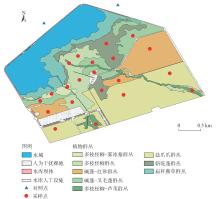
Fig. 1
Sampling sites of the reservoir soils"

Tab. 1
Mean values of soil physicochemical properties in control plant communities"
| 植物群丛 | BD/g·cm-3 | SWC/% | pH | TN/g·kg-1 | TP/g·kg-1 | CEC/cmol·kg-1 | SOC/g·kg-1 |
|---|---|---|---|---|---|---|---|
| CK-1 | 1.41 | 9.54 | 7.98 | 0.31 | 0.77 | 9.82 | 1.92 |
| CK-2 | 1.47 | 15.80 | 8.84 | 0.34 | 0.73 | 11.24 | 2.12 |
Fig. 2
Stratified means of soil physical properties by depth of plant communities in the reservoir area"
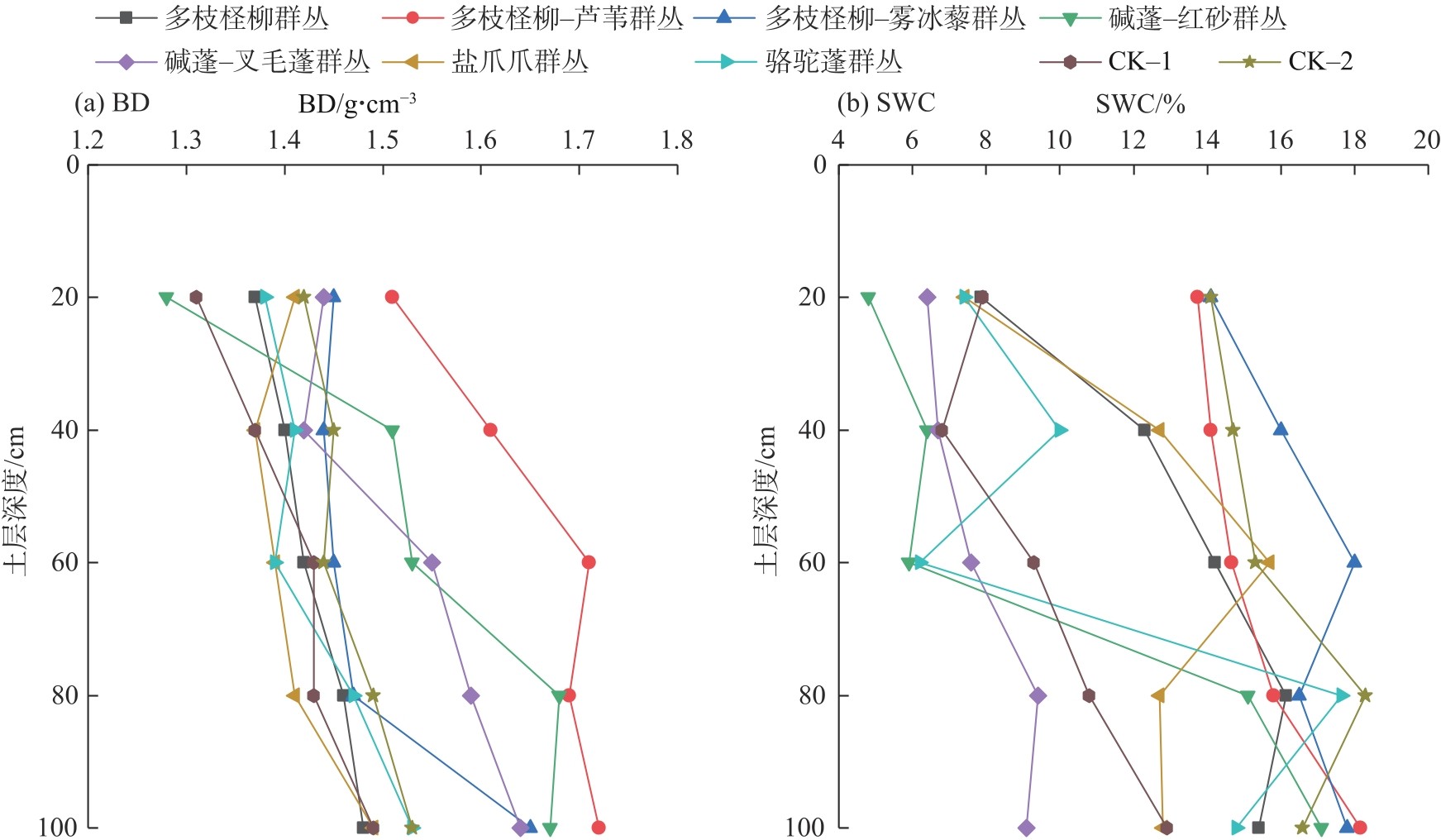
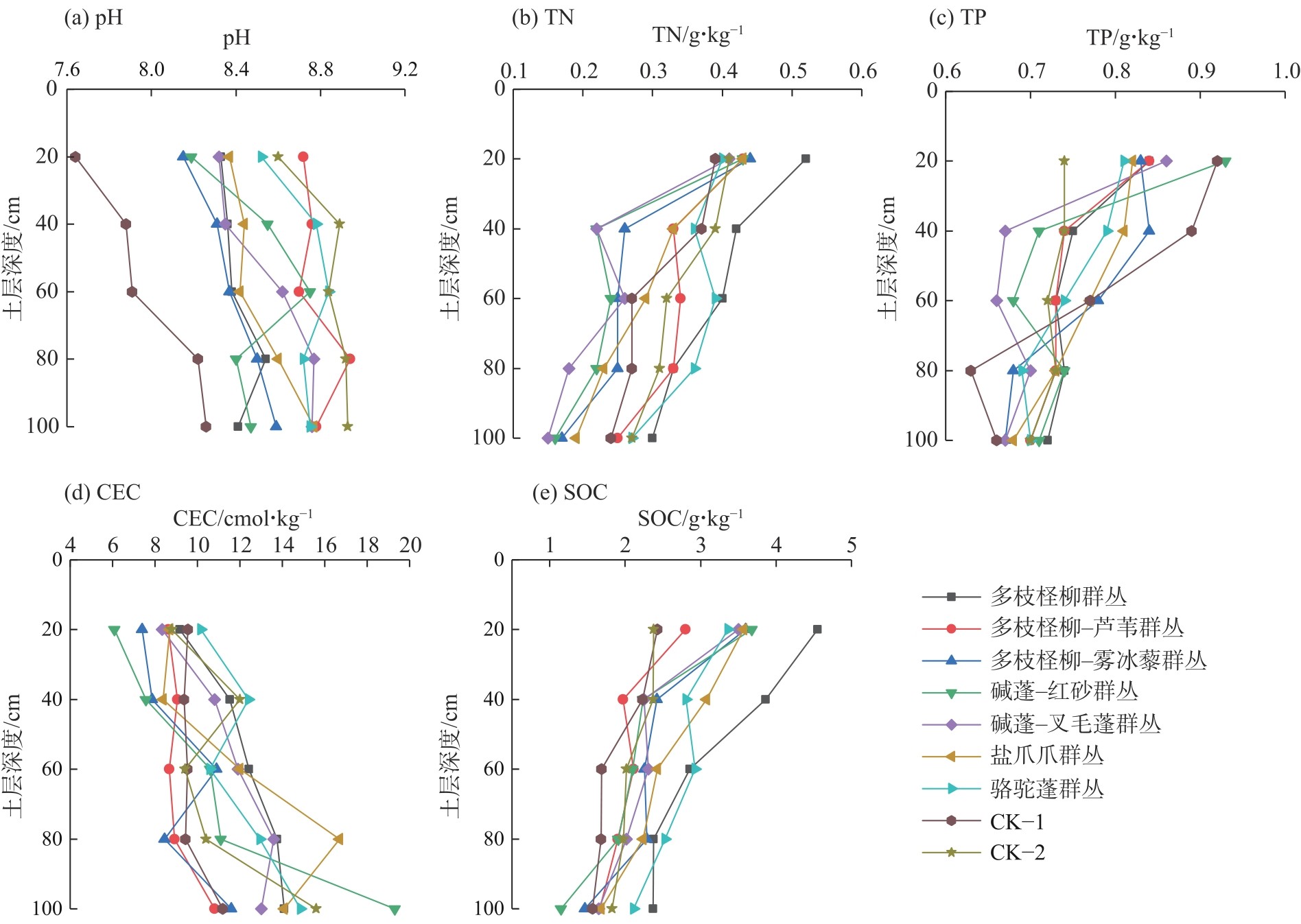
Fig. 3
Stratified means of soil chemical properties by depth of plant communities in the reservoir area"
Tab. 2
Mean stoichiometric ratios and biomass per unit area of plant communities in the reservoir area"
| 植物群丛 | C:N | C:P | N:P | 区域面积/hm2 | 单位面积生物量/t·hm-2 |
|---|---|---|---|---|---|
| 多枝柽柳群丛 | 8.07±0.94bc | 4.20±1.03a | 0.52±0.08a | 54.94 | 28.04b |
| 多枝柽柳-芦苇群丛 | 7.63±0.44b | 2.77±0.37b | 0.45±0.06ab | 14.83 | 39.67a |
| 多枝柽柳-雾冰藜群丛 | 9.07±0.53c | 3.14±0.79b | 0.36±0.10c | 11.07 | 10.92c |
| 碱蓬-红砂群丛 | 8.86±1.14bc | 2.88±0.86b | 0.33±0.09c | 86.61 | 0.97e |
| 碱蓬-叉毛蓬群丛 | 6.45±1.37a | 3.26±0.61b | 0.34±0.10c | 54.57 | 0.59e |
| 盐爪爪群丛 | 8.97±0.74b | 3.37±0.74b | 0.38±0.10bc | 162.76 | 0.12e |
| 骆驼蓬群丛 | 7.76±0.47c | 3.67±0.44b | 0.48±0.06ab | 52.09 | 6.00d |
Tab. 3
Correlation analysis between biomass, stoichiometric ratios and soil physicochemical properties of plant communities in the reservoir area"
| 指标 | 生物量 | C:N | C:P | N:P | BD | SWC | pH | TN | TP | CEC |
|---|---|---|---|---|---|---|---|---|---|---|
| C:N | -0.672** | 1.000 | - | - | - | - | - | - | - | - |
| C:P | 0.020 | 0.040 | 1.000 | - | - | - | - | - | - | - |
| N:P | 0.441** | -0.522** | 0.822** | 1.000 | - | - | - | - | - | - |
| BD | 0.320 | -0.210 | -0.734** | -0.471** | 1.000 | - | - | - | - | - |
| SWC | 0.423* | -0.395* | -0.477** | -0.180 | 0.428* | 1.000 | - | - | - | - |
| pH | 0.210 | -0.240 | -0.461** | -0.190 | 0.535** | 0.092 | 1.000 | - | - | - |
| TN | 0.361* | -0.453** | 0.830** | 0.961** | -0.554** | -0.260 | -0.320 | 1.000 | - | - |
| TP | 0.050 | -0.160 | 0.522** | 0.510** | -0.564** | -0.240 | -0.558** | 0.711** | 1.000 | - |
| CEC | -0.190 | 0.081 | -0.422* | -0.413* | 0.220 | 0.307 | 0.282 | -0.505** | -0.553** | 1.000 |
| SOC | 0.031 | -0.012 | 0.964** | 0.807** | -0.751** | -0.466** | -0.541** | 0.891** | 0.732** | -0.504** |
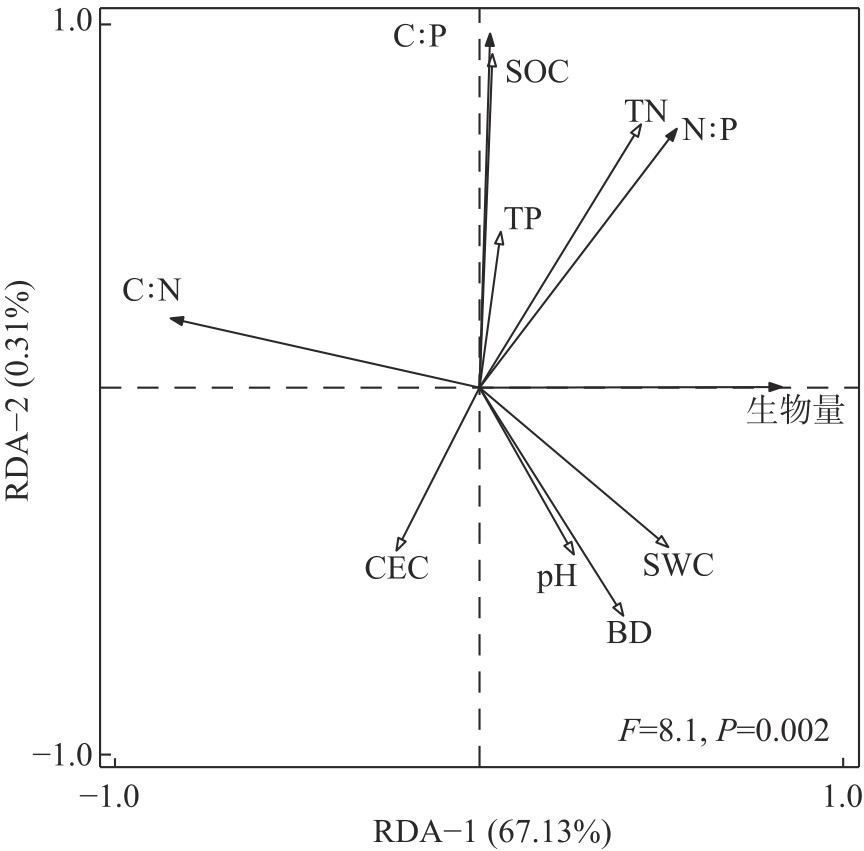
Fig. 4
RDA ranking plot of biomass, stoichiometric ratios and soil physicochemical properties of plant communities"
| [1] | 赵雯, 黄来明. 高寒山区不同土地利用类型土壤养分化学计量特征及影响因素[J]. 生态学报, 2022, 42(11): 4415-4427. |
| [Zhao Wen, Huang Laiming. Stoichiometric characteristics and influencing factors of soil nutrients under different land use types in an alpine mountain region[J]. Acta Ecologica Sinica, 2022, 42(11): 4415-4427.] | |
| [2] |
Wu C Y, Deng L, Huang C B, et al. Effects of vegetation restoration on soil nutrients, plant diversity, and its spatiotemporal heterogeneity in a desert-oasis ecotone[J]. Land Degradation and Development, 2020, 32(2): 670-683.
doi: 10.1002/ldr.v32.2 |
| [3] | 张继辉, 蔡道雄, 卢立华, 等. 不同林龄柚木人工林土壤生态化学计量特征[J]. 生态学报, 2020, 40(16): 5718-5728. |
| [Zhang Jihui, Cai Daoxiong, Lu Lihua, et al. Soil ecological stoichiometry of different aged teak (Tectona grandis) plantations[J]. Acta Ecologica Sinica, 2020, 40(16): 5718-5728.] | |
| [4] | Chen H, Yu Z C, Wu N, et al. “C-wetland”: A new paradigm to enhance conservation of carbon-rich wetlands[J]. The Innovation, 2023, 4(2): 100403, doi: 10.1016/j.xinn.2023.100403. |
| [5] | 郭京衡, 李尝君, 曾凡江, 等. 2种荒漠植物根系生物量分布与土壤水分、养分的关系[J]. 干旱区研究, 2016, 33(1): 166-171. |
| [Guo Jingheng, Li Changjun, Zeng Fanjiang, et al. Relationship between root biomass distribution and soil moisture nutrient for two desert plant species[J]. Arid Zone Research, 2016, 33(1): 166-171.] | |
| [6] | 莫保儒, 王子婷, 蔡国军, 等. 半干旱黄土区成熟柠条林地剖面土壤水分环境及影响因子研究[J]. 干旱区地理, 2014, 37(6): 1207-1215. |
| [Mo Baoru, Wang Ziting, Cai Guojun, et al. Soil water environment in different soil layers and influence factors of mature forest of Caragana korshinskii in semiarid loess area[J]. Arid Land Geography, 2014, 37(6): 1207-1215.] | |
| [7] | 王瑛瑛, 汤萃文, 贺媛真, 等. 甘肃民勤荒漠区植物群落土壤的理化性质和酶活性分析[J]. 植物资源与环境学报, 2024, 33(6): 56-64. |
| [Wang Yingying, Tang Cuiwen, He Yuanzhen, et al. Analyses on soil physicochemical properties and enzyme activities of plant communities in Minqin desert region of Gansu Province[J]. Journal of Plant Resources and Environment, 2024, 33(6): 56-64.] | |
| [8] | 张喜亭, 肖路, 王文杰. 大兴安岭落叶松林物种多样性和空间结构对生物量、土壤养分的影响[J]. 生态学报, 2025, 45(9): 1-8. |
| [Zhang Xiting, Xiao Lu, Wang Wenjie. Effects of species diversity and spatial structure on biomass and soil nutrients in Larix gmelinii, Daxing’anling Mts., NE China[J]. Acta Ecologica Sinica, 2025, 45(9): 1-8.] | |
| [9] | 张军, 安邦. 安徽省潜山市土壤养分地球化学特征及其影响因素[J]. 能源技术与管理, 2022, 47(4): 190-194. |
| [Zhang Jun, An Bang. Geochemical characteristics and influencing factors of soilnutrients in Qianshan City, Anhui Province[J]. Energy Technology and Management, 2022, 47(4): 190-194.] | |
| [10] | 李云霞, 王国栋, 刘瑜, 等. 新疆典型绿洲灌区土壤理化性状与盐分离子分布特征[J]. 农业机械学报, 2024, 55(7): 357-364, 414. |
| [Li Yunxia, Wang Guodong, Liu Yu, et al. Distribution characteristics of soil physicochemical properties and salt ions in typical oasis irrigation areas of Xinjiang[J]. Transactions of the Chinese Society for Agricultural Machinery, 2024, 55(7): 357-364, 414.] | |
| [11] |
唐光木, 张云舒, 徐万里, 等. 长期耕作对新疆绿洲农田土壤颗粒中有机碳和全氮含量的影响[J]. 中国农业科学, 2020, 53(24): 5039-5050.
doi: 10.3864/j.issn.0578-1752.2020.24.007 |
|
[Tang Guangmu, Zhang Yunshu, Xu Wanli, et al. Effects of long-term cultivation on contents of organic carbon and total nitrogen in soil particulate fraction in oasis farmland of Xinjiang[J]. Scientia Agricultura Sinica, 2020, 53(24): 5039-5050.]
doi: 10.3864/j.issn.0578-1752.2020.24.007 |
|
| [12] | 郑琦, 王海江, 董天宇, 等. 基于不同评价方法的绿洲棉田土壤质量综合评价[J]. 灌溉排水学报, 2019, 38(3): 90-98. |
| [Zheng Qi, Wang Haijiang, Dong Tianyu, et al. Evaluating soil quality of the cotton fields in oasis of Xinjiang using different methods[J]. Journal of lrrigation and Drainage, 2019, 38(3): 90-98.] | |
| [13] | 刘子金, 徐存东, 朱兴林, 等. 干旱荒漠区人工绿洲土壤盐碱化风险综合评估与演变分析[J]. 中国环境科学, 2022, 42(1): 367-379. |
| [Liu Zijin, Xu Cundong, Zhu Xinglin, et al. Comprehensive assessment and evolution analysis of soil salinization in artificial oasis in arid desert area[J]. China Environmental Science, 2022, 42(1): 367-379.] | |
| [14] | 李浩, 何静, 王理德, 等. 祁连山东段高寒草地修复过程中植被物种多样性及土壤理化性质[J]. 水土保持研究, 2025, 32(1): 110-120. |
| [Li Hao, He Jing, Wang Lide, et al. Vegetation species diversity and soil physicochemical properties during restoration of alpine grassland in eastern Qilian Mountains[J]. Research of Soil and Water Conservation, 2025, 32(1): 110-120.] | |
| [15] | 廖广寿, 李建升, 李就鹏, 等. 桂西北土壤理化性质对桉树人工林生长的影响[J]. 西部林业科学, 2024, 53(5): 64-70, 79. |
| [Liao Guangshou, Li Jiansheng, Li Jiupeng, et al. Effects of soil physical and chemical properties on growth of eucalyptus plantation in northwest Guangxi[J]. Journal of West China Forestry Science, 2024, 53(5): 64-70, 79.] | |
| [16] | 张玉芳, 李希来, 金立群, 等. 基于高寒矿区颗粒有机肥和羊板粪配施的无客土重构土壤理化性质分析[J]. 中国土壤与肥料, 2023(7): 129-137. |
| [Zhang Yufang, Li Xilai, Jin Liqun, et al. Analysis of soil physicochemical properties based on combined application of granular organic fertilizer and sheep board manure in alpine mining areas[J]. Soil and Fertilizer Sciences in China, 2023(7): 129-137.] | |
| [17] | Li J, Yang Y Q. How do plants maintain pH and ion homeostasis under saline-alkali stress?[J]. Frontiers in Plant Science, 2023, 14: 1217193, doi: 10.3389/fpls.2023.1217193. |
| [18] | 朱湾湾, 王攀, 许艺馨, 等. 降水量变化与氮添加下荒漠草原土壤酶活性及其影响因素[J]. 植物生态学报, 2021, 45(3): 309-320. |
|
[Zhu Wanwan, Wang Pan, Xu Yixin, et al. Soil enzyme activities and their influencing factors in a desert steppe of northwestern China under changing precipitation regimes and nitrogen addition[J]. Chinese Journal of Plant Ecology, 2021, 45(3): 309-320.]
doi: 10.17521/cjpe.2020.0264 |
|
| [19] | 赵茜宇, 于会彬, 杨芳, 等. 半干旱区湖泊湿地土壤养分与盐碱化特征研究: 以岱海为例[J]. 环境工程技术学报, 2023, 13(1): 188-196. |
| [Zhao Qianyu, Yu Huibin, Yang Fang, et al. Study on the characteristics of soil nutrients and salinization of lake wetlands in semi-arid region: Taking Daihai Lake as an example[J]. Journal of Environmental Engineering Technology, 2023, 13(1): 188-196.] | |
| [20] |
Chen X L, Chen H Y H, Chen C, et al. Effects of plant diversity on soil carbon in diverse ecosystems: A global meta-analysis[J]. Biological Reviews of the Cambridge Philosophical Society, 2019, 95(1): 167-183.
doi: 10.1111/brv.v95.1 |
| [21] |
张嘉睿, 段晓洋, 兰天翔, 等. 植物多样性对土壤有机碳及其稳定性影响的研究进展[J]. 植物生态学报, 2024, 48(11): 1393-1405.
doi: 10.17521/cjpe.2023.0370 |
|
[Zhang Jiarui, Duan Xiaoyang, Lan Tianxiang, et al. Advances in the role of plant diversity in soil organic carbon content and stability[J]. Chinese Journal of Plant Ecology, 2024, 48(11): 1393-1405.]
doi: 10.17521/cjpe.2023.0370 |
|
| [22] | 王铜林, 柴春山, 莫保儒, 等. 半干旱黄土丘陵区典型植被土壤养分含量及其分布特征[J]. 甘肃林业科技, 2024, 49(3): 67-72, 78. |
| [Wang Tonglin, Chai Chunshan, Mo Baoru, et al. Content and distribution characteristics of soil nutrients under typical vegetations in semiarid hilly loess area[J]. Journal of Gansu Forestry Science and Technology, 2024, 49(3): 67-72, 78.] | |
| [23] | 刘兴诏, 周国逸, 张德强, 等. 南亚热带森林不同演替阶段植物与土壤中N、P的化学计量特征[J]. 植物生态学报, 2010, 34(1): 64-71. |
| [Liu Xingzhao, Zhou Guoyi, Zhang Deqiang, et al. N and P stoichiometry of plant and soil in lower subtropical forest successional series in southern China[J]. Chinese Journal of Plant Ecology, 2010, 34(1): 64-71.] | |
| [24] | 尹逊霄, 华珞, 张振贤, 等. 土壤中磷素的有效性及其循环转化机制研究[J]. 首都师范大学学报(自然科学版), 2005(3): 95-101. |
| [Yin Xunxiao, Hua Luo, Zhang Zhenxian, et al. Study on the effectiveness of phosphorus and mechanism of its circle in soil[J]. Journal of Capital Normal University (Natural Science Edition), 2005(3): 95-101.] | |
| [25] | 聂玲玲, 冯娟娟, 吕素莲, 等. 真盐生植物盐角草对不同氮形态的响应[J]. 生态学报, 2012, 32(18): 5703-5712. |
|
[Nie Lingling, Feng Juanjuan, Lü Sulian, et al. The response of euhalophyte Salicornia europaea L. to different nitrogen forms[J]. Acta Ecologica Sinica, 2012, 32(18): 5703-5712.]
doi: 10.5846/stxb |
|
| [26] | Salar F, Kazem G. Improving electrochemical characteristics of plant roots by biochar is an efficient mechanism in increasing cations uptake by plants[J]. Chemosphere, 2022, 313: 137365, doi: 10.1016/j.chemosphere.2022.137365. |
| [27] | Ma D K, He Z B, Zhao W Z, et al. Long-term effects of conventional cultivation on soil cation exchange capacity and base saturation in an arid desert region[J]. Science of the Total Environment, 2024, 949: 175075, doi: 10.1016/j.scitotenv.2024.175075. |
| [28] | Chen M Y, Yang X, Shao M A, et al. Changes in soil C-N-P stoichiometry after 20 years of typical artificial vegetation restoration in semiarid continental climate zones[J]. Science of the Total Environment, 2022, 852: 158380, doi: 10.1016/j.scitotenv.2022.158380. |
| [29] |
Tian H Q, Chen G S, Zhang C, et al. Pattern and variation of C:N:P ratios in China’s soils: A synthesis of observational data[J]. Biogeochemistry, 2010, 98(1-3): 139-151.
doi: 10.1007/s10533-009-9382-0 |
| [30] |
Deng J J, Yin Y, Zhu W X, et al. Variations in soil bacterial community diversity and structures among different revegetation types in the Baishilazi Nature Reserve[J]. Frontiers in Microbiology, 2018, 9: 2874, doi: 10.3389/fmicb.2018.02874.
pmid: 30538689 |
| [31] | 张清, 陆素娟, 李品荣, 等. 半干旱石漠化地区直干桉生物量及含水率特征分析[J]. 西部林业科学, 2019, 48(4): 126-131. |
| [Zhang Qing, Lu Sujuan, Li Pinrong, et al. Biomass of Eucalyptus maidenii in semi-arid rocky desertification area[J]. Journal of West China Forestry Science, 2019, 48(4): 126-131.] | |
| [32] |
Liu Z F, Fu B J, Zheng X X, et al. Plant biomass, soil water content and soil N:P ratio regulating soil microbial functional diversity in a temperate steppe: A regional scale study[J]. Soil Biology and Biochemistry, 2009, 42(3): 445-450.
doi: 10.1016/j.soilbio.2009.11.027 |
| [33] |
甘淼, 贾玉华, 李同川, 等. 黄土区坡沟系统容重、饱和导水率和土壤含水量变化分析[J]. 干旱区研究, 2018, 35(2): 315-324.
doi: 10.13866/j.azr.2018.02.08 |
|
[Gan Miao, Jia Yuhua, Li Tongchuan, et al. Variation of soil bulk density, saturated hydraulic conductivity and soil moisture content in a slope-gully unit on the northern loess plateau[J]. Arid Zone Research, 2018, 35(2): 315-324.]
doi: 10.13866/j.azr.2018.02.08 |
|
| [34] |
高彩欣, 孙从建, 陈伟, 等. 生态恢复背景下黄土高原东部地区典型植物用水策略[J]. 地理研究, 2024, 43(8): 1958-1976.
doi: 10.11821/dlyj020240149 |
| [Gao Caixin, Sun Congjian, Chen Wei, et al. Typical plant water use strategies in the eastern part of the Loess Plateau under the background of ecological restoration[J]. Geographical Research, 2024, 43(8): 1958-1976.] |
|
||

