Arid Land Geography ›› 2026, Vol. 49 ›› Issue (9): 1855-1865.doi: 10.12118/j.issn.1000-6060.2025.615
• Ecology and Environment • Previous Articles Next Articles
YANG Zhihao1( ), WANG Jun2, TAN Qilin3, ZHAO Lijun3, HONG Xing1, LIU Xiaoni1, SHI Yafei1()
Received:2025-08-21
Revised:2025-11-20
Online:2026-09-25
Published:2026-09-07
Contact:
SHI Yafei
E-mail:yzh2364400957@163.com;shiyf@gsau.edu.cn
YANG Zhihao, WANG Jun, TAN Qilin, ZHAO Lijun, HONG Xing, LIU Xiaoni, SHI Yafei. Research progress on the impact of wind and solar power station construction on the ecological environment based on bibliometrics[J].Arid Land Geography, 2026, 49(9): 1855-1865.
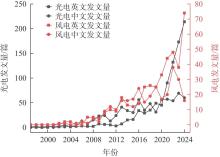
Fig. 1
Distribution of publication output in wind and solar power eco-environmental research"
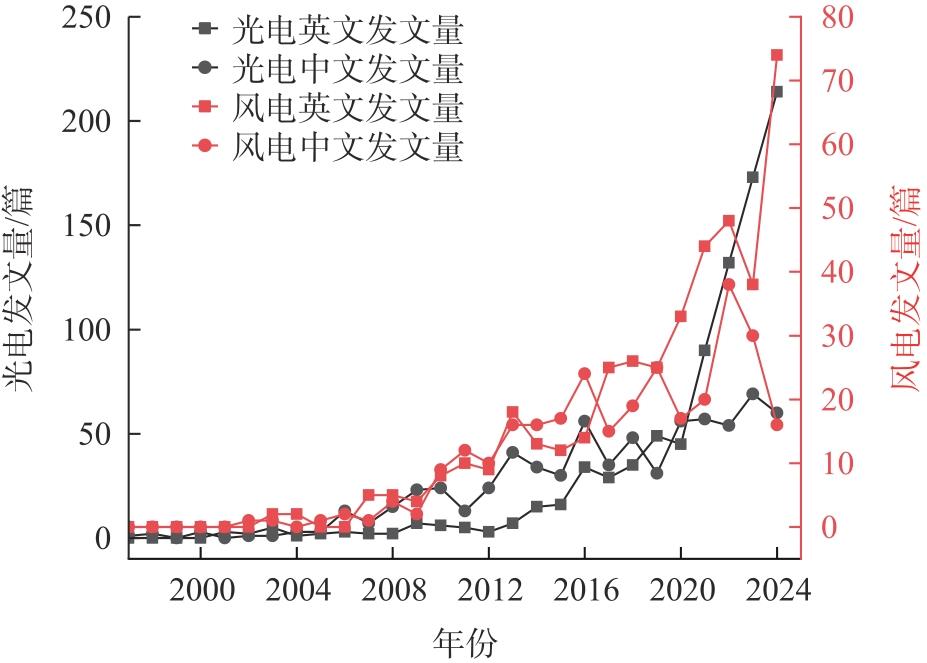
Tab. 1
Top five authors by publication output in wind and solar power eco-environmental research"
| 研究方向 | 中文文献 | 英文文献 | |||||
|---|---|---|---|---|---|---|---|
| 排名 | 作者 | 发文量/篇 | 排名 | 作者 | 发文量/篇 | ||
| 风能电站对 生态的影响 | 1 | 张韬 | 6 | 1 | May R | ||
| 2 | 曹阳 | 4 | 2 | Bouten W | |||
| 3 | 桂思睿 | 4 | 3 | Cook Aonghais S C P | |||
| 4 | 韩震 | 3 | 4 | Smallwood K S | |||
| 5 | 吴重仲 | 3 | 5 | Garthe S | |||
| 光能电站对 生态的影响 | 1 | 蒙仲举 | 11 | 1 | Armstrong A | ||
| 2 | 党晓宏 | 8 | 2 | Gao X Q | |||
| 3 | 隋欣 | 7 | 3 | Higgins C W | |||
| 4 | 常兆丰 | 6 | 4 | Bauerle A | |||
| 5 | 刘世增 | 6 | 5 | Hernandez R R | |||
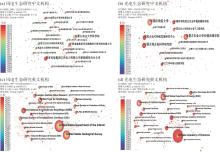
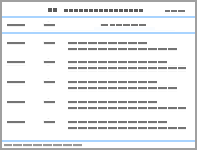
Fig. 2
Institutional collaboration network maps for wind and solar power eco-environmental research"
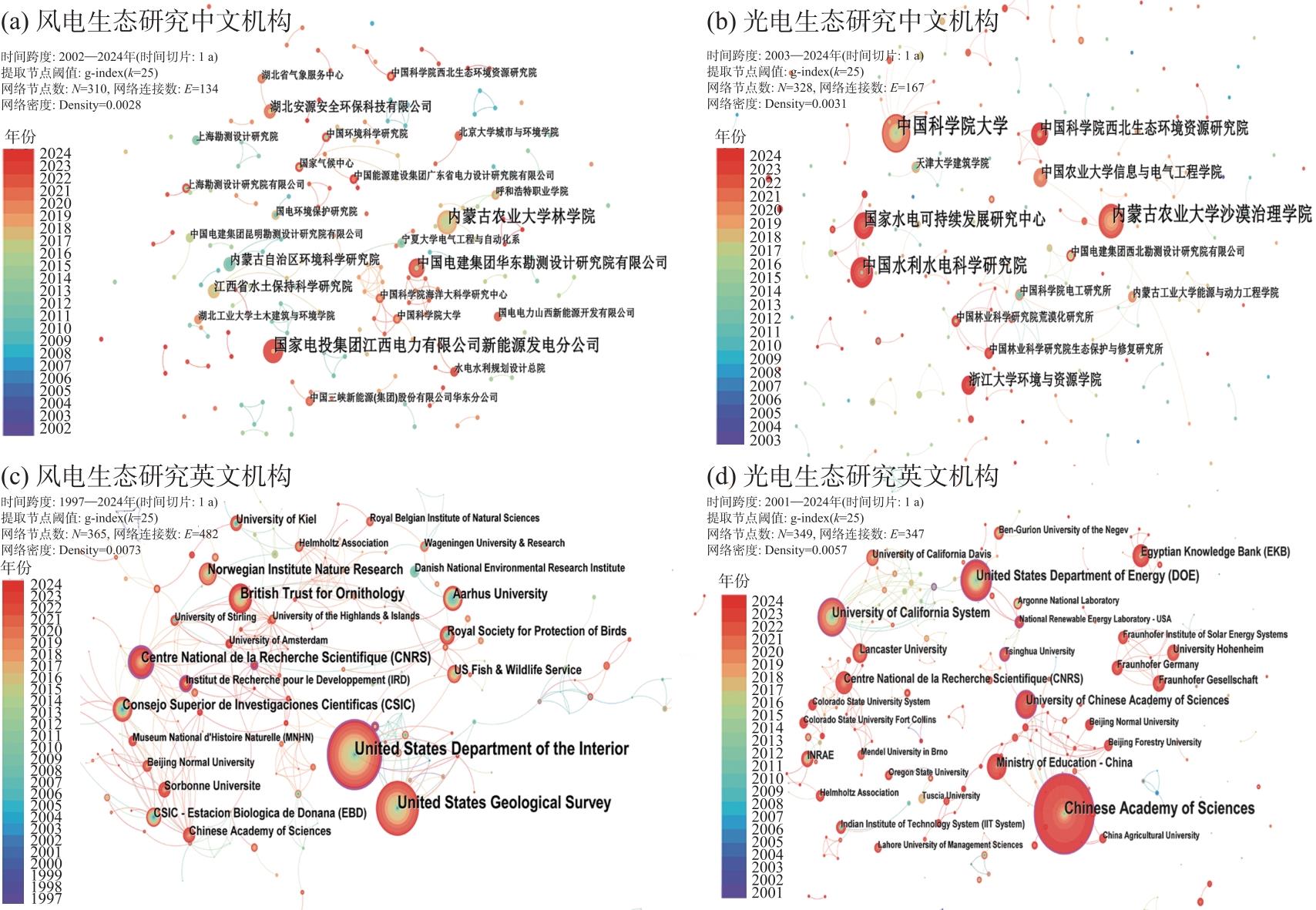
Fig. 3
Country-level collaboration network maps for wind and solar power eco-environmental research"
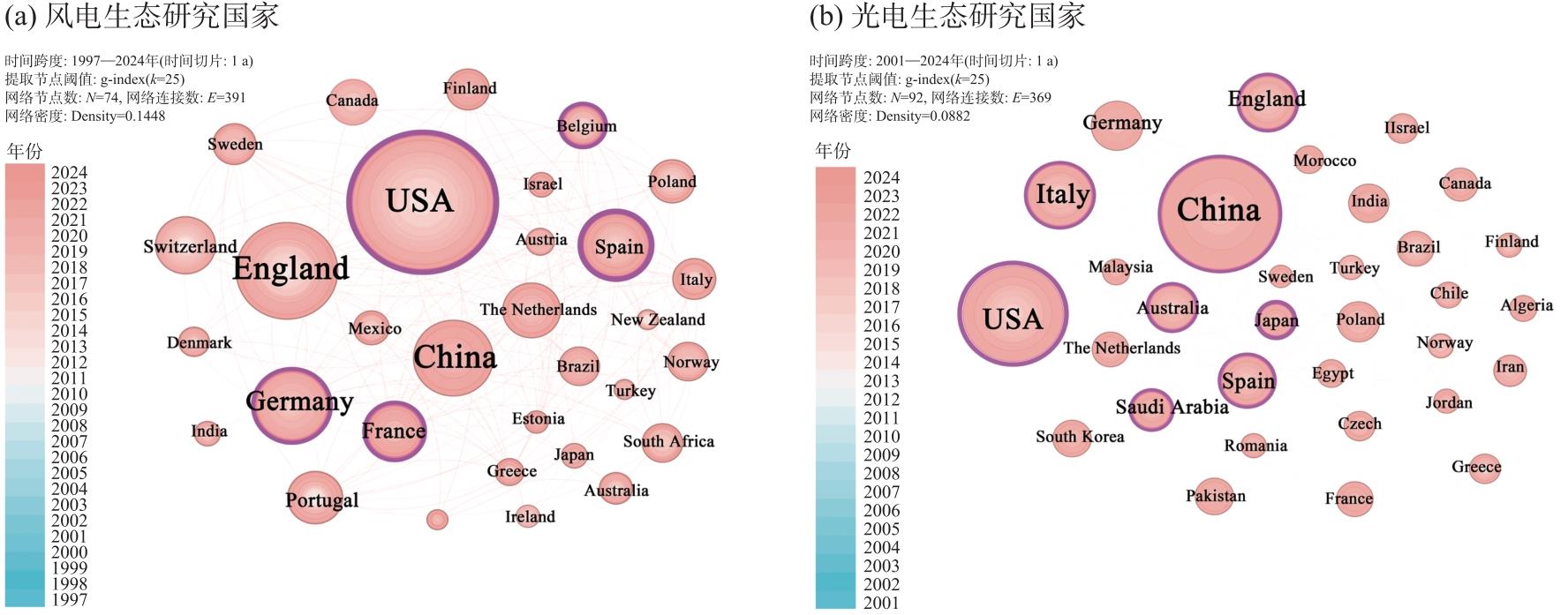
Tab. 2
Top five countries by publication output in wind- and solar-power eco-environmental research"
| 研究方向 | 排名 | 国家/地区 | 发文量/篇 | 中介中心性 |
|---|---|---|---|---|
| 风能电站对生态的影响 | 1 | USA | 197 | 0.35 |
| 2 | England | 171 | 0.07 | |
| 3 | Germany | 66 | 0.16 | |
| 4 | China | 60 | 0.02 | |
| 5 | Spain | 57 | 0.24 | |
| 光能电站对生态的影响 | 1 | China | 190 | 0.17 |
| 2 | USA | 151 | 0.44 | |
| 3 | Italy | 66 | 0.13 | |
| 4 | England | 52 | 0.17 | |
| 5 | Spain | 52 | 0.16 |
Tab. 3
Top five keywords in wind and solar power eco-environmental research"
| 研究方向 | 排名 | 中文关键词 | 频次 | 排名 | 英文关键词 | 频次 |
|---|---|---|---|---|---|---|
| 风能电站对 生态的影响 | 1 | 风电场 | 70 | 1 | farms | 188 |
| 2 | 风力发电 | 32 | 2 | impacts | 165 | |
| 3 | 环境影响 | 29 | 3 | wind energy | 143 | |
| 4 | 海上发电 | 26 | 4 | mortality | 137 | |
| 5 | 生态环境 | 23 | 5 | conservation | 86 | |
| 光能电站对 生态的影响 | 1 | 光伏电站 | 53 | 1 | renewable energy | 157 |
| 2 | 碳中和 | 21 | 2 | land use | 98 | |
| 3 | 光伏发电 | 17 | 3 | climate change | 63 | |
| 4 | 太阳能 | 17 | 4 | temperature | 58 | |
| 5 | 光伏产业 | 13 | 5 | environmental impacts | 51 |
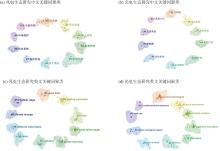
Fig. 4
Keyword clustering maps for wind and solar power eco-environmental research"
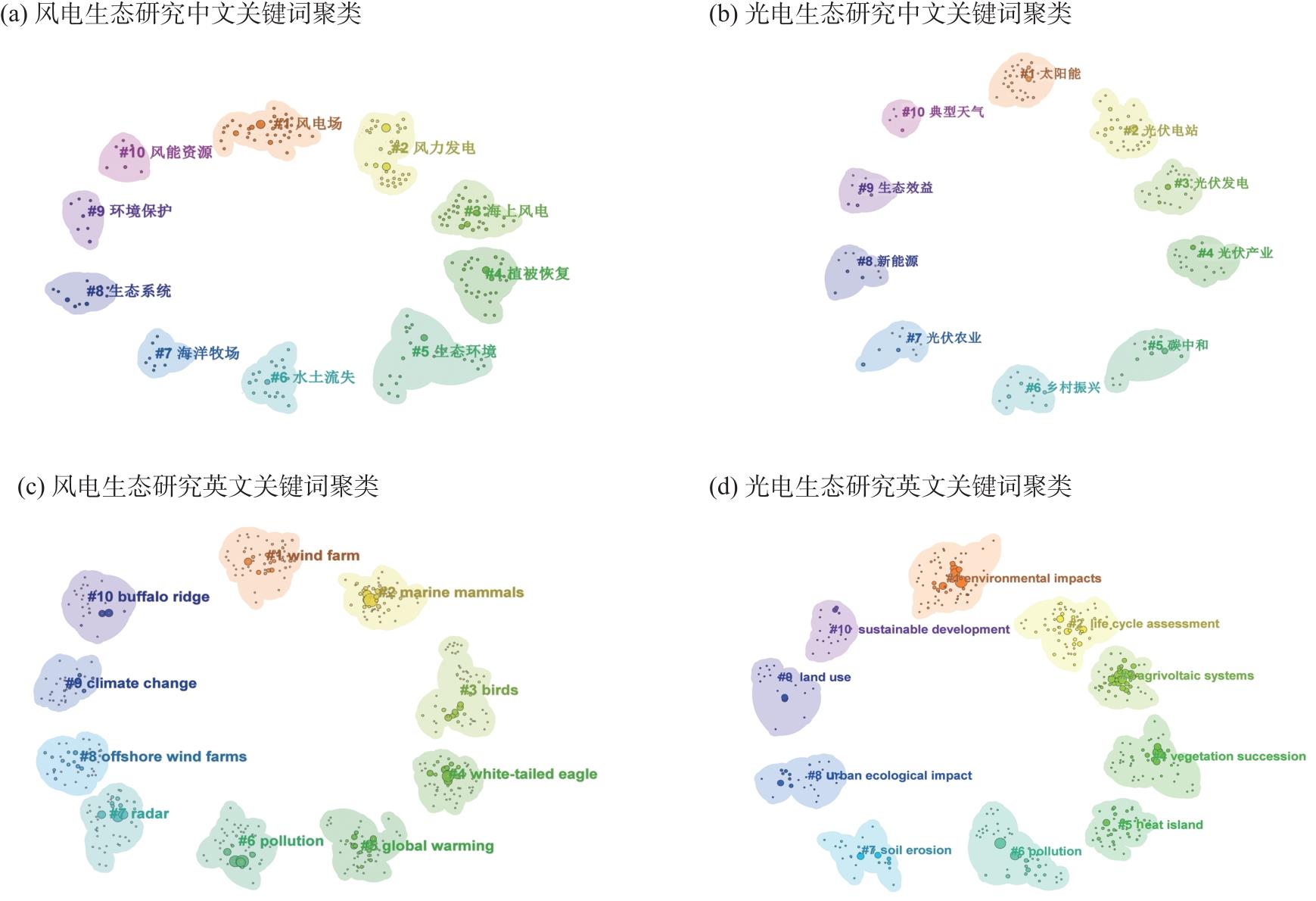
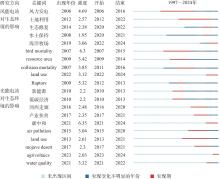
Fig. 5
Burst-term map of the top five burst keywords in wind and solar power eco-environmental research"

| [1] | International Renewable Energy Agency (IRENA). Renewable power generation costs in 2023[R]. Abu Dhabi: IRENA, 2024. |
| [2] |
郑隽卿, 罗勇, 常蕊, 等. 大规模光伏开发对局地气候生态影响研究[J]. 太阳能学报, 2023, 44(8): 253-265.
doi: 10.19912/j.0254-0096.tynxb.2022-0530 |
|
[Zheng Junqing, Luo Yong, Chang Rui, et al. Study on impact of large-scaled photovoltaic development on local climate and ecosystem[J]. Acta Energiae Solaris Sinica, 2023, 44(8): 253-265.]
doi: 10.19912/j.0254-0096.tynxb.2022-0530 |
|
| [3] | 邓鸣阳, 裴浩, 徐丽娜, 等. 风电场和光伏电站对局地气候的影响研究进展[J]. 南方能源建设, 2025, 12(2): 15-25. |
| [Deng Mingyang, Pei Hao, Xu Lina, et al. Research progress on the impact of wind farms and photovoltaic power plants on local climate[J]. Southern Energy Construction, 2025, 12(2): 15-25.] | |
| [4] |
Liu L Y, Liu P T, Yu J W, et al. Wind farms increase land surface temperature and reduce vegetation productivity in the Inner Mongolia[J]. Geography and Sustainability, 2024, 5(3): 319-328.
doi: 10.1016/j.geosus.2024.01.007 |
| [5] | Meng L N, Liu P F, Zhou Y G, et al. Blaming the wind? The impact of wind turbine on bird biodiversity[J]. Journal of Development Economics, 2025, 172: 103402, doi: 10.1016/j.jdeveco.2024.103402. |
| [6] |
贾馨, 李国庆, 王刚, 等. 风电场对草地土壤湿度的影响[J]. 干旱区地理, 2021, 44(4): 1125-1134.
doi: 10.12118/j.issn.1000–6060.2021.04.24 |
|
[Jia Xin, Li Guoqing, Wang Gang, et al. Effects of wind farms on soil moisture in grassland[J]. Arid Land Geography, 2021, 44(4): 1125-1134.]
doi: 10.12118/j.issn.1000–6060.2021.04.24 |
|
| [7] | Su N, Li X B, Lü X, et al. Comprehensive assessment of the climatic and vegetation impacts of wind farms on grasslands: A case study in inner Mongolia, China[J]. Journal of Environmental Management, 2024, 370: 122430, doi: 10.1016/j.jenvman.2024.122430. |
| [8] | Li L, Ma W J, Duan X Y, et al. Effects of wind farm construction on soil nutrients and vegetation: A case study of Linxiang wind farm in Hunan Province[J]. Sustainability, 2024, 16(15): 6350, doi: 10.3390/su16156350. |
| [9] |
Graff B J, Jenks J A, Stafford J D, et al. Assessing spring direct mortality to avifauna from wind energy facilities in the Dakotas[J]. The Journal of Wildlife Management, 2016, 80(4): 736-745.
doi: 10.1002/jwmg.v80.4 |
| [10] |
Grodsky S M, Hernandez R R. Reduced ecosystem services of desert plants from ground-mounted solar energy development[J]. Nature Sustainability, 2020, 3(12): 1036-1043.
doi: 10.1038/s41893-020-0574-x |
| [11] | 彭昀月, 罗永梅, 徐泽楠, 等. 集中式大型光伏及风电电场生态影响: 进展与展望[J]. 生物多样性, 2024, 32(2): 102-117. |
| [Peng Yunyue, Luo Yongmei, Xu Zenan, et al. Ecological impacts of centralized large-scale photovoltaics and wind farms: Progress and prospects[J]. Biodiversity Science, 2024, 32(2): 102-117.] | |
| [12] | 李森, 赵京东, 李泽东, 等. 沙漠、戈壁和荒漠地区光伏系统生态影响研究进展[J]. 环境工程技术学报, 2025, 15(2): 709-716. |
| [Li Sen, Zhao Jingdong, Li Zedong, et al. Research progress on ecological impacts of photovoltaic systems in deserts, gobi and desertification lands[J]. Journal of Environmental Engineering Technology, 2025, 15(2): 709-716.] | |
| [13] |
Mongeon P, Paul-Hus A. The journal coverage of Web of Science and Scopus: A comparative analysis[J]. Scientometrics, 2016, 106(1): 213-228.
doi: 10.1007/s11192-015-1765-5 |
| [14] |
Egghe L. Theory and practise of the g-index[J]. Scientometrics, 2006, 69(1): 131-152.
doi: 10.1007/s11192-006-0144-7 |
| [15] |
王希, 李微, 朱涛, 等. 基于文献计量的艾比湖区域遥感研究进展与热点分析[J]. 干旱区地理, 2025, 48(4): 689-703.
doi: 10.12118/j.issn.1000-6060.2024.378 |
|
[Wang Xi, Li Wei, Zhu Tao, et al. Progress and hotspot analysis of remote sensing research in the Ebinur Lake area based on bibliometrics[J]. Arid Land Geography, 2025, 48(4): 689-703.]
doi: 10.12118/j.issn.1000-6060.2024.378 |
|
| [16] |
Leydesdorff L. On the normalization and visualization of author co-citation data: Salton’s Cosine versus the Jaccard index[J]. Journal of the American Society for Information Science and Technology, 2008, 59(1): 77-85.
doi: 10.1002/asi.v59:1 |
| [17] | Long R, Cui W, Li Q. The evolution and effect evaluation of photovoltaic industry policy in China[J]. Sustainability, 2017, 9(12): 2147, doi: 10.3390/su9122147. |
| [18] | Green R E, Gill E, Hein C, et al. International assessment of priority environmental issues for land-based and offshore wind energy development[J]. Global Sustainability, 2022, 5: e17, doi: 10.1017/sus.2022.17. |
| [19] | 张力琛, 范立张, 马常威, 等. 山地风电场建设对土壤性质和植被覆盖的影响——以云南省将军山风电场为例[J]. 生态学杂志, 2022, 41(12): 2397-2405. |
| [Zhang Lichen, Fan Lizhang, Ma Changwei, et al. Influence of mountain wind farm construction on soil properties and vegetation cover: A case study of Jiangjunshan wind farm in Yunnan Province[J]. Chinese Journal of Ecology, 2022, 41(12): 2397-2405.] | |
| [20] | 陈悦, 陈超美, 刘则渊, 等. CiteSpace知识图谱的方法论功能[J]. 科学学研究, 2015, 33(2): 242-253. |
| [Chen Yue, Chen Chaomei, Liu Zeyuan, et al. The methodology function of CiteSpace mapping knowledge domains[J]. Studies in Science of Science, 2015, 33(2): 242-253.] | |
| [21] |
Newman M E J. Modularity and community structure in networks[J]. Proceedings of the National Academy of Sciences, 2006, 103(23): 8577-8582.
doi: 10.1073/pnas.0601602103 |
| [22] | Peng Y Y, Luo Y M, Xue Z A, et al. Ecological impacts of centralized large-scale photovoltaics and wind farms: Progress and prospects[J]. Biodiversity Science, 2024, 32(2): 232-241. |
| [23] |
Drewitt A L, Langston R H W. Assessing the impacts of wind farms on birds[J]. Ibis, 2006, 148(Suppl. 1): 29-42.
doi: 10.1111/ibi.2006.148.issue-s1 |
| [24] |
Smallwood K S, Thelander C. Bird mortality in the Altamont pass wind resource area, California[J]. The Journal of Wildlife Management, 2008, 72(1): 215-223.
doi: 10.2193/2007-032 |
| [25] |
Lovich J E, Ennen J R. Wildlife conservation and solar energy development in the desert southwest, United States[J]. BioScience, 2011, 61(12): 982-992.
doi: 10.1525/bio.2011.61.12.8 |
| [26] |
Turney D, Fthenakis V. Environmental impacts from the installation and operation of large-scale solar power plants[J]. Renewable and Sustainable Energy Reviews, 2011, 15(6): 3261-3270.
doi: 10.1016/j.rser.2011.04.023 |
| [27] | 国务院办公厅. 国务院办公厅转发国家发展改革委国家能源局关于促进新时代新能源高质量发展实施方案的通知[EB/OL]. [2022-05-30]. https://www.gov.cn/zhengce/zhengceku/2022-05/30/content_5693013.htm. |
| [General Office of the State Council. Notice of the General Office of the State Council forwarding the implementation plan for promoting the high-quality development of new energy in the new era by the National Development and Reform Commission and the National Energy Administration[EB/OL]. [2022-05-30]. https://www.gov.cn/zhengce/zhengceku/2022-05/30/content_5693013.htm.] | |
| [28] | 中共中央、 国务院. 国家创新驱动发展战略纲要[EB/OL]. [2016-05-19]. https://www.gov.cn/zhengce/2016-05/19/content_5074812.htm. |
| [The Communist Party of China Central Committee and the State Council. National strategic outline for innovation-driven development[EB/OL]. [2016-05-19]. https://www.gov.cn/zhengce/2016-05/19/content_5074812.htm.] | |
| [29] | 中共中央、国务院. 中共中央、国务院关于加快推进生态文明建设的意见[EB/OL]. [2015-04-25]. https://www.gov.cn/zhengce/2015-04/25/content_2850619.htm. |
| [The Communist Party of China Central Committee and the State Council. Opinions of the Communist Party of China Central Committee and the State Council on accelerating the advancement of ecological civilization construction [EB/OL]. [2015-04-25]. https://www.gov.cn/zhengce/2015-04/25/content_2850619.htm.] | |
| [30] |
Davidsson S, Höök M, Wall G. A review of life cycle assessments on wind energy systems[J]. The International Journal of Life Cycle Assessment, 2012, 17(6): 729-742.
doi: 10.1007/s11367-012-0397-8 |
| [31] |
Hernandez R R, Easter S B, Murphy-Mariscal M L, et al. Environmental impacts of utility-scale solar energy[J]. Renewable and Sustainable Energy Reviews, 2014, 29: 766-779.
doi: 10.1016/j.rser.2013.08.041 |
| [32] | Katzner T E, Bennett V J, Miller T A, et al. Wind energy development: Methods for assessing risks to birds and bats pre-construction[J]. Human-Wildlife Interactions, 2016, 10(1): 42-52. |
| [33] | 田政卿, 张勇, 刘向, 等. 光伏电站建设对陆地生态环境的影响: 研究进展与展望[J]. 环境科学, 2024, 45(1): 239-247. |
| [Tian Zhengqing, Zhang Yong, Liu Xiang, et al. Effects of photovoltaic power station construction on terrestrial environment: Retrospect and prospect[J]. Environmental Science, 2024, 45(1): 239-247.] | |
| [34] |
Bouten W, Baaij E W, Shamoun-Baranes J, et al. A flexible GPS tracking system for studying bird behaviour at multiple scales[J]. Journal of Ornithology, 2013, 154(2): 571-580.
doi: 10.1007/s10336-012-0908-1 |
| [35] |
Sakata I, Sasaki H. Bibliometric analysis of international collaboration in wind and solar energy[J]. Journal of Sustainable Development of Energy, Water and Environment Systems, 2013, 1(3): 187-198.
doi: 10.13044/j.sdewes.2013.01.0014 |
| [36] |
Bezuidenhout L, Leonelli S, Kelly A H, et al. Beyond the digital divide: Towards a situated approach to open data[J]. Science and Public Policy, 2017, 44(4): 464-475.
doi: 10.1093/scipol/scw036 |
| [37] |
Miller L M, Gans F, Kleidon A. Estimating maximum global land surface wind power extractability and associated climatic consequences[J]. Earth System Dynamics, 2011, 2(1): 1-12.
doi: 10.5194/esd-2-1-2011 |
| [38] |
Chang R, Shen Y, Luo Y, et al. Observed surface radiation and temperature impacts from the large-scale deployment of photovoltaics in the barren area of Gonghe, China[J]. Renewable Energy, 2018, 118: 131-137.
doi: 10.1016/j.renene.2017.11.007 |
| [39] |
Gasparatos A, Doll C N H, Esteban M, et al. Renewable energy and biodiversity: Implications for transitioning to a green economy[J]. Renewable and Sustainable Energy Reviews, 2017, 70: 161-184.
doi: 10.1016/j.rser.2016.08.030 |
| [40] |
Capellán-Pérez I, de Castro C, Arto I. Assessing vulnerabilities and limits in the transition to renewable energies: Land requirements under 100% solar energy scenarios[J]. Renewable and Sustainable Energy Reviews, 2017, 77: 760-782.
doi: 10.1016/j.rser.2017.03.137 |
| [41] |
Rehbein J A, Watson J E M, Lane J L, et al. Renewable energy development threatens globally important biodiversity areas[J]. Global Change Biology, 2020, 26(5): 3040-3051.
doi: 10.1111/gcb.15067 pmid: 32133726 |
| [42] |
Scheffer M, Bascompte J, Brock W A, et al. Early-warning signals for critical transitions[J]. Nature, 2009, 461(7260): 53-59.
doi: 10.1038/nature08227 |
|
||