Arid Land Geography ›› 2026, Vol. 49 ›› Issue (4): 683-696.doi: 10.12118/j.issn.1000-6060.2025.520
• New Quality Productive Forces Driving High-Quality Development of Tourism • Previous Articles Next Articles
WANG Weijun1( ), LI Juan1(), LI Hua2
Received:2025-08-29
Revised:2025-09-12
Online:2026-04-25
Published:2026-04-28
Contact:
LI Juan
E-mail:wjwang@nwnu.edu.cn;lijuanl021@163.com
WANG Weijun, LI Juan, LI Hua. Multi-scale spatiotemporal evolution and differentiation mechanisms of tourism-ecology-well-being coupling coordination in the Yellow River Basin[J].Arid Land Geography, 2026, 49(4): 683-696.
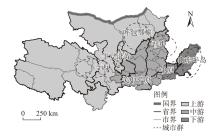
Fig. 1
Schematic diagram of the study area"
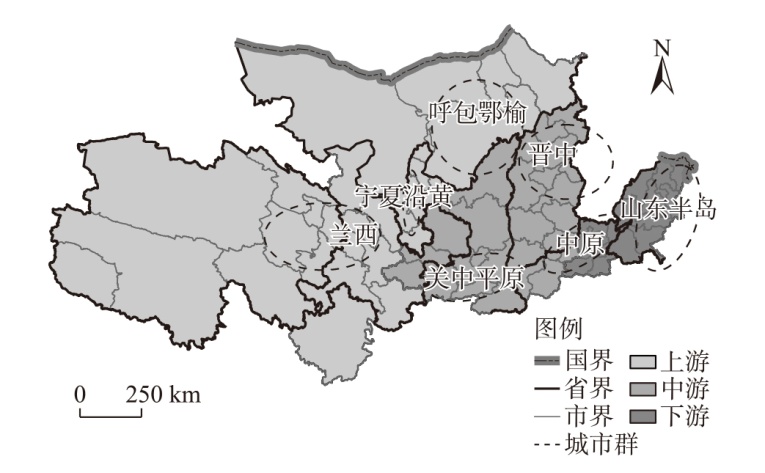
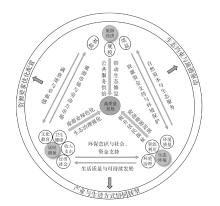
Fig. 2
Coupling development mechanism of tourism-ecology-well-being"
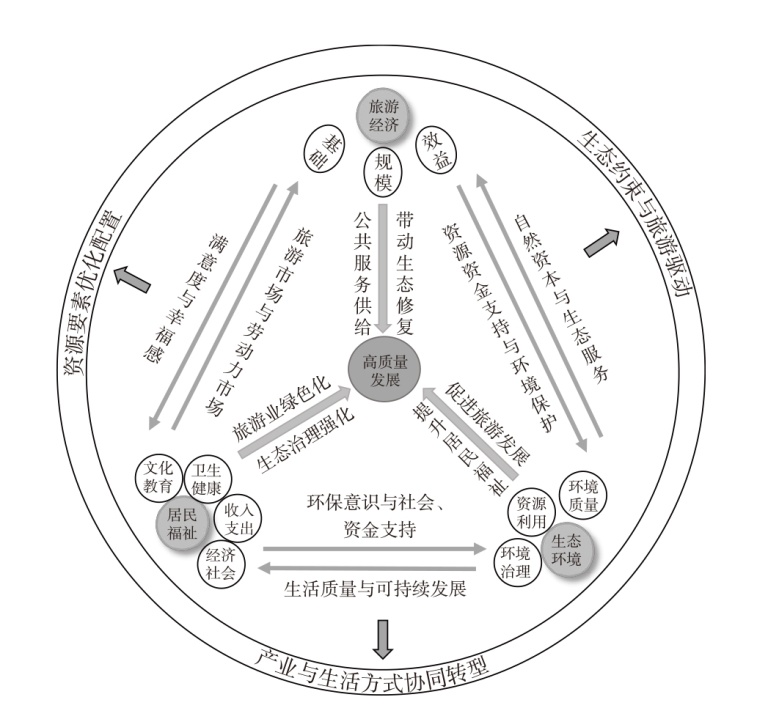
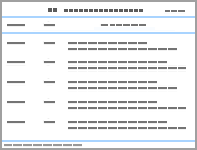
Tab. 1
Evaluation index system for tourism-ecology-well-being"
| 目标层 | 准则层 | 指标层 | 属性 | 权重 |
|---|---|---|---|---|
| 旅游经济 | 产业基础 | 旅行社数/个 | + | 0.100 |
| A级景区数/个 | + | 0.125 | ||
| 星级饭店/个 | + | 0.081 | ||
| 国家级、省级非物质文化遗产/个 | + | 0.113 | ||
| 国家重点文物保护单位/个 | + | 0.092 | ||
| 旅游从业人员数/104人 | + | 0.060 | ||
| 市场规模 | 国际游客接待人数/104人 | + | 0.050 | |
| 游客接待总数/104人 | + | 0.163 | ||
| 市场效益 | 国际旅游外汇收入/104元 | + | 0.043 | |
| 旅游总收入/104元 | + | 0.174 | ||
| 生态环境 | 生态压力 | 104元GDP氮氧化物排放量/t·(104元)-1 | - | 0.074 |
| 空气质量指数 | - | 0.085 | ||
| 104元GDP工业废水排放量/t·(104元)-1 | - | 0.074 | ||
| 化肥施用强度/t·hm-2 | - | 0.068 | ||
| 人均用水量/m2·人-1 | - | 0.063 | ||
| 生态状态 | 植被覆盖率/% | + | 0.084 | |
| 人均(公园)绿地面积/m3·人-1 | + | 0.075 | ||
| 人均水资源量/m3·人-1 | + | 0.041 | ||
| 国家自然保护区/个 | + | 0.069 | ||
| 土地综合变化率/% | - | 0.045 | ||
| 生态响应 | 万元GDP一般工业固体废物综合利用量/t·(104元)-1 | + | 0.053 | |
| 万元GDP污水处理厂处理量/m3·(104元)-1 | + | 0.063 | ||
| 环境污染治理投资额占财政支出比重/% | + | 0.078 | ||
| 环保词频占比/% | + | 0.055 | ||
| 生活垃圾无害化处理率/% | + | 0.073 | ||
| 居民福祉 | 文化与教育 | 普通中学师生比/% | + | 0.096 |
| 每万人拥有的文化机构数/个·(104人)-1 | + | 0.113 | ||
| 卫生与健康 | 每万人拥有的医院床位数/张·(104人)-1 | + | 0.095 | |
| 每万人拥有的卫生医疗机构数/个·(104人)-1 | + | 0.128 | ||
| 收入与支出 | 城镇居民人均可支配收入/104元 | + | 0.067 | |
| 农村居民人均可支配收入/104元 | + | 0.079 | ||
| 社会消费品零售额/104元 | + | 0.064 | ||
| 人均文教娱乐消费支出/104元·人-1 | + | 0.060 | ||
| 经济与社会发展 | 每万人拥有公共汽车数/辆·(104人)-1 | + | 0.063 | |
| 单位面积公路里程/km | + | 0.094 | ||
| 城镇化率/% | + | 0.070 | ||
| 人均GDP/104元·人-1 | + | 0.070 |
Tab. 2
Evaluation criteria for coupling coordination degree"
| 耦合协调度 | 耦合协调度等级 | 耦合协调度 | 耦合协调度等级 |
|---|---|---|---|
| 0.90~1.00 | 优质协调 | 0.40~0.49 | 濒临失调 |
| 0.80~0.89 | 良好协调 | 0.30~0.39 | 轻度失调 |
| 0.70~0.79 | 中级协调 | 0.20~0.29 | 中度失调 |
| 0.60~0.69 | 初级协调 | 0.10~0.19 | 严重失调 |
| 0.50~0.59 | 勉强协调 | 0.00~0.09 | 极度失调 |
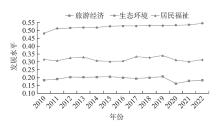
Fig. 3
Changing trend of the comprehensive development level of tourism-ecology-well-being"
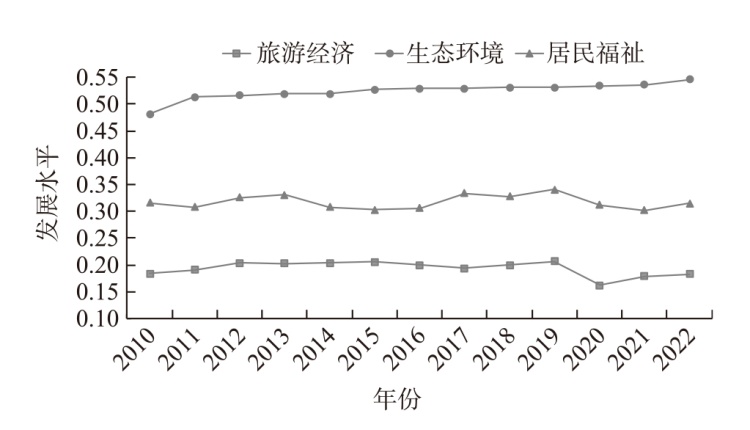
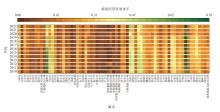
Fig. 4
Changing trend in the development level of tourism economy"
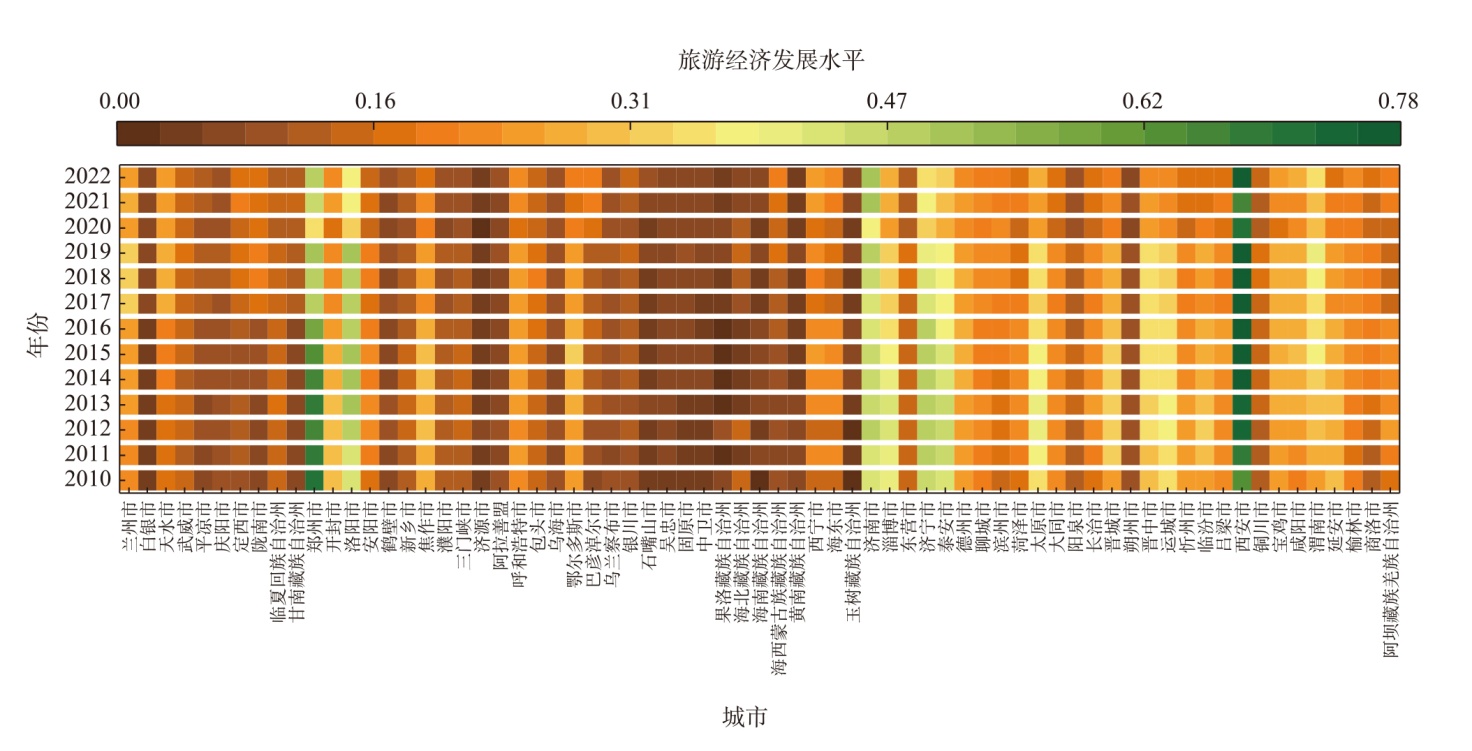
Fig. 5
Changing trend in the development level of ecological environment"
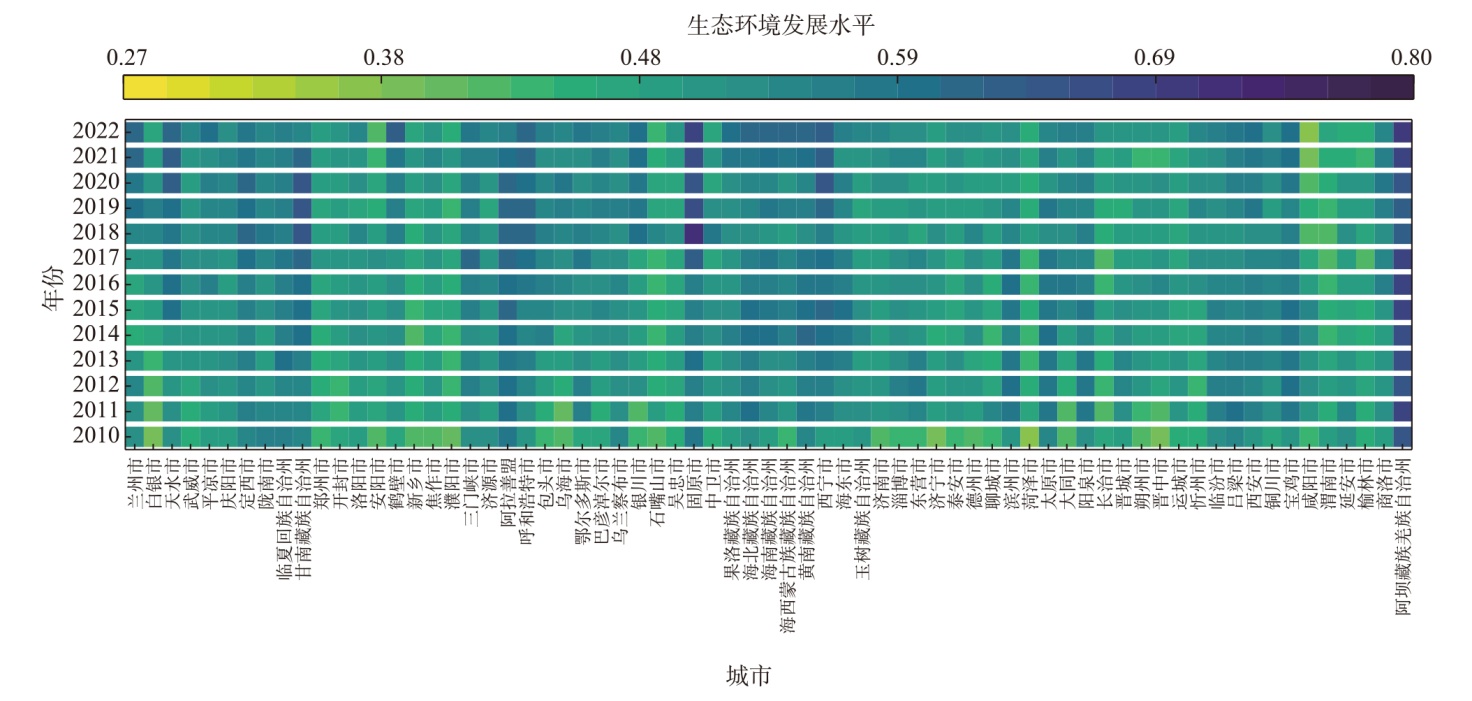
Fig. 6
Changing trend in the development level of residents’ well-being"
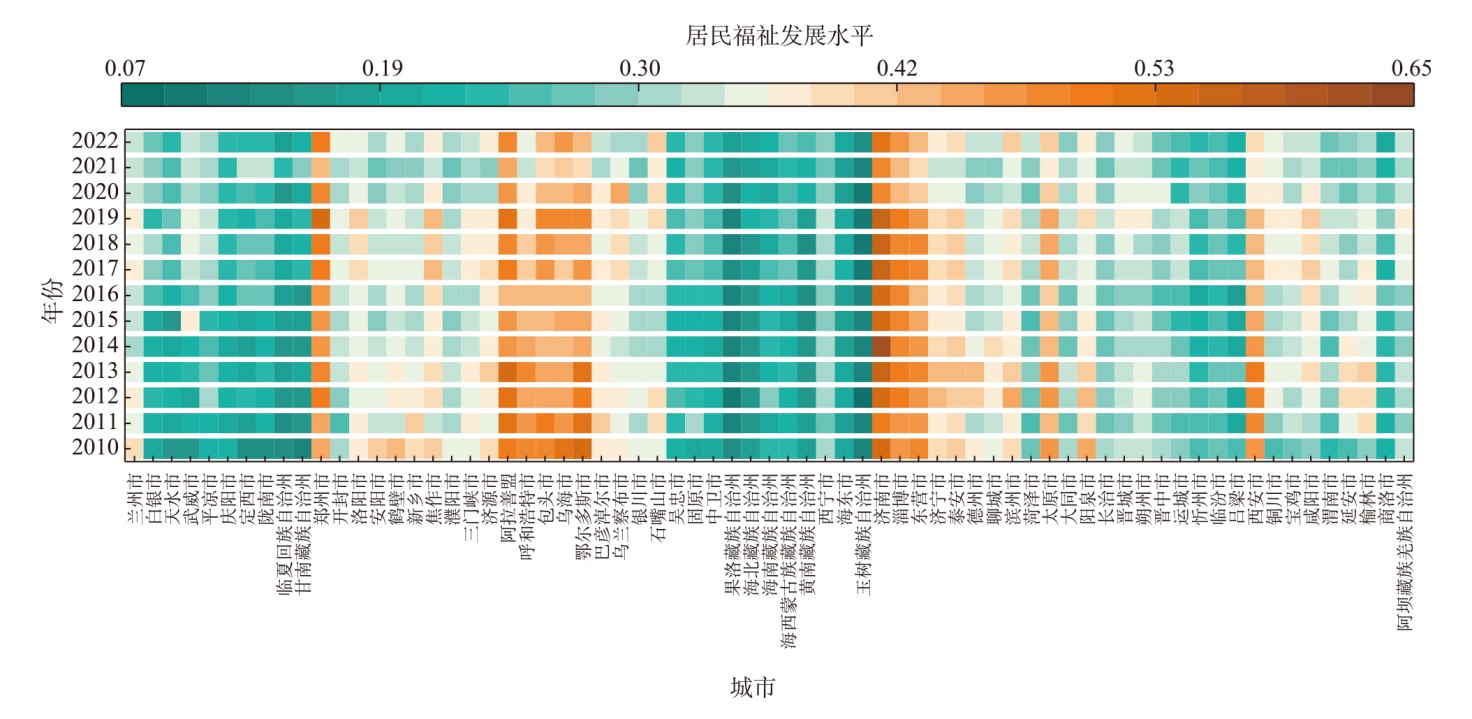
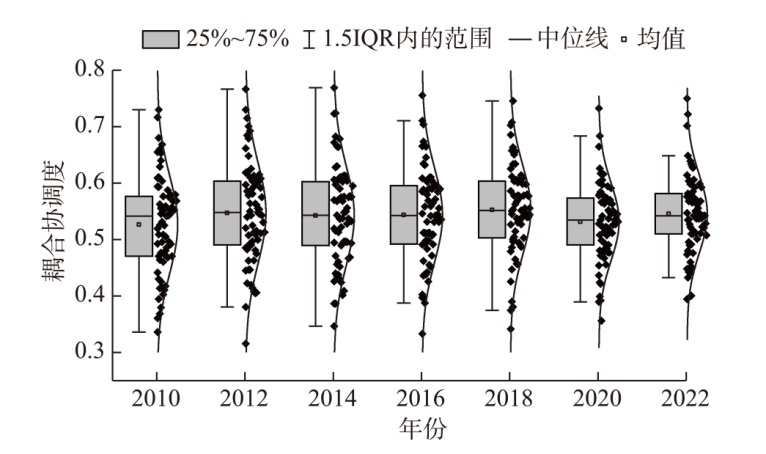
Fig. 7
Temporal evolution of the coupling coordination degree of tourism-ecology-well-being"
Tab. 3
Global autocorrelation index of the coupling coordination degree of tourism-ecology-well-being"
| 年份 | 全局Moran’s I | P值 |
|---|---|---|
| 2010 | 0.403*** | 0.000 |
| 2016 | 0.397*** | 0.000 |
| 2022 | 0.231*** | 0.000 |
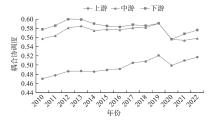
Fig. 8
Spatial characteristics of the coupling coordination degree of tourism-ecology-well-being at the watershed scale"
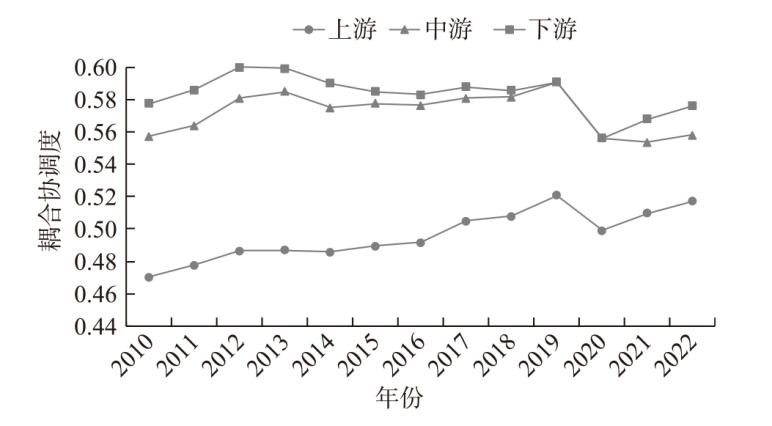
Fig. 9
Spatial characteristics of the coupling coordination degree of tourism-ecology-well-being at the urban agglomeration scale"
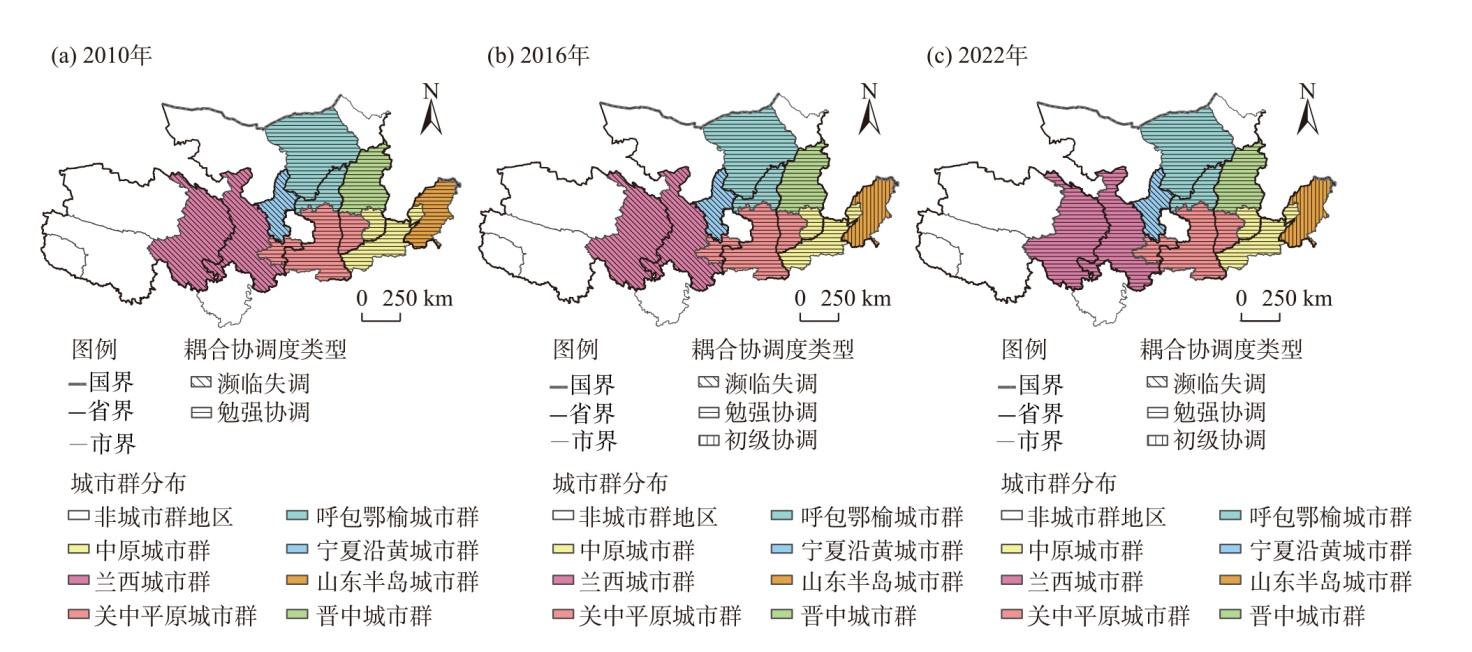
Fig. 10
Spatial characteristics of the coupling coordination degree of tourism-ecology-well-being at the municipal scale"
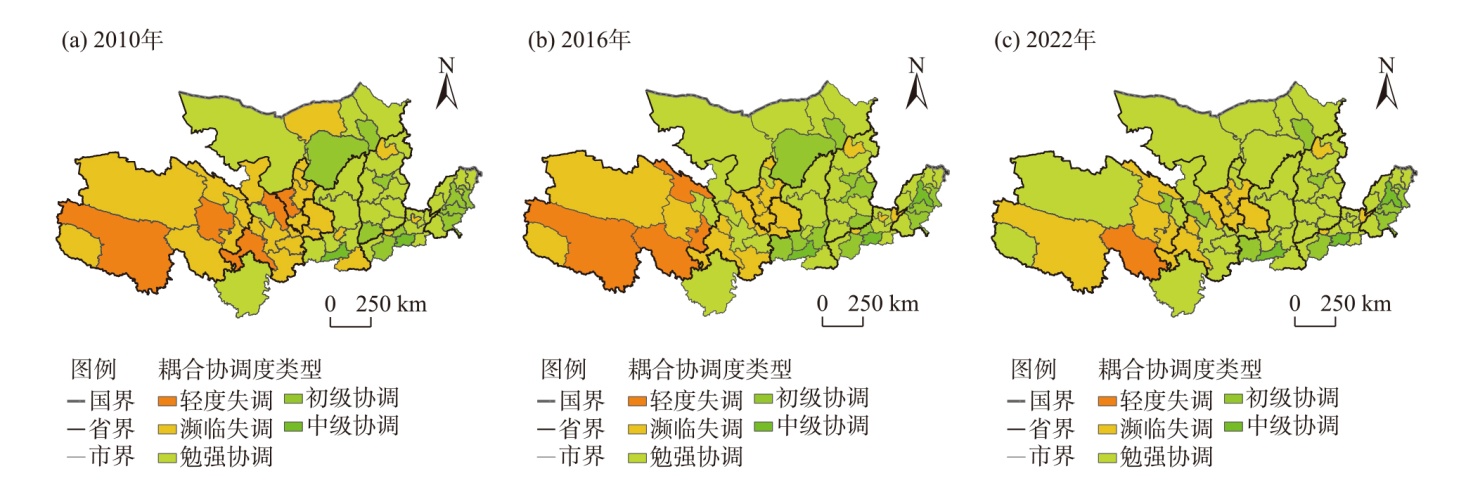
Fig. 11
Spatial distributions of the cold and hot spots of the coupling coordination degree of tourism-ecology-well-being"
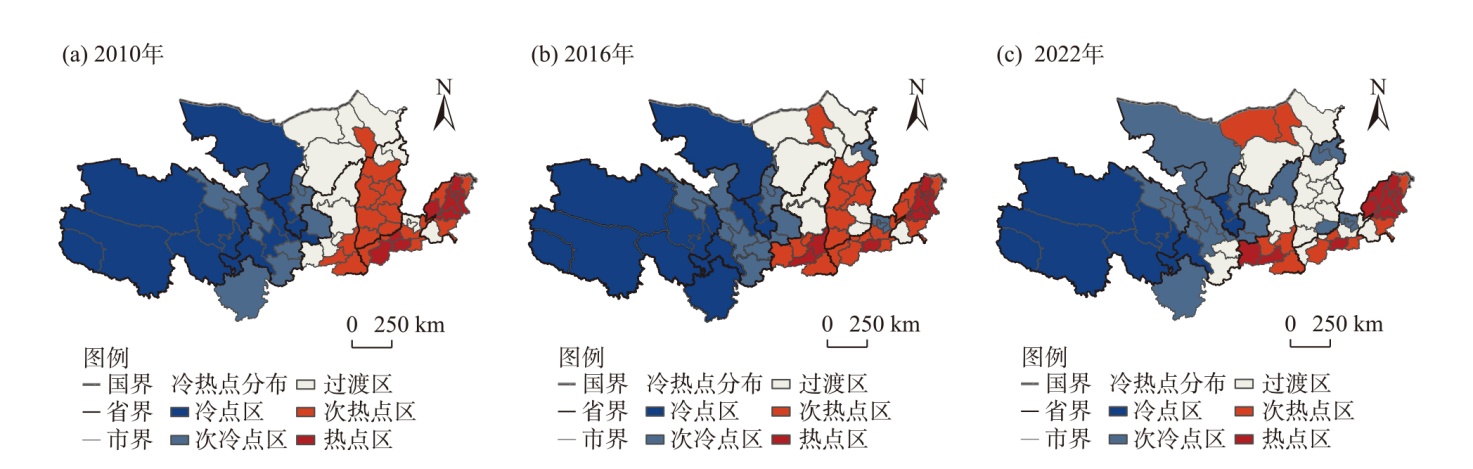
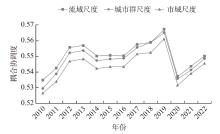
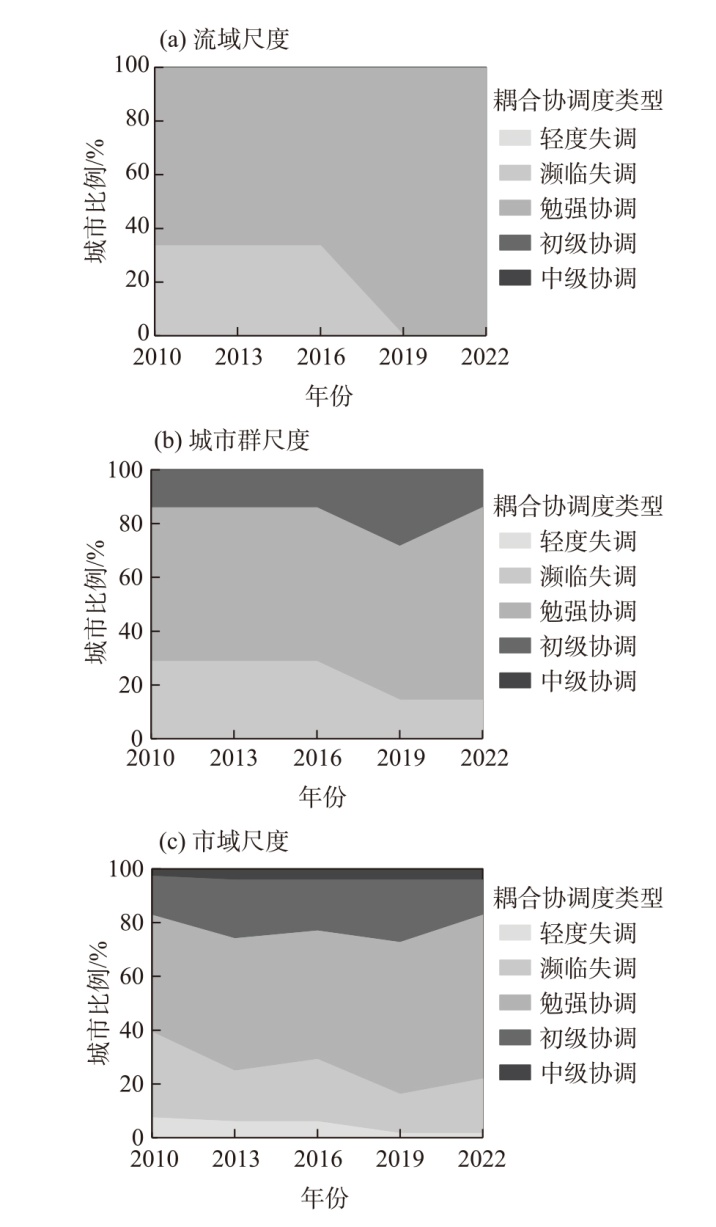
Fig. 12
Temporal evolution characteristics of the coupling coordination degree at three scales"
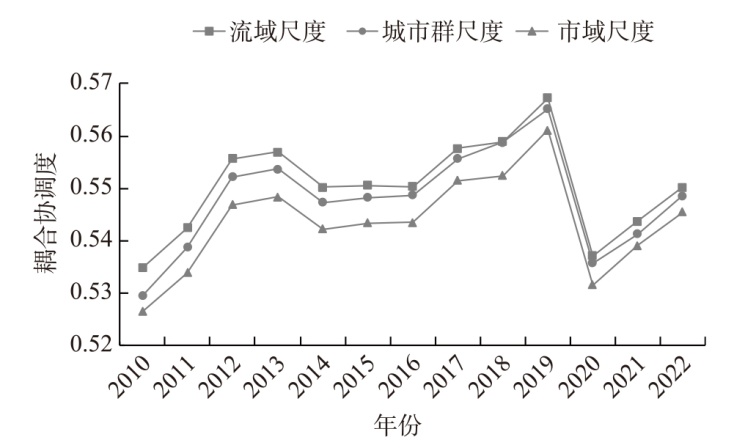
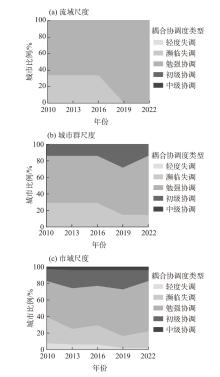
Fig. 13
Spatial difference characteristics of the coupling coordination degree at three scales"
Tab. 4
Results of geographic detector of the driving mechanisms of the coupting coordination degree of tourism-ecology-well-being"
| 变量 | 2010年 | 2016年 | 2022年 | |||||
|---|---|---|---|---|---|---|---|---|
| q值 | 排序 | q值 | 排序 | q值 | 排序 | |||
| X1 | 0.014 | 13 | 0.003 | 13 | 0.001 | 12 | ||
| X2 | 0.219*** | 7 | 0.295*** | 2 | 0.263*** | 5 | ||
| X3 | 0.142 | 11 | 0.147 | 7 | 0.249** | 6 | ||
| X4 | 0.026 | 12 | 0.069 | 11 | 0.234*** | 7 | ||
| X5 | 0.319*** | 3 | 0.333*** | 1 | 0.300*** | 3 | ||
| X6 | 0.185*** | 8 | 0.004 | 12 | 0.001 | 12 | ||
| X7 | 0.236*** | 6 | 0.265*** | 4 | 0.134** | 9 | ||
| X8 | 0.292*** | 4 | 0.287*** | 3 | 0.277*** | 4 | ||
| X9 | 0.444*** | 1 | 0.215*** | 5 | 0.323*** | 2 | ||
| X10 | 0.178** | 9 | 0.102** | 10 | 0.330*** | 1 | ||
| X11 | 0.165** | 10 | 0.207** | 6 | 0.096** | 10 | ||
| X12 | 0.334*** | 2 | 0.134** | 8 | 0.036 | 11 | ||
| X13 | 0.284*** | 5 | 0.134** | 8 | 0.188*** | 8 | ||
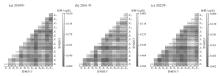
Fig. 14
Interaction effects of influencing factors on the coupling coordination degree of tourism-ecology-well-being"
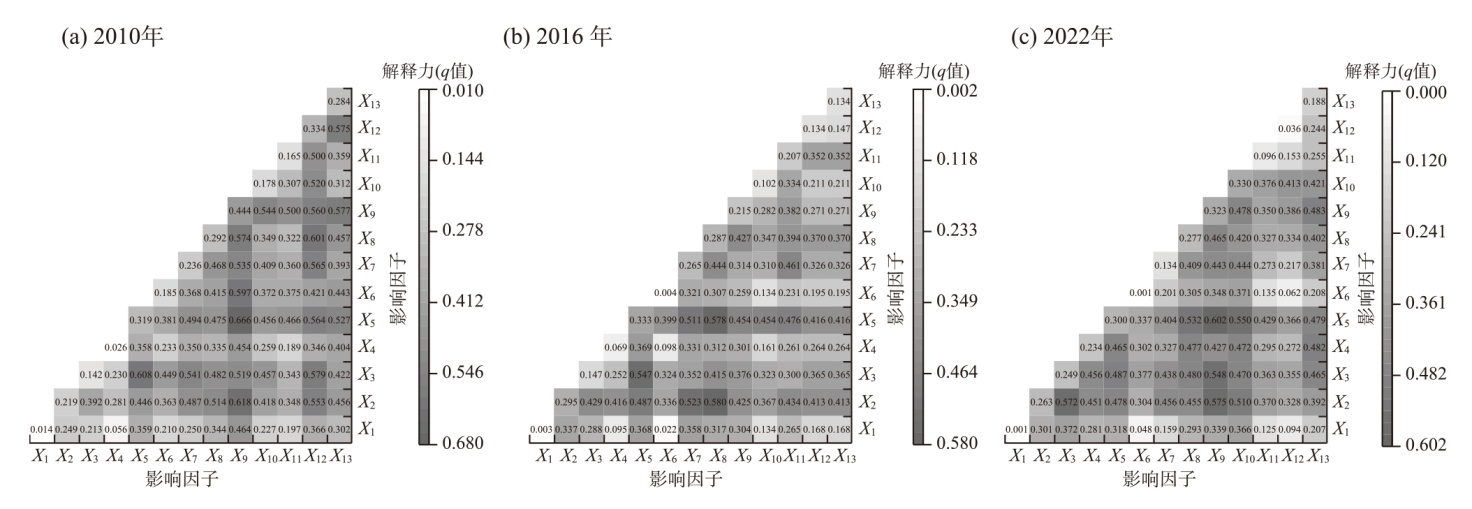
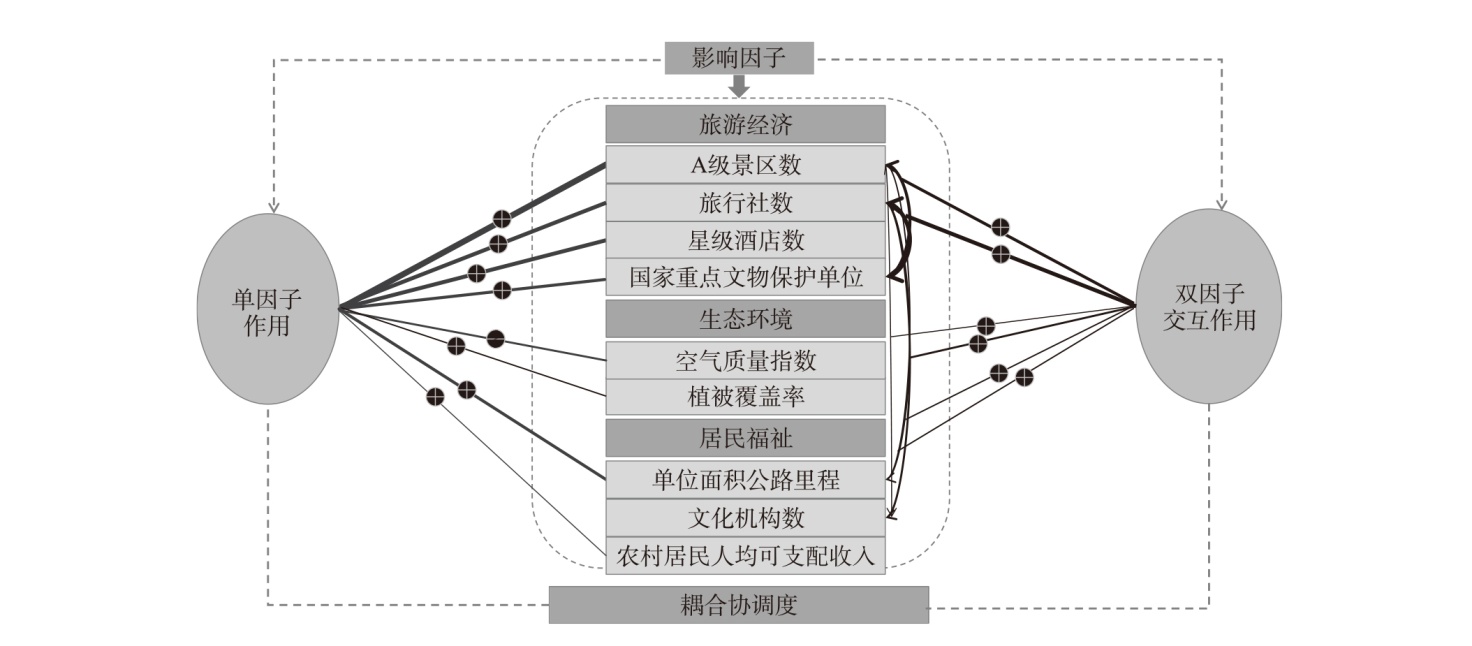
Fig. 15
Mechanism diagram of dominant factors in the coupling coordination development of tourism-ecology-well-being"
| [1] | 厉新建, 曾博伟, 张辉, 等. 新质生产力与旅游业高质量发展[J]. 旅游学刊, 2024, 39(5): 15-29. |
| [Li Xinjian, Zeng Bowei, Zhang Hui, et al. New quality productive forces and high-quality development in tourism: Problems, cognition and optimization direction[J]. Tourism Tribune, 2024, 39(5): 15-29.] | |
| [2] | 王兆峰, 谢佳亮. 长三角地区城市旅游业高质量发展时空动态演变及驱动因素[J]. 旅游科学, 2025, 39(7): 1-19. |
| [Wang Zhaofeng, Xie Jialiang. Space-time dynamic evolution and driving factors of high-quality development of urban tourism in Yangtze River Delta[J]. Tourism Science, 2025, 39(7): 1-19.] | |
| [3] | Yin Z X, Tang Y L, Liu H N, et al. Coupling coordination relationship between tourism economy-social welfare-ecological environment: Empirical analysis of western area, China[J]. Ecological Indicators, 2023, 155: 110938, doi: 10.1016/j.ecolind.2023.110938. |
| [4] | Huang Z H, Wei W, Han Y, et al. The coupling coordination evolutionary analysis of tourism-ecological environment-public service for the Yellow River Basin of China[J]. International Journal of Environmental Research and Public Health, 2022, 19(15): 9315, doi: 10.3390/ijerph19159315. |
| [5] |
Kurniawan F, Adrianto L, Bengen D G, et al. The social-ecological status of small islands: An evaluation of island tourism destination management in Indonesia[J]. Tourism Management Perspectives, 2019, 31: 136-144.
doi: 10.1016/j.tmp.2019.04.004 |
| [6] | 汪宇明. 广西桂林旅游资源的可持续利用[J]. 自然资源学报, 2002, 17(3): 361-365. |
| [Wang Yuming. Sustainable development of tourism resources of Guilin, Guangxi[J]. Journal of Natural Resources, 2002, 17(3): 361-365.] | |
| [7] | 王娜, 周翔, 卢学英, 等. 旅游者环境态度-行为差距影响因素研究——享乐偏好、 感知效力、 环境行为成本的调节作用[J]. 干旱区资源与环境, 2023, 37(10): 175-182. |
| [Wang Na, Zhou Xiang, Lu Xueying, et al. Influences on tourists’ environmental attitude-behavior gap: The moderating effects of enjoyment preference, perceived effectiveness and environmental behavior cost[J]. Journal of Arid Land Resources and Environment, 2023, 37(10): 175-182.] | |
| [8] | 席建超, 赵美风, 吴普, 等. 国际旅游科学研究新热点: 全球气候变化对旅游业影响研究[J]. 旅游学刊, 2010, 25(5): 86-92. |
| [Xi Jianchao, Zhao Meifeng, Wu Pu, et al. A new hot topic for the research of international tourism science: The impact of global climate change on tourism industry[J]. Tourism Tribune, 2010, 25(5): 86-92.] | |
| [9] |
白洋, 唐诚, 陈明珠, 等. 中国“生态-旅游-文化”系统协调发展与影响路径[J]. 干旱区地理, 2026, 49(1): 94-105.
doi: 10.12118/j.issn.1000-6060.2025.101 |
|
[Bai Yang, Tang Cheng, Chen Mingzhu, et al. Coordinated development and influence paths of “ecology-tourism-culture” system in China[J]. Arid Land Geography, 2026, 49(1): 94-105.]
doi: 10.12118/j.issn.1000-6060.2025.101 |
|
| [10] |
Ramkissoon H. Perceived social impacts of tourism and quality-of-life: A new conceptual model[J]. Journal of Sustainable Tourism, 2023, 31(2): 442-459.
doi: 10.1080/09669582.2020.1858091 |
| [11] |
Godovykh M, Ridderstaat J, Fyall A. The well-being impacts of tourism: Long-term and short-term effects of tourism development on residents’ happiness[J]. Tourism Economics, 2023, 29(1): 137-156.
doi: 10.1177/13548166211041227 |
| [12] | 侯兵, 李红缘, 余凤龙, 等. 旅游影响下的地方饮食文化生产转向: 特征与机制[J]. 旅游学刊, 2024, 39(1): 91-104. |
| [Hou Bing, Li Hongyuan, Yu Fenglong, et al. The production turn of local food culture under the influence of tourism: Characteristics and mechanism[J]. Tourism Tribune, 2024, 39(1): 91-104.] | |
| [13] | 黄从慧, 王群. 旅游社区居民生态正义感知及空间差异研究——以黄山风景区门户社区为例[J]. 旅游科学, 2024, 38(4): 59-79. |
| [Huang Conghui, Wang Qun. A study on residents’ perception of ecological justice and spatial differences in tourism community: A case study of the gateway communities of Huangshan scenic area[J]. Tourism Science, 2024, 38(4): 59-79.] | |
| [14] | 王兆峰, 张先甜. 中国省域旅游发展与民生福祉的动态响应及协调效应研究[J]. 旅游科学, 2023, 37(3): 1-19. |
| [Wang Zhaofeng, Zhang Xiantian. A research on the dynamic response and coordination effect of provincial tourism development and the residents’ well-being in China[J]. Tourism Science, 2023, 37(3): 1-19.] | |
| [15] | Jones S K, Boundaogo M, Declerck F A, et al. Insights into the importance of ecosystem services to human well-being in reservoir landscapes[J]. Ecosystem Services, 2019, 39: 100987, doi: 10.1016/j.ecoser.2019.100987. |
| [16] | Fu L R, Ren Y S, Lu L, et al. Relationship between ecosystem services and rural residential well-being in the Xin’an River Basin, China[J]. Ecological Indicators, 2022, 140: 108997, doi: 10.1016/j.ecolind.2022.108997. |
| [17] | Hu M J, Chen G, Li Z J. The progress and framework of ecological welfare performance within the context of the “Dual Carbon” goal: A comprehensive literature review[J]. Sustainability, 2025, 17(2): 410, doi: 10.3390/su17020410. |
| [18] | Wang S, Tian J, Namaiti A, et al. Spatial pattern optimization of rural production-living-ecological function based on coupling coordination degree in shallow mountainous areas of Quyang County, Hebei Province, China[J]. Frontiers in Ecology and Evolution, 2023, 11: 1169007, doi: 10.3389/fevo.2023.1169007. |
| [19] |
李文青, 赵雪雁, 杜昱璇, 等. 秦巴山区生态系统服务与居民福祉耦合关系的时空变化[J]. 自然资源学报, 2021, 36(10): 2522-2540.
doi: 10.31497/zrzyxb.20211006 |
|
[Li Wenqing, Zhao Xueyan, Du Yuxuan, et al. Spatio-temporal changes of the coupling relationship between ecosystem services and residents’ well-being in Qinba Mountains Area[J]. Journal of Natural Resources, 2021, 36(10): 2522-2540.]
doi: 10.31497/zrzyxb.20211006 |
|
| [20] | 毛爱涵, 李发祥, 杨思源, 等. 三江源地区环境足迹及居民福祉的动态变化特征评价[J]. 生态学报, 2023, 43(18): 7637-7650. |
| [Mao Aihan, Li Faxiang, Yang Siyuan, et al. Evaluation on the dynamic features of environmental footprint and human well-being in the Three-River Headwaters region[J]. Acta Ecologica Sinica, 2023, 43(18): 7637-7650.] | |
| [21] |
厉建梅, 单梦琦, 齐佳. 大运河文化带沿线城市文化-生态-旅游耦合协调发展[J]. 经济地理, 2022, 42(10): 201-207.
doi: 10.15957/j.cnki.jjdl.2022.10.023 |
|
[Li Jianmei, Shan Mengqi, Qi Jia. Coupling coordination development of culture-ecology-tourism in cities along the Grand Canal Cultural Belt[J]. Economic Geography, 2022, 42(10): 201-207.]
doi: 10.15957/j.cnki.jjdl.2022.10.023 |
|
| [22] | 左文超, 胡北明, 邱雪梅, 等. 消费信心重塑期的旅游消费脆弱性评价及时空演变特征分析[J]. 干旱区资源与环境, 2024, 38(10): 199-208. |
| [Zuo Wenchao, Hu Beiming, Qiu Xuemei, et al. Evaluation of tourist consumption vulnerability and characterization of spatiotemporal evolution during the period of consumer confidence remodeling[J]. Journal of Arid Land Resources and Environment, 2024, 38(10): 199-208.] | |
| [23] | 廖重斌. 环境与经济协调发展的定量评判及其分类体系——以珠江三角洲城市群为例[J]. 热带地理, 1999, 19(2): 171-177. |
| [Liao Chongbin. Quantitative judgement and classification system for coordinated development of environment and economy: A case study of the city group in the Pearl River Delta[J]. Tropical Geography, 1999, 19(2): 171-177.] | |
| [24] |
田小波. 黄河流域城市旅游业高质量发展水平测度与空间格局特征[J]. 干旱区地理, 2025, 48(9): 1660-1671.
doi: 10.12118/j.issn.1000-6060.2024.103 |
|
[Tian Xiaobo. Measurement and spatial pattern characteristics of tourism high-quality development level of urbans in the Yellow River Basin[J]. Arid Land Geography, 2025, 48(9): 1660-1671.]
doi: 10.12118/j.issn.1000-6060.2024.103 |
|
| [25] | Sui G H, Wang H X, Cai S Y, et al. Coupling coordination analysis of resources, economy, and ecology in the Yellow River Basin[J]. Ecological Indicators, 2023, 156: 111133, doi: 10.1016/j.ecolind.2023.111133. |
| [26] | Wang R, Xia B, Dong S C, et al. Research on the spatial differentiation and driving forces of eco-efficiency of regional tourism in China[J]. Sustainability, 2020, 13(1): 280, doi: 10.3390/su13010280. |
| [27] | Wang K, Chen X T, Lei Z X, et al. The effects of tourism development on eco-environment resilience and its spatio-temporal heterogeneity in the Yangtze River economic belt, China[J]. Sustainability, 2023, 15(22): 16124, doi: 10.3390/su152216124. |
|
||