干旱区地理 ›› 2025, Vol. 48 ›› Issue (6): 1043-1054.doi: 10.12118/j.issn.1000-6060.2024.408 cstr: 32274.14.ALG2024408
郭念发1( ), 王录仓1,2()
收稿日期:2024-07-04
修回日期:2024-11-21
出版日期:2025-06-25
发布日期:2025-06-18
通讯作者:
王录仓(1967-),男,博士,教授,主要从事城乡发展与规划研究. E-mail: wanglc007@nwnu.edu.cn作者简介:郭念发(1999-),男,硕士研究生,主要从事城乡发展与规划研究. E-mail: 17339833206@163.com
基金资助:
GUO Nianfa1(), WANG Lucang1,2()
Received:2024-07-04
Revised:2024-11-21
Published:2025-06-25
Online:2025-06-18
摘要: 幼儿园作为教育体系中的低洼地带,其入学可达性的精准量化有助于评估学前教育资源的空间分配效率。以兰州市主城区为案例地,结合幼儿园POI、适龄儿童数量、学位数、道路等级等数据,运用核密度分析、多等级-多出行模式高斯可达性算法对不同等级幼儿园集聚特征、入学可达性进行量化,并运用空间回归模型、双变量空间自相关探讨入学可达性分布的影响因素。结果表明:(1) 幼儿园整体呈“一核”“四心”带状分布特征,密集度自东向西递减,省级标准园、市级标准园、区级标准园、一般园基本呈“单核心”空间分布特征。(2) 幼儿园整体入学可达性等级呈“重心偏东”“南优北劣”的空间偏向性,不同等级品质幼儿园入学可达性均呈“多中心”结构特征,4类等级园中,一般园入学可达性高值区域最多,反映出其在承担幼儿就近入学方面起主要作用。(3) 学龄人口、家庭经济状况、幼儿园招生名额对入学可达性有显著的正向作用,路网密度、公交站、对入学可达性具有负向作用,但相关性不显著,此外幼儿园保教费对入学可达性也具有负向作用。
郭念发, 王录仓. 兰州市主城区幼儿园入学可达性及影响因素分析[J]. 干旱区地理, 2025, 48(6): 1043-1054.
GUO Nianfa, WANG Lucang. Analysis of accessibility and influencing factors of kindergarten enrollment in the main urban area of Lanzhou City[J]. Arid Land Geography, 2025, 48(6): 1043-1054.

图1
兰州市主城区各等级品质幼儿园空间分布"

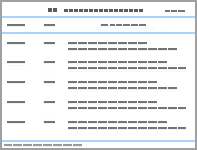
表1
各道路等级下4种出行方式的通行速度"
| 道路 | 步行 | 自行(电动)车 | 公交 | 小汽车 |
|---|---|---|---|---|
| 主干道 | 75 | 207 | 287 | 333 |
| 次干道 | 75 | 207 | 120 | 240 |
| 支路 | 75 | 207 | 85 | 170 |
| 其他路 | 75 | 207 | 0 | 120 |
表2
各出行方式下人口占比"
| 步行 | 自行(电动)车 | 公交 | 小汽车 |
|---|---|---|---|
| 42.9 | 10.5 | 40.7 | 5.9 |
表3
不同等级幼儿园服务半径"
| 省级标准园 | 市级标准园 | 区级标准园 | 一般园 |
|---|---|---|---|
| 25 | 20 | 15 | 10 |
表4
解释变量"
| 自变量 | 变量描述 | 数据来源 |
|---|---|---|
| 适龄儿童数量 | 格网内3~6岁适龄儿童总和/个 | 人口栅格数据、2014—2017年《兰州年鉴》、七普数据 |
| 家庭经济状况 | 格网内社区房价平均值/元·m-2 | 链家网、安居客房产交易网站爬取 |
| 路网密度 | 城市道路网络密度 | 高德地图路网矢量数据爬 |
| 公交站 | 距公交站0.3 km内赋值2;0.3~1 km赋值为1 | 高德地图公交站POI点爬取 |
| 幼儿园保教费 | 不同等级幼儿园保教费用标准/元·(生·月)-1 | 兰州市教育局官网 |
| 幼儿园招生人数 | 不同等级幼儿园秋季招生人数/个 | 兰州市教育局官网 |

图2
兰州市主城区幼儿园核密度"


图3
兰州市主城区不同等级品质幼儿园核密度"


图4
兰州市主城区全体幼儿园入学可达性"

表5
各区不同可达性的格网数量及占比"
| 区域 | 栅格数 量/个 | 低可达性 | 较低可达性 | 中等可达性 | 较高可达性 | 高可达性 | |||||||||
|---|---|---|---|---|---|---|---|---|---|---|---|---|---|---|---|
| 数量/个 | 占比/% | 数量/个 | 占比/% | 数量/个 | 占比/% | 数量/个 | 占比/% | 数量/个 | 占比/% | ||||||
| 城关区 | 2066 | 257 | 12.4 | 385 | 18.6 | 590 | 28.6 | 618 | 29.9 | 216 | 10.5 | ||||
| 七里河区 | 1365 | 174 | 12.8 | 350 | 25.6 | 258 | 18.9 | 444 | 32.5 | 139 | 10.2 | ||||
| 安宁区 | 1279 | 457 | 35.8 | 189 | 14.8 | 343 | 26.8 | 204 | 15.9 | 86 | 6.7 | ||||
| 西固区 | 1165 | 451 | 38.7 | 320 | 27.5 | 212 | 18.2 | 113 | 9.7 | 69 | 5.9 | ||||

图5
兰州市主城区不同等级品质幼儿园入学可达性"

表6
各自变量对入学可达性影响的空间回归分析结果"
| 解释变量 | OLS结果 | 解释变量 | SEM结果 | ||
|---|---|---|---|---|---|
| 协变量 | 学龄人口 | 0.001(4.292)*** | 协变量 | 学龄人口 | 0.001(4.259)*** |
| 家庭经济状况 | 2.571(1.268)*** | 家庭经济状况 | 2.267(2.465)** | ||
| 路网密度 | -0.001(0.001)* | 路网密度 | -0.001(0.001) | ||
| 公交站 | -1.639(1.408)* | 公交站 | -1.617(2.747) | ||
| 幼儿园保教费 | -1.110(1.428)*** | 幼儿园保教费 | -1.014(1.405)*** | ||
| 招生人数 | 0.005(0.001)*** | 招生人数 | 0.004(0.002)*** | ||
| 结果指标 | 常数 | 0.009(0.012)*** | 结果指标 | 常数 | 0.014(0.022)*** |
| Moran’s I (error) | 39.853*** | 空间误差项 | 1114.429*** | ||
| LM(lag) | 1526.068*** | Log Likelihood | 3203.709 | ||
| Robust LM(lag) | 4.084 | AIC | -6393.420 | ||
| LM(error) | 1569.102*** | SC | -6346.940 | ||
| Robust LM(error) | 47.113*** | R2 | 0.499 | ||
| LM(SARMA) | 1573.185*** | N | 5649 | ||
| Log Likelihood | 2646.490 | ||||
| AIC | -5278.990 | ||||
| SC | -5231.510 | ||||
| R2 | 0.349 | ||||
| N | 5649 | ||||
表7
各自变量与入学可达性双变量空间自相关结果的相关性"
| 自变量 | Moran’s I值 | P值 | Z值 | 自变量 | Moran’s I值 | P值 | Z值 |
|---|---|---|---|---|---|---|---|
| 学龄儿童数量 | 0.292 | 0.010 | 53.672 | 公交站 | -0.028 | 0.010 | -5.308 |
| 家庭经济状况 | 0.079 | 0.001 | 15.942 | 幼儿园保教费 | -0.121 | 0.010 | -26.417 |
| 路网密度 | -0.029 | 0.010 | -5.416 | 幼儿园招生人数 | 0.518 | 0.010 | 90.668 |

图6
入学可达性与各自变量双变量空间自相关"

| [1] | 沙莉, 张小娟, 康丽颖. “幼儿园”概念的生成与流变——基于历史语义学的分析视角[J]. 教育研究, 2023, 44(9): 51-63. |
| [Sha Li, Zhang Xiaojuan, Kang Liying. The creation and evolution of the concept of “Kindergarten”: Based on an analysis of historical semantics[J]. Educational Research, 2023, 44(9): 51-63. ] | |
| [2] | 李阿芳, 王小英. 我国学前教育供给主体变迁的历史发展逻辑——基于历史制度主义的视角[J]. 学前教育研究, 2021(12): 13-22. |
| [Li A’fang, Wang Xiaoying. The development logic of the supply subjects of preschool education in China based on the perspective of historical institutionalism[J]. Studies in Early Childhood Education, 2021(12): 13-22. ] | |
| [3] | 柳倩. 我国学前教育推行公私合作模式的风险及其规避: 国际的视角[J]. 教育发展研究, 2016, 36(20): 34-40. |
| [Liu Qian. How to control the risk of the implementation of public-private-partnership model in early childhood education in China: From the perspective of international concern[J]. Concern Educational Development Research, 2016, 36(20): 34-40. ] | |
| [4] | 程方平, 冯芳芳. 我国学前教育发展中政府角色的演变及影响因素[J]. 河北师范大学学报(教育科学版), 2024, 26(3): 114-124. |
| [Cheng Fangping, Feng Fangfang. The evolution of the government’s role in the development of preschool education in China and its influencing factors[J]. Journal of Hebei Normal University (Educational Science Edition), 2024, 26(3): 114-124. ] | |
| [5] | 国家教育督导团关于幼儿教育专项督导检查公报[J]. 学前教育研究, 2005(9): 5-6. |
| [National education supervision team’s special supervision and inspection bulletin on early childhood education[J]. Preschool Education Research, 2005(9): 5-6. ] | |
| [6] | 李艳, 李少梅. 我国幼儿园质量评估政策变迁的多源流阐释[J]. 陕西学前师范学院学报, 2024, 40(5): 105-112. |
| [Li Yan, Li Shaomei. A study on Chinese quality evaluation policy changes of kindergarten based on multiple streams theory[J]. Journal of Shaanxi Xueqian Normal University, 2024, 40(5): 105-112. ] | |
| [7] |
陶卓霖, 戴特奇, 宋长青. 空间公平导向的城市医疗设施优化配置模型研究[J]. 地理学报, 2023, 78(2): 474-489.
doi: 10.11821/dlxb202302013 |
| [Tao Zhuolin, Dai Teqi, Song Changqing. Improving spatial equity-oriented location-allocation models of urban medical facilities[J]. Acte Geographica Sinica, 2023, 78(2): 474-489. ] | |
| [8] | 李博. 基于两步移动搜索法的大连市医疗设施空间分布特征及可达性分析[J]. 测绘与空间地理信息, 2024, 47(5): 87-89. |
| [Li Bo. Spatial distribution characteristics and accessibility analysis of medical facilities in Dalian based on two-step mobile search method[J]. Geomatics & Spatial Information Technology, 2024, 47(5): 87-89. ] | |
| [9] |
陶卓霖, 程杨. 两步移动搜寻法及其扩展形式研究进展[J]. 地理科学进展, 2016, 35(5): 589-599.
doi: 10.18306/dlkxjz.2016.05.006 |
|
[Tao Zhuolin, Cheng Yang. Research progress of the two-step floating catchment area method and extensions[J]. Progress in Geography, 2016, 35(5): 589-599. ]
doi: 10.18306/dlkxjz.2016.05.006 |
|
| [10] |
宋正娜, 陈雯, 张桂香, 等. 公共服务设施空间可达性及其度量方法[J]. 地理科学进展, 2010, 29(10): 1217-1224.
doi: 10.11820/dlkxjz.2010.10.009 |
|
[Song Zhengna, Chen Wen, Zhang Guixiang, et al. Spatial accessibility to public service facilities and its measurement approaches[J]. Progress in Geography, 2010, 29(10): 1217-1224. ]
doi: 10.11820/dlkxjz.2010.10.009 |
|
| [11] | 孔云峰, 李小建, 张雪峰. 农村中小学布局调整之空间可达性分析——以河南省巩义市初级中学为例[J]. 遥感学报, 2008, 12(5): 800-809. |
| [Kong Yunfeng, Li Xiaojian, Zhang Xuefeng. Analysis of spatial accessibility for school redistricting in rural China: A case study of the secondary schools in Gongyi City Henan Province[J]. Journal of Remote Sensing, 2008, 12(5): 800-809. ] | |
| [12] |
汤鹏飞, 向京京, 罗静, 等. 基于改进潜能模型的县域小学空间可达性研究——以湖北省仙桃市为例[J]. 地理科学进展, 2017, 36(6): 697-708.
doi: 10.18306/dlkxjz.2017.06.005 |
|
[Tang Pengfei, Xiang Jingjing, Luo Jing, et al. Spatial accessibility analysis of primary schools at the county level based on the improved potential model: A case study of Xiantao City, Hubei Province[J]. Progress in Geography 2017, 36(6): 697-708. ]
doi: 10.18306/dlkxjz.2017.06.005 |
|
| [13] | 林鹏. 可达性研究方法综述[J]. 西部资源, 2022(1): 194-200, 202. |
| [Lin Peng. A review of accessibility research methods[J]. Western Resources, 2022(1): 194-200, 202. ] | |
| [14] | 王晶, 高向东. 上海市养老机构空间可达性的度量分析及其公平性评价[J]. 上海经济, 2018(3): 44-56. |
| [Wang Jing, Gao Xiangdong. Research on spatial accessibility and equity evaluation to residential care facilities in Shanghai[J]. Shanghai Economy, 2018(3): 44-56. ] | |
| [15] |
韩非, 罗仁朝. 基于可达性测度的城市社区居家养老服务供需匹配研究——以南京为例[J]. 经济地理, 2020, 40(9): 91-101.
doi: 10.15957/j.cnki.jjdl.2020.09.010 |
| [Han Fei, Luo Renchao. Matching of supply and demand for community service-oriented home care facilities based on accessibility measurement: A case study of Nanjing[J]. Economic Geography, 2020, 40(9): 91-101. ] | |
| [16] | 代佳欣. 可及性的概念、测度及影响因素研究: 文献综述[J]. 学习与实践, 2017(4): 86-94. |
| [Dai Jiaxin. Research on the concept, measurement and influencing factors of accessibility: A literature review[J]. Learning and Practice, 2017(4): 86-94. ] | |
| [17] |
汪凡, 白永平, 周亮, 等. 中国基础教育公共服务均等化空间格局及其影响因素[J]. 地理研究, 2019, 38(2): 285-296.
doi: 10.11821/dlyj020170219 |
| [Wang Fan, Bai Yongping, Zhou Liang, et al. Spatial pattern and influencing factors of the equalization of basic education public service in China[J]. Geographical Research, 2019, 38(2): 285-296. ] | |
| [18] |
王世琼, 刘睿, 戴技才, 等. 重庆市乡村义务教育资源可得性差异及影响因素[J]. 热带地理, 2022, 42(8): 1349-1362.
doi: 10.13284/j.cnki.rddl.003524 |
|
[Wang Shiqiong, Liu Rui, Dai Jicai, et al. Availability differences and influencing factors of rural compulsory education resources in Chongqing[J]. Tropical Geography, 2022, 42(8): 1349-1362. ]
doi: 10.13284/j.cnki.rddl.003524 |
|
| [19] |
郑銮娟, 肖童, 刘晔, 等. 基于多出行模式两步移动搜索法的东莞市小学空间可达性研究[J]. 地理科学进展, 2023, 42(7): 1341-1354.
doi: 10.18306/dlkxjz.2023.07.009 |
|
[Zheng Luanjuan, Xiao Tong, Liu Ye, et al. Using multiple travel mode two-step floating catchment area (2SFCA) approach to measure the spatial accessibility of primary schools in Dongguan City, China[J]. Progress in Geography, 2023, 42(7): 1341-1354. ]
doi: 10.18306/dlkxjz.2023.07.009 |
|
| [20] |
张艳林, 李敏, 刘宇文, 等. 基于学籍地址和地理编码的乡村小学教育资源空间可达性分析: 以湖南省株洲县为例[J]. 地理科学, 2022, 42(6): 993-1004.
doi: 10.13249/j.cnki.sgs.2022.06.005 |
|
[Zhang Yanlin, Li Min, Liu Yuwen, et al. Spatial accessibility analysis of primary educational resources based on student home address and geocoding: A case study in Zhuzhou County, Hunan Province[J]. Scientia Geographica Sinica, 2022, 42(6): 993-1004. ]
doi: 10.13249/j.cnki.sgs.2022.06.005 |
|
| [21] | 任平, 洪步庭, 刘寅, 等. 基于RS与GIS的农村居民点空间变化特征与景观格局影响研究[J]. 生态学报, 2014, 34(12): 3331-3340. |
| [Ren Ping, Hong Buting, Liu Yin, et al. A study of spatial evolution characteristics of rural settlements and influences of landscape patterns on their distribution using GIS and RS[J]. Acta Ecologica Sinica, 2014, 34(12): 3331-3340. ] | |
| [22] | Zhang J, Yue W, Fan P, et al. Measuring the accessibility of public green spaces in urban areas using web map services[J]. Applied Geography, 2021, 126: 102381, doi: 10.1016/j.apgeog.2020.102381. |
| [23] | 王侠, 陈晓键, 焦健. 基于家庭出行的城市小学可达性分析研究——以西安市为例[J]. 城市规划, 2015, 39(12): 64-72. |
| [Wang Xia, Chen Xiaojian, Jiao Jian. Accessibility of urban primary schools based on family travel behavior: A case study of Xi’an[J]. City Planning Review, 2015, 39(12): 64-72. ] | |
| [24] | 张京祥, 葛志兵, 罗震东, 等. 城乡基本公共服务设施布局均等化研究——以常州市教育设施为例[J]. 城市规划, 2012, 36(2): 9-15. |
| [Zhang Jingxiang, Ge Zhibing, Luo Zhendong, et al. Research on equalized layout of urban and rural public facilities: A case study of educational facilities in Changzhou[J]. City Planning Review, 2012, 36(2): 9-15. ] | |
| [25] | 程顺祺, 祁新华, 林涵, 等. 移动搜索法在教育公共服务可达性评价中的改进与应用——以福州城区幼儿园为例[J]. 人文地理, 2017, 32(3): 53-60. |
| [Cheng Shunqi, Qi Xinhua, Lin Han, et al. The improvement and application of two-step floating catchment area method in measuring accessibility to educational public service: A case study of kindergartens in Fuzhou[J]. Human Geography, 2017, 32(3): 53-60. ] | |
| [26] |
莫惠斌, 罗珂, 王少剑, 等. 广州市中心城区餐饮店空间分异与机制差异研究——基于传统店与外卖店的对比[J]. 地理研究, 2022, 41(12): 3318-3334.
doi: 10.11821/dlyj020220200 |
| [Mo Huibin, Luo Ke, Wang Shaojian, et al. Spatial heterogenicity and mechanism difference of restaurant in the central urban area of Guangzhou: A comparison between traditional restaurant and take-out restaurant[J]. Geographical Research, 2022, 41(12): 3318-3334. ] | |
| [27] | 黄涛, 王艳慧, 关鸿亮, 等. 乡村振兴背景下农村基本公共服务与多维贫困的时空耦合特征研究[J]. 人文地理, 2021, 36(6): 135-146, 192. |
| [Huang Tao, Wang Yanhui, Guan Hongliang, et al. Research on the coupling characteristics of time and space between rural basic public services and multidimensional poverty under the background of rural revitalization[J]. Human Geography, 2021, 36(6): 135-146, 192. ] | |
| [28] |
王子琳, 李志刚, 程晗蓓. 中国大城市公园绿地可达性的公平性研究——以武汉市中心城区为例[J]. 地理科学进展, 2022, 41(4): 621-635.
doi: 10.18306/dlkxjz.2022.04.007 |
|
[Wang Zilin, Li Zhigang, Cheng Hanbei. The equity of urban park green space accessibility in large Chinese cities: A case study of Wuhan City[J]. Progress in Geography, 2022, 41(4): 621-635. ]
doi: 10.18306/dlkxjz.2022.04.007 |
|
| [29] |
陈繁繁, 白永平, 梁建设, 等. 兰州市蔬菜市场的空间分布特征及影响因素研究[J]. 干旱区地理, 2024, 47(2): 293-306.
doi: 10.12118/j.issn.1000-6060.2023.100 |
|
[Cheng Fanfan, Bai Yongping, Liang Jianshe, et al. Spatial distribution characteristics and influencing factors of vegetable markets in Lanzhou City[J]. Arid Land Geography, 2024, 47(2): 293-306. ]
doi: 10.12118/j.issn.1000-6060.2023.100 |
| [1] | 卢晗, 曾永年, 王盼成. 青藏高原东北部实际蒸散发时空变化特征及影响因素[J]. 干旱区地理, 2025, 48(5): 753-764. |
| [2] | 李梦冉, 徐小任, 王梁, 段健, 史舒琪, 任丹丹. 黄河流域农业碳排放时空变化特征及影响因素分析[J]. 干旱区地理, 2025, 48(5): 854-865. |
| [3] | 刘海军, 张海虹, 闫俊杰, 李想, 李高峰. 新疆农业碳排放效率时空异质性及其影响因素[J]. 干旱区地理, 2025, 48(5): 866-878. |
| [4] | 王立奇, 李国柱. 中国城市生态韧性时空特征及影响因素分析[J]. 干旱区地理, 2025, 48(5): 893-904. |
| [5] | 庞家朋, 李梦园. 中国旅游休闲街区空间差异及成因分析[J]. 干旱区地理, 2025, 48(5): 905-915. |
| [6] | 李维露, 张明斗. 黄河流域城市人口集聚与土地生态韧性的协同性研究[J]. 干旱区地理, 2025, 48(4): 728-738. |
| [7] | 李松芮, 林秋平, 杨上广. 新疆物流企业空间布局多尺度演化特征及影响因素研究[J]. 干旱区地理, 2025, 48(4): 739-752. |
| [8] | 杨晓亚, 于坤霞, 李占斌, 李鹏, 刘永刚, 莫淑红, 杨建宏. 秦岭山区-黄土高原地区生态基流区域差异及其阈值研究[J]. 干旱区地理, 2025, 48(3): 380-390. |
| [9] | 张杰, 屈建军, 陈海, 石金鑫, 马羽赫, 刘迪. 基于电路理论的生态安全格局时空演变与影响因素研究——以陕北黄土高原为例[J]. 干旱区地理, 2025, 48(3): 494-505. |
| [10] | 付晓, 黄颖敏. 主体功能视角下中国革命老区高质量发展空间格局及影响因素[J]. 干旱区地理, 2025, 48(3): 517-527. |
| [11] | 李梦园, 庞家朋, 李欢. 省域典型旅游集散地综合可达性协调发展及空间关系研究——以新疆为例[J]. 干旱区地理, 2025, 48(3): 539-548. |
| [12] | 朱怡婷, 赵晨, 曹开军, 梁桂仙, 姚昊. 国家矿山公园游憩满意度影响因素研究[J]. 干旱区地理, 2025, 48(3): 549-558. |
| [13] | 唐延东, 臧翠萍, 于云鹏, 余青霖. 基于分形理论的陇东地区沟谷发育特征及影响因素分析[J]. 干旱区地理, 2025, 48(2): 223-233. |
| [14] | 殷一丹, 鱼腾飞, 韩拓, 谭天逸, 陈小玲. 黑河下游胡杨林土壤碳空间分异特征及其影响因素[J]. 干旱区地理, 2025, 48(1): 94-104. |
| [15] | 张璐, 孙美平, 闫欣, 王伟生, 范蕊谊. 基于多源数据的昆仑山北坡地表太阳辐射调查评估[J]. 干旱区地理, 2024, 47(8): 1304-1313. |
|
||

