Arid Land Geography ›› 2026, Vol. 49 ›› Issue (10): 2079-2093.doi: 10.12118/j.issn.1000-6060.2025.600
• Ecology and Environment • Previous Articles Next Articles
MA Liping1,2,3( ), ZHAO Hui1,2,3(), YANG Jianling1,2,3, HAN Yingjuan1,2,3, LI Menghua1,2,3, MA Li1,2,3, YANG Xuemei1,2,3
Received:2025-09-27
Revised:2025-10-13
Online:2026-10-25
Published:2026-10-26
Contact:
ZHAO Hui
E-mail:malp_172@163.com;zhaohui_cau@163.com
MA Liping, ZHAO Hui, YANG Jianling, HAN Yingjuan, LI Menghua, MA Li, YANG Xuemei. Impacts of climate change and human activities on vegetation net primary productivity in the Liupan Mountains area[J].Arid Land Geography, 2026, 49(10): 2079-2093.
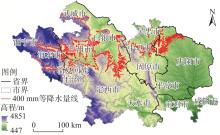
Fig. 1
Schematic diagram of the study area"
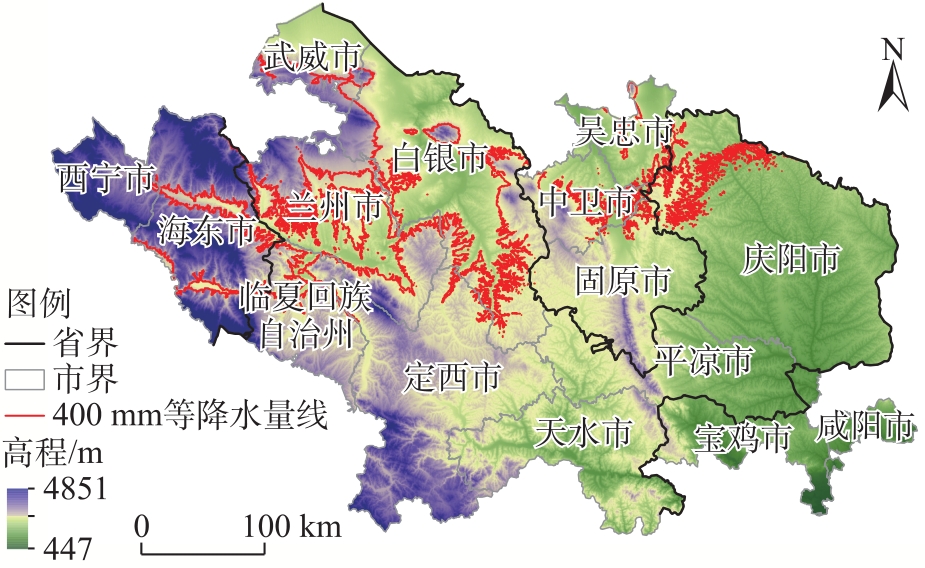
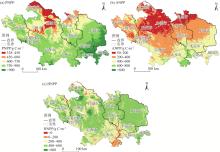
Fig. 2
Spatial distributions of mean PNPP, ANPP and HNPP in the Liupan Mountains area from 2001 to 2024"
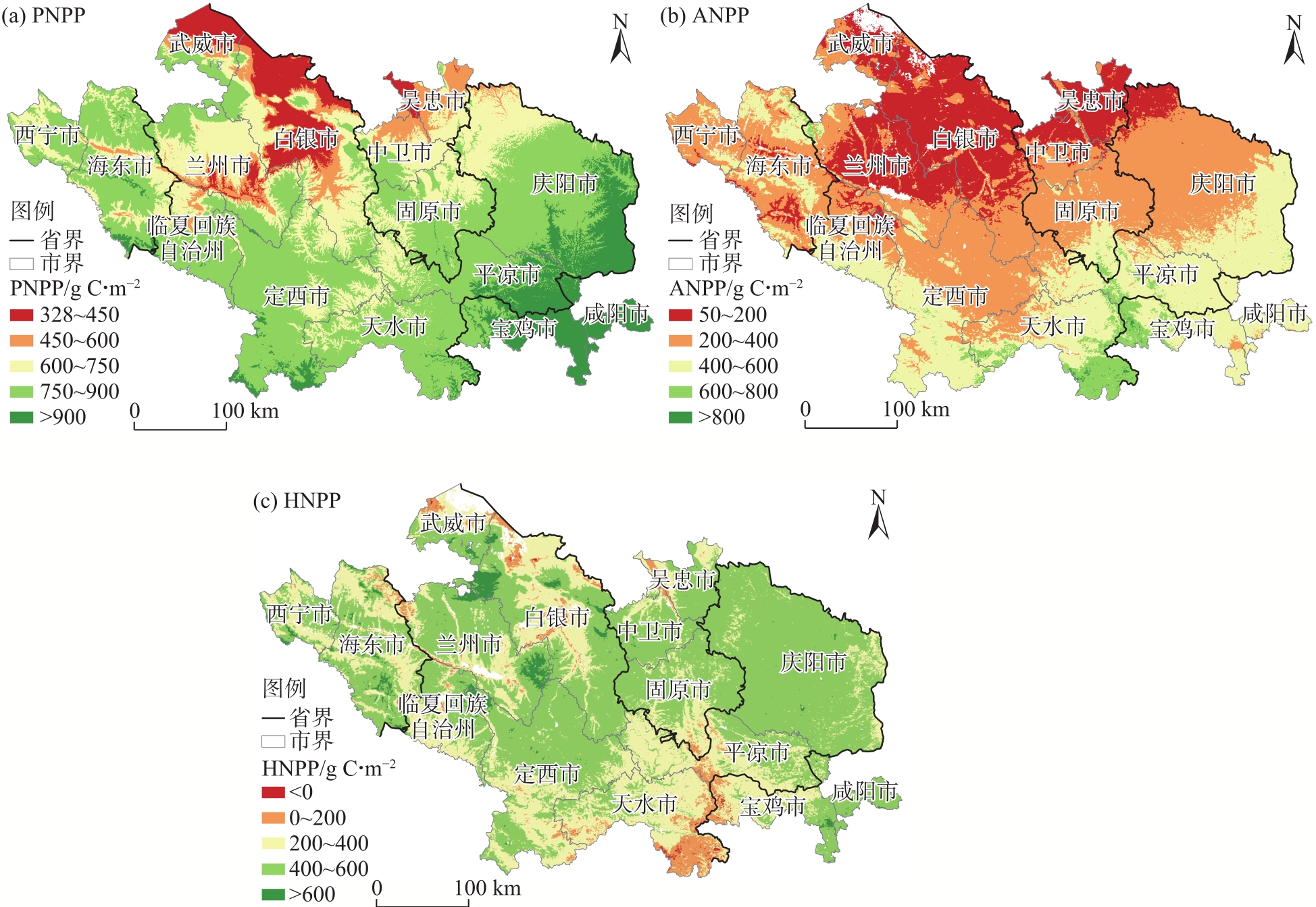
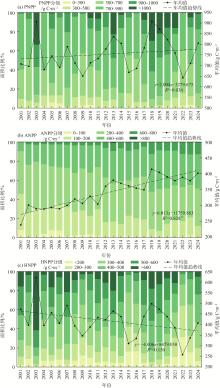
Fig. 3
Interannual variation trends of PNPP, ANPP and HNPP in the Liupan Mountains area from 2001 to 2024"

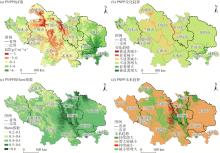
Fig. 4
Spatial distributions of the PNPP’s K-value, Hurst index and variation trends of PNPP in the Liupan Mountains area from 2001 to 2024"
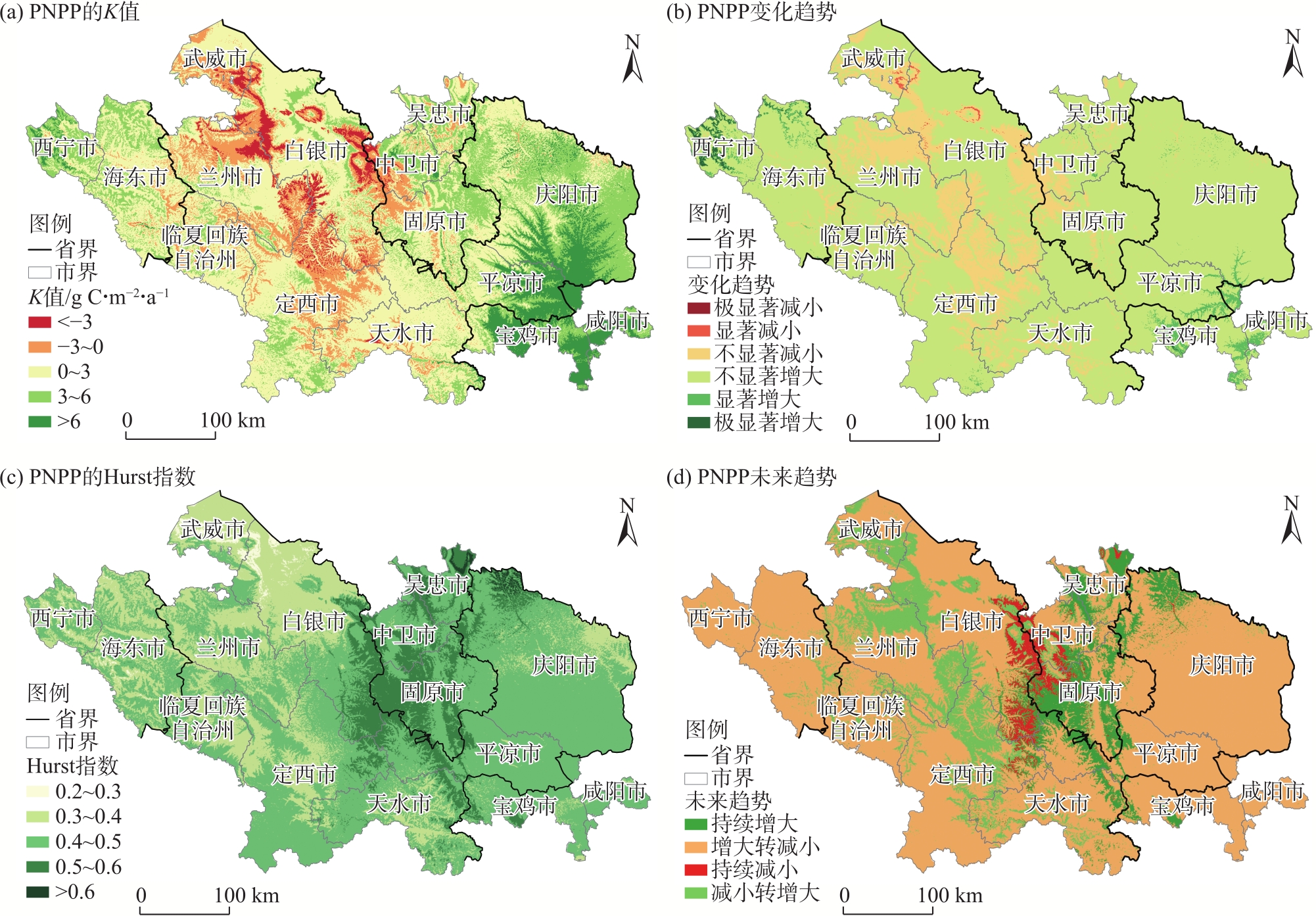
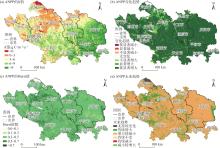
Fig. 5
Spatial distributions of the ANPP’s K-value, Hurst index and variation trends of ANPP in the Liupan Mountains area from 2001 to 2024"

Fig. 6
Spatial distributions of the HNPP’s K-value, Hurst index and variation trends of HNPP in the Liupan Mountains area from 2001 to 2024"
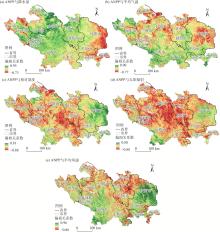
Fig. 7
Spatial distributions of partial correlation coefficients between ANPP and meteorological elements"

Fig. 8
Spatial distributions of partial correlation coefficients between ANPP and anthropogenic factors"
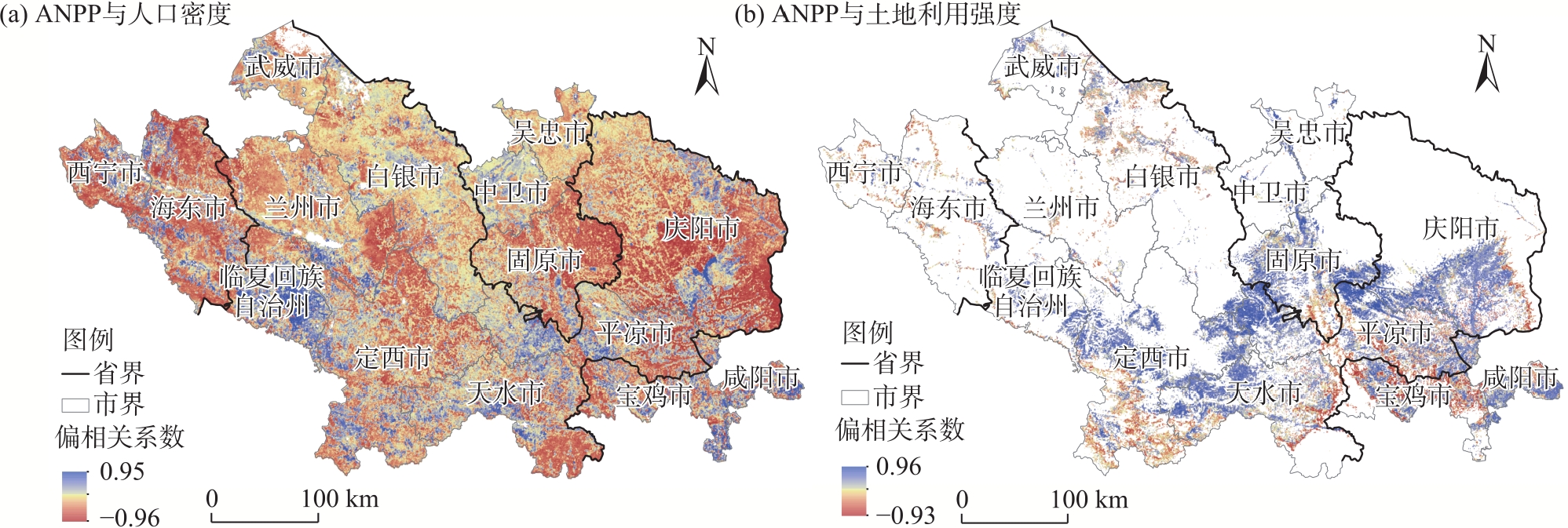
Fig. 9
Spatial distributions of the dominant driving forces for vegetation change"
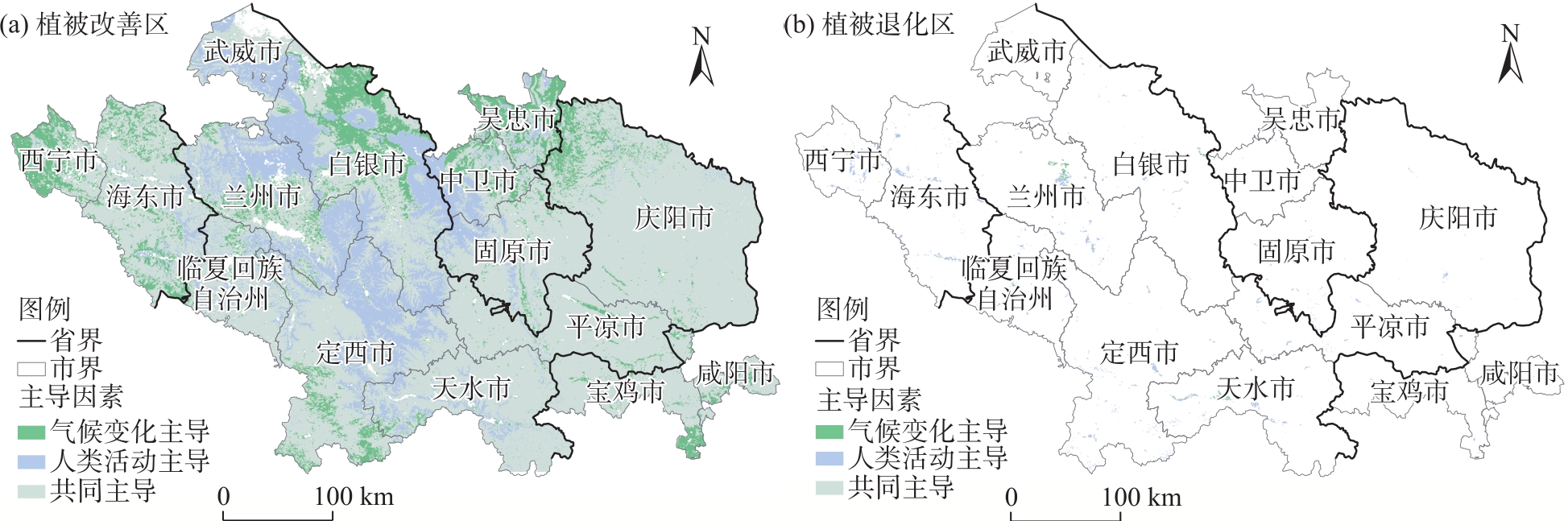
Fig. 10
Spatial distributions of the relative contributions of climate change and human activities in vegetation improvement and degradation areas"

| [1] |
Liu Y, Li Y, Li S C, et al. Spatial and temporal patterns of global NDVI trends: Correlations with climate and human factors[J]. Remote Sensing, 2015, 7(10): 13233-13250.
doi: 10.3390/rs71013233 |
| [2] |
Stow D A, Hope A, Mcguire D, et al. Remote sensing of vegetation and land-cover change in Arctic tundra ecosystems[J]. Remote Sensing of Environment, 2004, 89(3): 281-308.
doi: 10.1016/j.rse.2003.10.018 |
| [3] |
Yang Y, Wang Z Q, Li J L. Comparative assessment of grassland degradation dynamics in response to climate variation and human activities in China, Mongolia, Pakistan and Uzbekistan from 2000 to 2013[J]. Journal of Arid Environments, 2016, 135: 164-172.
doi: 10.1016/j.jaridenv.2016.09.004 |
| [4] | 许洁, 陈惠玲, 商沙沙, 等. 2000-2014年青藏高原植被净初级生产力时空变化及对气候变化的响应[J]. 干旱区地理, 2020, 43(3): 592-601. |
| [Xu Jie, Chen Huiling, Shang Shasha, et al. Response of net primary productivity of Tibetan Plateau vegetation to climate change based on CEVSA model[J]. Arid Land Geography, 2020, 43(3): 592-601. ] | |
| [5] |
Zhao M S, Running S W. Drought-induced reduction in global terrestrial net primary production from 2000 through 2009[J]. Science, 2010, 329: 940-943.
doi: 10.1126/science.1192666 pmid: 20724633 |
| [6] |
张飞, 李建, 李慧融, 等. 2001-2024年锡林郭勒盟草原净初级生产力时空特征及对影响因子的响应[J]. 干旱区地理, 2025, 48(9): 1555-1566.
doi: 10.12118/j.issn.1000-6060.2024.759 |
|
[Zhang Fei, Li Jian, Li Huirong, et al. Spatiotemporal characteristics of net primary productivity and its response to influencing factors in Xilin Gol League grassland from 2001 to 2024[J]. Arid Land Geography, 2025, 48(9): 1555-1566. ]
doi: 10.12118/j.issn.1000-6060.2024.759 |
|
| [7] | 杨钊, 冯克鹏, 冯雄. 宁夏扬黄灌溉工程区净初级生产力影响因素及其社会经济影响的定量评估[J]. 灌溉排水学报, 2025, 44(8): 93-103. |
| [Yang Zhao, Feng Kepeng, Feng Xiong. Quantitative assessment of influencing factors and socio-economic impacts of net primary productivity in the Yellow River Water-pumping Irrigation Project Areas, Ningxia[J]. Journal of Irrigation and Drainage, 2025, 44(8): 93-103. ] | |
| [8] | 刘文瑞, 李晓婷, 李彤, 等. 基于MODIS和CASA模型的伊春市森林植被NPP变化特征及其影响因子分析[J]. 生态学杂志, 2022, 41(1): 150-158. |
|
[Liu Wenrui, Li Xiaoting, Li Tong, et al. Spatiotemporal variations of forest NPP and related driving factors based on MODIS and CASA models in Yichun[J]. Chinese Journal of Ecology, 2022, 41(1): 150-158. ]
doi: 10.13292/j.1000-4890.202201.026 |
|
| [9] | 朱文泉, 陈云浩, 徐丹, 等. 陆地植被净初级生产力计算模型研究进展[J]. 生态学杂志, 2005, 24(3): 296-300. |
| [Zhu Wenquan, Chen Yunhao, Xu Dan, et al. Advances in terrestrial net primary productivity (NPP) estimation models[J]. Chinese Journal of Ecology, 2005, 24(3): 296-300. ] | |
| [10] | 徐勇, 周清华, 窦世卿, 等. 基于ZGS和TW模型的长江流域植被NPP时空演变特征[J]. 水土保持通报, 2022, 42(1): 225-232. |
| [Xu Yong, Zhou Qinghua, Dou Shiqing, et al. Spatiotemporal characteristics of vegetation net primary productivity in Yangtze River Basin based on ZGS and Thornthwaite Memorial models[J]. Bulletin of Soil and Water Conservation, 2022, 42(1): 225-232. ] | |
| [11] |
任涵玉, 温仲明, 刘洋洋, 等. 我国北方草地净初级生产力时空动态特征及其与水热因子的关系[J]. 草地学报, 2021, 29(8): 1779-1792.
doi: 10.11733/j.issn.1007-0435.2021.08.021 |
|
[Ren Hanyu, Wen Zhongming, Liu Yangyang, et al. Spatial-temporal dynamics of grassland net primary productivity and its relationship with hydrothermic factors in northern China[J]. Acta Agrestia Sinica, 2021, 29(8): 1779-1792. ]
doi: 10.11733/j.issn.1007-0435.2021.08.021 |
|
| [12] | 王川, 王丽莎, 张勇勇, 等. 2000-2020年祁连山植被净初级生产力时空变化及其驱动因素[J]. 生态学报, 2023, 43(23): 9710-9720. |
| [Wang Chuan, Wang Lisha, Zhang Yongyong, et al. Spatiotemporal change and driving factors of net primary productivity in Qilian Mountains from 2000 to 2020[J]. Acta Ecologica Sinica, 2023, 43(23): 9710-9720. ] | |
| [13] | 杨安乐, 张小平, 李宗省, 等. 气候变化和人类活动对祁连山国家公园植被净初级生产力的定量影响[J]. 生态学报, 2023, 43(5): 1784-1792. |
| [Yang Anle, Zhang Xiaoping, Li Zongsheng, et al. Quantitative analysis of the impacts of climate change and human activities on vegetation NPP in the Qilian Mountain National Park[J]. Acta Ecologica Sinica, 2023, 43(5): 1784-1792. ] | |
| [14] | 李慧, 魏兴萍. 重庆岩溶区和非岩溶区植被净初级生产力时空演变特征及其驱动因素[J]. 生态学报, 2025, 45(5): 2479-2493. |
| [Li Hui, Wei Xingping. Comparative study on spatio-temporal evolution and driving factors of NPP in karst and non-karst areas of Chongqing[J]. Acta Ecologica Sinica, 2025, 45(5): 2479-2493. ] | |
| [15] | Xi Z L, Chen G Z, Xing Y Q, et al. Spatial and temporal variation of vegetation NPP and analysis of influencing factors in Heilongjiang Province, China[J]. Ecological Indicators, 2023, 154: 110798, doi: 10.1016/j.ecolind.2023.110798. |
| [16] |
王劲峰, 徐成东. 地理探测器: 原理与展望[J]. 地理学报, 2017, 72(1): 116-134.
doi: 10.11821/dlxb201701010 |
|
[Wang Jinfeng, Xu Chengdong. Geodetector: Principle and prospective[J]. Acta Geographica Sinica, 2017, 72(1): 116-134. ]
doi: 10.11821/dlxb201701010 |
|
| [17] | Lu Z W, Chen P W, Yang Y R, et al. Exploring quantification and analyzing driving force for spatial and temporal differentiation characteristics of vegetation net primary productivity in Shandong Province, China[J]. Ecological Indicators, 2023, 153: 110471, doi: 10.1016/j.ecolind.2023.110471. |
| [18] |
石智宇, 王雅婷, 赵清, 等. 2001-2020年中国植被净初级生产力时空变化及其驱动机制分析[J]. 生态环境学报, 2022, 31(11): 2111-2123.
doi: 10.16258/j.cnki.1674-5906.2022.11.002 |
| [Shi Zhiyu, Wang Yating, Zhao Qing, et al. The spatiotemporal changes of NPP and its driving mechanisms in China from 2001 to 2020[J]. Ecology and Environmental Sciences, 2022, 31(11): 2111-2123. ] | |
| [19] |
赵慧, 崔洋, 李梦华, 等. 气候变化和人类活动对宁夏植被净初级生产力的影响[J]. 应用生态学报, 2025, 36(8): 2429-2441.
doi: 10.13287/j.1001-9332.202508.029 |
| [Zhao Hui, Cui Yang, Li Menghua, et al. Impacts of climate change and human activities on net primary productivity of vegetation in Ningxia northwest China[J]. Chinese Journal of Applied Ecology, 2025, 36(8): 2429-2441. ] | |
| [20] | 陈鹏飞, 王金颖, 诸云强. 黄土高原不同生态地理区植被净初级生产力变化与驱动力分析[J]. 生态科学, 2024, 43(3): 43-52. |
| [Chen Pengfei, Wang Jinying, Zhu Yunqiang. Analysis change of vegetation net primary productivity and its driving force in different eco-geographical zones on the Loess Plateau[J]. Ecological Science, 2024, 43(3): 43-52. ] | |
| [21] |
洪乐乐, 沈艳, 马红彬, 等. 2000-2019年宁夏植被净初级生产力时空变化及其驱动因素[J]. 应用生态学报, 2022, 33(10): 2769-2776.
doi: 10.13287/j.1001-9332.202210.019 |
|
[Hong Lele, Shen Yan, Ma Hongbing, et al. Temporal and spatial variation of vegetation net primary productivity and its driving factors in Ningxia, China from 2000 to 2019[J]. Chinese Journal of Applied Ecology, 2022, 33(10): 2769-2776. ]
doi: 10.13287/j.1001-9332.202210.019 |
|
| [22] | 蔡东东, 党小虎, 赵尚林, 等. 1990-2020年黄土高原农牧交错带草地NPP时空变化及其驱动机制[J]. 水土保持研究, 2025, 32(6): 236-244, 257. |
| [Cai Dongdong, Dang Xiaohu, Zhao Shanglin, et al. Spatiotemporal variation and driving mechanisms of grassland NPP in farming-pastoral ecotone of the Loess Plateau from 1990 to 2020[J]. Research of Soil and Water Conservation, 2025, 32(6): 236-244, 257. ] | |
| [23] | 袁倩颖, 马彩虹, 文琦, 等. 六盘山贫困区生长季植被覆盖变化及其对水热条件的响应[J]. 国土资源遥感, 2021, 33(2): 220-227. |
| [Yuan Qianying, Ma Caihong, Wen Qi, et al. Vegetation cover change and its response to water and heat conditions in the growing season in Liupanshan poverty-stricken area[J]. Remote Sensing for Land and Resources, 2021, 33(2): 220-227. ] | |
| [24] |
王云霓, 熊伟, 王彦辉, 等. 宁夏六盘山3种针叶林降水利用率的年际变化及其对气象因子的响应[J]. 植物生态学报, 2013, 37(10): 901-911.
doi: 10.3724/SP.J.1258.2013.00093 |
|
[Wang Yunni, Xiong Wei, Wang Yanhui, et al. Interannual variation of rain-use efficiency of three coniferous forests and their response to meteorological factors in Liupan Mountains of Ningxia[J]. Chinese Journal of Plant Ecology, 2013, 37(10): 901-911. ]
doi: 10.3724/SP.J.1258.2013.00093 |
|
| [25] | Lebakula V, Gonzales J, Stipek C, et al. LandScan 2024[DB/OL]. [2025-09-01]. https://landscan.ornl.gov/.OakRidgeNationalLaboratory.2024. |
| [26] |
Jiang W G, Yuan L H, Wang W J, et al. Spatio-temporal analysis of vegetation variation in the Yellow River Basin[J]. Ecological Indicators, 2015, 51: 117-126.
doi: 10.1016/j.ecolind.2014.07.031 |
| [27] | 张子凡, 熊茂秋, 李福杰, 等. 内蒙古草原自然资源大区植被净初级生产力时空变化及其影响因子分析[J]. 草业科学, 2022, 39(12): 2492-2502. |
| [Zhang Zifan, Xiong Maoqiu, Li Fujie, et al. Analysis of the temporal and spatial variations in net primary productivity of vegetation in the grassland region of Inner Mongolia and the factors influencing those changes[J]. Pratacultural Science, 2022, 39(12): 2492-2502. ] | |
| [28] |
John R, Chen J Q, Lu N, et al. Predicting plant diversity based on remote sensing products in the semi-arid region of Inner Mongolia[J]. Remote Sensing of Environment, 2008, 112(5): 2018-2032.
doi: 10.1016/j.rse.2007.09.013 |
| [29] |
马炳鑫, 靖娟利, 徐勇, 等. 2000-2019年滇黔桂岩溶区植被NPP时空变化及与气候变化的关系研究[J]. 生态环境学报, 2021, 30(12): 2285-2293.
doi: 10.16258/j.cnki.1674-5906.2021.12.002 |
| [Ma Bingxin, Jing Juanli, Xu Yong, et al. Spatial-temporal changes of NPP and its relationships with climate change in karst areas of Yunnan, Guizhou and Guangxi from 2000 to 2019[J]. Ecology and Environmental Sciences, 2021, 30(12): 2285-2293. ] | |
| [30] |
李诗瑶, 丛士翔, 王融融, 等. 气候变化和人类活动对盐池县植被净初级生产力的影响[J]. 干旱区地理, 2022, 45(4): 1186-1199.
doi: 10.12118/j.issn.1000-6060.2021.507 |
|
[Li Shiyao, Cong Shixiang, Wang Rongrong, et al. Effects of climate change and human activities on net primary productivity of vegetation in Yanchi County[J]. Arid Land Geography, 2022, 45(4): 1186-1199. ]
doi: 10.12118/j.issn.1000-6060.2021.507 |
|
| [31] | 潘帅, 于澎涛, 王彦辉, 等. 六盘山森林植被碳密度空间分布特征及其成因[J]. 生态学报, 2014, 34(22): 6666-6677. |
| [Pan Shuai, Yu Pengtao, Wang Yanhui, et al. Spatial distribution of carbon density for forest vegetation and the influencing factors in Liupan Mountains of Ningxia, NW China[J]. Acta Ecologica Sinica, 2014, 34(22): 6666-6677. ] | |
| [32] | 朱玉果, 杜灵通, 谢应忠, 等. 2000-2015年宁夏草地净初级生产力时空特征及其气候响应[J]. 生态学报, 2019, 39(2): 518-529. |
| [Zhu Yuguo, Du Lingtong, Xie Yingzhong, et al. Spatiotemporal characteristics of grassland net primary production in Ningxia Province from 2000 to 2015 and its response to climate change[J]. Acta Ecologica Sinica, 2019, 39(2): 518-529. ] | |
| [33] |
王娟, 何慧娟, 董金芳, 等. 黄河流域植被净初级生产力时空特征及自然驱动因子[J]. 中国沙漠, 2021, 41(6): 213-222.
doi: 10.7522/j.issn.1000-694X.2021.00116 |
|
[Wang Juan, He Huijuan, Dong Jinfang, et al. Spatio-temporal distribution of vegetation net primary productivity in the Yellow River Basin in 2000-2019 and its natural driving factors[J]. Journal of Desert Research, 2021, 41(6): 213-222. ]
doi: 10.7522/j.issn.1000-694X.2021.00116 |
|
| [34] | 李志军, 陈晓光, 李剑萍, 等. 六盘山植被覆盖度的变化及其与气温降水蒸发量的关系[J]. 安徽农业科学, 2010, 38(15): 8077-8081. |
| [Li Zhijun, Chen Xiaoguang, Li Jianping, et al. Variations of vegetation coverage in Liupan Mountains and its relationships with temperature, precipitation, and evaporation[J]. Journal of Anhui Agricultural Sciences, 2010, 38(15): 8077-8081. ] | |
| [35] | 同琳静, 刘洋洋, 王倩, 等. 西北植被净初级生产力时空变化及其驱动因素[J]. 水土保持研究, 2019, 26(4): 367-374. |
| [Tong Linjing, Liu Yangyang, Wang Qian, et al. Spatial and temporal dynamics of net primary productivity and its driving factors in northwest China[J]. Research of Soil and Water Conservation, 2019, 26(4): 367-374. ] | |
| [36] | 张心茹, 曹茜, 季舒平, 等. 气候变化和人类活动对黄河三角洲植被动态变化的影响[J]. 环境科学学报, 2022, 42(1): 56-69. |
| [Zhang Xinru, Cao Qian, Ji Shuping, et al. Quantifying the contributions of climate change and human activities to vegetation dynamic changes in the Yellow River Delta[J]. Acta Scientiae Circumstantiae, 2022, 42(1): 56-69. ] | |
| [37] | 雒新萍, 刘晓煌, 严宇翔, 等. 2000-2020年宁夏植被生长季变化及其对人类活动的响应[J]. 现代地质, 2025, 39(2): 504-513. |
| [Luo Xinping, Liu Xiaohuang, Yan Yuxiang, et al. Variation of vegetation during the growing season and its response to human activities in Ningxia during 2000-2020[J]. Geoscience, 2025, 39(2): 504-513. ] | |
| [38] | 王琪, 王永生, 杜国明, 等. 基于人地关系的干旱区耕地流转空间分异特征与驱动机制的地理探测[J]. 农业资源与环境学报, 2021, 38(2): 241-248. |
| [Wang Qi, Wang Yongsheng, Du Guoming, et al. Geographical exploration of spatial differentiation characteristics and driving mechanism of cultivated land circulation in arid regions based on human-land relationships[J]. Journal of Agricultural Resources and Environment, 2021, 38(2): 241-248. ] | |
| [39] |
刘一丹, 姚晓军, 李宗省, 等. 气候变化和土地利用覆盖变化对河西地区植被净初级生产力的影响[J]. 干旱区研究, 2024, 41(1): 169-180.
doi: 10.13866/j.azr.2024.01.16 |
|
[Liu Yidan, Yao Xiaojun, Li Zongxing, et al. Impacts of climate change and land use/cover change on the net primary productivity of vegetation in Hexi region, northwest China[J]. Arid Zone Research, 2024, 41(1): 169-180. ]
doi: 10.13866/j.azr.2024.01.16 |
|
| [40] | Xu Y, Lu Y G, Zou B, et al. Unraveling the enigma of NPP variation in Chinese vegetation ecosystems: The interplay of climate change and land use change[J]. Science of the Total Environment, 2024, 912: 169023, doi: 10.1016/j.scitotenv.2023.169023. |
| [41] |
Liu Y K, Huang C L, Yang C, et al. Spatiotemporal variation and driving factors of vegetation net primary productivity in the Guan-zhong Plain urban agglomeration, China from 2001 to 2020[J]. Journal of Arid Land, 2025, 17(1): 74-92.
doi: 10.1007/s40333-025-0070-2 |
| [42] | 吴小梅. 甘肃地区土地沙化现状、形成原因及防沙治沙措施分析[J]. 现代园艺, 2023, 46(18): 178-180. |
| [Wu Xiaomei. Current status, formation mechanisms, and countermeasures for desertification control in Gansu Province, China[J]. Contemporary Horticulture, 2023, 46(18): 178-180. ] |
| [1] | ZHANG Qifei, YUAN Zebin, CHEN Yaning, XIANG Yanyun, JIA Rong, LIU Yuting. Spatiotemporal dynamic changes of typical lakes on the northern slope of Kunlun Mountains from 1990 to 2024 [J]. Arid Land Geography, 2026, 49(8): 1531-1544. |
| [2] | ZHAI Yongjian, YAO Junqiang, QIN Yan. Progress on climate change and its impacts in the arid Central Asia: A bibliometric analysis [J]. Arid Land Geography, 2026, 49(8): 1545-1559. |
| [3] | YAN Pengxu, ZHANG Lihua, ZENG Fanxing, BAI Xiaohui, YE Yang, CAO Yijie. Spatiotemporal changes and influencing factors of water and carbon variables in the Qinghai Lake Basin over the past 25 years [J]. Arid Land Geography, 2026, 49(8): 1572-1586. |
| [4] | ZHAO Jianrong, SHI Hongyan, NI Honghe, YANG Wenhua, LIU Dongwei. Comprehensive evaluation of desertification in the Mongolian Plateau based on a multi-factor linear model [J]. Arid Land Geography, 2026, 49(8): 1700-1710. |
| [5] | GUAN Jingyun, SUN Zhiyang, XU Xiaoliang, CHENG Yifeng, SONG Beibei, FANG Ruiying. Spatiotemporal evolution of tourism climate comfort in Xinjiang, China and five Central Asian countries under climate change [J]. Arid Land Geography, 2026, 49(4): 697-712. |
| [6] | LIU Yaqi, LI Jianyong, WANG Ninglian, RAN Yi. Quantitative reconstructions of paleofire and their driving mechanisms in Wenquan County, western Tianshan Mountains over the past 5000 years [J]. Arid Land Geography, 2026, 49(4): 804-815. |
| [7] | ZHANG Bo, XU Honggang. A review of the impacts and risks of climate change on mountain glacier tourism [J]. Arid Land Geography, 2026, 49(3): 474-483. |
| [8] | CHEN Bing, WANG Futao, WANG Shixin, GU Xingguang, ZHU Jinfeng. Characteristics and driving factors of glacial lake changes in transboundary basins between China and Bhutan [J]. Arid Land Geography, 2026, 49(3): 496-507. |
| [9] | CAO Xiaoyun, ZHOU Bingrong, LEI Chunmiao, LIU Zhiyuan, SHI Feifei, YAN Yuqian. Spatiotemporal changes of snow depth and climate attribution in the Three River Source Region from 1980 to 2020 based on remote sensing monitoring [J]. Arid Land Geography, 2026, 49(2): 356-368. |
| [10] | ZHANG Fei, LI Jian, LI Huirong, XIE Tao, ZHANG Xuehong, WANG Chao, BAI Shuying, SONG Zhengshan. Spatiotemporal characteristics of net primary productivity and its response to influencing factors in Xilin Gol League grassland from 2001 to 2024 [J]. Arid Land Geography, 2025, 48(9): 1555-1566. |
| [11] | LI Wenhua, LI Shengyu, XU Xinwen, MIAO Jiamin, LYU Zhentao. Predicting the potential distribution of Artemisia songarica in Xinjiang under climate change based on the MaxEnt model [J]. Arid Land Geography, 2025, 48(9): 1578-1588. |
| [12] | ZHANG Kexin, ZHAO Yujuan, LI Meiyu. Hail climate characteristics and influencing factors in eastern Gansu Province from 1978 to 2023 [J]. Arid Land Geography, 2025, 48(8): 1374-1384. |
| [13] | CHEN Shilong, MENG Qingkai, DAI Yong, YANG Liqiang, WU Han. Geological disaster hazard assessment and prediction in the Ili River Basin based on CMIP6 future scenarios [J]. Arid Land Geography, 2025, 48(4): 599-611. |
| [14] | YAO Di, ZHANG Ziwen, HAN Weiwei. Distinguishing climate- and human-driven water storage anomalies in the Yellow River Basin [J]. Arid Land Geography, 2025, 48(2): 190-201. |
| [15] | GAO Na, CUI Yang, GAO Ruina, LI Wanchun, SUN Jian, LI Xin. Impact of urbanization on local temperatures in different functional areas of cities in arid regions [J]. Arid Land Geography, 2025, 48(12): 2132-2142. |
|
||