Arid Land Geography ›› 2026, Vol. 49 ›› Issue (7): 1385-1394.doi: 10.12118/j.issn.1000-6060.2025.343
• Land Use and Ecosystem • Previous Articles Next Articles
WANG Ziyang1( ), XIA Yong1(), WANG Fuhong1,2, DING Ning1, LYU Yi1, SU Zechen3
Received:2025-06-12
Revised:2025-07-02
Online:2026-07-25
Published:2026-07-07
Contact:
XIA Yong
E-mail:wsqy113@163.com;x0991y@163.com
WANG Ziyang, XIA Yong, WANG Fuhong, DING Ning, LYU Yi, SU Zechen. Spatiotemporal evolution and driving factors of ecological efficiency of cultivated land use in counties of Xinjiang[J].Arid Land Geography, 2026, 49(7): 1385-1394.
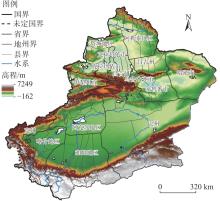
Fig. 1
Schematic diagram of the study area"
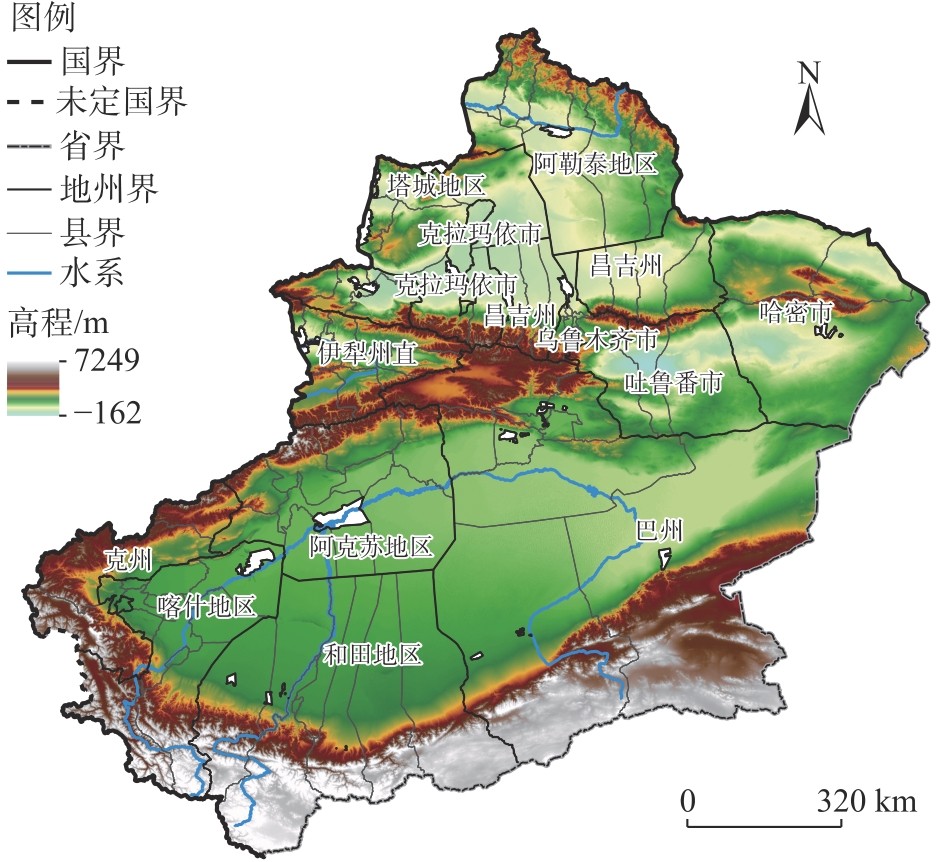
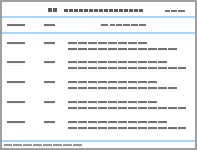
Tab. 1
Evaluation index system of ecological efficiency of cultivated land use"
| 指标类别 | 指标名称 | 指标释义 |
|---|---|---|
| 投入指标 | 土地投入 | 耕地面积/hm2 |
| 劳动力投入 | 从事农业人员/人 | |
| 农机投入 | 农业机械总动力/kW | |
| 化肥投入 | 化肥施用折纯量/t | |
| 期望产出指标 | 农业产值 | 农业总产值/104元 |
| 粮食产量 | 粮食总产量/t | |
| 非期望产出指标 | 碳排放 | 耕地利用碳排放量/t |
Tab. 2
Selection of indicators for factors influencing ecological efficiency of cultivated land use"
| 变量类型 | 解释变量 | 指标释义 |
|---|---|---|
| 自然资源禀赋 | 水土协调比例(X1) | 水域面积与耕地面积之比 |
| 农业科技创新 | 农业专业化服务(X2) | 专业化服务产值与农林牧渔业总产值之比 |
| 机械化水平(X3) | 机械总动力与农作物播种面积之比/kW·hm-2 | |
| 农业基础设施 | 地膜覆盖率(X4) | 地膜覆盖面积与农作物播种面积之比 |
| 农业种植收益 | 人均农业产值(X5) | 农业总产值与乡村人口之比/104元·人-1 |
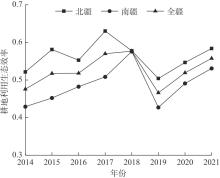
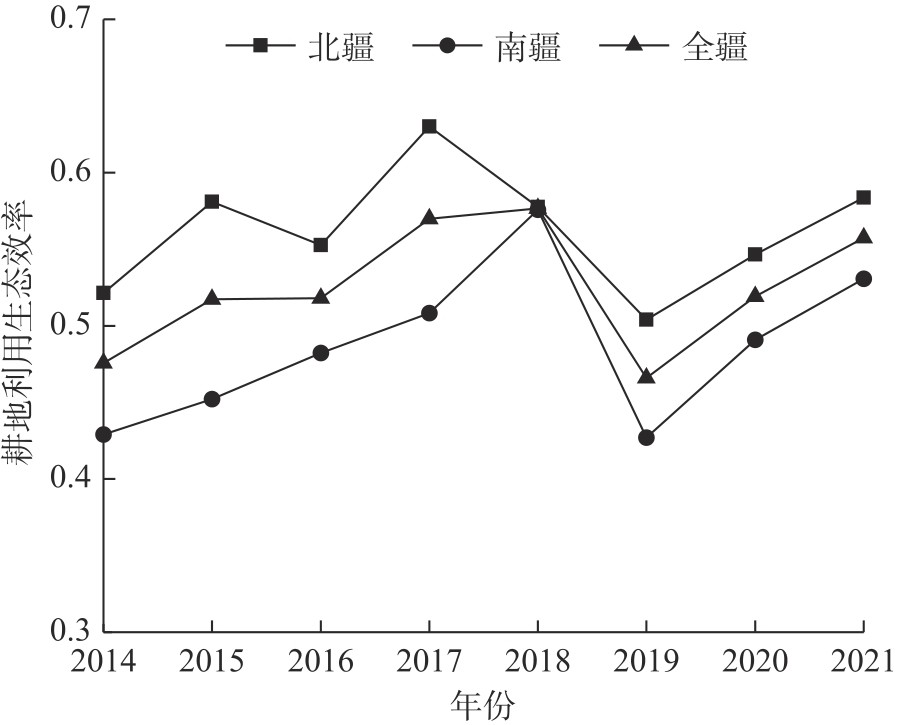
Fig. 2
Change trend of ecological efficiency of cultivated land use in Xinjiang from 2014 to 2021"
Tab. 3
Global Moran’s I of ecological efficiency of cultivated land use in Xinjiang from 2014 to 2021"
| 年份 | 全局Moran’s I | Z值 |
|---|---|---|
| 2014 | 0.076** | 2.276 |
| 2015 | 0.174*** | 4.831 |
| 2016 | 0.122*** | 3.484 |
| 2017 | 0.171*** | 4.756 |
| 2018 | 0.013 | 0.679 |
| 2019 | 0.079** | 2.374 |
| 2020 | 0.100** | 2.942 |
| 2021 | 0.151*** | 4.195 |
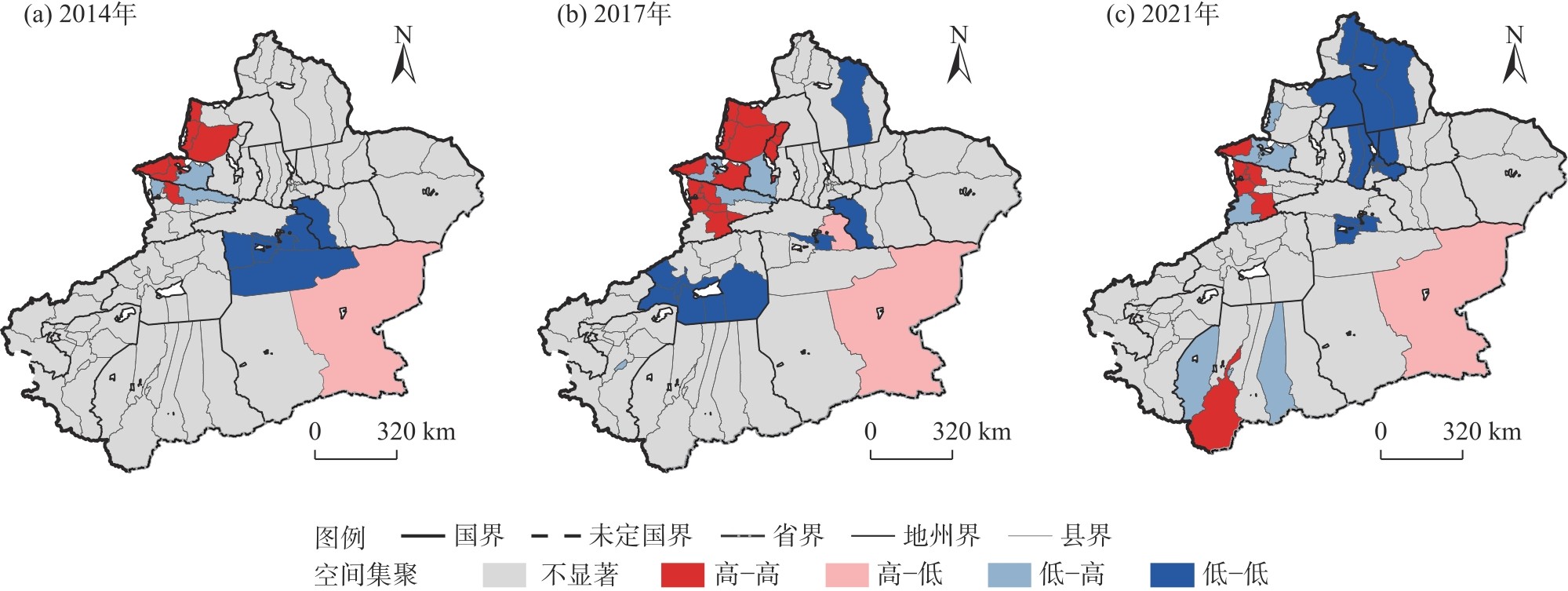
Fig. 3
LISA agglomeration of ecological efficiency of cultivated land use in Xinjiang from 2014 to 2021"
Tab. 4
Regression results of factors affecting ecological efficiency of cultivated land use in Xinjiang"
| 变量名称 | 系数 | 标准误差 | T值 | P值 |
|---|---|---|---|---|
| 水土协调比例 | 0.295 | 0.157 | 1.880 | 0.061 |
| 农业专业化服务 | 0.048 | 0.022 | 2.160 | 0.031 |
| 机械化水平 | -0.129 | 0.062 | -2.080 | 0.038 |
| 地膜覆盖率 | -0.186 | 0.094 | -1.970 | 0.049 |
| 人均农业产值 | 0.033 | 0.010 | 3.380 | 0.001 |
| 常数项 | 0.759 | 0.134 | 5.640 | 0.000 |
| 地区固定效应 | 控制 | |||
| 年份固定效应 | 控制 | |||
| R2 | 0.116 | |||
| [1] | 冯起, 尹鑫卫, 朱猛, 等. 统筹推进西北地区盐碱地综合治理利用: 现状、挑战与对策建议[J]. 中国科学院院刊, 2024, 39(12): 2060-2073. |
| [Feng Qi, Yin Xinwei, Zhu Meng, et al. Overall promotion of integrated management and utilization of saline-alkali land in northwest China: Conditions, challenges, and recommendations[J]. Bulletin of Chinese Academy of Sciences, 2024, 39(12): 2060-2073.] | |
| [2] | Wang J Y, Su D, Wu Q, et al. Study on eco-efficiency of cultivated land utilization based on the improvement of ecosystem services and emergy analysis[J]. Science of the Total Environment, 2023, 882: 163489, doi: 10.1016/j.scitotenv.2023.163489. |
| [3] |
王福红, 夏咏. 干旱区主要农作物生产时空格局演化及影响因素分析——以新疆地区为例[J]. 干旱区地理, 2025, 48(3): 444-454.
doi: 10.12118/j.issn.1000-6060.2024.201 |
|
[Wang Fuhong, Xia Yong. Spatio-temporal pattern evolution and influencing factors of main cropsproduction in arid region: A case of Xinjiang[J]. Arid Land Geography, 2025, 48(3): 444-454.]
doi: 10.12118/j.issn.1000-6060.2024.201 |
|
| [4] |
丁建丽, 王飞. 干旱区大尺度土壤盐度信息环境建模: 以新疆天山南北中低海拔冲积平原为例[J]. 地理学报, 2017, 72(1): 64-78.
doi: 10.11821/dlxb201701006 |
|
[Ding Jianli, Wang Fei. Environmental modeling of large-scale soil salinity informationin an arid region: A case study of the low and middle altitude alluvial plain north and south of the Tianshan Mountains, Xinjiang[J]. Acta Geographica Sinica, 2017, 72(1): 64-78.]
doi: 10.11821/dlxb201701006 |
|
| [5] | Yang B, Wang Z Q, Zou L, et al. Exploring the eco-efficiency of cultivated land utilization and its influencing factors in China’s Yangtze River Economic Belt, 2001—2018[J]. Journal of Environmental Management, 2021, 294: 112939, doi: 10.1016/j.jenvman.2021.112939. |
| [6] | 张红梅, 宋戈. 黑龙江垦区耕地利用生态效率及其内部协调性[J]. 华中农业大学学报(社会科学版), 2019(4): 160-168, 178. |
| [Zhang Hongmei, Song Ge. Eco-efficiency of cultivated land use and the internal coordinationin Heilongjiang reclamation area[J]. Journal of Huazhong Agricultural University (Social Sciences Edition), 2019(4): 160-168, 178.] | |
| [7] | 吕添贵, 付舒斐, 胡晗, 等. 农业绿色转型约束下耕地利用生态效率时空分异特征及空间效应[J]. 水土保持研究, 2024, 31(1): 269-279, 289. |
| [Lü Tiangui, Fu Shufei, Hu Han, et al. Spatiotemporal differentiation characteristics and spatial effects of ecological efficiency of cultivated land use based on the constraints of agricultural green transformation[J]. Research of Soil and Water Conservation, 2024, 31(1): 269-279, 289.] | |
| [8] | 吴诗嫚, 丁如, 匡兵, 等. 土地综合整治对耕地利用生态效率的影响研究——基于农户微观数据的实证分析[J]. 中国土地科学, 2023, 37(11): 95-105. |
| [Wu Shiman, Ding Ru, Kuang Bing, et al. Impact of comprehensive land consolidation on ecological efficiency of cultivated land use: Empirical analysis based on the microsurvey data of farmers[J]. China Land Science, 2023, 37(11): 95-105.] | |
| [9] |
文高辉, 刘蒙罢, 胡贤辉, 等. 洞庭湖平原耕地利用生态效率空间相关性与空间效应[J]. 地理科学, 2022, 42(6): 1102-1112.
doi: 10.13249/j.cnki.sgs.2022.06.016 |
| [Wen Gaohui, Liu Mengba, Hu Xianhui, et al. Spatial correlation and spatial effect of cultivated land use ecological efficiency in the Dongting Lake Plain[J]. Geographical Science, 2022, 42(6): 1102-1112.] | |
| [10] | 李继霞, 王华春, 樊骋琳. “双碳”目标下中国耕地利用生态效率的区域差异、动态演进及收敛性[J]. 华中农业大学学报(社会科学版), 2023(5): 167-181. |
| [Li Jixia, Wang Huachun, Fan Chenglin. Regional differences dynamic evolution and convergence of ecological efficiency of cultivated land use in China under the dual carbon target[J]. Journal of Huazhong Agricultural University (Social Sciences Edition), 2023(5): 167-181.] | |
| [11] | 杨和平, 李红波. 农业新质生产力对耕地利用生态效率的影响——以长江经济带为例[J]. 中国土地科学, 2024, 38(11): 94-104. |
| [Yang Heping, Li Hongbo. Impact of agricultural new quality productivity on ecological efficiency of cultivated land use: A case study of the Yangtze River Economic Belt[J]. China Land Science, 2024, 38(11): 94-104.] | |
| [12] | 周爱群, 陈彩虹. 耕地利用生态效率的时空演变及影响因素研究[J]. 经济问题, 2023(12): 95-101. |
| [Zhou Aiqun, Chen Caihong. Temporal and spatial evolution and influencing factors of ecological efficiency of cultivated land use[J]. On Economic Problems, 2023(12): 95-101.] | |
| [13] | 刘蒙罢, 张安录, 文高辉. 长江中下游粮食主产区耕地利用生态效率时空格局与演变趋势[J]. 中国土地科学, 2021, 35(2): 50-60. |
| [Liu Mengba, Zhang Anlu, Wen Gaohui. Temporal and spatial pattern and evolution trend of cultivated land use ecological efficiency in the main grain producing areas in the lower Yangtze region[J]. China Land Science, 2021, 35(2): 50-60.] | |
| [14] |
王良健, 李辉. 中国耕地利用效率及其影响因素的区域差异——基于281个市的面板数据与随机前沿生产函数方法[J]. 地理研究, 2014, 33(11): 1995-2004.
doi: 10.11821/dlyj201411001 |
| [Wang Liangjian, Li Hui. Cultivated land use efficiency and the regional characteristics of its influencing factors in China: By using a panel data of 281 prefectural cities and the stochastic frontier production function[J]. Geographical Research, 2014, 33(11): 1995-2004.] | |
| [15] | 刘沙沙, 蒲金芳, 张蚌蚌, 等. 基于动态网络二阶段DEA模型的洞庭湖区耕地利用效率研究[J]. 中国农业大学学报, 2022, 27(12): 257-269. |
| [Liu Shasha, Pu Jinfang, Zhang Bangbang, et al. Cultivated landutilization efficiency in Dongting Lake area: Based on a dynamic network two-stage DEA model[J]. Journal of China Agricultural University, 2022, 27(12): 257-269.] | |
| [16] | 陈丹玲, 卢新海, 匡兵. 基于随机森林的耕地利用效率测度模型构建及其应用[J]. 自然资源学报, 2019, 34(6): 1331-1344. |
|
[Chen Danling, Lu Xinhai, Kuang Bing. Measurement of cultivated land utilization efficiency: Construction and application of random forest[J]. Journal of Natural Resources, 2019, 34(6): 1331-1344.]
doi: 10.31497/zrzyxb.20190618 |
|
| [17] | 马林燕, 张仁慧, 潘子纯, 等. 中国省际耕地利用生态效率时空格局演变及影响因素分析——基于2000—2019年面板数据[J]. 中国土地科学, 2022, 36(3): 74-85. |
| [Ma Linyan, Zhang Renhui, Pan Zichun, et al. Analysis of the evolution and influencing factors of temporal and spatial pattern of eco-efficiency of cultivated land use among provinces in China: Based on panel data from 2000 to 2019[J]. China Land Science, 2022, 36(3): 74-85.] | |
| [18] |
Huang K P, Tang W, Zhou F M, et al. Agricultural productive services and ecological efficiency of cultivated land use: Evidence from Hunan Province, China[J]. Polish Journal of Environmental Studies, 2024, 33: 5127-5140.
doi: 10.15244/pjoes/182907 |
| [19] | 薛选登, 谢宇. 黄河流域粮食主产区耕地利用生态效率时空差异与空间收敛——来自60个地级市的经验证据[J]. 中国农业资源与区划, 2024, 45(4): 52-65. |
| [Xue Xuandeng, Xie Yu. The spatial-temporal differences and cpatial convergence of ecological efficiency in cultivated land utilization in the main grain-producing areas of the Yellow River Basin: Evidence from 60 prefecture-level cities[J]. Chinese Journal of Agricultural Resources and Regional Planning, 2024, 45(4): 52-65.] | |
| [20] | 胡贤辉, 蔺思琪, 何庆, 等. 耕地细碎化、耕地经营规模对农户耕地利用生态效率的影响——以常德市为例[J]. 中国土地科学, 2023, 37(4): 95-106. |
| [Hu Xianhui, Lin Siqi, He Qing, et al. Effects of cultivated land fragmentation and cultivated land operation scale on ecological efficiency of famers’ cultivated land use: A case study of Changde City[J]. China Land Science, 2023, 37(4): 95-106.] | |
| [21] | 朱文娟, 孙华. 江苏省县域耕地利用生态效率时空动态性及驱动机制[J]. 长江流域资源与环境, 2024, 33(4): 784-798. |
| [Zhu Wenjuan, Sun Hua. Spatio-temporal dynamics and driving mechanism of cultivated land use eco-efficiency at county scale in Jiangsu Province[J]. Resources and Environment in the Yangtze Basin, 2024, 33(4): 784-798.] | |
| [22] | 杨欣, 杜梦晴, 肖豪立, 等. 湖北省县域新型城镇化与耕地利用生态效率时空耦合关系研究[J]. 长江流域资源与环境, 2024, 33(10): 2180-2190. |
| [Yang Xin, Du Mengqing, Xiao Haoli, et al. Coupling relationship between new-type urbanization and farmland utilization eco-efficiency at county-level in Hubei Province[J]. Resources and Environment in the Yangtze Basin, 2024, 33(10): 2180-2190.] | |
| [23] | 阿曼妮萨·库尔班, 满苏尔·沙比提, 艾克旦·依萨克, 等. 近19年新疆阿克苏河流域耕地利用时空演变特征[J]. 中国水土保持科学(中英文), 2022, 20(3): 72-80. |
| [Kuerban Amannisa, Shabit Mansuer, Yisake Aikedan, et al. Spatiotemporal evolution of arable land use in Aksu River Basin, Xinjiang in recent 19 years[J]. Science of Soil and Water Conservation, 2022, 20(3): 72-80.] | |
| [24] |
吕宁, 国语, 彭琴, 等. 新疆耕地利用碳源/汇效应时空演变特征及其贡献因子[J]. 干旱区研究, 2025, 42(1): 179-190.
doi: 10.13866/j.azr.2025.01.16 |
|
[Lü Ning, Guo Yu, Peng Qin, et al. Spatiotemporal evolution characteristics and contributing factors of the carbon effect in cultivated land use in Xinjiang[J]. Arid Zone Research, 2025, 42(1): 179-190.]
doi: 10.13866/j.azr.2025.01.16 |
|
| [25] | 各文克, 王浩阳, 李奇峰, 等. 新疆耕地景观细碎化演变特征及驱动因素[J]. 水土保持研究, 2025, 32(3): 260-269. |
| [Ge Wenke, Wang Haoyang, Li Qifeng, et al. Evolution characteristics and driving factors of farmland landscape fragmentation in Xinjiang[J]. Research of Soil and Water Conservation, 2025, 32(3): 260-269.] | |
| [26] |
李亮亮, 夏咏, 王福红, 等. 新疆甜瓜生产格局及其贡献因素分析[J]. 干旱区地理, 2025, 48(9): 1567-1577.
doi: 10.12118/j.issn.1000-6060.2024.631 |
|
[Li Liangliang, Xia Yong, Wang Fuhong, et al. Analysis of muskmelon production pattern and its contributing factors in Xinjiang[J]. Arid Land Geography, 2025, 48(9): 1567-1577.]
doi: 10.12118/j.issn.1000-6060.2024.631 |
|
| [27] | 王鹏程, 张利国, 陆汝成. “边境-粮食-生态”安全视域下耕地利用生态效率演变特征与机制——以中越边境地区为例[J]. 生态学报, 2024, 44(11): 4637-4649. |
| [Wang Pengcheng, Zhang Liguo, Lu Rucheng. Evolution characteristics and mechanism of cultivated land use eco-efficiency from the triple-security perspective in China-Vietnam border area[J]. Acta Ecologica Sinica, 2024, 44(11): 4637-4649.] | |
| [28] | 李波, 张俊飚, 李海鹏. 中国农业碳排放时空特征及影响因素分解[J]. 中国人口·资源与环境, 2011, 21(8): 80-86. |
| [Li Bo, Zhang Junbiao, Li Haipeng. Research on spatial-temporal characteristics and affecting factors decomposition of agricultural carbon emission in China[J]. China Population, Resources and Environment, 2011, 21(8): 80-86.] | |
| [29] |
Tone K. A slacks-based measure of efficiency in data envelopment analysis[J]. European Journal of Operational Research, 2001, 130: 498-509.
doi: 10.1016/S0377-2217(99)00407-5 |
| [30] | 官卫华, 江璇. 国内外耕地保护补偿实践及其启示[J]. 规划师, 2021, 37(13): 80-86, 94. |
| [Guan Weihua, Jiang Xuan. Practice and inspiration of farmland compensation at home and abroad[J]. Planners, 2021, 37(13): 80-86, 94.] | |
| [31] | 和田地区融媒体中心. 和田戈壁沙漠设施农业蓬勃兴起[EB/OL]. [2025-01-05]. https://mp.weixin.qq.com/s/thb0bCbnVEICjntUQGoVAw. |
| [Hotan Regional Media Convergence Center. Facility agriculture has flourished in the gobi desert region of Hotan[EB/OL]. [2025-01-05]. https://mp.weixin.qq.com/s/thb0bCbnVEICjntUQGoVAw.] | |
| [32] | 石志恒, 符越. 社会化服务对农户农药减量行为的影响——基于服务专业化维度的考察[J]. 中国农业资源与区划, 2023, 44(3): 130-142. |
| [Shi Zhiheng, Fu Yue. Influnce of socialized service on framers pesticide reduction behavior: Investigation based on the dimension of service specialization[J]. Chinese Journal of Agricultural Resources and Regional Planning, 2023, 44(3): 130-142.] | |
| [33] | 刘成坤, 汪乐, 孟静静. 农业机械化影响农业生态效率的理论分析及实证检验[J]. 中国生态农业学报(中英文), 2025, 33(6): 1219-1234. |
| [Liu Chengkun, Wang Le, Meng Jingjing. Theoretical analysis and empirical testing of the impact of agricultural mechanization on agricultural eco-efficiency[J]. Chinese Journal of Eco-Agriculture, 2025, 33(6): 1219-1234.] | |
| [34] | 杜美玲, 祝宏辉, 尹小君. 农业机械化对农业生态效率的影响研究[J]. 农业现代化研究, 2023, 44(6): 1082-1092. |
| [Du Meiling, Zhu Honghui, Yin Xiaojun. Study on the impact of agricultural mechanization on agricultural ecological efficiency[J]. Research of Agricultural Modernization, 2023, 44(6): 1082-1092.] | |
| [35] | 王永静, 陈增增. 天山北坡经济带农业生态效率评价及提升路径研究——基于Super-SBM模型和Global-Malmquist指数[J]. 生态经济, 2020, 36(2): 111-117. |
| [Wang Yongjing, Chen Zengzeng. Study on agricultural ecology efficiency evaluation and improvement path of economic belt on the north slope of Tianshan Mountains: Based on the Super-SBM and Global-Malmquist index[J]. Ecological Economy, 2020, 36(2): 111-117.] | |
| [36] | 韩佳敏, 孟梅. “双碳”目标下新疆耕地利用生态效率时空演变特征及原因分析[J]. 中国农机化学报, 2025, 46(2): 287-294. |
| [Han Jiamin, Meng Mei. Analysis on characteristics and causes of spatial and temporal evolution of cropland utilization eco-efficiency in Xinjiang under the “dual-carbon” target[J]. Journal of Chinese Agricultural Mechanization, 2025, 46(2): 287-294.] | |
| [37] |
焦岩, 闫峰, 卢琦, 等. 西北干旱区绿洲时空变化及驱动力[J]. 应用生态学报, 2024, 35(8): 2206-2216.
doi: 10.13287/j.1001-9332.202408.025 |
|
[Jiao Yan, Yan Feng, Lu Qi, et al. Spatiotemporal variation and driving factors of oases in the arid region of northwest China[J]. Chinese Journal of Applied Ecology, 2024, 35(8): 2206-2216.]
doi: 10.13287/j.1001-9332.202408.025 |
|
| [38] |
杜辰, 刘涛, 黄大全, 等. 中国空间规划耕地保护指标分配和优化——以2006—2020年省级土地利用总体规划为例[J]. 自然资源学报, 2023, 38(5): 1240-1261.
doi: 10.31497/zrzyxb.20230509 |
|
[Du Chen, Liu Tao, Huang Daquan, et al. The allocation and optimization of the area of cultivated land reserved in China’s spatial planning: Taking the 2006—2020 provincial overall plans for land utilization as example[J]. Journal of Natural Resources, 2023, 38(5): 1240-1261.]
doi: 10.31497/zrzyxb.20230509 |
|
| [39] | 谷琴, 渠丽萍. “双碳”背景下河南省耕地绿色利用效率时空变化及影响因素研究[J]. 资源开发与市场, 2025, 41(8): 1142-1149. |
| [Gu Qin, Qu Liping. Research on spatio-temporal variation and influencing factors of green utilization efficiency of cultivated land in Henan Province under the “dual carbon” background[J]. Resource Development & Market, 2025, 41(8): 1142-1149.] |
|
||