Arid Land Geography ›› 2026, Vol. 49 ›› Issue (7): 1395-1404.doi: 10.12118/j.issn.1000-6060.2025.369
• Land Use and Ecosystem • Previous Articles Next Articles
ZHANG Dengke1( ), ZHANG Yanhong1(), ZHANG Pengju2, ZHANG Wanguang1
Received:2025-06-19
Revised:2025-09-29
Online:2026-07-25
Published:2026-07-07
Contact:
ZHANG Yanhong
E-mail:konamizdk@gmail.com;zhyh9606@163.com
ZHANG Dengke, ZHANG Yanhong, ZHANG Pengju, ZHANG Wanguang. Spatiotemporal changes and influencing factors of land use and vegetation cover in Qingyang City from 2000 to 2022[J].Arid Land Geography, 2026, 49(7): 1395-1404.
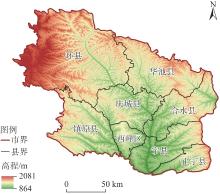
Fig. 1
Overview of the study area"
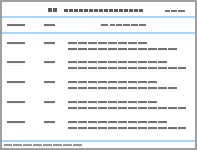
Tab. 1
Classification of vegetation status trend"
| Sen趋势值(β) | Z值 | 变化趋势 |
|---|---|---|
| β>0.0005 | Z>1.96 | 显著增长 |
| β>0.0005 | -1.65<Z≤1.65 | 轻度增长 |
| -0.0005<β≤0.0005 | -1.65<Z≤1.65 | 稳定不变 |
| β<-0.0005 | -1.65<Z≤1.65 | 轻度下降 |
| β<-0.0005 | Z≤-1.96 | 严重下降 |
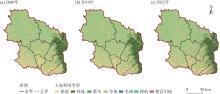
Fig. 2
Land use status of Qingyang City from 2000 to 2022"
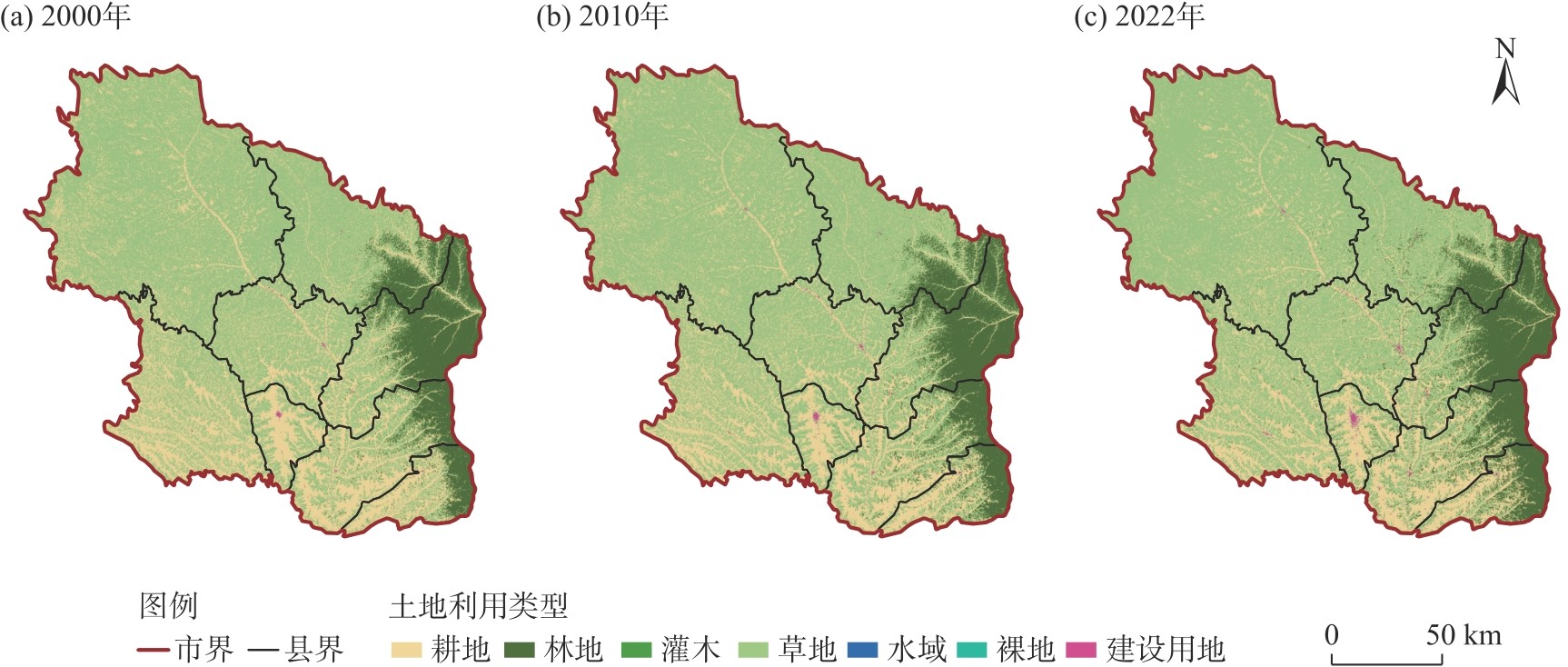
Tab. 2
Statistics of land use type area in Qingyang City from 2000 to 2022"
| 土地利用类型 | 面积/km2 | 2000—2022年 面积变化/km2 | 动态度/% | |||
|---|---|---|---|---|---|---|
| 2000年 | 2010年 | 2022年 | 2000—2010年 | 2010—2022年 | ||
| 耕地 | 7207.03 | 6375.58 | 5992.93 | -1214.10 | -1.15 | -0.50 |
| 林地 | 2962.11 | 3160.16 | 3796.28 | 834.17 | 0.67 | 1.68 |
| 灌木 | 58.85 | 17.85 | 3.33 | -55.53 | -6.97 | -6.78 |
| 草地 | 16834.87 | 17493.57 | 17221.91 | 387.04 | 0.39 | -0.13 |
| 水域 | 2.22 | 2.90 | 3.79 | 1.58 | 3.08 | 2.56 |
| 裸地 | 0.78 | 1.08 | 7.29 | 6.51 | 3.89 | 47.76 |
| 建设用地 | 45.24 | 59.97 | 88.28 | 43.04 | 3.26 | 3.93 |
Fig. 3
Sankey diagram of land use transfer in Qingyang City from 2000 to 2022"
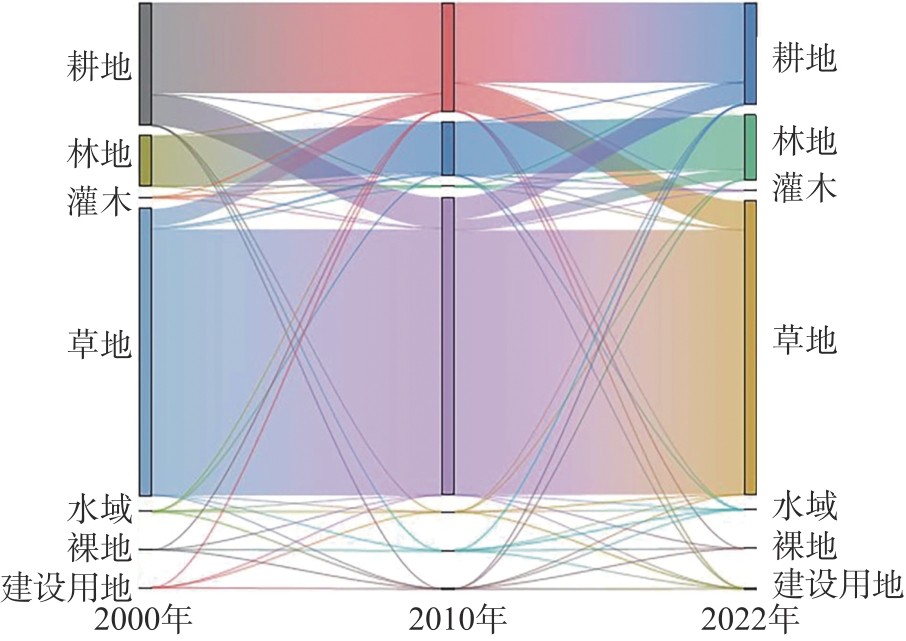
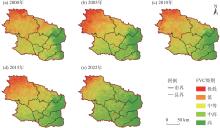
Fig. 4
Distribution pattern of FVC at different levels in Qingyang City from 2000 to 2022"
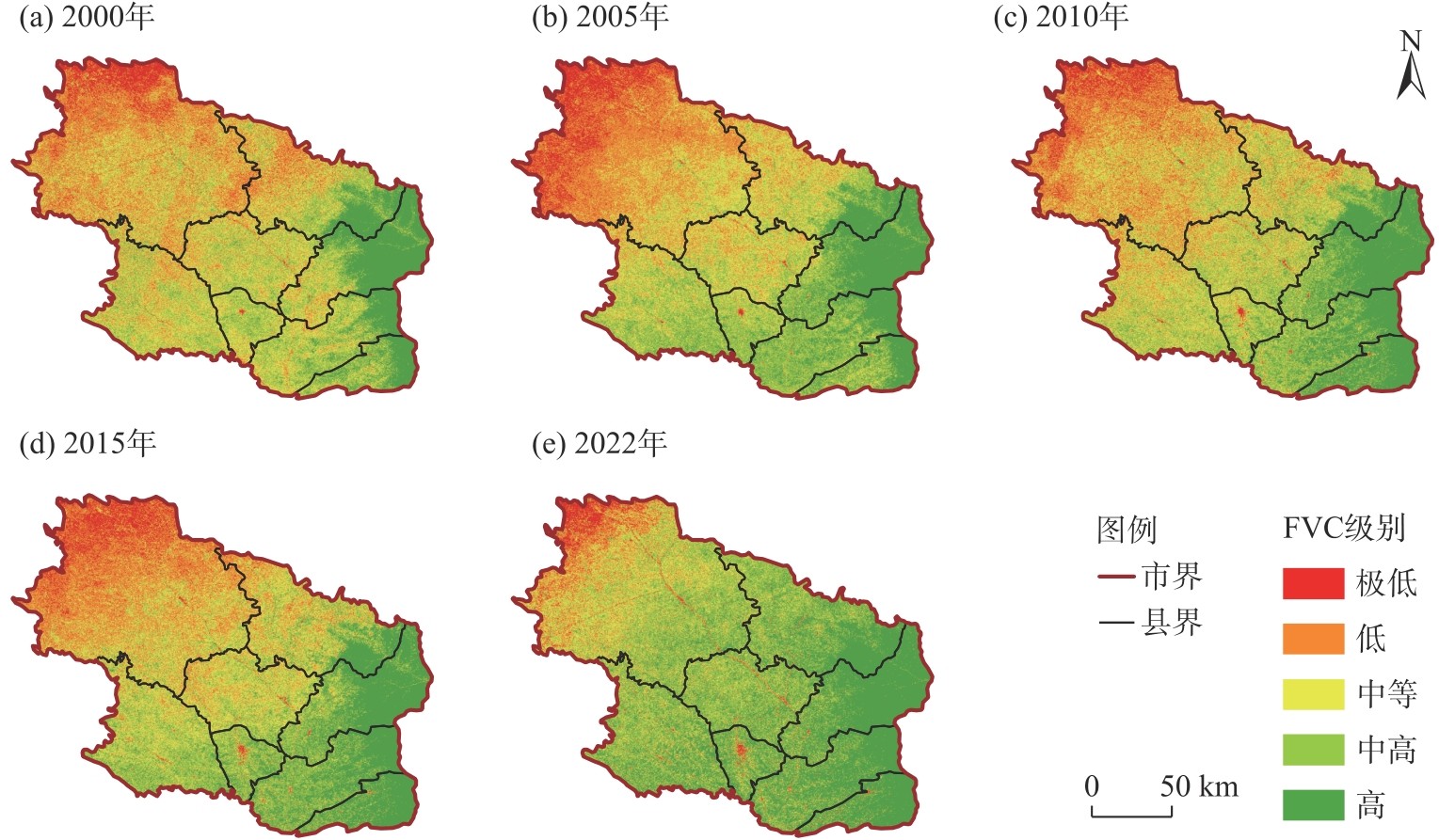
Fig. 5
Interannual change trend of FVC in Qingyang City from 2000 to 2022"
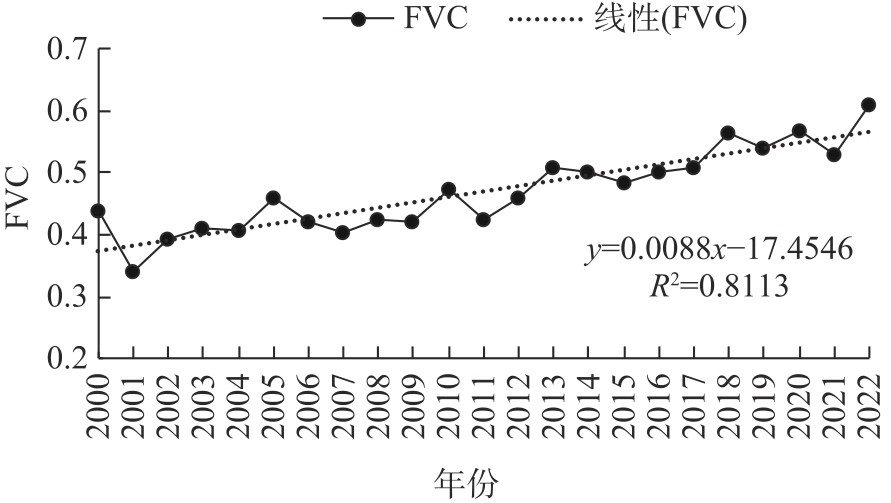
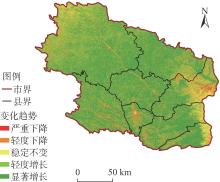
Fig. 6
Spatial distribution of FVC change trend in Qingyang City from 2000 to 2022"
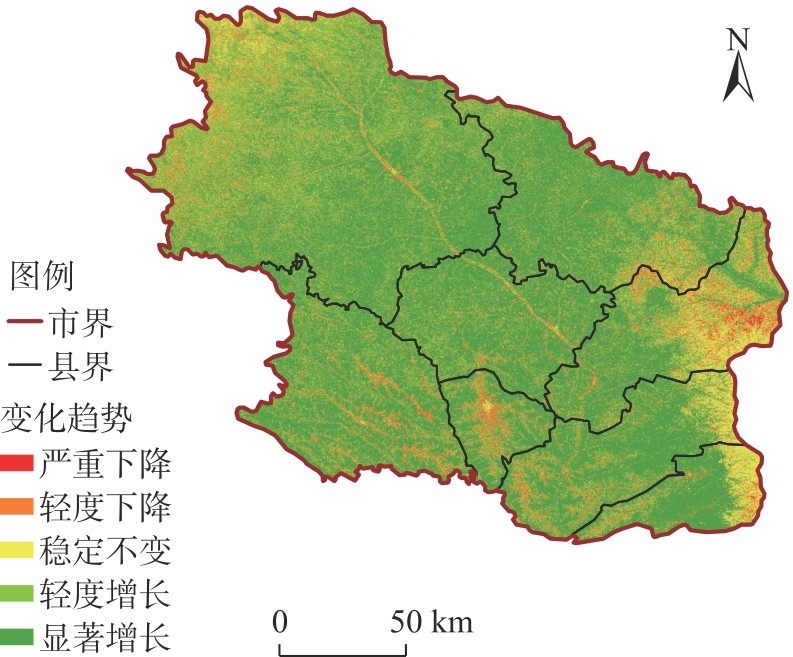
Fig. 7
Spatial distribution of FVC drivers in Qingyang City from 2000 to 2022"
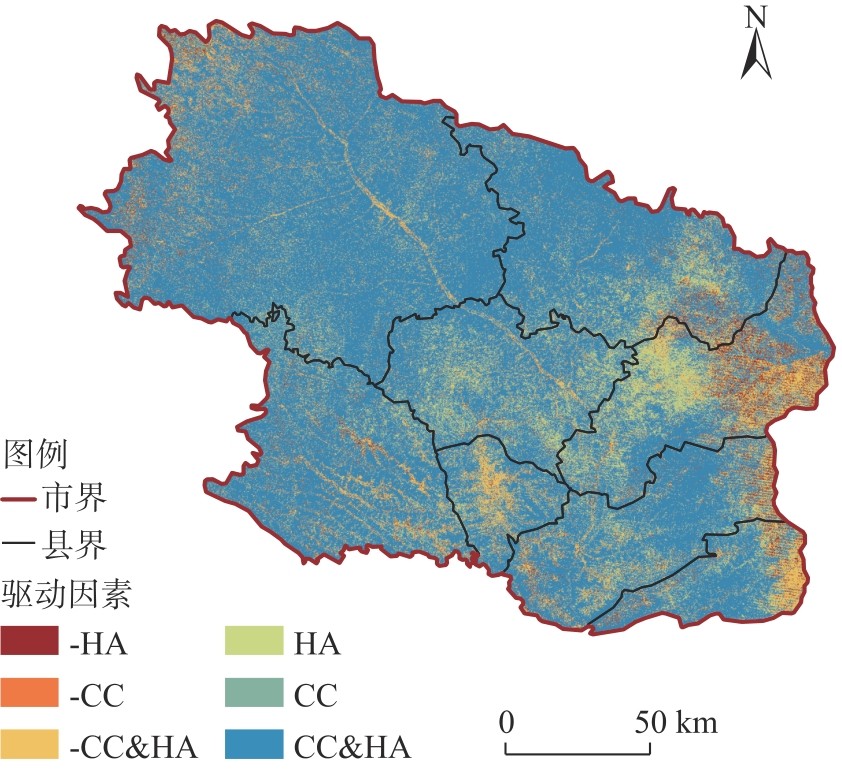
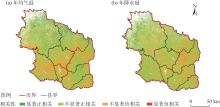
Fig. 8
Spatial distributions of correlation between FVC and climate factors in Qingyang City from 2000 to 2022"
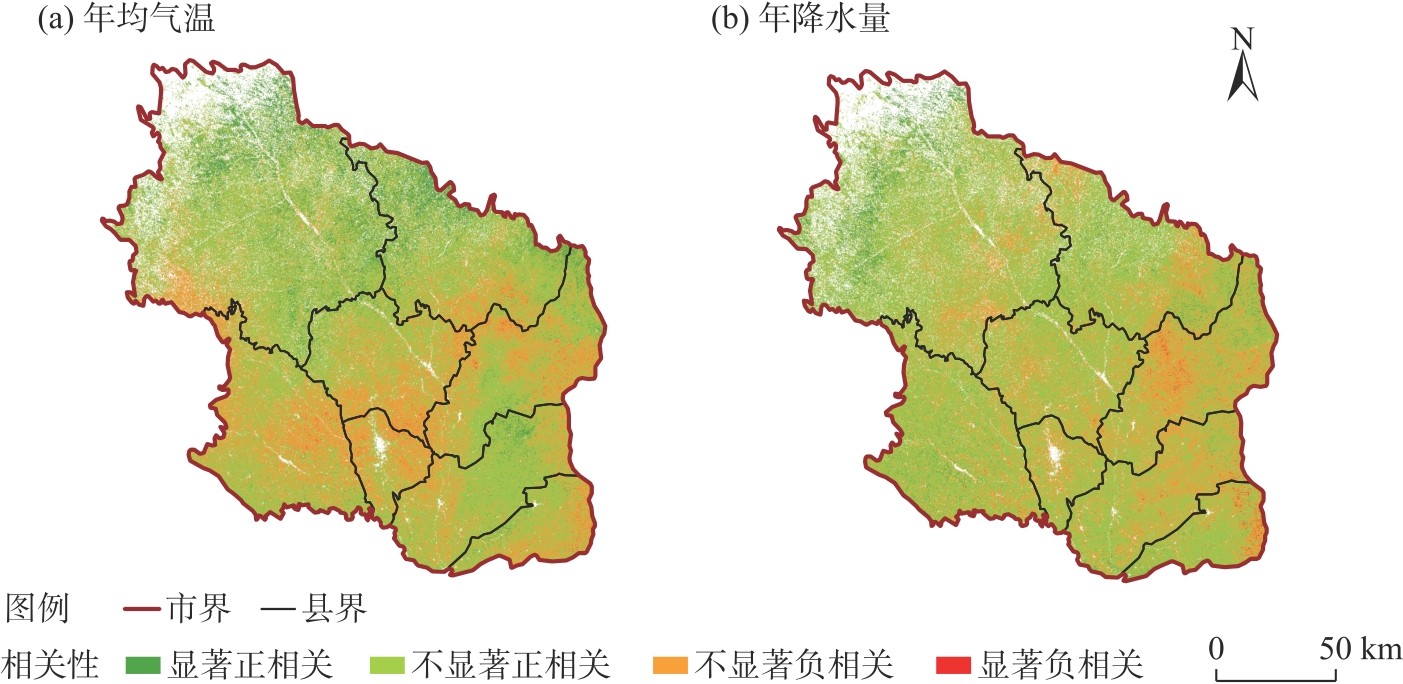
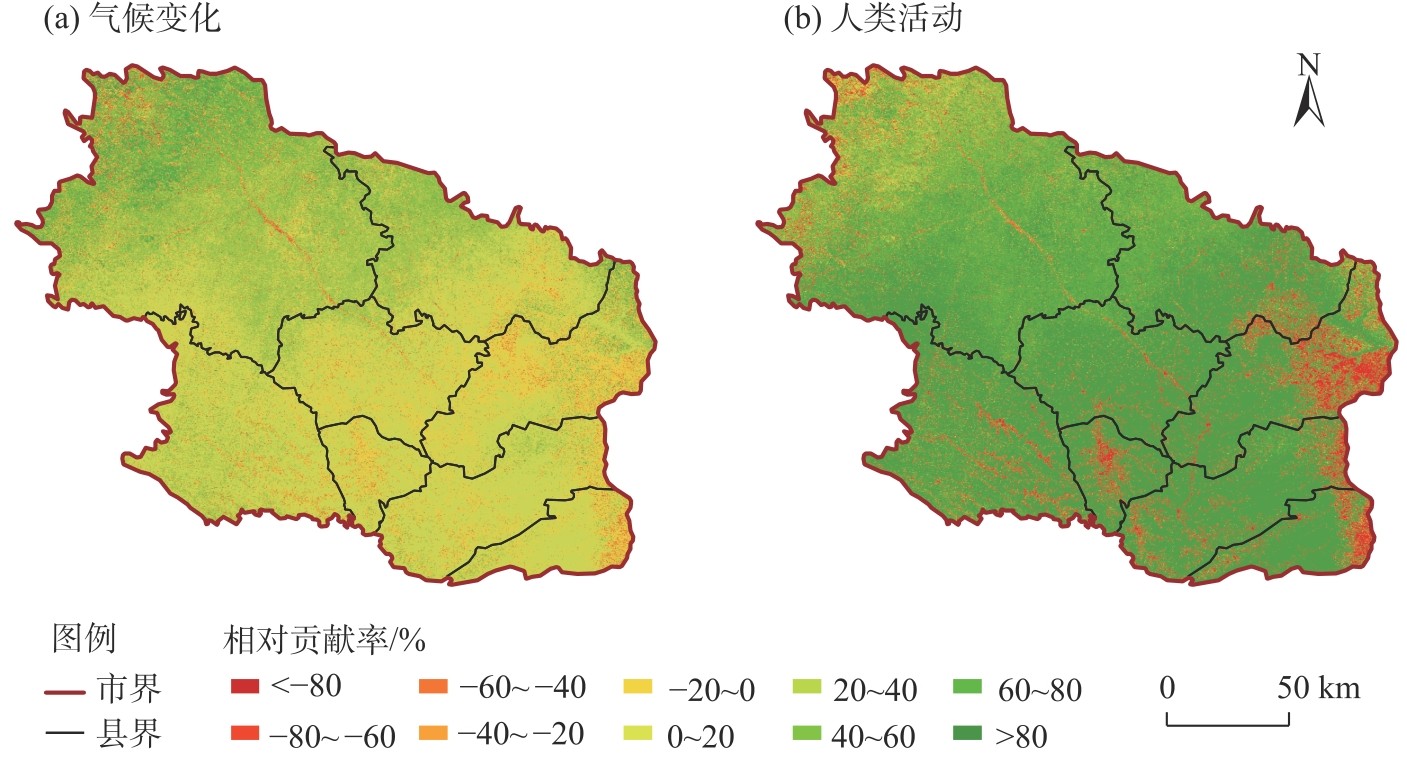
Fig. 9
Spatial distributions of the relative contribution rates of FVC change to climate change and human activities in Qingyang City from 2000 to 2022"
| [1] | 王建国, 张飞, 蔡吉祥, 等. 干旱区土地利用与植被覆盖时空变化特征及其关联性分析[J]. 草业科学, 2025, 42(5): 1118-1130. |
| [Wang Jianguo, Zhang Fei, Cai Jixiang, et al. Spatiotemporal variation and correlation between land use and vegetation cover in arid areas[J]. Pratacultural Science, 2025, 42(5): 1118-1130.] | |
| [2] | 杨霞, 乌吉木吉, 朝力格尔. 半干旱区草原生态环境质量时空变化及其驱动因素研究——以锡林郭勒为例[J]. 水土保持研究, 2025, 32(3): 231-240. |
| [ Yang Xia, Wujimuji, Chaoligeer. Research on the spatiotemporal change of ecological environment quality and its driving factors in semi-arid grasslands: A case study of Xilingol[J]. Research of Soil and Water Conservation, 2025, 32(3): 231-240.] | |
| [3] | 宋奇, 冯春晖, 马自强, 等. 基于1990—2019年Landsat影像的干旱区绿洲土地利用变化与模拟[J]. 自然资源遥感, 2022, 34(1): 198-209. |
| [Song Qi, Feng Chunhui, Ma Ziqiang, et al. Simulation of land use change in oasis of arid areas based on Landsat images from 1990 to 2019[J]. Remote Sensing for Natural Resources, 2022, 34(1): 198-209.] | |
| [4] |
刘玉婷, 张齐飞, 刘景时, 等. 近20 a新疆南部植被覆盖度时空特征及对气候因素的响应——以塔什库尔干塔吉克自治县为例[J]. 干旱区地理, 2022, 45(5): 1481-1489.
doi: 10.12118/j.issn.1000-6060.2021.606 |
|
[Liu Yuting, Zhang Qifei, Liu Jingshi, et al. Temporal and spatial characteristics of fractional vegetation coverage and its response to climatic factors in southern Xinjiang in recent 20 years: A case of Taxkorgan Tajik Autonomous County[J]. Arid Land Geography, 2022, 45(5): 1481-1489.]
doi: 10.12118/j.issn.1000-6060.2021.606 |
|
| [5] | 张金良, 王炜, 付健, 等. 黄河流域内流区土地利用与植被覆盖时空演变规律[J]. 人民黄河, 2022, 44(11): 1-5, 19. |
| [Zhang Jinliang, Wang Wei, Fu Jian, et al. Spatial-temporal dynamic characteristics of land use and vegetation cover in inland flow area of Yellow River Basin[J]. Yellow River, 2022, 44(11): 1-5, 19.] | |
| [6] | 薛成起, 杨恩祺, 潘乐瑶, 等. 近20 a兰州新区土地利用与植被覆盖时空演变规律[J]. 兰州大学学报(自然科学版), 2024, 60(4): 466-472, 479. |
| [Xue Chengqi, Yang Enqi, Pan Leyao, et al. Spatial-temporal evolution of land use and vegetation cover in Lanzhou New District in recent 20 years[J]. Journal of Lanzhou University (Natural Sciences Edtion), 2024, 60(4): 466-472, 479.] | |
| [7] |
常文静, 丛士翔, 王融融, 等. 气候变化和人类活动对毛乌素沙地NDVI变化的量化分析[J]. 干旱区地理, 2025, 48(1): 63-74.
doi: 10.12118/j.issn.1000-6060.2024.029 |
|
[Chang Wenjing, Cong Shixiang, Wang Rongrong, et al. Quantitative analysis of NDVI changes in Mu Us Sandy Land by climate change and human activities[J]. Arid Land Geography, 2025, 48(1): 63-74.]
doi: 10.12118/j.issn.1000-6060.2024.029 |
|
| [8] |
张秀霞, 韩丽莎, 党星海, 等. 西北干旱区近30 a植被覆盖的时空变化及其对气候因子的响应[J]. 干旱区研究, 2025, 42(6): 1067-1079.
doi: 10.13866/j.azr.2025.06.10 |
|
[Zhang Xiuxia, Han Lisha, Dang Xinghai, et al. Spatiotemporal changes in vegetation coverage in the arid regions of northwest China over the past 30 years and their response to climatic factors[J]. Arid Zone Research, 2025, 42(6): 1067-1079.]
doi: 10.13866/j.azr.2025.06.10 |
|
| [9] | 沈鸿飞, 张军, 邱慧珍, 等. 区域生态环境状况综合评价——以甘肃省庆阳市为例[J]. 干旱区资源与环境, 2011, 25(6): 13-17. |
| [Shen Hongfei, Zhang Jun, Qiu Huizhen, et al. Integrated evaluation of eco-environmental status in Qingyang City[J]. Journal of Arid Land Resources and Environment, 2011, 25(6): 13-17.] | |
| [10] | 李彩霞, 武雪, 胡杨. 典型黄土高原沟壑区土地利用与景观格局变化分析——以甘肃省庆阳市为例[J]. 中国沙漠, 2025, 45(5): 1-9. |
| [Li Caixia, Wu Xue, Hu Yang. Land use and landscape pattern changes in Qingyang, Gansu, China: A typical Loess Plateau Gully region[J]. Journal of Desert Research, 2025, 45(5): 1-9.] | |
| [11] | 何丽娟, 许泰, 祁娟. 2000—2022年庆阳市NDVI时空变化及影响因素研究[J]. 草业科学, 2026, 43(2): 273-283. |
| [He Lijuan, Xu Tai, Qi Juan. Spatiotemporal changes and impact factors of NDVI in Qingyang City from 2000 to 2022[J]. Pratacultural Science, 2026, 43(2): 273-283.] | |
| [12] | 盖艾鸿. 基于3S技术的庆阳市土地利用变化及土地生态安全研究[D]. 兰州: 甘肃农业大学, 2013. |
| [Gai Aihong. Study on land use/cover change and land ecological security based on 3S technique in Qingyang City[D]. Lanzhou: Gansu agricultural university, 2013.] | |
| [13] |
Yang J, Huang X. The 30 m annual land cover datasets and its dynamics in China from 1990 to 2021[J]. Earth System Science Data, 2022, 13(1): 3907-3925.
doi: 10.5194/essd-13-3907-2021 |
| [14] | 董金玮, 周岩, 尤南山, 等. 2000—2022年中国30米年最大NDVI数据集[DB/OL]. 国家生态科学数据中心. [2021-01-01]. https://cstr.cn/15732.11.nesdc.ecodb.rs.2021.012. |
| [Dong Jinwei, Zhou Yan, You Nanshan, et al. 30-meter annual largest NDVI dataset in China from 2000 to 2022[DB/OL]. National Ecological Science Data Center. [2021-01-01]. https://cstr.cn/15732.11.nesdc.ecodb.rs.2021.012.] | |
| [15] | 彭守璋 中国1 km分辨率逐月降水量数据集(1901—2024)[DB/OL]. 国家青藏高原数据中心. [2020-01-01]. https://doi.org/10.5281/zenodo.3114194. |
| [Peng Shouzhang. 1 km monthly precipitation dataset for China (1901—2024)[DB/OL]. National Tibetan Plateau/Third Pole Environment Data Center. [2020-01-01].https://doi.org/10.5281/zenodo.3114194.] | |
| [16] | 彭守璋. 中国1 km分辨率逐月平均气温数据集(1901—2024)[DB/OL]. 国家青藏高原数据中心. [2019-01-01]. https://doi.org/10.11888/Meteoro.tpdc.270961. |
| [Peng Shouzhang. 1 km monthly mean temperature dataset for China (1901—2024)[DB/OL]. National Tibetan Plateau/Third Pole Environment Data Center. [2019-01-01].https://doi.org/10.11888/Meteoro.tpdc.270961.] | |
| [17] | 卡米兰·阿布力克, 杨涵. 乌鲁木齐河流域植被覆盖度变化及驱动力研究[J]. 灌溉排水学报, 2024(2): 96-105. |
| [Abulike Kamilan, Yang Han. Change in vegetation coverage in Urumqi River Basin and the underlying determinants[J]. Journal of Irrigation and Drainage, 2024(2): 96-105.] | |
| [18] | 涂杰, 周学林, 王松松. 基于NDVI的近20年包头市植被覆盖度时空变化研究[J]. 草原与草坪, 2024, 44(4): 121-132. |
| [Tu Jie, Zhou Xueling, Wang Songsong. Study on spatiotemporal changes of fractional vegetation cover in Baotou City based on NDVI in the past 20 years[J]. Grassland and Turf, 2024, 44(4): 121-132.] | |
| [19] | 崔囤月, 王世东, 张学军. 1991—2021年雄安新区土地利用与植被覆盖变化遥感研究[J]. 自然资源遥感, 2023, 35(4): 214-225. |
| [Cui Dunyue, Wang Shidong, Zhang Xuejun. A remote sensing-based study on change in land use and vegetation cover in Xiong’an New Area from 1991 to 2021[J]. Remote Sensing for Natural Resources, 2023, 35(4): 214-225.] | |
| [20] |
汪洋, 安沙舟. 干旱区内陆河流域典型灌区土地利用变化与耗水量研究[J]. 新疆农业科学, 2018, 55(2): 362-370.
doi: 10.6048/j.issn.1001-4330.2018.02.020 |
|
[Wang Yang, An Shazhou. Research on land use/cover change and water consumption in typical irrigation areas of inland river basin in arid region[J]. Xinjiang Agricultural Sciences, 2018, 55(2): 362-370.]
doi: 10.6048/j.issn.1001-4330.2018.02.020 |
|
| [21] | 李云, 罗长莲, 武红旗, 等. 2000—2020年新疆阿克苏地区土地覆被变化的研究[J]. 中国农业科技导报, 2024, 26(8): 172-179. |
| [Li Yun, Luo Changlian, Wu Hongqi, et al. Land cover change in Aksu Region of Xinjiang from 2000 to 2020[J]. Journal of Agricultural Science and Technology, 2024, 26(8): 172-179.] | |
| [22] | 鲁金萍, 李满根, 多玲花, 等. 江西吉安市近20 a植被覆盖度时空演变的特征及驱动因素分析[J]. 江西科学, 2024, 42(5): 974-981, 1059. |
| [Lu Jinping, Li Mangen, Duo Linghua, et al. Analysis of characteristics and driving factors of spatiotemporal evolution of vegetation coverage in Ji’an City, Jiangxi Province over the past 20 years[J]. Jiangxi Science, 2024, 42(5): 974-981, 1059.] | |
| [23] | 廖美玉, 方秀琴, 蒋心远, 等. 黄河流域近40年土地利用/覆被时空变化特征[J]. 水土保持学报, 2024, 38(2): 165-177, 189. |
| [Liao Meiyu, Fang Xiuqin, Jiang Xinyuan, et al. Spatiotemporal characteristics of land use/cover changes in the Yellow River Basin over the past 40 years[J]. Journal of Soil and Water Conservation, 2024, 38(2): 165-177, 189.] | |
| [24] |
金凯, 王飞, 韩剑桥, 等. 1982—2015年中国气候变化和人类活动对植被NDVI变化的影响[J]. 地理学报, 2020, 75(5): 961-974.
doi: 10.11821/dlxb202005006 |
| [Jin Kai, Wang Fei, Han Jianqiao, et al. Contribution of climatic change and human activities to vegetation NDVI change over China during 1982—2015[J]. Acta Geographica Sinica, 2020, 75(5): 961-974.] | |
| [25] | 张明祥, 谷晓平, 廖留峰, 等. 气候变化和人类活动对贵州省石漠化区植被覆盖变化的影响[J]. 地球与环境, 2023, 51(1): 76-86. |
| [Zhang Mingxiang, Gu Xiaoping, Liao Liufeng, et al. Effects of climate change and human activities on vegetation cover change in rocky desertification area of Guizhou Province[J]. Earth and Environment, 2023, 51(1): 76-86.] | |
| [26] | 陆荫, 张强, 李晓红, 等. 黄河流域甘肃段植被覆盖度时空变化及对气候因子的响应[J]. 水土保持通报, 2020, 40(2): 232-238. |
| [Lu Yin, Zhang Qiang, Li Xiaohong, et al. Temporal and spatial variation of vegetation coverage and its response to climate factors in Gansu section of Yellow River Basin[J]. Bulletin of Soil and Water Conservation, 2020, 40(2): 232-238.] | |
| [27] | 杜婷, 焦继宗, 颉耀文, 等. 甘肃省庆阳市2000—2015年生态环境状况变化分析[J]. 兰州大学学报(自然科学版), 2019, 55(1): 26-32. |
| [Du Ting, Jiao Jizong, Xie Yaowen, et al. Analysis of ecological environment changes from 2000 to 2015 in Qingyang, Gansu Province[J]. Journal of Lanzhou University (Natural Sciences Edition), 2019, 55(1): 26-32.] | |
| [28] | 孙刚, 万华伟, 王昌佐, 等. 蒙陕甘宁能源金三角植被覆盖遥感监测与动态分析[J]. 农业机械学报, 2013, 44(增刊2): 247-250. |
| [Sun Gang, Wan Huawei, Wang Changzuo, et al. Vegetation monitoring and analyzing of golden triangle energy in Inner Mongolia, Shaanxi, Gansu, and Ningxia region[J]. Transactions of the Chinese Society for Agricultural Machinery, 2013, 44(Suppl. 2): 247-250.] | |
| [29] |
张博, 刘长星, 王璇. 陕北黄土高原植被覆盖时空变化及其归因分析[J]. 测绘通报, 2022(8): 22-29.
doi: 10.13474/j.cnki.11-2246.2022.0227 |
|
[Zhang Bo, Liu Changxing, Wang Xuan. Spatio-temporal changes of vegetation coverage in the Loess Plateau of northern Shaanxi and its attribution analysis[J]. Bulletin of Surveying and Mapping, 2022(8): 22-29.]
doi: 10.13474/j.cnki.11-2246.2022.0227 |
|
| [30] |
齐容镰, 李庆波, 任佳, 等. “三北”工程地区植被覆盖变化特征及其驱动力分析——以宁夏为例[J]. 干旱区研究, 2024, 41(10): 1740-1752.
doi: 10.13866/j.azr.2024.10.12 |
|
[Qi Ronglian, Li Qingbo, Ren Jia, et al. Study on the characteristics of changes in vegetation cover and its driving forces in the Three-North Shelterbelt program regions: Taking Ningxia as example[J]. Arid Zone Research, 2024, 41(10): 1740-1752.]
doi: 10.13866/j.azr.2024.10.12 |
|
| [31] | 冯喜斌, 薛亮. 从“沙进人退”到“绿进沙退”的庆阳实践[N]. 陇东报, 2024-7-18(001). |
| [Feng Xibin, Xue Liang. Qingyang practice from “sand in and people retreat” to “green in and sand retreat”[N]. Longdong Daily, 2024-7-18(001).] | |
| [32] |
戴晓爱, 马佳欣, 唐艺菱, 等. 甘肃省植被时空动态变化及其归因分析[J]. 生态环境学报, 2024, 33(8): 1163-1173.
doi: 10.16258/j.cnki.1674-5906.2024.08.001 |
| [Dai Xiaoai, Ma Jiaxin, Tang Yiling, et al. Spatio-temporal dynamics and attribution analysis of vegetation in Gansu Province[J]. Ecology and Environmental Sciences, 2024, 33(8): 1163-1173.] | |
| [33] | 王迎霞, 颉满斌, 史俊斌. 陕甘宁革命老区: 从黄到绿,生态建设展现喜人画卷[N]. 科技日报, 2022-4-20(001). |
| [Wang Yingxia, Jie Manbin, Shi Junbin. Shaanxi-Gansu-Ningxia revolutionary old area: From yellow to green, ecological construction shows a gratifying picture[N]. Science and Technology Daily, 2022-4-20(001).] |
|
||