Arid Land Geography ›› 2026, Vol. 49 ›› Issue (4): 656-668.doi: 10.12118/j.issn.1000-6060.2025.774
• New Quality Productive Forces Driving High-Quality Development of Tourism • Previous Articles Next Articles
WANG Shengxia( ), WU Xinru()
Received:2025-11-28
Revised:2025-12-19
Online:2026-04-25
Published:2026-04-28
Contact:
WU Xinru
E-mail:wangshx@lzufe.edu.cn;19893162684@163.com
WANG Shengxia, WU Xinru. Synergistic evolution and spatial effects of new quality productive forces and cultural-tourism integration[J].Arid Land Geography, 2026, 49(4): 656-668.
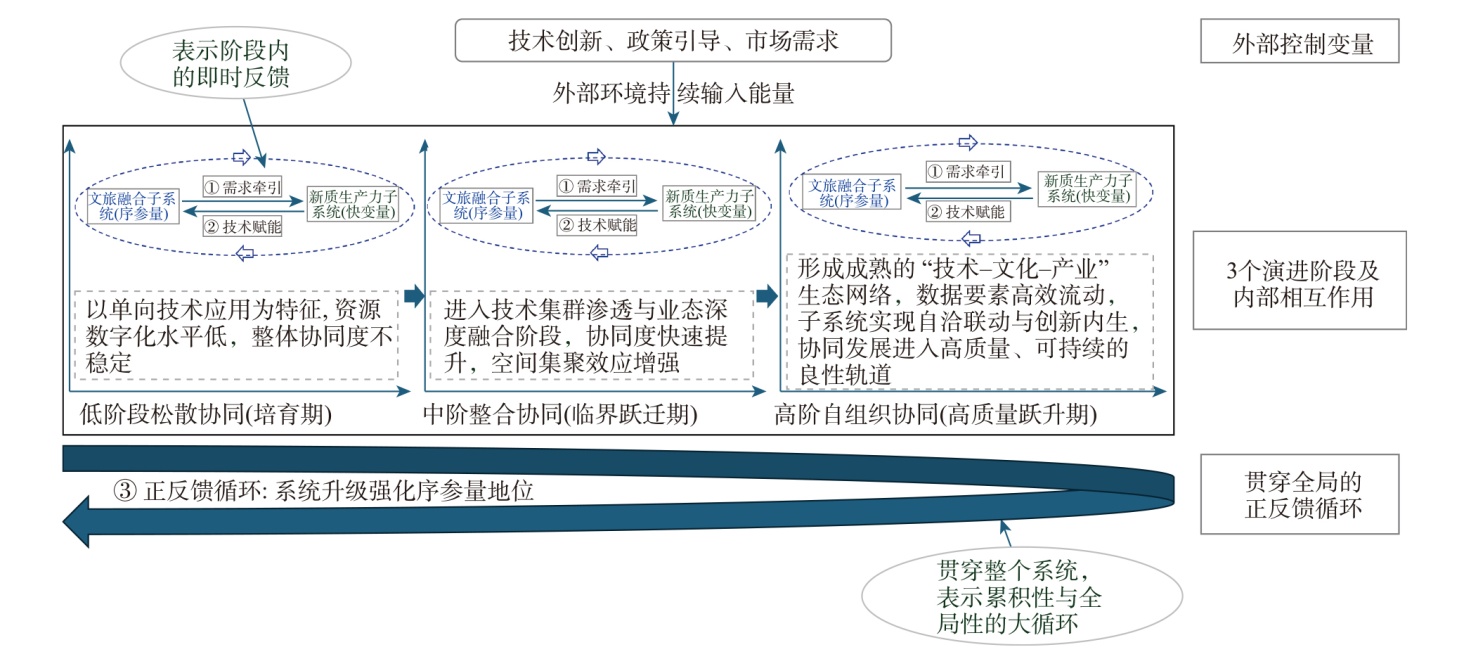
Fig. 1
Theoretical framework of the synergistic evolution of the new quality productive forces and cultural-tourism integration composite system"

Tab. 1
Evaluation index system of new quality productive forces"
| 评价目标 | 一级指标 | 二级指标 | 指标说明 | 单位 | 属性 |
|---|---|---|---|---|---|
| 新质生产力 | 创新驱动 | R&D经费投入强度 | 研究与试验发展经费内部支出/地区生产总值 | % | + |
| 高技术产业营业收入 | 直接数据 | 108元 | + | ||
| 每万人口R&D人员全时当量 | R&D人员全时当量/常住人口 | 人年·(104人)-1 | + | ||
| 数字赋能 | 互联网宽带接入率 | 互联网宽带接入端口/地区常住人口 | % | + | |
| 域名数 | 直接数据 | 104个 | + | ||
| 每百家企业拥有网站数 | 直接数据 | 个·(100家)-1 | + | ||
| 要素供给 | 高等教育学校数 | 直接数据 | 所 | + | |
| 信息软件业就业人员占比 | 信息传输、软件和信息技术服务业城镇单位就业人员/总城镇单位就业人员 | % | + | ||
| 绿色高效 | 单位GDP能耗 | 能源消耗总量/GDP | tce·(104元)-1 | - | |
| 全员劳动生产率 | 地区生产总值/全社会就业人员数 | 104元·人-1 | + |
Tab. 2
Evaluation index system for the development of cultural-tourism integration"
| 评价目标 | 一级指标 | 二级指标 | 指标说明 | 单位 | 属性 |
|---|---|---|---|---|---|
| 文旅融合发展 | 融合基础力 | 文旅资源丰度 | A级景区总数 | 个 | + |
| 公共文化服务设施覆盖率 | (博物馆+公共图书馆+文化馆)机构数/常住人口 | 个·(104人)-1 | + | ||
| 融合驱动力 | 文旅融合财政投入强度 | 文化与旅游事业费 | 108元 | + | |
| 文旅消费需求潜力 | 居民人均教育文化娱乐消费支出/人均消费支出 | % | + | ||
| 融合彰显力 | 第三产业发展 | 第三产业增加值/GDP | % | + | |
| 文化体验活动参与度 | (博物馆+演艺+非遗体验)参观人数/游客总人数×100% | % | + | ||
| 在线旅游收入占比 | 在线旅游交易额/旅游总收入 | % | + | ||
| 文旅带动就业系数 | (文化、体育、娱乐业+住宿餐饮业)/总从业人数 | % | + |
Tab. 3
Regression results of the Haken model"
| 假设序量 | 运动方程 | 控制参量 | 结论 |
|---|---|---|---|
| q1=N q2=I | λ1=-0.072 λ2=-0.049 a=0.044 b=-0.005 | 不满足绝热近似假设,即原假设不成立 | |
| q1=I q2=N | λ1=-0.048 λ2=0.155 a=0.020 b=0.009 | 满足绝热近似假设,即原假设成立 | |
Fig. 2
Changing trend of the synergy values of the new quality productive forces and cultural-tourism integration composite system"
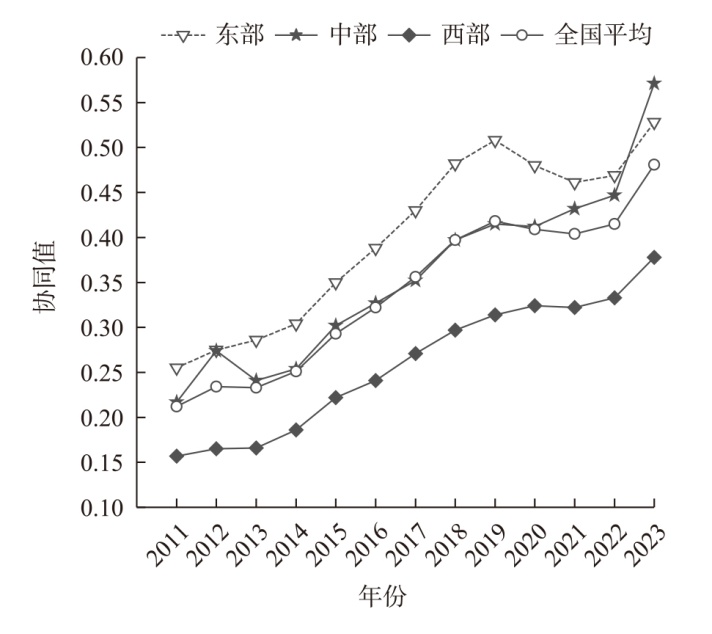
Fig. 3
Classification of synergy types for the new quality productive forces and cultural-tourism integration composite system"
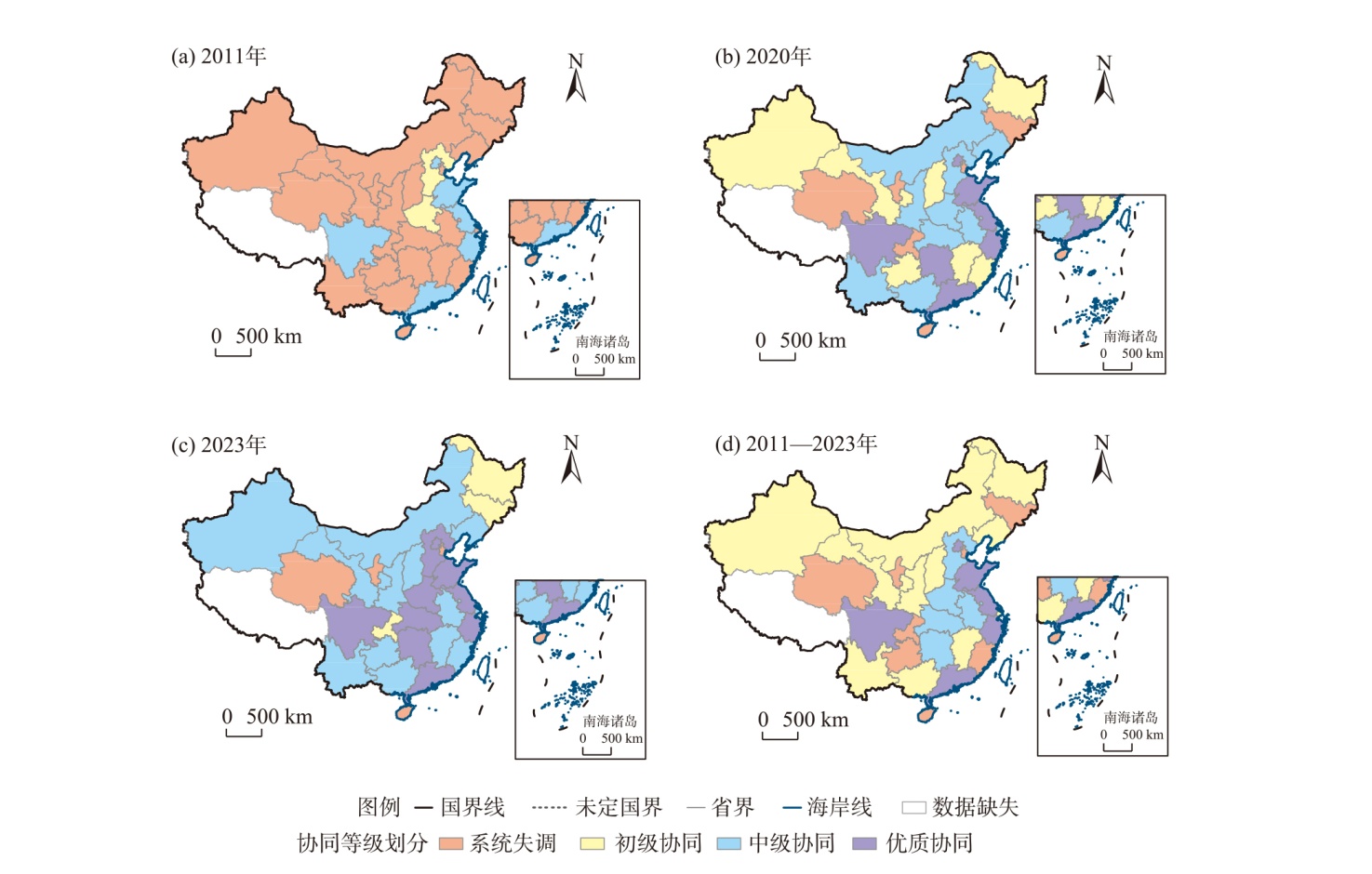
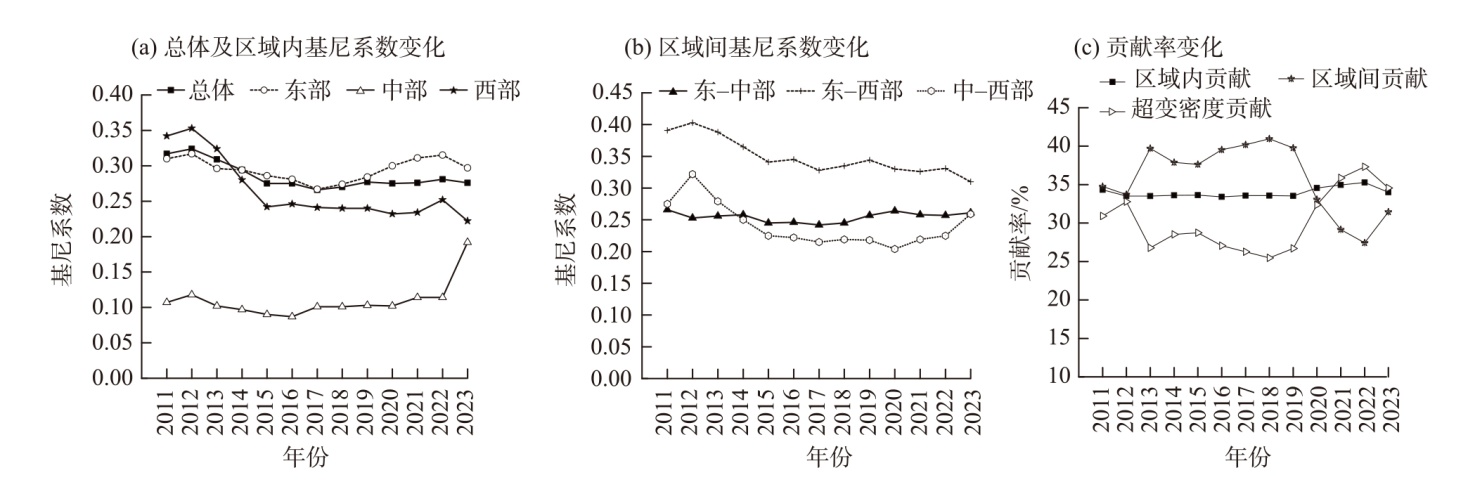
Fig. 4
Decomposition of Dagum Gini coefficient, regional disparities, and contribution rates"
Tab. 4
Spatial correlation test results of the synergy degree between new quality productive forces and cultural-tourism integration from 2011 to 2023"
| 年份 | 全局Moran’s I | E(I) | Sd(I) | Z |
|---|---|---|---|---|
| 2011 | 0.176** | -0.034 | 0.115 | 1.822 |
| 2012 | 0.179** | -0.034 | 0.116 | 1.847 |
| 2013 | 0.196** | -0.034 | 0.116 | 1.988 |
| 2014 | 0.190** | -0.034 | 0.116 | 1.932 |
| 2015 | 0.198** | -0.034 | 0.116 | 2.009 |
| 2016 | 0.240*** | -0.034 | 0.115 | 2.379 |
| 2017 | 0.242*** | -0.034 | 0.116 | 2.395 |
| 2018 | 0.238*** | -0.034 | 0.116 | 2.354 |
| 2019 | 0.195** | -0.034 | 0.115 | 1.992 |
| 2020 | 0.174** | -0.034 | 0.116 | 1.804 |
| 2021 | 0.226*** | -0.034 | 0.116 | 2.254 |
| 2022 | 0.276*** | -0.034 | 0.116 | 2.689 |
| 2023 | 0.257*** | -0.034 | 0.116 | 2.518 |
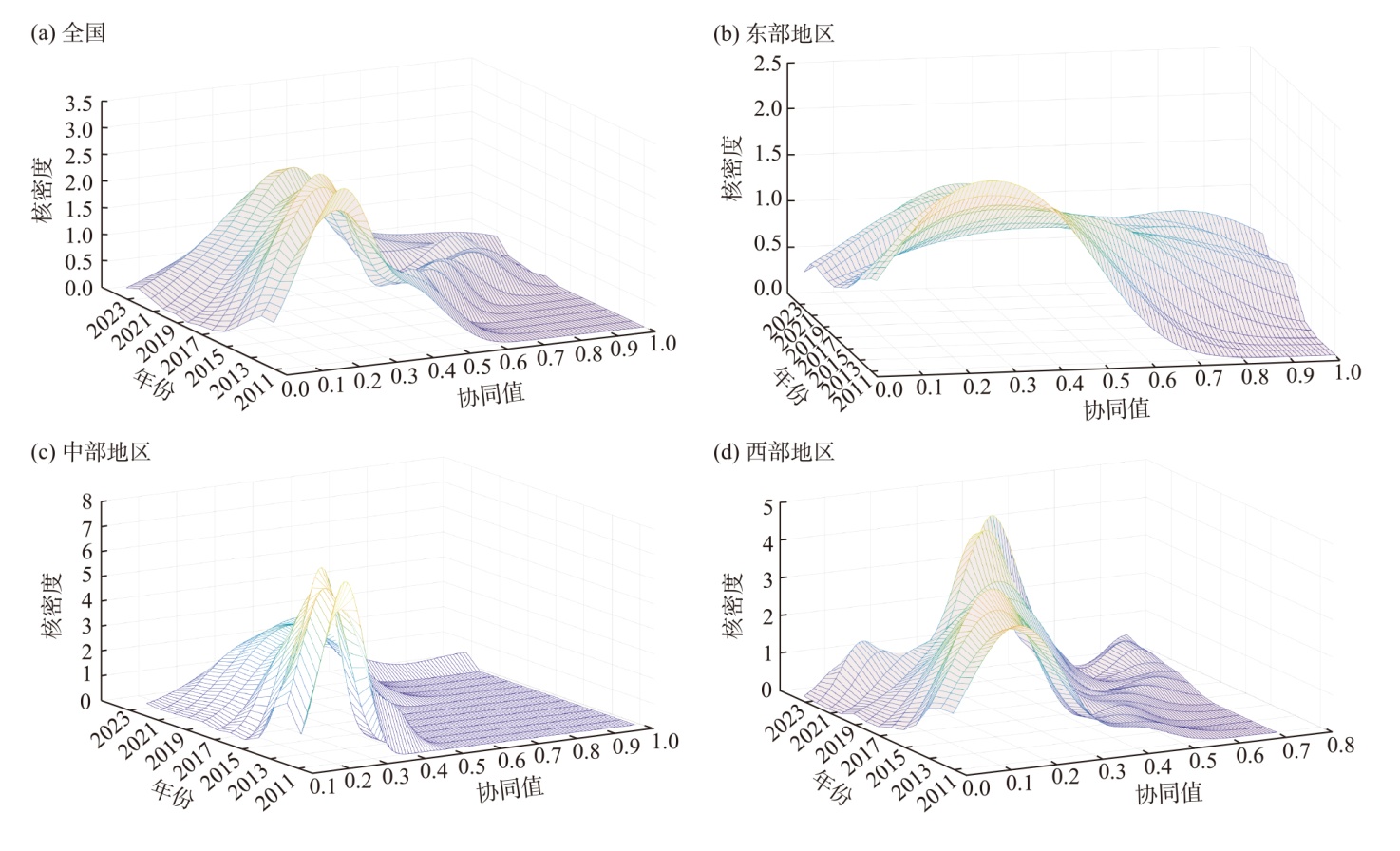
Fig. 5
Kernel density curves of synergy values for China and three major regions"
| [1] | 韩文龙, 张瑞生, 赵峰. 新质生产力水平测算与中国经济增长新动能[J]. 数量经济技术经济研究, 2024, 41(6): 5-25. |
| [Han Wenlong, Zhang Ruisheng, Zhao Feng. The measurement of new quality productivity and new driving force of the Chinese economy[J]. Journal of Quantitative & Technical Economics, 2024, 41(6): 5-25.] | |
| [2] |
高帅, 张务伟. 中国新质生产力与新型城镇化的协同演化研究[J]. 干旱区地理, 2025, 48(8): 1445-1456.
doi: 10.12118/j.issn.1000-6060.2025.150 |
|
[Gao Shuai, Zhang Wuwei. Synergistic evolution of new quality productivity and new urbanization in China’s provinces[J]. Arid Land Geography, 2025, 48(8): 1445-1456.]
doi: 10.12118/j.issn.1000-6060.2025.150 |
|
| [3] |
张玉玲, 方玉婷. 中国文旅融合与经济韧性时空特征及互动关系研究[J]. 热带地理, 2024, 44(7): 1329-1340.
doi: 10.13284/j.cnki.rddl.20230676 |
|
[Zhang Yuling, Fang Yuting. Spatial-temporal characteristics and interaction between integration of culture and tourism and economic resilience in China[J]. Tropical Geography, 2024, 44(7): 1329-1340.]
doi: 10.13284/j.cnki.rddl.20230676 |
|
| [4] | 周在霞, 张玉明, 吕强. 中国数字技术创新效率测度与区域差异分析[J]. 科技管理研究, 2025, 45(3): 48-59. |
| [Zhou Zaixia, Zhang Yuming, Lü Qiang. Efficiency measurement and regional difference analysis of digital technology innovation in China[J]. Science and Technology Management Research, 2025, 45(3): 48-59.] | |
| [5] | 肖旭, 洪祥镇. 中国资源错配演化动态、区域差异及收敛特征[J]. 统计与决策, 2024, 40(3): 112-117. |
| [Xiao Xu, Hong Xiangzhen. Evolution dynamics, regional difference and convergence characteristics of resource misallocation in China[J]. Statistics & Decision, 2024, 40(3): 112-117.] | |
| [6] | 张高军, 石碧洋, 刘淑仪. 新质生产力促进旅游业高质量发展的理论框架与实施路径[J/OL]. 旅游科学. [2026-02-10]. https://doi.org/10.16323/j.cnki.lykx.20250610.001. |
| [Zhang Gaojun, Shi Biyang, Liu Shuyi. Theoretical framework and implementation path for promoting high-quality development of the tourism industry through new quality productivity[J/OL]. Tourism Science. [2026-02-10]. https://doi.org/10.16323/j.cnki.lykx.20250610.001.] | |
| [7] | 李柏桐, 李健, 唐燕, 等. 数字经济对工业碳排放绩效的影响——基于异质型环境规制的门槛效应[J]. 中国环境科学, 2024, 44(9): 5263-5274. |
| [Li Baitong, Li Jian, Tang Yan, et al. The impact of digital economy on industrial carbon emission performance: Threshold effect analysis of heterogeneous environmental regulations[J]. China Environmental Science, 2024, 44(9): 5263-5274.] | |
| [8] | 周文, 许凌云. 论新质生产力: 内涵特征与重要着力点[J]. 改革, 2023(10): 1-13. |
| [Zhou Wen, Xu Lingyun. On new quality productivity: Connotative characteristics and important focus[J]. Reform, 2023(10): 1-13.] | |
| [9] | 方敏, 杨虎涛. 政治经济学视域下的新质生产力及其形成发展[J]. 经济研究, 2024, 59(3): 20-28. |
| [Fang Min, Yang Hutao. New quality productive forces and their formation and development from the perspective of political economy[J]. Economic Research Journal, 2024, 59(3): 20-28.] | |
| [10] | 王凯, 刘美伦. 新质生产力与旅游业高质量发展耦合协调关系及影响因素[J]. 湖北民族大学学报(哲学社会科学版), 2025, 43(1): 125-137. |
| [Wang Kai, Liu Meilun. Coupling coordination relationship and influencing factors of new quality productive forces and high quality development of tourism[J]. Journal of Hubei Minzu University (Philosophy and Social Sciences Edition), 2025, 43(1): 125-137.] | |
| [11] | 张劲. 数字基础设施、新质生产力与城乡共同富裕[J]. 技术经济与管理研究, 2024(10): 128-133. |
| [Zhang Jin. Digital infrastructure, new quality productivity and common prosperity of urban and rural areas[J]. Journal of Technical Economics & Management, 2024(10): 128-133.] | |
| [12] | 黄月玲, 汤新怡. 数字新质生产力赋能文旅融合的影响与作用机制研究——基于长三角地区41个城市的实证研究[J]. 大连大学学报, 2025, 46(3): 70-81. |
| [Huang Yueling, Tang Xinyi. On the influence and mechanism of the integration of digital new quality productivity and cultural tourism: An empirical study based on 41 cities in the Yangtze River Delta[J]. Journal of Dalian University, 2025, 46(3): 70-81.] | |
| [13] |
杨丽华, 王伟, 毛伟, 等. 中国海洋新质生产力空间关联网络结构及驱动因素[J]. 经济地理, 2025, 45(4): 13-25.
doi: 10.15957/j.cnki.jjdl.2025.04.002 |
|
[Yang Lihua, Wang Wei, Mao Wei, et al. Structure and driving factors of spatial correlation network of marine new quality productive forces in China[J]. Economic Geography, 2025, 45(4): 13-25.]
doi: 10.15957/j.cnki.jjdl.2025.04.002 |
|
| [14] |
江剑平, 李祎, 何召鹏. 中国新质生产力与高质量就业耦合协调度变化特征[J]. 经济地理, 2025, 45(2): 144-152.
doi: 10.15957/j.cnki.jjdl.2025.02.014 |
|
[Jiang Jianping, Li Yi, He Zhaopeng. Change characteristics of coupling coordination degree between new quality productive forces and high-quality employment in China[J]. Economic Geography, 2025, 45(2): 144-152.]
doi: 10.15957/j.cnki.jjdl.2025.02.014 |
|
| [15] | 杜传忠, 李钰葳. 强化科技创新能力加快形成新质生产力的机理研究[J]. 湖南科技大学学报(社会科学版), 2024, 27(1): 100-109. |
| [Du Chuanzhong, Li Yuwei. Mechanism of strengthening the ability of scientific and technological innovation to accelerate the formation of new quality productivity[J]. Journal of Hunan University of Science and Technology (Social Sciences Edition), 2024, 27(1): 100-109.] | |
| [16] | 魏崇辉. 新质生产力的基本意涵、历史演进与实践路径[J]. 理论与改革, 2023(6): 25-38. |
| [Wei Chonghui. The basic connotation, historical evolution and practical path of new quality productive forces[J]. Theory and Reform, 2023(6): 25-38.] | |
| [17] | 任保平. 以新质生产力赋能中国式现代化的重点与任务[J]. 经济问题, 2024(5): 1-6. |
| [Ren Baoping. Empowering Chinese path to modernization with new quality productivity: Priorities and tasks[J]. Economic Issues, 2024(5): 1-6.] | |
| [18] | 洪银兴. 发展新质生产力建设现代化产业体系[J]. 当代经济研究, 2024(2): 7-9. |
| [Hong Yinxing. Developing new quality productive forces and building a modern industrial system[J]. Contemporary Economic Research, 2024(2): 7-9.] | |
| [19] |
Cheer J M, Reeves K J, Laing J H. Tourism and traditional culture: Land diving in Vanuatu[J]. Annals of Tourism Research, 2013, 43: 435-455.
doi: 10.1016/j.annals.2013.06.005 |
| [20] | Jung T H, Lee H, Chung N, et al. Cross-cultural differences in adopting mobile augmented reality at cultural heritage tourism sites[J]. International Journal of Contemporary Hospitality Management, 2018(3): 1621-1645. |
| [21] | Lexagen M, Ziakas V, Lundberg C. Popular culture tourism: Conceptual foundations and state of play[J]. Journal of Travel Research, 2023(7): 1391-1410. |
| [22] | 钟声宏. 广西民俗文化与民俗旅游开发研究[D]. 桂林: 广西师范大学, 2000. |
| [Zhong Shenghong. A research on the folklore culture and the development of folklore tourismin in Guangxi[D]. Guilin: Guangxi Normal University, 2000.] | |
| [23] | 田志奇. 文旅融合下旅游目的地互联网思维的产品营销及创新[J]. 旅游学刊, 2019, 34(8): 8-10. |
| [Tian Zhiqi. Product marketing and innovation of internet thinking for tourist destinations under the integration of culture and tourism[J]. Tourism Tribune, 2019, 34(8): 8-10.] | |
| [24] | 李任. 深度融合与协同发展: 文旅融合的理论逻辑与实践路径[J]. 理论月刊, 2022, 481(1): 88-96. |
| [Li Ren. Deep integration and coordinated development: Theoretical logic and practical path of cultural and tourism integration[J]. Theory Monthly, 2022, 481(1): 88-96.] | |
| [25] |
龙井然, 杜姗姗, 张景秋. 文旅融合导向下的乡村振兴发展机制与模式[J]. 经济地理, 2021, 41(7): 222-230.
doi: 10.15957/j.cnki.jjdl.2021.07.024 |
|
[Long Jingran, Du Shanshan, Zhang Jingqiu. Mechanism and model of rural vitalization guided by culture-tourism integration[J]. Economic Geography, 2021, 41(7): 222-230.]
doi: 10.15957/j.cnki.jjdl.2021.07.024 |
|
| [26] |
Zimmerhackel J S, Kragt M E, Rogers A A, et al. Evidence of increased economic benefits from shark-diving tourism in the Maldives[J]. Marine Policy, 2019, 100: 21-26.
doi: 10.1016/j.marpol.2018.11.004 |
| [27] |
谢佳亮, 王兆峰. 中国文旅融合发展效率动态演化及影响因素[J]. 经济地理, 2024, 44(5): 212-221.
doi: 10.15957/j.cnki.jjdl.2024.05.022 |
|
[Xie Jialiang, Wang Zhaofeng. Dynamic evolution and influencing factors of culture and tourism integration development efficiency in China[J]. Economic Geography, 2024, 44(5): 212-221.]
doi: 10.15957/j.cnki.jjdl.2024.05.022 |
|
| [28] |
刘安乐, 杨承玥, 明庆忠, 等. 中国文化产业与旅游产业协调态势及其驱动力[J]. 经济地理, 2020, 40(6): 203-213.
doi: 10.15957/j.cnki.jjdl.2020.06.022 |
|
[Liu Anle, Yang Chengyue, Ming Qingzhong, et al. Spatial-temporal coordination and driving forces of provincial culture industryand tourism industry in China[J]. Economic Geography, 2020, 40(6): 203-213.]
doi: 10.15957/j.cnki.jjdl.2020.06.022 |
|
| [29] | 马鑫艺. 文旅融合背景下城市品牌形象传播探究[J]. 当代旅游, 2020, 6: 69-70. |
| [Ma Xinyi. Research on the communication of urban brand image under the background of cultural and tourism integration[J]. Tourism Today, 2020, 6: 69-70.] | |
| [30] | 周彬, 张梦瑶, 钟林生, 等. 内蒙古旅游经济与文化产业耦合协调度测评[J]. 干旱区资源与环境, 2020, 33(4): 203-208. |
| [Zhou Bin, Zhang Mengyao, Zhong Linsheng, et al. Assessment of coupling coordination degree of tourism economy and cultural industry in Inner Mongolia[J]. Journal of Arid Land Resources and Environment, 2020, 33(4): 203-208.] | |
| [31] | 翁钢民, 李凌雁. 中国旅游与文化产业融合发展的耦合协调度及空间相关分析[J]. 经济地理, 2016, 36(1): 178-185. |
| [Weng Gangmin, Li Lingyan. The coupling coordination degree and spatial correlation analysis on integrational development of tourism industry and cultural industry in China[J]. Economic Geography, 2016, 36(1): 178-185.] | |
| [32] | 甘畅, 王凯. 中国文旅融合对碳排放绩效的作用机制与空间效应[J]. 环境科学研究, 2025, 38(4): 736-745. |
| [Gan Chang, Wang Kai. Influence mechanism and spatial effect of culture and tourism integration on carbon emission performance in China[J]. Research of Environmental Science, 2025, 38(4): 736-745.] | |
| [33] | 韩景旺, 李瑞晶. 基于哈肯模型的绿色金融与绿色经济协同演化机制研究[J]. 甘肃社会科学, 2024(6): 218-227. |
| [Han Jingwang, Li Ruijing. Research on the co-evolution mechanism of green finance and green economy based on Haken model[J]. Gansu Social Sciences, 2024(6): 218-227.] | |
| [34] |
杨莎莎, 胡隆. 数字赋能背景下中国城市文旅融合水平测度及其时空特征[J]. 经济地理, 2024, 44(5): 202-211.
doi: 10.15957/j.cnki.jjdl.2024.05.021 |
|
[Yang Shasha, Hu Long. Measurement and spatiotemporal characteristics of cultural and tourism integration level at the prefecture level in the context of digital empowerment[J]. Economic Geography, 2024, 44(5): 202-211.]
doi: 10.15957/j.cnki.jjdl.2024.05.021 |
|
| [35] |
贺小荣, 陈文灏. 中国数字经济与文旅产业融合的协同关系及其影响因素[J]. 热带地理, 2024, 44(7): 1314-1328.
doi: 10.13284/j.cnki.rddl.20230368 |
|
[He Xiaorong, Chen Wenhao. The coordinated relationship between digital economy and culture-tourism industry integration and its influencing factors of China[J]. Tropical Geography, 2024, 44(7): 1314-1328.]
doi: 10.13284/j.cnki.rddl.20230368 |
|
| [36] | 唐健雄, 何庆, 刘雨婧. 长三角城市群城镇化质量与规模的时空错位及影响因素分析[J]. 华中师范大学学报(自然科学版), 2022, 56(4): 703-716. |
| [Tang Jianxiong, He Qing, Liu Yujing. Spatiotemporal dislocation and influencing factors of urbanization quality and scale in the Yangtze River Delta urban agglomeration[J]. Journal of Central China Normal University (Natural Sciences), 2022, 56(4): 703-716.] | |
| [37] | 王生霞, 武芯如. 中国西北地区数字经济与旅游经济韧性的协同演化[J/OL]. 干旱区地理. [2026-02-10]. https://link.cnki.net/urlid/65.1103.X.20251107.1537.003. |
| [Wang Shengxia, Wu Xinru. Synergistic evolution of digital economy and tourism economic resilience in northwest China[J/OL]. Arid Land Geography. [2026-02-10]. https://link.cnki.net/urlid/65.1103.X.20251107.1537.003. ] | |
| [38] | 白芙蓉, 陈楠. 城市创新与低碳发展耦合协调及预测[J]. 生态经济, 2025, 41(6): 87-94, 102. |
| [Bai Furong, Chen Nan. Coupled coordination and forecasting of urban innovation and low carbon development[J]. Ecological Economy, 2025, 41(6): 87-94, 102.] | |
| [39] |
邹易, 蒙吉军. 干旱区绿洲-城镇-荒漠景观演变及生态环境效应[J]. 干旱区研究, 2023, 40(6): 988-1001.
doi: 10.13866/j.azr.2023.06.14 |
|
[Zou Yi, Meng Jijun. Evaluation of an oasis-urban-desert landscape and the related eco-environmental effects in an arid area[J]. Arid Zone Research, 2023, 40(6): 988-1001.]
doi: 10.13866/j.azr.2023.06.14 |
|
||