Arid Land Geography ›› 2026, Vol. 49 ›› Issue (2): 255-264.doi: 10.12118/j.issn.1000-6060.2025.220
• New Quality Productive Forces Driving High-Quality Development of Tourism • Previous Articles Next Articles
ZHAO Junzhou( ), LU Yinong(), LI Yun, WEI Qiwu
Received:2025-05-06
Revised:2025-06-03
Online:2026-02-25
Published:2026-02-27
Contact:
LU Yinong
E-mail:zjzhou0224@163.com;lyn202506@163.com
ZHAO Junzhou, LU Yinong, LI Yun, WEI Qiwu. Comprehensive measurement and influencing factors of carbon emission efficiency of tourism in five provinces (autonomous regions) of northwest China[J].Arid Land Geography, 2026, 49(2): 255-264.

Tab. 1
Carbon emission efficiency index system of tourism in the five northwestern provinces (autonomous regions)"
| 类型 | 一级指标 | 二级指标 |
|---|---|---|
| 投入 | 资本 | 旅游业固定资本存量/108元 |
| 劳动力 | 旅游业年末从业人员/104人 | |
| 能源消耗 | 旅游业能源消耗量/MJ | |
| 技术创新 | 旅游相关专利累计申请数量/个 | |
| 产出 | 期望产出 | 旅游业总收入/108元 |
| 非期望产出 | 旅游业CO2排放量/MT |
Tab. 2
Total carbon emissions of tourism in the five northwe-stern provinces (autonomous regions) from 2011 to 2020 /MT"
| 年份 | 陕西 | 青海 | 宁夏 | 甘肃 | 新疆 |
|---|---|---|---|---|---|
| 2011 | 1.634 | 0.243 | 0.407 | 0.894 | 1.241 |
| 2012 | 1.794 | 0.348 | 0.437 | 1.059 | 1.353 |
| 2013 | 1.937 | 0.385 | 0.448 | 1.293 | 1.395 |
| 2014 | 2.257 | 0.423 | 0.527 | 1.381 | 1.240 |
| 2015 | 2.449 | 0.543 | 0.563 | 1.729 | 1.667 |
| 2016 | 2.702 | 0.605 | 0.579 | 1.897 | 1.778 |
| 2017 | 3.021 | 0.713 | 0.565 | 2.143 | 1.838 |
| 2018 | 3.506 | 0.772 | 0.538 | 2.456 | 1.823 |
| 2019 | 3.805 | 0.741 | 0.556 | 2.721 | 1.825 |
| 2020 | 3.595 | 0.762 | 0.590 | 2.667 | 1.964 |
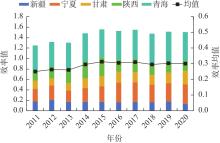
Fig. 1
Accumulated carbon emission efficiency of tourism in the five northwestern provinces (autonomous regions) from 2011 to 2020"
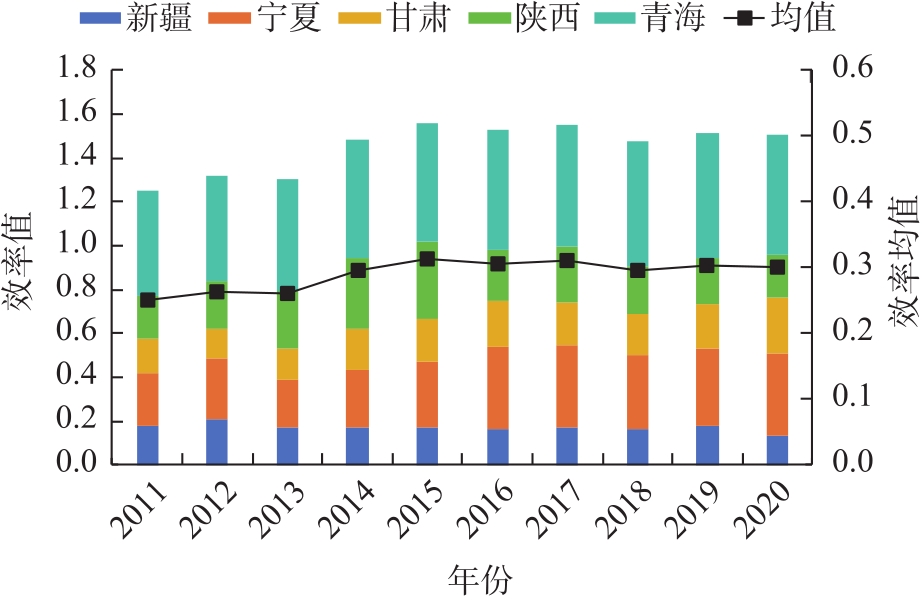
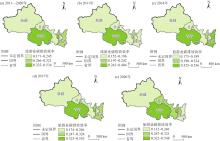
Fig. 2
Spatial distributions of carbon emission efficiency of tourism in five northwestern provinces (autonomous regions) from 2011 to 2020"
Tab. 3
Average ML index and decomposition of carbon emission efficiency of tourism in the five northwestern provinces (autonomous regions) from 2011 to 2020"
| 地区 | 碳排放效率ML指数 | 技术效率指数 | 技术进步指数 |
|---|---|---|---|
| 新疆 | 1.083 | 1.019 | 1.227 |
| 宁夏 | 1.061 | 1.178 | 0.928 |
| 甘肃 | 1.081 | 1.118 | 0.959 |
| 陕西 | 1.230 | 1.100 | 1.150 |
| 青海 | 1.250 | 1.212 | 1.056 |
| 均值 | 1.141 | 1.125 | 1.064 |
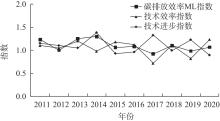
Fig. 3
Average ML index and decomposition of carbon emission efficiency of tourism in the five northwestern provinces (autonomous regions) from 2011 to 2020"
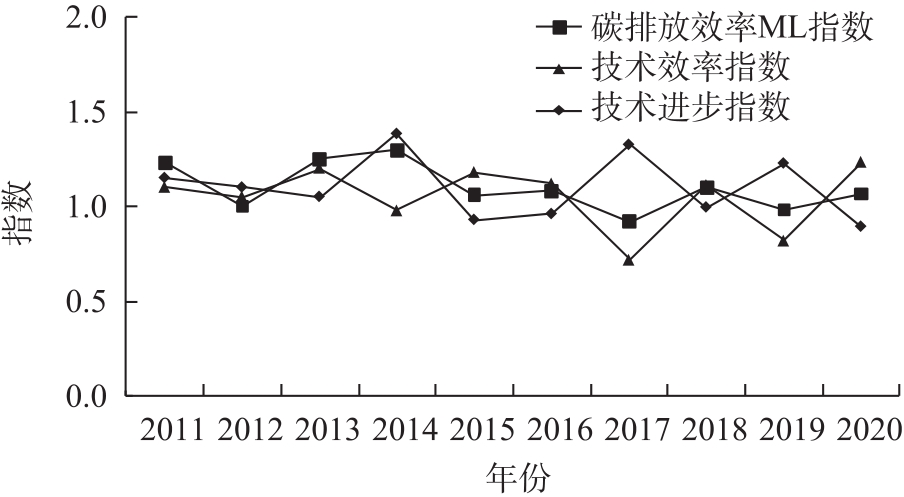
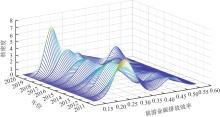
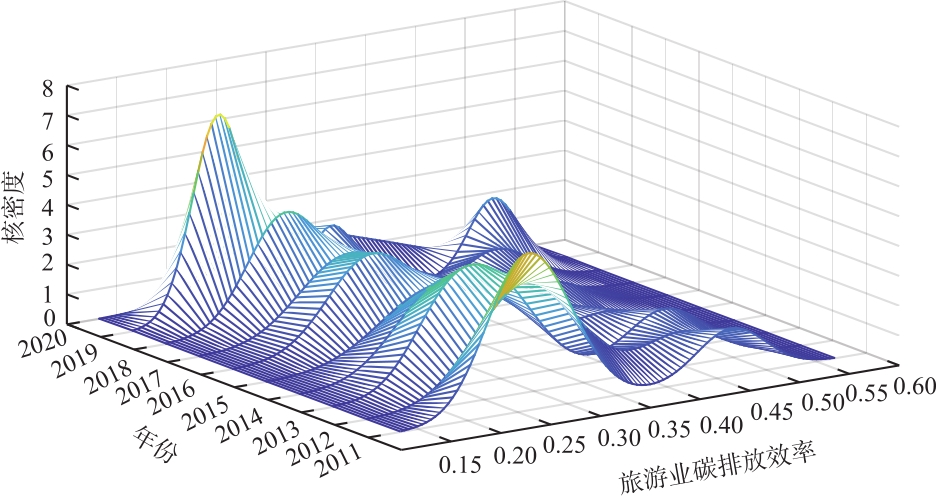
Fig. 4
Three-dimensional kernel density of carbon emission efficiency of tourism in the five northwestern provinces (autonomous regions)"
Tab. 4
Influence factors and co-linearity test results of carbon emission efficiency of tourism in the five northwestern provinces (autonomous regions)"
| 变量 | 指标选取 | 方差膨胀因子 | 判断 |
|---|---|---|---|
| 经济发展水平 | 人均地区生产总值/108元 | 3.242 | 可接受 |
| 产业结构 | 第三产业占GDP的比重/% | 4.832 | 接近临界值 |
| 旅游接待规模 | 旅行社与星级酒店总数/家 | 4.521 | 接近临界值 |
| 技术创新能力 | 专利申请数量/件 | 2.123 | 可接受 |
| 对外开放程度 | 实际利用外资额占GDP的比重/% | 1.957 | 可接受 |
| 交通基础设施 建设 | 公路通车里程和铁路营业里程之和与区域面积的比值[ | 4.343 | 接近临界值 |
Tab. 5
Tobit regression results"
| 变量 | 随机效应Tobit | 混合Tobit | 固定效应OLS | 随机效应OLS |
|---|---|---|---|---|
| 经济发展水平 | 0.755*** | 0.0645* | 0.278** | 0.113* |
| (0.044) | (0.0326) | (0.0429) | (0.0646) | |
| 产业结构 | 0.189** | 0.188** | -0.165* | 0.172 |
| (0.0282) | (0.0371) | (0.0438) | (0.0293) | |
| 旅游接待规模 | -0.336** | -0.329 | 0.319 | 0.284 |
| (0.0102) | (0.0106) | (0.0373) | (0.0146) | |
| 技术创新能力 | 0.0028*** | 0.0108*** | 0.0032*** | 0.0013 |
| (0.0015) | (0.0060) | (0.0014) | (0.0342) | |
| 对外开放程度 | 0.0117 | 0.0736 | 0.0134 | 0.0146 |
| (0.0105) | (0.0187) | (0.0896) | (0.0847) | |
| 交通基础设施建设 | -0.167 | -0.189 | -0.152 | -0.154* |
| (0.0174) | (0.0109) | (0.0404) | (0.0240) | |
| Log-L | 55.841 | - | - | - |
| LR(chi) | 146.300 | - | - | - |
| Prob>chi2 | 0.000 | - | - | - |
| [1] | Kelly J, Willianms P W. Tourism destination energy consumption and greenhouse gas emissions: Whistler, British Columbia, Canada[J]. Sustainable Tourism, 2007, 15(1): 67-90. |
| [2] | 洪禹, 王凤霞, 李浩. 中国省域旅游业碳排放公平性及其影响因素[J]. 生态经济, 2025, 41(3): 139-149. |
| [Hong Yu, Wang Fengxia, Li Hao. Carbon emission equity in China’s provincial tourism industry and influencing factors[J]. Ecological Economy, 2025, 41(3):139-149.] | |
| [3] | 王立国, 朱海, 叶炎婷, 等. 中国省域旅游业碳中和时空分异与模拟[J]. 生态学报, 2024, 44(2): 625-636. |
| [Wang Liguo, Zhu Hai, Ye Yanting, et al. Spatio-temporal differentiation and simulation of provincial tourism carbon neutrality in China[J]. Acta Ecologica Sinica, 2024, 44(2): 625-636.] | |
| [4] | 李素珍, 任家琪, 崔玉玮, 等. 武夷山旅游产业碳足迹核算[J]. 环境工程, 2023, 41(12): 312-318. |
| [Li Suzhen, Ren Jiaqi, Cui Yuwei, et al. Accounting of carbon footprint of Wuyishan tourism industry[J]. Environmental Engineering, 2023, 41(12): 312-318.] | |
| [5] | Campos C, Laso J, Cristóbal J, et al. Towards more sustainable tourism under a carbon footprint approach: The Camino Lebaniego case study[J]. Journal of Cleaner Production, 2022: 369: 133222, doi: 10.1016/j.jclepro.2022.133222. |
| [6] | 李思迪, 李姝萱, 钟永德, 等. 基于DEA模型的区域旅游资源配置效率研究[J]. 控制与决策, 2022, 37(8): 1945-1954. |
| [Li Sidi, Li Shuxuan, Zhong Yongde, et al. Research on efficiency of regional tourism resources allocation based on DEA model[J]. Control and Decision, 2022, 37(8): 1945-1954.] | |
| [7] | 胡剑波, 张宽元, 韩君. 我国省域降碳减污绩效测度、时空分异与收敛性研究[J]. 统计研究, 2025, 42(2): 99-110. |
| [Hu Jianbo, Zhang Kuanyuan, Han Jun. Research on the measurement, spatiotemporal differentiation and convergence of carbon and pollution reduction performance in China[J]. Statistical Research, 2025, 42(2): 99-110.] | |
| [8] | 方琰, 张怡琳, 张旖旎, 等. 旅游业发展对中国碳排放的影响——基于中国东、中、西部的比较分析[J]. 生态学报, 2024, 44(10): 4105-4116. |
| [Fang Yan, Zhang Yilin, Zhang Yimi, et al. The impact of tourism development on China’s carbon emissions: The comparative analysis of east, middle and west China[J]. Acta Ecologica Sinica, 2024, 44(10): 4105-4116.] | |
| [9] |
杜娅明, 白永平, 梁建设, 等. 黄河流域旅游业碳排放效率综合测度及影响因素研究[J]. 干旱区地理, 2023, 46(12): 2074-2085.
doi: 10.12118/j.issn.1000-6060.2023.193 |
|
[Du Yaming, Bai Yongping, Liang Jianshe, et al. Comprehensive measurement and influencing factors of carbon emission efficiency of tourism in the Yellow River Basin[J]. Arid Land Geography, 2023, 46(12): 2074-2085.]
doi: 10.12118/j.issn.1000-6060.2023.193 |
|
| [10] | 毕斗斗, 张宇嘉, 贾振立. 粤港澳大湾区“三生空间”转型对旅游业碳排放环境负荷的影响研究[J]. 生态经济, 2025, 41(4): 148-158. |
| [Bi Doudou, Zhang Yujia, Jia Zhenli. Study on the impact of the transformation of “production-living-ecological spaces” on the environmental load of tourism carbon emissions in the Guangdong-Hong Kong-Macao Greater Bay Area[J]. Ecological Economy, 2025, 41(4): 148-158.] | |
| [11] | 王珊, 张泽矩, 王梦涵, 等. 中国省域旅游业碳排放效率综合测度及成因分析[J]. 财经理论研究, 2025, 41(1): 71-83. |
| [Wang Shan, Zhang Zeju, Wang Menghan, et al. Comprehensive measurement and causal analysis of carbon emission efficiency in China’s provincial tourism industry[J]. Finance and Economics Theory, 2025, 41(1): 71-83.] | |
| [12] | 朱海, 王立国, 贺焱, 等. 多情景下中国省域旅游业碳达峰的时空特征研究[J]. 干旱区资源与环境, 2023, 37(1): 169-176. |
| [Zhu Hai, Wang Liguo, He Yan, et al. Spatial and temporal characteristics of carbon peak of provincial tourism in China under multiple scenarios[J]. Arid Land Resources and Environment, 2023, 37(1): 169-176.] | |
| [13] | 徐琼, 程慧, 钟美瑞. 中国旅游业碳排放效率趋同演变及其趋势预测[J]. 生态学报, 2023, 43(9): 3417-3429. |
| [Xu Qiong, Cheng Hui, Zhong Meirui. Convergent evolution and trend prediction of carbon emission efficiency in China’s tourism industry[J]. Acta Ecologica Sinica, 2023, 43(9): 3417-3429.] | |
| [14] |
Tang C C, Zhong L S, Jiang Q O. Energy efficiency and carbon effi-ciency of tourism industry in destination[J]. Energy Efficiency, 2020, 11(3): 539-558.
doi: 10.1007/s12053-017-9598-0 |
| [15] | JianP Z, Rong F, Yao Y, et al. Framework for accounting for tourism carbon emissions in China: An industrial linkage perspective[J]. Tourism Economics, 2020, 27(7): 50-64. |
| [16] | 高源遥, 沈西林, 梁文灏, 等. 基于STIRPAT模型的四川省旅游业碳排放量影响因素分析[J]. 环境污染与防治, 2023, 45(12): 1737-1742. |
| [Gao Yuanyao, Shen Xilin, Liang Wenhao, et al. Analysis of the factors influencing carbon emissions from tourism in Sichuan Province based on the STIRPAT model[J]. Environmental Pollution and Prevention, 2023, 45(12): 1737-1742.] | |
| [17] |
Wang L G, Jia G D. Spatial spillover and threshold effects of high-quality tourism development on carbon emission efficiency of tourism under the “Double Carbon” target: Case study of Jiangxi, China[J]. Sustainability, 2023, 11(3): 539-558.
doi: 10.3390/su11020539 |
| [18] | 陈玲玲. 多尺度视角下中国旅游业碳排放强度时空动态研究[J]. 生态经济, 2024, 40(5): 124-131. |
| [Chen Lingling. Study on the spatiotemporal dynamics of carbon emission intensity of China’s tourism industry from a multi-scale perspective[J]. Ecological Economics, 2024, 40(5): 124-131.] | |
| [19] | 苏振, 郑应宏, 郭峦. 数字经济对旅游业碳排放效率的影响及门槛效应[J]. 中国人口资源与环境, 2023, 33(8): 69-79. |
| [Su Zhen, Zheng Yinghong, Guo Luan. Impact of the digital economy on the carbon efficiency of the tourism industry and its threshold effect[J]. China Population Resources and Environment, 2023, 33(8): 69-79.] | |
| [20] | 章锦河. 旅游业碳排放测度与管理[J]. 旅游学刊, 2023, 38(11): 8-10. |
| [Zhang Jinhe. Measurement and management of carbon emissions in tourism[J]. Tourism Tribune, 2023, 38(11): 8-10.] | |
| [21] | 王凯, 关锐, 甘畅, 等. 中国新型城镇化水平对旅游业碳排放效率的空间效应[J]. 长江流域资源与环境, 2023, 32(3): 582-595. |
| [Wang Kai, Guan Rui, Gan Chang, et al. Spatial effect of new-type urbanization on tourism carbon emission efficiency in China[J]. Resources and Environment in the Yangtze Basin, 2023, 32(3): 582-595.] | |
| [22] | Zhang Y P. Carbon emissions dynamics and environmental sustainability in China’s tourism sector: A 22-year comprehensive regional study[J]. Sustainability, 2024, 16(16): 7091, doi: 10.3390/su16167091. |
| [23] |
王钰凯, 郭辉. 新疆旅游业生态效率时空分异与收敛性研究[J]. 干旱区地理, 2022, 45(4): 1320-1331.
doi: 10.12118/j.issn.1000-6060.2021.533 |
|
[Wang Yukai, Guo Hui. Spatial and temporal differentiation and convergence studies of the ecoefficiency of Xinjiang tourism industry[J]. Arid Land Geography, 2022, 45(4): 1320-1331.]
doi: 10.12118/j.issn.1000-6060.2021.533 |
|
| [24] | 李智慧, 王凯, 徐丽萍. 中国环境规制对旅游业碳排放强度影响的空间异质性[J]. 生态学报, 2023, 43(5): 2128-2140. |
| [Li Zhihui, Wang Kai, Xu Liping. Spatial heterogeneity of the environmental regulation’s impacts on the carbon emission intensity of tourism in China[J]. Acta Ecologica Sinica, 2023, 43(5): 2128-2140.] | |
| [25] | Yang G X, Jia L. Estimation of carbon emissions from tourism transport and analysis of its influencing factors in Dunhuang[J]. Sustainability, 2022, 14(21): 14323, doi: 10.3390/su142114323. |
| [26] |
Young A. Gold into base metals: Productivity growth in the People’s Republic of China during the reform period[J]. Journal of Political Economy, 2003, 111(6): 1220-1261.
doi: 10.1086/378532 |
| [27] | Mcdonald G, Patterson M. How clean and green is New Zealand tourism?[M]. Lincoln: Manaki Whenua, 1994: 1-52. |
| [28] |
Chung Y H, Färe R, Grosskopf S. Productivity and undesirable out-puts: A directional distance function approach[J]. Journal of Environmental Management, 1997, 51(3): 229-240.
doi: 10.1006/jema.1997.0146 |
| [29] | 周华林, 李雪松. Tobit模型估计方法与应用[J]. 经济学动态, 2012(5): 105-119. |
| [Zhou Hualin, Li Xuesong. Tobit model estimation method and application[J]. Economic Perspectives, 2012(5): 105-119.] | |
| [30] | 彭红松, 章锦河, 韩娅, 等. 旅游地生态效率测度的SBM-DEA模型及实证分析[J]. 生态学报, 2017, 37(2): 628-638. |
| [Peng Hongsong, Zhang Jinhe, Han Ya, et al. Measurement and empirical analysis of eco-efficiency in tourism destinations based on a slack-based measure-data envelopment analysis model[J]. Acta Ecologica Sinica, 2017, 37(2): 628-638.] | |
| [31] |
Demurger S. Infrastructure development and economic growth: An explanation for regional disparities in China[J]. Journal of Comparative Economics, 2001, 29(1): 95-117.
doi: 10.1006/jcec.2000.1693 |
|
||

