Arid Land Geography ›› 2026, Vol. 49 ›› Issue (10): 2054-2064.doi: 10.12118/j.issn.1000-6060.2025.642
• Ecology and Environment • Previous Articles Next Articles
MA Huifang( ), WANG E, WANG Yanli, SUN Zhuona, ZHAO Runfang, ZHANG Jun()
Received:2025-10-18
Revised:2025-11-12
Online:2026-10-25
Published:2026-10-26
Contact:
ZHANG Jun
E-mail:mhf13309381493@163.com;zhangjun@gsau.edu.cn
MA Huifang, WANG E, WANG Yanli, SUN Zhuona, ZHAO Runfang, ZHANG Jun. Ecological security pattern and optimization in the Hexi region under a “core-potential” dual-source framework[J].Arid Land Geography, 2026, 49(10): 2054-2064.
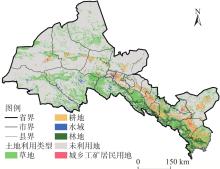
Fig. 1
Schematic diagram of the study area"
Tab. 1
Data sources"
| 数据 | 年份 | 分辨率/m | 来源 |
|---|---|---|---|
| 土壤保持/t·km-2 | 2020 | 1000 | https://www.scidb.cn/ |
| 水源涵养/mm | 2020 | 30 | https://www.scidb.cn/ |
| 防风固沙/kg·m-2 | 2020 | 30 | https://www.scidb.cn/ |
| 土地沙化 | 2020 | 90 | https://gis5g.com/home |
| 土地利用 | 2000、2010、2020、2022 | 1000 | https://gis5g.com/home |
| 归一化植被指数 | 2020 | 1000 | https://data.tpdc.ac.cn/ |
| 河流数据 | 2020 | - | https://www.openstreet-map.org/ |
| 道路数据 | 2020 | - | https://www.openstreet-map.org/ |
| MOD09A1 | 2020年8月 | 500 | https://ladsweb.modaps.eosdis.nasa.gov/archive/ |
Tab. 2
Grading criteria and weights of ecological resistance factors"
| 阻力因子 | 生态扩张阻力分值 | 权重 | ||||
|---|---|---|---|---|---|---|
| 1级 | 2级 | 3级 | 4级 | 5级 | ||
| 土地利用 | 林地、水域 | 草地 | 耕地 | 未利用地 | 建设用地 | 0.32 |
| 归一化植被指数 | 0.8~1.0 | 0.6~0.8 | 0.4~0.6 | 0.2~0.4 | 0.0~0.2 | 0.18 |
| 高程/m | <1610 | 1610~2284 | 2284~3079 | 3079~3884 | >3884 | 0.15 |
| 坡度/(°) | 0~3 | 3~8 | 8~15 | 15~25 | >25 | 0.10 |
| 距道路距离/m | >2000 | 1500~2000 | 1000~1500 | 500~1000 | <500 | 0.09 |
| 距水域距离/m | <1000 | 1000~2000 | 2000~3000 | 3000~4000 | >4000 | 0.16 |
Tab. 3
Landscape connectivity index for ecological source areas /%"
| 源地类型 | 斑块编号 | dLCP | dIIC | dPC | 斑块编号 | dLCP | dIIC | dPC | 斑块编号 | dLCP | dIIC | dPC |
|---|---|---|---|---|---|---|---|---|---|---|---|---|
| 核心生态源地 | 1 | 1.461 | 0.821 | 1.278 | 6 | 0.035 | 0.032 | 1.274 | 11 | 0.723 | 0.415 | 0.645 |
| 2 | 98.455 | 98.939 | 98.435 | 7 | 5.690 | 1.782 | 3.920 | 12 | 11.989 | 7.089 | 10.674 | |
| 3 | 0.498 | 0.190 | 0.395 | 8 | 9.619 | 3.260 | 2.966 | 13 | 0.019 | 0.013 | 0.506 | |
| 4 | 3.105 | 1.659 | 2.520 | 9 | 10.142 | 3.545 | 0.624 | 14 | 0.289 | 0.088 | 0.206 | |
| 5 | 0.206 | 0.114 | 0.191 | 10 | 0.339 | 0.195 | 0.330 | |||||
| 高潜力生态源地 | A1 | 0.759 | 0.510 | 0.680 | A8 | 0.177 | 0.121 | 0.146 | A15 | 0.103 | 0.069 | 0.094 |
| A2 | 83.165 | 82.238 | 78.505 | A9 | 39.194 | 34.326 | 40.341 | A16 | 11.241 | 5.998 | 9.178 | |
| A3 | 13.519 | 7.259 | 10.937 | A10 | 0.963 | 0.649 | 0.863 | A17 | 0.584 | 0.456 | 1.528 | |
| A4 | 7.384 | 3.722 | 5.868 | A11 | 30.459 | 15.801 | 10.790 | A18 | 0.013 | 0.008 | 0.184 | |
| A5 | 1.800 | 1.251 | 1.489 | A12 | 0.265 | 0.409 | 7.063 | A19 | 0.010 | 0.006 | 0.112 | |
| A6 | 1.214 | 0.826 | 1.158 | A13 | 1.979 | 1.335 | 1.914 | |||||
| A7 | 0.662 | 0.455 | 0.633 | A14 | 0.176 | 0.118 | 0.180 |
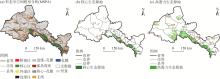
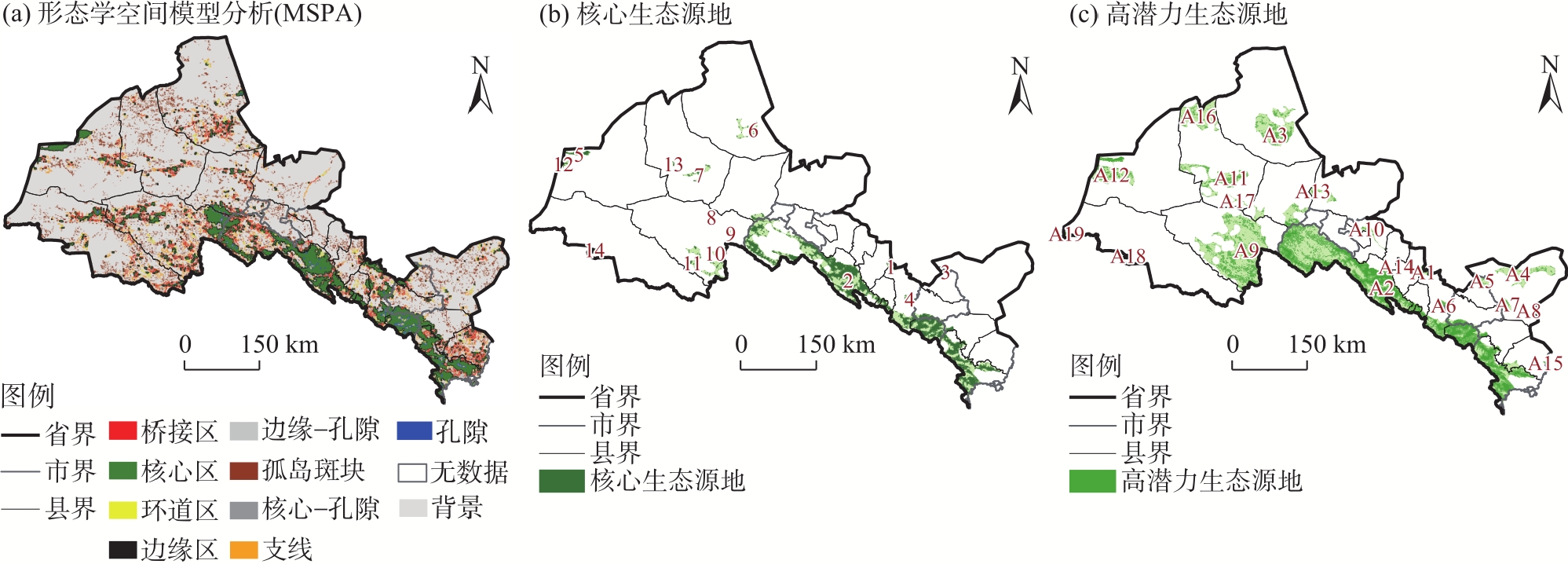
Fig. 2
Distributions of ecological source areas in the Hexi region"
Tab. 4
Statistics on the area of ecological source areas"
| 源地类型 | 林地 | 草地 | 水域 | 生态源地 | ||||||||
|---|---|---|---|---|---|---|---|---|---|---|---|---|
| 面积/km2 | 占比/% | 面积/km2 | 占比/% | 面积/km2 | 占比/% | 面积/km2 | 占比/% | 个数 | ||||
| 核心生态源地 | 4031 | 33.99 | 7677 | 64.74 | 105 | 0.89 | 11941.29 | 4.82 | 14 | |||
| 高潜力生态源地 | 5547 | 22.09 | 16394 | 65.30 | 259 | 1.03 | 25259.22 | 10.20 | 19 | |||
Fig. 3
Comprehensive resistance surface classification for the Hexi region"
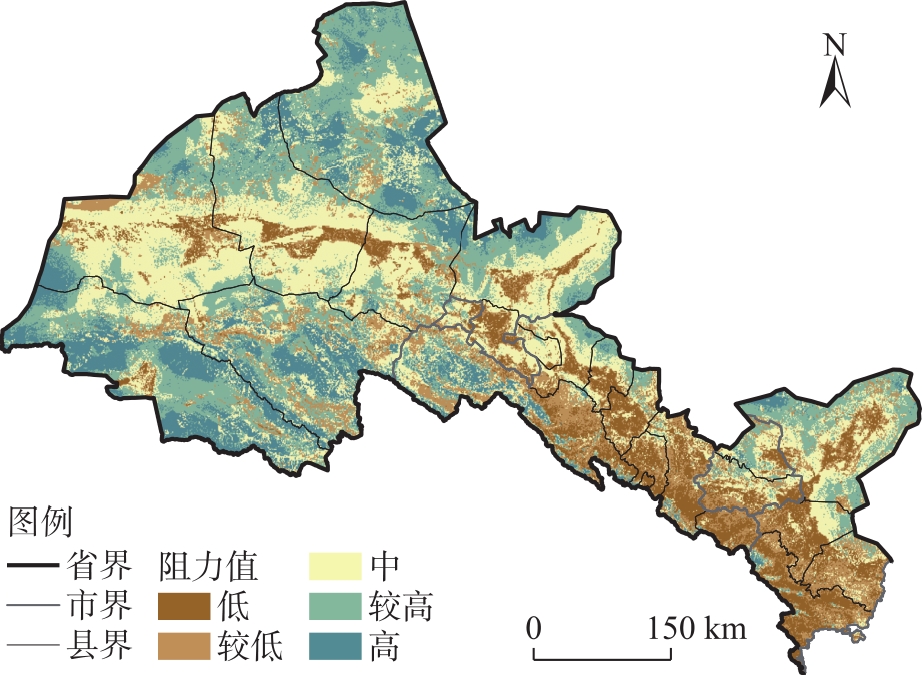
Fig. 4
Ecological security network patterns of the Hexi region"
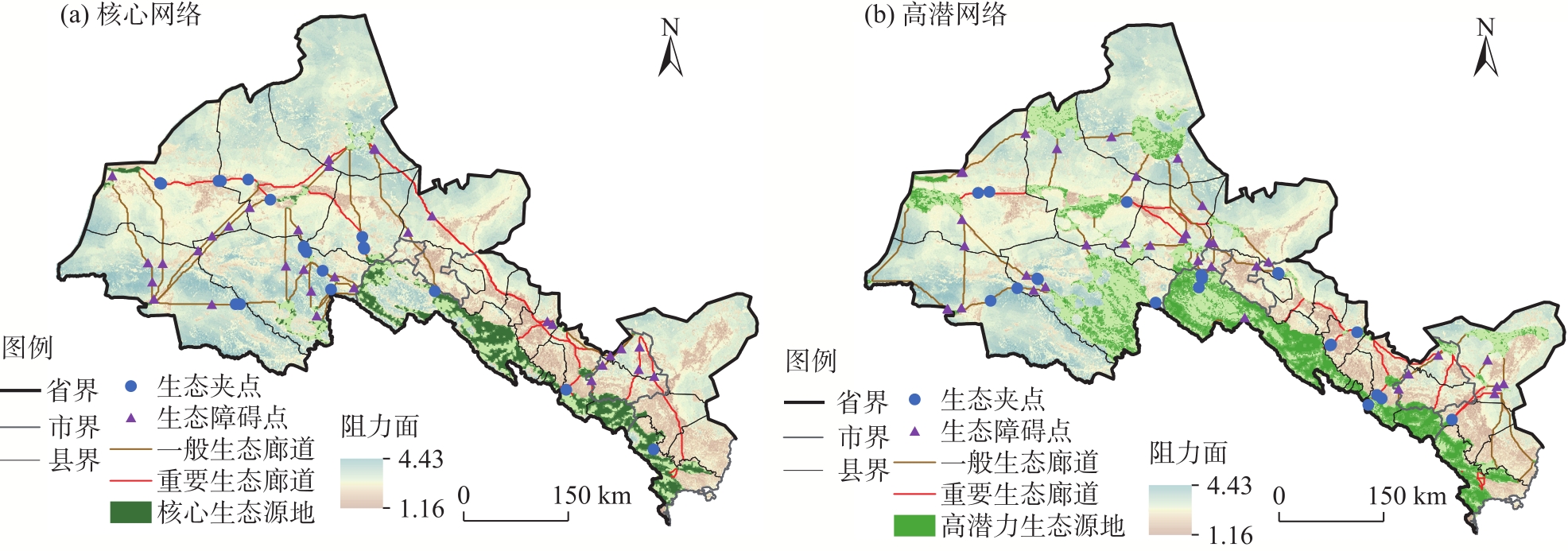
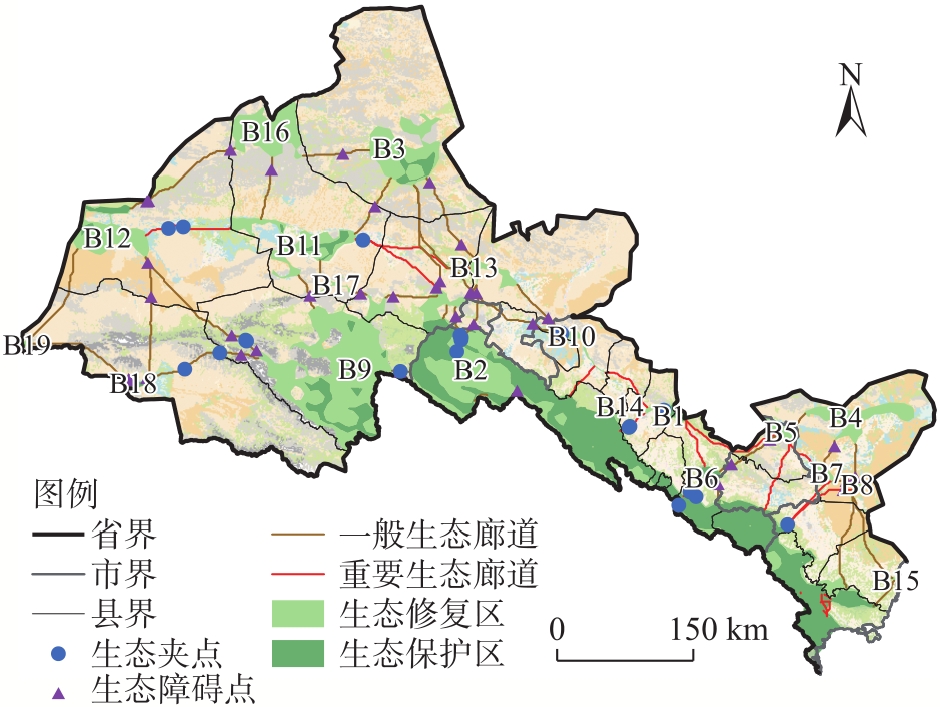
Fig. 5
Spatial distribution of ecological issues in the Hexi region"
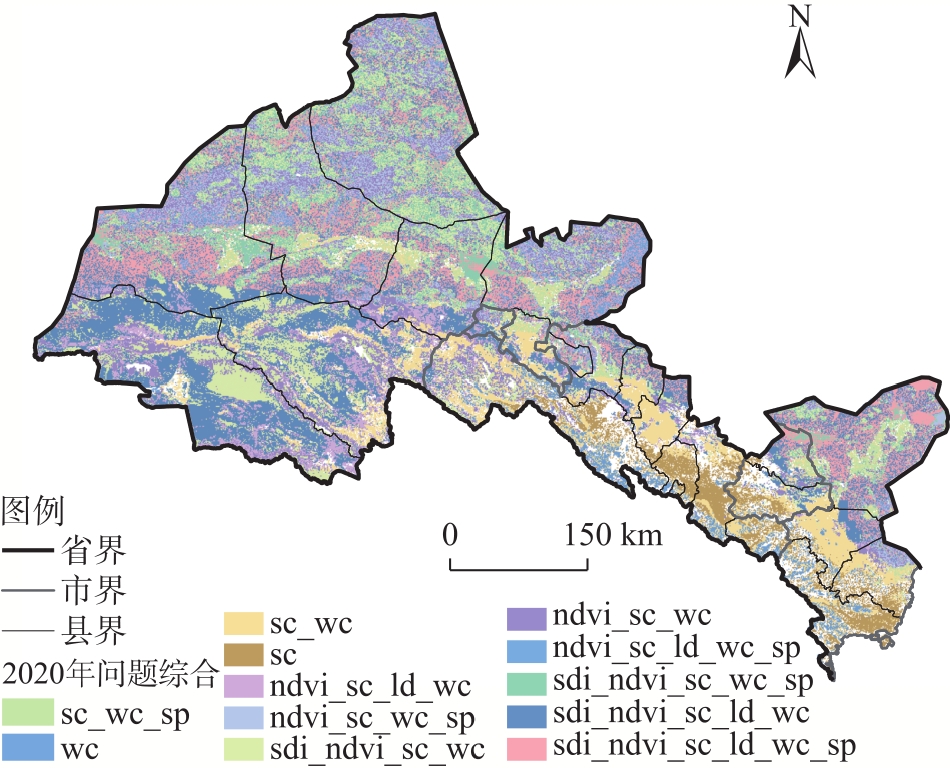
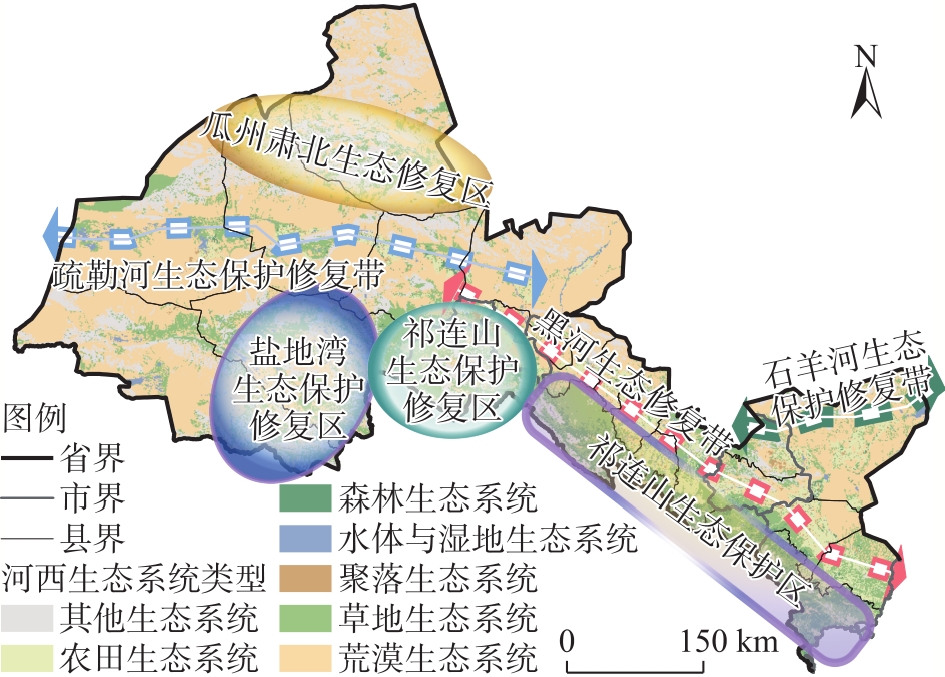
Fig. 6
Ecological protection and restoration zoning"
Tab. 5
Ecological safety network structure index before and after optimization"
| 生态网络 | 生态廊道 | 廊道总长/km | 生态夹点 | 闭合度指数(α) | 线点率指数(β) | 连接度指数(γ) | 成本比(R) |
|---|---|---|---|---|---|---|---|
| 核心网络(优化前) | 40 | 4456.31 | 19 | 0.67 | 2.11 | 0.78 | 0.99 |
| 高潜网络(优化后) | 55 | 3574.71 | 21 | 0.95 | 2.62 | 0.96 | 0.98 |
Fig. 7
Ecological security planning for the Hexi region"
| [1] | 叶鑫, 邹长新, 刘国华, 等. 生态安全格局研究的主要内容与进展[J]. 生态学报, 2018, 38(10): 3382-3392. |
| [Ye Xin, Zou Changxin, Liu Guohua, et al. Main research contents and advances in the ecological security pattern[J]. Acta Ecologica Sinica, 2018, 38(10): 3382-3392. ] | |
| [2] | Chen W H, Liu H M, Wang J L. Construction and optimization of regional ecological security patterns based on MSPA-MCR-GA model: A case study of Dongting Lake Basin in China[J]. Ecological Indicators, 2024, 165: 112169, doi: 10.1016/j.ecolind.2024.112169. |
| [3] | 国务院. 国务院关于印发全国国土规划纲要(2016-2030年)的通知[EB/OL]. [2017-02-04]. https://www.gov.cn/zhengce/content/2017-02/04/content_5165309.htm. |
| [State Council. Notice of the State Council on issuing the national territorial planning outline (2016-2030)[EB/OL]. [2017-02-04]. https://www.gov.cn/zheng-ce/content/2017-02/04/content_5165309.htm.] | |
| [4] | 中共中央办公厅,国务院办公厅. 《关于划定并严守生态保护红线的若干意见》[EB/OL]. [2017-02-07]. https://www.gov.cn/zhengce/2017-02/07/content_5166291.htm. |
| [General Office of the Central Committee of the Communist Party of China, General Office of the State Council. Several opinions on delineating and strictly observing ecological protection red lines[EB/OL]. [2017-02-07]. https://www.gov.cn/zhengce/2017-02/07/content_5166-291.htm.] | |
| [5] | 胡军. 加快建设国家生态安全屏障[EB/OL]. [2025-06-03]. https://theory.people.com.cn/n1/2025/0603/c40531-40492725.html. |
| [Hu Jun. Accelerating the construction of the national ecological security barrier[EB/OL]. [2025-06-03]. https://theory.people.com.cn/n1/2025/0603/c40531-40492725.html.] | |
| [6] | Gong D H, Huang M, Lin H. Construction of an ecological security pattern in rapidly urbanizing areas based on ecosystem sustainability, stability, and integrity[J]. Remote Sensing, 2023, 15(24): 5728, doi: 10.3390/rs15245728. |
| [7] |
Graves R A, Williamson M A, Belote R T, et al. Quantifying the contribution of conservation easements to large-landscape conservation[J]. Biological Conservation, 2019, 232: 83-96.
doi: 10.1016/j.biocon.2019.01.024 |
| [8] | Luo J L, Fu H. Construct the future wetland ecological security pattern with multi-scenario simulation[J]. Ecological Indicators, 2023, 153: 110473, doi: 10.1016/j.ecolind.2023.110473. |
| [9] | Chen Y, Wang J L, Kurbanov E, et al. Ecological security assessment at different spatial scales in central Yunnan Province, China[J]. Plos One, 2022, 17(6): e0270267, doi: 10.1371/journal.pone.0270267. |
| [10] | Cao W Y, Li X B, Lü X, et al. To explore the effectiveness of various ecological security pattern construction methods in many growth situations in the future: A case study of the west Liaohe River Basin in Inner Mongolia[J]. Science of the Total Environment, 2024, 948: 174607, doi: 10.1016/j.scitotenv.2024.174607. |
| [11] | Nie W B, Xu B, Yang F, et al. Simulating future land use by coupling ecological security patterns and multiple scenarios[J]. Science of the Total Environment, 2023, 859: 160262, doi: 10.1016/j.scitotenv.2022.160262. |
| [12] | Pan N H, Du Q Q, Guan Q Y, et al. Ecological security assessment and pattern construction in arid and semi-arid areas: A case study of the Hexi region, NW China[J]. Ecological Indicators, 2022, 138: 108797, doi: 10.1016/j.ecolind.2022.108797. |
| [13] | Huang L Y, Wang J, Cheng H G. Spatiotemporal changes in ecological network resilience in the Shandong Peninsula urban agglomeration[J]. Journal of Cleaner Production, 2022, 339: 130681, doi: 10.1016/j.jclepro.2022.130681. |
| [14] | Li H, Yi N, Yao W J, et al. Shangri-La County ecological land use planning based on landscape security pattern[J]. Acta Ecologica Sinica, 2011, 31(20): 5928-5936. |
| [15] | Zhou G J, Huan Y Z, Wang L Q, et al. Linking ecosystem services and circuit theory to identify priority conservation and restoration areas from an ecological network perspective[J]. Science of the Total Environment, 2023, 873: 162261, doi: 10.1016/j.scitotenv.2023.162261. |
| [16] |
黄秋淞, 何浩. 耦合生态系统服务和景观连通性的环塔里木盆地绿洲区生态安全格局研究[J]. 干旱区地理, 2024, 47(10): 1745-1754.
doi: 10.12118/j.issn.1000-6060.2024.022 |
|
[Huang Qiusong, He Hao. Ecological security pattern of the oasis area around the Tarim Basin based on coupled ecosystem services and landscape connectivity[J]. Arid Land Geography, 2024, 47(10): 1745-1754. ]
doi: 10.12118/j.issn.1000-6060.2024.022 |
|
| [17] | Cui X F, Deng W, Yang J X, et al. Construction and optimization of ecological security patterns based on social equity perspective: A case study in Wuhan, China[J]. Ecological Indicators, 2022, 136: 108714, doi: 10.1016/j.ecolind.2022.108714. |
| [18] |
马晓武, 徐昔保. 区域尺度生态保护红线连通性优化与管控--以长三角为例[J]. 自然资源学报, 2022, 37(12): 3088-3101.
doi: 10.31497/zrzyxb.20221205 |
|
[Ma Xiaowu, Xu Xibao. Optimization and management of the connectivity of ecological red lines at regional scale: A case study of Yangtze River Delta[J]. Journal of Natural Resources, 2022, 37(12): 3088-3101. ]
doi: 10.31497/zrzyxb.20221205 |
|
| [19] |
张杰, 屈建军, 陈海, 等. 基于电路理论的生态安全格局时空演变与影响因素研究--以陕北黄土高原为例[J]. 干旱区地理, 2025, 48(3): 494-505.
doi: 10.12118/j.issn.1000-6060.2024.199 |
|
[Zhang Jie, Qu Jianjun, Chen Hai, et al. Spatial and temporal evolution and influencing factors of ecological security pattern based on circuit theory: A case of Loess Plateau in northern Shaanxi[J]. Arid Land Geography, 2025, 48(3): 494-505. ]
doi: 10.12118/j.issn.1000-6060.2024.199 |
|
| [20] | Wang N N, Zhao Y. Construction of an ecological security pattern in Jiangnan water network area based on an integrated approach: A case study of Gaochun, Nanjing[J]. Ecological Indicators, 2024, 158: 111314, doi: 10.1016/j.ecolind.2023.111314. |
| [21] |
Senf C, Seidl R. Mapping the forest disturbance regimes of Europe[J]. Nature Sustainability, 2021, 4(1): 63-70.
doi: 10.1038/s41893-020-00609-y |
| [22] |
邓晓红, 宋玉琳, 李宗省, 等. 河西地区生态敏感性演变格局及分区治理[J]. 中国沙漠, 2023, 43(5): 232-240.
doi: 10.7522/j.issn.1000-694X.2023.00083 |
|
[Deng Xiaohong, Song Yulin, Li Zongsheng, et al. Evolution pattern of terrestrial ecological sensitivity in the Hexi region and its zoning governance[J]. Journal of Desert Research, 2023, 43(5): 232-240. ]
doi: 10.7522/j.issn.1000-694X.2023.00083 |
|
| [23] | 自然资源部. 《中国陆域生态基础分区(试行)》[EB/OL]. [2023-05-16]. https://www.guoturen.com/wenku-7024. |
| [Ministry of Natural Resources. China’s terrestrial ecological base zoning (trial)[EB/OL]. [2023-05-16]. https://www.guoturen.com/wenku-7024.] | |
| [24] | 薛明月, 吴孟泉, 郑龙啸, 等. 基于电路理论的县域生态安全格局构建: 以山东省栖霞市为例[J]. 生态学杂志, 2024, 43(10): 3223-3232. |
|
[Xue Mingyue, Wu Mengquan, Zheng Longxiao, et al. The construction of county-level ecological security pattern based on circuit theory: A case study in Qixia City, Shandong Province[J]. Chinese Journal of Ecology, 2024, 43(10): 3223-3232. ]
doi: 10.13292/j.1000-4890.202410.021 |
|
| [25] |
Bodin Ö, Saura S. Ranking individual habitat patches as connectivity providers: Integrating network analysis and patch removal experiments[J]. Ecological Modelling, 2010, 221(19): 2393-2405.
doi: 10.1016/j.ecolmodel.2010.06.017 |
| [26] |
Baranyi G, Saura S, Podani J, et al. Contribution of habitat patches to network connectivity: Redundancy and uniqueness of topological indices[J]. Ecological Indicators, 2011, 11(5): 1301-1310.
doi: 10.1016/j.ecolind.2011.02.003 |
| [27] | 陈春娣, 吴胜军, Douglas M C, 等. 阻力赋值对景观连接模拟的影响[J]. 生态学报, 2015, 35(22): 7367-7376. |
| [Chen Chundi, Wu Shengjun, Douglas M C, et al. Effects of changing cost values on landscape connectivity simulation[J]. Acta Ecologica Sinica, 2015, 35(22): 7367-7376. ] | |
| [28] | 潘竟虎, 刘晓. 基于空间主成分和最小累积阻力模型的内陆河景观生态安全评价与格局优化--以张掖市甘州区为例[J]. 应用生态学报, 2015, 26(10): 3126-3136. |
|
[Pan Jinghu, Liu Xiao. Assessment of landscape ecological security and optimization of landscape pattern based on spatial principal component analysis and resistance model in arid inland area: A case study of Ganzhou District, Zhangye City, northwest China[J]. Chinese Journal of Applied Ecology, 2015, 26(10): 3126-3136. ]
pmid: 26995922 |
|
| [29] | 魏柏浩, 阿里木江·卡斯木, 如克亚·热合曼, 等. 天山北坡城市群生态承载力演变与生态敏感性分析[J]. 生态学报, 2023, 43(4): 1399-1411. |
| [Wei Bohao, Kasimu Alimujiang, Reheman Rukya, et al. Ecological carrying capacity evolution and ecological sensitivity analysis of urban agglomeration in the northern slope of the Tianshan Mountains[J]. Acta Ecologica Sinica, 2023, 43(4): 1399-1411. ] | |
| [30] |
金银丽, 周冬梅, 周凡, 等. 疏勒河流域生态安全网络构建及优化[J]. 应用生态学报, 2023, 34(4): 1063-1072.
doi: 10.13287/j.1001-9332.202304.020 |
|
[Jin Yinli, Zhou Dongmei, Zhou Fan, et al. Construction and optimization of ecological security network in the Shule River Basin, China[J]. Chinese Journal of Applied Ecology, 2023, 34(4): 1063-1072. ]
doi: 10.13287/j.1001-9332.202304.020 |
|
| [31] | Ding M M, Liu W, Xiao L, et al. Construction and optimization strategy of ecological security pattern in a rapidly urbanizing region: A case study in central-south China[J]. Ecological Indicators, 2022, 136: 108604, doi: 10.1016/j.ecolind.2022.108604. |
| [32] | Kang J M, Zhang X, Zhu X W, et al. Ecological security pattern: A new idea for balancing regional development and ecological protection. A case study of the Jiaodong Peninsula, China[J]. Global Ecology and Conservation, 2021, 26: e01472, doi: 10.1016/j.gecco.2021.e01472. |
| [33] | 张德魁, 安富博, 赵艳丽, 等. 甘肃河西走廊典型戈壁土壤粒度特征分析[J]. 中国水土保持, 2020(11): 41-45. |
| [Zhang Dekui, An Fubo, Zhao Yanli, et al. Analysis on grain size characteristics of typical Gobi soil in Hexi Corridor of Gansu Province[J]. Soil and Water Conservation in China, 2020(11): 41-45. ] | |
| [34] | 曹巍, 黄麟, 肖桐, 等. 人类活动对中国国家级自然保护区生态系统的影响[J]. 生态学报, 2019, 39(4): 1338-1350. |
| [Cao Wei, Huang Lin, Xiao Tong, et al. Effects of human activities on the ecosystems of China’s National Nature Reserves[J]. Acta Ecologica Sinica, 2019, 39(4): 1338-1350. ] | |
| [35] | 杨艳敏, 王晓泾. 张掖民乐: 祁连山下重披绿衣退耕还林还草累计完成逾22万亩[EB/OL]. [2023-06-15]. https://www.gs.chinanews.com.cn/news/2023/06-15/361047.shtml. |
| [Yang Yanmin, Wang Xiaojing. Zhangye Minle: Forests and grasslands returned to nature under Qilian Mountains, with over 220000 mu restored[EB/OL]. [2023-06-15]. https://www.gs.chinanews.com.cn/news/2023/06-15/361047.shtml.] | |
| [36] | 新华社. 密织“格子衫”沙漠大“锁边”-甘肃吹响河西走廊-塔克拉玛干沙漠边缘阻击战冲锋号[EB/OL]. [2025-03-13]. https://www.gs.gov.cn/gsszf/c100002/c100011/202503/174096597.shtml. |
| [Xinhua News Agency. Weaving a tight ‘checkered shirt’ across the desert’s edges: Gansu sounds the charge for the battle to secure the Hexi Corridor-Taklamakan Desert frontier[EB/OL]. [2025-03-13]. https://www.gs.gov.cn/gsszf/c100002/c100011/202503/1740-96597.shtml.] | |
| [37] | 鲁明. 甘肃: “四大技术”支撑盐碱地治理利用稳步推进[EB/OL]. [2024-01-08]. https://www.rmzxw.com.cn/c/2024-01-08/3472664.shtml. |
| [Lu Ming. Gansu: Four key technologies underpin steady progress in saline-alkali land management and utilisation[EB/OL]. [2024-01-08]. https://www.rmzxw.com.cn/c/2024-01-08/3472664.shtml.] | |
| [38] | 董文龙, 张花. 风沙线上筑起“绿色长城”--酒泉市持续推进生态文明建设综述[EB/OL]. [2025-05-16]. https://www.gs.gov.cn/gsszf/c100002/c100006/c100008/202505/174141431.shtml. |
| [Dong Wenlong, Zhang Hua. Building a “Green Great Wall” along the wind and sand frontline: An overview of Jiuquan City’s sustained advancement in ecological civilisation construction[EB/OL]. [2025-05-16]. https://www.gs.gov.cn/gsszf/c100002/c100006/c100-008/202505/174141431.shtml.] |
|
||