Arid Land Geography ›› 2026, Vol. 49 ›› Issue (1): 106-116.doi: 10.12118/j.issn.1000-6060.2024.789
• Tourism Geography • Previous Articles Next Articles
LI Yaru1,2( ), BAI Yang1,2(), ZHOU Chunshan3, CHEN Mingzhu1,2
Received:2024-12-25
Revised:2025-03-20
Online:2026-01-25
Published:2026-01-18
Contact:
BAI Yang
E-mail:liyaru20002023@163.com;baiyang@xju.edu.cn
LI Yaru, BAI Yang, ZHOU Chunshan, CHEN Mingzhu. Relationship between rapid transportation, tourism economy and tourism eco-efficiency in China based on PVAR model[J].Arid Land Geography, 2026, 49(1): 106-116.
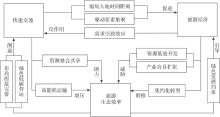
Fig. 1
Influence mechanism of rapid transportation, tourism economy and tourism eco-efficiency"
Tab. 1
Comprehensive evaluation index system of rapid transportation"
| 目标层 | 准则层 | 指标层 | 测算方法 |
|---|---|---|---|
| 快速 交通 | 高速 公路 | 路网密度/km∙km-2 | 各省高速公路里程与国土面积之比 |
| 路网衔接性/% | 各省高速公路里程占公路总里程比例 | ||
| 干线影响力/ 104人∙d-1 | 各省日均公路客运量 | ||
| 通车覆盖率/% | 各省高速公路通车地级市比例 | ||
| 民航 | 通航密度/架次∙d-1 | 各省日均飞机起降架次 | |
| 机场等级/分 | 依据各省境内机场飞行区等级,3C、4C、4D、4E、4F依次计2分、4分、6分、8分、10分,并求和 | ||
| 通航覆盖率/% | 各省民航通航地级市比例 | ||
| 枢纽影响力/ 104人∙d-1 | 各省日均旅客吞吐量 | ||
| 高铁 | 路网密度/km∙km-2 | 各省高铁里程与国土面积之比 | |
| 站点密度/个∙km-2 | 各省高铁站点数量与国土面积之比 | ||
| 干线数量/条 | 各省高铁线路数量 | ||
| 通车覆盖率/% | 各省高铁通车地级市比例 |
Tab. 2
Unit panel root test"
| 变量 | 项目 | HT | IPS | Fisher-ADF | 检验结论 |
|---|---|---|---|---|---|
| lnRTS | 水平数据 | -2.769*** | -5.604*** | 195.473*** | 平稳 |
| lnTE | 0.225 | -1.971** | 48.999 | 不平稳 | |
| lnTEE | -3.209*** | -3.636*** | 114.658*** | 平稳 | |
| DlnRTS | 一阶差分 | -9.706*** | -9.576*** | 286.120*** | 平稳 |
| DlnTE | -9.666*** | -6.744*** | 142.364*** | 平稳 | |
| DlnTEE | -13.090*** | -9.208*** | 169.420*** | 平稳 |
Tab. 3
Model lag order selection under different criteria"
| 区域 | 滞后阶数 | AIC | BIC | HQIC | 区域 | 滞后阶数 | AIC | BIC | HQIC |
|---|---|---|---|---|---|---|---|---|---|
| 全国 | 1 | 9.260* | -84.718* | -28.606* | 中部 | 1 | -18.771* | -80.241* | -43.243* |
| 2 | 12.707 | -49.944 | -12.537 | 2 | -13.546 | -54.526 | -29.860 | ||
| 3 | 12.641 | -18.648 | 0.019 | 3 | -4.176 | -24.666 | -12.334 | ||
| 东部 | 1 | -9.415* | -78.653* | -37.402* | 西部 | 1 | -15.640 | -77.110* | -40.112* |
| 2 | -5.910 | -52.069 | -24.568 | 2 | -16.282* | -57.262 | -32.596 | ||
| 3 | -4.144 | -27.223 | -13.473 | 3 | -9.117 | -29.607 | -17.274 |
Tab. 4
Granger causality test results"
| 区域 | 变量 | DlnRTS | DlnTE | DlnTEE | |||||
|---|---|---|---|---|---|---|---|---|---|
| 卡方 | P值 | 卡方 | P值 | 卡方 | P值 | ||||
| 全国 | DlnRTS | - | - | 3.262* | 0.071 | 4.748** | 0.029 | ||
| DlnTE | 2.758* | 0.097 | - | - | 6.140** | 0.013 | |||
| DlnTEE | 2.499 | 0.114 | 4.888** | 0.027 | - | - | |||
| 东部 | DlnRTS | - | - | 4.314** | 0.038 | 0.092 | 0.762 | ||
| DlnTE | 3.126* | 0.077 | - | - | 1.287 | 0.257 | |||
| DlnTEE | 0.559 | 0.455 | 1.768 | 0.184 | - | - | |||
| 中部 | DlnRTS | - | - | 0.879 | 0.349 | 0.137 | 0.712 | ||
| DlnTE | 1.054 | 0.305 | - | - | 2.976* | 0.085 | |||
| DlnTEE | 2.940* | 0.086 | 1.204 | 0.273 | - | - | |||
| 西部 | DlnRTS | - | - | 2.978* | 0.084 | 4.520** | 0.033 | ||
| DlnTE | 0.003 | 0.954 | - | - | 3.038* | 0.081 | |||
| DlnTEE | 2.057 | 0.152 | 0.441 | 0.507 | - | - | |||
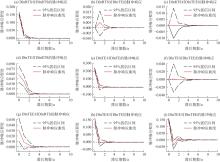
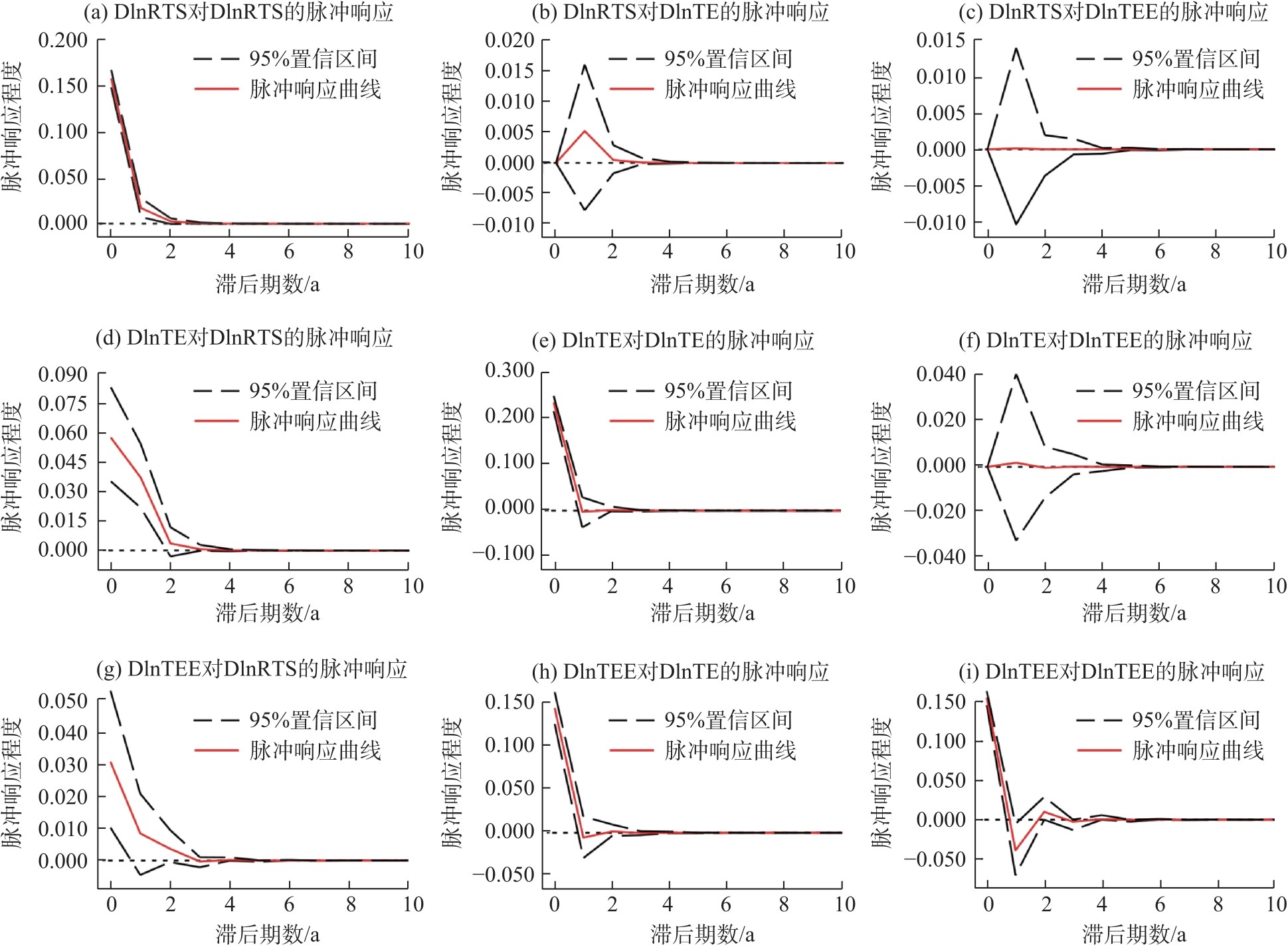
Fig. 2
Impulse response at the national level"
Tab. 5
Variance decomposition results of PVAR model"
| 预测期 | 响应变量 | 冲击变量 | 冲击变量 | ||||||
|---|---|---|---|---|---|---|---|---|---|
| DlnRTS | DlnTE | DlnTEE | DlnRTS | DlnTE | DlnTEE | ||||
| 1 | DlnRTS | 全国 | 1.000 | 0.000 | 0.000 | 中部 | 1.000 | 0.000 | 0.000 |
| 5 | 0.999 | 0.001 | 0.000 | 0.997 | 0.001 | 0.002 | |||
| 10 | 0.999 | 0.001 | 0.000 | 0.997 | 0.001 | 0.002 | |||
| 1 | DlnTE | 0.048 | 0.952 | 0.000 | 0.047 | 0.953 | 0.000 | ||
| 5 | 0.075 | 0.925 | 0.000 | 0.110 | 0.888 | 0.002 | |||
| 10 | 0.075 | 0.925 | 0.000 | 0.110 | 0.888 | 0.002 | |||
| 1 | DlnTEE | 0.022 | 0.502 | 0.477 | 0.013 | 0.560 | 0.427 | ||
| 5 | 0.023 | 0.479 | 0.498 | 0.017 | 0.536 | 0.447 | |||
| 10 | 0.023 | 0.479 | 0.498 | 0.017 | 0.536 | 0.447 | |||
| 1 | DlnRTS | 东部 | 1.000 | 0.000 | 0.000 | 西部 | 1.000 | 0.000 | 0.000 |
| 5 | 0.994 | 0.001 | 0.005 | 0.995 | 0.002 | 0.003 | |||
| 10 | 0.994 | 0.001 | 0.005 | 0.995 | 0.002 | 0.003 | |||
| 1 | DlnTE | 0.071 | 0.929 | 0.000 | 0.037 | 0.963 | 0.000 | ||
| 5 | 0.066 | 0.879 | 0.055 | 0.079 | 0.908 | 0.012 | |||
| 10 | 0.066 | 0.878 | 0.056 | 0.079 | 0.908 | 0.012 | |||
| 1 | DlnTEE | 0.028 | 0.616 | 0.356 | 0.027 | 0.396 | 0.577 | ||
| 5 | 0.029 | 0.618 | 0.353 | 0.047 | 0.363 | 0.590 | |||
| 10 | 0.029 | 0.618 | 0.353 | 0.047 | 0.363 | 0.590 | |||
| [1] |
Lenzen M, Sun Y Y, Faturay F, et al. The carbon footprint of global tourism[J]. Nature Climate Change, 2018, 8(6): 522-529.
doi: 10.1038/s41558-018-0141-x |
| [2] |
Gössling S, Peeters P, Ceron J P, et al. The eco-efficiency of tourism[J]. Ecological Economics, 2005, 54(4): 417-434.
doi: 10.1016/j.ecolecon.2004.10.006 |
| [3] | 王兆峰, 刘庆芳. 长江经济带旅游生态效率时空演变及其影响因素[J]. 长江流域资源与环境, 2019, 28(10): 2289-2298. |
| [Wang Zhaofeng, Liu Qingfang. Spatio-temporal evolution and influencing factors of tourism eco-efficiency in the Yangtze River Economic Belt[J]. Resources and Environment in the Yangtze Basin, 2019, 28(10): 2289-2298.] | |
| [4] | 田坤, 行伟波, 黄坤. 交通基础设施升级与旅游经济高质量发展——基于高铁开通的实证研究[J]. 经济学报, 2023, 10(4): 227-251. |
|
[Tian Kun, Xing Weibo, Huang Kun. Transportation infrastructure upgrading and high-quality development of tourism economy: An empirical study based on the opening of high-speed railway[J]. China Journal of Economics, 2023, 10(4): 227-251.]
doi: 10.26599/CJE.2023.9300408 |
|
| [5] | Wang R, Xia B, Dong S C, et al. Research on the spatial differentiation and driving forces of eco-efficiency of regional tourism in China[J]. Sustainability, 2020, 13(1): 280, doi: 10.3390/su13010280. |
| [6] |
郭向阳, 穆学青, 明庆忠, 等. 旅游地交通服务功能与旅游强度协调时空分异特征——以云南省为例[J]. 自然资源学报, 2020, 35(6): 1425-1444.
doi: 10.31497/zrzyxb.20200615 |
|
[Guo Xiangyang, Mu Xueqing, Ming Qingzhong, et al. Spatial and temporal differentiation characteristics of transportation service function and tourism intensity coordination: A case study of Yunnan Province[J]. Journal of Natural Resources, 2020, 35(6): 1425-1444.]
doi: 10.31497/zrzyxb.20200615 |
|
| [7] | 孔令章, 李晓东, 白洋, 等. 长距离高铁对沿线城市旅游经济联系的空间影响及角色分析——以兰新高铁为例[J]. 干旱区地理, 2019, 42(3): 681-688. |
| [Kong Lingzhang, Li Xiaodong, Bai Yang, et al. Spatial effect of long-distance high-speed railway on tourism economic link and role analysis of cities along the railway: A case of Lanzhou-Xinjiang high-speed rail[J]. Arid Land Geography, 2019, 42(3): 681-688.] | |
| [8] |
林玉英, 靳一东, 张发梓, 等. 中国优秀旅游城市旅游经济空间格局演变特征及影响因素[J]. 地理科学, 2024, 44(6): 973-983.
doi: 10.13249/j.cnki.sgs.20230579 |
|
[Lin Yuying, Jin Yidong, Zhang Fazi, et al. Spatial pattern evolution characteristics and influencing factors of tourism economy in Chinese excellent tourism cities[J]. Scientia Geographica Sinica, 2024, 44(6): 973-983.]
doi: 10.13249/j.cnki.sgs.20230579 |
|
| [9] |
白洋, 谭李娜, 刘晓燕, 等. 高铁开通对西北地区旅游经济的影响效应及其融合路径[J]. 干旱区地理, 2024, 47(12): 2124-2134.
doi: 10.12118/j.issn.1000-6060.2024.238 |
|
[Bai Yang, Tan Lina, Liu Xiaoyan, et al. Integration path and influence effect of tourism economy in northwest China[J]. Arid Land Geography, 2024, 47(12): 2124-2134.]
doi: 10.12118/j.issn.1000-6060.2024.238 |
|
| [10] | 凌欢, 程励. 非对称视角下区域旅游经济差异形成机制研究——基于31个省(区、市)的清晰集定性比较分析[J]. 旅游科学, 2023, 37(4): 161-182. |
| [Ling Huan, Cheng Li. A study of the formation mechanism of regional tourism economic disparity from asymmetrical perspective based on a comparative analysis of csQCA of the 31 provinces[J]. Tourism Science, 2023, 37(4): 161-182.] | |
| [11] | 李瑞, 奚世军, 吴晓俊, 等. 贵广高铁对沿线旅游城市可达性影响测度及其地域结构系统构建[J]. 世界地理研究, 2017, 26(4): 62-72. |
| [Li Rui, Xi Shijun, Wu Xiaojun, et al. The influence of accessibility of tourism cities and the construction of regional structure system under the Guiyang-Guangzhou high-speed railway[J]. World Regional Studies, 2017, 26(4): 62-72.] | |
| [12] | 姬宸宇, 张含宇. 旅游业、民航业和经济增长之间的动态关系——基于中国主要旅游城市的面板数据分析[J]. 旅游学刊, 2021, 36(12): 40-53. |
| [Ji Chenyu, Zhang Hanyu. Dynamic relationship between civil aviation, tourism and economic growth: Based on panel data analysis of major tourist cities in China[J]. Tourism Tribune, 2021, 36(12): 40-53.] | |
| [13] | 汪晓文, 陈垚. 西北地区交通基础设施与旅游经济增长的交互影响研究——基于PVAR模型的实证分析[J]. 兰州大学学报(社会科学版), 2020, 48(4): 31-38. |
| [Wang Xiaowen, Chen Yao. Research on reciprocal effects of transportation infrastructure and tourism economic growth in northwest China: An empirical analysis based on PVAR model[J]. Journal of Lanzhou University (Social Sciences Edition), 2020, 48(4): 31-38.] | |
| [14] |
Kelly J, Williams P W. Modelling tourism destination energy consumption and greenhouse gas emissions: Whistler, British Columbia, Canada[J]. Journal of Sustainable Tourism, 2007, 15(1): 67-90.
doi: 10.2167/jost609.0 |
| [15] | 田红, 赵庆朋. 高质量发展下区域旅游生态效率评价及影响因素研究——以山东省为例[J]. 干旱区资源与环境, 2022, 36(12): 201-208. |
| [Tian Hong, Zhao Qingpeng. Evaluation on regional tourism ecological efficiency under high quality development: A case of Shandong Province[J]. Journal of Arid Land Resources and Environment, 2022, 36(12): 201-208.] | |
| [16] |
王凯, 邹楠, 甘畅. 旅游技术效率、旅游绿色生产率收敛性及其影响因素[J]. 经济地理, 2022, 42(6): 215-224.
doi: 10.15957/j.cnki.jjdl.2022.06.022 |
| [Wang Kai, Zou Nan, Gan Chang. Convergence and influencing factors of tourism technical efficiency, green productivity[J]. Economic Geography, 2022, 42(6): 215-224.] | |
| [17] | 郑兵云, 杨冕. 基于生态环境的城市交通效率及其影响因素分析[J]. 华东经济管理, 2018, 32(6): 164-170. |
| [Zheng Bingyun, Yang Mian. An analysis of urban transport efficiency based on ecological environment and its influencing factors[J]. East China Economic Management, 2018, 32(6): 164-170.] | |
| [18] |
麻学锋, 谭佳欣. 湘西地区交通可达性对旅游环境系统韧性的影响及空间溢出效应[J]. 地理科学, 2023, 43(2): 291-300.
doi: 10.13249/j.cnki.sgs.2023.02.011 |
|
[Ma Xuefeng, Tan Jiaxin. Impact of traffic accessibility on the resilience of tourism environment system and spatial spillover effects in Xiangxi area[J]. Scientia Geographica Sinica, 2023, 43(2): 291-300.]
doi: 10.13249/j.cnki.sgs.2023.02.011 |
|
| [19] | Bai Y, Li Y R. The threshold effect and driving path of the rapid transit system on tourism eco-efficiency in China[J]. Frontiers in Environmental Science, 2024, 12: 1386631, doi: 10.3389/fenvs.2024.1386631. |
| [20] | WBCSD. Eco-efficiency: Creating more value with less impact[R]. Geneva: WBCSD, 2000. |
| [21] |
Gössling S. Global environmental consequences of tourism[J]. Global Environmental Change, 2002, 12(4): 283-302.
doi: 10.1016/S0959-3780(02)00044-4 |
| [22] | 刘佳, 刘贤明, 安珂珂, 等. 长三角城市群旅游环境承载力时空分异格局与空间效应研究[J]. 长江流域资源与环境, 2022, 31(7): 1441-1454. |
| [Liu Jia, Liu Xianming, An Keke, et al. Research on spatio-temporal differentiation and spatial effect of tourism environmental carrying capacity of Yangtze River Delta urban agglomerations[J]. Resources and Environment in the Yangtze Basin, 2022, 31(7): 1441-1454.] | |
| [23] | 李智慧, 王凯, 余芳芳, 等. 中国旅游业碳排放—旅游经济—生态环境耦合协调时空分异研究[J]. 地理与地理信息科学, 2022, 38(6): 110-118. |
| [Li Zhihui, Wang Kai, Yu Fangfang, et al. Temporal and spatial differentiation of coupling coordination of tourism carbon emissions, tourism economy and ecological environment in China[J]. Geography and Geo-Information Science, 2022, 38(6): 110-118.] | |
| [24] | 马勇, 李丽霞, 任洁. 神农架林区旅游经济—交通状况—生态环境协调发展研究[J]. 经济地理, 2017, 37(10): 215-220. |
| [Ma Yong, Li Lixia, Ren Jie. Coordination development research among the tourism economy-traffic condition-ecological environment in shennongjia forest district[J]. Economic Geography, 2017, 37(10): 215-220.] | |
| [25] |
王胜鹏, 乔花芳, 冯娟, 等. 黄河流域旅游生态效率时空演化及其与旅游经济互动响应[J]. 经济地理, 2020, 40(5): 81-89.
doi: 10.15957/j.cnki.jjdl.2020.05.009 |
|
[Wang Shengpeng, Qiao Huafang, Feng Juan, et al. The spatio-temporal evolution of tourism eco-efficiency in the Yellow River Basin and its interactive response with tourism economy development level[J]. Economic Geography, 2020, 40(5): 81-89.]
doi: 10.15957/j.cnki.jjdl.2020.05.009 |
|
| [26] | Bo Z, Wen Z H, Yang Y. Agglomerating or dispersing? Spatial effects of high-speed trains on regional tourism economies[J]. Tourism Management, 2021, 87: 104392, doi: 10.1016/j.tourman.2021.104392. |
| [27] |
徐晓亮, 黄丹, 刘旭义, 等. 中国省域旅游效率时空演变特征及影响因素研究[J]. 干旱区地理, 2023, 46(12): 2052-2060.
doi: 10.12118/j.issn.1000-6060.2023.157 |
|
[Xu Xiaoliang, Huang Dan, Liu Xuyi, et al. Spatiotemporal evolution characteristics and influencing factors of provincial tourism efficiency in China[J]. Arid Land Geography, 2023, 46(12): 2052-2060.]
doi: 10.12118/j.issn.1000-6060.2023.157 |
|
| [28] |
郭向阳, 穆学青, 明庆忠, 等. 长江经济带快速交通系统对城市旅游生产率的影响效应分析[J]. 经济地理, 2021, 41(12): 213-222.
doi: 10.15957/j.cnki.jjdl.2021.12.023 |
|
[Guo Xiangyang, Mu Xueqing, Ming Qingzhong, et al. Impact effect of rapid transport system on urban tourism productivity in the Yangtze River Economic Belt[J]. Economic Geography, 2021, 41(12): 213-222.]
doi: 10.15957/j.cnki.jjdl.2021.12.023 |
|
| [29] |
郭向阳, 穆学青, 明庆忠, 等. 旅游地快速交通优势度与旅游流强度的空间耦合分析[J]. 地理研究, 2019, 38(5): 1119-1135.
doi: 10.11821/dlyj020181347 |
| [Guo Xiangyang, Mu Xueqing, Ming Qingzhong, et al. Spatial coupling between rapid traffic superiority degree and tourist flow intensity in tourist destinations[J]. Geographical Research, 2019, 38(5): 1119-1135.] | |
| [30] | 卢飞, 宫红平. 中国旅游生态效率测度、时空特征与影响因素研究[J]. 统计与决策, 2020, 36(16): 96-100. |
| [Lu Fei, Gong Hongping. Research on the measurement, spatial and temporal characteristics and influencing factors of tourism eco-efficiency in China[J]. Statistics & Decision, 2020, 36(16): 96-100.] | |
| [31] |
张燕, 章杰宽. 旅游收入、交通基础设施和二氧化碳排放——基于PVAR模型的多变量经济学分析[J]. 中国生态旅游, 2022, 12(4): 632-645.
doi: 10.12342/zgstly.20220025 |
|
[Zhang Yan, Zhang Jiekuan. Tourism revenue, transport infrastructure, and carbon dioxide emissions: A multivariate economic analysis using the PVAR model[J]. Journal of Chinese Ecotourism, 2022, 12(4): 632-645.]
doi: 10.12342/zgstly.20220025 |
|
| [32] |
王超, 雷婷, 孟晓莎, 等. “交旅”融合下旅游经济与高速交通协调发展分析——以关中平原城市群为例[J]. 干旱区地理, 2024, 47(6): 1015-1025.
doi: 10.12118/j.issn.1000-6060.2023.332 |
|
[Wang Chao, Lei Ting, Meng Xiaosha, et al. Analysis of the coordinated development of tourism economy and high-speed transportation under the integration of “transportation and tourism”: Based on Guanzhong Plain urban agglometration[J]. Arid Land Geography, 2024, 47(6): 1015-1025.]
doi: 10.12118/j.issn.1000-6060.2023.332 |
|
| [33] | 白洋, 李亚茹. 中国快速交通系统与旅游生态效率脱钩关系及时空格局演化[J]. 生态经济, 2025, 41(1): 176-184. |
| [Bai Yang, Li Yaru. The decoupling relationship between rapid transit system and tourism eco-efficiency and the evolution of spatial-temporal pattern in China[J]. Ecological Economy, 2025, 41(1): 176-184.] | |
| [34] |
王兆峰, 刘庆芳. 长江经济带旅游生态效率时空演变及其与旅游经济互动响应[J]. 自然资源学报, 2019, 34(9): 1945-1961.
doi: 10.31497/zrzyxb.20190911 |
|
[Wang Zhaofeng, Liu Qingfang. The spatio-temporal evolution of tourism eco-efficiency in the Yangtze River Economic Belt and its interactive response with tourism economy[J]. Journal of Natural Resources, 2019, 34(9): 1945-1961.]
doi: 10.31497/zrzyxb.20190911 |
|
| [35] | 洪铮, 王林, 章成. 绿色发展背景下区域旅游生态效率影响因素——以西部地区为例[J]. 生态学报, 2021, 41(9): 3512-3524. |
| [Hong Zheng, Wang Lin, Zhang Cheng. Influencing factors of regional tourism eco-efficiency under the background of green development in the western China[J]. Acta Ecologica Sinica, 2021, 41(9): 3512-3524.] |
|
||