Arid Land Geography ›› 2025, Vol. 48 ›› Issue (12): 2260-2270.doi: 10.12118/j.issn.1000-6060.2025.160
• Regional Development • Previous Articles
CHEN Long1( ), ZHANG Zhibin2, WANG Xiaoqi3, ZHAO Xuewei2, DONG Jianhong4
Received:2025-03-25
Revised:2025-05-27
Online:2025-12-25
Published:2025-12-30
CHEN Long, ZHANG Zhibin, WANG Xiaoqi, ZHAO Xuewei, DONG Jianhong. Urban spatial structure characteristics of Lanzhou from the perspective of construction environment[J].Arid Land Geography, 2025, 48(12): 2260-2270.
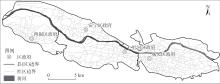
Fig. 1
Study location map"
Tab. 1
Construct on objective community built environment quality (CBEQ) index"
| 准则层 | 要素层权重 | 指标层 | 权重 | 数据来源 |
|---|---|---|---|---|
| 环境宜居 | 居住条件 | 建筑时间/a | 0.031 | 安居客网站 |
| 建筑结构 | 0.025 | 安居客网站 | ||
| 建筑密度/% | 0.023 | 百度地图 | ||
| 建筑平均高度/% | 0.019 | 百度地图 | ||
| 房价/元·m-2 | 0.053 | 安居客网站 | ||
| 停车位/个 | 0.048 | 房天下 | ||
| 环境质量 | 社区蓝绿空间面积/m2 | 0.043 | 地理空间数据云 | |
| 空气质量指数 | 0.041 | 环境监测数据 | ||
| 地表温度/(°) | 0.023 | 地理空间数据云 | ||
| 下垫面不透水面/m2 | 0.016 | 地理空间数据云 | ||
| 生活便利 | 交通设施 | 地铁站和公交站/个 | 0.067 | 高德POI |
| 道路通达性(用道路交叉口数量表征)/m·m-2 | 0.028 | OpenStreetMap | ||
| 教育设施 | 幼儿园、小学、中学、课外培训机构/座 | 0.065 | 高德POI | |
| 生活服务设施 | 银行、综合超市、购物中心、理发店、农贸市场、日常饭店/家 | 0.061 | 高德POI | |
| 一级医院、二级医院、三级医院、疗养院、妇幼保健所、社区卫生站/家 | 0.058 | 高德POI | ||
| 健身房、体育场所/个 | 0.037 | 高德POI | ||
| 社会稳定 | 社区安全 | 消防站/个 | 0.031 | 高德POI |
| 社区警务室/个 | 0.055 | 高德POI | ||
| 派出所/处 | 0.058 | 高德POI | ||
| 应急避难 | 避难点/处 | 0.047 | 高德POI | |
| 运动场地/座 | 0.045 | 高德POI | ||
| 精神富足 | 社交空间 | 休闲餐饮(咖啡馆、酒吧、茶座)/个 | 0.040 | 高德POI |
| 公园广场/个 | 0.033 | 高德POI | ||
| 文化休闲 | 图书馆、博物馆/座 | 0.031 | 高德POI | |
| 娱乐场所(电影院、KTV等)/个 | 0.022 | 高德POI |
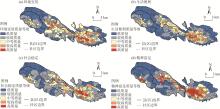
Fig. 2
Spatial distributions of the community built environment quality by dimension"
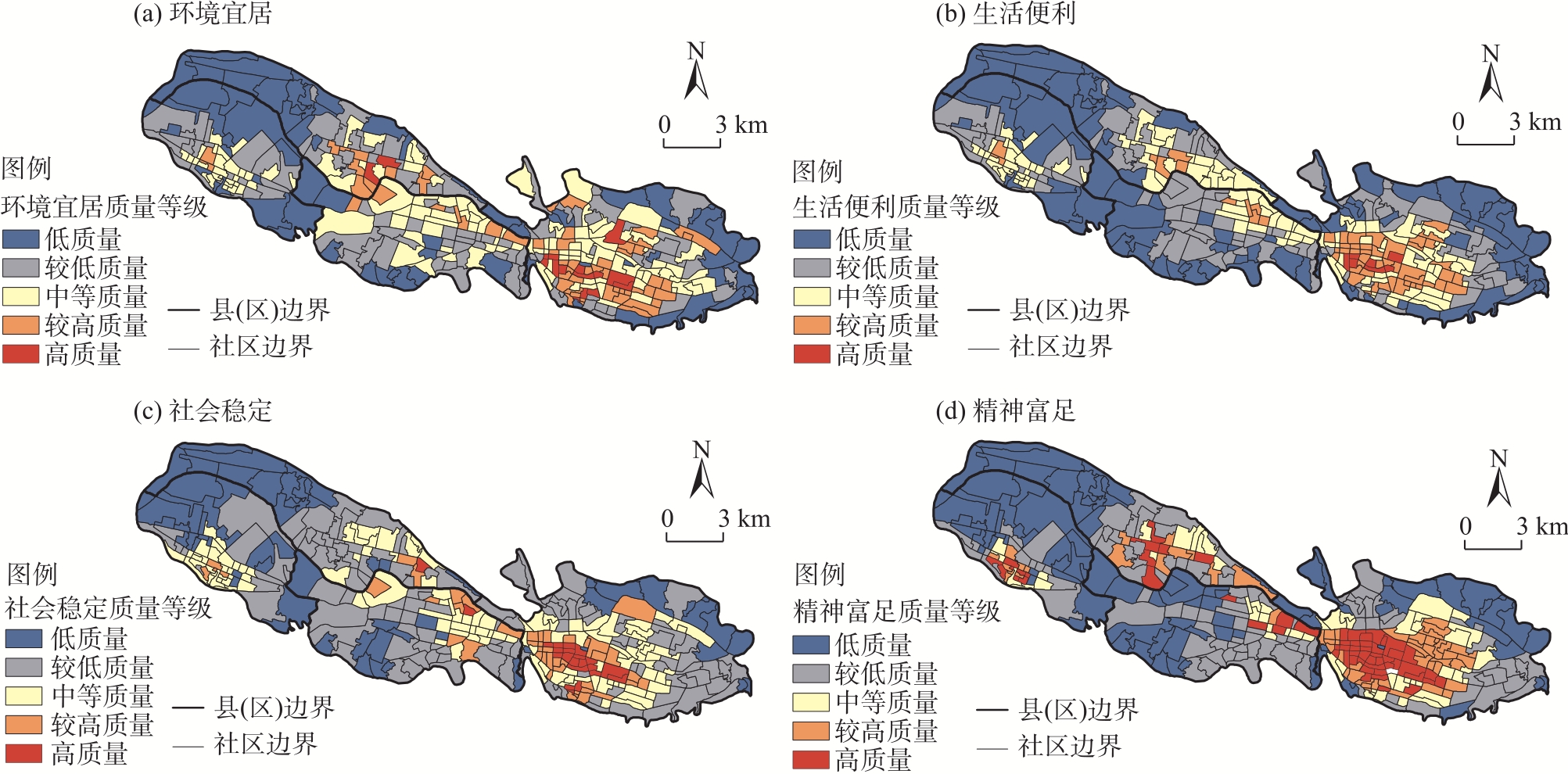
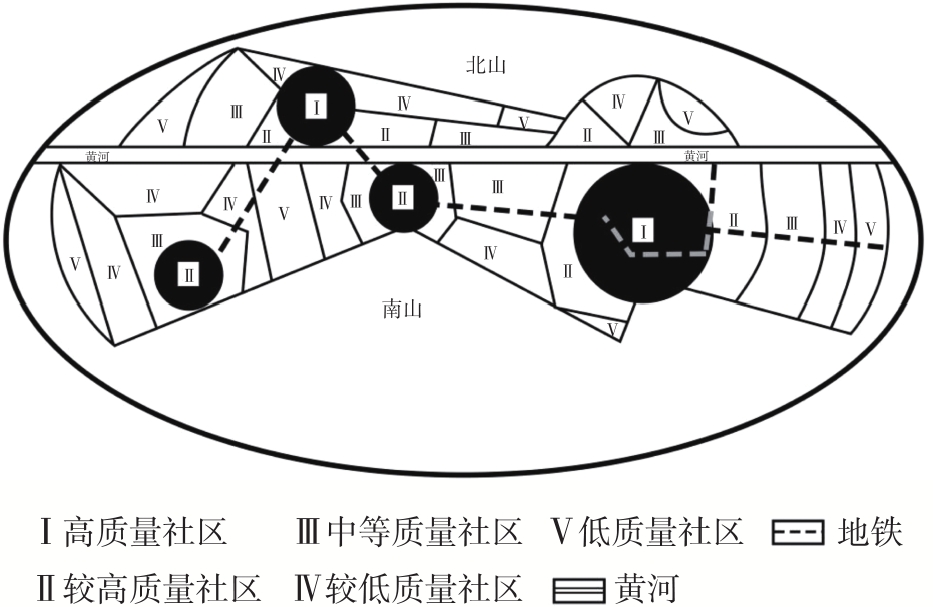
Fig. 3
Spatial distribution pattern of the CBEQ"
Tab. 2
Variables and indicators of the geographical detectors"
| 影响因子 | 单位 | 数据获得途径 | 定义与解释 | 分级 |
|---|---|---|---|---|
| 社区到区行政中心的距离(x1) | m | ArcGIS距离工具 | 到最近区行政中心的距离(取对数) | 9 |
| 社区到地铁站的距离(x2) | m | ArcGIS距离工具 | 到最近地铁站的距离(取对数) | 8 |
| 社区到车站的距离(x3) | m | ArcGIS距离工具 | 到最近公交车站、汽车站、火车站和高铁站的距离(取对数) | 9 |
| 社区道路网密度(x4) | m·m-2 | OpenStreetMap | 路网密度(取对数) | 8 |
| 社区到黄河的距离(x5) | m | ArcGIS距离工具 | 到最近黄河的距离(取对数) | 6 |
| 平均高程(x6) | m | ArcGIS栅格统计 | 平均高程值(取对数) | 7 |
| 人口数量(x7) | 104人 | 第七次人口普查数据 | 社区人口数量:(Pi/PSj)×街道人口(取对数) | 6 |
| 土地价格(x8) | 元·m-2 | 2020年兰州市商业基准地价 | 设定基准地价分七级,其中一级代表最高地价并赋值为7 | 7 |
| 用地类型(x9) | 类 | 第五版兰州市国土空间规划现状图 | 用地面积≥1/2的类型确定为该社区用地属性,否则为混合用地 | 6 |
| 公共空间(x10) | m2 | 第五版兰州市国土空间规划现状图 | 社区内公园与绿地等面积占社区面积的比例 | 6 |
Tab. 3
Multiple collinearity detection"
| 因子 | 未标准化系数 | 标准化系数 | t | P | VIF | ||
|---|---|---|---|---|---|---|---|
| B | 标准错误 | Beta | |||||
| 常量 | 1.681 | 0.594 | - | 1.995 | 0.009** | - | |
| x1 | -0.031 | 0.051 | -0.044 | -0.614 | 0.484 | 1.484 | |
| x2 | 0.045 | 0.061 | 0.074 | 0.741 | 0.494 | 2.775 | |
| x3 | -0.032 | 0.049 | -0.045 | -0.511 | 0.614 | 2.813 | |
| x4 | 0.140 | 0.043 | 0.224 | 3.029 | 0.005*** | 1.414 | |
| x5 | 0.105 | 0.052 | 0.139 | 1.712 | 0.070* | 1.514 | |
| x6 | 0.032 | 0.068 | 0.025 | 0.434 | 0.781 | 1.041 | |
| x7 | 0.117 | 0.086 | 0.176 | 2.491 | 0.021** | 1.447 | |
| x8 | 0.243 | 0.089 | 0.265 | 3.457 | 0.001*** | 1.579 | |
| x9 | 0.005 | 0.051 | 0.011 | 0.181 | 1.104 | 1.371 | |
| x10 | -0.065 | 0.062 | -0.074 | -1.042 | 0.417 | 1.910 | |
Tab. 4
Regression analysis results"
| 因子 | OLS | QR-10 | QR-25 | QR-50 | QR-75 | QR-90 |
|---|---|---|---|---|---|---|
| x1 | 0.498 (0.475) | 0.482 (0.031) | 0.816 (0.039) | 0.801 (0.024) | 0.596 (0.027) | 0.586 (0.094) |
| x2 | 0.452 (0.808) | 0.401 (0.013) | 0.235 (0.025) | 0.694 (0.077) | 0.304 (0.125) | 0.556 (0.033) |
| x3 | 0.613 (-0.507) | 0.402 (0.053) | 0.341 (0.030) | 0.421 (0.029) | 0.315 (-0.056) | 0.094* (-0.132) |
| x4 | 0.303*** (3.089) | 0.271 (0.091) | 0.396** (0.202) | 0.590** (0.306) | 0.478** (0.140) | 0.291*** (0.321) |
| x5 | 0.109* (1.124) | 0.053*** (0.144) | 0.045 (0.118*) | 0.127*** (0.115) | -0.441 (0.160) | -0.526 (0.020) |
| x6 | 0.811 (0.402) | 0.218 (0.134) | 0.203 (0.039) | 0.229 (0.009) | 0.249 (-0.237) | 0.130 (0.054) |
| x7 | 0.297* (0.736) | 0.436 (0.102) | 0.333* (0.167) | 0.592*** (0.334) | 0.501 (0.094) | 0.182 (0.021) |
| x8 | 0.494*** (2.104) | 0.740*** (1.108) | 0.671*** (0.992) | 0.538*** (0.886) | 0.794*** (0.512) | 0.820** (0.567) |
| x9 | 0.157 (0.782) | 0.119 (0.142) | 0.419 (0.005) | 0.494 (0.062) | 0.611 (0.154) | 0.653 (0.139) |
| x10 | 0.365 (0.892) | 0.550 (0.059) | 0.272 (0.010) | 0.381 (0.059) | 0.199 (0.054) | 0.124 (0.208) |
| 常数 | 0.010** (1.995) | 0.001 (0.789) | 0.199 (1.108) | 0.281 (0.883) | 0.001 (2.894***) | 0.001 (3.757***) |
| [1] |
周春山, 叶昌东. 中国城市空间结构研究评述[J]. 地理科学进展, 2013, 32(7): 1030-1038.
doi: 10.11820/dlkxjz.2013.07.006 |
| [Zhou Chunshan, Ye Changdong. Progress on studies of urban spatial structure in China[J]. Progress in Geographic Sciences, 2013, 32(7): 1030-1038.] | |
| [2] | 张志斌, 李雪梅. 城市产业结构调整与空间结构优化的研究——以兰州市为例[J]. 干旱区资源与环境, 2007, 31(12): 1-5. |
| [Zhang Zhibin, Li Xuemei. The optimization urban space with upgrading industrial structure: The case of Lanzhou[J]. Journal of Arid Land Resources and Environmen, 2007, 31(12): 1-5.] | |
| [3] | 王立, 王兴中. 城市社区生活空间结构之解构及其质量重构[J]. 地理科学, 2011, 31(1): 22-28. |
| [Wang Li, Wang Xingzhong. Deconstruction and quality reconstruction of the living spatial structure in urban community[J]. Geographical Sciences, 2011, 31(1): 22-28.] | |
| [4] | Sirle S, Zenia K. Spatial interventions and built environment features in developing age-friendly communities from the perspective of urban planning and design[J]. Cities, 2023, 141: 104417, doi: 10.1016/j.cities.2023.104417. |
| [5] |
孙斌栋, 张之帆, 李琬. 中国省域人口空间结构特征及其对经济绩效的影响——基于实体城市的空间识别[J]. 地理科学, 2021, 41(11): 1884-1896.
doi: 10.13249/j.cnki.sgs.2021.11.002 |
| [Sun Bindong, Zhang Zhifan, Li Wan. Characteristics and impact of population spatial structure on economic performance in China based on spatial identification of physical cities[J]. Geographical Sciences, 2021, 41(11): 1884-1896.] | |
| [6] |
席强敏, 李国平. 超大城市规模与空间结构效应研究评述与展望[J]. 经济地理, 2018, 38(1): 61-68.
doi: 10.15957/j.cnki.jjdl.2018.01.008 |
|
[Xi Qiangmin, Li Guoping. Research progress and prospect of the interactive effects of urban size and spatial structure for mega cities[J]. Economic Geography, 2018, 38(1): 61-68.]
doi: 10.15957/j.cnki.jjdl.2018.01.008 |
|
| [7] | 陈蜒, 张志斌. 兰州市商品住房价格空间分布格局及其影响因素[J]. 干旱区资源与环境, 2015, 29(12): 44-50. |
| [Chen Yan, Zhang Zhibin. The spatial distribution patterns and influential factors of commodity housing prices in Lanzhou City[J]. Journal of Arid Regions Resources and Environment, 2015, 29(12): 44-50.] | |
| [8] |
公维民, 张志斌, 高峰, 等. 关联视角下兰州市生产性服务业与制造业空间分布及区位选择比较[J]. 地理研究, 2021, 40(11): 3154-3172.
doi: 10.11821/dlyj020201119 |
| [Gong Weimin, Zhang Zhibin, Gao Feng, et al. Comparison of the spatial distribution and location selection of producer services and manufacturing in Lanzhou from the perspective of relevance[J]. Geography Research, 2021, 40(11): 3154-3172.] | |
| [9] | 柴彦威, 肖作鹏, 刘志林. 居民家庭日常出行碳排放的发生机制与调控策略——以北京市为例[J]. 地理研究, 2012, 31(2): 334-344. |
| [Chai Yanwei, Xiao Zuopeng, Liu Zhilin. Low-carbon optimization strategies based on CO2 emission mechanism of household daily travels: A case study of Beijing[J]. Geography Research, 2012, 31(2): 334-344.] | |
| [10] | 高岩琰, 张晓瑞, 张奇智, 等. 基于POI大数据和可达性双重约束的城市空间结构研究[J]. 地理与地理信息科学, 2021, 37(3): 59-64. |
| [Gao Yanyan, Zhang Xiaorui, Zhang Qizhi, et al. Research on urban spatial structure based on double constraints of POI big data and accessibility[J]. Geography and Geo-Information Science, 2021, 37(3): 59-64.] | |
| [11] |
孙鸿鹄, 姜玉培. 建成环境对城市活力影响的空间异质性研究——以南京中心城区为例[J]. 地理研究, 2024, 43(7): 1700-1714.
doi: 10.11821/dlyj020230911 |
| [Sun Honghu, Jiang Yupei. Spatial heterogeneity of the impact of built environment on urban vitality: A case study of the central urban area of Nanjing[J]. Geography Research, 2024, 43(7): 1700-1714.] | |
| [12] | 高德辉, 许奇, 陈培文, 等. 城市轨道交通客流与精细尺度建成环境的空间特征分析[J]. 交通运输系统工程与信息, 2021, 21(6): 25-32. |
| [Gao Dehui, Xu Qi, Chen Peiwen, et al. Spatial characteristics of urban rail transit passenger flows and fine-scale built environment[J]. Journal of Transportation Systems Engineering and Information Technology, 2021, 21(6): 25-32.] | |
| [13] | 罗珂, 田立涛, 何豫, 等. 基于文献计量的城市空间结构与生态环境关联性研究[J]. 生态学报, 2023, 43(17): 7352-7365. |
| [Luo Ke, Tian Litao, He Yu, et al. A study on the correlation between urban spatial structure and ecological environment based on bibliometric analysis[J]. Acta Ecologica Sinica, 2023, 43(17): 7352-7365.] | |
| [14] |
张文斌, 张志斌. 基于扩展生态位理论的居住空间分异研究——以兰州市为例[J]. 干旱区地理, 2023, 46(8): 1376-1386.
doi: 10.12118/j.issn.1000-6060.2022.486 |
|
[Zhang Wenbing, Zhang Zhibing. Residential spatial differentiation based on extended niche theory: A case of Lanzhou City[J]. Arid Land Geography, 2023, 46(8): 1376-1386.]
doi: 10.12118/j.issn.1000-6060.2022.486 |
|
| [15] | 兰州市地方志编纂委员会. 兰州市志·建置区划志(第一卷)[M]. 兰州: 兰州大学出版社, 1999. |
| [Lanzhou Local Chronicles Compilation Committee. Lanzhou Chronicles:Administrative Divisions (Volume 1)[M]. Lanzhou: Lanzhou University Press, 1999.] | |
| [16] |
Gong P, Liu H, Zhang M, et al. Stable classification with limited sample: Transferring a 30-m resolution sample set collected in 2015 to mapping 10-m resolution global land cover in 2017[J]. Science Bulletin, 2019, 64(6): 370-373.
doi: 10.1016/j.scib.2019.03.002 pmid: 36659725 |
| [17] | Chen L, Zhang Z B, Wang X Q. Spatial heterogeneity of community built environment quality in river valley city: The case of Lanzhou, China[J]. Journal of Urban Planning and Development, 2025, 151(2): 04025007, doi: 10.1061/jupddm.upeng-5249. |
| [18] | Daniel F, Martine S, Stephanie S, et al. Common measures of green and blue space for built environment, health equity and intervention research: A scoping review[J]. Cities & Health, 2023, 7(6): 2260134, doi: 10.1080/23748834.2023.2260134. |
| [19] |
郭燕, 张志斌, 陈龙, 等. 居住自选择视角下城市建成环境对通勤模式选择的影响——以兰州市主城区为例[J]. 干旱区地理, 2024, 47(2): 307-318.
doi: 10.12118/j.issn.1000-6060.2023.074 |
|
[Guo Yan, Zhang Zhibin, Chen Long, et al. Impact of urban built environment on commuting mode choices from the residential self-selection perspective[J]. Arid Land Geography, 2024, 47(2): 307-318.]
doi: 10.12118/j.issn.1000-6060.2023.074 |
|
| [20] |
陈呈奕, 张文忠, 湛东升, 等. 环渤海地区城市人居环境质量评估及影响因素[J]. 地理科学进展, 2017, 36(12): 1562-1570.
doi: 10.18306/dlkxjz.2017.12.011 |
| [Chen Chengyi, Zhang Wenzhong, Zhan Dongsheng, et al. Quantitative evaluation of human settlement environment and influencing factors in the Bohai Rim area[J]. Progress in Geographic Sciences, 2017, 36(12): 1562-1570.] | |
| [21] | 陈建宝, 丁军军. 分位数回归技术综述[J]. 统计与信息论坛, 2008, 15(3): 89-96. |
| [Chen Jianbao, Ding Junjun. A review of technologies on quantile regression[J]. Journal of Statistics and Information, 2008, 15(3): 89-96.] | |
| [22] |
申悦, 傅行行. 社区主客观特征对社区满意度的影响机理——以上海市郊区为例[J]. 地理科学进展, 2019, 38(5): 686-697.
doi: 10.18306/dlkxjz.2019.05.006 |
| [Shen Yue, Fu Xingxing. Impact of the built environment and perceived neighborhood characteristics on residents’ satisfaction: Evidence from the Shanghai suburbs[J]. Progress in Geographical Sciences, 2019, 38(5): 686-697.] | |
| [23] | Yao W, Chen F, Wang S, et al. Impact of exposure to natural and built environments on positive and negative affect: A systematic review and Meta-analysis[J]. Frontiers in Public Health, 2021, 12(9): 758457, doi: 10.3389/fpubh.2021.758457. |
| [24] | Chen E, Ye Z, Wu H. Nonlinear effects of built environment on intermodal transit trips considering spatial heterogeneity[J]. Transportation Research Part D, 2021, 90(1): 102677, doi: 10.1016/j.trd.2020.102677. |
| [25] | 周锡浈, 宫贺, 李敦敦, 等. 建成环境对路内停车泊位使用率的非线性影响模型[J]. 吉林大学学报(工学版), 2024, 54(9): 2520-2530. |
| [Zhou Xizhen, Gong He, Li Dundun, et al. Nonlinear model for impact of built environment on curb parking spaces occupancy[J]. Journal of Jilin University (Engineering and Technology Edition), 2024, 54(9): 2520-2530.] | |
| [26] | 陈龙, 张志斌, 王晓琪, 等. 农业劳动力代际变迁对农业生产的影响机理研究——以黄土高原地区陇西县为例[J]. 人文地理, 2024, 39(5): 119-128. |
| [Chen Long, Zhang Zhibin, Wang Xiaoqi, et al. The mechanism of intergenerational change of agricultural laborforce on agricultural production: A case study of Longxi County[J]. Human Geography, 2024, 39(5): 119-128.] | |
| [27] |
陈龙, 张志斌, 赵学伟, 等. 甘肃省区域空间格局形成机制与发展战略[J]. 干旱区地理, 2023, 46(9): 1556-1566.
doi: 10.12118/j.issn.1000-6060.2022.591 |
|
[Chen Long, Zhang Zhibin, Zhao Xuewei, et al. Formation mechanism and development strategy of regional spatial pattern of Gansu Province[J]. Arid Land Geography, 2023, 46(9): 1556-1566.]
doi: 10.12118/j.issn.1000-6060.2022.591 |
|
| [28] |
Huang Z, Bao Y, Mao R, et al. Big geodata reveals spatial patterns of built environment stocks across and within cities in China[J]. Engineering, 2024, 34(3): 143-153.
doi: 10.1016/j.eng.2023.05.015 |
| [29] | 张志斌, 陈龙, 笪晓军, 等. 基于社会阶层的公共服务设施空间公正性——以兰州市中心城区为例[J]. 城市规划, 2021, 45(12): 48-58. |
| [Zhang Zhibin, Chen Long, Da Xiaojun, et al. Spatial justice of public service facilities based on social stratification: A case study of the central urban area of Lanzhou[J]. City Planning Review, 2021, 45(12): 48-58.] | |
| [30] |
白雪雅, 张志斌, 马晓敏, 等. 老年群体视角下兰州市医疗设施可达性研究[J]. 干旱区地理, 2025, 48(7): 1317-1327.
doi: 10.12118/j.issn.1000-6060.2024.495 |
|
[Bai Xueya, Zhang Zhibin, Ma Xiaomin, et al. Accessibility of medical facilities in Lanzhou City from the perspective of the elderly population[J]. Arid Land Geography, 2025, 48(7): 1317-1327.]
doi: 10.12118/j.issn.1000-6060.2024.495 |
|
||

