干旱区地理 ›› 2026, Vol. 49 ›› Issue (5): 1026-1038.doi: 10.12118/j.issn.1000-6060.2025.431 cstr: 32274.14.ALG2025431
付伟1( ), 王煜承1, 崔龙芳1, 陈建成2
收稿日期:2025-07-26
修回日期:2025-10-26
出版日期:2026-05-25
发布日期:2026-05-25
作者简介:付伟(1986-),女,博士,教授,主要从事农林经济管理、资源经济、生态经济与可持续发展研究. E-mail: fuweiynlzd@163.com
基金资助:
FU Wei1(), WANG Yucheng1, CUI Longfang1, CHEN Jiancheng2
Received:2025-07-26
Revised:2025-10-26
Published:2026-05-25
Online:2026-05-25
摘要:
食物消费作为温室气体排放的重要部分,研究其碳排放的城乡差异与驱动因素对推进“双碳”目标实现区域协同绿色发展具有重要意义。通过混合生命周期评价法测算2014—2023年中国西部地区城乡居民食物消费碳排放量,结合泰尔指数、K-means聚类和地理探测器模型揭示其区域差异性与驱动因素。结果表明:(1) 2014—2023年中国西部地区居民人均食物消费碳排放总量呈增长趋势,由1.51×10⁴ kg·人-1上涨至2.05×10⁴ kg·人-1。相较于城镇,青海省农村地区人均食物消费碳排放量增速最为明显,年均增长率为6.1%。(2) 区域差异主要源于省内差异,“省域内部消费不同步”成为空间分异的矛盾焦点。多数地区处于食物消费结构过渡期,而内蒙古自治区、重庆市的食物消费碳排放量则主要受本地产业结构的影响。(3) 多因子交互作用以双因子增强为主,且城乡异质性突出。城镇表现为人口规模与消费水平协同驱动,农村则呈现交通设施与其他因素交互主导。
付伟, 王煜承, 崔龙芳, 陈建成. 中国西部地区城乡居民食物消费碳排放差异与驱动因素分析[J]. 干旱区地理, 2026, 49(5): 1026-1038.
FU Wei, WANG Yucheng, CUI Longfang, CHEN Jiancheng. Carbon emission differences and driving factors of food consumption among urban and rural residents in the western region of China[J]. Arid Land Geography, 2026, 49(5): 1026-1038.
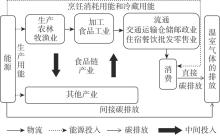
图1
居民食物消费碳排放测算系统边界示意图"
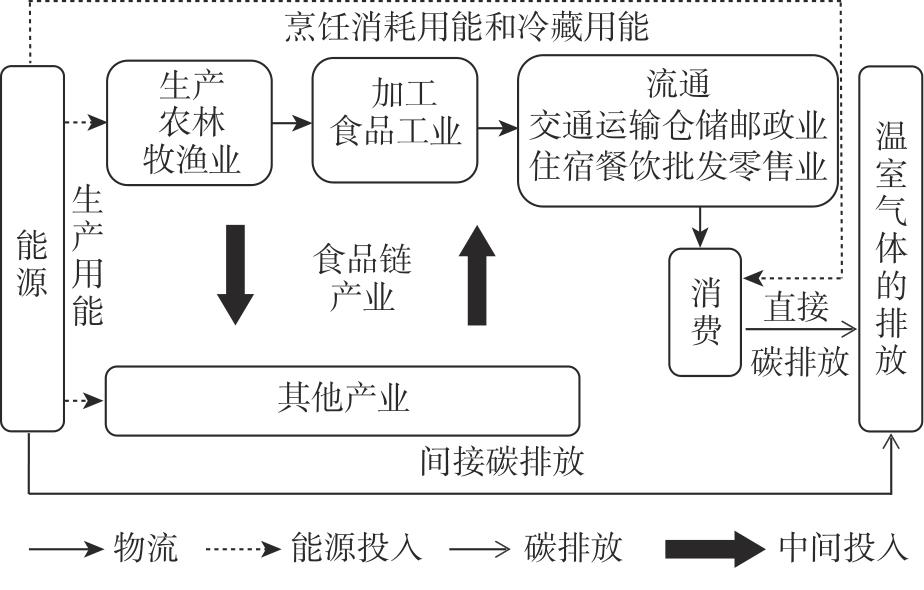

表1
不同食物的碳折算系数"
| 食物种类 | 植物性食物 | 动物性食物 | |||||||||||
|---|---|---|---|---|---|---|---|---|---|---|---|---|---|
| 粮食 | 植物油 | 蔬菜 | 瓜果 | 食糖 | 猪肉 | 牛肉 | 羊肉 | 禽肉 | 蛋类 | 水产品 | 奶类 | ||
| 综合碳折算系数 | 0.3268 | 1.1588 | 0.0274 | 0.0498 | 0.3965 | 1.1892 | 1.3657 | 1.3657 | 1.0062 | 0.9026 | 0.7315 | 0.4256 | |
表2
不同食物的烹饪加工系数"
| 食物种类 | 植物性食物 | 动物性食物 | |||||||||||
|---|---|---|---|---|---|---|---|---|---|---|---|---|---|
| 粮食 | 植物油 | 蔬菜 | 瓜果 | 食糖 | 猪肉 | 牛肉 | 羊肉 | 禽肉 | 蛋类 | 水产品 | 奶类 | ||
| 烹饪加工系数 | 0.1090 | 0.6540 | 0.0109 | 0.0000 | 0.0000 | 0.1588 | 0.1772 | 0.1772 | 0.1363 | 0.1363 | 0.0818 | 0.0164 | |
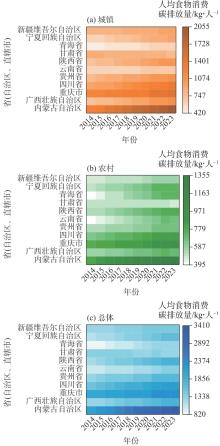
图2
2014—2023年中国西部地区城乡居民人均食物消费碳排放量变化情况"
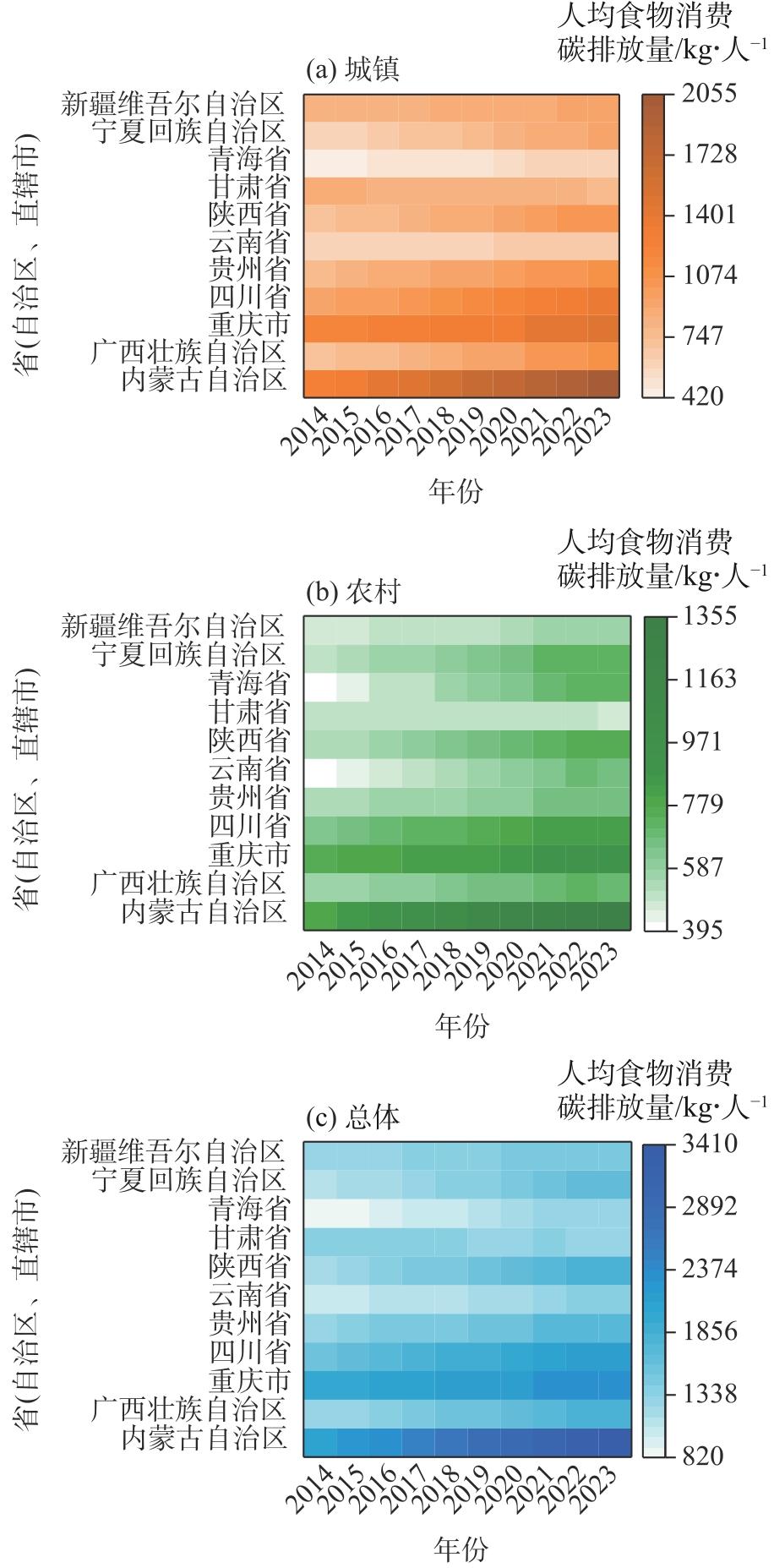
表3
根据地理位置的中国西部地区划分结果"
| 区域 | 省(自治区、直辖市) |
|---|---|
| 西北地区 | 内蒙古自治区、陕西省、甘肃省、青海省、宁夏回族自治区、新疆维吾尔自治区 |
| 西南地区 | 广西壮族自治区、重庆市、四川省、贵州省、云南省 |
表4
中国西部地区城乡居民食物消费碳排放强度泰尔指数"
| 年份 | 总体差异 | 组内差异 | 组间差异 | 组内 | |
|---|---|---|---|---|---|
| 西北地区 | 西南地区 | ||||
| 2014 | 0.0270 | 0.0141(52.21%) | 0.0129(47.79%) | 0.0260(39.80%) | 0.0057(12.41%) |
| 2015 | 0.0203 | 0.0119(58.69%) | 0.0084(41.31%) | 0.0223(43.84%) | 0.0050(14.85%) |
| 2016 | 0.0157 | 0.0102(64.79%) | 0.0055(35.21%) | 0.0184(45.39%) | 0.0050(19.40%) |
| 2017 | 0.0145 | 0.0114(78.32%) | 0.0032(21.68%) | 0.0236(60.63%) | 0.0041(17.69%) |
| 2018 | 0.0145 | 0.0111(76.34%) | 0.0034(23.66%) | 0.0233(60.47%) | 0.0037(15.87%) |
| 2019 | 0.0165 | 0.0158(95.74%) | 0.0007(4.26%) | 0.0263(56.48%) | 0.0100(39.25%) |
| 2020 | 0.0157 | 0.0155(98.85%) | 0.0002(1.15%) | 0.0241(53.17%) | 0.0110(45.68%) |
| 2021 | 0.0155 | 0.0147(94.76%) | 0.0008(5.24%) | 0.0210(47.96%) | 0.0113(46.81%) |
| 2022 | 0.0166 | 0.0145(87.00%) | 0.0022(13.00%) | 0.0191(42.17%) | 0.0118(44.83%) |
| 2023 | 0.0171 | 0.0149(86.79%) | 0.0023(13.21%) | 0.0194(41.88%) | 0.0122(44.91%) |
表5
中国西部地区城乡居民人均食物消费碳排放泰尔指数"
| 年份 | 泰尔指数 | 组内差异 | 组间差异 | 组内 | |
|---|---|---|---|---|---|
| 西北地区 | 西南地区 | ||||
| 2014 | 0.0261 | 0.0136(51.96%) | 0.0126(48.04%) | 0.0290(37.20%) | 0.0058(14.76%) |
| 2015 | 0.0197 | 0.0115(58.52%) | 0.0082(41.48%) | 0.0244(41.63%) | 0.0050(16.89%) |
| 2016 | 0.0153 | 0.0099(64.57%) | 0.0054(35.43%) | 0.0195(43.00%) | 0.0050(21.57%) |
| 2017 | 0.0138 | 0.0107(77.58%) | 0.0031(22.42%) | 0.0241(58.27%) | 0.0040(19.31%) |
| 2018 | 0.0137 | 0.0103(75.36%) | 0.0034(24.64%) | 0.0236(57.96%) | 0.0036(17.40%) |
| 2019 | 0.0160 | 0.0153(95.66%) | 0.0007(4.34%) | 0.0268(56.21%) | 0.0095(39.45%) |
| 2020 | 0.0155 | 0.0153(98.84%) | 0.0002(1.16%) | 0.0247(53.87%) | 0.0105(44.97%) |
| 2021 | 0.0152 | 0.0144(94.70%) | 0.0008(5.30%) | 0.0215(47.57%) | 0.0108(47.13%) |
| 2022 | 0.0162 | 0.0141(86.84%) | 0.0021(13.16%) | 0.0197(40.79%) | 0.0112(46.06%) |
| 2023 | 0.0168 | 0.0145(86.68%) | 0.0022(13.32%) | 0.0202(40.60%) | 0.0116(46.07%) |
表6
根据K-means分层聚类的中国西部地区划分结果"
| 区域 | 省(自治区、直辖市) |
|---|---|
| 高碳-高收-高城地区 | 内蒙古自治区、重庆市 |
| 中碳-中收-中城地区 | 陕西省、甘肃省、青海省、宁夏回族自治区、新疆维吾尔自治区、广西壮族自治区、四川省、贵州省、云南省 |
图3
中国西部地区城乡居民食物消费碳排放量的聚类分析结果 注:圆点大小表示城市化率大小。"
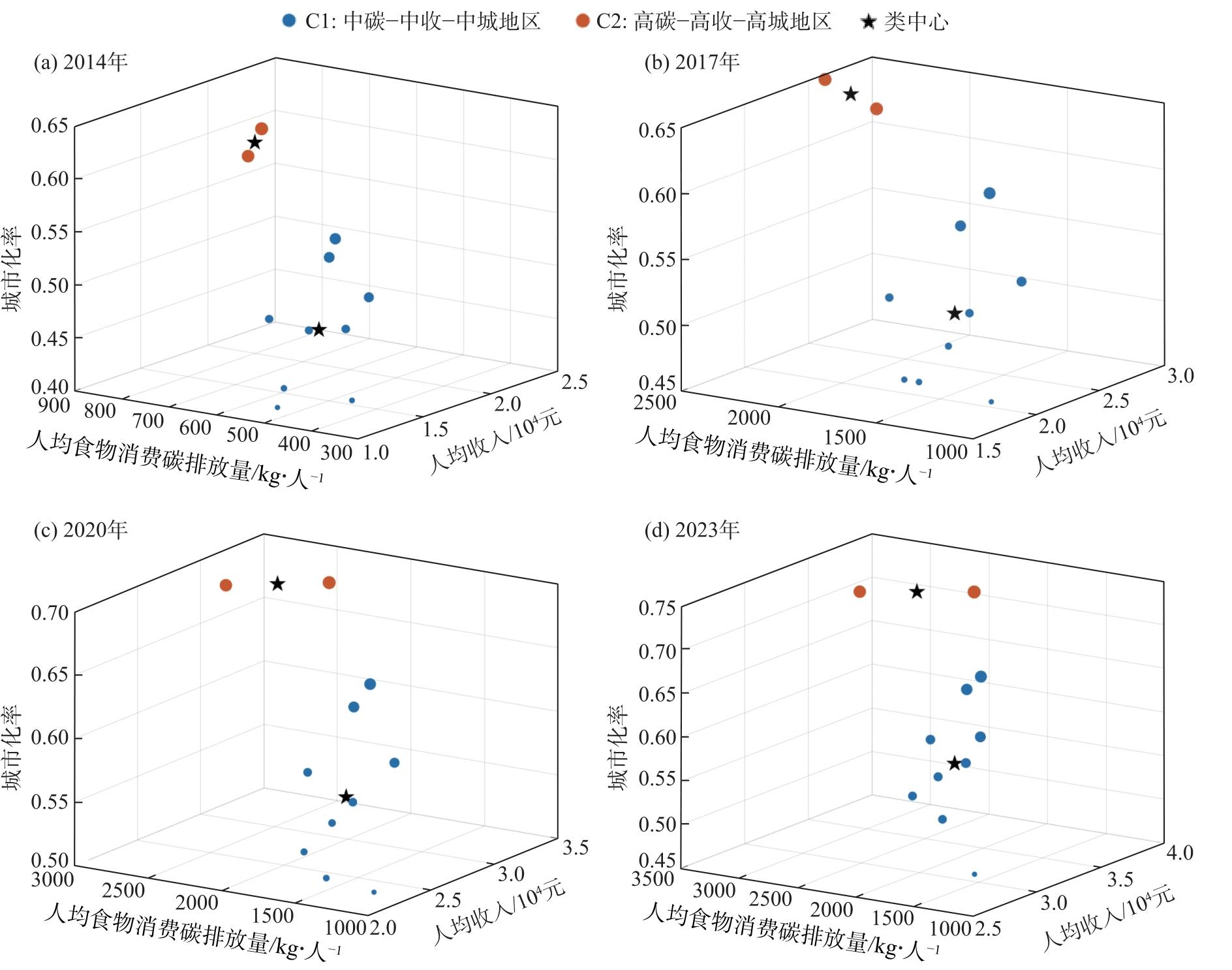
表7
变量说明"
| 类型 | 变量名称 |
|---|---|
| 经济结构 | 城镇居民人均可支配收入(U1)/元·人-1 |
| 城镇居民消费价格指数(U2) | |
| 城镇居民商品零售价格指数(U3) | |
| 农村居民人均可支配收入(R1)/元·人-1 | |
| 农村居民消费价格指数(R2) | |
| 农村居民商品零售价格指数(R3) | |
| 人口结构 | 城镇人口规模(U4)/人 |
| 农村人口规模(R4)/人 | |
| 消费结构 | 城镇居民人均植物性食物消费量(U5)/kg·人-1 |
| 城镇居民人均动物性食物消费量(U6)/kg·人-1 | |
| 城镇居民恩格尔系数(U7)/% | |
| 农村居民人均植物性食物消费量(R5)/kg·人-1 | |
| 农村居民人均动物性食物消费量(R6)/kg·人-1 | |
| 农村居民恩格尔系数(R7)/% | |
| 人均家庭电冰箱拥有量(X1)/台 | |
| 交通结构 | 旅客周转量(X2)/人·km |
| 货物周转量(X3)/t·km |
图4
中国西部地区城镇居民食物消费碳排放驱动因子的交互作用分析 注:U1~U7、X1~X3含义见表7;q为因子对因变量城乡居民食物消费碳排放空间异质性的解释力。下同。"
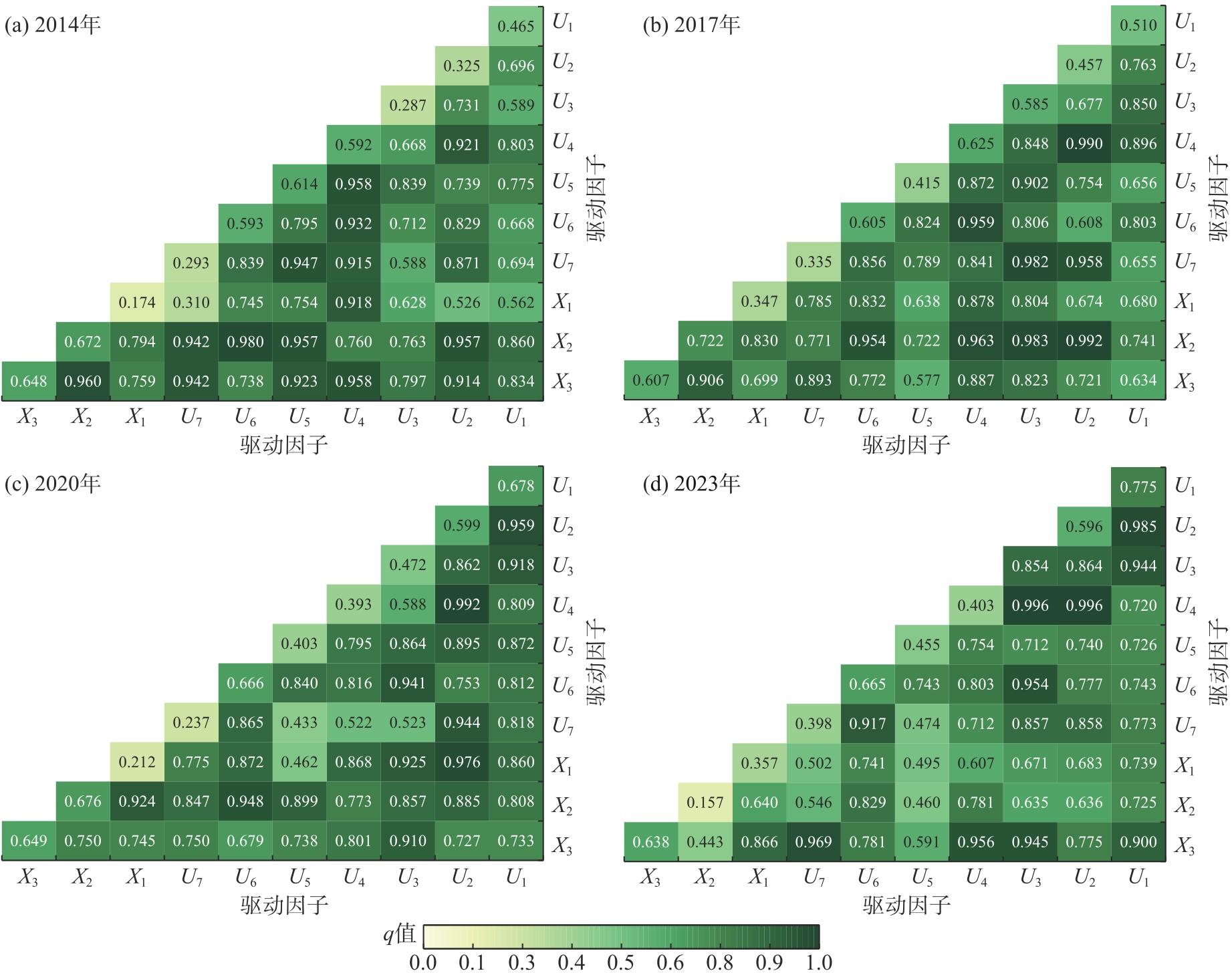
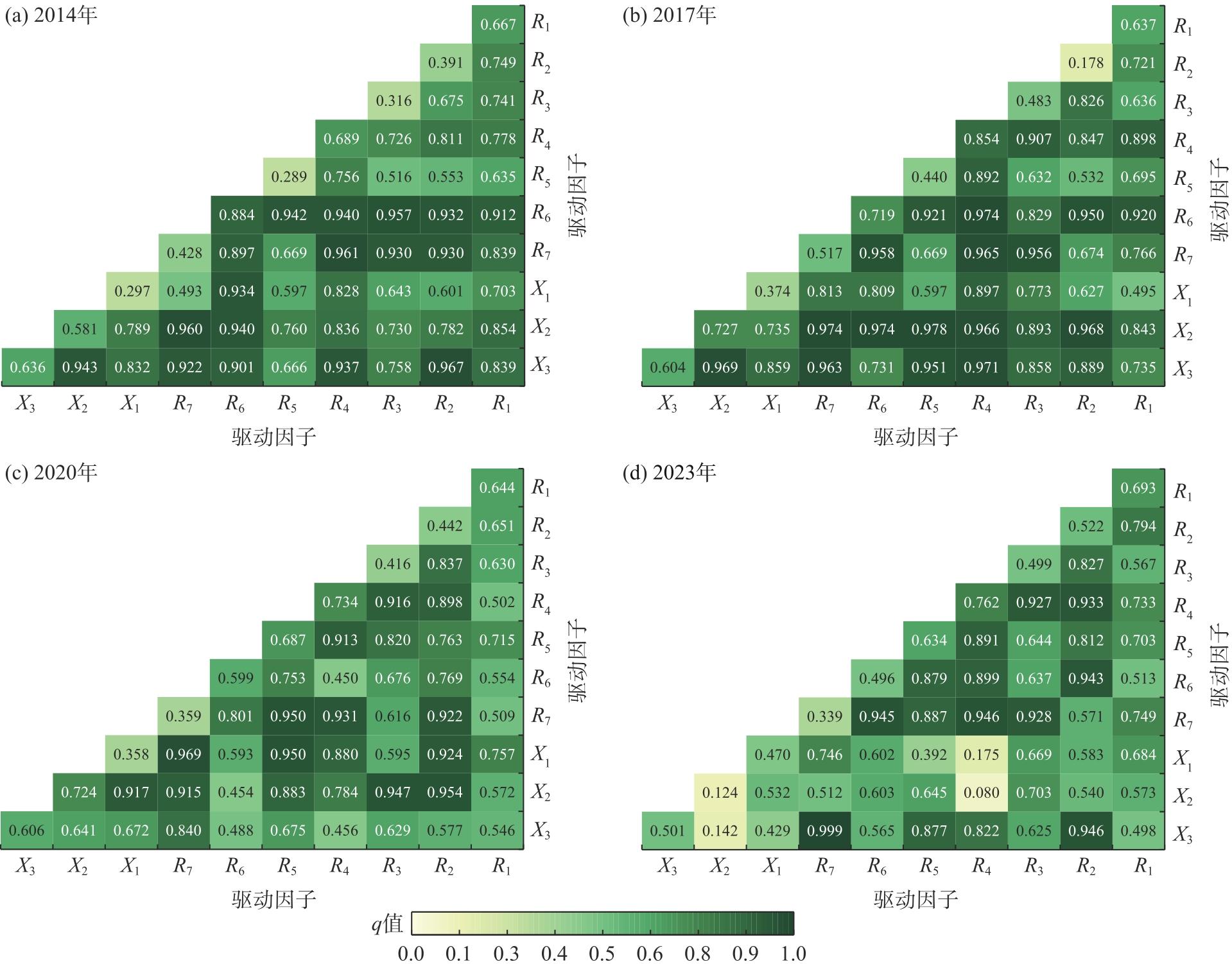
图5
中国西部地区农村居民食物消费碳排放驱动因子的交互作用分析 注:R1~R7含义见表7。"
| [1] | 杜鹏, 章征科. 系统观念视域下的“大农业观大食物观”: 出场背景、核心要义与践行进路[J]. 经济学家, 2025(4): 120-128. |
| [Du Peng, Zhang Zhengke. The “comprehensive agriculture perspective and diversified food systems concept” under the framework of systems thinking: The background, core essence and synergistic approach[J]. Economist, 2025(4): 120-128.] | |
| [2] | 戴俊骋. 一“鲜”难求? 地方流动对可持续饮食系统的影响机制[J]. 人文地理, 2022, 37(4): 32-38, 74. |
| [Dai Juncheng. Hard to find a “fresh” meal? Research on place mobility and sustainable food systems[J]. Human Geography, 2022, 37(4): 32-38, 74.] | |
| [3] | 郭帅辰, 李德龙, 李兵抗, 等. 中国家庭食物浪费影响因素识别及形成机理——基于扎根理论的质性研究[J]. 干旱区资源与环境, 2025, 39(6): 117-131. |
| [Guo Shuaichen, Li Delong, Li Bingkang, et al. Identification of influencing factors and formation mechanism of household food waste in China: A qualitative study based on grounded theory[J]. Journal of Arid Land Resources and Environment, 2025, 39(6): 117-131.] | |
| [4] | 薛佳敏, 徐明岗, 张建杰. 食物系统碳足迹研究进展[J]. 中国生态农业学报(中英文), 2024, 32(2): 196-205. |
| [Xue Jiamin, Xu Minggang, Zhang Jianjie. Proceedings in carbon footprint research of food systems[J]. Chinese Journal of Eco-Agriculture, 2024, 32(2): 196-205.] | |
| [5] | 马倩倩, 陈诗一. 经济收敛与环境失衡: 基于西部大开发战略的研究[J]. 世界经济, 2023, 46(8): 108-133. |
| [Ma Qianqian, Chen Shiyi. Economic convergence and environmental disparities: Evidence from the western development program[J]. The Journal of World Economy, 2023, 46(8): 108-133.] | |
| [6] | 孙豪, 桂河清, 何伟. 消费升级、碳排放与中国碳达峰目标实现[J]. 财经研究, 2025, 51(7): 79-93. |
| [Sun Hao, Gui Heqing, He Wei. Consumption upgrading, carbon emissions, and the achievement of China’s carbon peak target[J]. Journal of Finance and Economics, 2025, 51(7): 79-93.] | |
| [7] | 樊胜根, 张玉梅. 中国农业食物系统低碳转型战略思考[J]. 农业经济问题, 2024(12): 15-23. |
| [Fan Shenggen, Zhang Yumei. Strategic thinking on the low-carbon transformation of agrifood systems in China[J]. Issues in Agricultural Economy, 2024(12): 15-23.] | |
| [8] | Feng W, Cai B M, Zhang B. A bite of China: Food consumption and carbon emission from 1992 to 2007[J]. China Economic Review, 2020, 59: 100949, doi: 10.1016/j.chieco.2016.06.007. |
| [9] | 黄和平, 李亚丽, 杨斯玲. 中国城镇居民食物消费碳排放的时空演变特征分析[J]. 中国环境管理, 2021, 13(1): 112-120. |
| [Huang Heping, Li Yali, Yang Siling. Spatio-temporal evolution characteristics of carbon emissions from food consumption of urban residents in China[J]. Chinese Journal of Environmental Management, 2021, 13(1): 112-120.] | |
| [10] |
Elliott M, Bhunnoo R. Scenarios for transforming the UK food system to meet global agreements[J]. Nature Food, 2021, 2(5): 310-312.
doi: 10.1038/s43016-021-00257-1 pmid: 37117716 |
| [11] | 谢金良, 郭静, 黄雨婷, 等. 基于多源数据的中国家庭碳排放核算与占比估计[J]. 环境工程学报, 2024, 18(11): 3081-3091. |
| [Xie Jinliang, Guo Jing, Huang Yuting, et al. Accounting for household carbon emissions and estimating their proportion in China based on multi-source data[J]. Chinese Journal of Environmental Engineering, 2024, 18(11): 3081-3091.] | |
| [12] |
Boehm R, Wilde P E, Ver P M, et al. A comprehensive life cycle assessment of greenhouse gas emissions from US household food choices[J]. Food Policy, 2018, 79: 67-76.
doi: 10.1016/j.foodpol.2018.05.004 |
| [13] |
刘莉娜, 曲建升, 黄雨生, 等. 中国居民生活碳排放的区域差异及影响因素分析[J]. 自然资源学报, 2016, 31(8): 1364-1377.
doi: 10.11849/zrzyxb.20150905 |
|
[Liu Lina, Qu Jiansheng, Huang Yusheng, et al. Analyze on the spatial-temporal pattern and influence factors of China’s per capita household carbon emissions[J]. Journal of Natural Resources, 2016, 31(8): 1364-1377.]
doi: 10.11849/zrzyxb.20150905 |
|
| [14] | 刘莉娜, 曲建升, 曾静静, 等. 基于文献计量的居民食物消费碳排放研究进展及发展态势[J]. 生态学报, 2023, 43(17): 7331-7340. |
| [Liu Lina, Qu Jiansheng, Zeng Jingjing, et al. Research progress and development trend of carbon emissions from residents’ food consumption based on bibliometrics[J]. Acta Ecological Sinica, 2023, 43(17): 7331-7340.] | |
| [15] |
李梦冉, 徐小任, 王梁, 等. 黄河流域农业碳排放时空变化特征及影响因素分析[J]. 干旱区地理, 2025, 48(5): 854-865.
doi: 10.12118/j.issn.1000-6060.2024.401 |
|
[Li Mengran, Xu Xiaoran, Wang Liang, et al. Spatial-temporal characteristics and influencing factors of agricultural carbon emissions in the Yellow River Basin[J]. Arid Land Geography, 2025, 48(5): 854-865.]
doi: 10.12118/j.issn.1000-6060.2024.401 |
|
| [16] | Long Y L, Hu R Z, Yin T, et al. Spatial-temporal footprints assessment and driving mechanism of China household diet based on CHNS[J]. Foods, 2021, 10(8): 1858, doi: 10.3390/foods10081858. |
| [17] |
Corrado S, Luzzani G, Trevisan M, et al. Contribution of different life cycle stages to the greenhouse gas emissions associated with three balanced dietary patterns[J]. Science of the Total Environment, 2019, 660: 622-630.
doi: 10.1016/j.scitotenv.2018.12.267 |
| [18] | 祁闯, 孙璇, 黄雅丽, 等. 中国城乡居民食品消费模式及其碳足迹演化特征[J]. 环境科学, 2025, 46(1): 66-75. |
| [Qi Chuang, Sun Xuan, Huang Yali, et al. Transition of food consumption patterns and carbon footprint of urban and rural residents in China[J]. Environmental Science, 2025, 46(1): 66-75.] | |
| [19] | 蒋璐, 汪瑞, 刘蓓蓓. 食品消费模式的碳足迹差异研究[J]. 中国环境科学, 2023, 43(12): 6755-6762. |
| [Jiang Lu, Wang Rui, Liu Beibei. Differences in carbon footprint of food consumption patterns[J]. China Environmental Science, 2023, 43(12): 6755-6762.] | |
| [20] | 张丽娜, 郝宵, 庞庆华, 等. 城乡分异视角下居民食品消费碳排放驱动效应研究——以江苏省为例的实证分析[J]. 软科学, 2021, 35(2): 54-59. |
| [Zhang Lina, Hao Xiao, Pang Qinghua, et al. Study on the driving effect of carbon emissions from residential food consumption based on the perspective of urban and rural differentiation: Taking Jiangsu Province as the example[J]. Soft Science, 2021, 35(2): 54-59.] | |
| [21] |
曹志宏, 郝晋珉, 邢红萍. 中国居民食物消费碳排放时空演变趋势及其驱动机制分析[J]. 地理科学进展, 2020, 39(1): 91-99.
doi: 10.18306/dlkxjz.2020.01.009 |
|
[Cao Zhihong, Hao Jinmin, Xing Hongping. Spatial-temporal change of Chinese resident food consumption carbon emissions and its driving mechanism[J]. Progress in Geography, 2020, 39(1): 91-99.]
doi: 10.18306/dlkxjz.2020.01.009 |
|
| [22] | Aprti A E, Bamba B W W, Edoh E D, et al. Wealth inequality and carbon inequality[J]. Ecological Economics, 2025, 227: 108406, doi: 10.1016/j.ecolecon.2024.108406. |
| [23] | Li S J, Chen W M. Regional carbon inequality and its impact in China: A new perspective from urban agglomerations[J]. Journal of Cleaner Production, 2024, 480: 144059, doi: 10.1016/j.jclepro.2024.144059. |
| [24] |
曹开军, 商宁, 王秘秘. 中国西北五省乡村旅游重点村时空分布格局与可达性分析[J]. 干旱区地理, 2023, 46(7): 1196-1205.
doi: 10.12118/j.issn.1000-6060.2022.531 |
|
[Cao Kaijun, Shang Ning, Wang Mimi. Spatial distribution pattern and accessibility analysis of the key rural tourism villages in the five northwestern provinces of China[J]. Arid Land Geography, 2023, 46(7): 1196-1205.]
doi: 10.12118/j.issn.1000-6060.2022.531 |
|
| [25] | 杨旺舟. 中国农村居民食品消费碳排放的时空格局及其影响因素[J]. 中国环境管理, 2022, 14(3): 112-117. |
| [Yang Wangzhou. Spatio-temporal pattern and its driving forces on carbon emission of food consumption from rural households in China[J]. Chinese Journal of Environmental Management, 2022, 14(3): 112-117.] | |
| [26] | 智静, 高吉喜. 中国城乡居民食品消费碳排放对比分析[J]. 地理科学进展, 2009, 28(3): 429-434. |
|
[Zhi Jing, Gao Jixi. Analysis of carbon emission caused by food consumption in urban and rural inhabitants in China[J]. Progress in Geography, 2009, 28(3): 429-434.]
doi: 10.11820/dlkxjz.2009.03.016 |
|
| [27] | 庞梦伊. 中国城乡居民食品消费碳排放时空演变特征及影响因素分析[D]. 长春: 吉林大学, 2023. |
| [Pang Mengyi. Analysis of the spatial and temporal evolution characteristics and influencing factors of carbon emissions from food consumption of urban and rural residents in China[D]. Changchun: Jilin University, 2023.] | |
| [28] | 罗婷文, 欧阳志云, 王效科, 等. 北京城市化进程中家庭食物碳消费动态[J]. 生态学报, 2005(12): 3252-3258. |
| [Luo Tingwen, Ouyang Zhiyun, Wang Xiaoke, et al. Dynamics of urban food-carbon consumption in Beijing households[J]. Acta Ecologic Sinica, 2005(12): 3252-3258.] | |
| [29] | 辛良杰, 李鹏辉, 范玉枝. 中国食物消费随人口结构变化分析[J]. 农业工程学报, 2018, 34(14): 296-302. |
| [Xin Liangjie, Li Penghui, Fan Yuzhi. Change of food consumption with population age structure in China[J]. Transactions of the Chinese Society of Agricultural Engineering, 2018, 34(14): 296-302.] | |
| [30] |
Pan W, Pan W L, Shi Y D, et al. China’s inter-regional carbon emissions: An input-output analysis under considering national economic strategy[J]. Journal of Cleaner Production, 2018, 197: 794-803.
doi: 10.1016/j.jclepro.2018.06.207 |
| [31] | 杨骞, 刘华军. 中国二氧化碳排放的区域差异分解及影响因素——基于1995—2009年省际面板数据的研究[J]. 数量经济技术经济研究, 2012, 29(5): 36-49, 148. |
| [Yang Qian, Liu Huajun. Regional difference decomposition and influence factors of China’s carbon dioxide emissions: A study based on interprovincial panel data from 1995 to 2009[J]. Journal of Quantitative and Technological Economics, 2012, 29(5): 36-49, 148.] | |
| [32] |
杨俊闯, 赵超. K-Means聚类算法研究综述[J]. 计算机工程与应用, 2019, 55(23): 7-14, 63.
doi: 10.3778/j.issn.1002-8331.1908-0347 |
|
[Yang Junchuang, Zhao Chao. Survey on K-Means clustering algorithm[J]. Computer Engineering and Applications, 2019, 55(23): 7-14, 63.]
doi: 10.3778/j.issn.1002-8331.1908-0347 |
|
| [33] |
王劲峰, 徐成东. 地理探测器: 原理与展望[J]. 地理学报, 2017, 72(1): 116-134.
doi: 10.11821/dlxb201701010 |
| [Wang Jinfeng, Xu Chengdong. Geodetector: Principle and prospective[J]. Acta Geographic Sinica, 2017, 72(1): 116-134.] | |
| [34] | 孙黄平, 黄震方, 徐冬冬, 等. 泛长三角城市群城镇化与生态环境耦合的空间特征与驱动机制[J]. 经济地理, 2017, 37(2): 163-170, 186. |
| [Sun Huangping, Huang Zhenfang, Xu Dongdong, et al. The spatial characteristics and drive mechanism of coupling relationship between urbanization and eco-environment in the Pan Yangtze River Delta[J]. Economic Geography, 2017, 37(2): 163-170, 186.] | |
| [35] |
王彬燕, 田俊峰, 程利莎, 等. 中国数字经济空间分异及影响因素[J]. 地理科学, 2018, 38(6): 859-868.
doi: 10.13249/j.cnki.sgs.2018.06.004 |
|
[Wang Binyan, Tian Junfeng, Cheng Lisha, et al. Spatial differentiation of digital economy and its influencing factors in China[J]. Scientia Geographica Sinica, 2018, 38(6): 859-868.]
doi: 10.13249/j.cnki.sgs.2018.06.004 |
|
| [36] |
王兴民, 吴静, 白冰, 等. 中国CO2排放的空间分异与驱动因素——基于198个地级及以上城市数据的分析[J]. 经济地理, 2020, 40(11): 29-38.
doi: 10.15957/j.cnki.jjdl.2020.11.004 |
|
[Wang Xingmin, Wu Jing, Bai Bing, et al. Spatial differentiation and driving factors of CO2 emissions: Analysis based on 198 cities at prefecture level and above in China[J]. Economic Geography, 2020, 40(11): 29-38.]
doi: 10.15957/j.cnki.jjdl.2020.11.004 |
|
| [37] |
马海清, 陈强强. 甘肃省农业碳排放时空分异特征及影响因素[J]. 干旱区地理, 2025, 48(5): 879-892.
doi: 10.12118/j.issn.1000-6060.2024.329 |
|
[Ma Haiqing, Chen Qiangqiang. Spatio-temporal differentiation characteristics and influencing factors of agricultural carbon emissions in Gansu Province[J]. Arid Land Geography, 2025, 48(5): 879-892.]
doi: 10.12118/j.issn.1000-6060.2024.329 |
|
| [38] | 高晶, 唐增, 李重阳. 中国城乡居民食物消费碳排放的对比分析[J]. 草业科学, 2018, 35(8): 2022-2030. |
| [Gao Jing, Tang Zeng, Li Chongyang. A comparative analysis of food consumption on carbon emission of urban and rural residents in China[J]. Pratacultural Science, 2018, 35(8): 2022-2030.] | |
| [39] |
杨思存, 霍琳, 王成宝, 等. 基于STIRPAT模型的甘肃省农业碳排放特征分析[J]. 干旱区地理, 2023, 46(9): 1493-1502.
doi: 10.12118/j.issn.1000-6060.2022.649 |
|
[Yang Sicun, Huo Lin, Wang Chengbao, et al. Characteristics of agricultural carbon emission in Gansu Province based on STIRPAT model[J]. Arid Land Geography, 2023, 46(9): 1493-1502.]
doi: 10.12118/j.issn.1000-6060.2022.649 |
|
| [40] |
袁长伟, 张帅, 焦萍, 等. 中国省域交通运输全要素碳排放效率时空变化及影响因素研究[J]. 资源科学, 2017, 39(4): 687-697.
doi: 10.18402/resci.2017.04.10 |
|
[Yuan Changwei, Zhang Shuai, Jiao Ping, et al. Temporal and spatial variation and influencing factors research on total factor efficiency for transportation carbon emissions in China[J]. Resources Science, 2017, 39(4): 687-697.]
doi: 10.18402/resci.2017.04.10 |
|
| [41] | 王宇杰, 段霄东, 薛颖, 等. 中国资源型城市碳排放特征、达峰态势及驱动因素分析[J]. 生态经济, 2025, 41(3): 43-49, 63. |
| [Wang Yujie, Duan Xiaodong, Xue Ying, et al. Analysis of carbon emission characteristics, peaking situation and driving factors in China’s resource-based cities[J]. Ecological Economy, 2025, 41(3): 43-49, 63.] | |
| [42] | 林志富, 陶楠, 单立先, 等. 县域尺度下云南省碳排放时空演变特征及驱动机制[J]. 水土保持研究, 2026, 33(2): 264-273. |
| [Lin Zhifu, Tao Nan, Shan Lixian, et al. Spatiotemporal evolution characteristics and driving mechanisms of carbon emissions at county scale in Yunnan Province[J]. Research of Soil and Water Conservation, 2026, 33(2): 264-273.] |
| [1] | 刘法建, 梁婉欣, 黄超群, 李松渊, 张博涵. 中国旅游新质生产力发展时空演化特征与驱动因素[J]. 干旱区地理, 2026, 49(3): 429-439. |
| [2] | 朱怡婷, 梁桂仙, 周春山, 辛龙, 李金雪. 新疆文旅新质生产力发展时空演变特征与驱动因素[J]. 干旱区地理, 2026, 49(1): 128-139. |
| [3] | 刘全渝, 刘馨璐, 李桂真, 李从娟. 新疆表层土壤粒径分形特征及驱动因素分析[J]. 干旱区地理, 2026, 49(1): 56-68. |
| [4] | 张飞, 李建, 李慧融, 谢涛, 张雪红, 王超, 白淑英, 宋正姗. 2001—2024年锡林郭勒盟草原净初级生产力时空特征及对影响因子的响应[J]. 干旱区地理, 2025, 48(9): 1555-1566. |
| [5] | 王鑫, 郑芳, 何铃瑶, 何浩亮, 侯迎. 宁夏县域共同富裕水平时空分异格局及驱动因素研究[J]. 干旱区地理, 2025, 48(7): 1293-1303. |
| [6] | 王佩佩, 王娇, 蔡咏梅. 多尺度视域下中国滑雪场空间分异格局及其驱动因素研究[J]. 干旱区地理, 2025, 48(6): 1080-1088. |
| [7] | 郑孟林, 赵勇, 杨霞. 1961—2022年中国西北干旱区夏季降水变化特征[J]. 干旱区地理, 2025, 48(3): 367-379. |
| [8] | 李锦, 蒲娟, 李明亮, 赵兰兰, 余国新. 新型城镇化与和美乡村耦合协调发展水平测度、地区差异及动态演进[J]. 干旱区地理, 2025, 48(12): 2220-2231. |
| [9] | 马晓敏, 张志斌, 郭倩倩, 赵学伟, 张宁. 2000—2020年兰州市人口时空格局演变及驱动因素分析[J]. 干旱区地理, 2025, 48(1): 168-178. |
| [10] | 徐晓亮, 刘旭义, 关靖云, 杨晶晶, 王明辰, 暴龙飞. 中国西部边疆民族地区文旅融合高质量发展时空演化及驱动因素分析[J]. 干旱区地理, 2024, 47(9): 1596-1605. |
| [11] | 李稚, 朱成刚, 汪家友, 刘永昌, 王川, 张雪琪, 韩诗茹, 方功焕. 东昆仑库木库里盆地典型湖泊水量蒸发损失估算[J]. 干旱区地理, 2024, 47(8): 1263-1276. |
| [12] | 夏文浩, 霍瑜, 逯渊, 王超毅. 新疆农业碳排放的时空差异与空间溢出效应分析[J]. 干旱区地理, 2024, 47(6): 1084-1096. |
| [13] | 王剑, 管瑶, 贺兴宏, 代云豪, 陈艺伟, 王育强, 李会文, 范德宝. 2000—2021年图木舒克市生态环境质量动态监测与评价[J]. 干旱区地理, 2024, 47(3): 465-473. |
| [14] | 周成, 赵亚玲, 任敏敏, 靳轶婷, 吕丝丝. 黄河流域国家湿地公园时空分异、重心演化与驱动因素分析[J]. 干旱区地理, 2024, 47(3): 506-514. |
| [15] | 王慧娴, 杨蓓, 杨宁君, 李璐瑶. 黄河流域旅游经济差异及关键驱动因素研究[J]. 干旱区地理, 2024, 47(3): 515-527. |
|
||

