干旱区地理 ›› 2026, Vol. 49 ›› Issue (5): 1013-1025.doi: 10.12118/j.issn.1000-6060.2025.405 cstr: 32274.14.ALG2025405
赵晓琴( ), 孙德华()
收稿日期:2025-07-14
修回日期:2025-11-14
出版日期:2026-05-25
发布日期:2026-05-25
通讯作者:
孙德华(1996-),女,博士研究生,主要从事人口、资源与区域可持续发展研究. E-mail: sundehua5210@126.com作者简介:赵晓琴(1977-),女,博士,副教授,主要从事区域经济、企业治理研究. E-mail: zxq_play@163.com
基金资助:
ZHAO Xiaoqin(), SUN Dehua()
Received:2025-07-14
Revised:2025-11-14
Published:2026-05-25
Online:2026-05-25
摘要:
基于2019—2023年的百度迁徙数据构建了中国城际劳动力流动网络,运用社会网络分析方法、时间指数随机图模型(TERGM)和空间计量模型系统检验了城市舒适度对于劳动力流动网络形成概率和路径关系强度的影响,并进一步探究了其空间依赖性及溢出效应。结果表明:(1) 劳动力流动网络表现出时间上的二元稳定性,形成了以京津冀、长三角、珠三角和成渝城市群为顶点的菱形结构;广州市、上海市、东莞市等“双高”节点城市集聚于珠三角和长三角地区,其他城市群的人口吸引力也在不断增强;2019—2023年劳动者出行所形成的流网络形成了较为明显的子群结构,且子群内部城市间劳动力流动较为频繁。(2) 劳动力流动过程中存在城市舒适度偏好,特别是人为舒适度增加了城市间劳动力流动网络的形成概率,对于人口流入、流出均具有重要影响。(3) 城市舒适度对劳动力流动路径关系强度具有空间溢出性,这种影响也会作用于其他城市。研究通过探究非补偿性地区差异因素对劳动力流动网络的作用机制,扩展了劳动力流动动因的研究,对于揭示中国劳动力流动网络演化及驱动机制具有科学意义。
赵晓琴, 孙德华. 中国劳动力流动网络中的城市舒适度偏好——基于百度迁徙大数据[J]. 干旱区地理, 2026, 49(5): 1013-1025.
ZHAO Xiaoqin, SUN Dehua. Preferences for urban amenity in China’s labor mobility network: Based on Baidu migration big data[J]. Arid Land Geography, 2026, 49(5): 1013-1025.

表1
时间指数随机图模型(TERGM)统计量说明"
| 类别 | 变量 | 示意图 | 统计意义 |
|---|---|---|---|
| 内生结构变量 | 边 |  | 网络中连边数量,相当于常数项 |
| 互惠性 |  | 两城市间的双向流动关系 | |
| 传递三元组 |  | 开放性:劳动力流动网络中有许多三元开放,即3个地点形成一条链状 结构 | |
| 三循环 |  | 闭合性:劳动力流动模式中存在一种“环流”现象 | |
| 外生变量 | 同配性 |  | 属性相同或相近的城市之间是否劳动力流动更加频繁 |
| 接收者效应 |  | 具备某种属性的城市倾向于吸引人口流入 | |
| 发送者效应 |  | 具备某种属性的城市倾向于致使人口流出 | |
| 网络协变量 | 外生情境因素,城市间的关系对网络形成的影响 | ||
| 时序统计量 | 记忆-二元稳定 | 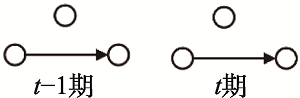 | 网络稳定性,即在t-1时期已经建立(或未建立)的连边,在t时期仍然维持(或未建立)的趋势 |
| 记忆-消融 |  | t-1期存在的网络连带,在t期消失了 | |
| 记忆-创新 |  | t-1期不存在的网络连带,在t期产生了 | |
| 延迟互惠 |  | 存在某种形式的反馈机制,即t-1期城市A与城市B发生A到B的劳动力流动,而t期时城市B流向城市A |
表2
TERGM外生统计量及变量构成"
| 统计量 | 变量名称 | 变量内容 | 单位 |
|---|---|---|---|
| 节点属性变量 | 人为舒适度 | 教育、文化、医疗、公共服务、交通和环境指数 | - |
| 自然舒适度 | 年均降水量 | mm | |
| 采暖度日数 | d | ||
| 经济发展 | 人均地区生产总值 | 元 | |
| 数字普惠金融指数 | - | ||
| 人口规模 | 年末户籍人口 | 104人 | |
| 产业结构 | 第三产业产值/第二产业产值 | - | |
| 房价收入比 | 房价/收入 | - | |
| 网络协变量 | 地理距离 | 各城市间实际地理距离 | km |
| 文化距离 | 测算的方言距离,数值范围在0~4之间[ | - |
表3
城市舒适度测算指标体系"
| 指数名称 | 具体指标 | 载荷系数 |
|---|---|---|
| 教育指数 | 每百生中学教师数/人 | 0.7071 |
| 每百生小学教师数/人 | 0.7071 | |
| 文化指数 | 每百人公共藏书数/本 | 0.7071 |
| 每万人博物馆数/个 | 0.7071 | |
| 医疗指数 | 每百万人医院数/个 | 0.7071 |
| 每万人病床数/张 | 0.7071 | |
| 公共服务指数 | 人均公共预算支出/元 | 0.4592 |
| 城镇职工基本养老保险参保比例/% | 0.5197 | |
| 职工基本医疗保险参保比例/% | 0.4927 | |
| 失业保险参保比例/% | 0.5255 | |
| 交通指数 | 人均铺装道路面积/m2 | 0.7071 |
| 每万人拥有公共汽电车数量/辆 | 0.7071 | |
| 环境指数 | 人均公园绿地面积/m2 | 0.7071 |
| PM2.5年均浓度/μg·m-3 | -0.7071 | |
| 人为舒适度 | 教育指数 | 0.2387 |
| 文化指数 | 0.4943 | |
| 医疗指数 | 0.4700 | |
| 公共服务指数 | 0.4975 | |
| 交通指数 | 0.3877 | |
| 环境指数 | 0.2829 | |
| 自然舒适度 | 年均降水量/mm | 0.7071 |
| 采暖度日数/d | -0.7071 |
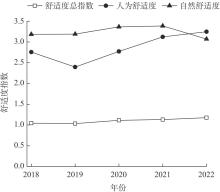
图1
2018—2022年城市舒适度"
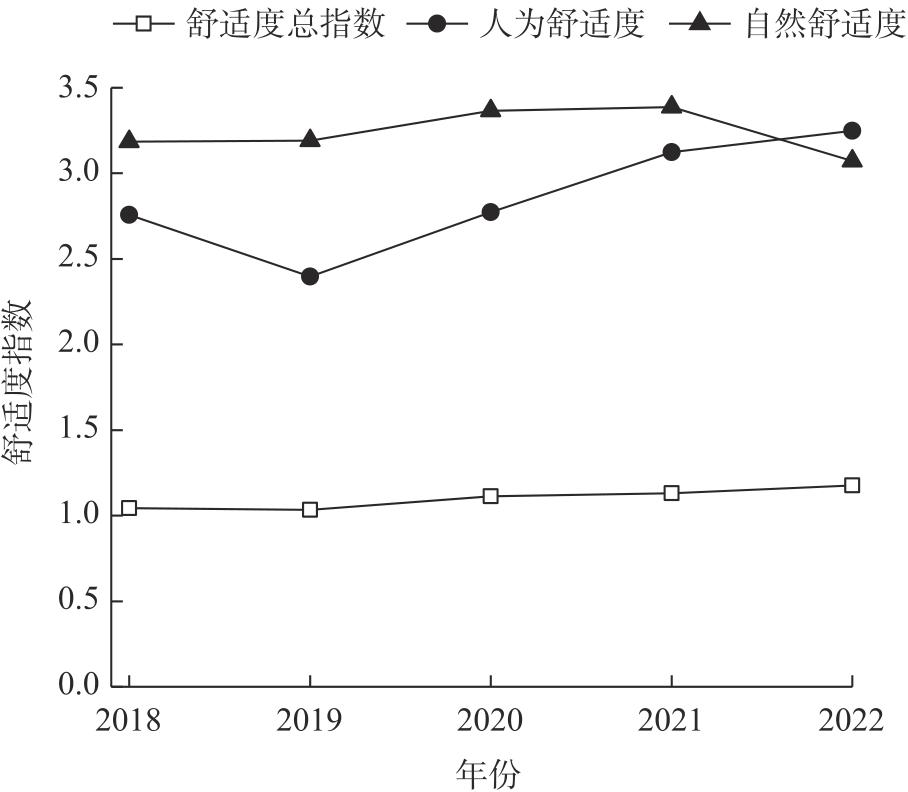
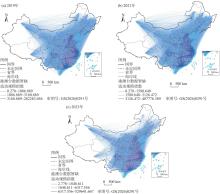
图2
2019—2023年劳动力流动网络空间格局"
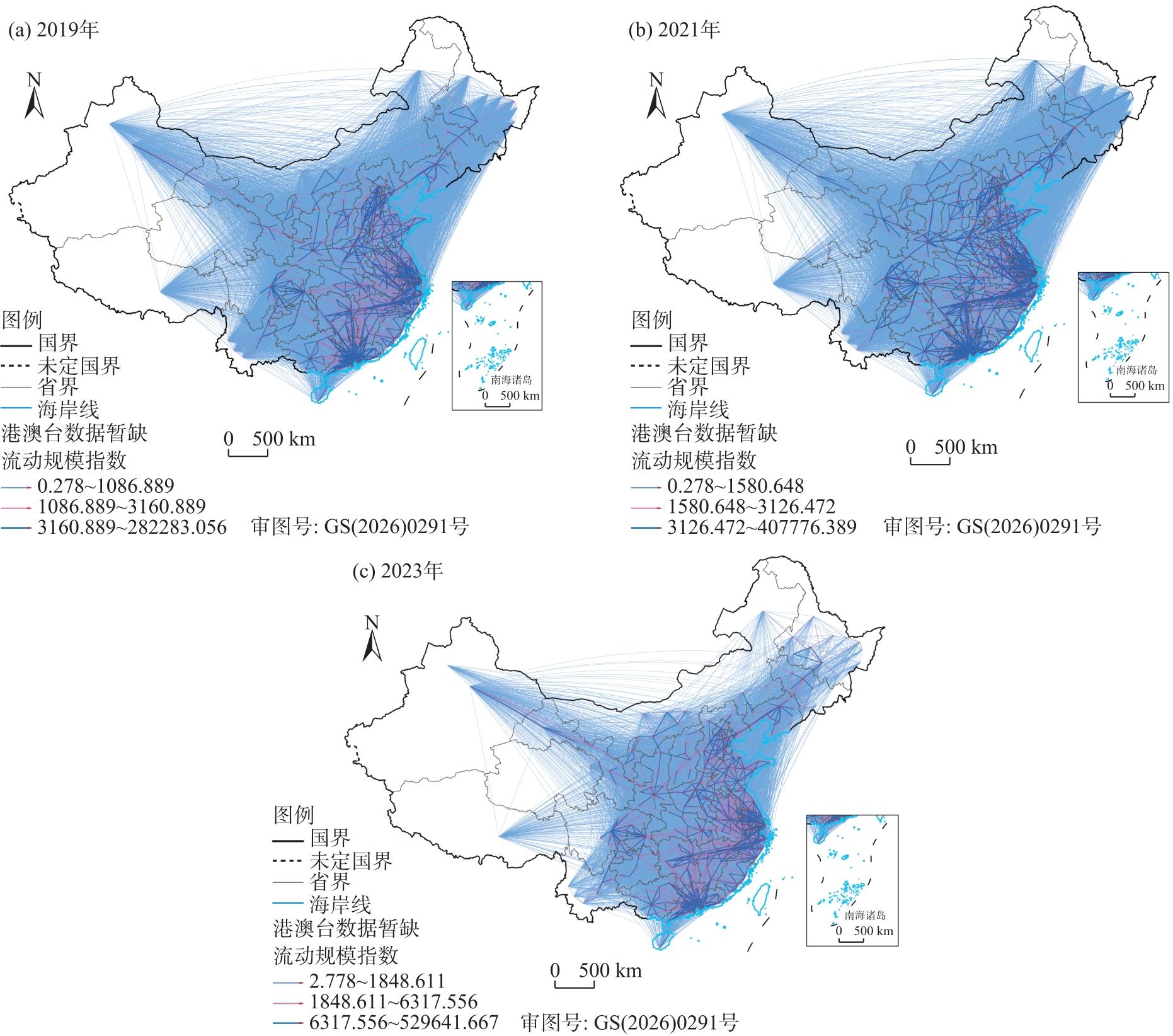
图3
2019—2023年劳动力流动网络节点重要性分析"
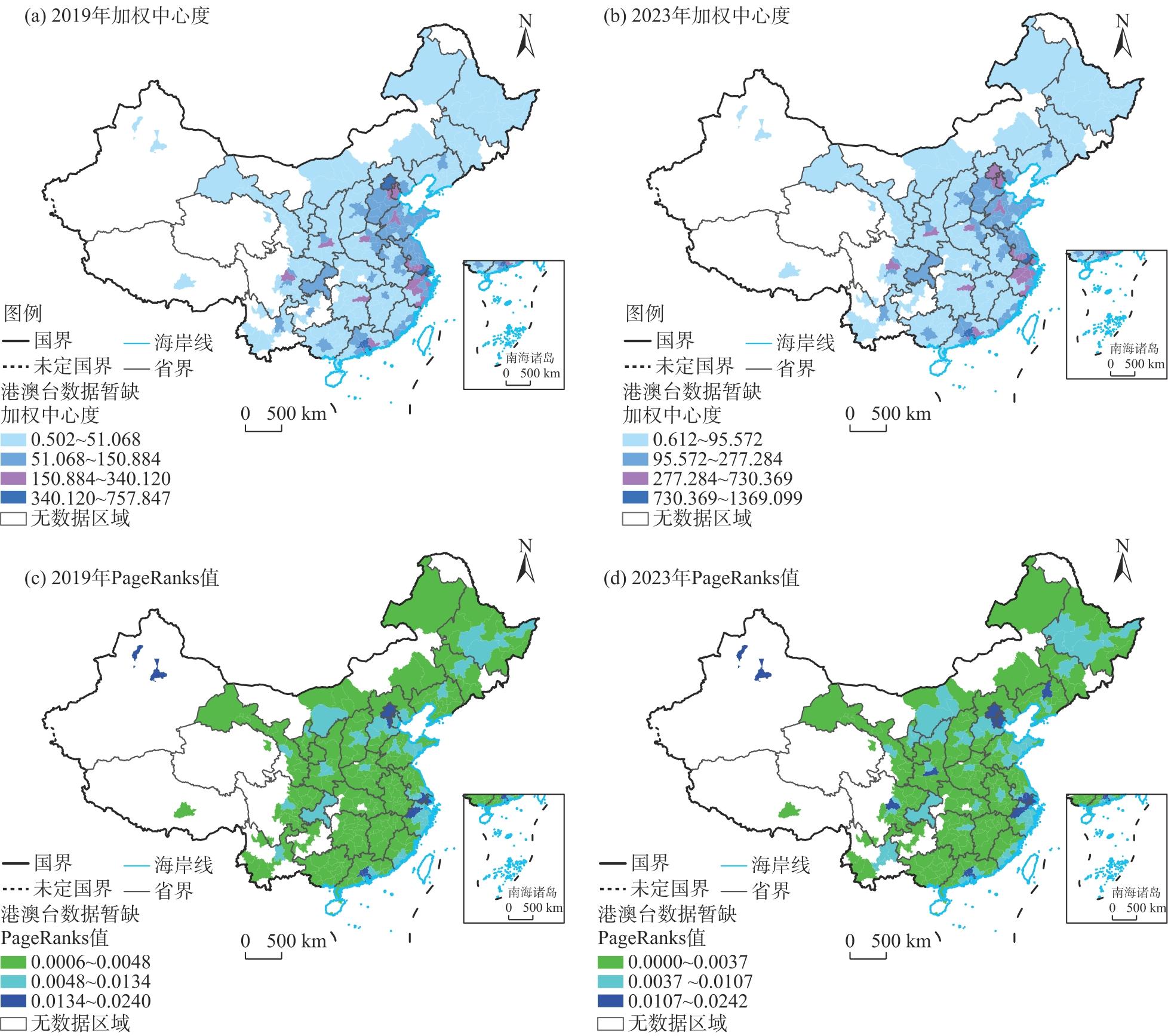

图4
2019—2023年劳动力流动网络子群结构示意图"
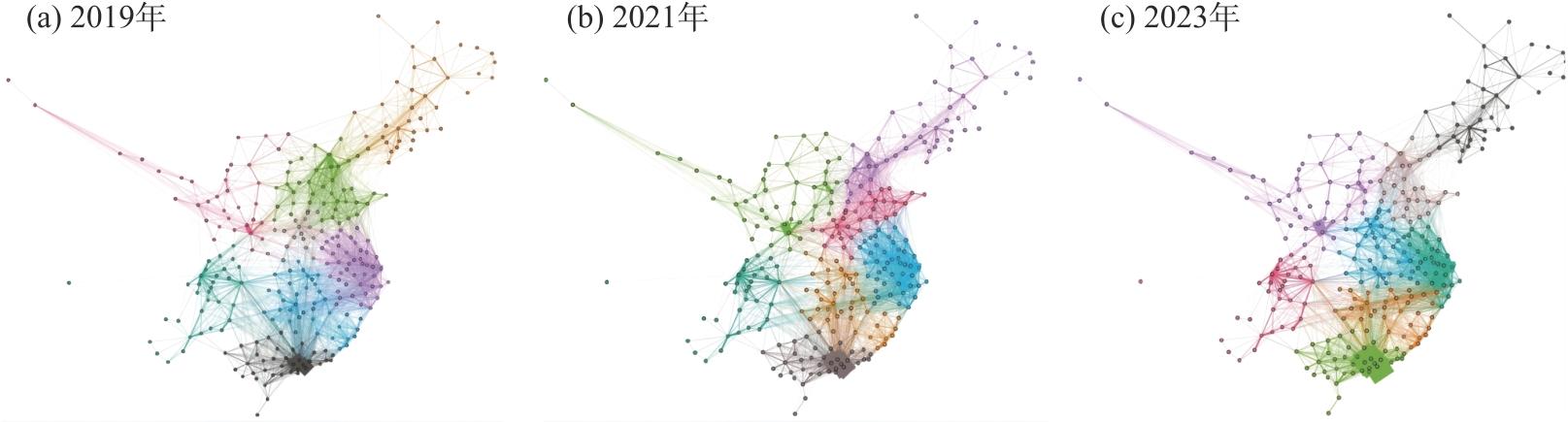
表4
TERGM回归结果"
| 变量名称 | 模型1 | 模型 2 | 模型3 | 模型4 | 模型5 | 模型6 | 模型7 | |
|---|---|---|---|---|---|---|---|---|
| 内生 结构 变量 | 边 | -5.67***(0.235) | -23.77***(1.005) | -14.30***(1.143) | -7.89***(0.837) | -9.14***(1.066) | -9.14***(1.227) | -6.64***(0.811) |
| 互惠性 | 2.41***(0.107) | - | 2.02***(0.077) | 1.76***(0.117) | 1.76***(0.099) | 1.76***(0.117) | 1.76***(0.097) | |
| 传递三元组 | 0.03***(0.003) | - | 0.03***(0.003) | 0.03***(0.000) | 0.03***(0.000) | 0.03***(0.000) | 0.03***(0.000) | |
| 三循环 | -0.06***(0.005) | - | -0.04***(0.005) | -0.03***(0.005) | -0.03***(0.005) | -0.03***(0.005) | -0.03***(0.005) | |
| 节点 属性 变量 | 人为舒适度-接收 | - | 0.29***(0.038) | 0.37***(0.036) | 0.36***(0.013) | 0.36***(0.010) | 0.36***(0.018) | 0.36***(0.013) |
| 人为舒适度-发送 | - | 0.18***(0.036) | 0.12***(0.038) | 0.15***(0.023) | 0.15***(0.023) | 0.15***(0.026) | 0.15***(0.020) | |
| 自然舒适度-接收 | - | -0.03(0.028) | -0.06(0.038) | -0.05(0.054) | -0.05(0.054) | -0.05(0.056) | -0.05(0.056) | |
| 自然舒适度-发送 | - | -0.01(0.028) | -0.09***(0.031) | -0.11***(0.038) | -0.11***(0.036) | -0.11***(0.041) | -0.11***(0.041) | |
| 人口规模-接收 | - | 0.88***(0.084) | 1.17***(0.115) | 0.39***(0.153) | 0.39***(0.140) | 0.39***(0.173) | 0.39***(0.171) | |
| 人口规模-发送 | - | 0.70***(0.000) | 0.35***(0.001) | -0.12(0.001) | -0.12(0.001) | -0.12(0.001) | -0.12(0.001) | |
| 产业结构-接收 | - | 0.23***(0.020) | 0.18***(0.031) | 0.12***(0.043) | 0.12***(0.038) | 0.12***(0.038) | 0.12***(0.043) | |
| 产业结构-发送 | - | 0.13***(0.023) | 0.07***(0.031) | 0.11***(0.018) | 0.11***(0.018) | 0.11***(0.018) | 0.11***(0.018) | |
| 房价收入比-接收 | - | -0.40(0.357) | -0.20(0.589) | -1.59(1.469) | -1.59(1.429) | -1.59(1.548) | -1.59(1.622) | |
| 房价收入比-发送 | - | -0.40(0.311) | -0.58(0.587) | -1.20(1.574) | -1.20(1.495) | -1.20(1.617) | -1.20(1.617) | |
| 经济发展-接收 | - | -0.03(0.084) | 0.18(0.138) | -0.08(0.133) | -0.08(0.105) | -0.08(0.110) | -0.08(0.125) | |
| 经济发展-发送 | - | -0.16***(0.061) | -0.34***(0.112) | -0.44***(0.102) | -0.44***(0.102) | -0.44***(0.115) | -0.44***(0.107) | |
| 经济发展匹配性 | - | 0.04***(0.015) | -0.15***(0.026) | -0.13***(0.048) | -0.13***(0.041) | -0.13***(0.041) | -0.13***(0.046) | |
| 网络协变量 | 地理距离 | - | -0.001***(0.000) | -0.001**(0.000) | -0.001**(0.000) | -0.001***(0.000) | -0.001***(0.000) | -0.001***(0.000) |
| 文化距离 | - | -0.30***(0.010) | -0.24***(0.023) | -0.27***(0.054) | -0.27***(0.054) | -0.27***(0.054) | -0.27***(0.046) | |
| 时序 统计 变量 | 延迟互惠性 | 0.09(0.217) | - | - | 0.13(0.189) | 0.13(0.194) | 0.13(0.222) | 0.13(0.209) |
| 二元稳定性 | 1.34***(0.296) | - | - | 1.25***(0.291) | - | - | - | |
| 自聚集性 | - | - | - | - | 2.50***(0.474) | - | - | |
| 消融/创新 | - | - | - | - | - | -2.50***(0.533) | -2.50***(0.536) | |
| 样本量 | 323760 | 404700 | 404700 | 323760 | 323760 | 323760 | 323760 | |
| 赤池信息准则(AIC) | 125249.54 | 254505.66 | 163069.05 | 110344.32 | 110344.32 | 110344.32 | 110344.32 | |
| 贝叶斯信息准则(BIC) | 125313.67 | 254702.06 | 163298.18 | 110590.14 | 110590.14 | 110590.14 | 110590.14 | |
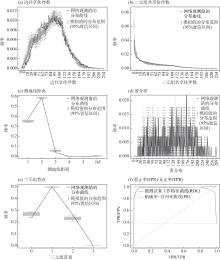
图5
拟合优度检验 注:Inf表示网络中不可达节点对的测地距离(即两城市间不存在任何有向路径),按惯例记为无穷大。"
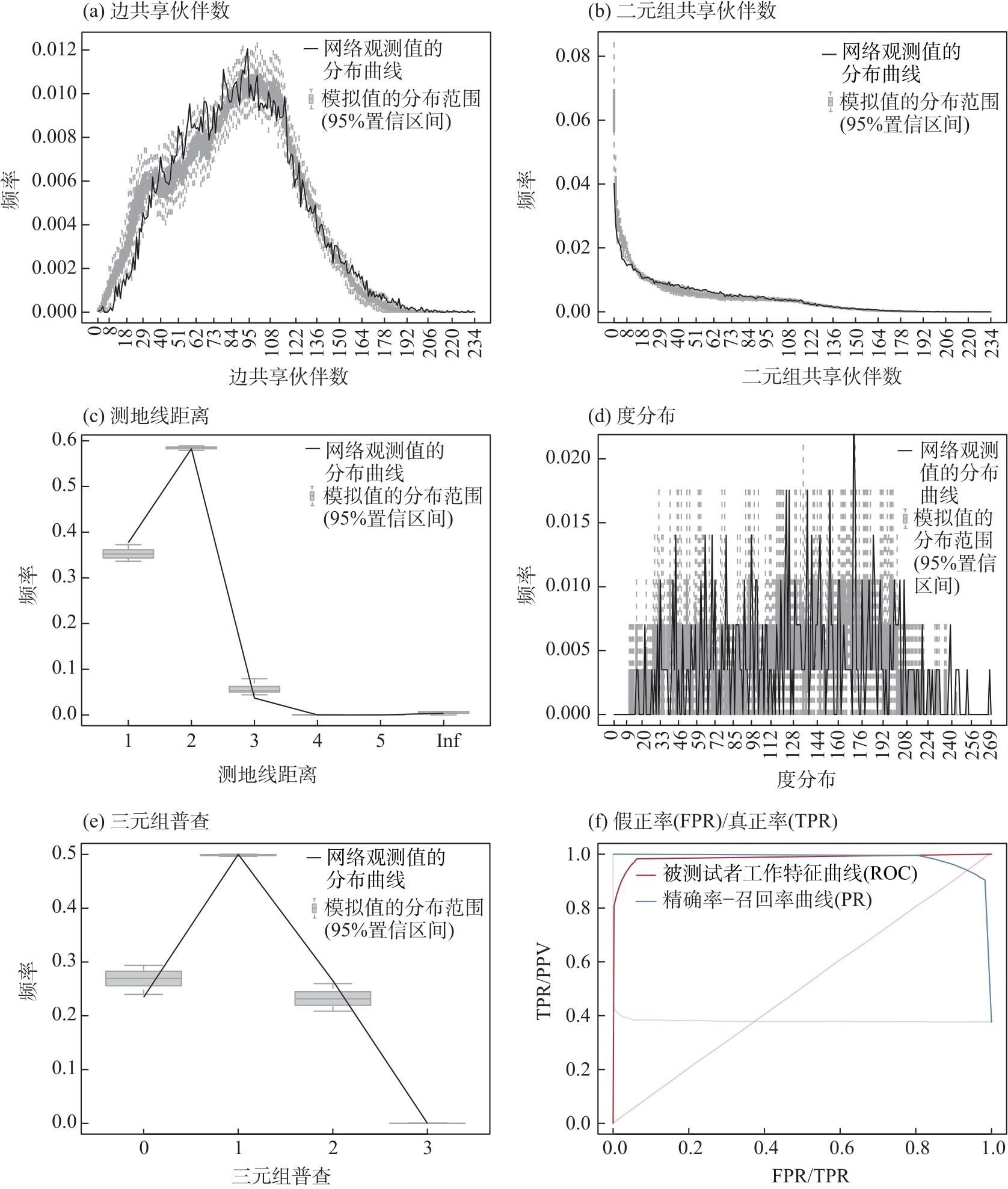
表5
全局空间自相关检验"
| 变量 | 2019年 | 2020年 | 2021年 | 2022年 | 2023年 |
|---|---|---|---|---|---|
| 城市舒适度 | 0.34***(0.027) | 0.35***(0.027) | 0.22**(0.027) | 0.38***(0.027) | 0.38***(0.027) |
| 劳动力流动强度 | 0.21***(0.027) | 0.32***(0.027) | 0.20***(0.027) | 0.21***(0.027) | 0.18***(0.027) |
表6
空间效应回归结果"
| 变量 | 劳动力流动强度 |
|---|---|
| 城市舒适度 | 4.92*(2.553) |
| W×城市舒适度 | 13.48**(6.223) |
| 控制变量 | 控制 |
| rho | 0.15***(0.048) |
| LM-lag | 4.63** |
| LM-error | 3.63* |
| Wald-lag | 40.2*** |
| Wald-error | 51.78*** |
| 样本量 | 1425 |
| R2 | 0.226 |
表7
空间溢出效应分解回归结果"
| 变量 | 直接效应 | 间接效应 | 总效应 |
|---|---|---|---|
| 城市舒适度 | 5.32**(2.605) | 16.20**(6.778) | 21.52***(7.175) |
| 控制变量 | 控制 | 控制 | 控制 |
| 样本量 | 1425 | 1425 | 1425 |
| R2 | 0.226 | 0.226 | 0.226 |
| [1] |
朱宇, 林李月. 中国人口迁移流动的时间过程及其空间效应研究: 回顾与展望[J]. 地理科学, 2016, 36(6): 820-828.
doi: 10.13249/j.cnki.sgs.2016.06.003 |
| [Zhu Yu, Lin Liyue. Studies on the temporal processes of migration and their spatial effects in China: Progress and prospect[J]. Geographical Science, 2016, 36(6): 820-828.] | |
| [2] |
古恒宇, 沈体雁, 刘子亮, 等. 基于空间滤波方法的中国省际人口迁移驱动因素[J]. 地理学报, 2019, 74(2): 222-237.
doi: 10.11821/dlxb201902002 |
|
[Gu Hengyu, Shen Tiyan, Liu Ziliang, et al. Driving mechanism of interprovincial population migration flows in China based on spatial filtering[J]. Acta Geographica Sinica, 2019, 74(2): 222-237.]
doi: 10.11821/dlxb201902002 |
|
| [3] | 王洁晶, 张沐华, 王霓霓. 中国流动人口分布的空间格局和影响因素——基于人口普查分县数据的研究[J]. 人口学刊, 2023, 45(4): 82-96. |
| [Wang Jiejing, Zhang Muhua, Wang Nini. Spatial pattern and influencing factors of China’s migrant population distribution: A study based on county level data from national population censuses[J]. Population Journal, 2023, 45(4): 82-96.] | |
| [4] | 周颖刚, 蒙莉娜, 卢琪. 高房价挤出了谁?——基于中国流动人口的微观视角[J]. 经济研究, 2019, 54(9): 106-122. |
| [Zhou Yinggang, Meng Lina, Lu Qi. Who is crowded out by high housing prices? Evidence from microdata in China[J]. Economic Research Journal, 2019, 54(9): 106-122.] | |
| [5] | 高波, 陈健, 邹琳华. 区域房价差异、劳动力流动与产业升级[J]. 经济研究, 2012, 47(1): 66-79. |
| [Gao Bo, Chen Jian, Zou Linhua. Housing price regional differences, labor mobility and industrial upgrading[J]. Economic Research Journal, 2012, 47(1): 66-79.] | |
| [6] | 夏怡然, 陆铭. 城市间的“孟母三迁”——公共服务影响劳动力流向的经验研究[J]. 管理世界, 2015(10): 78-90. |
| [Xia Yiran, Lu Ming. The “three moves of meng mother” among cities: An empirical study on the impact of public services on labor force mobility[J]. Journal of Management World, 2015(10): 78-90.] | |
| [7] | 张亚丽, 方齐云. 城市舒适度对劳动力流动的影响[J]. 中国人口·资源与环境, 2019, 29(3): 118-125. |
| [Zhang Yali, Fang Qiyun. The impact of city amenity on labor migration[J]. China Population, Resources and Environment, 2019, 29(3): 118-125.] | |
| [8] |
Greenwood M J, Hunt G L. Jobs versus amenities in the analysis of metropolitan migration[J]. Journal of Urban Economics, 1989, 25(1): 1-16.
pmid: 12281691 |
| [9] |
马凌, 李丽梅, 朱竑. 中国城市舒适物评价指标体系构建与实证[J]. 地理学报, 2018, 73(4): 755-770.
doi: 10.11821/dlxb201804012 |
|
[Ma Ling, Li Limei, Zhu Hong. The construction of urban amenities index in China: An empirical research based on a statistical analysis of 26 Chinese major cities[J]. Acta Geographica Sinica, 2018, 73(4): 755-770.]
doi: 10.11821/dlxb201804012 |
|
| [10] |
王毅, 苗转莹, 陆玉麒, 等. 经济发展对城市宜居性的影响——基于中国40个大中城市的实证分析[J]. 地理学报, 2022, 77(10): 2529-2546.
doi: 10.11821/dlxb202210008 |
|
[Wang Yi, Miao Zhuanying, Lu Yuqi, et al. The impact of economic development on urban livability: Evidence from 40 large and medium-sized cities of China[J]. Acta Geographica Sinica, 2022, 77(10): 2529-2546.]
doi: 10.11821/dlxb202210008 |
|
| [11] |
刘嘉杰, 刘涛, 曹广忠. 舒适性迁移研究进展与启示[J]. 地理科学进展, 2023, 42(6): 1216-1228.
doi: 10.18306/dlkxjz.2023.06.016 |
|
[Liu Jiajie, Liu Tao, Cao Guangzhong. Amenity migration: An international review and inspiration[J]. Progress in Geography, 2023, 42(6): 1216-1228.]
doi: 10.18306/dlkxjz.2023.06.016 |
|
| [12] | 刘涛, 彭荣熙, 曹广忠. 流动人口居留稳定性的群体分异与空间格局[J]. 人文地理, 2021, 36(3): 37-46. |
| [Liu Tao, Peng Rongxi, Cao Guangzhong. Duration of residence at destination among China’s internal migrants: Group differences and spatial variations[J]. Human Geography, 2021, 36(3): 37-46.] | |
| [13] |
温婷, 林静, 蔡建明, 等. 城市舒适性: 中国城市竞争力评估的新视角及实证研判[J]. 地理研究, 2016, 35(2): 214-226.
doi: 10.11821/dlyj201602002 |
| [Wen Ting, Lin Jing, Cai Jianming, et al. Urban amenity: A new perspective and empirical testimony on China’s city competitiveness assessment[J]. Geographical Research, 2016, 35(2): 214-226.] | |
| [14] |
喻忠磊, 唐于渝, 张华, 等. 中国城市舒适性的空间格局与影响因素[J]. 地理研究, 2016, 35(9): 1783-1798.
doi: 10.11821/dlyj201609015 |
| [Yu Zhonglei, Tang Yuyu, Zhang Hua, et al. Spatial pattern and driving factors of Chinese urban amenities[J]. Geographical Research, 2016, 35(9): 1783-1798.] | |
| [15] |
Watts D J, Strogatz S H. Collective dynamics of ‘small-world’ networks[J]. Nature, 1998, 393(6684): 440-442.
doi: 10.1038/30918 |
| [16] | 王群勇, 孙倩. 中国城市劳动力流动的网络特征——基于百度迁徙大数据的研究[J]. 南方人口, 2023, 38(6): 51-67. |
| [Wang Qunyong, Sun Qian. The characteristics of urban labor mobility network in China: An analysis of Baidu migration big data[J]. South China Population, 2023, 38(6): 51-67.] | |
| [17] | Zhang W L, Chong Z H, Li X J, et al. Spatial patterns and determinant factors of population flow networks in China: Analysis on Tencent location big data[J]. Cities, 2020, 99: 102640, doi: 10.1016/j.cities.2020.102640. |
| [18] | Zhang F, Ning Y M, Lou X Y. The evolutionary mechanism of China’s urban network from 1997 to 2015: An analysis of air passenger flows[J]. Cities, 2021, 109: 103005, doi: 10.1016/j.cities.2020.103005. |
| [19] | 张伟丽, 晏晶晶, 聂桂博. 中国城市人口流动格局演变及影响因素分析[J]. 中国人口科学, 2021, 2: 76-87, 127-128. |
| [Zhang Weili, Yan Jingjing, Nie Guibo. Evolution of the pattern of China’s urban population flows and its proximate determinants[J]. Chinese Journal of Population Science, 2021, 2: 76-87, 127-128.] | |
| [20] | Zhao Y T Z, Gao Y. Spatial patterns and trends of inter-city population mobility in China: Based on Baidu migration big data[J]. Cities, 2024, 151: 105124, doi: 10.1016/j.cities.2024.105124. |
| [21] | 林赛南, 彭馨雨, 冯馨, 等. 中国城市人口再流动的网络特征及影响因素[J]. 现代城市研究, 2025, 3: 97-104. |
| [Lin Sainan, Peng Xinyu, Feng Xin, et al. Network features and mechanisms of onward migration in urban China[J]. Modern Urban Research, 2025, 3: 97-104.] | |
| [22] |
赵梓渝, 王士君, 李卓伟, 等. 中国人口流动网络中的语言纽带效应[J]. 地理学报, 2024, 79(4): 873-889.
doi: 10.11821/dlxb202404004 |
| [Zhao Ziyu, Wang Shijun, Li Zhuowei, et al. A study on the effect of language ties in China’s population flow network[J]. Acta Geographica Sinica, 2024, 79(4): 873-889.] | |
| [23] |
雷玮倩, 焦利民. 城市人口集聚与城市间人口流动对经济产出的影响[J]. 地理学报, 2023, 78(8): 1969-1982.
doi: 10.11821/dlxb202308008 |
|
[Lei Weiqian, Jiao Limin. The impacts of urban population agglomeration and human mobility on economic performance[J]. Acta Geographica Sinica, 2023, 78(8): 1969-1982.]
doi: 10.11821/dlxb202308008 |
|
| [24] |
Brin S, Page L. The anatomy of a large-scale hypertextual web search engine[J]. Computer Networks and ISDN Systems, 1998, 30: 107-117.
doi: 10.1016/S0169-7552(98)00110-X |
| [25] |
Newman M E. Modularity and community structure in networks[J]. Proceedings of the National Academy of Sciences, 2006, 103(23): 8577-8582.
doi: 10.1073/pnas.0601602103 |
| [26] | Hanneke S, Fu W, Xing E P. Discrete temporal models of social networks[J]. Electronic Journal of Statistics, 2010, 4: 585-605. |
| [27] | 刘毓芸, 徐现祥, 肖泽凯. 劳动力跨方言流动的倒U型模式[J]. 经济研究, 2015, 50(10): 134-146, 162. |
| [Liu Yuyun, Xu Xianxiang, Xiao Zekai. The pattern of labor cross dialects migration[J]. Economic Research Journal, 2015, 50(10): 134-146, 162.] | |
| [28] |
Anselin L. Model validation in spatial econometrics: A review and evaluation of alternative approaches[J]. International Regional Science Review, 1988, 11(3): 279-316.
doi: 10.1177/016001768801100307 |
| [29] |
Diamond R. The determinants and welfare implication of US workers’ diverging location choice by skill: 1980—2000[J]. American Economic Review, 2016, 106(3): 479-524.
doi: 10.1257/aer.20131706 |
| [30] |
Graves P E. Migration and climate[J]. Journal of Regional Science, 1980, 20(2): 227-237.
pmid: 12263179 |
| [31] |
李积宏, 周刊社, 张东东, 等. 西藏高原人体舒适度指数时空变化特征分析[J]. 干旱区地理, 2024, 47(6): 980-992.
doi: 10.12118/j.issn.1000-6060.2023.224 |
|
[Li Jihong, Zhou Kanshe, Zhang Dongdong, et al. Spatial and temporal variation characteristics of comfort index of human body in Xizang Plateau[J]. Arid Land Geography, 2024, 47(6): 980-992.]
doi: 10.12118/j.issn.1000-6060.2023.224 |
|
| [32] | 李科洋. 人口流动对城市经济韧性的影响及对策研究[D]. 郑州: 郑州轻工业大学, 2023. |
| [Li Keyang. Study on the influence of population mobility on urban economic resilience and measures[D]. Zhengzhou: Zhengzhou University of Light Industry, 2023.] | |
| [33] | 张勋, 杨紫, 谭莹. 数字经济、家庭分工与性别平等[J]. 经济学(季刊), 2023, 23(1): 125-141. |
| [Zhang Xun, Yang Zi, Tan Ying. Digital economy, household labor division, and gender equality[J]. China Economic Quarterly, 2023, 23(1): 125-141.] | |
| [34] |
郭卫东, 钟业喜, 李炜. 基于不同交通方式的中国城市间人口流动网络比较研究[J]. 世界地理研究, 2023, 32(7): 102-112.
doi: 10.3969/j.issn.1004-9479.2023.07.2021377 |
|
[Guo Weidong, Zhong Yexi, Li Wei. A comparative study on the population flow network between Chinese cities based on different transportation modes[J]. World Regional Studies, 2023, 32(7): 102-112.]
doi: 10.3969/j.issn.1004-9479.2023.07.2021377 |
|
| [35] | 蒋小荣, 汪胜兰, 杨永春. 中国城市人口流动网络研究——基于百度LBS大数据分析[J]. 人口与发展, 2017, 23(1): 13-23. |
| [Jiang Xiaorong, Wang Shenglan, Yang Yongchun. Research on China’s urban population mobility network: Based on Baidu LBS big data[J]. Population and Development, 2017, 23(1): 13-23.] | |
| [36] |
Guo H W, Han J, Wang J. Population mobility, urban centrality and subnetworks in China revealed by social sensing big data[J]. Environment and Planning A: Economy and Space, 2021, 53(8): 1855-1858.
doi: 10.1177/0308518X211035400 |
| [37] | 邓仲良, 程杰. 流动人口空间分布与公共服务可及性[J]. 经济学动态, 2024(6): 114-131. |
| [Deng Zhongliang, Cheng Jie. Spatial distribution of internal migrants and public service accessibility[J]. Economic Perspectives, 2024(6): 114-131.] | |
| [38] | Li Z H, Li C, Gibson J, et al. Two decades of inter-city migration in China: The role of economic, natural and social amenities[EB/OL]. [2024-07-23]. https://econpapers.repec.org/paper/waieconwp/24_2f05.htm. |
| [39] |
Liu W B, Chen R R. Migration networks pattern of China’s floating population from the perspective of complex network[J]. Chinese Geographical Science, 2024, 34(2): 327-341.
doi: 10.1007/s11769-023-1402-9 |
| [40] | Liu J J, Liu T, Cao G Z. Emerging amenity migration in China: The spatially heterogeneous process[J]. Applied Geography, 2025, 178: 103577, doi: 10.1016/j.apgeog.2025.103577. |
| [1] | 米瑞华, 高向东.
陕西省人口分布影响因素的空间计量分析 [J]. 干旱区地理, 2020, 43(2): 491-498. |
|
||