干旱区地理 ›› 2025, Vol. 48 ›› Issue (10): 1855-1865.doi: 10.12118/j.issn.1000-6060.2024.784 cstr: 32274.14.ALG2024784
李文龙1,2( ), 郭靖1, 林海英1, 潘霞1()
收稿日期:2024-12-25
修回日期:2025-02-24
出版日期:2025-10-25
发布日期:2025-10-27
通讯作者:
潘霞(1993-),女,博士,讲师,主要从事生态经济价值转化研究. E-mail: xiapan0712@foxmail.com作者简介:李文龙(1986-),男,博士,教授,主要从事生态经济发展研究. E-mail: nmgliwenlong@126.com
基金资助:
LI Wenlong1,2(), GUO Jing1, LIN Haiying1, PAN Xia1()
Received:2024-12-25
Revised:2025-02-24
Published:2025-10-25
Online:2025-10-27
摘要:
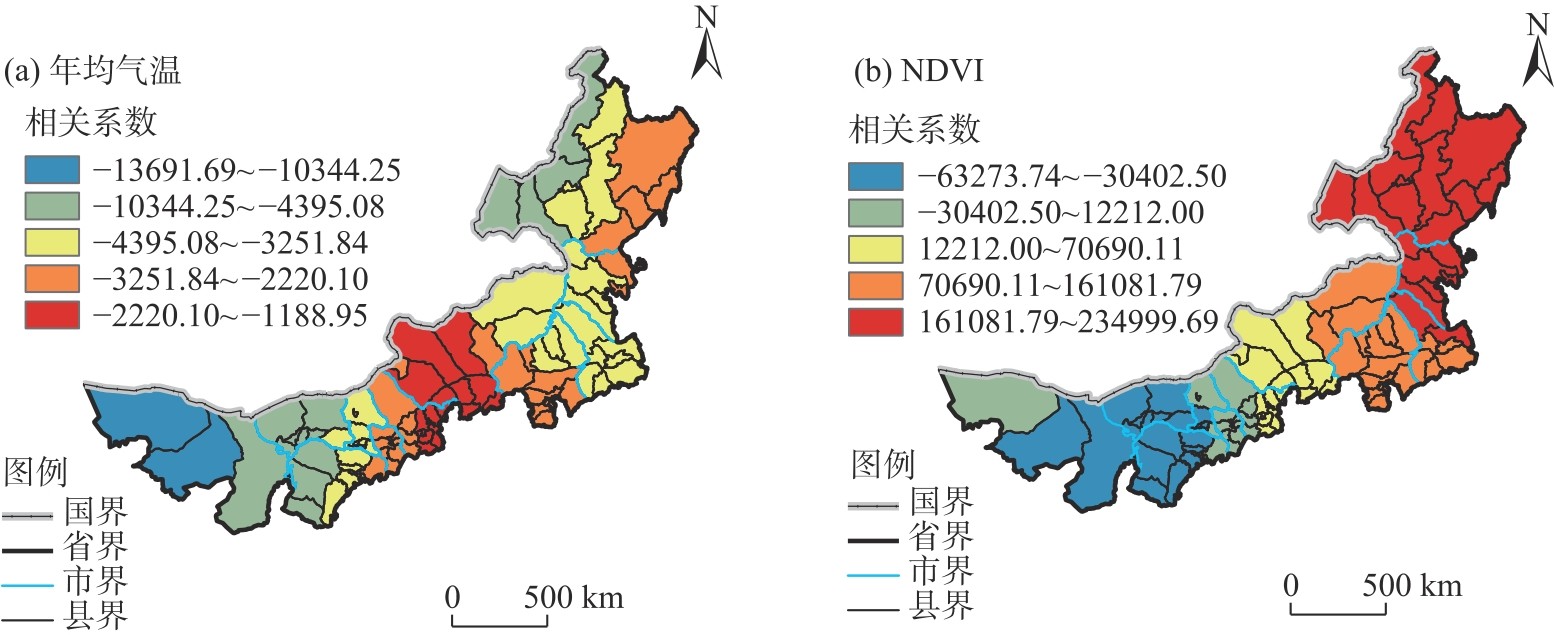
生态文明建设是当今时代的重大课题,开展生态经济价值时空分异及影响因素研究对于区域经济增长与生态保护协调发展具有重要意义。基于1983—2023年土地利用遥感监测数据,采用当量因子法对内蒙古县域尺度下生态经济价值进行定量评估并分析其时空演变特征,利用地理探测器、地理加权回归模型探讨了生态经济价值空间分异的影响因素。结果表明:(1) 1983—2023年内蒙古整体土地利用类型变化显著,其中草地转出面积最大,是耕地的最大转换来源。(2) 1983—2023年内蒙古生态经济价值由663.41×10⁸元下降到650.40×10⁸元,共损失13.01×10⁸元;从空间分布特征来看,内蒙古生态经济价值整体呈现“北高南低”“东高西低”的空间分布格局。(3) 年均气温和归一化植被指数(NDVI)是影响内蒙古生态经济价值的主导因子,年均气温与生态经济价值呈现负相关关系;NDVI对生态经济价值影响表现出由西向东递增、从负值向正值过渡的特征。研究结果可为内蒙古制定生态保护政策提供参考,未来要注重平衡不同土地利用类型之间的相互转化,以便协同推进经济社会发展和生态环境保护。
李文龙, 郭靖, 林海英, 潘霞. 资源依赖性地区生态经济价值时空演变与影响因素研究——以内蒙古县域为例[J]. 干旱区地理, 2025, 48(10): 1855-1865.
LI Wenlong, GUO Jing, LIN Haiying, PAN Xia. Spatio-temporal evolution of ecological-economic values in resource-dependent regions and influencing factors: A case study of Inner Mongolia counties[J]. Arid Land Geography, 2025, 48(10): 1855-1865.
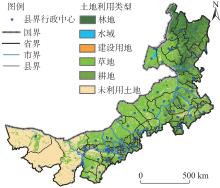
图1
研究区示意图 注:基于自然资源部标准地图服务网站审图号为GS(2024)0650号的标准地图制作,底图边界无修改。下同。"
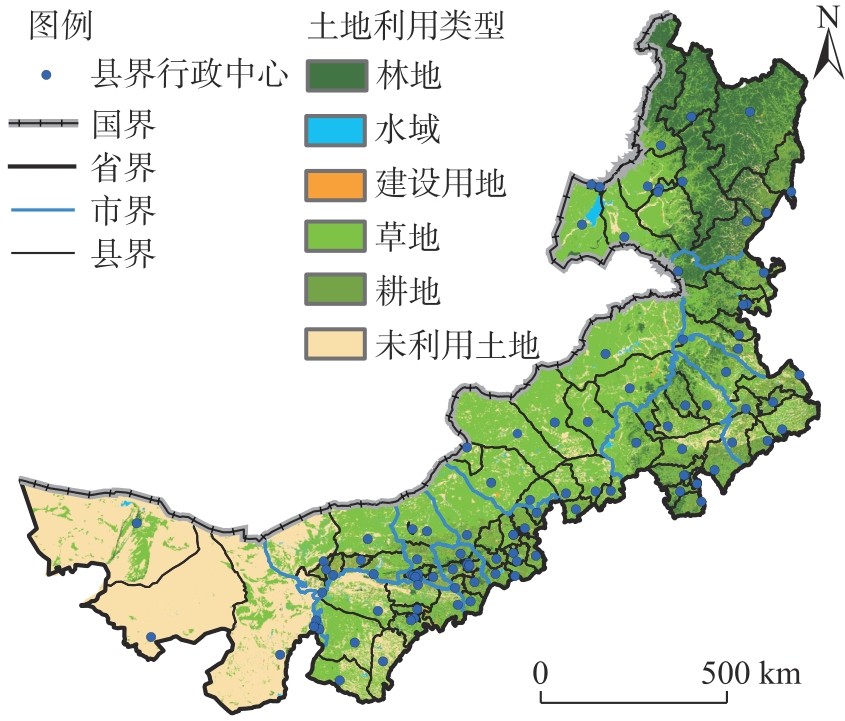
表1
不同生态系统的生态价值当量[26]"
| 生态价 值当量 | Costanza (1997年) | 谢高地 (2002年) | 谢高地 (2007年) |
|---|---|---|---|
| 林地 | 1.00 | 1.00 | 1.00 |
| 草地 | 0.25 | 0.42 | 0.42 |
| 耕地 | 0.09 | 0.20 | 0.28 |
| 湿地 | 2.35 | 2.41 | 1.95 |
| 河流湖泊 | 0.97 | 4.99 | 1.61 |
| 荒漠 | 0.00 | 0.02 | 0.05 |
表2
内蒙古县域生态价值当量与生态经济价值"
| 县域单元 | 生态价值 当量/104 | 生态经济 价值/108元 | 县域单元 | 生态价值 当量/104 | 生态经济 价值/108元 | 县域单元 | 生态价值 当量/104 | 生态经济 价值/108元 |
|---|---|---|---|---|---|---|---|---|
| 阿巴嘎旗 | 108.99 | 14.27 | 杭锦旗 | 59.22 | 7.75 | 土默特左旗 | 13.40 | 1.75 |
| 阿尔山市 | 61.59 | 8.06 | 和林格尔县 | 14.98 | 1.96 | 托克托县 | 5.28 | 0.69 |
| 阿拉善右旗 | 41.31 | 5.41 | 红山区 | 1.92 | 0.25 | 翁牛特旗 | 47.95 | 6.28 |
| 阿拉善左旗 | 108.45 | 14.20 | 化德县 | 8.62 | 1.13 | 乌达区 | 0.64 | 0.08 |
| 阿鲁科尔沁旗 | 70.73 | 9.26 | 回民区 | 0.95 | 0.12 | 乌拉特后旗 | 60.20 | 7.88 |
| 阿荣旗 | 95.49 | 12.50 | 霍林郭勒市 | 2.80 | 0.37 | 乌拉特前旗 | 34.97 | 4.58 |
| 敖汉旗 | 34.88 | 4.57 | 集宁区 | 0.34 | 0.04 | 乌拉特中旗 | 92.76 | 12.14 |
| 巴林右旗 | 46.76 | 6.12 | 九原区 | 3.63 | 0.48 | 乌兰浩特市 | 11.47 | 1.50 |
| 巴林左旗 | 34.94 | 4.57 | 喀喇沁旗 | 17.90 | 2.34 | 乌审旗 | 34.98 | 4.58 |
| 白云鄂博矿区 | 1.31 | 0.17 | 开鲁县 | 17.31 | 2.27 | 五原县 | 8.17 | 1.07 |
| 察哈尔右翼后旗 | 14.69 | 1.92 | 科尔沁区 | 14.53 | 1.90 | 武川县 | 21.86 | 2.86 |
| 察哈尔右翼前旗 | 10.46 | 1.37 | 科尔沁右翼前旗 | 105.40 | 13.80 | 西乌珠穆沁旗 | 115.26 | 15.09 |
| 察哈尔右翼中旗 | 16.51 | 2.16 | 科尔沁右翼中旗 | 68.36 | 8.95 | 锡林浩特市 | 61.87 | 8.10 |
| 陈巴尔虎旗 | 96.26 | 12.60 | 科尔沁左翼后旗 | 55.10 | 7.21 | 镶黄旗 | 20.84 | 2.73 |
| 达尔罕茂明安联合旗 | 74.42 | 9.74 | 科尔沁左翼中旗 | 35.86 | 4.69 | 新巴尔虎右旗 | 140.35 | 18.37 |
| 达拉特旗 | 33.34 | 4.37 | 克什克腾旗 | 100.54 | 13.16 | 新巴尔虎左旗 | 116.12 | 15.20 |
| 磴口县 | 8.05 | 1.05 | 库伦旗 | 18.60 | 2.44 | 兴和县 | 13.58 | 1.78 |
| 东河区 | 2.12 | 0.28 | 昆都仑区 | 1.15 | 0.15 | 牙克石市 | 246.07 | 32.22 |
| 东胜区 | 9.75 | 1.28 | 凉城县 | 17.59 | 2.30 | 伊金霍洛旗 | 23.16 | 3.03 |
| 东乌珠穆沁旗 | 247.13 | 32.35 | 林西县 | 17.94 | 2.35 | 玉泉区 | 0.56 | 0.07 |
| 多伦县 | 17.47 | 2.29 | 临河区 | 7.47 | 0.98 | 元宝山区 | 4.30 | 0.56 |
| 额尔古纳市 | 240.88 | 31.54 | 满洲里市 | 3.08 | 0.40 | 扎赉诺尔区 | 1.07 | 0.14 |
| 额济纳旗 | 98.25 | 12.86 | 莫力达瓦达斡尔族自治旗 | 62.62 | 8.20 | 扎赉特旗 | 67.82 | 8.88 |
| 鄂伦春自治旗 | 493.06 | 64.55 | 奈曼旗 | 31.33 | 4.10 | 扎兰屯市 | 152.63 | 19.98 |
| 鄂托克旗 | 74.62 | 9.77 | 宁城县 | 23.87 | 3.13 | 扎鲁特旗 | 93.17 | 12.20 |
| 鄂托克前旗 | 40.33 | 5.28 | 清水河县 | 12.41 | 1.63 | 正蓝旗 | 40.47 | 5.30 |
| 鄂温克族自治旗 | 130.94 | 17.14 | 赛罕区 | 4.11 | 0.54 | 正镶白旗 | 24.04 | 3.15 |
| 二连浩特市 | 14.79 | 1.94 | 商都县 | 15.01 | 1.97 | 准格尔旗 | 31.37 | 4.11 |
| 丰镇市 | 10.03 | 1.31 | 石拐区 | 4.02 | 0.53 | 卓资县 | 14.17 | 1.86 |
| 根河市 | 181.69 | 23.79 | 四子王旗 | 96.23 | 12.60 | 康巴什区 | 1.61 | 0.21 |
| 固阳县 | 19.86 | 2.60 | 苏尼特右旗 | 89.06 | 11.66 | 新城区 | 3.67 | 0.48 |
| 海勃湾区 | 1.53 | 0.20 | 苏尼特左旗 | 138.99 | 18.20 | 青山区 | 1.15 | 0.15 |
| 海拉尔区 | 7.43 | 0.97 | 太仆寺旗 | 12.45 | 1.63 | 松山区 | 28.02 | 3.67 |
| 海南区 | 3.61 | 0.47 | 突泉县 | 23.86 | 3.12 | |||
| 杭锦后旗 | 5.25 | 0.69 | 土默特右旗 | 10.04 | 1.31 |
表3
1983—2023年内蒙古土地利用结构"
| 年份 | 耕地 | 林地 | 草地 | 湿地 | 河流湖泊 | 荒漠 | |||||||||||
|---|---|---|---|---|---|---|---|---|---|---|---|---|---|---|---|---|---|
| 面积/km2 | 占比/% | 面积/km2 | 占比/% | 面积/km2 | 占比/% | 面积/km2 | 占比/% | 面积/km2 | 占比/% | 面积/km2 | 占比/% | ||||||
| 1983 | 99895 | 8.99 | 168208 | 15.14 | 541038 | 48.69 | 28368 | 2.55 | 9177 | 0.83 | 264434 | 23.80 | |||||
| 1993 | 103272 | 9.30 | 167587 | 15.09 | 538173 | 48.45 | 28014 | 2.52 | 8986 | 0.81 | 264687 | 23.83 | |||||
| 2003 | 113616 | 10.23 | 163772 | 14.75 | 530198 | 47.76 | 26360 | 2.37 | 9376 | 0.84 | 266761 | 24.03 | |||||
| 2013 | 118926 | 10.71 | 178664 | 16.09 | 471153 | 42.43 | 51214 | 4.61 | 8248 | 0.74 | 282219 | 25.42 | |||||
| 2023 | 113834 | 10.28 | 165313 | 14.93 | 526151 | 47.53 | 25751 | 2.33 | 9363 | 0.85 | 266672 | 24.09 | |||||
表4
1983—2023年内蒙古不同土地利用类型的生态经济价值"
| 年份 | 生态经济价值 | 耕地 | 林地 | 草地 | 湿地 | 河流湖泊 | 荒漠 | 合计 |
|---|---|---|---|---|---|---|---|---|
| 1983 | 价值量/108元 | 36.62 | 220.22 | 297.50 | 72.42 | 19.34 | 17.31 | 663.41 |
| 占比/% | 5.52 | 33.19 | 44.84 | 10.92 | 2.92 | 2.61 | 100.00 | |
| 1993 | 价值量/108元 | 37.86 | 219.40 | 295.92 | 71.52 | 18.94 | 17.33 | 660.97 |
| 占比/% | 5.73 | 33.19 | 44.77 | 10.82 | 2.87 | 2.62 | 100.00 | |
| 2003 | 价值量/108元 | 41.65 | 214.41 | 291.54 | 67.30 | 19.76 | 17.46 | 652.12 |
| 占比/% | 6.39 | 32.88 | 44.71 | 10.32 | 3.03 | 2.68 | 100.00 | |
| 2013 | 价值量/108元 | 43.60 | 233.91 | 259.07 | 130.75 | 17.39 | 18.47 | 703.18 |
| 占比/% | 6.20 | 33.26 | 36.84 | 18.59 | 2.47 | 2.63 | 100.00 | |
| 2023 | 价值量/108元 | 41.73 | 216.43 | 289.31 | 65.74 | 19.74 | 17.46 | 650.40 |
| 占比/% | 6.42 | 33.28 | 44.48 | 10.11 | 3.03 | 2.68 | 100.00 |
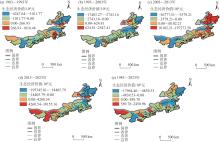
图2
内蒙古生态经济价值时间变化"
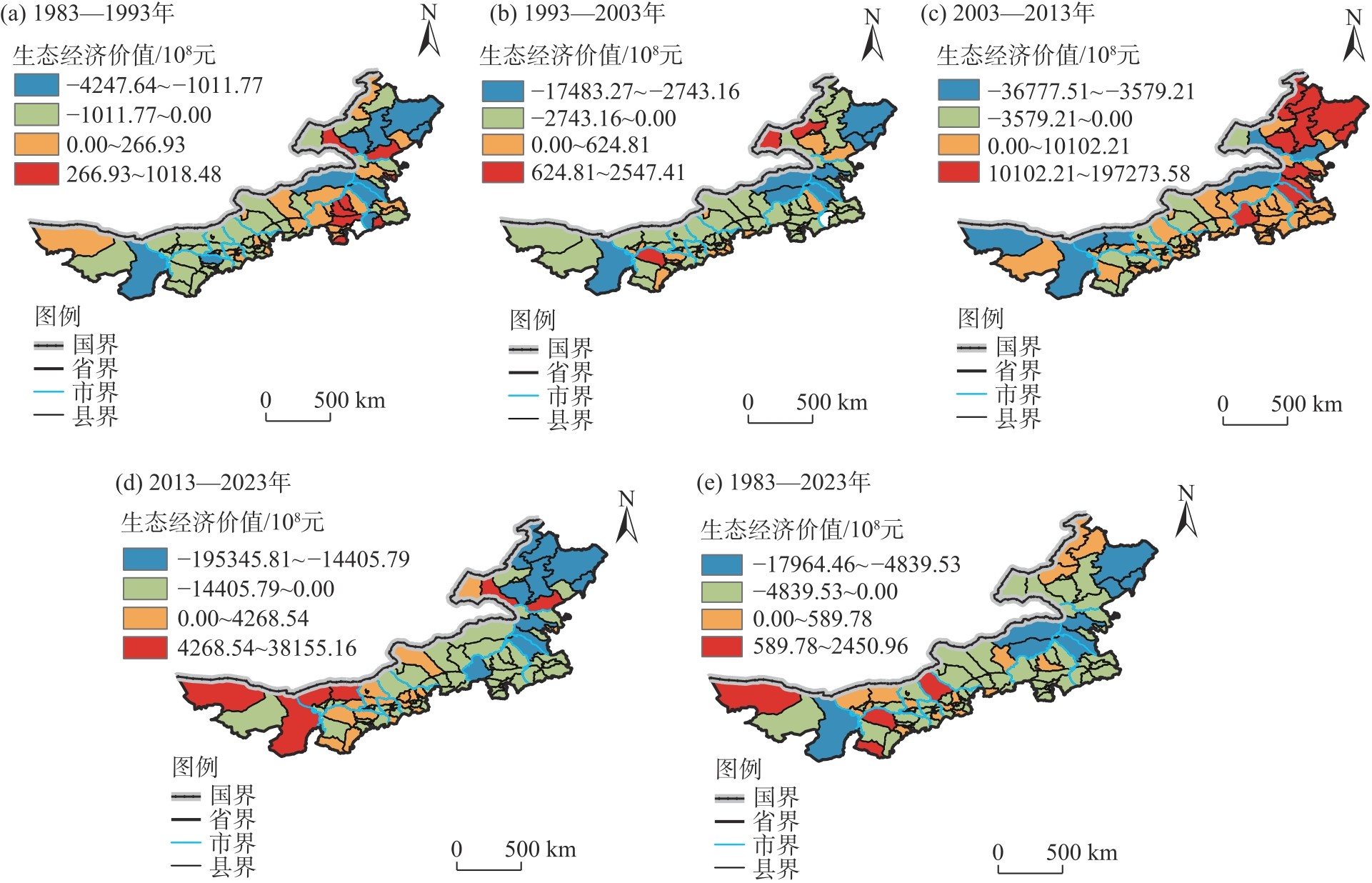
图3
内蒙古生态经济价值空间分布"
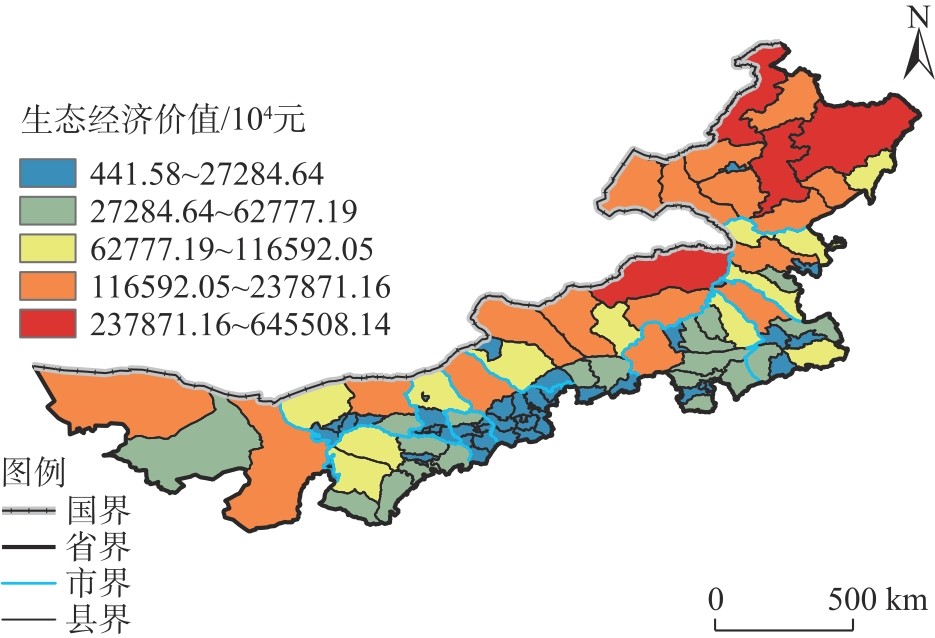
表5
1983—2023年内蒙古生态经济价值全局莫兰指数"
| 年份 | 全局莫兰指数 | P值 | Z得分 |
|---|---|---|---|
| 1983 | 0.410 | 0.001 | 6.450 |
| 1993 | 0.411 | 0.001 | 6.453 |
| 2003 | 0.406 | 0.001 | 6.387 |
| 2013 | 0.447 | 0.001 | 7.389 |
| 2023 | 0.409 | 0.001 | 6.434 |
表6
内蒙古生态经济价值空间演化探测因子"
| 影响因素 | 影响因子 | 单位 | 影响方向 |
|---|---|---|---|
| 自然因素 | 年均气温(X1) | ℃ | 负相关 |
| 年均降水量(X2) | mm | 正相关 | |
| NDVI(X3) | - | 正相关 | |
| 高程(X4) | m | 正相关 | |
| 社会因素 | 人口密度(X5) | 人·km-2 | 负相关 |
| 人口总量(X6) | 人 | 负相关 | |
| 城镇化率(X7) | % | 负相关 | |
| 经济因素 | 地区生产总值(X8) | 104元 | 负相关 |
| 全体居民人均可支配收入(X9) | 元·人-1 | 正相关 | |
| 社会消费品零售总额(X10) | 104元 | 正相关 |
表7
地理探测器结果"
| 指标 | X1 | X2 | X3 | X4 | X5 | X6 | X7 | X8 | X9 | X10 |
|---|---|---|---|---|---|---|---|---|---|---|
| q值 | 0.37 | 0.17 | 0.24 | 0.07 | 0.11 | 0.07 | 0.06 | 0.06 | 0.09 | 0.08 |
| P值 | 0.00 | 0.01 | 0.00 | 0.17 | 0.02 | 0.15 | 0.23 | 0.19 | 0.08 | 0.08 |
表8
线性回归结果"
| 变量 | 系数 | 标准差 | t值 | P值 | 方差膨胀因子 |
|---|---|---|---|---|---|
| 年均气温 | -1.2858 | 0.2830 | -4.54 | 0.000 | 1.69 |
| 年均降水量 | -1174.998 | 2805.002 | -0.42 | 0.676 | 4.28 |
| NDVI | 14.8112 | 5.8676 | 2.52 | 0.013 | 3.82 |
| 人口密度 | -0.0007 | 0.0012 | -0.57 | 0.570 | 1.13 |
表9
地理加权回归模型结果"
| 模型 | 修正项 | R2 | 调整后的R2 |
|---|---|---|---|
| 地理加权回归 | 2287.66 | 0.9765 | 0.9727 |
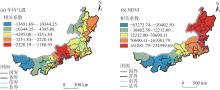
图4
内蒙古生态经济价值影响因素空间分异"
| [1] | 王瑞祥, 叶青, 郭晓佳. 福州都市圈生态系统服务价值时空演变及生态-经济协调发展[J]. 地球科学与环境学报, 2024, 46(2): 211-228. |
| [Wang Ruixiang, Ye Qing, Guo Xiaojia. Spatio-temporal evolution of ecosystem service value and the eco-economic harmonious development in Fuzhou metropolitan area, China[J]. Journal of Earth Sciences and Environment, 2024, 46(2): 211-228.] | |
| [2] | 郇庆治. 社会主义生态文明观与“绿水青山就是金山银山”[J]. 学习论坛, 2016, 32(5): 42-45. |
| [Huan Qingzhi. The socialist view of ecological civilisation and “green water and green mountains are golden mountains and silver mountains”[J]. Tribune of Study, 2016, 32(5): 42-45.] | |
| [3] | 毛碧琦, 敖长林, 焦扬, 等. 基于选择实验的三江平原湿地生态系统服务功能价值评价及偏好异质性研究[J]. 生态学报, 2017, 37(4): 1297-1308. |
| [Mao Biqi, Ao Changlin, Jiao Yang, et al. Evaluation of preference heterogeneity of ecosystem services in the Sanjiang Plain Wetlands based on choice experiments[J]. Acta Ecologica Sinica, 2017, 37(4): 1297-1308.] | |
| [4] | 王兵, 鲁绍伟, 尤文忠, 等. 辽宁省森林生态系统服务价值评估[J]. 应用生态学报, 2010, 21(7): 1792-1798. |
|
[Wang Bing, Lu Shaowei, You Wenzhong, et al. Evaluation of forest ecosystem services value in Liaoning Province[J]. Chinese Journal of Applied Ecology, 2010, 21(7): 1792-1798.]
pmid: 20879539 |
|
| [5] | 于丽瑶, 石田, 郭静静. 森林生态产品价值实现机制构建[J]. 林业资源管理, 2019(6): 28-31, 61. |
| [Yu Liyao, Shi Tian, Guo Jingjing. Developing mechanisms to realize the value of forest ecological products[J]. Forest and Grassland Resources Research, 2019(6): 28-31, 61.] | |
| [6] | 王丽芳, 苏建军, 黄解宇. 山西省森林公园旅游经济发展与生态环境耦合协调度分析[J]. 农业技术经济, 2013(8): 98-104. |
| [Wang Lifang, Su Jianjun, Huang Xieyu. Analysis of the coupled coordination degree of tourism economic development and ecological environment in forest parks in Shanxi Province[J]. Journal of Agrotechnical Economics, 2013(8): 98-104.] | |
| [7] | 白永飞, 赵玉金, 王扬, 等. 中国北方草地生态系统服务评估和功能区划助力生态安全屏障建设[J]. 中国科学院院刊, 2020, 35(6): 675-689. |
| [Bai Yongfei, Zhao Yujin, Wang Yang, et al. Assessment of ecosystem services and ecological regionalization of grasslands support establishment of ecological security barriers in northern China[J]. Bulletin of Chinese Academy of Sciences, 2020, 35(6): 675-689.] | |
| [8] |
邓楚雄, 钟小龙, 谢炳庚, 等. 洞庭湖区土地生态系统的服务价值时空变化[J]. 地理研究, 2019, 38(4): 844-855.
doi: 10.11821/dlyj020170999 |
| [Deng Chuxiong, Zhong Xiaolong, Xie Binggeng, et al. Spatial and temporal changes of land ecosystem service value in Dongting Lake area in 1995—2015[J]. Geographical Research, 2019, 38(4): 844-855.] | |
| [9] | 谢高地, 肖玉. 农田生态系统服务及其价值的研究进展[J]. 中国生态农业学报, 2013, 21(6): 645-651. |
| [Xie Gaodi, Xiao Yu. Review of agro-ecosystem services and their values[J]. Chinese Journal of Eco-Agriculture, 2013, 21(6): 645-651.] | |
| [10] |
刘耕源, 何萍, 王永阳. 农业生态产品及其价值实现路径[J]. 应用生态学报, 2021, 32(2): 737-749.
doi: 10.13287/j.1001-9332.202102.024 |
|
[Liu Gengyuan, He Ping, Wang Yongyang. Agro-ecological product and its value realization pathway[J]. Chinese Journal of Applied Ecology, 2021, 32(2): 737-749.]
doi: 10.13287/j.1001-9332.202102.024 |
|
| [11] | 谢高地, 张彩霞, 张昌顺, 等. 中国生态系统服务的价值[J]. 资源科学, 2015, 37(9): 1740-1746. |
| [Xie Gaodi, Zhang Caixia, Zhang Changshun, et al. The value of ecosystem services in China[J]. Resources Science, 2015, 37(9): 1740-1746.] | |
| [12] |
靳诚, 陆玉麒. 我国生态产品价值实现研究的回顾与展望[J]. 经济地理, 2021, 41(10): 207-213.
doi: 10.15957/j.cnki.jjdl.2021.10.023 |
|
[Jin Cheng, Lu Yuqi. Review and prospect of research on value realization of ecological products in China[J]. Economic Geography, 2021, 41(10): 207-213.]
doi: 10.15957/j.cnki.jjdl.2021.10.023 |
|
| [13] | Frelichova J, Vackar D. Integrated assessment of ecosystem services in the Czech Republic[J]. Ecosystem Services, 2014, 8: 110-117. |
| [14] | Wang K F, Liu P L, Sun F S. Progress in realizing the value of ecological products in China and its practice in Shandong Province[J]. Sustainability, 2023, 15(12): 9480, doi: 10.3390/su15129480. |
| [15] |
陈万旭, 李江风, 朱丽君. 长江中游地区生态系统服务价值空间分异及敏感性分析[J]. 自然资源学报, 2019, 34(2): 325-337.
doi: 10.31497/zrzyxb.20190209 |
|
[Chen Wanxu, Li Jiangfeng, Zhu Lijun. Spatial heterogeneity and sensitivity analysis of ecosystem services value in the Middle Yangtze River region[J]. Journal of Natural Resources, 2019, 34(2): 325-337.]
doi: 10.31497/zrzyxb.20190209 |
|
| [16] | Zhou Z X, Sun X R, Zhang X T, et al. Inter-regional ecological compensation in the Yellow River Basin based on the value of ecosystem services[J]. Journal of Environmental Management, 2022, 322: 116073, doi: 10.1016/j.jenvman.2022.116073. |
| [17] |
孔伟, 任亮, 王淑佳, 等. 河北省生态环境与经济协调发展的时空演变[J]. 应用生态学报, 2016, 27(9): 2941-2949.
doi: 10.13287/j.1001-9332.201609.030 |
|
[Kong Wei, Ren Liang, Wang Shujia, et al. Spatial and temporal evolution of the ecological environment and economy coordinated development in Hebei Province, China[J]. Chinese Journal of Applied Ecology, 2016, 27(9): 2941-2949.]
doi: 10.13287/j.1001-9332.201609.030 |
|
| [18] |
Wang Z B, Fang C L, Cheng S W, et al. Evolution of coordination degree of eco-economic system and early-warning in the Yangtze River Delta[J]. Journal of Geographical Sciences, 2013, 23(1): 147-162.
doi: 10.1007/s11442-013-1000-3 |
| [19] | 喻建华, 高中贵, 张露, 等. 昆山市生态系统服务价值变化研究[J]. 长江流域资源与环境, 2005, 14(2): 213-217. |
| [Yu Jianhua, Gao Zhonggui, Zhang Lu, et al. Change in ecosystem service value in Kunshan City[J]. Resources and Environment in the Yangtze Basin, 2005, 14(2): 213-217.] | |
| [20] |
魏晓旭, 赵军, 魏伟, 等. 基于县域单元的中国生态经济系统协调度及空间演化[J]. 地理科学进展, 2014, 33(11): 1535-1545.
doi: 10.11820/dlkxjz.2014.09.010 |
|
[Wei Xiaoxu, Zhao Jun, Wei Wei, et al. Coordinated development of ecological-economic system and spatial evolution based on county unit in China[J]. Progress in Geography, 2014, 33(11): 1535-1545.]
doi: 10.11820/dlkxjz.2014.09.010 |
|
| [21] | 易平, 方世明. 地质公园社会经济与生态环境效益耦合协调度研究——以嵩山世界地质公园为例[J]. 资源科学, 2014, 36(1): 206-216. |
| [Yi Ping, Fang Shiming. Coupling coordination between the socio-economic benefits and eco-environmental benefits of the Songshan Global Geopark[J]. Resources Science, 2014, 36(1): 206-216.] | |
| [22] | Acemoglu D. Institutions, ecological resilience, and the resource curse: A dynamic model[J]. American Economic Review, 2021, 112(1): 131-159. |
| [23] | Fotheringham A S, Yang W, Kang W. Multiscale geographically weighted regression (MGWR)[J]. Annals of the American Association of Geographers, 2022, 110(6): 1642-1665. |
| [24] | 内蒙古社会科学院. 蒙古族传统文化与草原生态保护研究[M]. 呼和浩特: 内蒙古人民出版社, 2022. |
| [Inner Mongolia Academy of Social Sciences. Research on Mongolian traditional culture and grassland ecological conservation[M]. Hohhot: Inner Mongolia People's Publishing House, 2022.] | |
| [25] | 刘春腊, 刘卫东, 徐美. 基于生态价值当量的中国省域生态补偿额度研究[J]. 资源科学, 2014, 36(1): 148-155. |
| [Liu Chunla, Liu Weidong, Xu Mei. The provincial eco-compensation standard of China based on ecological value equivalents[J]. Resources Science, 2014, 36(1): 148-155.] | |
| [26] | 谢高地, 甄霖, 鲁春霞, 等. 一个基于专家知识的生态系统服务价值化方法[J]. 自然资源学报, 2008, 23(5): 911-919. |
|
[Xie Gaodi, Zhen Lin, Lu Chunxia, et al. Expert knowledge based valuation method of ecosystem services in China[J]. Journal of Natural Resources, 2008, 23(5): 911-919.]
doi: 10.11849/zrzyxb.2008.05.019 |
|
| [27] |
裴志林, 曹晓娟, 王冬, 等. 内蒙古植被覆盖时空变化特征及其对人类活动的响应[J]. 干旱区研究, 2024, 41(4): 629-638.
doi: 10.13866/j.azr.2024.04.09 |
|
[Pei Zhilin, Cao Xiaojuan, Wang Dong, et al. Spatiotemporal variation in vegetation coverage in Inner Mongolia and its response to human activities[J]. Arid Zone Research, 2024, 41(4): 629-638.]
doi: 10.13866/j.azr.2024.04.09 |
|
| [28] |
刘纪远, 宁佳, 匡文慧, 等. 2010—2015年中国土地利用变化的时空格局与新特征[J]. 地理学报, 2018, 73(5): 789-802.
doi: 10.11821/dlxb201805001 |
|
[Liu Jiyuan, Ning Jia, Kuang Wenhui, et al. Spatio-temporal patterns and characteristics of land-use change in China during 2010—2015[J]. Acta Geographica Sinica, 2018, 73(5): 789-802.]
doi: 10.11821/dlxb201805001 |
|
| [29] | 程珂怡, 郭传旭, 张婷, 等. 江苏省生态系统服务价值时空分异及影响因素研究[J]. 自然资源情报, 2024(1): 8-18. |
| [Cheng Keyi, Guo Chuanxu, Zhang Ting, et al. Spatial and temporal differentiation of ecosystem service value and its influencing factors in Jiangsu[J]. Natural Resources Information, 2024(1): 8-18.] | |
| [30] |
王劲峰, 徐成东. 地理探测器: 原理与展望[J]. 地理学报, 2017, 72(1): 116-134.
doi: 10.11821/dlxb201701010 |
|
[Wang Jinfeng, Xu Chengdong. Geodetector: Principle and prospective[J]. Acta Geographica Sinica, 2017, 72(1): 116-134.]
doi: 10.11821/dlxb201701010 |
|
| [31] | Liu C H, Wu X L, Wang L. Analysis on land ecological security change and affect factors using RS and GWR in the Danjiangkou Reservoir area, China[J]. Applied Geography, 2019, 105: 1-14. |
| [32] | 牛堃瑛, 仇泸毅. 土地利用视角下流域地区生态系统服务价值评估——以长江三峡生态经济走廊为例[J]. 中国国土资源经济, 2022, 35(12): 19-28. |
| [Niu Kunying, Qiu Luyi. Evaluation of ecosystem service value in watershed area from the perspective of land use: A case study of the Three Gorges Eco-Economic Corridor[J]. Natural Resource Economics of China, 2022, 35(12): 19-28.] | |
| [33] |
马丽娜, 张飞云, 翟玉鑫, 等. 1980—2020年新疆土地利用变化下生态系统服务价值时空演变分析[J]. 干旱区地理, 2023, 46(2): 253-263.
doi: 10.12118/j.issn.1000-6060.2022.202 |
|
[Ma Li'na, Zhang Yunfei, Zhai Yuxin, et al. Temporal and spatial evolution of ecosystem service value under land use change in Xinjiang from 1980 to 2020[J]. Arid Land Geography, 2023, 46(2): 253-263.]
doi: 10.12118/j.issn.1000-6060.2022.202 |
|
| [34] | 沈贝贝, 魏一博, 马磊超, 等. 内蒙古草原植被覆盖度时空格局变化及驱动因素分析[J]. 农业工程学报, 2022, 38(12): 118-126. |
| [Shen Beibei, Wei Yibo, Ma Leichao, et al. Spatiotemporal changes and drivers of fractional vegetation cover in Inner Mongolia grassland of China[J]. Transactions of the Chinese Society of Agricultural Engineering, 2022, 38(12): 118-126.] | |
| [35] | 林晨宇, 宋羽, 叶玲兰. 福建省生态系统服务价值时空演变及驱动因素[J]. 自然保护地, 2024, 4(2): 81-94. |
| [Lin Chenyu, Song Yu, Ye Linglan. Spatiotemporal evolution and its driving factors of ecosystem service value in Fujian Province[J]. Natural Protected Areas, 2024, 4(2): 81-94.] | |
| [36] | 周宇, 张余, 王琴, 等. 东北地区生态系统服务价值特征及其驱动因子研究[J]. 环境污染与防治, 2024, 46(3): 435-442. |
| [Zhou Yu, Zhang Yu, Wang Qin, et al. Research on the characteristics and driving factors of ecosystem service value in northeast China[J]. Environmental Pollution & Control, 2024, 46(3): 435-442.] | |
| [37] | 谢高地, 张昌顺, 李士美. 中国生态系统服务价值当量因子修正与价值量评估[J]. 自然资源学报, 2015, 30(7): 1-10. |
| [Xie Gaodi, Zhang Changshun, Li Shimei. Revision and valuation of equivalent factors for ecosystem service values in China[J]. Journal of Natural Resources, 2015, 30(7): 1-10.] | |
| [38] | Xu T T, Zhang M N, Ding S W, et al. Grassland degradation reduces carbon sequestration and increases soil erosion in northern China[J]. Ecological Indicators, 2020, 115: 106432, doi: 10.1016/j.ecolind.2021.108194. |
| [39] |
Chang J F, Ciais P, Gasser T, et al. Climate warming from managed grasslands cancels the cooling effect of carbon sinks in sparsely grazed and natural grasslands[J]. Nature Communications, 2021, 12: 118, doi: 10.1038/s41467-020-20406-7.
pmid: 33402687 |
| [40] | Jia Y, Liu Y, Zhang S L. Evaluation of agricultural ecosystem service value in arid and semiarid regions of northwest China based on the equivalent factor method[J]. Environmental Processes, 2021, 8: 713-727. |
| [41] | Gong L X, Wang Z Q, Ke C. The diet of bats in forest ecosystems and their potential as natural enemies of forest pests: A case study in the Khingan Mountains, northeast China[J]. Ecological Indicators, 2025, 177: 113765, doi: 10.1016/j.ecolind.2025.113765. |
| [42] |
施金里, 徐丽萍, 李晓航, 等. 南疆县域生态-经济协调性评估及可持续发展分区[J]. 干旱区地理, 2024, 47(10): 1794-1804.
doi: 10.12118/j.issn.1000-6060.2023.738 |
|
[Shi Jinli, Xu Liping, Li Xiaohang, et al. Evaluation of ecological-economic harmony and sustainable development zoning in counties of southern Xinjiang[J]. Arid Land Geography, 2024, 47(10): 1794-1804.]
doi: 10.12118/j.issn.1000-6060.2023.738 |
|
| [43] | Ning X, Wang L Y, Feng Y F. Coupling and coordination of urbanization and ecological environment in Ningxia, China[J]. Frontiers in Environmental Science, 2022, 10: 1053810, doi: 10.3389/fenvs.2022.1053810. |
| [44] | 黄颖利, 孙晨, 乔振华. 生态保护修复视角下京津冀地区社会经济-生态环境系统耦合关系及影响机制[J]. 环境科学研究, 2024, 37(12): 2824-2835. |
| [Huang Yingli, Sun Chen, Qiao Zhenhua. Coupling relationship and influence mechanism of socio-economic and eco-environment system in Beijing-Tianjin-Hebei region under the perspective of ecological protection and restoration[J]. Research of Environmental Sciences, 2024, 37(12): 2824-2835.] | |
| [45] |
程玉恒, 乔伟峰, 何天祺, 等. 南京市高淳区村域尺度土地利用功能变化及生态系统服务价值响应研究[J]. 地理科学, 2024, 44(2): 340-350.
doi: 10.13249/j.cnki.sgs.20220938 |
|
[Cheng Yuheng, Qiao Weifeng, He Tianqi, et al. Response of ecosystem services value to land use function change at the village scale in Gaochun District, Nanjing[J]. Scientia Geographica Sinica, 2024, 44(2): 340-350.]
doi: 10.13249/j.cnki.sgs.20220938 |
| [1] | 田志馥, 于亚娟, 黄辰宇. 基于POI数据挖掘的内蒙古县域旅游要素空间分布特征及影响因素[J]. 干旱区地理, 2025, 48(7): 1255-1266. |
| [2] | 李梦冉, 徐小任, 王梁, 段健, 史舒琪, 任丹丹. 黄河流域农业碳排放时空变化特征及影响因素分析[J]. 干旱区地理, 2025, 48(5): 854-865. |
| [3] | 马海清, 陈强强. 甘肃省农业碳排放时空分异特征及影响因素[J]. 干旱区地理, 2025, 48(5): 879-892. |
| [4] | 王立奇, 李国柱. 中国城市生态韧性时空特征及影响因素分析[J]. 干旱区地理, 2025, 48(5): 893-904. |
| [5] | 王志春, 王彦平, 徐震宇, 薛文超. 内蒙古不同干湿区潜在蒸散发变化特征及主导因子分析[J]. 干旱区地理, 2025, 48(4): 612-622. |
| [6] | 于亚娟. 基于POI数据的内蒙古公共文化设施空间结构与影响因素[J]. 干旱区地理, 2025, 48(3): 528-538. |
| [7] | 王超, 何友均, 韩丽丽. 黄土高原退耕还林与植被恢复的空间错配格局及影响因素研究[J]. 干旱区地理, 2025, 48(10): 1815-1827. |
| [8] | 张傲翔, 苗成林, 陈峥妍. 黄河流域城市生态韧性、社会网络及其影响因素分析[J]. 干旱区地理, 2025, 48(1): 130-142. |
| [9] | 吴一帆, 邢培学, 郑伟伟, 夏显力, 张超正. 粮食产销平衡区耕地非粮化动态演变及分区管控——以陕西省为例[J]. 干旱区地理, 2025, 48(1): 153-167. |
| [10] | 林秋平, 李松芮, 杨上广, 王云云. 乌鲁木齐市物流企业区位时空演化、影响因素和发展策略研究[J]. 干旱区地理, 2024, 47(7): 1252-1262. |
| [11] | 利辉, 刘铁军, 王少慧, 刘东伟. 2001—2021年内蒙古荒漠草原水分利用效率时空变化特征及影响因素研究[J]. 干旱区地理, 2024, 47(6): 993-1003. |
| [12] | 徐伟, 刘振领. 内蒙古光伏开发空间适宜性及减排效益研究[J]. 干旱区地理, 2024, 47(4): 684-694. |
| [13] | 慕石雷, 杨玉欢, 乌日陶克套胡. 国家沙漠(石漠)公园空间分异格局与影响因素[J]. 干旱区地理, 2024, 47(2): 356-368. |
| [14] | 林墨飞, 矫红运, 李珍. 内蒙古沿边地区生态旅游绿道选线研究——以陈巴尔虎旗为例[J]. 干旱区地理, 2024, 47(11): 1970-1980. |
| [15] | 牛怡莹, 李春兰, 王军, 许瀚卿, 刘青. 内蒙古ERA5再分析降水数据性能评估与极端降水时空特征分析[J]. 干旱区地理, 2023, 46(9): 1418-1431. |
|
||