Arid Land Geography ›› 2026, Vol. 49 ›› Issue (4): 841-855.doi: 10.12118/j.issn.1000-6060.2025.580
• Land Use and Sustainable Development • Previous Articles Next Articles
CAO Haoran1,2( ), MENG Mei1(), LIU Hongguang2
Received:2025-09-25
Revised:2025-12-26
Online:2026-04-25
Published:2026-04-28
Contact:
MENG Mei
E-mail:caohaoran@stu.njau.edu.cn;mengmeihh@163.com
CAO Haoran, MENG Mei, LIU Hongguang. Spatiotemporal variation characteristics and simulation prediction of land ecological vulnerability in Gansu Province from 2000 to 2024[J].Arid Land Geography, 2026, 49(4): 841-855.
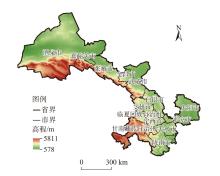
Fig. 1
Schematic diagram of the study area"
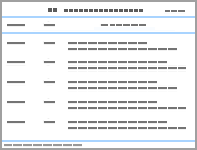
Tab. 1
Data sources"
| 数据名称 | 年份 | 数据来源及分辨率 |
|---|---|---|
| DEM数据 | 2024 | 地理空间数据云( |
| 气象数据 | 2000、2005、2010、2015、2020、2024 | 国家地球系统科学数据中心( |
| 土壤数据 | 2023 | HWSD2.0( |
| 遥感数据 | 2000、2005、2010、2015、2020、2024 | 美国地质调查局(USGS)官方数据平台( |
| MODIS数据 | 2000、2005、2010、2015、2020、2024 | 美国国家航空航天局(NASA)地球数据检索系统( |
| 地理信息数据 | 2024 | 资源环境科学与数据平台( |
| 社会经济数据 | 2000、2005、2010、2015、2020、2024 | 《甘肃统计年鉴(2001—2025)》《甘肃省农经统计报表(2000—2024)》 |
Tab. 2
Evaluation index system of land ecological vulnerability"
| 目标层 | 准则层 | 次准则层 | 影响因子层 | 属性 |
|---|---|---|---|---|
| 土地生态脆弱性评价 | 敏感度 | 地形因子(静态) | 高程 | 正向 |
| 坡度 | 定性 | |||
| 地形起伏度 | 定性 | |||
| 地表粗糙度 | 正向 | |||
| 气象因子(动态) | 年均气温 | 负向 | ||
| 干旱指数 | 正向 | |||
| 环境因子(动态) | 水土流失 | 正向 | ||
| 水源涵养能力 | 负向 | |||
| 土壤因子(动态) | 土壤沙化度 | 定性 | ||
| 土壤盐渍化 | 定性 | |||
| 土壤碳储量 | 负向 | |||
| 土壤水分 | 负向 | |||
| 恢复力 | 植被因子(动态) | NDVI | 负向 | |
| NPP | 负向 | |||
| 多样性因子(动态) | 生物丰度 | 负向 | ||
| 水文因子(动态) | 河流缓冲区 | 正向 | ||
| 压力 | 社会因子(动态) | 人口密度 | 正向 | |
| 人均GDP | 正向 |
Tab. 3
Quantitative criteria of indicators"
| 指标层 | 指标量化标准 | ||||
|---|---|---|---|---|---|
| 0.00 | 0.25 | 0.50 | 0.75 | 1.00 | |
| 坡向/(°) | 157.5~202.5 | 112.5~157.5,202.5~247.5 | 67.5~112.5,247.5~292.5 | 22.5~67.5,292.5~337.5 | 0.0~22.5,337.5~360.0 |
| 坡度/(°) | 0~5 | 5~10 | 10~15 | 15~25 | >25 |
| 土壤沙化度/g·kg-1 | 25 | 25~40 | 40~55 | 55~70 | >70 |
| 土壤盐渍化/g·kg-1 | 1 | - | 3 | - | 6 |
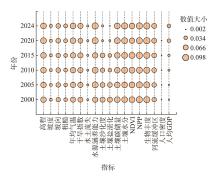
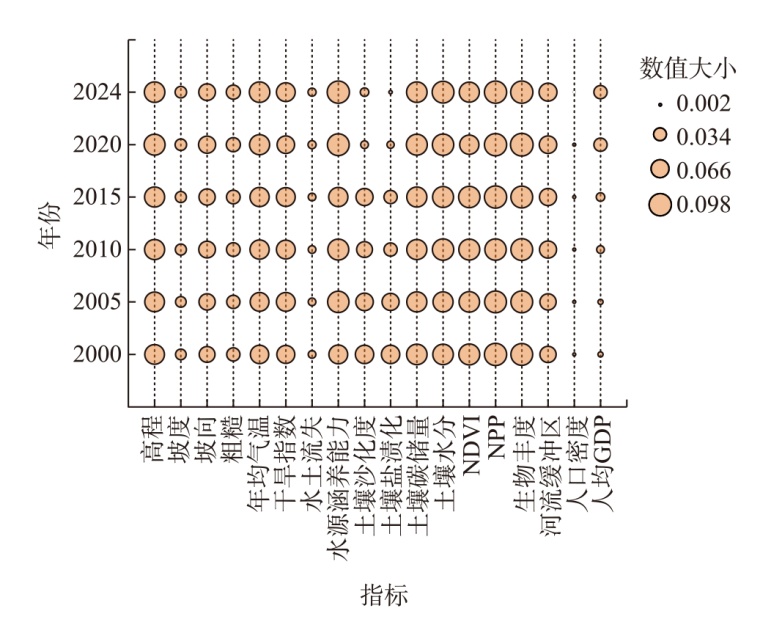
Fig. 2
Weight bubble diagram of land ecological vulnerability evaluation index in Gansu Province"
Tab. 4
Classification standard of land ecological vulnerability in Gansu Province"
| 脆弱类型 | 脆弱等级 | 分级范围 | 生态效果 |
|---|---|---|---|
| 微度脆弱 | Ⅰ | <0.40 | 土地生态系统结构完整,生态服务功能价值显著,稳定性良好,抗扰动能力与恢复潜力强,生态环境风险水平低 |
| 轻度脆弱 | Ⅱ | 0.40~0.50 | 土地生态系统结构相对完整,生态服务功能价值可观,稳定性较好,具备一定抗扰动能力与较强恢复潜力,存在潜在生态风险 |
| 中度脆弱 | Ⅲ | 0.50~0.58 | 土地生态系统处于临界状态,结构完整性受挑战,生态服务功能有限;稳定性差,扰动缓冲能力接近阈值,敏感性显著;自然恢复缓慢低效,已显现生态退化迹象 |
| 重度脆弱 | Ⅳ | 0.58~0.65 | 土地生态系统结构缺陷明显,生态服务功能显著退化;稳定性严重不足,对外界压力高度敏感;自我调节与恢复机制受损,多重生态风险显现,系统整体失衡 |
| 极度脆弱 | Ⅴ | >0.65 | 土地生态系统结构高度脆弱,生态服务功能严重退化;处于高度不稳定状态,对高强度外界压力极端敏感;自然恢复能力基本丧失,区域生态异常广泛存在,系统濒临崩溃 |
Tab. 5
Influencing factors and data sources"
| 类别 | 影响因子 | 数据来源 |
|---|---|---|
| 社会经济因子 | 人为影响综合指数(X1) | 中国科学院资源环境科学数据中心 |
| 耕地面积比重(X2) | 《甘肃省统计年鉴》 | |
| 人口增长率(X3) | 《甘肃省统计年鉴》 | |
| 城市化率(X4) | 《甘肃省统计年鉴》 | |
| 自然因素 | NDVI(X5) | 中国科学院资源环境科学数据中心 |
| 地形起伏度(X6) | 地理空间数据云DEM数据 | |
| 平均日照时数(X7) | 国家地球系统科学数据中心 | |
| 年蒸散发量(X8) | 国家地球系统科学数据中心 | |
| 土壤类型(X9) | 国家青藏高原科学数据中心,并结合FAO1990的土壤分类 | |
| 景观因素 | 生态用地比例(X10) | 中国科学院资源环境科学数据中心;第三次全国国土调查成果分析报告 |
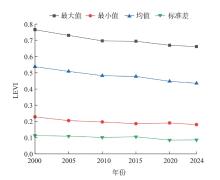
Fig. 3
Land ecological vulnerability index in Gansu Province from 2000 to 2024"
Tab. 6
Area and proportion of land ecological vulnerability in Gansu Province from 2000 to 2024"
| 脆弱类型 | 2000年 | 2005年 | 2010年 | 2015年 | 2020年 | 2024年 | |||||||||||
|---|---|---|---|---|---|---|---|---|---|---|---|---|---|---|---|---|---|
| 面积/km2 | 占比/% | 面积/km2 | 占比/% | 面积/km2 | 占比/% | 面积/km2 | 占比/% | 面积/km2 | 占比/% | 面积/km2 | 占比/% | ||||||
| 微度脆弱 | 70441.67 | 16.54 | 92745.38 | 21.78 | 112913.85 | 26.52 | 119256.13 | 28.01 | 139340.04 | 32.72 | 155618.58 | 36.55 | |||||
| 轻度脆弱 | 67143.68 | 15.77 | 70357.10 | 16.52 | 73845.36 | 17.34 | 69976.57 | 16.43 | 104520.89 | 24.55 | 110207.80 | 25.88 | |||||
| 中度脆弱 | 62915.49 | 14.78 | 69257.77 | 16.27 | 95366.85 | 22.40 | 99933.30 | 23.47 | 137437.36 | 32.28 | 132046.41 | 31.01 | |||||
| 重度脆弱 | 148663.20 | 34.91 | 168641.41 | 39.61 | 138557.83 | 32.54 | 132109.84 | 31.03 | 44396.01 | 10.43 | 27863.78 | 6.54 | |||||
| 极度脆弱 | 76635.97 | 18.00 | 24798.34 | 5.82 | 5116.11 | 1.20 | 4524.16 | 1.06 | 105.70 | 0.02 | 63.42 | 0.01 | |||||
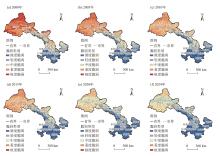
Fig. 4
Spatial distributions of land ecological vulnerability in Gansu Province from 2000 to 2024"
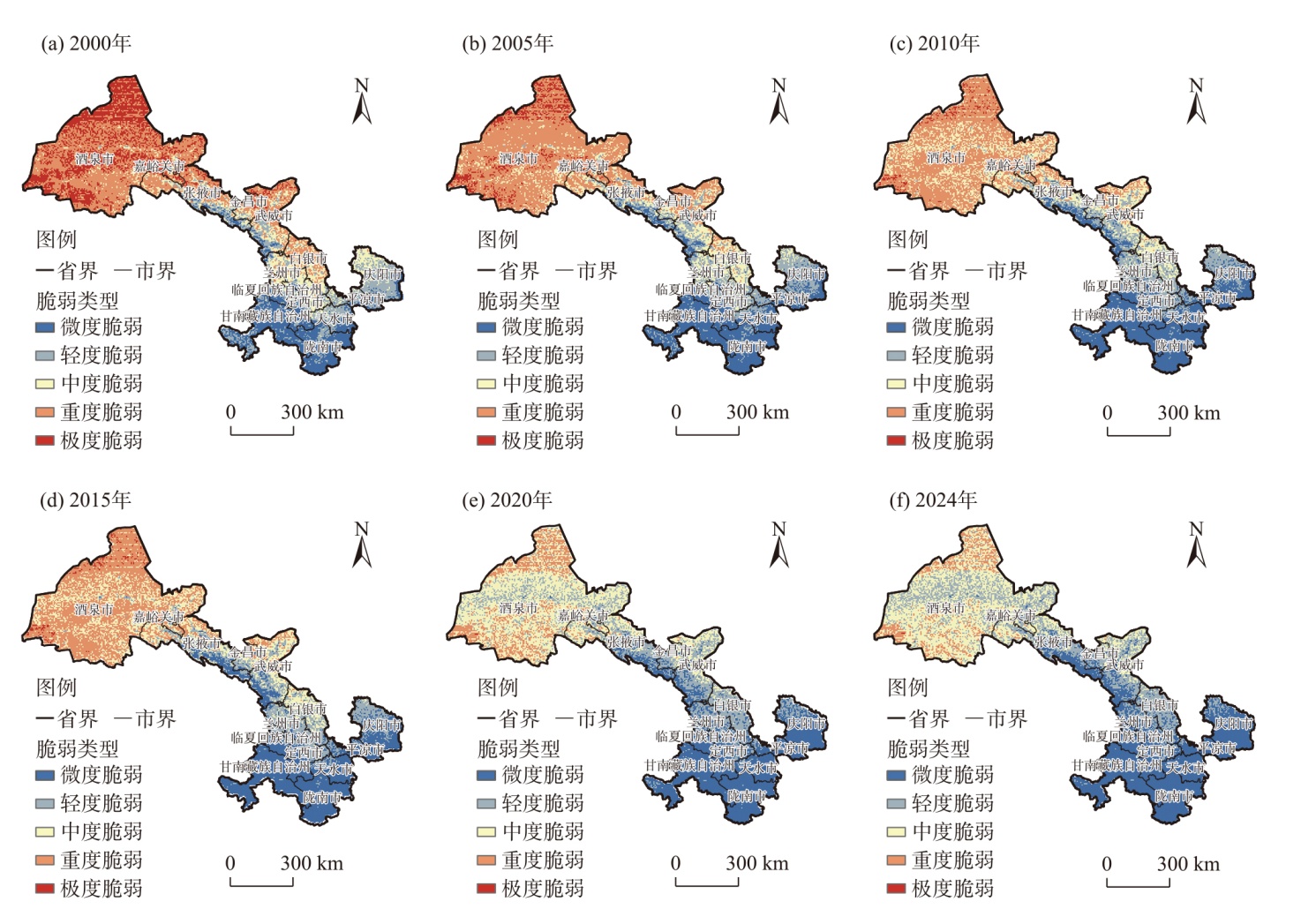
Fig. 5
Moran scatter plots of LEVI in Gansu Province from 2000 to 2024"
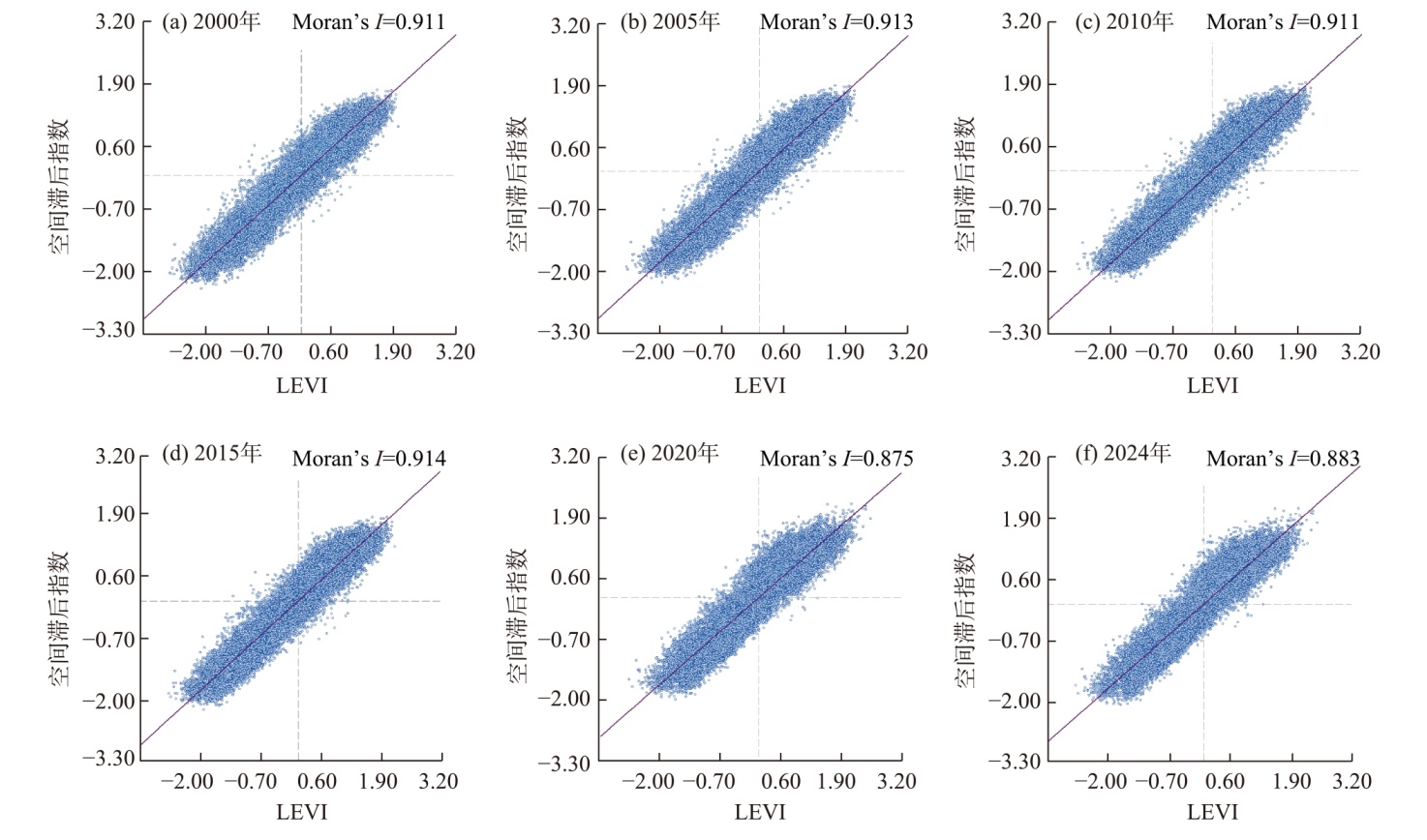
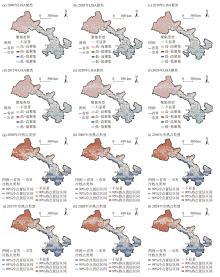
Fig. 6
LISA clustering and cold and hot spot analysis of land ecological vulnerability in Gansu Province from 2000 to 2024"

Tab. 7
Detection results of land ecological vulnerability impact factors in Gansu Province from 2000 to 2024"
| 影响因子 | 解释力(q值) | |||||
|---|---|---|---|---|---|---|
| 2000年 | 2005年 | 2010年 | 2015年 | 2020年 | 2024年 | |
| X1 | 0.378 | 0.277 | 0.274 | 0.278 | 0.295 | 0.310 |
| X2 | 0.082 | 0.080 | 0.101 | 0.156 | 0.125 | 0.130 |
| X3 | 0.122 | 0.163 | 0.183 | 0.218 | 0.215 | 0.210 |
| X4 | 0.030 | 0.129 | 0.160 | 0.123 | 0.024 | 0.035 |
| X5 | 0.417 | 0.514 | 0.589 | 0.557 | 0.586 | 0.600 |
| X6 | 0.007 | 0.029 | 0.124 | 0.022 | 0.027 | 0.030 |
| X7 | 0.589 | 0.517 | 0.456 | 0.467 | 0.555 | 0.560 |
| X8 | 0.453 | 0.594 | 0.451 | 0.418 | 0.650 | 0.670 |
| X9 | 0.031 | 0.023 | 0.026 | 0.117 | 0.013 | 0.020 |
| X10 | 0.224 | 0.255 | 0.276 | 0.240 | 0.219 | 0.225 |
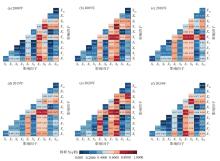
Fig. 7
Interactive detection results of influencing factors of land ecological vulnerability in Gansu Province from 2000 to 2024"
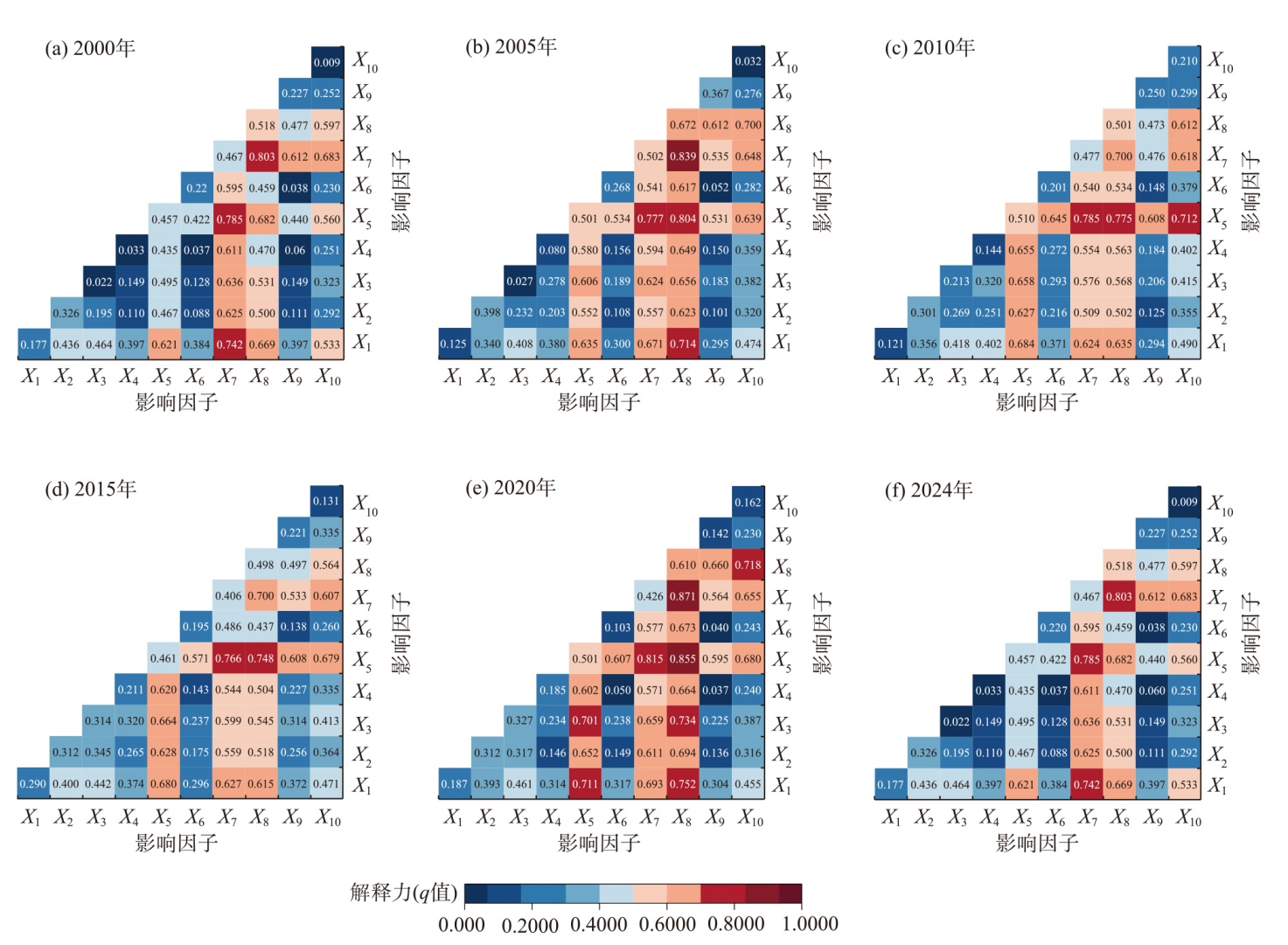
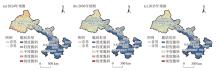
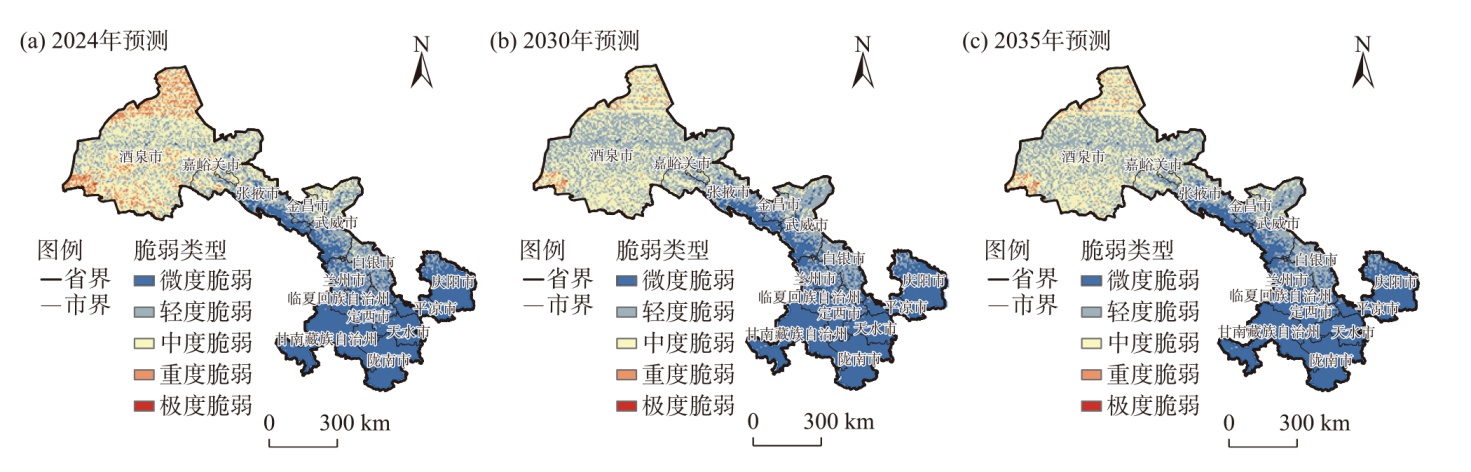
Fig. 8
Simulation and prediction results of land ecological vulnerability in Gansu Province from 2024 to 2035"
Tab. 8
Predicted changes in land ecological vulnerability in Gansu Province from 2024 to 2035"
| 脆弱类型 | 2024年 | 2030年 | 2035年 | |||||
|---|---|---|---|---|---|---|---|---|
| 面积/km2 | 占比/% | 面积/km2 | 占比/% | 面积/km2 | 占比/% | |||
| 微度脆弱 | 159360.53 | 37.43 | 164962.88 | 38.74 | 163144.76 | 38.31 | ||
| 轻度脆弱 | 108854.78 | 25.56 | 117564.86 | 27.61 | 115831.30 | 27.20 | ||
| 中度脆弱 | 63824.55 | 14.99 | 123484.33 | 29.00 | 125936.68 | 29.58 | ||
| 重度脆弱 | 93591.01 | 21.98 | 19766.79 | 4.64 | 20866.12 | 4.90 | ||
| 极度脆弱 | 169.13 | 0.04 | 21.14 | 0.01 | 21.14 | 0.01 | ||
| [1] | 邸乘光. 论习近平新时代中国特色社会主义思想[J]. 新疆师范大学学报(哲学社会科学版), 2018, 39(2): 7-21. |
| [Di Chengguang. On Xi Jinping thought on socialism with Chinese characteristics for a new era[J]. Journal of Xinjiang Normal University (Philosophy and Social Sciences), 2018, 39(2): 7-21.] | |
| [2] | 高世楫, 王海芹, 李维明. 改革开放40年生态文明体制改革历程与取向观察[J]. 改革, 2018(8): 49-63. |
| [Gao Shiji, Wang Haiqin, Li Weiming. Course and orientation of ecological civilization system reform over 40 years of reform and opening-up[J]. Reform, 2018(8): 49-63.] | |
| [3] | 刘愿理, 廖和平, 李靖, 等. 生态脆弱区土地利用多功能空间格局特征及影响因素分析[J]. 中国土地科学, 2020, 34(2): 75-83. |
| [Liu Yuanli, Liao Heping, Li Jing, et al. Analysis of characteristics and influencing factors of multi-functional spatial pattern of land use in ecological frangible regions[J]. China Land Science, 2020, 34(2): 75-83.] | |
| [4] | 赵哲远, 吴次芳, 顾海杰, 等. 关于土地生态管理的探讨[J]. 浙江国土资源, 2003(6): 31-34. |
| [Zhao Zheyuan, Wu Cifang, Gu Haijie, et al. Discussion on land ecological management[J]. Zhejiang Land & Resources, 2003(6): 31-34.] | |
| [5] |
Metzger M J, Rounsevell M D A, Acosta-Michlik L, et al. The vulnerability of ecosystem services to land use change[J]. Agriculture, Ecosystems & Environment, 2006, 114(1): 69-85.
doi: 10.1016/j.agee.2005.11.025 |
| [6] |
Butterbach-Bahl K, Kögel-Knabner I, Han X G. Steppe ecosystems and climate and land-use changes: Vulnerability, feedbacks and possibilities for adaptation[J]. Plant and Soil, 2011, 340: 1-6.
doi: 10.1007/s11104-010-0651-4 |
| [7] |
Finkl C W, Charlier R H, Krupa S L. Vulnerability of coastal environments to land use and abuse: The example of southeast Florida[J]. International Journal of Environmental Studies, 2005, 62(5): 535-554.
doi: 10.1080/00207230500196278 |
| [8] |
Birkmann J. Risk and vulnerability indicators at different scales: Applicability, usefulness and policy implications[J]. Environmental Hazards, 2007, 7(1): 20-31.
doi: 10.1016/j.envhaz.2007.04.002 |
| [9] | Hou K, Tao W D, He D, et al. A new perspective on ecological vulnerability and its transformation mechanisms[J]. Ecosystem Health and Sustainability, 2022, 8(1): 2115403, doi: 10.1080/20964129.2022.2115403. |
| [10] | 安芬, 李旭东, 程东亚. 贵州省乌江流域生态脆弱性评价及其空间变化特征[J]. 水土保持通报, 2019, 39(4): 261-269. |
| [An Fen, Li Xudong, Cheng Dongya. Ecological vulnerability assessment and spatial variation characteristics of Wujiang River Basin in Guizhou Province[J]. Bulletin of Soil and Water Conservation, 2019, 39(4): 261-269.] | |
| [11] | 韦晶, 郭亚敏, 孙林, 等. 三江源地区生态环境脆弱性评价[J]. 生态学杂志, 2015, 34(7): 1968-1975. |
| [Wei Jing, Guo Yamin, Sun Lin, et al. Evaluation of ecological environment vulnerability for Sanjiangyuan area[J]. Chinese Journal of Ecology, 2015, 34(7): 1968-1975.] | |
| [12] | 马骏, 李昌晓, 魏虹, 等. 三峡库区生态脆弱性评价[J]. 生态学报, 2015, 35(21): 7117-7129. |
| [Ma Jun, Li Changxiao, Wei Hong, et al. Dynamic evaluation of ecological vulnerability in the Three Gorges Reservoir Region in Chongqing Municipality, China[J]. Acta Ecologica Sinica, 2015, 35(21): 7117-7129.] | |
| [13] | 陈枫, 李泽红, 董锁成, 等. 基于VSD模型的黄土高原丘陵沟壑区县域生态脆弱性评价——以甘肃省临洮县为例[J]. 干旱区资源与环境, 2018, 32(11): 74-80. |
| [Chen Feng, Li Zehong, Dong Suocheng, et al. Evaluation of ecological vulnerability in gully-hilly region of Loess Plateau based on VSD model: A case of Lintao County[J]. Journal of Arid Land Resources and Environment, 2018, 32(11): 74-80.] | |
| [14] | 郭荣中, 申海建, 杨敏华. 基于改进PSR模型的长株潭地区土地生态系统健康评价研究[J]. 环境监测管理与技术, 2021, 33(3): 29-34. |
| [Guo Rongzhong, Shen Haijian, Yang Minhua. Studies on land ecosystem health evaluation in Chang-Zhu-Tan Region based on the improved PSR model[J]. The Administration and Technique of Environmental Monitoring, 2021, 33(3): 29-34.] | |
| [15] |
王同达, 曹锦雪, 赵永华, 等. 基于PSR模型的陕西省土地生态系统健康评价[J]. 应用生态学报, 2021, 32(5): 1563-1572.
doi: 10.13287/j.1001-9332.202105.013 |
|
[Wang Tongda, Cao Jinxue, Zhao Yonghua, et al. Evaluation of land ecosystem health in Shaanxi Province, northwest China based on PSR model[J]. Chinese Journal of Applied Ecology, 2021, 32(5): 1563-1572.]
doi: 10.13287/j.1001-9332.202105.013 |
|
| [16] |
江文甲, 林满红, 翁佩莹, 等. 福建安溪县乡镇土地生态系统服务价值的演变机制[J]. 应用生态学报, 2021, 32(12): 4457-4566.
doi: 10.13287/j.1001-9332.202110.011 |
|
[Jiang Wenjia, Lin Manhong, Weng Peiying, et al. Evolution mechanism of ecosystem service value at the township-scale in Anxi County of Fujian Province, China[J]. Chinese Journal of Applied Ecology, 2021, 32(12): 4457-4566.]
doi: 10.13287/j.1001-9332.202110.011 |
|
| [17] | 高洁芝, 郑华伟, 刘友兆. 基于DPSIR模型的土地生态系统健康诊断[J]. 江苏农业科学, 2021, 49(11): 178-185. |
| [Gao Jiezhi, Zheng Huawei, Liu Youzhao. Health diagnosis of land ecosystem based on DPSIR model[J]. Jiangsu Agricultural Sciences, 2021, 49(11): 178-185.] | |
| [18] | 王振鹏, 蒲泓君. 基于生态系统服务价值的土地生态敏感性研究[J]. 农业与技术, 2021, 41(13): 119-122. |
| [Wang Zhenpeng, Pu Hongjun. Study on land ecological sensitivity based on ecosystem service value[J]. Agriculture and Technology, 2021, 41(13): 119-122.] | |
| [19] | Kamran M, Yamamoto K. Evolution and use of remote sensing in ecological vulnerability assessment: A review[J]. Ecological Indicators, 2023, 147: 110024, doi: 10.1016/j.ecolind.2023.110024. |
| [20] | Lan G X, Jiang X L, Xu D H, et al. Ecological vulnerability assessment based on remote sensing ecological index (RSEI): A case of Zhongxian County, Chongqing[J]. Frontiers in Environmental Science, 2023, 11: 1074376, doi: 10.1016/j.ecolind.2023.110099. |
| [21] |
Guo B, Xu M, Zhang R, et al. A new monitoring index for ecological vulnerability and its application in the Yellow River Basin, China from 2000 to 2022[J]. Journal of Arid Land, 2024, 16(9): 1163-1182.
doi: 10.1007/s40333-024-0106-z |
| [22] | Xu M, Cao C X, Zhong S B, et al. Ecological vulnerability assessment and spatial-temporal variations analysis in typical ecologically vulnerable areas of China[J]. Frontiers in Ecology and Evolution, 2024, 12: 1406444, doi: 10.3389/fevo.2024.1406444. |
| [23] | 张帅, 董会忠, 曾文霞. 土地生态系统脆弱性时空演化特征及影响因素——以黄河三角洲高效生态经济区为例[J]. 中国环境科学, 2019, 39(4): 1696-1704. |
| [Zhang Shuai, Dong Huizhong, Zeng Wenxia. The time-space evolution characteristics of the vulnerability of land ecosystems and influencing factors: A case study of the Yellow River delta efficiency eco-economic zone[J]. China Environmental Science, 2019, 39(4): 1696-1704.] | |
| [24] | 乌宁巴特, 刘新平, 马相平. 叶尔羌河流域土地生态脆弱性差异评价[J]. 干旱区地理, 2020, 43(3): 849-858. |
| [Wu Ningbart, Liu Xinping, Ma Xiangping. Evaluation on the difference of land ecological vulnerability in the Yarkant River Basin[J]. Arid Land Geography, 2020, 43(3): 849-858.] | |
| [25] | 张行, 陈海, 史琴琴, 等. 陕西省景观生态脆弱性时空演变及其影响因素[J]. 干旱区研究, 2020, 37(2): 496-505. |
| [Zhang Hang, Chen Hai, Shi Qinqin, et al. Spatiotemporal evolution and driving factors of landscape ecological vulnerability in Shaanxi Province[J]. Arid Zone Research, 2020, 37(2): 496-505.] | |
| [26] | 魏明欢, 胡波洋, 张贵军, 等. 山区县土地生态脆弱性动态变化分析——以青龙满族自治县为例[J]. 水土保持研究, 2018, 25(2): 322-327. |
| [Wei Minghuan, Hu Boyang, Zhang Guijun, et al. Analysis on dynamic change of land ecological vulnerability in mountainous county: Taking Qinglong Manchu Autonomous County as an example[J]. Research of Soil and Water Conservation, 2018, 25(2): 322-327.] | |
| [27] | 高文明, 宋芊, 张皓翔, 等. 三江源区生态脆弱性时空演变及驱动因素分析[J]. 环境工程学报, 2024, 33(10): 1648-1660. |
| [Gao Wenming, Song Qian, Zhang Haoxiang, et al. Analysis of spatial and temporal changes and driving factors of ecological vulnerability in Sanjiangyuan Region[J]. Chinese Journal of Environmental Engineering, 2024, 33(10): 1648-1660.] | |
| [28] |
Feng Y, He D M. Transboundary water vulnerability and its drivers in China[J]. Journal of Geographical Sciences, 2009, 19: 189-199.
doi: 10.1007/s11442-009-0189-7 |
| [29] | 厉彦玲. 基于灰色聚类分析方法的生态环境质量综合评价模型[J]. 测绘科学, 2007, 32(5): 77-79, 203. |
| [Li Yanling. Ecological environment quality comprehensive evaluation model based on grey clustering[J]. Science of Surveying and Mapping, 2007, 32(5): 77-79, 203.] | |
| [30] | 邱彭华, 徐颂军, 谢跟踪, 等. 基于景观格局和生态敏感性的海南西部地区生态脆弱性分析[J]. 生态学报, 2007, 27(4): 1257-1264. |
|
[Qiu Penghua, Xu Songjun, Xie Gengzong, et al. Analysis on the ecological vulnerability of the western Hainan Island based on its landscape pattern and ecosystem sensitivity[J]. Acta Ecologica Sinica, 2007, 27(4): 1257-1264.]
doi: 10.1016/S1872-2032(07)60026-2 |
|
| [31] | 李静, 张平宇, 李鹤, 等. 大庆市生态环境脆弱性空间格局[J]. 应用生态学报, 2011, 22(12): 3279-3284. |
|
[Li Jing, Zhang Pingyu, Li He, et al. Spatial patterns of eco-environmental vulnerability in Daqing City[J]. Chinese Journal of Applied Ecology, 2011, 22(12): 3279-3284.]
pmid: 22384598 |
|
| [32] | 廖炜, 李璐, 吴宜进, 等. 丹江口库区土地利用变化与生态环境脆弱性评价[J]. 自然资源学报, 2011, 26(11): 1879-1889. |
|
[Liao Wei, Li Lu, Wu Yijin, et al. Land use change and eco-environmental vulnerability evaluation in the Danjiangkou Reservoir Area[J]. Journal of Natural Resources, 2011, 26(11): 1879-1889.]
doi: 10.11849/zrzyxb.2011.11.007 |
|
| [33] | 刘正佳, 于兴修, 李蕾, 等. 基于SRP概念模型的沂蒙山区生态环境脆弱性评价[J]. 应用生态学报, 2011, 22(8): 2084-2090. |
|
[Liu Zhengjia, Yu Xingxiu, Li Lei, et al. Vulnerability assessment of eco-environment in Yimeng mountainous area of Shandong Province based on SRP conceptual model[J]. Chinese Journal of Applied Ecology, 2011, 22(8): 2084-2090.]
pmid: 22097371 |
|
| [34] | 何冬晓. 重庆典型岩溶山地生态环境脆弱性分析及生态重建探讨[D]. 重庆: 西南大学, 2008. |
| [He Dongxiao. The eco-environment fragility analysis of typical karst mountainous regions and the discussion of ecology reconstruction on Chongqing[D]. Chongqing: Southwest University, 2008.] | |
| [35] | 张鑫, 杜朝阳, 蔡焕杰. 黄土高原典型流域生态环境脆弱性的集对分析[J]. 水土保持研究, 2010, 17(4): 96-99. |
| [Zhang Xin, Du Chaoyang, Cai Huanjie. Assessment of ecological vulnerability based on set pair analysis in typical Loess Plateau Watershed[J]. Research of Soil and Water Conservation, 2010, 17(4): 96-99.] | |
| [36] |
Tobler W R. A computer movie simulating urban growth in the Detroit region[J]. Economic Geography, 1970, 46: 234-240.
doi: 10.2307/143141 |
| [37] | 宋鸿, 陈晓玲. 运用空间自相关分析中国入境旅游增长空间格局[J]. 世界地理研究, 2006, 15(1): 99-106. |
| [Song Hong, Chen Xiaoling. Application of spatial autocorrelation analysis to the spatial pattern of inbound tourism increase in China[J]. World Regional Studies, 2006, 15(1): 99-106.] | |
| [38] | 陈万旭. 长江中游城市群生态系统健康时空演变及其城镇化驱动机制研究[D]. 武汉: 中国地质大学, 2019. |
| [Chen Wanxu. Spatiotemporal evolution of ecosystem health and its driving mechanism of urbanization in the middle reaches of the Yangtze River urban agglomerations[D]. Wuhan: China University of Geosciences, 2019.] | |
| [39] | 童威, 郎丰铠. 基于地理探测器的武汉市土地利用变化及其驱动机制探讨[J]. 水利水电技术(中英文), 2021, 52(4): 45-56. |
| [Tong Wei, Lang Fengkai. Geodetector-based analysis on land-use variation and its driving force in Wuhan[J]. Water Resources and Hydropower Engineering, 2021, 52(4): 45-56.] | |
| [40] | 杨园园. 晋西北生态脆弱区土地生态安全评价及影响因素研究[D]. 太原: 山西财经大学, 2023. |
| [Yang Yuanyuan. Evaluation and influencing factors of land ecological security in ecologically fragile area of northwest Shanxi Province[D]. Taiyuan: Shanxi University of Finance and Economics, 2023.] | |
| [41] | 商屹. 吉林省西部地区生态修复区识别及修复策略研究[D]. 长春: 吉林大学, 2024. |
| [Shang Yi. Identification of ecological restoration areas and restoration strategies in western Jilin Province[D]. Changchun: Jilin University, 2024.] |
|
||

