Arid Land Geography ›› 2026, Vol. 49 ›› Issue (6): 1157-1167.doi: 10.12118/j.issn.1000-6060.2025.308
• Vegetation and Pedology • Previous Articles Next Articles
WU Rui1,2( ), SUN Huilan1,2(), YE Mao1,2, JIN Xiaoliang1,2, ZHOU Meiling1,2, YANG Han1,2, WU Fang1,2
Received:2025-05-29
Revised:2025-07-02
Online:2026-06-25
Published:2026-06-29
Contact:
SUN Huilan
E-mail:107622023210570@stu.xjnu.edu.cn;huilsunxjnu@sina.com
WU Rui, SUN Huilan, YE Mao, JIN Xiaoliang, ZHOU Meiling, YANG Han, WU Fang. Analysis on the spatiotemporal variation characteristics and driving forces of fractional vegetation coverage in the Ili River Valley, Xinjiang[J].Arid Land Geography, 2026, 49(6): 1157-1167.
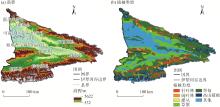
Fig. 1
Schematic diagram of the study area"
Tab. 1
Classification of fractional vegetation coverage in the Ili River Valley"
| FVC范围 | FVC类型 |
|---|---|
| 0.00~0.30 | 低等级FVC |
| 0.30~0.45 | 中低等级FVC |
| 0.45~0.60 | 中等级FVC |
| 0.60~0.75 | 中高等级FVC |
| 0.75~1.00 | 高等级FVC |
Tab. 2
Source of driving factors data"
| 类型 | 评价指标 | 数据来源 |
|---|---|---|
| 气候 | 气温/℃ | 国家青藏高原科学数据中心( |
| 降水量/mm | ||
| 蒸散发/mm | 中国科学院资源环境科学与数据中心( | |
| 日照时数/h | ||
| 相对湿度/% | 国家地球系统科学数据中心( | |
| 地形 | 高程/m | 地理空间数据云( |
| 坡度/(°) | ||
| 坡向 | ||
| 地貌 | 地貌类型 | 中国科学院资源环境科学与数据中心( |
| 土壤 | 土壤类型 | |
| 植被 | 植被类型 | |
| 人为因子 | 人口密度/人∙km-2 | Worldpop Dataset( |
| 夜间灯光强度 | 中国科学院资源环境科学与数据中心( | |
| 地区生产总值/104元∙km-2 | Figshare( | |
| 土地利用类型 | Zenodo( |
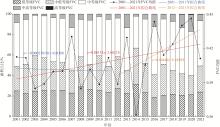
Fig. 2
Proportions of different FVC classes and changes in mean values in the Ili River Valley in Xinjiang from 2001 to 2021"
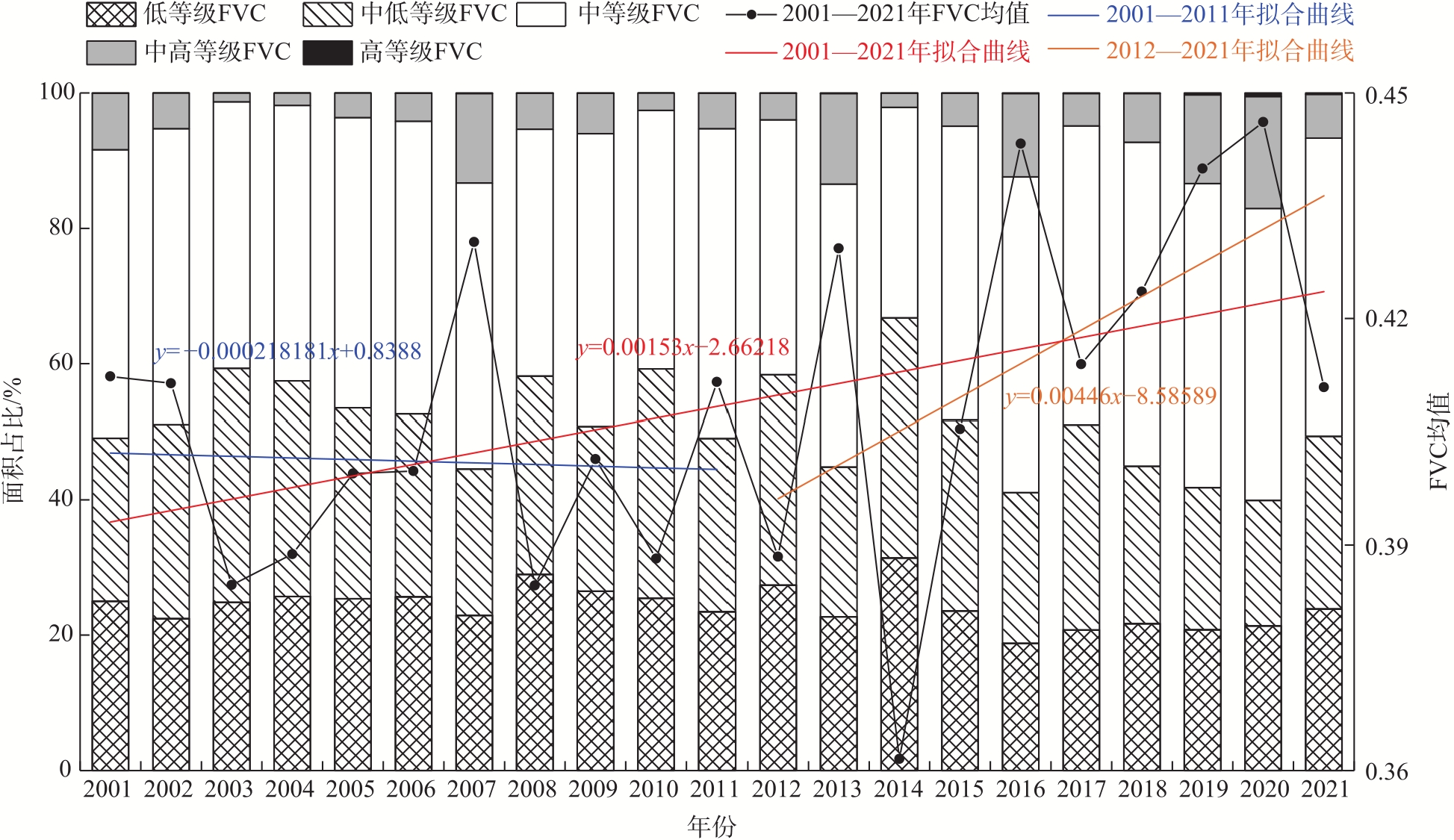
Fig 3
Spatial distributions and center of gravity migration trajectories of different FVC classes in the Ili River Valley in Xinjiang from 2001 to 2021"
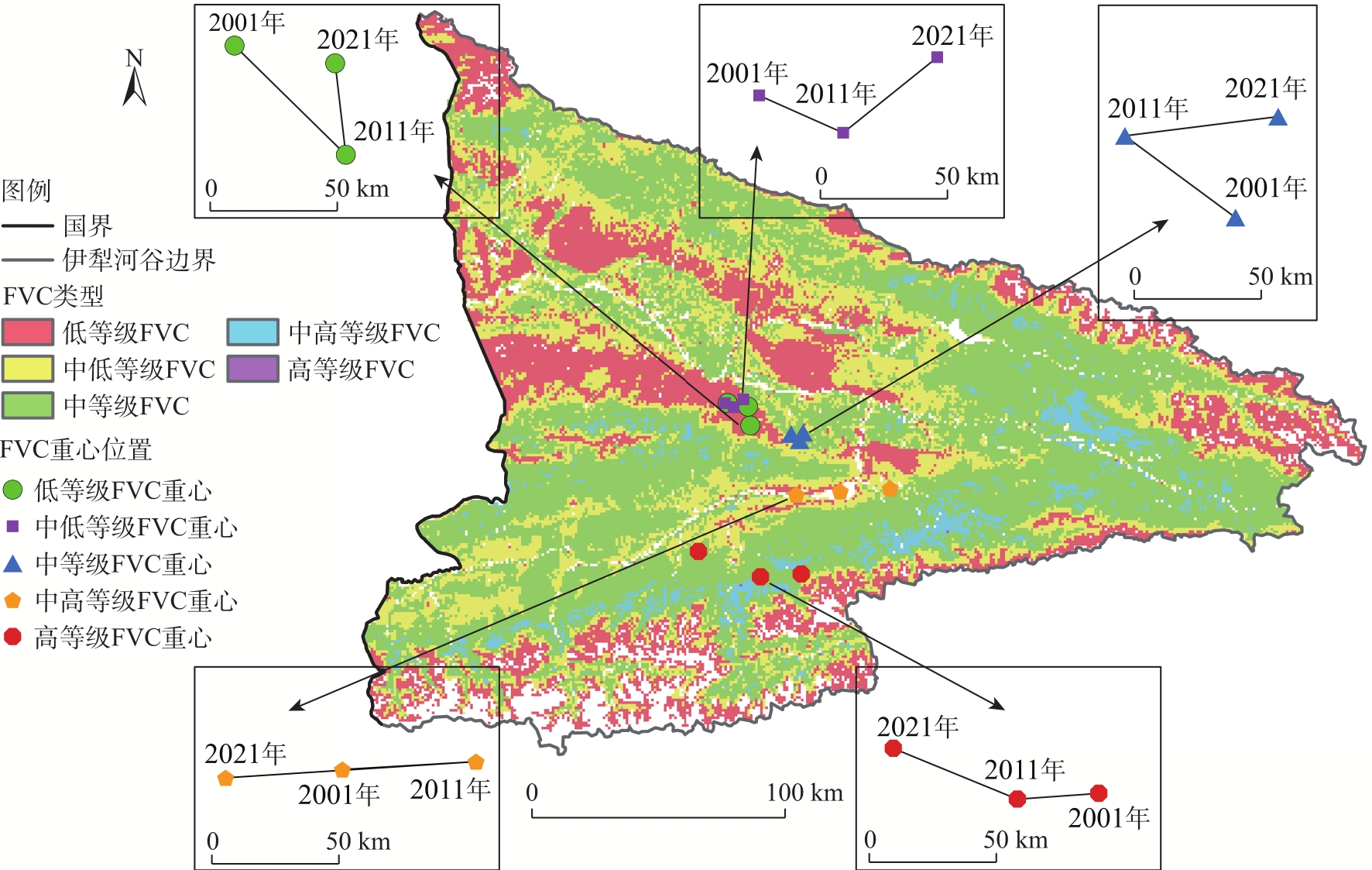
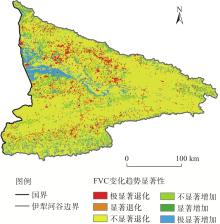
Fig. 4
Variation trends of FVC in the Ili River Valley in Xinjiang from 2001 to 2021"
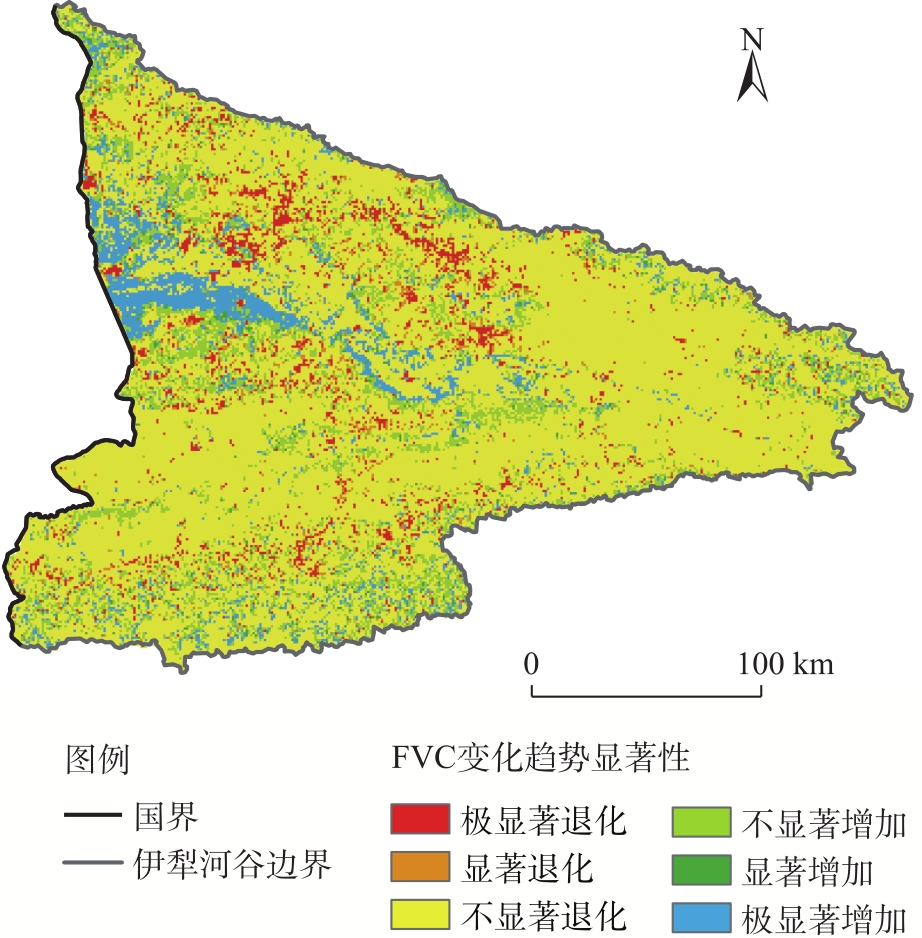
Fig. 5
Ranking of explanatory forces of driving factors"
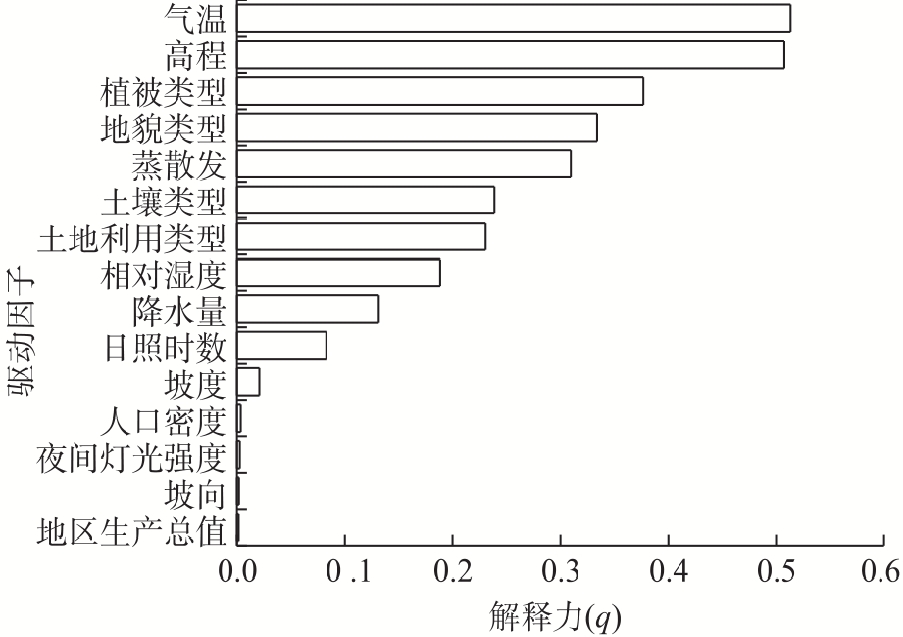
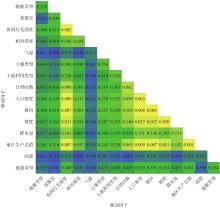
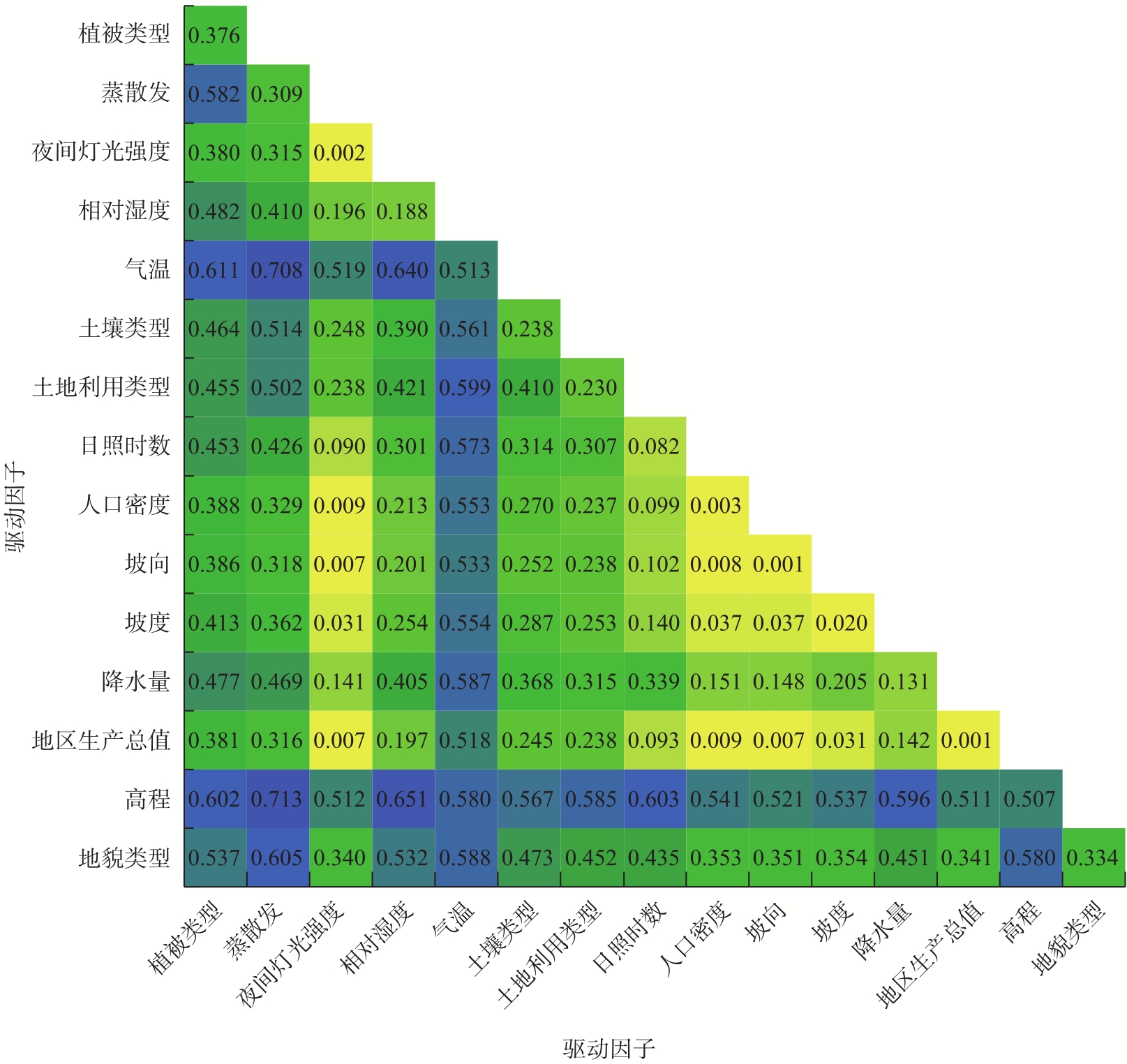
Fig. 6
Results of the interaction detection among various driving factors"
| [1] | Tenreiro T R, García-Vila M, Gómez J A, et al. Using NDVI for the assessment of canopy cover in agricultural crops within modelling research[J]. Computers and Electronics in Agriculture, 2021, 182: 106038, doi: 10.1016/j.compag.2021.106038. |
| [2] |
Gitelson A A, Kaufman Y J, Stark R, et al. Novel algorithms for remote estimation of vegetation fraction[J]. Remote Sensing of Environment, 2002, 80(1): 76-87.
doi: 10.1016/S0034-4257(01)00289-9 |
| [3] | 庞娇, 郭欣雨, 李晨阳, 等. 京津冀生态屏障区植被覆盖时空演变驱动力定量解析[J]. 环境科学, 2025, 46(7): 4370-4381. |
| [Pang Jiao, Guo Xinyu, Li Chenyang, et al. Quantitative analysis of the drivers of spatial and temporal evolution of vegetation cover in the Beijing-Tianjin-Hebei ecological barrier area[J]. Environmental Science, 2025, 46(7): 4370-4381. ] | |
| [4] |
Liu Q Y, Zhang T L, Li Y Z, et al. Comparative analysis of fractional vegetation cover estimation based on multi-sensor data in a semi-arid sandy area[J]. Chinese Geographical Science, 2019, 29: 166-180.
doi: 10.1007/s11769-018-1010-2 |
| [5] |
Guo J T, Wang K B, Wang T J, et al. Spatiotemporal variation of vegetation NDVI and its climatic driving forces in global land surface[J]. Polish Journal of Environmental Studies, 2022, 31(4): 3541-3549.
doi: 10.15244/pjoes/147194 |
| [6] |
徐佳乐, 杨兴川, 赵文吉, 等. 气候变化背景下内蒙古中西部植被覆盖度演变特征研究[J]. 生态环境学报, 2024, 33(7): 1008-1018.
doi: 10.16258/j.cnki.1674-5906.2024.07.002 |
| [Xu Jiale, Yang Xingchuan, Zhao Wenji, et al. Evolution characteristics of vegetation coverage in central and western Inner Mongolia under the background of climate change[J]. Ecology and Environmental Sciences, 2024, 33(7): 1008-1018. ] | |
| [7] | Liu Y W, Zhao Y N, Wu W T, et al. The response of vegetation dynamics to climate in Xinjiang from 1991 to 2018[J]. Forests, 2024, 15(12): 2065, doi: 10.3390/f15122065. |
| [8] |
申子傲, 吴静, 李纯斌. 2000—2020年河西内陆河流域植被覆盖时空变化特征及其驱动力[J]. 中国沙漠, 2024, 44(3): 119-127.
doi: 10.7522/j.issn.1000-694X.2023.00180 |
|
[Shen Ziao, Wu Jing, Li Chunbin. Temporal and spatial changes of vegetation cover and its driving forces in the Hexi inland river basin from 2000 to 2020[J]. Journal of Desert Research, 2024, 44(3): 119-127. ]
doi: 10.7522/j.issn.1000-694X.2023.00180 |
|
| [9] | 符帆, 赵德轩, 张贝尔, 等. 我国不同气候带多年植被覆盖度时空变化特征及其地形效应[J]. 环境科学, 2025, 46(8): 5206-5216. |
| [Fu Fan, Zhao Dexuan, Zhang Beier, et al. Characteristics of spatial and temporal variations of multi-year vegetation cover in different climatic zones of China and their topographic effects[J]. Environmental Science, 2025, 46(8): 5206-5216. ] | |
| [10] | 田云, 刘俊艳, 白爽, 等. 近20年黄河流域甘肃段植被覆盖度变化与驱动因素分析[J]. 农业机械学报, 2024, 55(7): 365-372, 404. |
| [Tian Yun, Liu Junyan, Bai Shuang, el al. Fractional vegetation cover change and driving factors in Gansu section of Yellow River Basin[J]. Transactions of the Chinese Society for Agricultural Machinery, 2024, 55(7): 365-372, 404. ] | |
| [11] | 柴文雯, 贾夏, 赵永华, 等. 黄土高原人类活动强度与植被覆盖的时空关联[J]. 生态学报, 2024, 44(15): 6708-6721. |
| [Chai Wenwen, Jia Xia, Zhao Yonghua, et al. Spatio-temporal correlation between human activity intensity and vegetation cover on the Loess Plateau[J]. Acta Ecologica Sinica, 2024, 44(15): 6708-6721. ] | |
| [12] | 胡文可, 刘维忠, 彭亚萍. 草原生态恢复工程下新疆草原植被覆盖动态及其对生态系统服务的约束效应[J]. 水土保持学报, 2025, 39(3): 202-214, 223. |
| [Hu Wenke, Liu Weizhong, Peng Yaping. Vegetation cover dynamics of Xinjiang grassland under grassland ecological restoration project and its constraining effects on ecosystem services[J]. Journal of Soil and Water Conservation, 2025, 39(3): 202-214, 223. ] | |
| [13] | 王建国, 张飞, 蔡吉祥, 等. 干旱区土地利用与植被覆盖时空变化特征及其关联性分析[J]. 草业科学, 2025, 42(5): 1118-1130. |
| [Wang Jianguo, Zhang Fei, Cai Jixiang, et al. Spatiotemporal variation and correlation between land use and vegetation cover in arid areas[J]. Pratacultural Science, 2025, 42(5): 1118-1130. ] | |
| [14] |
郝潘潘, 刘志有. 新疆绿洲土地利用隐性形态与土地生态安全协调特征——以伊犁河谷为例[J]. 干旱区研究, 2024, 41(9): 1605-1614.
doi: 10.13866/j.azr.2024.09.16 |
|
[Hao Panpan, Liu Zhiyou. Coordination characteristics between land use implicit forms and land ecological security in Xinjiang oasis: The Ili River Valley as a case study[J]. Arid Zone Research, 2024, 41(9): 1605-1614. ]
doi: 10.13866/j.azr.2024.09.16 |
|
| [15] | 刘志有, 曲秀武, 魏冉, 等. 生态文明视角下的伊犁河谷绿洲土地生态安全评价及障碍因子诊断[J]. 水土保持通报, 2022, 42(1): 137-143. |
| [Liu Zhiyou, Qu Xiuwu, Wei Ran, et al. Evaluation of land ecological security and diagnosis of obstacle factors for oasis land in Yili River Valley from perspective of ecological civilization[J]. Bulletin of Soil and Water Conservation, 2022, 42(1): 137-143. ] | |
| [16] |
李雅倩, 杨建华, 夏皓斌, 等. 2000—2022年伊犁河流域植被时空变化特征[J]. 干旱区地理, 2024, 47(5): 741-752.
doi: 10.12118/j.issn.1000-6060.2023.480 |
|
[Li Yaqian, Yang Jianhua, Xia Haobin, et al. Spatiotemporal variations of vegetation in the Ili River Basin from 2000 to 2022[J]. Arid Land Geography, 2024, 47(5): 741-752. ]
doi: 10.12118/j.issn.1000-6060.2023.480 |
|
| [17] | Qi J G, Tao S Q, Pueppke S G, et al. Changes in land use/land cover and net primary productivity in the transboundary Ili-Balkhash Basin of Central Asia, 1995—2015[J]. Environmental Research Communications, 2019, 2(1): 011006, doi: 10.1088/2515-7620/ab5e1f. |
| [18] | 阿依丁·热西坦, 阿斯娅·曼力克, 贠静, 等. 伊犁河谷草地资源利用现状及可持续利用对策[J]. 草学, 2021(3): 78-81, 86. |
| [Rexitan Ayiding, Manlike Asiya, Yun Jing, et al. Current situation and sustainable utilization countermeasures of grassland resources in Ili River Valley[J]. Journal of Grassland and Forage Science, 2021(3): 78-81, 86. ] | |
| [19] | 刘天弋, 孙慧兰, 卢宝宝, 等. 1998—2018年新疆伊犁河谷植被覆盖度时空变化及驱动力[J]. 东北林业大学学报, 2023, 51(4): 68-74, 79. |
| [Liu Tianyi, Sun Huilan, Lu Baobao, et al. Spatial-temporal variation and driving force analysis of vegetation coverage in the Ili River Valley of Xinjiang from 1998 to 2018[J]. Journal of Northeast Forestry University, 2023, 51(4): 68-74, 79. ] | |
| [20] |
Yang J, Huang X. The 30 m annual land cover datasets and its dynamics in China from 1985 to 2022[J]. Earth System Science Data, 2023, 13: 3907-3925.
doi: 10.5194/essd-13-3907-2021 |
| [21] | Chen J D, Gao M, Cheng S L, et al. Global 1 km×1 km gridded revised real gross domestic product and electricity consumption during 1992—2019 based on calibrated nighttime light data[J]. Scientific Data, 2022, 9(1): 202, doi: 10.1038/s41597-022-01322-5. |
| [22] |
张琨, 吕一河, 傅伯杰, 等. 黄土高原植被覆盖变化对生态系统服务影响及其阈值[J]. 地理学报, 2020, 75(5): 949-960.
doi: 10.11821/dlxb202005005 |
|
[Zhang Kun, Lü Yihe, Fu Bojie, et al. The effects of vegetation coverage changes on ecosystem service and their threshold in the Loess Plateau[J]. Acta Geographica Sinica, 2020, 75(5): 949-960. ]
doi: 10.11821/dlxb202005005 |
|
| [23] | Liu C X, Zhang X D, Wang T, et al. Detection of vegetation coverage changes in the Yellow River Basin from 2003 to 2020[J]. Ecological Indicators, 2022, 138: 108818, doi: 10.1016/j.ecolind.2022.108818. |
| [24] |
Zhang Z X, Chang J, Xu C Y, et al. The response of lake area and vegetation cover variations to climate change over the Qinghai-Tibetan Plateau during the past 30 years[J]. Science of the Total Environment, 2018, 635: 443-451.
doi: 10.1016/j.scitotenv.2018.04.113 |
| [25] | 杨鹏辉, 田佳, 张楠, 等. 1990—2022年黄河流域植被时空变化特征及未来趋势预测[J]. 生态学报, 2024, 44(19): 8542-8553. |
| [Yang Penghui, Tian Jia, Zhang Nan, et al. Characteristics of spatio-temporal changes and future trends forecast of vegetation cover in the Yellow River Basin from 1990 to 2022[J]. Acta Ecologica Sinica, 2024, 44(19): 8542-8553. ] | |
| [26] |
王劲峰, 徐成东. 地理探测器: 原理与展望[J]. 地理学报, 2017, 72(1): 116-134.
doi: 10.11821/dlxb201701010 |
|
[Wang Jinfeng, Xu Chendong. Geodetector: Principle and prospective[J]. Acta Geographica Sinica, 2017, 72(1): 116-134. ]
doi: 10.11821/dlxb201701010 |
|
| [27] |
康雄, 曹俊涛, 陈成, 等. 不同趋势法的宁夏长时序植被变化分析[J]. 测绘通报, 2020(11): 23-27.
doi: 10.13474/j.cnki.11-2246.2020.0348 |
|
[Kang Xiong, Cao Juntao, Chen Cheng, et al. Analysis of long-term vegetation change in Ningxia with different trend methods[J]. Bulletin of Surveying and Mapping, 2020(11): 23-27. ]
doi: 10.13474/j.cnki.11-2246.2020.0348 |
|
| [28] |
陈以恒, 玉素甫江·如素力, 阿卜杜热合曼·吾斯曼. 2001—2020年天山新疆段草地植被覆盖度时空变化及驱动因素分析[J]. 植物生态学报, 2024, 48(5): 561-576.
doi: 10.17521/cjpe.2023.0155 |
|
[Chen Yiheng, Rusuli Yusufujiang, Wusiman Abdureheman. Analysis of spatial and temporal variation in grassland vegetation cover in Xinjiang section of Tianshan Mountains and the driving factors from 2001 to 2020[J]. Chinese Journal of Plant Ecology, 2024, 48(5): 561-576. ]
doi: 10.17521/cjpe.2023.0155 |
|
| [29] | 金晓亮, 孙慧兰, 叶茂, 等. 伊犁河流域植被覆盖时空变化趋势及驱动力[J]. 中山大学学报(自然科学版中英文), 2025, 64(2): 42-55. |
| [Jin Xiaoliang, Sun Huilan, Ye Mao, et al. The spatiotemporal change trends and driving forces of vegetation coverage in the Ili River Basin[J]. Acta Scientiarum Naturalium Universitatis Sunyatseni, 2025, 64(2): 42-55. ] | |
| [30] |
文广超, 赵梅娟, 谢洪波, 等. 伊犁河谷西部土地植被覆盖演化及驱动力分析[J]. 干旱区研究, 2021, 38(3): 843-854.
doi: 10.13866/j.azr.2021.03.26 |
|
[Wen Guangchao, Zhao Meijuan, Xie Hongbo, et al. Analysis of land vegetation cover evolution and driving forces in the western part of the Ili River Valley[J]. Arid Zone Research, 2021, 38(3): 843-854. ]
doi: 10.13866/j.azr.2021.03.26 |
|
| [31] | 何辉, 玉素甫江·如素力. 2001—2015年伊犁地区植被NDVI变化及其影响因子的相对作用分析[J]. 中南林业科技大学学报, 2019, 39(10): 76-87. |
| [He Hui, Rusuli Yusufujiang. Analysis of the relative role of vegetation cover changes and its influencing factors in Yili area from 2001 to 2015[J]. Journal of Central South University of Forestry & Technology, 2019, 39(10): 76-87. ] | |
| [32] |
Yuan W, Wu S Y, Hou S G, et al. Normalized difference vegetation index-based assessment of climate change impact on vegetation growth in the humid-arid transition zone in northern China during 1982—2013[J]. International Journal of Climatology, 2019, 39(15): 5583-5598.
doi: 10.1002/joc.v39.15 |
| [33] |
Zhang R P, Liang T G, Guo J, et al. Grassland dynamics in response to climate change and human activities in Xinjiang from 2000 to 2014[J]. Scientific Reports, 2018, 8(1): 2888, doi: 10.1038/s41598-018-21089-3.
pmid: 29440664 |
|
||

