Arid Land Geography ›› 2026, Vol. 49 ›› Issue (5): 1063-1073.doi: 10.12118/j.issn.1000-6060.2025.247
• Tourism Geography • Previous Articles Next Articles
LYU Wanqing( ), SONG Zhigao(), XIAO Zhaofu
Received:2025-05-06
Revised:2025-10-19
Online:2026-05-25
Published:2026-05-25
Contact:
SONG Zhigao
E-mail:lvwq@ynu.edu.cn;songzhigao@stu.ynu.edu.cn
LYU Wanqing, SONG Zhigao, XIAO Zhaofu. Coupling coordination, obstacle diagnosis and driving factors of new urbanization and high-quality development of tourism in China[J].Arid Land Geography, 2026, 49(5): 1063-1073.
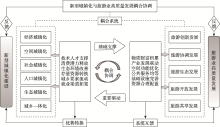
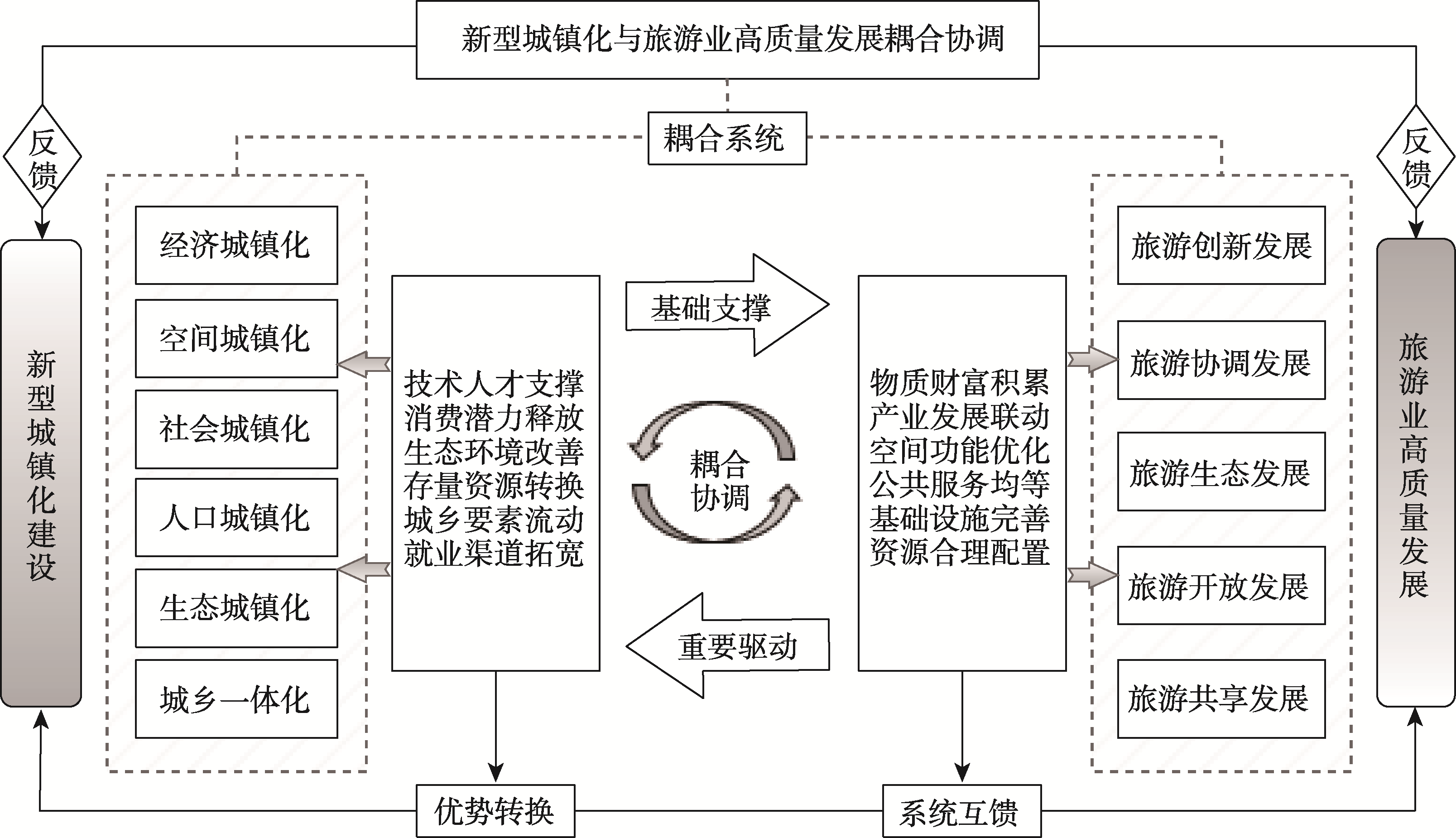
Fig. 1
Coupling coordination mechanism between new urbanization and high-quality development of tourism"

Tab. 1
Evaluation index system for new urbanization and high-quality development of tourism"
| 系统层 | 准则层 | 指标层 | 指标说明 | 属性 |
|---|---|---|---|---|
| 新型城镇化 | 经济城镇化 | 城镇居民人均可支配收入(X1)/元 | 城镇居民人均可用于日常生活开支的收入 | + |
| 人均社会消费品零售总额(X2)/元 | 社会消费品零售总额/常住人口数量 | + | ||
| 第三产业增加值占比(X3)/% | 第三产业增加值/GDP | + | ||
| 人均地区生产总值(X4)/元 | GDP/常住人口数量 | + | ||
| 空间城镇化 | 人均城市道路面积(X5)/m2 | 城市道路面积/常住人口数量 | + | |
| 人均拥有建成区面积(X6)/m2 | 建成区面积/常住人口数量 | + | ||
| 建成区面积占比(X7)/% | 建成区面积/城区面积 | + | ||
| 公共交通工具普及率(X8)/辆 | 每万人拥有公共交通车数量 | + | ||
| 社会城镇化 | 教育投入占比(X9)/% | 地方财政教育支出/GDP | + | |
| 医疗卫生水平(X10)/张 | 每万人拥有医疗卫生机构床位数 | + | ||
| 教育规模(X11)/人 | 每十万人高等学校在校生数 | + | ||
| 人均拥有公共图书馆藏量(X12)/册 | 公共图书馆藏数量/常住人口数量 | + | ||
| 人口城镇化 | 人口城镇化率(X13)/% | 城镇人口数量/常住人口数量 | + | |
| 城镇人口密度(X14)/人·km-2 | 城镇人口数量/城镇建成区面积 | + | ||
| 二三产业从业人员占比(X15)/% | 第二、第三产业从业人员/总从业人员 | + | ||
| 城镇就业情况(X16)/% | 城镇人口登记失业率 | - | ||
| 生态城镇化 | 每万人拥有公共厕所(X17)/座 | 每万人拥有公共厕所数量 | + | |
| 人均公园绿地面积(X18)/m2 | 公园绿地总面积/常住人口数量 | + | ||
| 污水处理率(X19)/% | 污水处理量/污水排放总量 | + | ||
| 生活垃圾无害化处理率(X20)/% | 无害化城镇垃圾处理量/生活垃圾产生总量 | + | ||
| 城乡一体化 | 城乡居民消费水平比(X21)/% | 城镇居民人均消费支出/农村居民人均消费支出 | - | |
| 城乡居民收入水平比(X22)/% | 城镇居民人均收入/乡村居民人均收入 | - | ||
| 城乡居民家庭恩格尔系数比(X23)/% | 城镇居民家庭恩格尔系数/乡村居民恩格尔系数 | + | ||
| 旅游业高质量发展 | 创新发展 | 人均旅游R&D经费支出(X24)/元 | 旅游R&D经费支出/常住人口数量 | + |
| 旅游发明专利(X25)/个 | 每万人旅游相关发明专利授权数量 | + | ||
| 旅游学生数量(X26)/人 | 每万人高等和中等职业旅游院校在校人数 | + | ||
| 旅游劳动生产率(X27)/104元·人-1 | 旅游总收入/旅游从业人员数量 | + | ||
| 协调发展 | 旅游产业地位(X28)/% | 旅游总收入/GDP | + | |
| 旅游产业结构高级化(X29)/% | 二、三产业比重/GDP占旅游总收入比重 | + | ||
| 旅游产业结构合理化(X30)/% | 旅游总收入/第三产业增加值 | + | ||
| 旅游产业聚集度(X31)/% | 旅游收入占GDP比重/中国旅游收入占GDP比重 | + | ||
| 绿色发展 | 自然保护区面积占比(X32)/% | 自然保护区面积/辖区面积 | + | |
| 森林覆盖率(X33)/% | 森林覆盖率 | + | ||
| 旅游业废气排放量(X34)/104 t | 旅游交通、住宿和旅游活动碳排放总量 | - | ||
| 开放发展 | 旅游资源丰度(X35)/个·km-2 | A级以上景区数量/区域面积 | + | |
| 接待服务能力(X36)/个·km-2 | 星级饭店、旅行社数量/区域面积 | + | ||
| 旅游外汇占比(X37)/% | 旅游外汇收入/旅游总收入 | + | ||
| 入境游客人均花费(X38)/USD | 旅游外汇收入/入境游客数量 | + | ||
| 共享发展 | 客运量(X39)/104人 | 公路、铁路和水运总量 | + | |
| 人均文化体育支出(X40)/元 | 文化体育与传媒支出/常住人口数量 | + | ||
| 人均旅游收入(X41)/元 | 旅游总收入/常住人口数量 | + | ||
| 艺术表演场馆演出场次(X42)/104场 | 艺术表演场馆演出场次 | + |
Tab. 2
Classification of the coupling coordination degree level between new urbanization and high-quality tourism development of tourism"
| 等级划分 | 取值区间 | 等级划分 | 取值区间 |
|---|---|---|---|
| 极度失调 | [0.0, 0.1) | 勉强协调 | [0.5, 0.6) |
| 严重失调 | [0.1, 0.2) | 初级协调 | [0.6, 0.7) |
| 中度失调 | [0.2, 0.3) | 中级协调 | [0.7, 0.8) |
| 轻度失调 | [0.3, 0.4) | 良好协调 | [0.8, 0.9) |
| 濒临失调 | [0.4, 0.5) | 优质协调 | [0.9, 1.0] |
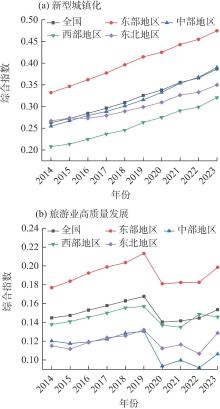
Fig. 2
Temporal evolution of new urbanization and high-quality development of tourism in China from 2014 to 2023"
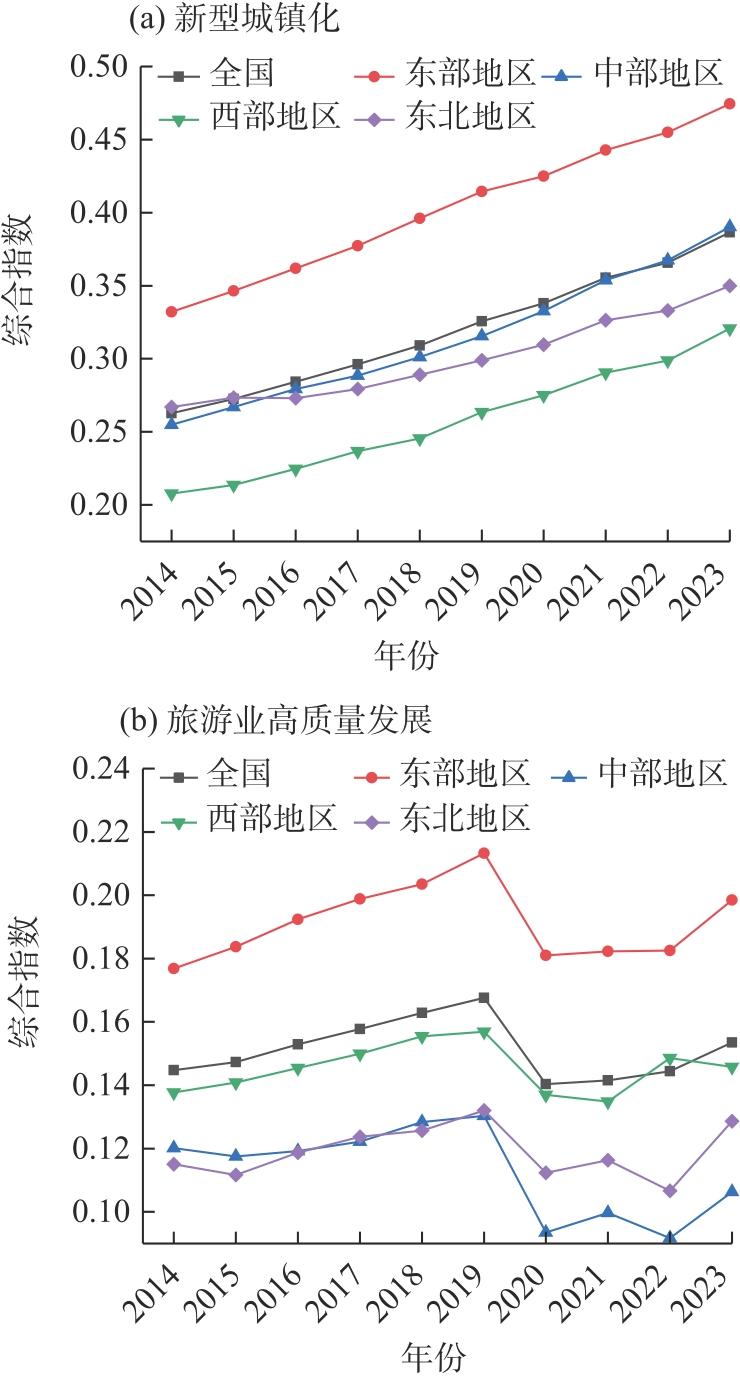
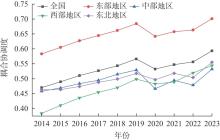
Fig. 3
Temporal evolution of the coupling coordination degree between new urbanization and high-quality development of tourism in China from 2014 to 2023"
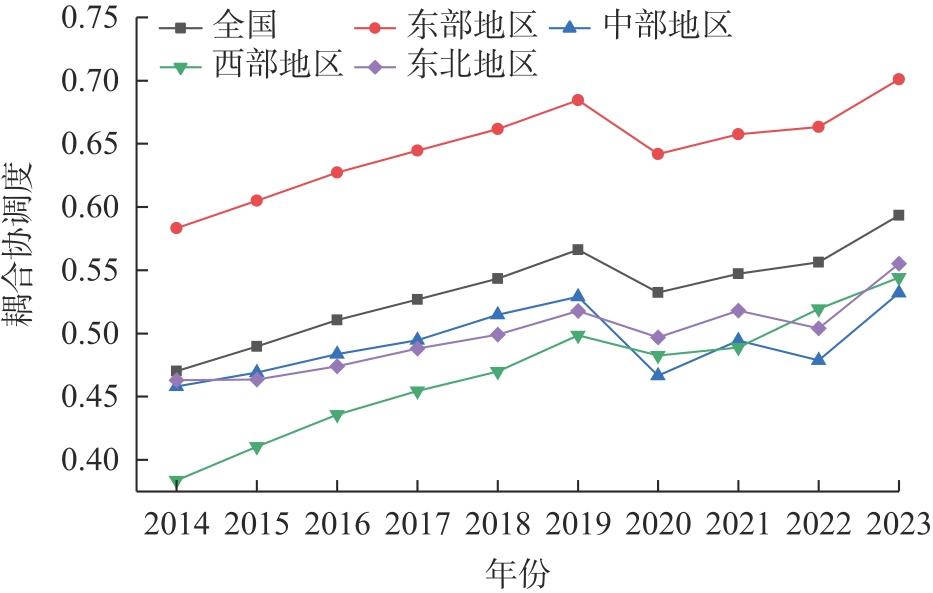
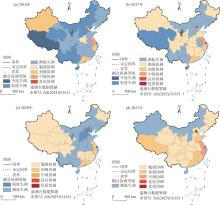
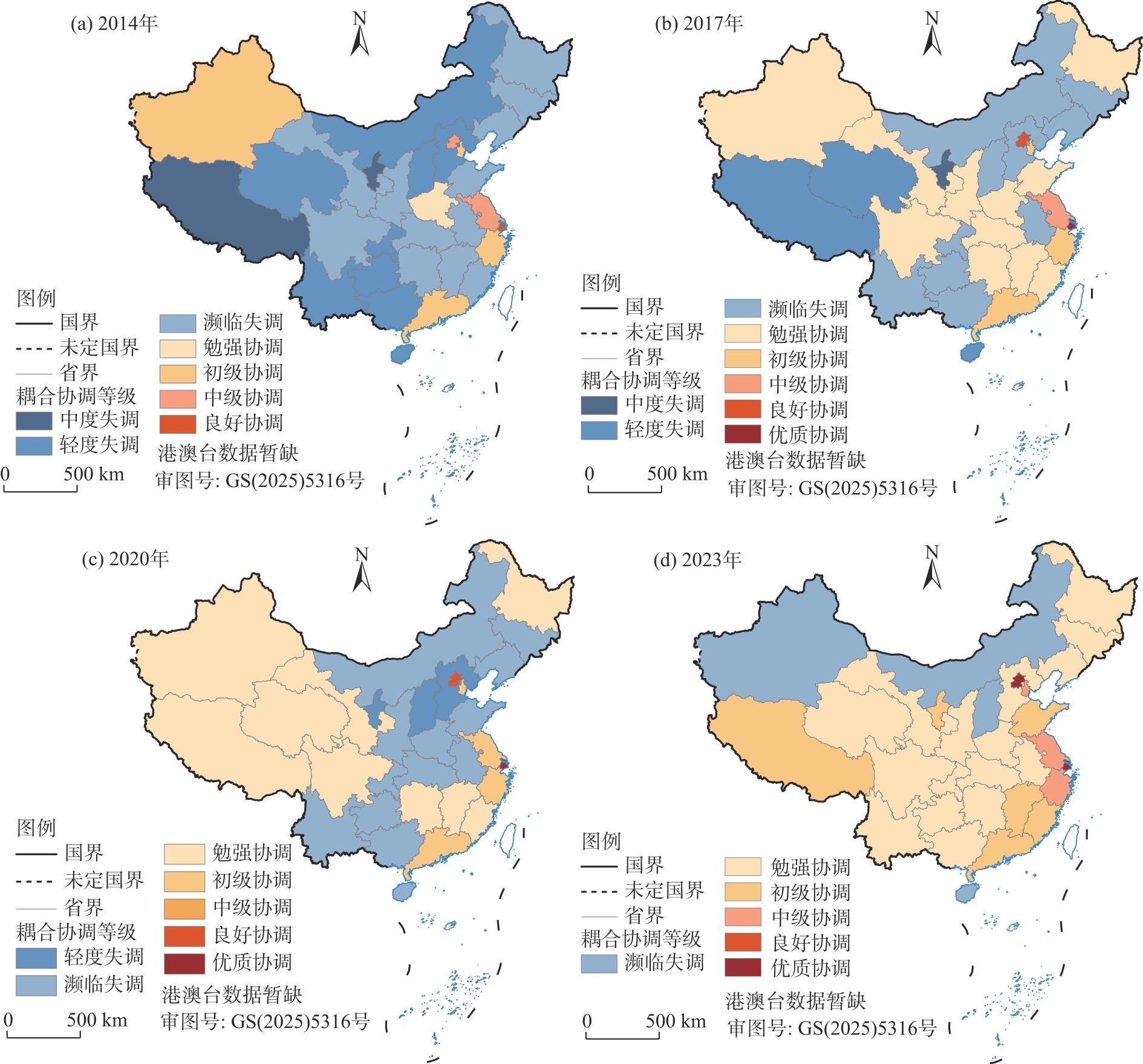
Fig. 4
Spatial distributions of the coupling coordination degree between new urbanization and high-quality development of tourism in China from 2014 to 2023"
Tab. 3
Obstacle degree at the criterion layer for new urbanization and high-quality development of tourism"
| 年份 | 新型城镇化 | 旅游业高质量发展 | ||||||||||
|---|---|---|---|---|---|---|---|---|---|---|---|---|
| 经济城镇化 | 空间城镇化 | 社会城镇化 | 人口城镇化 | 生态城镇化 | 城乡一体化 | 创新发展 | 协调发展 | 绿色发展 | 开放发展 | 共享发展 | ||
| 2014 | 0.282 | 0.145 | 0.253 | 0.106 | 0.180 | 0.034 | 0.282 | 0.102 | 0.072 | 0.358 | 0.186 | |
| 2015 | 0.275 | 0.145 | 0.256 | 0.108 | 0.182 | 0.034 | 0.295 | 0.085 | 0.059 | 0.377 | 0.185 | |
| 2016 | 0.269 | 0.146 | 0.259 | 0.108 | 0.184 | 0.034 | 0.303 | 0.102 | 0.064 | 0.335 | 0.195 | |
| 2017 | 0.266 | 0.146 | 0.260 | 0.109 | 0.185 | 0.035 | 0.293 | 0.100 | 0.066 | 0.368 | 0.173 | |
| 2018 | 0.262 | 0.149 | 0.262 | 0.106 | 0.186 | 0.034 | 0.294 | 0.090 | 0.060 | 0.371 | 0.185 | |
| 2019 | 0.259 | 0.15 | 0.265 | 0.105 | 0.189 | 0.033 | 0.292 | 0.096 | 0.058 | 0.376 | 0.178 | |
| 2020 | 0.264 | 0.151 | 0.262 | 0.104 | 0.188 | 0.031 | 0.295 | 0.087 | 0.050 | 0.375 | 0.194 | |
| 2021 | 0.262 | 0.156 | 0.259 | 0.104 | 0.189 | 0.030 | 0.298 | 0.072 | 0.052 | 0.389 | 0.189 | |
| 2022 | 0.268 | 0.150 | 0.257 | 0.107 | 0.189 | 0.029 | 0.298 | 0.086 | 0.048 | 0.382 | 0.187 | |
| 2023 | 0.265 | 0.143 | 0.262 | 0.109 | 0.193 | 0.029 | 0.303 | 0.099 | 0.058 | 0.346 | 0.193 | |
Tab. 4
Top three obstacle factors and their obstacle degrees at the indicator layer for new urbanization and high-quality development of tourism"
| 省域 | 新型城镇化 | 旅游业高质量发展 | |||||
|---|---|---|---|---|---|---|---|
| 第一障碍因子 | 第二障碍因子 | 第三障碍因子 | 第一障碍因子 | 第二障碍因子 | 第三障碍因子 | ||
| 北京 | X19(0.148) | X14(0.134) | X10(0.125) | X26(0.190) | X37(0.119) | X36(0.099) | |
| 天津 | X19(0.151) | X10(0.122) | X12(0.107) | X26(0.157) | X36(0.140) | X37(0.098) | |
| 河北 | X12(0.132) | X19(0.111) | X4(0.095) | X36(0.140) | X26(0.140) | X37(0.092) | |
| 山西 | X12(0.119) | X19(0.118) | X4(0.091) | X36(0.146) | X26(0.144) | X37(0.095) | |
| 内蒙古 | X19(0.122) | X12(0.110) | X10(0.84) | X36(0.145) | X26(0.141) | X37(0.091) | |
| 辽宁 | X12(0.105) | X19(0.095) | X4(0.087) | X26(0.146) | X36(0.145) | X37(0.095) | |
| 吉林 | X19(0.116) | X12(0.108) | X4(0.087) | X36(0.151) | X26(0.148) | X37(0.097) | |
| 黑龙江 | X12(0.128) | X19(0.121) | X4(0.100) | X36(0.145) | X26(0.141) | X37(0.092) | |
| 上海 | X19(0.148) | X10(0.130) | X17(0.087) | X26(0.182) | X37(0.106) | X42(0.103) | |
| 江苏 | X12(0.133) | X14(0.104) | X19(0.079) | X36(0.157) | X36(0.147) | X37(0.101) | |
| 浙江 | X19(0.109) | X12(0.104) | X14(0.096) | X36(0.157) | X36(0.147) | X37(0.099) | |
| 安徽 | X12(0.129) | X19(0.108) | X4(0.090) | X36(0.143) | X26(0.143) | X37(0.092) | |
| 福建 | X19(0.132) | X19(0.116) | X10(0.091) | X36(0.147) | X26(0.147) | X37(0.089) | |
| 江西 | X12(0.128) | X19(0.128) | X4(0.095) | X36(0.150) | X26(0.148) | X37(0.098) | |
| 山东 | X12(0.139) | X14(0.102) | X19(0.095) | X26(0.143) | X36(0.140) | X37(0.092) | |
| 河南 | X12(0.148) | X19(0.111) | X4(0.102) | X36(0.141) | X26(0.140) | X37(0.092) | |
| 湖北 | X12(0.125) | X19(0.107) | X4(0.082) | X36(0.144) | X26(0.143) | X37(0.093) | |
| 湖南 | X12(0.130) | X19(0.112) | X4(0.091) | X36(0.147) | X26(0.145) | X37(0.095) | |
| 广东 | X12(0.142) | X4(0.092) | X17(0.083) | X26(0.149) | X36(0.145) | X37(0.088) | |
| 广西 | X12(0.115) | X19(0.096) | X4(0.093) | X36(0.149) | X26(0.147) | X37(0.095) | |
| 海南 | X19(0.121) | X12(0.112) | X10(0.093) | X26(0.142) | X36(0.141) | X37(0.090) | |
| 重庆 | X12(0.121) | X19(0.120) | X14(0.079) | X36(0.144) | X26(0.137) | X37(0.091) | |
| 四川 | X12(0.130) | X19(0.105) | X4(0.093) | X36(0.149) | X26(0.145) | X37(0.096) | |
| 贵州 | X12(0.117) | X19(0.112) | X4(0.091) | X36(0.152) | X26(0.149) | X37(0.099) | |
| 云南 | X12(0.119) | X19(0.115) | X4(0.089) | X36(0.150) | X26(0.146) | X37(0.094) | |
| 西藏 | X19(0.117) | X14(0.104) | X10(0.092) | X36(0.162) | X26(0.119) | X37(0.101) | |
| 陕西 | X12(0.131) | X19(0.124) | X4(0.086) | X36(0.147) | X26(0.145) | X37(0.093) | |
| 甘肃 | X19(0.119) | X12(0.110) | X4(0.094) | X36(0.154) | X26(0.150) | X37(0.098) | |
| 青海 | X19(0.118) | X12(0.097) | X10(0.091) | X36(0.146) | X26(0.142) | X37(0.093) | |
| 宁夏 | X19(0.127) | X10(0.099) | X12(0.096) | X36(0.139) | X26(0.136) | X37(0.090) | |
| 新疆 | X19(0.120) | X12(0.117) | X4(0.087) | X36(0.155) | X26(0.150) | X37(0.081) | |
Tab. 5
Driving factors for the coupling coordination between new urbanization and high-quality development of tourism"
| 指标名称 | 指标说明 | q值 |
|---|---|---|
| 经济发展水平/108元 | 地区生产总值 | 0.492* |
| 科技创新水平/% | R&D项目经费投入强度 | 0.260* |
| 人力资本水平/a | 平均受教育年限 | 0.178 |
| 对外开放程度/104 USD | 进出口贸易总额/地区生产总值 | 0.329 |
| 政府干预能力/% | 财政支出/地区生产总值 | 0.418* |
| 交通条件/km·km-2 | 路网密度 | 0.273 |
| [1] | 李志飞, 曹珍珠. 旅游引导的新型城镇化: 一个多维度的中外比较研究[J]. 旅游学刊, 2015, 30(7): 16-25. |
| [Li Zhifei, Cao Zhenzhu. Tourism-oriented new urbanization: A multi-dimensional comparative study[J]. Tourism Tribune, 2015, 30(7): 16-25.] | |
| [2] | 蔡刚. 旅游产业对新型城镇化影响的实证分析[J]. 统计与决策, 2018, 34(17): 102-104. |
| [Cai Gang. An empirical analysis of the impact of tourism industry on new urbanization[J]. Statistics and Decision, 2018, 34(17): 102-104.] | |
| [3] |
Yu J, Safarov B, Wang C, et al. The effect of transportation networks on heritage tourism and new urbanization: Empirical research based on rich heritage sites in a Chinese province[J]. Heritage, 2023, 6(12): 7293-7315.
doi: 10.3390/heritage6120383 |
| [4] | 赵磊, 李诗琪, 康敏. 旅游发展影响经济增长的动态新型城镇化门限效应[J]. 旅游学刊, 2024, 39(10): 31-48. |
| [Zhao Lei, Li Shiqi, Kang Min. The dynamic new urbanization threshold effect of tourism development on China’s economic growth[J]. Tourism Tribune, 2024, 39(10): 31-48.] | |
| [5] | Hao M, Li G, Chen C Y, et al. A coupling relationship between new-type urbanization and tourism resource conversion efficiency: A case study of the Yellow River Basin in China[J]. Sustainability, 2022, 14(21): 14007, doi: 10.3390/su142114007. |
| [6] | 王兆峰, 汪倩. 长江经济带新型城镇化对旅游业碳排放的门槛效应研究[J]. 长江流域资源与环境, 2022, 31(1): 13-24. |
| [Wang Zhaofeng, Wang Qian. Threshold effect of new urbanization on tourism carbon emission in Yangtze River Economic Belt[J]. Resources and Environment in the Yangtze Basin, 2022, 31(1): 13-24.] | |
| [7] | 杨主泉. 旅游业与新型城镇化协同发展机理研究[J]. 社会科学家, 2018(10): 85-90. |
| [Yang Zhuquan. Research on the coordinated development mechanism of tourism and new urbanization[J]. Social Scientist, 2018(10): 85-90.] | |
| [8] | 赵磊, 潘婷婷, 方成, 等. 旅游业与新型城镇化——基于系统耦合协调视角[J]. 旅游学刊, 2020, 35(1): 14-31. |
| [Zhao Lei, Pan Tingting, Fang Cheng, et al. Tourism industry and new urbanization: A view based on system coupling perspective[J]. Tourism Tribune, 2020, 35(1): 14-31.] | |
| [9] | 王生霞, 李茂兰, 刘芮廷. 旅游业效率与城镇化耦合协调度的时空演变及障碍因素分析——以“一带一路”核心段为例[J]. 干旱区地理, 2025, 48(11): 1-13. |
| [Wang Shengxia, Li Maolan, Liu Ruiting. Spatio-temporal evolution and obstacle factors of the coupling coordination degree of tourism efficiency and urbanization: A case of the core section of the “Belt and Road”[J]. Arid Land Geography, 2025, 48(11): 1-13.] | |
| [10] |
王金伟, 王启翔, 陆大道. 数字经济、旅游经济与新型城镇化时空耦合格局及影响因素——以长三角地区为例[J]. 地理研究, 2024, 43(12): 3301-3326.
doi: 10.11821/dlyj020231126 |
| [Wang Jinwei, Wang Qixiang, Lu Dadao. Spatio-temporal coupling pattern and its influencing factors of digital economy, tourism economy and new urbanization: A case study of Yangtze River Delta region[J]. Geographical Research, 2024, 43(12): 3301-3326.] | |
| [11] | 贺小荣, 夏凡, 彭坤杰. 新型城镇化与旅游产业协同发展的时空演化及驱动因素——以长三角城市群为例[J]. 现代城市研究, 2022(10): 73-80, 87. |
| [He Xiaorong, Xia Fan, Peng Kunjie. Spatial and temporal evolution and driving factors of synergistic development of new urbanization and tourism industry: A case study of Yangtze River Delta city cluster[J]. Journal of Modern Urban Research, 2022(10): 73-80, 87.] | |
| [12] |
闫明月, 闫明涛, 张野, 等. 中国市域旅游高质量发展格局演化与影响因素[J]. 经济地理, 2024, 44(12): 206-217.
doi: 10.15957/j.cnki.jjdl.2024.12.021 |
|
[Yan Mingyue, Yan Mingtao, Zhang Ye, et al. Pattern evolution and influencing factors of high-quality tourism development in urban areas of China[J]. Economic Geography, 2024, 44(12): 206-217.]
doi: 10.15957/j.cnki.jjdl.2024.12.021 |
|
| [13] |
邵海琴, 吴卫, 王兆峰. 长江经济带旅游资源绿色利用效率与新型城镇化的时空耦合协调[J]. 经济地理, 2021, 41(8): 204-213.
doi: 10.15957/j.cnki.jjdl.2021.08.024 |
|
[Shao Haiqin, Wu Wei, Wang Zhaofeng. Temporal and spatial coupling coordination of green utilization efficiency of tourism resources and new urbanization in the Yangtze River Economic Belt[J]. Economic Geography, 2021, 41(8): 204-213.]
doi: 10.15957/j.cnki.jjdl.2021.08.024 |
|
| [14] |
刘天曌, 刘沛林, 王良健. 新型城镇化背景下的古村镇保护与旅游发展路径选择——以萱洲古镇为例[J]. 地理研究, 2019, 38(1): 133-145.
doi: 10.11821/dlyj020180576 |
| [Liu Tiancao, Liu Peilin, Wang Liangjian. The protection and tourism development path of ancient villages and old towns under the background of new-type urbanization: A case study of old town of Xuanzhou in Hunan Province[J]. Geographical Research, 2019, 38(1): 133-145.] | |
| [15] | 王凯, 林惠. 新型城镇化对旅游扶贫效率的影响研究——以恩施土家族苗族自治州八个国家级贫困县为例[J]. 湖北民族大学学报(哲学社会科学版), 2020, 38(3): 56-63. |
| [Wang Kai, Lin Hui. Research on the influence of new-type urbanization on the efficiency of pro-poor tourism: A case study of 8 national-level poor counties in Enshi Autonomous Prefecture[J]. Journal of Hubei University for Nationalities (Philosophy and Social Science Edition), 2020, 38(3): 56-63.] | |
| [16] | Fang L Q, Liu Z H, Jin C Y. How does the integration of cultural tourism industry affect rural revitalization? The mediating effect of new urbanization[J]. Sustainability, 2023, 15(14): 10824, doi: 10.3390/su151410824. |
| [17] | 赵磊, 陈衍, 刘颖. 旅游业、新型城镇化与经济增长[J]. 旅游科学, 2022, 36(6): 20-44. |
| [Zhao Lei, Chen Yan, Liu Ying. Tourism, new urbanization, and economic growth[J]. Tourism Science, 2022, 36(6): 20-44.] | |
| [18] | Zhang G H, Xing L. Research on tourism economic effect under the threshold of new-type urbanization in coastal cities of China: From the perspective of development economics[J]. Ocean & Coastal Management, 2023, 239: 106587, doi: 10.1016/j.ocecoaman.2023.106587. |
| [19] |
Romao J, Neuts B. Territorial capital, smart tourism specialization and sustainable regional development: Experiences from Europe[J]. Habitat International, 2017, 68: 64-74.
doi: 10.1016/j.habitatint.2017.04.006 |
| [20] | 刘佳, 李煜轩. 低碳城市建设与旅游业绿色全要素生产率: 基于276个地级以上城市的准自然实验[J]. 西南民族大学学报(人文社会科学版), 2024, 45(6): 38-55. |
| [Liu Jia, Li Yuxuan. Low carbon city construction and green total factor productivity of tourism industry: A ouasi natural experiment based on 276 prefecture level and above cities[J]. Journal of Southwest Minzu University (Humanities and Social Sciences Edition), 2024, 45(6): 38-55.] | |
| [21] |
黄泰, 卫嫚, 席建超. 长三角乡村旅游典型县新型城镇化与乡村共同富裕的共生演进的实证分析[J]. 经济地理, 2024, 44(6): 213-223.
doi: 10.15957/j.cnki.jjdl.2024.06.022 |
|
[Huang Tai, Wei Man, Xi Jianchao. Symbiotic evolution between new-type urbanization and rural common prosperity in typical counties of rural tourism in Yangtze River Delta[J]. Economic Geography, 2024, 44(6): 213-223.]
doi: 10.15957/j.cnki.jjdl.2024.06.022 |
|
| [22] |
刘沛林. 新型城镇化建设中“留住乡愁”的理论与实践探索[J]. 地理研究, 2015, 34(7): 1205-1212.
doi: 10.11821/dlyj201507001 |
| [Liu Peilin. The theory and practice exploration of “remembering nostalgia” in the construction of new urbanization[J]. Geographical Research, 2015, 34(7): 1205-1212.] | |
| [23] | 陈菲菲, 赵静, 高科佳. 乡村旅游发展对城乡居民消费差距的影响——基于新型城镇化的中介效应[J]. 商业经济研究, 2024(17): 95-98. |
| [Chen Feifei, Zhao Jing, Gao Kejia. Research on the impact of rural tourism development on the consumption gap between urban and rural areas in China: The mediation effect based on new urbanization[J]. Journal of Business Economics, 2024(17): 95-98.] | |
| [24] | 徐雪. 新型城镇化高质量发展的多维测度、空间差异及动态演进[J]. 统计与决策, 2024, 40(10): 100-105. |
| [Xu Xue. Multi-dimensional measurement, spatial difference and dynamic evolution of high-quality development of new urbanization[J]. Statistics and Decision, 2024, 40(10): 100-105.] | |
| [25] | 孙晓, 刘力钢, 演克武, 等. 旅游产业高质量发展水平测度和区域差异分析[J]. 统计与决策, 2022, 38(19): 92-97. |
| [Sun Xiao, Liu Ligang, Yan Kewu, et al. Measurement of high-quality development level of tourism industry and analysis of regional differences[J]. Statistics and Decision, 2022, 38(19): 92-97.] | |
| [26] |
王劲峰, 徐成东. 地理探测器: 原理与展望[J]. 地理学报, 2017, 72(1): 116-134.
doi: 10.11821/dlxb201701010 |
|
[Wang Jinfeng, Xu Chengdong. Geodetector: Principle and prospective[J]. Acta Geographica Sinica, 2017, 72(1): 116-134.]
doi: 10.11821/dlxb201701010 |
|
||

