Arid Land Geography ›› 2026, Vol. 49 ›› Issue (2): 235-244.doi: 10.12118/j.issn.1000-6060.2025.138
• New Quality Productive Forces Driving High-Quality Development of Tourism • Previous Articles Next Articles
CHEN Yu( ), YUE Yousong()
Received:2025-03-13
Revised:2025-06-13
Online:2026-02-25
Published:2026-02-27
Contact:
YUE Yousong
E-mail:cy19952013@163.com;yueyousong@163.com
CHEN Yu, YUE Yousong. Accessibility and influencing factors of ice and snow tourism destinations in the Yellow River Basin[J].Arid Land Geography, 2026, 49(2): 235-244.
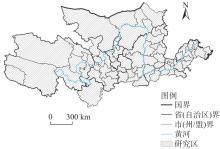
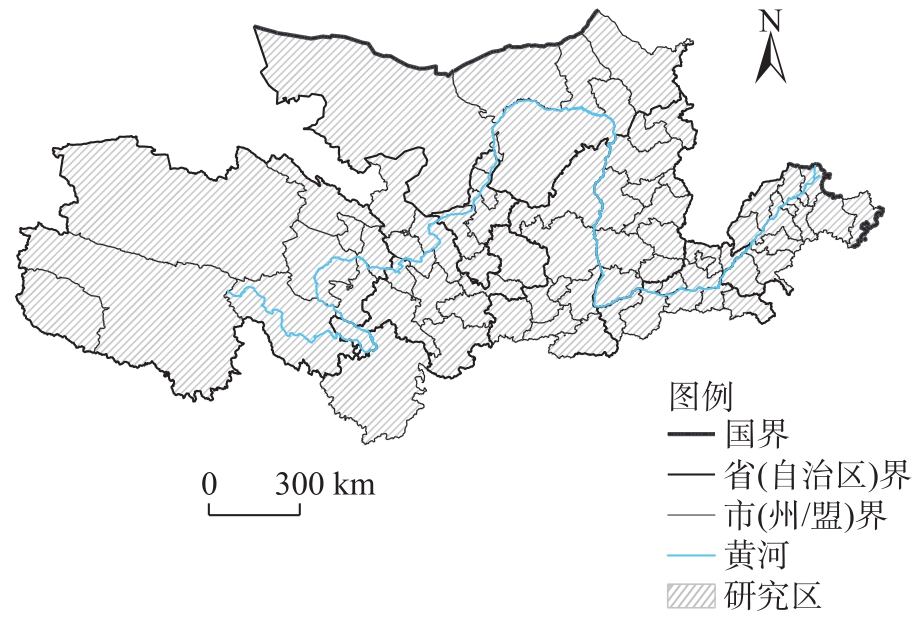
Fig. 1
Schematic diagram of the study area"

Tab. 1
Accessibility and influencing factors of ice and snow tourism destinations in the Yellow River Basin"
| 维度 | 变量 | 符号 | 含义 |
|---|---|---|---|
| 社会维度 | 人口密度/人·km-2 | X1 | 反映人口集聚程度 |
| 人均体育场地面积/m2 | X2 | 反映居民体育资源供给水平 | |
| 城市化率/% | X3 | 反映整体基础设施水平 | |
| 经济维度 | 人均可支配收入/104元 | X4 | 反映居民消费水平 |
| 旅游收入/108元 | X5 | 反映地级市旅游经济的活跃程度 | |
| 公路里程/km | X6 | 反映地级市内交通网络的建设水平 | |
| 生态维度 | 年均降雪量/mm | X7 | 反映冰雪资源禀赋 |
| 高程/m | X8 | 反映地形特点 | |
| 森林覆盖率/% | X9 | 反映生态环境特征 |
Tab. 2
Accessibility of ice and snow tourism destinations in the Yellow River Basin under different function types and basin divisions"
| 维度 | 类别 | 数量 | 比例/% | 可达性 |
|---|---|---|---|---|
| 功能类型 | 旅游体验型 | 178 | 76.72 | 3.85 |
| 城郊学习型 | 47 | 20.26 | 3.58 | |
| 目的地度假型 | 7 | 3.02 | 3.40 | |
| 流域分区 | 上游 | 36 | 15.52 | 4.83 |
| 中游 | 76 | 32.76 | 4.26 | |
| 下游 | 120 | 51.72 | 3.17 |
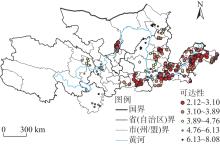
Fig. 2
Spatial pattern of accessibility of ice and snow tourism destinations in the Yellow River Basin"
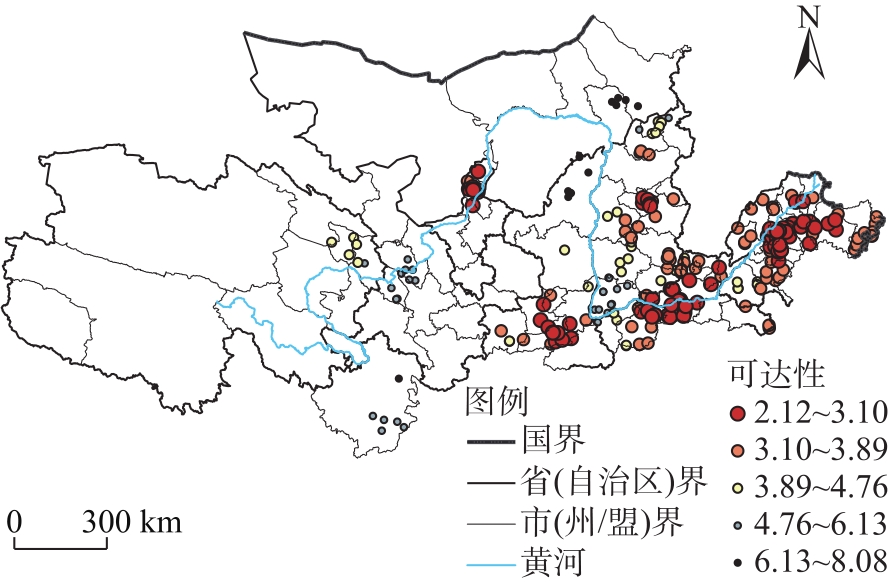
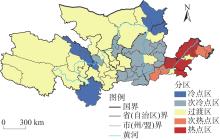
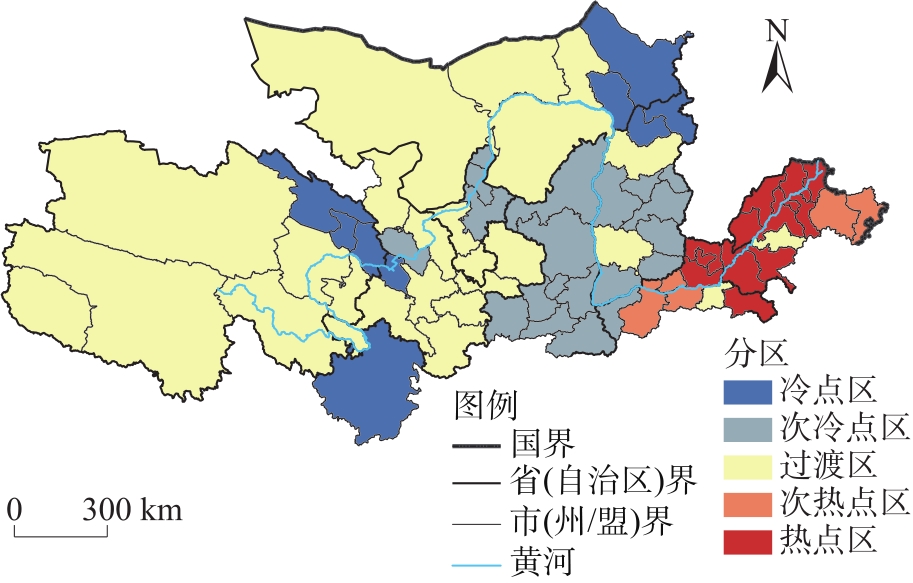
Fig. 3
Analysis of hot and cold spots in accessibility of ice and snow tourism destinations in the Yellow River Basin"
Tab. 3
Detection results of geographic detector factors"
| 变量 | X1 | X2 | X3 | X4 | X5 | X6 | X7 | X8 | X9 |
|---|---|---|---|---|---|---|---|---|---|
| q值 | 0.58 | 0.37 | 0.71 | 0.53 | 0.41 | 0.85 | 0.60 | 0.49 | 0.35 |
Tab. 4
Detection results of different watershed factors"
| 流域 | X1 | X2 | X3 | X4 | X5 | X6 | X7 | X8 | X9 |
|---|---|---|---|---|---|---|---|---|---|
| 上游 | 0.81 | 0.24 | 0.62 | 0.46 | 0.33 | 0.72 | 0.37 | 0.74 | 0.36 |
| 中游 | 0.27 | 0.31 | 0.51 | 0.81 | 0.47 | 0.77 | 0.43 | 0.79 | 0.85 |
| 下游 | 0.77 | 0.84 | 0.72 | 0.53 | 0.35 | 0.89 | 0.73 | 0.38 | 0.24 |
| [1] | 央广网. 把“冷资源”转化为“热动力”让冬季旅游“燃”起来[EB/OL]. [2024-12-01]. https://news.cnr.cn/native/gd/20241201/t20241201_526995329.shtml. |
| [China National Radio. Transforming “Cold Resources” into “Hot Power” to ignite winter tourism[EB/OL]. [2024-12-01]. https://news.cnr.cn/native/gd/20241201/t20241201_526995329.shtml.] | |
| [2] | 冯雪玉. 冰雪出圈, 文旅出彩[N]. 内蒙古日报, 2025-02-18(002). |
| [Feng Xueyu. Ice and snow breaks out, cultural tourism shines[N]. Inner Mongolia Daily, 2025-02-18(002).] | |
| [3] | 王涛. 打好三张文化牌[N]. 中国旅游报, 2025-04-04(001). |
| [Wang Tao. Playing the three cultural cards[N]. China Tourism News, 2025-04-04(001).] | |
| [4] | 牛莹, 马青彦. 热“雪”陇原五彩“冰”纷[N]. 中国旅游报, 2025-02-20(002). |
| [Niu Ying, Ma Qingyan. Hot “Snow” on Longyuan, colorful “Ice” displays[N]. China Tourism News, 2025-02-20(002).] | |
| [5] | 罗浩, 万发达, 李娟. 黄河流域文体旅资源开发与空间集聚特征[J]. 社会科学家, 2024(5): 79-86. |
| [Luo Hao, Wan Fada, Li Juan. Development and spatial agglomeration characteristics of cultural, sports, and tourism resources in the Yellow River Basin[J]. Social Scientist, 2024(5): 79-86.] | |
| [6] | 杨铭. 黄河下游地区体育旅游产业高质量发展: 逻辑、困境与纾解[J]. 体育与科学, 2024, 45(1): 96-105. |
| [Yang Ming. High-quality development of sports tourism industry in the downstream area of the Yellow River: Logic, dilemma and optimize[J]. Journal of Sports and Science, 2024, 45(1): 96-105.] | |
| [7] | 戢晓峰, 薛唯, 李静, 等. 基于时空效用法的黄金周自驾游可达性测度及影响因素研究[J]. 干旱区资源与环境, 2024, 38(11):197-208. |
| [Ji Xiaofeng, Xue Wei, Li Jing, et al. Measurement of accessibility of self-driving tour during Golden Week basedon spatio-temporal utility method[J]. Journal of Arid Land Resources and Environment, 2024, 38(11):197-208.] | |
| [8] | 杨利峰, 高晓宁. 河南省4A级及以上景区公路交通可达性研究[J]. 地域研究与开发, 2023, 42(3): 129-134, 141. |
| [Yang Lifeng, Gao Xiaoning. Study on evolution of adaptation space between county traffic dominanceand agglomeration of tourism industry: A case study of Henan Province[J]. Areal Research and Development, 2023, 42(3): 129-134, 141.] | |
| [9] |
曹开军, 商宁, 王秘秘. 中国西北五省乡村旅游重点村时空分布格局与可达性分析[J]. 干旱区地理, 2023, 46(7): 1196-1205.
doi: 10.12118/j.issn.1000-6060.2022.531 |
|
[Cao Kaijun, Shang Ning, Wang Mimi. Spatial distribution pattern and accessibility analysis of the key ruraltourism villages in the five northwestern provinces of China[J]. Arid Land Geography, 2023, 46(7): 1196-1205.]
doi: 10.12118/j.issn.1000-6060.2022.531 |
|
| [10] |
崔亚芹, 范超云, 梁慧龙, 等. 产业融合进程中冰雪旅游产业高质量发展的系统解构与驱动机制[J]. 沈阳体育学院学报, 2024, 43(6): 8-15.
doi: 10.12163/j.ssu.20241002 |
|
[Cui Yaqin, Fan Chaoyun, Liang Huilong, et al. System deconstruction and driving mechanisms for high-quality development of ice and snow tourism industry in the process of industrial integration[J]. Journal of Shenyang Sport University, 2024, 43(6): 8-15.]
doi: 10.12163/j.ssu.20241002 |
|
| [11] | 王恒, 宿伟玲. 冰雪文化体育旅游融合发展机制、模式及路径[J]. 社会科学家, 2024(1): 87-95. |
| [Wang Heng, Su Weiling. Mechanism, model, and path of the integration of ice and snow cultural sports tourism[J]. Social Scientist, 2024(1): 87-95.] | |
| [12] |
杨建平, 唐凡, 郭新瑜, 等. 中国冰雪旅游发展模式及其体系建构[J]. 冰川冻土, 2023, 45(6): 1923-1939.
doi: 10.7522/j.issn.1000-0240.2023.0147 |
|
[Yang Jianping, Tang Fan, Guo Xinyu, et al. Development modes and system establishments of ice and snow tourism in China[J]. Journal of Glaciology and Geocryology, 2023, 45(6): 1923-1939.]
doi: 10.7522/j.issn.1000-0240.2023.0147 |
|
| [13] | 唐承财, 方琰, 厉新建, 等. 新时代中国冰雪旅游高质量发展模式构建与路径创新[J]. 干旱区资源与环境, 2023, 37(12): 140-150. |
| [Tang Chengcai, Fang Yan, Li Xinjian, et al. Construction of high-quality development model and innovation path of China’s ice and snow tourism in the new era[J]. Journal of Arid Land Resources and Environment, 2023, 37(12): 140-150.] | |
| [14] |
Tóth G, Lóránt D. Tourism and accessibility: An integrated approach[J]. Applied Geography, 2010, 30(4): 666-677.
doi: 10.1016/j.apgeog.2010.01.008 |
| [15] | 朱政, 朱翔. 基于空间模拟的都市圈旅游景区综合交通可达性分析——以长株潭都市圈为例[J]. 旅游学刊, 2024, 39(1): 130-146. |
| [Zhu Zheng, Zhu Xiang. Analysis on comprehensive transportation accessibility of scenic spots in metropolitan area based on spatial simulation: A case study of Changsha-Zhuzhou-Xiangtan metropolitan area[J]. Tourism Tribune, 2024, 39(1): 130-146.] | |
| [16] | 付强, 杨壮, 董锁成, 等. 河南省国家级传统村落空间可达性及影响因素研究[J]. 河南师范大学学报(自然科学版), 2021, 49(6): 82-90. |
| [Fu Qiang, Yang Zhuang, Dong Suocheng, et al. Research on spatial accessibility and influencing factors of national traditional villages in Henan Province[J]. Journal of Henan Normal University (Natural Science Edition), 2021, 49(6): 82-90.] | |
| [17] |
何小芊, 刘策. 长江经济带国家级自然保护地空间可达性及影响因素[J]. 长江科学院院报, 2022, 39(11): 9-16.
doi: 10.11988/ckyyb.202111682022 |
| [He Xiaoqian, Liu Ce. Spatial accessibility of national nature reserves in the Yangtze River Economic Belt and its influencing factors[J]. Journal of Changjiang River Scientific Research Institute, 2022, 39(11): 9-16.] | |
| [18] | Coppola P, Carbone A, Aveta C, et al. Assessing transport policies for tourist mobility based on accessibility indicators[J]. European Transport Research Review, 2020, 12(1): 56, doi: 10.1186/s125-44-020-00444-4. |
| [19] | Recchi E, Deutschmann E, Gabrielli L, et al. The global visa cost divide: How and why the price for travel permits varies worldwide[J]. Political Geography, 2021(86): 102350, doi: 10.1016/j.polgeo.2021.102350. |
| [20] |
Muñoz C, Álvarez A, Baños J. Modelling the effect of weather on tourism: Does it vary across seasons?[J]. Tourism Geographies, 2023, 25(1): 265-286.
doi: 10.1080/14616688.2020.1868019 |
| [21] | Sun F, Xu M, Li Z, et al. Spatial distribution, accessibility, and influencing factors of the tourism and leisure industry in Qingdao, China[J]. Sustainability, 2024, 16(16): 6961, doi: 10.3390/su16-166961. |
| [22] |
Pütz M, Gallati D, Kytzia S, et al. Winter tourism, climate change, and snowmaking in the Swiss Alps: Tourists’ attitudes and regional economic impacts[J]. Mountain Research and Development, 2011, 31(4): 357-362.
doi: 10.1659/MRD-JOURNAL-D-11-00039.1 |
| [23] |
Knowles N, Scott D, Steiger R. Climate change and the future of ski tourism in Canada’s western mountains[J]. Tourism and Hospitality, 2024, 5(1): 187-202.
doi: 10.3390/tourhosp5010013 |
| [24] |
Komatsu H, Ohe Y. The effectiveness of countermeasure services against declining visitor numbers to ski resorts in Nagano, Japan[J]. Tourism Economics, 2025, 31(3): 538-556.
doi: 10.1177/13548166241281801 |
| [25] |
窦文康, 王世金, 韩彤彤, 等. 中国滑雪场可达性及市场潜力测度[J]. 地理科学, 2021, 41(2): 319-327.
doi: 10.13249/j.cnki.sgs.2021.02.015 |
| [Dou Wenkang, Wang Shijin, Han Tongtong, et al. Measurement of accessibility and market potential of ski resorts in China[J]. Geographical Science, 2021, 41(2): 319-327.] | |
| [26] | 张宇飞, 任艳路. 东北三省滑雪场空间分布与可达性研究[J]. 大连民族大学学报, 2023, 25(2): 135-140. |
| [Zhang Yufei, Ren Yanlu. Study on the spatial distribution and accessibility of ski resorts in the Three Northeastern Provinces[J]. Journal of Dalian Minzu University, 2023, 25(2): 135-140.] | |
| [27] |
唐承财, 肖小月, 秦珊. 中国冰雪旅游研究: 内涵辨析、脉络梳理与体系构建[J]. 地理研究, 2023, 42(2): 332-351.
doi: 10.11821/dlyj020220353 |
| [Tang Chengcai, Xiao Xiaoyue, Qin Shan. Research on ice and snow tourism in China: Connotation identification, context sorting and system construction[J]. Geographical Research, 2023, 42(2): 332-351.] | |
| [28] | 张瑞林. 新时代冰雪旅游协同生态文明建设: 逻辑理路与推进策略[J]. 体育学研究, 2024, 38(2): 52-62. |
| [Zhang Ruilin. Collaborative ecological civilization construction of ice and snow tourism in the new era: Logic and promotion strategies[J]. Sports Studies, 2024, 38(2): 52-62.] | |
| [29] |
孙辉, 刘冬磊, 王子朴. 中国式现代化视域下冰雪产业高质量发展: 基础、使命与路径[J]. 沈阳体育学院学报, 2023, 42(2): 9-16.
doi: 10.12163/j.ssu.20221593 |
| [Sun Hui, Liu Donglei, Wang Zipu. High-quality development of ice and snow industry in the perspective of chinese path to modernization: Foundation, missions and paths[J]. Journal of Shenyang Sport University, 2023, 42(2): 9-16.] | |
| [30] |
梁巧霞, 韦孟丹, 梁赛, 等. 新疆滑雪产业的经济和社会效应分析[J]. 冰川冻土, 2023, 45(4): 1401-1412.
doi: 10.7522/j.issn.1000-0240.2023.0107 |
|
[Liang Qiaoxia, Wei Mengdan, Liang Sai, et al. Analysis of economic and social effects of ski industry in Xinjiang[J]. Journal of Glaciology and Geocryology, 2023, 45(4): 1401-1412.]
doi: 10.7522/j.issn.1000-0240.2023.0107 |
|
| [31] | 张莹, 王飞, 王志博. 新疆滑雪旅游服务实践经验与优化路向[J]. 体育文化导刊, 2024(1): 91-96, 110. |
| [Zhang Ying, Wang Fei, Wang Zhibo. Practical experience and optimization path of skiing tourism services in Xinjiang[J]. Sports Culture Guide, 2024(1): 91-96, 110.] | |
| [32] | 刘贝, 刘欢欢, 王国荣. 东北三省冰雪体育旅游高质量发展研究[J]. 体育文化导刊, 2024(8): 84-90. |
| [Liu Bei, Liu Huanhuan, Wang Guorong. High-quality development of ice and snow sports tourism in the three provinces of northeast China[J]. Sports Culture Guide, 2024(8): 84-90.] | |
| [33] |
李鹏, 王熙尧, 王辉, 等. 中国东北三省冰雪旅游产业时空格局演变特征及优化策略研究[J]. 地理研究, 2025, 44(5): 1342-1360.
doi: 10.11821/dlyj020240640 |
| [Li Peng, Wang Xiyao, Wang Hui, et al. Spatio-temporal characteristics and optimization strategy ofice and snow tourism industry in northeast China[J]. Geographical Research, 2025, 44(5):1342-1360.] | |
| [34] | 冯俊新, 李墨寒, 李时宇. 中国内地公路可达性演变研究——基于三种可达性指标的视角[J/OL]. 经济地理. [2024-10-09]. http://kns.cnki.net/kcms/detail/43.1126.K.20241008.1109.002.html. |
| [Feng Junxin, Li Mohan, Li Shiyu. The evolution of road accessibility in Chinese mainland:Analysis withthree accessibility indicators[J/OL]. Economic Geography.[2024-10-09]. http://kns.cnki.net/kcms/detail/43.1126.K.20241008.1109.002.html.] | |
| [35] | 杨玉珍, 闫佳笑, 杨洋, 等. 黄河流域旅游生态效率时空演变及空间溢出效应———基于73个城市数据的分析[J]. 生态学报, 2022, 42(20): 8202-8212. |
| [Yang Yuzhen, Yan Jiaxiao, Yang Yang, et al. The spatio-temporal evolution and spatial spillover effect of tourism eco-efficiency in the Yellow River Basin: Based on data from the 73 cities[J]. Acta Ecologica Sinica, 2022, 42(20): 8202-8212.] | |
| [36] | 胡玉洁, 蒋凯伦, 陈准, 等. 山区县域旅游资源空间结构及其交通可达性分析——以河南栾川县为例[J]. 农业现代化研究, 2023, 44(5): 869-880. |
| [Hu Yujie, Jiang Kailun, Chen Zhun, et al. Analysis of the spatial structure of tourism resources and traffic accessibility in mountainous counties: Taking Luanchuan County, Henan Province as an example[J]. Research of Agricultural Modernization, 2023, 44(5): 869-880.] | |
| [37] |
周海涛, 马钰松, 樊亚宇, 等. 内蒙古红色旅游资源空间分布及可达性分析[J]. 干旱区地理, 2023, 46(5): 814-822.
doi: 10.12118/j.issn.1000-6060.2022.423 |
|
[Zhou Haitao, Ma Yusong, Fan Yayu, et al. Spatial distribution and accessibility analysis of red tourismresources in Inner Mongolia[J]. Arid Land Geography, 2023, 46(5): 814-822.]
doi: 10.12118/j.issn.1000-6060.2022.423 |
|
| [38] | 大同市人民政府. 大同市召开2024—2025大同冰雪季赛事活动情况介绍新闻发布会[EB/OL]. [2024-12-01]. https://www.dt.gov.cn/dtszf/xwfbh/202412/fb355bd8dc254fec9884c20aa7941406.shtml. |
| [Datong Municipal People’s Government. Press conference introducing the events of the 2024—2025 Datong ice and snow season[EB/OL]. [2024-12-01]. https://www.dt.gov.cn/dtszf/xwfbh/202412/fb355bd8dc254fec9884c20aa7941406.shtml.] | |
| [39] | 山东省体育局. 2025年全国体育产业工作会议现场直击[EB/OL]. [2025-04-17]. http://ty.shandong.gov.cn/tycy/cyxx/202504/t2025-0417_4816071.html. |
| [Shandong Provincial Sports Bureau. Live coverage of the 2025 national sports industry work conference[EB/OL]. [2025-04-17]. http://ty.shandong.gov.cn/tycy/cyxx/202504/t2025-0417_4816071.html.] | |
| [40] | 新华网. 济南冰雪经济持续升温各滑雪场客流量增多[EB/OL]. [2024-12-28]. http://www.sd.xinhuanet.com/20241228/f329222f-24434663b451fbd44ce355eb/c.html. |
| [Xinhua News Agency. Jinan’s ice and snow economy continues to heat up as ski resorts see increased visitor numbers[EB/OL]. [2024-12-28]. http://www.sd.xinhuanet.com/20241228/f329222f24434663b451fbd44ce355-eb/c.html.] | |
| [41] |
朱磊, 李燕楠, 徐佳慧, 等. 中国冰雪旅游地空间分布格局及成因[J]. 干旱区地理, 2024, 47(8): 1399-1410.
doi: 10.12118/j.issn.1000-6060.2024.120 |
|
[Zhu Lei, Li Yannan, Xu Jiahui, et al. Spatial distribution pattern and causes of ice and snow tourism in China[J]. Arid Land Geography, 2024, 47(8):1399-1410.]
doi: 10.12118/j.issn.1000-6060.2024.120 |
|
| [42] | 人民网. 全国主要城市3小时通达, 2035年山东交通将变成这样[EB/OL]. [2024-12-20]. http://sd.people.com.cn/n2/2024/1220/c166188-41081901.html. |
| [People’s Daily. Nationwide major cities reachable within 3 hours: How Shandong’s transportation will transform by 2035[EB/OL]. [2024-12-20]. http://sd.people.com.cn/n2/2024/1220/c166188-41081901.html.] | |
| [43] | 黄馨, 韩玲, 赵永华, 等. 城市社会-生态系统研究理论基础与分析框架[J]. 生态学报, 2024, 44(15): 6892-6905. |
| [Huang Xin, Han Ling, Zhao Yonghua, et al. Theoretical foundations and analytical frameworks for urban socio-ecological system[J]. Acta Ecologica Sinica, 2024, 44(15): 6892-6905.] | |
| [44] | 新华网. 济南公交推出观光巴士双线双日畅游通票[EB/OL]. [2024-12-25]. http://www.sd.xinhuanet.com/20241225/4ba8400-a888e4384b8682794fdd71946/c.html. |
| [Xinhua News Agency. Jinan public transport launchestwo routes, two-day sightseeing bus pass[EB/OL]. [2024-12-25]. http://www.sd.xinhuanet.com/2024-1225/4ba8400a888e4384b8682794fdd71946/c.html.] | |
| [45] | 赵静, 郭佩云, 汪辉. 黄河流域文化产业—旅游产业—生态环境耦合协调研究[J]. 人文地理, 2024, 39(5): 184-192. |
| [Zhao Jing, Guo Peiyun, Wang Hui. Research on coupling coordination of the cultural industry, the tourism industry, and the ecological environment in the Yellow River Basin[J]. Human Geography, 2024, 39(5): 184-192.] | |
| [46] | 闫静, 刘光怡, 徐诗枧, 等. 我国冰雪体育旅游可持续发展研究[J]. 体育文化导刊, 2024(10): 77-83. |
| [Yan Jing, Liu Guangyi, Xu Shijian, et al. Sustainable development of ice and snow sports tourism in China[J]. Sports Culture Guide, 2024(10): 77-83.] |
|
||

