Arid Land Geography ›› 2026, Vol. 49 ›› Issue (11): 2426-2436.doi: 10.12118/j.issn.1000-6060.2025.757
• Regional Development • Previous Articles Next Articles
JIA Xinyu1( ), TANG Mengying1,2,3, XIA Nan1,2,3(), LI Anlan1, LI Yufei1, SUN Sifan1
Received:2025-11-24
Revised:2026-01-26
Online:2026-11-25
Published:2026-11-13
Contact:
XIA Nan
E-mail:estella_1215@163.com;xn_gis@xju.edu.cn
JIA Xinyu, TANG Mengying, XIA Nan, LI Anlan, LI Yufei, SUN Sifan. Identification of key ecological restoration areas in Xinjiang based on the “three barriers and two belts” ecological security pattern[J].Arid Land Geography, 2026, 49(11): 2426-2436.
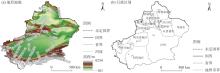
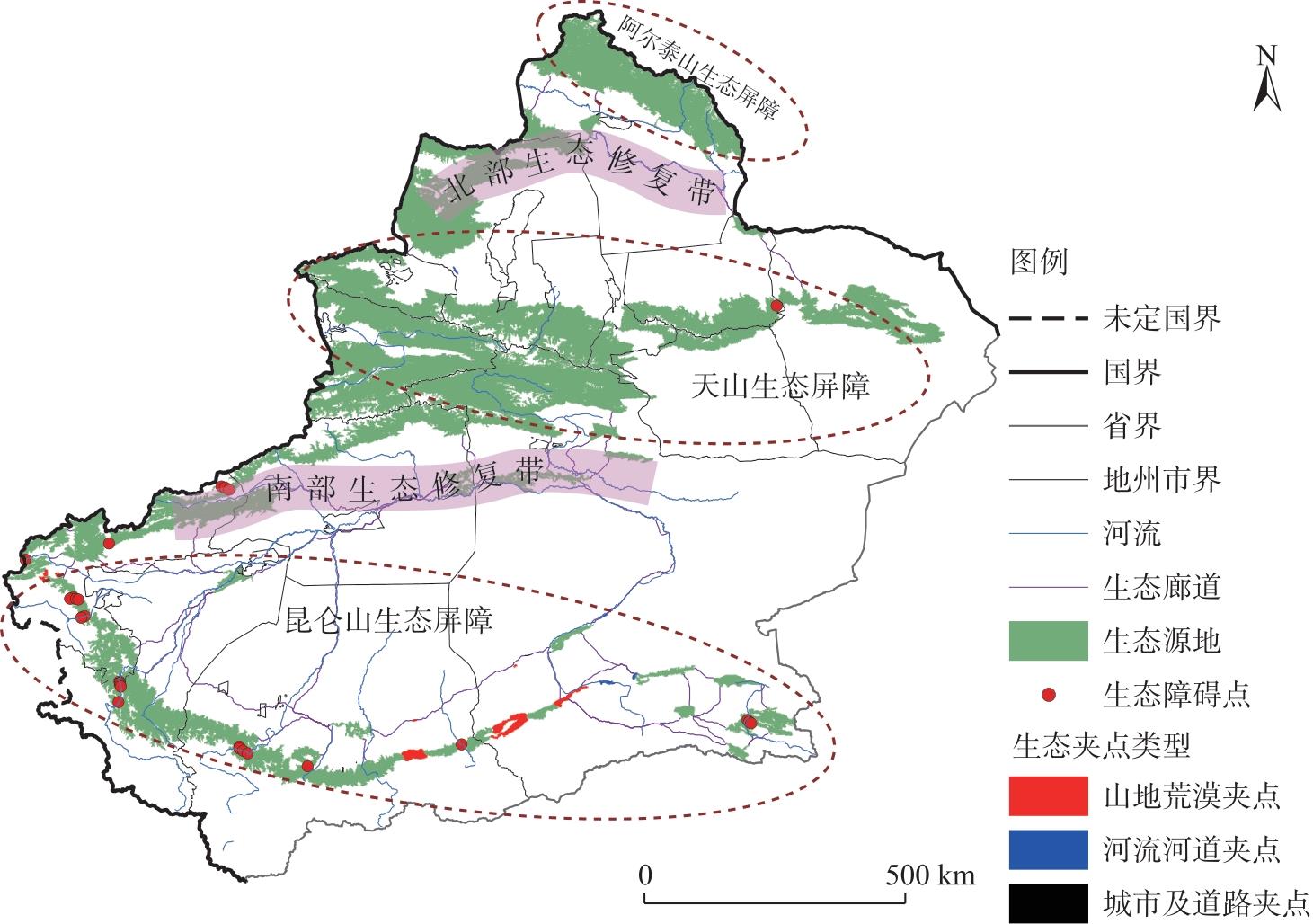
Fig. 1
Overview of the study area"
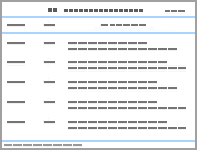
Tab. 1
Rating and weights of resistance factors"
| 阻力因子 | 分级标准 | 阻力系数 | 权重 | 阻力因子 | 分级标准 | 阻力系数 | 权重 |
|---|---|---|---|---|---|---|---|
| 归一化植被指数 | -0.2000~0.0998 | 9 | 0.1409 | 距河流距离/m | <500 | 1 | 0.1875 |
| 0.0998~0.2298 | 7 | 500~1500 | 3 | ||||
| 0.2298~0.4248 | 5 | 1500~3500 | 5 | ||||
| 0.4248~0.6427 | 3 | 3500~10000 | 7 | ||||
| 0.6427~0.9990 | 1 | >10000 | 9 | ||||
| 高程/m | <939 | 1 | 0.0981 | 距道路距离/m | <500 | 9 | 0.0625 |
| 939~1714 | 3 | 500~1000 | 7 | ||||
| 1714~2867 | 5 | 1000~5000 | 5 | ||||
| 2867~4246 | 7 | 5000~10000 | 3 | ||||
| >4246 | 9 | >10000 | 1 | ||||
| 坡度/(°) | <5 | 1 | 0.1554 | 土地利用类型 | 森林,草原 | 1 | 0.3556 |
| 5~15 | 3 | 灌木 | 2 | ||||
| 15~25 | 5 | 水域,湿地 | 5 | ||||
| 25~35 | 7 | 冰雪,裸地 | 30 | ||||
| >35 | 9 | 农田 | 40 | ||||
| 不透水面 | 50 |
Tab. 2
Landscape type classification statistics"
| 景观要素 | 面积/km2 | 占生态景观面积比例/% | 占研究区面积比例/% |
|---|---|---|---|
| 核心区 | 325394.54 | 83.10 | 19.83 |
| 孤岛 | 6570.09 | 1.68 | 0.40 |
| 孔隙区 | 10993.20 | 2.81 | 0.67 |
| 边缘区 | 29161.90 | 7.44 | 1.78 |
| 桥接区 | 6449.84 | 1.65 | 0.39 |
| 环路区 | 3784.94 | 0.97 | 0.23 |
| 支线区 | 9199.11 | 2.35 | 0.56 |
| 总计 | 391553.62 | 100.00 | 23.86 |
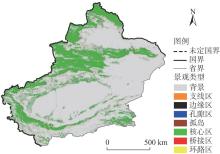
Fig. 2
Spatial distribution of landscape types"
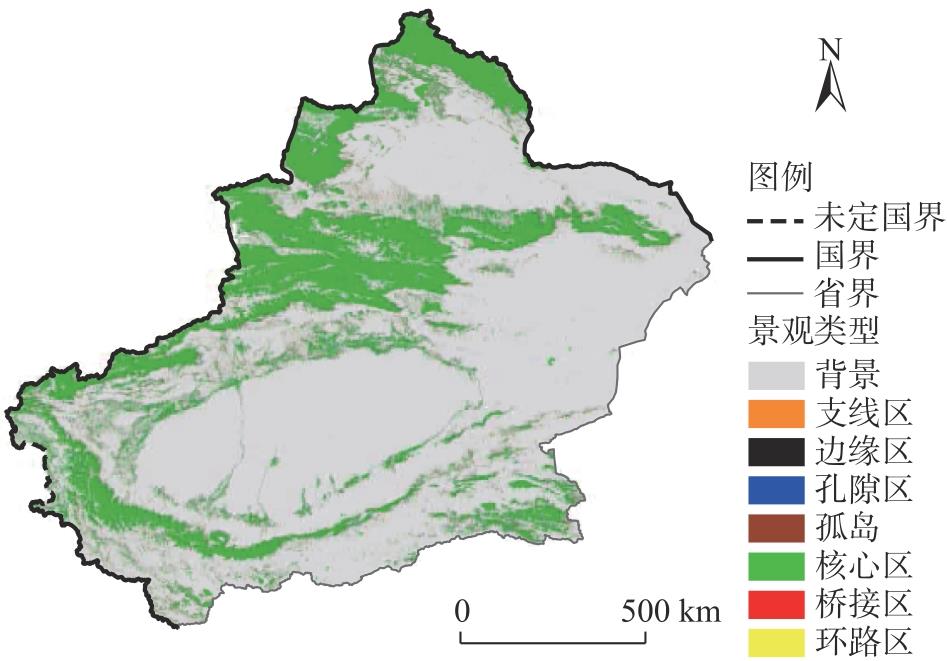
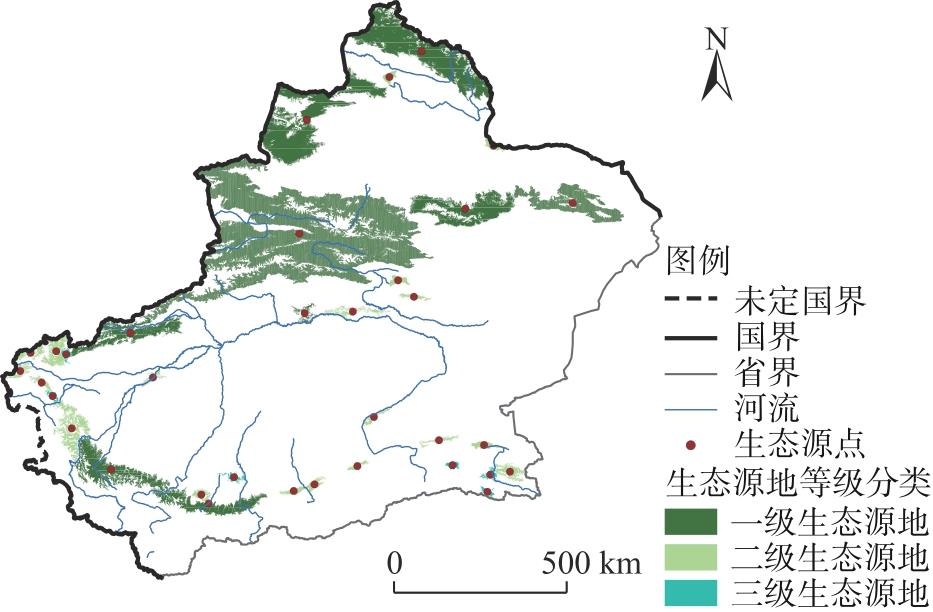
Fig. 3
Spatial distribution of ecological source areas"
Tab. 3
Classification of ecological source areas and landscape connectivity indices"
| 源地序号 | dIIC | dPC | 均值 | 源地序号 | dIIC | dPC | 均值 | 源地序号 | dIIC | dPC | 均值 |
|---|---|---|---|---|---|---|---|---|---|---|---|
| 1 | 0.48 | 0.80 | 0.64 | 13 | 0.64 | 0.76 | 0.70 | 25 | 0.39 | 0.37 | 0.38 |
| 2 | 16.95 | 16.87 | 16.91 | 14 | 3.61 | 5.96 | 4.78 | 26 | 0.43 | 0.29 | 0.36 |
| 3 | 18.85 | 22.96 | 20.91 | 15 | 0.51 | 0.52 | 0.52 | 27 | 0.32 | 0.35 | 0.34 |
| 4 | 0.46 | 0.77 | 0.61 | 16 | 0.33 | 0.33 | 0.33 | 28 | 0.36 | 0.40 | 0.38 |
| 5 | 10.91 | 11.06 | 10.99 | 17 | 1.09 | 1.17 | 1.13 | 29 | 0.52 | 0.47 | 0.49 |
| 6 | 0.56 | 0.54 | 0.55 | 18 | 0.22 | 0.23 | 0.22 | 30 | 3.77 | 3.31 | 3.54 |
| 7 | 75.08 | 76.16 | 75.62 | 19 | 0.39 | 1.19 | 0.79 | 31 | 0.24 | 0.27 | 0.25 |
| 8 | 5.75 | 5.74 | 5.74 | 20 | 2.46 | 2.45 | 2.45 | 32 | 0.29 | 0.29 | 0.29 |
| 9 | 5.09 | 5.17 | 5.13 | 21 | 0.35 | 0.50 | 0.43 | 33 | 0.74 | 0.70 | 0.72 |
| 10 | 0.28 | 0.30 | 0.29 | 22 | 5.44 | 5.18 | 5.31 | 34 | 0.21 | 0.20 | 0.20 |
| 11 | 1.35 | 1.38 | 1.36 | 23 | 0.28 | 0.30 | 0.29 | ||||
| 12 | 0.43 | 0.40 | 0.41 | 24 | 0.34 | 0.38 | 0.36 |
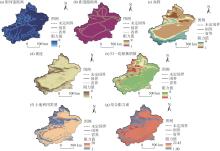
Fig. 4
Construction of various resistance factors and comprehensive resistance surface"
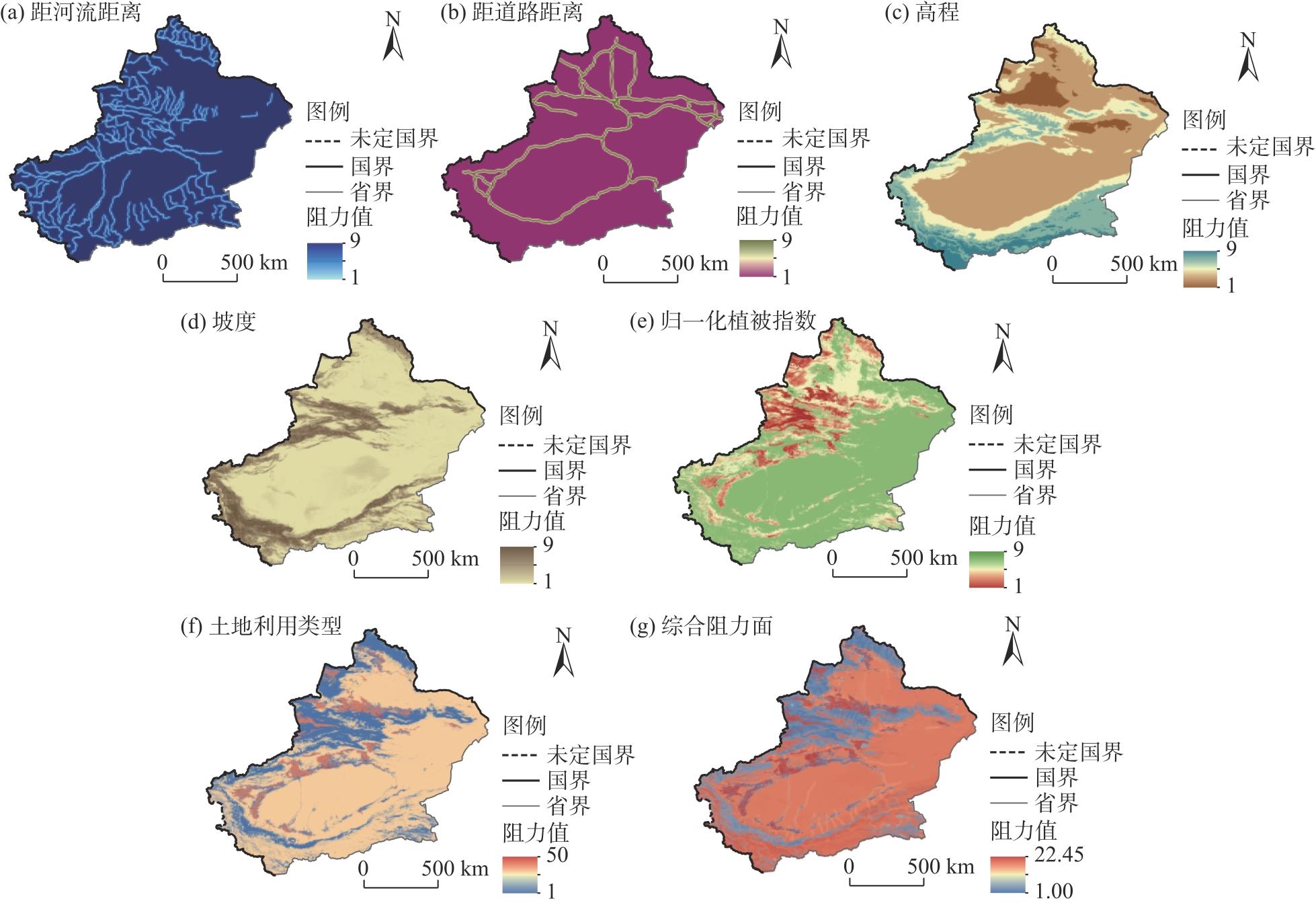
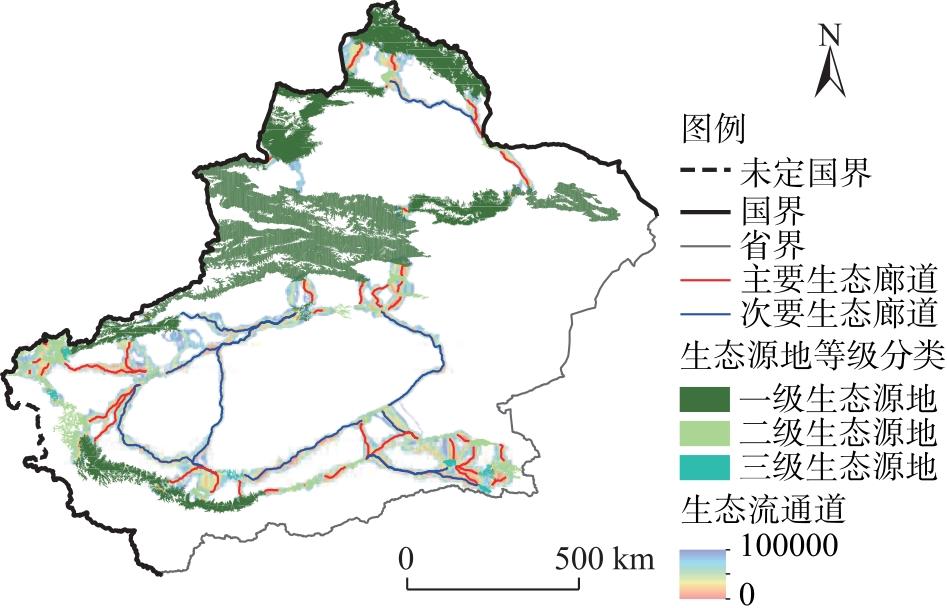
Fig. 5
Spatial distribution of ecological corridor grades"
Tab. 4
Statistics of ecological pinch points and ecological barrier points"
| 地州市 | 区县 | 夹点 | 障碍点 | |||
|---|---|---|---|---|---|---|
| 数量 | 面积/km2 | 数量 | 面积/km2 | |||
| 和田地区 | 民丰县 | 2 | 36.84 | 1 | 8.48 | |
| 于田县 | 1 | 682.98 | - | - | ||
| 皮山县 | - | - | 2 | 9.76 | ||
| 策勒县 | - | - | 1 | 7.17 | ||
| 克孜勒苏柯尔克孜自治州 | 乌恰县 | 5 | 141.92 | 6 | 48.08 | |
| 阿克陶县 | 2 | 23.96 | 3 | 11.48 | ||
| 阿合奇县 | - | - | 3 | 17.90 | ||
| 巴音郭楞蒙古自治州 | 且末县 | 10 | 1577.23 | - | - | |
| 博尔塔拉蒙古自治州 | 阿拉山口市 | 1 | 65.72 | - | - | |
| 塔城地区 | 乌苏市 | 1 | 23.14 | - | - | |
| 乌鲁木齐市 | 沙依巴克区 | 1 | 14.15 | - | - | |
| 昌吉回族自治州 | 木垒哈萨克自治县 | - | - | 1 | 6.30 | |
| 喀什地区 | 塔什库尔干塔吉克自治县 | - | - | 4 | 11.18 | |
| 巴音郭楞蒙古自治州 | 若羌县 | - | - | 3 | 11.15 | |
Fig. 6
Spatial distribution of ecological pinch points"
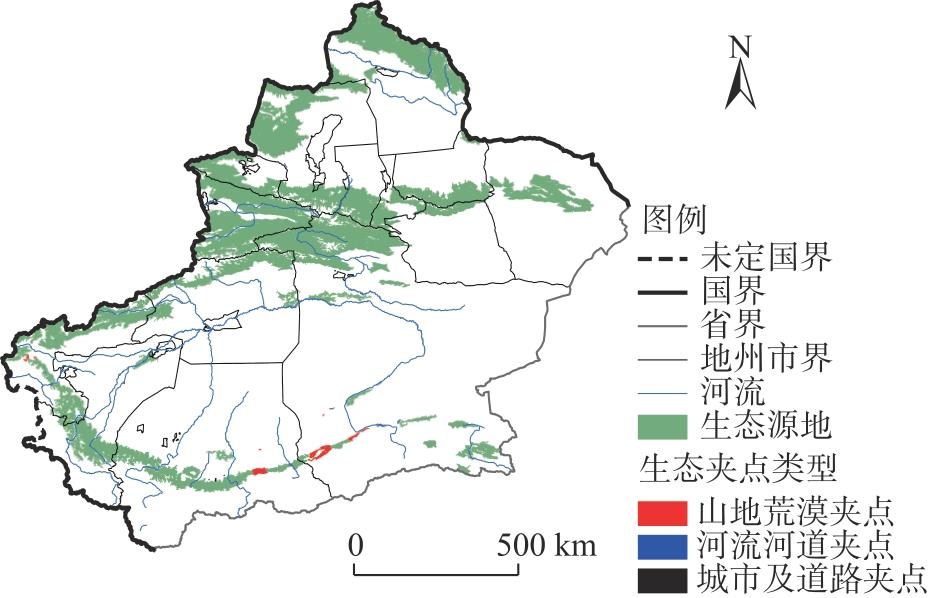
Tab. 5
Area statistics of land use types in ecological pinch points"
| 土地利用类型 | 面积/km2 | 占生态夹点面积比例/% | 土地利用类型 | 面积/km2 | 占生态夹点面积比例/% |
|---|---|---|---|---|---|
| 农田 | 8.29 | 0.32 | 冰雪 | 0.95 | 0.04 |
| 森林 | 1.01 | 0.04 | 裸地 | 923.52 | 35.99 |
| 草地 | 1625.81 | 63.36 | 不透水面 | 4.69 | 0.18 |
| 水体 | 1.32 | 0.05 | 湿地 | 0.37 | 0.01 |
Fig. 7
Spatial distribution of ecological barrier points"
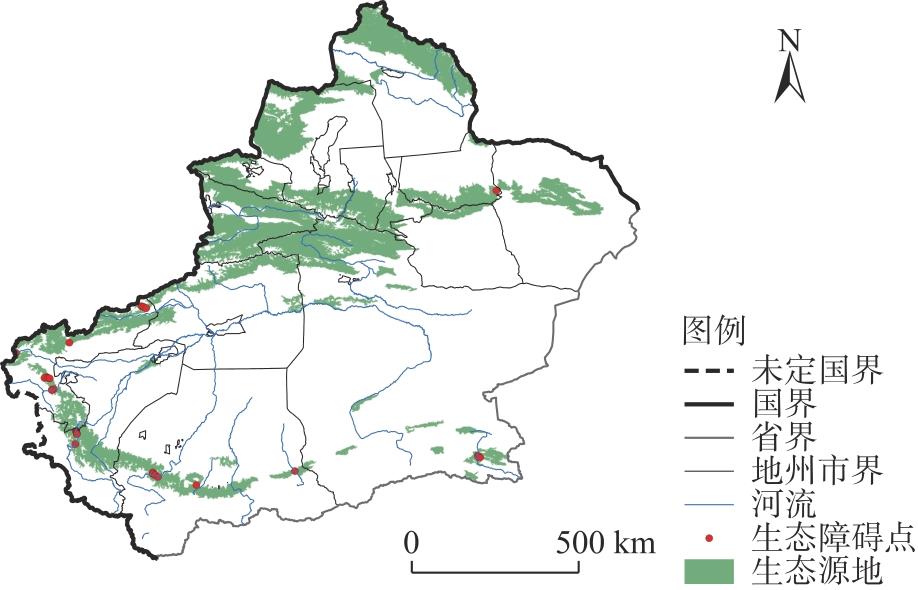
Tab. 6
Area statistics of land use types for ecological barrier points"
| 土地利用类型 | 面积/km2 | 占生态障碍点面积比例/% |
|---|---|---|
| 农田 | 1.95 | 1.48 |
| 草地 | 68.19 | 51.86 |
| 裸地 | 61.34 | 46.66 |
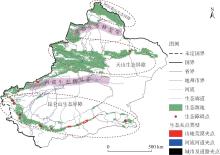
Fig. 8
Optimization pattern of ecological security"
| [1] | Yi J L, Zhang Y, Li X, et al. Building a more secure territory spatial pattern in China: An analysis based on human-environment interactions[J]. Land, 2023, 12(12): 2137, doi: 10.3390/LAND12-122137. |
| [2] |
张帅航, 原野, 苗颖凤, 等. 国土空间生态保护修复对中国脱贫地区经济发展的影响——基于PSM-DID方法的实证分析[J]. 干旱区地理, 2025, 48(5): 930-940.
doi: 10.12118/j.issn.1000-6060.2024.525 |
|
[Zhang Shuaihang, Yuan Ye, Miao Yingfeng, et al. Impact of territorial spatial ecological protection and restoration on the economic development of China poverty-alleviated regions: Empirical analysis based on PSM-DID method[J]. Arid Land Geography, 2025, 48(5): 930-940.]
doi: 10.12118/j.issn.1000-6060.2024.525 |
|
| [3] | 苏香燕, 周妍, 张成鹏, 等. 山水林田湖草沙一体化保护和修复工程空间布局与生物多样性保护需求的关联性[J]. 生态学报, 2025, 45(11): 5113-5123. |
| [Su Xiangyan, Zhou Yan, Zhang Chengpeng, et al. Association analysis between the spatial layout of holistic ecological conservation and restoration projects of mountains, rivers, forests, farmlands, lakes, grasslands and deserts and the demand for biodiversity conservation[J]. Acta Ecologica Sinica, 2025, 45(11): 5113-5123.] | |
| [4] |
吕飞南, 郭炳茹, 牛新生, 等. 国内外生态保护修复技术体系及其标准比较[J]. 应用生态学报, 2025, 36(12): 3595-3602.
doi: 10.13287/j.1001-9332.202512.032 |
|
[Lü Feinan, Guo Bingru, Niu Xinsheng, et al. Comparison of ecological protection and restoration technology systems and their standards at home and abroad[J]. Chinese Journal of Applied Ecology, 2025, 36(12): 3595-3602.]
doi: 10.13287/j.1001-9332.202512.032 |
|
| [5] | 俞孔坚. 生物保护的景观生态安全格局[J]. 生态学报, 1999, 19(1): 10-17. |
| [Yu Kongjian. Landscape ecological security patterns in biological conservation[J]. Acta Ecologica Sinica, 1999, 19(1): 10-17.] | |
| [6] | Li J M, Liang L E, Chao Y, et al. Construction of the ecological security pattern of Mu Us Sandy Land on the basis of the “source-resistance-corridor” theory[J]. Ecological Indicators, 2025, 171: 113162, doi: 10.1016/j.ecolind.2025.113162. |
| [7] | 王晓峰, 朱梦娜, 张欣蓉, 等. 基于“源地-阻力-廊道”的三江源区生态安全格局构建[J]. 生态学报, 2024, 44(11): 4609-4623. |
| [Wang Xiaofeng, Zhu Mengna, Zhang Xinrong, et al. Ecological security pattern construction of the Three-River Source Region based on source-resistance-corridor[J]. Acta Ecologica Sinica, 2024, 44(11): 4609-4623.] | |
| [8] | 张梦瑶, 易桂花, 张廷斌, 等. 川西高原荒野地优先保护区识别[J]. 生态学报, 2025, 45(14): 7105-7122. |
| [Zhang Mengyao, Yi Guihua, Zhang Tingbin, et al. Study of identifying wilderness areas for priority conservation on the western Sichuan Plateau[J]. Acta Ecologica Sinica, 2025, 45(14): 7105-7122.] | |
| [9] | Wu C S, Guo X W, Liu F, et al. Land use zoning planning based on ecosystem services can improve regional comprehensive benefits[J]. Ecological Indicators, 2025, 181: 114420, doi: 10.1016/j.ecolind.2025.114420. |
| [10] | 秦子博, 玄锦, 黄柳菁, 等. 基于MSPA和MCR模型的海岛型城市生态网络构建——以福建省平潭岛为例[J]. 水土保持研究, 2023, 30(2): 303-311. |
| [Qin Zibo, Xuan Jin, Huang Liujing, et al. Ecological network construction of sea-island city based on MSPA and MCR model: A case study of Pingtan Island, Fujian Province[J]. Research of Soil and Water Conservation, 2023, 30(2): 303-311.] | |
| [11] |
闫晓梅, 王宏卫, 罗魁, 等. 基于生态安全格局确定县域生物多样性保护的优先区域——以布尔津县为例[J]. 干旱区地理, 2025, 48(4): 586-598.
doi: 10.12118/j.issn.1000-6060.2024.354 |
|
[Yan Xiaomei, Wang Hongwei, Luo Kui, et al. Determining priority areas for county biodiversity conservation based on ecological security pattern: A case study of Burqin County[J]. Arid Land Geography, 2025, 48(4): 586-598.]
doi: 10.12118/j.issn.1000-6060.2024.354 |
|
| [12] | Xue F, Yang Y R, Hu Y N. Integrating supply and benefits of ecosystem services into ecological security pattern: A spatial flow perspective[J]. Ecological Indicators, 2024, 166: 112455, doi: 10.1016/j.ecolind.2024.112455. |
| [13] | Nie H R, Zhao Y, Zhu J, et al. Ecological security pattern construction in typical oasis area based on ant colony optimization: A case study in Yili River Valley, China[J]. Ecological Indicators, 2024, 169: 112770, doi: 10.1016/j.ecolind.2024.112770. |
| [14] |
Prima M C, Renaud J, Witté I, et al. A comprehensive framework to assess multi-species landscape connectivity[J]. Methods in Ecology and Evolution, 2024, 15(12): 2385-2399.
doi: 10.1111/mee3.v15.12 |
| [15] |
宋利利, 秦明周. 整合电路理论的生态廊道及其重要性识别[J]. 应用生态学报, 2016, 27(10): 3344-3352.
doi: 10.13287/j.1001-9332.201610.035 |
|
[Song Lili, Qin Mingzhou. Identification of ecological corridors and its importance by integrating circuit theory[J]. Chinese Journal of Applied Ecology, 2016, 27(10): 3344-3352.]
doi: 10.13287/j.1001-9332.201610.035 |
|
| [16] |
杜箫宇, 吕飞南, 王春雨, 等. 基于MSPA-Conefor-MCR的县域尺度生态网络构建——以延庆区为例[J]. 应用生态学报, 2023, 34(4): 1073-1082.
doi: 10.13287/j.1001-9332.202303.023 |
| [Du Xiaoyu, Lü Feinan, Wang Chunyu, et al. Construction of ecological network based on MSPA-Conefor-MCR at the county scale: A case study in Yanqing District, Beijing, China[J]. Chinese Journal of Applied Ecology, 2023, 34(4): 1073-1082.] | |
| [17] | 钟味蓉, 魏雯. 基于生态安全格局的大理州国土空间生态修复关键区域识别[J]. 生态学杂志, 2024, 43(10): 3211-3222. |
|
[Zhong Weirong, Wei Wen. Identification of key areas of ecological restoration of land space in Dali Prefecture based on ecological security pattern[J]. Chinese Journal of Ecology, 2024, 43(10): 3211-3222.]
doi: 10.13292/j.1000-4890.202410.017 |
|
| [18] | 陈刚, 吴孟泉, 王强, 等. 基于MSPA和电路理论的生态安全格局构建研究——以烟台市福山区为例[J]. 鲁东大学学报(自然科学版), 2025, 41(2): 145-155. |
| [Chen Gang, Wu Mengquan, Wang Qiang, et al. Construction of ecological security pattern based on MSPA and circuit theory: A case study of Fushan District, Yantai City[J]. Journal of Ludong University (Natural Science Edition), 2025, 41(2): 145-155.] | |
| [19] | 富丽, 彭双云, 龚陆平, 等. 喀斯特地区生态安全格局构建与演变分析[J]. 水土保持学报, 2025, 39(2): 218-229. |
| [Fu Li, Peng Shuangyun, Gong Luping, et al. Analysis of the construction and evolution of ecological security patterns in karst areas[J]. Journal of Soil and Water Conservation, 2025, 39(2): 218-229.] | |
| [20] | 孔凡斌, 段淑慧, 徐彩瑶. 基于生态系统服务和生态敏感性的生态安全格局构建——以钱塘江流域为例[J]. 生态学报, 2024, 44(24): 11359-11374. |
| [Kong Fanbin, Duan Shuhui, Xu Caiyao. The construction of ecological security pattern based on ecosystem services and ecological sensitivity: A case study of the Qiantang River Basin[J]. Acta Ecologica Sinica, 2024, 44(24): 11359-11374.] | |
| [21] | 佘宇晨, 陈楚琳, 毛淑桢, 等. 基于MSPA-Linkage Mapper的长株潭核心区生态网络构建与优化[J]. 林草资源研究, 2024, 4(4): 60-69. |
| [She Yuchen, Chen Chulin, Mao Shuzhen, et al. Construction and optimization of ecological network in the core area of Changsha-Zhuzhou-Xiangtan based on MSPA-Linkage Mapper[J]. Forest and Grassland Resources Research, 2024, 4(4): 60-69.] | |
| [22] | 黄丽萍, 向芳芳, 陈荣清. 基于生态安全格局的县域国土空间生态保护修复关键区域识别——以抚州市宜黄县为例[J]. 环境工程技术学报, 2023, 13(4): 1334-1344. |
| [Huang Liping, Xiang Fangfang, Chen Rongqing. Identification of key areas for ecological protection and restoration of county territorial space based on ecological security pattern: A case study in Yihuang County of Fuzhou City[J]. Journal of Environmental Engineering Technology, 2023, 13(4): 1334-1344.] | |
| [23] | 许新利, 李龙, 黄晓燕, 等. 基于生态安全格局的国土空间生态修复重点区域识别——以秦巴山区为例[J]. 陕西师范大学学报(自然科学版), 2025, 53(5): 68-83, 2. |
| [Xu Xinli, Li Long, Huang Xiaoyan, et al. Spatial ecological restoration zoning and key area identification based on ecological security pattern: A case study of Qinling-Daba Mountain area[J]. Journal of Shaanxi Normal University (Natural Science Edition), 2025, 53(5): 68-83, 2.] | |
| [24] |
李治明, 张国飞, 邢捷, 等. 基于MSPA-InVEST模型的陇南市生态安全格局时空演变[J]. 干旱区研究, 2025, 42(6): 1103-1113.
doi: 10.13866/j.azr.2025.06.13 |
|
[Li Zhiming, Zhang Guofei, Xing Jie, et al. Spatiotemporal evolution of the ecological security pattern in Longnan City based on the MSPA-InVEST model[J]. Arid Zone Research, 2025, 42(6): 1103-1113.]
doi: 10.13866/j.azr.2025.06.13 |
|
| [25] |
李可璇, 张蕾, 李豪, 等. 基于MSPA模型和电路理论的晋西北国土空间生态修复关键区域识别[J]. 干旱区研究, 2024, 41(9): 1593-1604.
doi: 10.13866/j.azr.2024.09.15 |
|
[Li Kexuan, Zhang Lei, Li Hao, et al. Identification of the key regions of spatial ecological restoration in the northwest Shanxi based on the MSPA model and circuit theory[J]. Arid Zone Research, 2024, 41(9): 1593-1604.]
doi: 10.13866/j.azr.2024.09.15 |
|
| [26] |
马丽娜, 张飞云, 翟玉鑫, 等. 1980—2020年新疆土地利用变化下生态系统服务价值时空演变分析[J]. 干旱区地理, 2023, 46(2): 253-263.
doi: 10.12118/j.issn.1000-6060.2022.202 |
|
[Ma Lina, Zhang Feiyun, Zhai Yuxin, et al. Temporal and spatial evolution of ecosystem service value under land use change in Xinjiang from 1980 to 2020[J]. Arid Land Geography, 2023, 46(2): 253-263.]
doi: 10.12118/j.issn.1000-6060.2022.202 |
|
| [27] | 樊影, 王宏卫, 杨胜天, 等. 基于生境质量和生态安全格局的阿勒泰地区生态保护关键区域识别[J]. 生态学报, 2021, 41(19): 7614-7626. |
| [Fan Ying, Wang Hongwei, Yang Shengtian, et al. Identification of ecological protection crucial areas in Altay Prefecture based on habitat quality and ecological security pattern[J]. Acta Ecologica Sinica, 2021, 41(19): 7614-7626.] | |
| [28] | 杨荣钦, 穆振侠, 黄娩婷, 等. 基于生态系统可持续的塔里木河流域生态安全格局构建[J]. 环境科学, 2025, 46(11): 7329-7343. |
| [Yang Rongqin, Mu Zhenxia, Huang Mianting, et al. Construction of ecological security pattern of Tarim River Basin based on ecosystem sustainability[J]. Environmental Science, 2025, 46(11): 7329-7343.] | |
| [29] |
刘文君, 胡可可, 苏里坦, 等. 塔里木河流域农业耗水特征及其影响因素分析[J]. 干旱区地理, 2025, 48(11): 1951-1960.
doi: 10.12118/j.issn.1000-6060.2024.757 |
|
[Liu Wenjun, Hu Keke, Su Litan, et al. Characteristics and influencing factors of agricultural water consumption in the Tarim River Basin[J]. Arid Land Geography, 2025, 48(11): 1951-1960.]
doi: 10.12118/j.issn.1000-6060.2024.757 |
|
||