Arid Land Geography ›› 2025, Vol. 48 ›› Issue (8): 1432-1444.doi: 10.12118/j.issn.1000-6060.2024.686
• Urbanization Research • Previous Articles Next Articles
XU Jing1( ), YANG Bin2
Received:2024-11-07
Revised:2024-11-27
Online:2025-08-25
Published:2025-08-21
XU Jing, YANG Bin. Coupling coordination of new urbanization and ecological security and spatial-temporal non-stationarity of its driving factors in Gansu Province[J].Arid Land Geography, 2025, 48(8): 1432-1444.
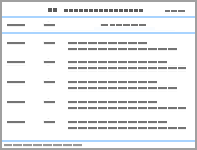
Tab. 1
Evaluation index system of new urbanization in Gansu Province"
| 要素层 | 指标层 | 方向 | 权重 |
|---|---|---|---|
| 人口 | 城镇人口比重/% | + | 0.062 |
| 城镇新增就业人员/人 | + | 0.079 | |
| 第二产业从业人数/104人 | + | 0.100 | |
| 第三产业从业人数/104人 | + | 0.087 | |
| 经济 | 人均GDP/元 | + | 0.091 |
| GDP增长率/% | + | 0.004 | |
| 固定资产投资/104元 | + | 0.093 | |
| 社会 | 人均拥有道路面积/m2 | + | 0.040 |
| 公共图书馆藏书量/104册 | + | 0.032 | |
| 卫生机构床位数/张 | + | 0.068 | |
| 供水普及率/% | + | 0.008 | |
| 燃气普及率/% | + | 0.020 | |
| 空间 | 建成区面积/km2 | + | 0.129 |
| 建成区供水管道密度/km·km-2 | + | 0.054 | |
| 建成区排水管道密度/km·km-2 | + | 0.066 | |
| 建成区路网密度/km·km-2 | + | 0.038 | |
| 建成区道路面积率/% | + | 0.029 |
Tab. 2
Evaluation index system of ecological security in Gansu Province"
| 要素层 | 指标层 | 方向 | 权重 |
|---|---|---|---|
| 驱动力 | 城镇人口密度/人·km-2 | - | 0.048 |
| 城镇化率/% | - | 0.045 | |
| 第二产业增加值占GDP比重/% | - | 0.025 | |
| 年降水量/mm | + | 0.072 | |
| 年均气温/℃ | + | 0.070 | |
| 压力 | 工业烟粉尘排放量/t | - | 0.011 |
| 工业SO2排放量/t | - | 0.020 | |
| 工业废水排放量/104 t | - | 0.003 | |
| 工业固体废弃物产生量/104 t | - | 0.019 | |
| 农药、化肥施用量/104 t | - | 0.026 | |
| 状态 | 归一化植被指数 | + | 0.071 |
| 每日人均生活用水量/L | - | 0.031 | |
| 人均公园绿地面积/m2 | + | 0.096 | |
| 粮食综合生产能力/104 t | + | 0.047 | |
| 生活垃圾无害化处理率/% | + | 0.012 | |
| 影响 | 第三产业占GDP比重/% | + | 0.030 |
| 建成区绿化面积/hm2 | + | 0.168 | |
| 人均农业机械总动力/kW | + | 0.049 | |
| 响应 | 城市污水处理率/% | + | 0.014 |
| 一般工业固体废物综合利用率/% | + | 0.043 | |
| 畜禽粪污综合利用率/% | + | 0.035 | |
| 管理 | 建成区绿化覆盖率/% | + | 0.029 |
| 建成区绿地率/% | + | 0.038 |
Tab. 3
Classification criteria of new urbanization and ecological security"
| 区间 | 新型城镇化 | 生态安全 |
|---|---|---|
| (0.0, 0.2) | 低水平 | 不安全 |
| [0.2, 0.4) | 较低水平 | 低度安全 |
| [0.4, 0.6) | 中等水平 | 中度安全 |
| [0.6, 0.8) | 较高水平 | 高度安全 |
| [0.8, 1.0] | 高水平 | 极高度安全 |
Tab. 4
Classification criteria for coupling coordination degree"
| 区间 | 等级 | 含义 | 区间 | 等级 | 含义 |
|---|---|---|---|---|---|
| [0.000, 0.100) | Ⅰ | 极度失调 | [0.500, 0.600) | Ⅵ | 勉强协调 |
| [0.100, 0.200) | Ⅱ | 严重失调 | [0.600, 0.700) | Ⅶ | 初级协调 |
| [0.200, 0.300) | Ⅲ | 中度失调 | [0.700, 0.800) | Ⅷ | 中级协调 |
| [0.300, 0.400) | Ⅳ | 轻度失调 | [0.800, 0.900) | Ⅸ | 良好协调 |
| [0.400, 0.500) | Ⅴ | 濒临失调 | [0.900, 1.000] | Ⅹ | 优质协调 |
Tab. 5
New urbanization and ecological security levels in Gansu Province from 2012 to 2021"
| 综合发展指数 | 2012年 | 2013年 | 2014年 | 2015年 | 2016年 | 2017年 | 2018年 | 2019年 | 2020年 | 2021年 |
|---|---|---|---|---|---|---|---|---|---|---|
| 新型城镇化指数 | 0.213 | 0.238 | 0.250 | 0.257 | 0.267 | 0.270 | 0.263 | 0.304 | 0.314 | 0.328 |
| 生态安全指数 | 0.399 | 0.417 | 0.426 | 0.430 | 0.448 | 0.470 | 0.487 | 0.491 | 0.491 | 0.498 |
Tab. 6
Coupling coordination between new urbanization and ecological security in different cities/prefectures of Gansu Province from 2012 to 2021"
| 市州 | 耦合协调度 | |||
|---|---|---|---|---|
| 2012年 | 2015年 | 2018年 | 2021年 | |
| 兰州市 | 0.666 | 0.730 | 0.786 | 0.792 |
| 嘉峪关市 | 0.559 | 0.567 | 0.620 | 0.630 |
| 金昌市 | 0.488 | 0.502 | 0.553 | 0.596 |
| 白银市 | 0.514 | 0.546 | 0.568 | 0.613 |
| 天水市 | 0.559 | 0.601 | 0.584 | 0.651 |
| 武威市 | 0.467 | 0.500 | 0.543 | 0.588 |
| 张掖市 | 0.516 | 0.595 | 0.584 | 0.624 |
| 平凉市 | 0.605 | 0.644 | 0.621 | 0.659 |
| 酒泉市 | 0.578 | 0.602 | 0.604 | 0.621 |
| 庆阳市 | 0.557 | 0.611 | 0.622 | 0.675 |
| 定西市 | 0.506 | 0.549 | 0.567 | 0.608 |
| 陇南市 | 0.487 | 0.533 | 0.575 | 0.610 |
| 临夏州 | 0.463 | 0.516 | 0.538 | 0.597 |
| 甘南州 | 0.414 | 0.421 | 0.490 | 0.532 |
| 平均值 | 0.527 | 0.565 | 0.590 | 0.628 |

Fig. 1
Spatiotemporal evolution of the coupling coordination between new urbanization and ecological security in Gansu Province from 2012 to 2021"

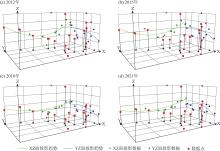
Fig. 2
Trends of new urbanization and ecological security coupling coordination in Gansu Province from 2012 to 2021"
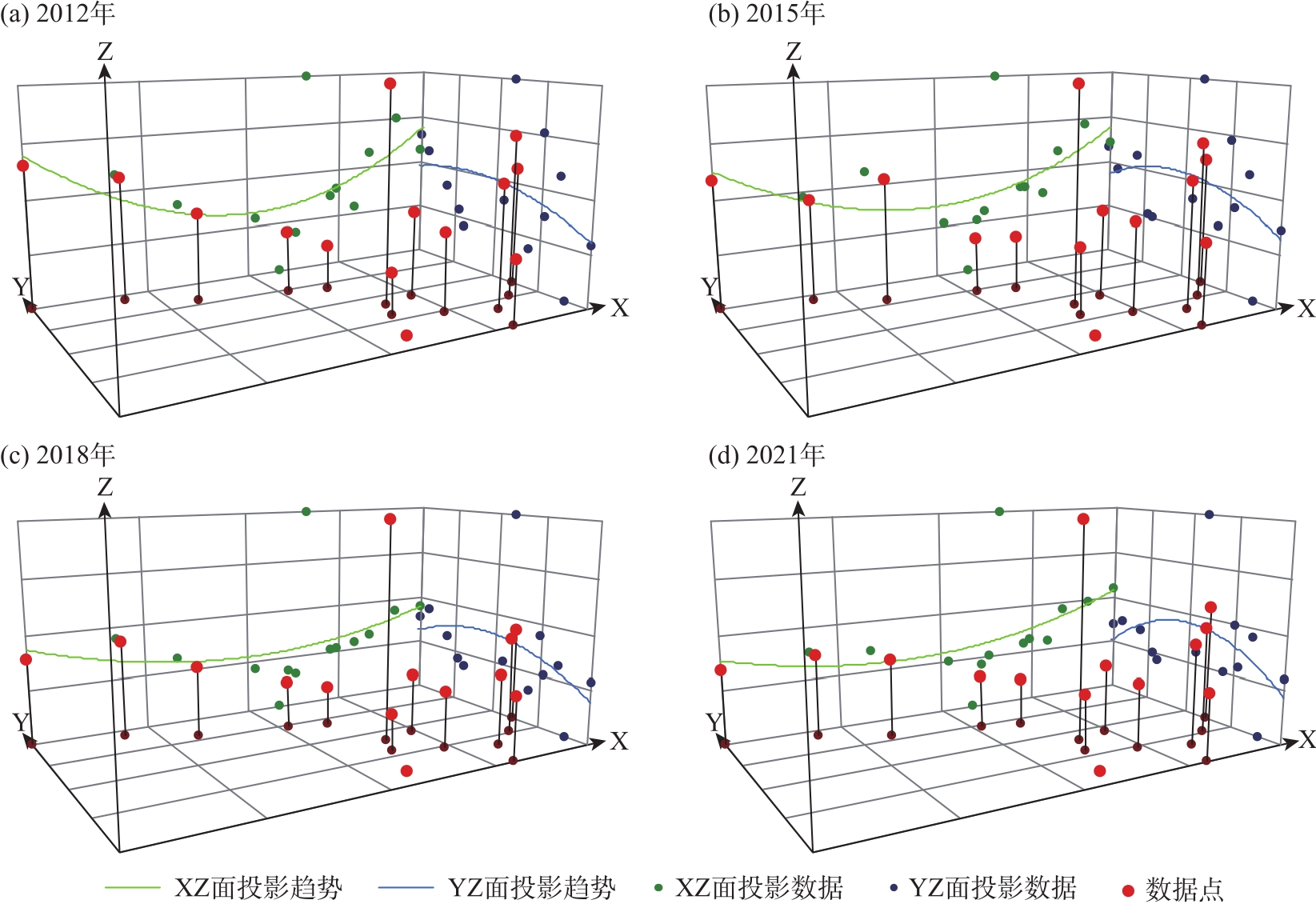
Tab. 7
Detection results for single driving factor of coupling coordination of new urbanization and ecological security in Gansu Province"
| 驱动因子 | 驱动因子的解释力 | ||||
|---|---|---|---|---|---|
| 2012年 | 2015年 | 2018年 | 2021年 | 平均值 | |
| 城镇人口密度 | 0.571 | 0.657 | 0.413 | 0.586 | 0.557 |
| 第二产业占GDP比重 | 0.747 | 0.491 | 0.417 | 0.383 | 0.510 |
| 年降水量 | 0.604 | 0.566 | 0.418 | 0.333 | 0.480 |
| 年均气温 | 0.531 | 0.593 | 0.403 | 0.463 | 0.498 |
| 归一化植被指数 | 0.496 | 0.509 | 0.411 | 0.513 | 0.482 |
| 第二产业从业人数 | 0.630 | 0.822 | 0.685 | 0.635 | 0.693 |
| 人均GDP | 0.638 | 0.533 | 0.653 | 0.348 | 0.543 |
| 固定资产投资 | 0.745 | 0.538 | 0.753 | 0.765 | 0.701 |
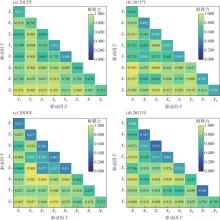
Fig. 3
Interactive detection results of driving factors for the coupling coordination of new urbanization and ecological security in Gansu Province"

Tab. 8
Model comparison"
| 模型 | R2 | 调整R2 | AICc |
|---|---|---|---|
| OLS | 0.787 | 0.774 | 202.706 |
| GWR | 0.941 | 0.923 | 91.730 |
| GTWR | 0.976 | 0.975 | -670.016 |
Tab. 9
Regression coefficients of driving factorsin the GTWR model"
| 驱动因子 | 2012年 | 2015年 | 2018年 | 2021年 |
|---|---|---|---|---|
| 城镇人口密度 | -0.078 | -0.087 | -0.092 | -0.088 |
| 第二产业占GDP比重 | -0.046 | -0.097 | -0.105 | -0.073 |
| 年降水量 | -0.024 | -0.016 | -0.029 | -0.067 |
| 年均气温 | 0.077 | 0.068 | 0.064 | 0.010 |
| 归一化植被指数 | -0.039 | -0.008 | 0.010 | 0.035 |
| 第二产业从业人数 | 0.168 | 0.130 | 0.075 | 0.100 |
| 人均GDP | -0.003 | 0.134 | 0.163 | 0.127 |
| 固定资产投资 | 0.176 | 0.158 | 0.120 | 0.052 |
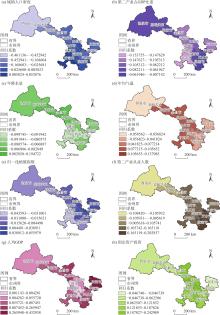
Fig. 4
Spatial non-stationary for driving factors of new urbanization and ecological security coupling coordination in Gansu Province"

| [1] |
刘海龙, 王改艳, 张鹏航, 等. 汾河流域新型城镇化与生态韧性耦合协调时空演变及协调影响力研究[J]. 自然资源学报, 2024, 39(3): 640-667.
doi: 10.31497/zrzyxb.20240309 |
|
[Liu Hailong, Wang Gaiyan, Zhang Penghang, et al. Spatio-temporal evolution and coordination influence of coupling coordination between new urbanization and ecological resilience in Fenhe River Basin[J]. Journal of Natural Resources, 2024, 39(3): 640-667. ]
doi: 10.31497/zrzyxb.20240309 |
|
| [2] |
赵杨, 王京, 潘为华. 中国省域新型城镇化水平与绿色发展水平的区域特征及其影响机制[J]. 经济地理, 2023, 43(9): 1-9.
doi: 10.15957/j.cnki.jjdl.2023.09.001 |
|
[Zhao Yang, Wang Jing, Pan Weihua. Regional characteristics and impact mechanisms of new urbanization and green development level in China at the provincial level urbanization[J]. Economic Geography, 2023, 43(9): 1-9. ]
doi: 10.15957/j.cnki.jjdl.2023.09.001 |
|
| [3] | Cao N, Luo N, Peng Y, et al. Evaluation of urbanization development dynamics based on quadrilateral diamond structure model: Evidence from Chongqing, China, in the new era[J]. Journal of Urban Planning and Development, 2023, 149(3): 04023030, doi: 10.1016/j.ecolind.2022.109483. |
| [4] | 赵磊, 方成. 中国省际新型城镇化发展水平地区差异及驱动机制[J]. 数量经济技术经济研究, 2019, 36(5): 44-64. |
| [Zhao Lei, Fang Cheng. Distribution dynamics and driving mechanism of China’s provincial new urbanization development level[J]. Journal of Quantitative & Technological Economics, 2019, 36(5): 44-64. ] | |
| [5] |
胡飞鹏, 赵军, 孙紫云, 等. 石羊河流域生态系统服务相互作用的时空变化及驱动机制研究[J]. 干旱区地理, 2024, 47(10): 1755-1766.
doi: 10.12118/j.issn.1000-6060.2023.708 |
|
[Hu Feipeng, Zhao Jun, Sun Ziyun, et al. Spatiotemporal changes and driving mechanism of ecosystem service interactions in the Shiyang River Basin[J]. Arid Land Geography, 2024, 47(10): 1755-1766. ]
doi: 10.12118/j.issn.1000-6060.2023.708 |
|
| [6] |
欧进锋, 许抄军, 陈东. 广东省新型城镇化高质量发展水平演变及其影响因素[J]. 经济地理, 2023, 43(3): 78-87.
doi: 10.15957/j.cnki.jjdl.2023.03.009 |
|
[Ou Jinfeng, Xu Chaojun, Chen Dong. High-quality development of new urbanization in Guangdong Province: Spatio-temporal evolution, influencing factors[J]. Economic Geography, 2023, 43(3): 78-87. ]
doi: 10.15957/j.cnki.jjdl.2023.03.009 |
|
| [7] |
常新锋, 管鑫. 新型城镇化进程中长三角城市群生态效率的时空演变及影响因素[J]. 经济地理, 2020, 40(3): 185-195.
doi: 10.15957/j.cnki.jjdl.2020.03.021 |
|
[Chang Xinfeng, Guan Xin. Spatial and temporal evolution of eco-efficiency and its influencing factors in the Yangtze River Delta urban agglomeration in the process of new urbanization[J]. Economic Geography, 2020, 40(3): 185-195. ]
doi: 10.15957/j.cnki.jjdl.2020.03.021 |
|
| [8] | Yu B. Ecological effects of new-type urbanization in China[J]. Renewable and Sustainable Energy Reviews, 2021, 135: 110239, doi:10.1016/j.rser.2020.110239. |
| [9] | Luo Z, Wang F, Pan H, et al. Evaluation and improvement strategy of tourism industrial park competitiveness from the perspective of new urbanization: Case study of the Suining Tourism Industrial Park[J]. Journal of Urban Planning and Development, 2022, 148(4): 05022029, doi: 10.1061/(ASCE)UP.1943-5444.0000865. |
| [10] | Li X, Zheng Z, Shi D, et al. New urbanization and carbon emissions intensity reduction: Mechanisms and spatial spillover effects[J]. Science of the Total Environment, 2023: 167172, doi: 10.1016/j.scitotenv.2023.167172. |
| [11] | Cai J, Li X, Liu L, et al. Coupling and coordinated development of new urbanization and agro-ecological environment in China[J]. Science of the Total Environment, 2021, 776: 145837, doi: 10.1016/j.scitotenv.2021.145837. |
| [12] | Jiang B, Ding L, Fang X. Sustainable development of new urbanization from the perspective of coordination: A new complex system of urbanization-technology innovation and the atmospheric environment[J]. Atmosphere, 2019, 10(11): 652, doi: 10.3390/atmos10110652. |
| [13] | 刘瑞宽, 杨林朋, 李同昇, 等. 基于ERA和MCR模型的生态安全格局构建——陕西沿黄地区为例[J]. 中国环境科学, 2024, 44(2): 1053-1063. |
| [Liu Ruikuan, Yang Linpeng, Li Tongsheng, et al. Establishment of ecological security pattern along the Yellow River in Shaanxi Province based on ERA and MCR models[J]. China Environmental Science, 2024, 44(2): 1053-1063. ] | |
| [14] | 林一诚, 周怡宁, 郑景明. 基于MCR模型的围场县小滦河流域生态安全格局识别[J]. 北京林业大学学报, 2024, 46(5): 26-36. |
| [Lin Yicheng, Zhou Yining, Zheng Jingming. Identification of ecological security pattern of Xiaoluanhe River Basin in Weichang County, Hebei Province of northern China based on MCR model[J]. Journal of Beijing Forestry University, 2024, 46(5): 26-36. ] | |
| [15] |
杨荣美, 周宏, 张燕妮, 等. 基于熵权TOPSIS方法与模糊物元模型的河西走廊地区旅游生态安全评估[J]. 干旱区地理, 2024, 47(1): 117-126.
doi: 10.12118/j.issn.1000-6060.2023.321 |
|
[Yang Rongmei, Zhou Hong, Zhang Yanni, et al. Tourism ecological security assessment in Hexi Corridor region based on entropy weight TOPSIS method and fuzzy matter-element model[J]. Arid Land Geography, 2024, 47(1): 117-126. ]
doi: 10.12118/j.issn.1000-6060.2023.321 |
|
| [16] | Lai S, Sha J, Eladawy A, et al. Evaluation of ecological security and ecological maintenance based on pressure-state-response (PSR) model, case study: Fuzhou City, China[J]. Human and Ecological Risk Assessment: An International Journal, 2022, 28(7): 734-761. |
| [17] | Zhang R, Li P, Xu L. Evaluation and analysis of ecological security based on the improved three-dimensional ecological footprint in Shaanxi Province, China[J]. Ecological Indicators, 2022, 144: 109483, doi: 10.1016/j.ecolind.2022.109483. |
| [18] | 晁云舒, 严雨桐, 闫思嘉, 等. 基于MCR和重力模型的县域生态安全格局构建——以福建省永春县为例[J]. 水土保持通报, 2023, 43(4): 203-210. |
| [Chao Yunshu, Yan Yutong, Yan Sijia, et al. County scale ecological security pattern construction based on MCR model: A case study of Yongchun County, Fujian Province[J]. Bulletin of Soil and Water Conservation, 2023, 43(4): 203-210. ] | |
| [19] | 刘志有, 曲秀武, 魏冉, 等. 生态文明视角下的伊犁河谷绿洲土地生态安全评价及障碍因子诊断[J]. 水土保持通报, 2022, 42(1): 137-143. |
| [Liu Zhiyou, Qu Xiuwu, Wei Ran, et al. Evaluation of land ecological security and diagnosis of obstacle factors for oasis land in Yili River valley from perspective of ecological civilization[J]. Bulletin of Soil and Water Conservation, 2022, 42(1): 137-143. ] | |
| [20] |
何国兴, 韩天虎, 柳小妮, 等. 甘肃省草地植被NDVI时空变化特征及驱动因素研究[J]. 草地学报, 2021, 29(5): 1004-1013.
doi: 10.11733/j.issn.1007-0435.2021.05.017 |
|
[He Guoxing, Han Tianhu, Liu Xiaoni, et al. Spatio-temporal variation and the driving factors of NDVI of grassland vegetation in Gansu Province[J]. Acta Agrestia Sinica, 2021, 29(5): 1004-1013. ]
doi: 10.11733/j.issn.1007-0435.2021.05.017 |
|
| [21] |
苗龙, 文炳勋, 文倩雅. 中国地方财政教育投入与经济发展水平的时空耦合协调关系研究[J]. 经济地理, 2021, 41(12): 149-157.
doi: 10.15957/j.cnki.jjdl.2021.12.016 |
|
[Miao Long, Wen Bingxun, Wen Qianya. Coupling and coordination relationship between local financial investment in education and economic development level in China[J]. Economic Geography, 2021, 41(12): 149-157. ]
doi: 10.15957/j.cnki.jjdl.2021.12.016 |
|
| [22] | 何志远, 杨振凯, 丁志伟, 等. 2010—2020年中国市域城镇化与生态环境协调状态的空间分异及影响因素[J]. 生态学报, 2024, 44(12): 5040-5058. |
| [He Zhiyuan, Yang Zhenkai, Ding Zhiwei, et al. Spatial differentiation and influencing factors of the coupling coordination degree of urbanization and eco-environment in China at city-level from 2010 to 2020[J]. Acta Ecologica Sinica, 2024, 44(12): 5040-5058. ] | |
| [23] | 汤良, 胡希军, 罗紫薇, 等. 生态脆弱性与城镇化水平时空耦合及其交互影响因素——以湖南省为例[J]. 生态学报, 2024, 44(11): 4662-4677. |
| [Tang Liang, Hu Xijun, Luo Ziwei, et al. Spatiotemporal coupling of ecological vulnerability and urbanization level and their interactive influencing factors: A case study of Hunan Province[J]. Acta Ecologica Sinica, 2024, 44(11): 4662-4677. ] | |
| [24] | Du W, Liao X, Tong Z, et al. Early warning and scenario simulation of ecological security based on DPSIRM model and Bayesian network: A case study of east Liaohe River in Jilin Province, China[J]. Journal of Cleaner Production, 2023, 398: 136649, doi: 10.1016/j.jclepro.2023.136649. |
| [25] | 向丽, 周伟, 任君, 等. 基于DPSIRM模型的高原城市湿地生态安全评价——以湟水流域西宁段为例[J]. 生态学杂志, 2022, 41(10): 2064-2071. |
|
[Xiang Li, Zhou Wei, Ren Jun, et al. Ecological security evaluation of plateau urban wetland based on DPSIRM model: With Xining section of Huangshui Basin as an example[J]. Chinese Journal of Ecology, 2022, 41(10): 2064-2071. ]
doi: DOI: 10.13292/j.1000-4890.202209.003 |
|
| [26] | 吕添贵, 邱蓉, 赵巧, 等. 基于DPSIRM模型的长江中游城市群生态安全时空特征及障碍因素[J]. 水土保持研究, 2024, 31(2): 379-388. |
| [Lü Tiangui, Qiu Rong, Zhao Qiao, et al. Temporal-spatial evaluation of regional ecological security and obstacle diagnosis of the urban agglomerations in the middle reaches of the Yangtze River based on DPSIRM model[J]. Research of Soil and Water Conservation, 2024, 31(2): 379-388. ] | |
| [27] | 谢贤健. 基于熵权TOPSIS和耦合协调模型的四川省土地利用效益耦合协调关系及时空演变特征[J]. 水土保持学报, 2024, 38(1): 267-277. |
| [Xie Xianjian. Coupling coordination relationship and spatiotemporal evolution characteristics of land use benefit in Sichuan Province based on entropy weight TOPSIS and coupling coordination model[J]. Journal of Soil and Water Conservation, 2024, 38(1): 267-277. ] | |
| [28] | 洪蕾, 孙杰, 刘冬, 等. 长三角中心城市群生态环境与社会经济耦合协调发展及其影响因素研究[J]. 生态与农村环境学报, 2024, 40(9): 1155-1166. |
| [Hong Lei, Sun Jie, Liu Dong, et al. Research on the development of coupling coordinated relationship and the affecting factors of eco-environment and socio-economy in central urban agglomeration of Yangtze River Delta region[J]. Journal of Ecology and Rural Environment, 2024, 40(9): 1155-1166. ] | |
| [29] |
刘颖洁, 王爽. 长江经济带养老产业与旅游产业耦合协调与经济增长的关系[J]. 经济地理, 2022, 42(8): 123-131.
doi: 10.15957/j.cnki.jjdl.2022.08.014 |
|
[Liu Yingjie, Wang Shuang. Coupling and coordination between elderly care industry and tourism industry in Yangtze River Economic Zone and its relationship with economic growth[J]. Economic Geography, 2022, 42(8): 123-131. ]
doi: 10.15957/j.cnki.jjdl.2022.08.014 |
|
| [30] | 蔡绍洪, 谷城, 张再杰. 西部新型城镇化与乡村振兴协调的时空特征及影响机制[J]. 中国农业资源与区划, 2022, 43(12): 202-213. |
| [Cai Shaohong, Gu Cheng, Zhang Zaijie. Spatial and temporal characteristics and influencing mechanism of coordination between new-type urbanization and rural revitalization in western China[J]. Chinese Journal of Agricultural Resources and Regional Planning, 2022, 43(12): 202-213. ] | |
| [31] | 罗良清, 谢海洋. 我国省域绿色全要素生产率的增长机制及其时空非平稳性研究[J]. 数理统计与管理, 2024, 43(2): 315-330. |
| [Luo Liangqing, Xie Haiyang. Research on the influencing factors and spatio-temporal nonstationarity of provincial green total factor productivity in China[J]. Journal of Applied Statistics and Management, 2024, 43(2): 315-330. ] | |
| [32] | 张恬姿, 王小军, 齐广平, 等. 甘肃省水资源-经济社会-生态环境耦合协调演变分析[J]. 水利水运工程学报, 2023(2): 53-63. |
| [Zhang Tianzi, Wang Xiaojun, Qi Guangping, et al. Analysis of the spatial-temporal evolution characteristics of water resources economic society-ecological environment coupling and coordination in Gansu Province[J]. Hydro-Science and Engineering, 2023(2): 53-63. ] | |
| [33] | 马飞, 张东伟, 陈龙, 等. 城市群城市韧性水平测度及障碍因子识别[J]. 长安大学学报(社会科学版), 2024, 26(2): 112-124. |
| [Ma Fei, Zhang Dongwei, Chen Long, et al. Measurement of urban resilience level and identification of obstacle factors in urban agglomeration[J]. Journal of Chang’an University (Social Science Edition), 2024, 26(2): 112-124. ] | |
| [34] | 韩燕, 张玉婷. 甘肃省城镇化与生态环境耦合协调度[J]. 水土保持研究, 2021, 28(3): 256-263. |
| [Han Yan, Zhang Yuting. Coupling and coordination development between urbanization and eco-environment in Gansu Province[J]. Research of Soil and Water Conservation, 2021, 28(3): 256-263. ] | |
| [35] | 暴向平, 周瑞平, 宋永永. 乌兰察布市生态安全与新型城镇化耦合协调度及其影响因素[J]. 西北师范大学学报(自然科学版), 2021, 57(5): 64-70. |
| [Bao Xiangping, Zhou Ruiping, Song Yongyong. The coupling coordination and influencing factors of ecological safety and new-type urbanization in Ulanqab City[J]. Journal of Northwest Normal University (Natural Science Edition), 2021, 57(5): 64-70. ] | |
| [36] | 卢晶. 公共服务供给对新型城镇化发展地区差异的影响研究[J]. 经济体制改革, 2024(2): 67-73. |
| [Lu Jing. Research on the impact of public service supply on regional differences in new urbanization development[J]. Reform of Economic System, 2024(2): 67-73. ] | |
| [37] |
马明德, 李俊杰, 薛晨皓. 宁夏区域发展对环境胁迫的时空演变及驱动机制分析[J]. 干旱区地理, 2024, 47(6): 1061-1072.
doi: 10.12118/j.issn.1000-6060.2023.318 |
|
[Ma Mingde, Li Junjie, Xue Chenhao. Spatiotemporal evolution and driving mechanism of environmental stress of regional development in Ningxia Hui Autonomous Region[J]. Arid Land Geography, 2024, 47(6): 1061-1072. ]
doi: 10.12118/j.issn.1000-6060.2023.318 |
|
| [38] |
田成诗, 张亚兵. 中国多中心城市空间结构与能源效率关系[J]. 自然资源学报, 2022, 37(1): 135-148.
doi: 10.31497/zrzyxb.20220110 |
|
[Tian Chengshi, Zhang Yabing. The relationship between polycentric urban spatial structure and energy efficiency of cities in China[J]. Journal of Natural Resources, 2022, 37(1): 135-148. ]
doi: 10.31497/zrzyxb.20220110 |
|
| [39] | 孙瑞茜, 姚峰. 京津冀地区绿色发展与数字经济耦合时空及障碍因子研究[J/OL]. 环境保护科学. [2024-10-28]. https://doi.org/10.16803/j.cnki.issn.1004-6216.202403031. |
| [Sun Ruiqian, Yao Feng. Research on space and time coupling of green development and digital economy in Beijing-Tianjin-Hebei region[J/OL]. Environmental Protection Science. [2024-10-28]. https://doi.org/10.16803/j.cnki.issn.1004-6216.202403031. ] | |
| [40] | 李文佳, 王瑞燕, 徐家豪, 等. 西北干旱区农田灌溉事件遥感检测[J]. 农业工程学报, 2024, 40(17): 120-128. |
| [Li Wenjia, Wang Ruiyan, Xu Jiahao, et al. Detecting farmland irrigation in arid areas of northwest China using remote sensing[J]. Transactions of the Chinese Society of Agricultural Engineering, 2024, 40(17): 120-128. ] | |
| [41] | 李元征, 冯智志, 李立, 等. 中国陆地生态系统生态敏感性评价[J]. 生态科学, 2024, 43(4): 129-139. |
| [Li Yuanzheng, Feng Zhizhi, Li Li, et al. Evaluation of ecological sensitivity of terrestrial ecosystem in China[J]. Ecological Science, 2024, 43(4): 129-139. ] | |
| [42] | 柴建, 田凌钺, 张晓空. 经济-能源-环境系统耦合协调发展的动态演化与影响要素研究[J]. 管理评论, 2024, 36(1): 29-41. |
| [Chai Jian, Tian Lingyue, Zhang Xiaokong. Research on the dynamic evolution and influence factors of the coupling coordination development of the economy-energy-environment system[J]. Management Review, 2024, 36(1): 29-41. ] |
|
||