Arid Land Geography ›› 2025, Vol. 48 ›› Issue (7): 1267-1278.doi: 10.12118/j.issn.1000-6060.2024.431
• Regional Development • Previous Articles Next Articles
LUO Xiaomei1,2( ), WEN Qi3,4,5(), SHI Linna4,5, WU Xinyan6, AN Fengping2,7, WANG Zhenting1
Received:2024-07-17
Revised:2024-10-11
Online:2025-07-25
Published:2025-07-04
Contact:
WEN Qi
E-mail:luoxiaomei22@mails.ucas.ac.cn;wenq98@163.com
LUO Xiaomei, WEN Qi, SHI Linna, WU Xinyan, AN Fengping, WANG Zhenting. Identification of county shrinkage and its driving factors in agro-pastoral zone of north China from a multidimensional perspective[J].Arid Land Geography, 2025, 48(7): 1267-1278.
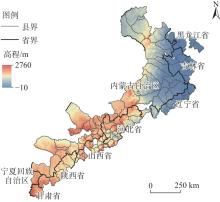
Fig. 1
Schematic diagram of the study area"

Tab. 1
Comprehensive evaluation indicator system and weighting coefficients"
| 准测层 | 准则层权重 | 指标层 | 属性 | 指标层权重 |
|---|---|---|---|---|
| 人口维度 | 0.5 | 常住人口/人 | + | 0.331 |
| 出生率/% | + | 0.266 | ||
| 就业总人口/人 | + | 0.403 | ||
| 经济维度 | 0.3 | GDP/104元 | + | 0.265 |
| 人均GDP/104元·人-1 | + | 0.212 | ||
| 财政收入/104元 | + | 0.364 | ||
| 第一产业占比/% | - | 0.064 | ||
| 第二产业占比/% | + | 0.053 | ||
| 第三产业占比/% | + | 0.042 | ||
| 空间维度 | 0.2 | 平均夜间灯光指数 | + | 0.416 |
| 空城指数 | + | 0.388 | ||
| 生态用地/km2 | + | 0.196 |
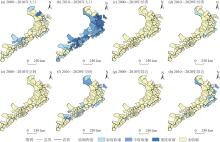
Fig. 2
Spatial distributions of shrinkage degree of counties in agro-pastoral zone of north China from 2000 to 2020"
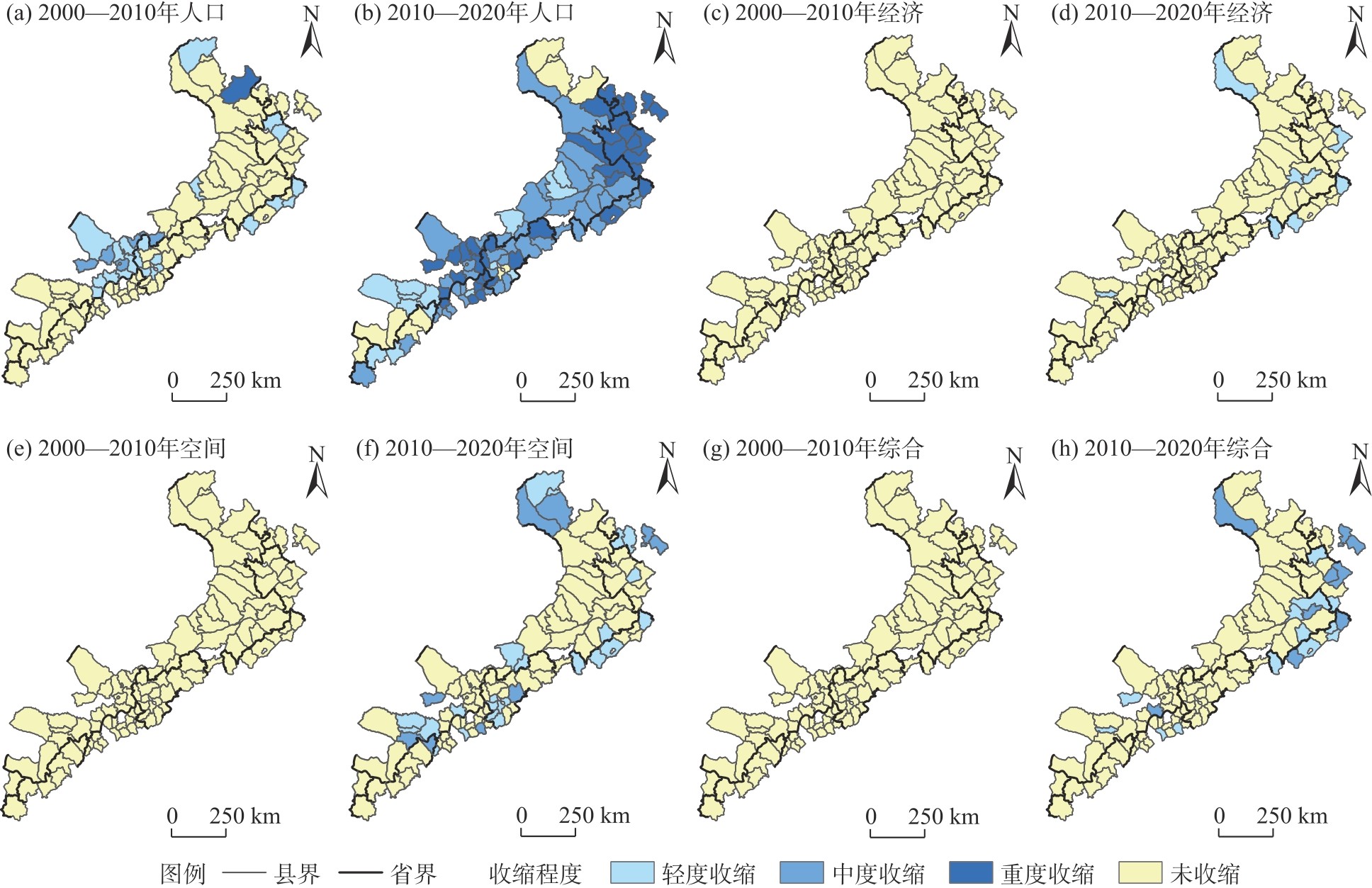
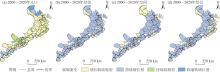
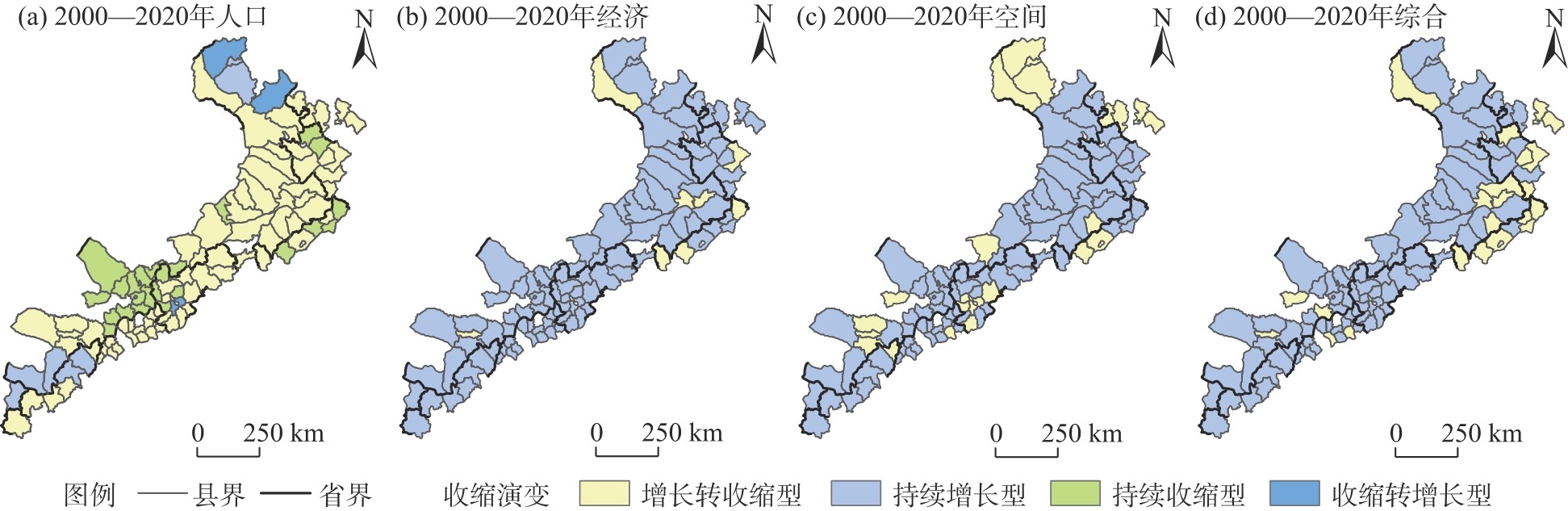
Fig. 3
Spatial distributions of county shrinkage evolution in agro-pastoral zone of north China from 2000 to 2020"
Tab. 2
Relationship of shrinkage county combination in different periods and dimensions"
| 年份 | 全维收缩县域 | 双维收缩城市 | |||
|---|---|---|---|---|---|
| 人口-经济-空间 | 人口-经济 | 人口-空间 | 经济-空间 | ||
| 2000—2010 | 无 | 无 | 无 | 无 | |
| 2010—2020 | 新巴尔虎左旗、 北票市、东胜区 | 开鲁县、科尔沁区、前郭尔罗斯蒙古族自治县、昌图县、建平县 | 库伦旗、肇东市、泰来县、安达市、杜尔伯特蒙古族自治县、赤城县、怀安县、阜新蒙古族自治县、万全区、蔚县、正蓝旗、武川县、浑源县、达拉特旗、伊金霍洛旗、府谷县 | 无 | |
Tab. 3
Selection of driving factors"
| 解释变量 | 具体指标 | 数据来源 |
|---|---|---|
| 经济因素 | 社会消费品零售总额/104元 | 县域统计年鉴 |
| 固定资产投资完成额/104元 | 县域统计年鉴 | |
| 地方财政支出/104元 | 县域统计年鉴 | |
| 规模以上企业数量/个 | 县域统计年鉴 | |
| 社会因素 | 卫生、社会保障从业人数/人 | 人口普查数据 |
| 在校小学生数量/人 | 县域统计年鉴 | |
| 距地级市距离/km | 经纬度计算 | |
| 自然因素 | 高程/m | 500 m全球海洋测深DEM数据集 |
| 年均气温/℃ | 1000 m国家地球栅格数据 | |
| 年均降雨量/mm | 1000 m国家地球栅格数据 |
Tab. 4
Comparison of regression properties of driving factors in OLS, GWR and MGWR models"
| 模型 | R2 | Adjusted R2 | AICc | RSS |
|---|---|---|---|---|
| OLS | 0.522 | 0.472 | 494.894 | 537.447 |
| GWR | 0.772 | 0.748 | 462.079 | 258.579 |
| MGWR | 0.780 | 0.729 | 192.995 | 23.280 |
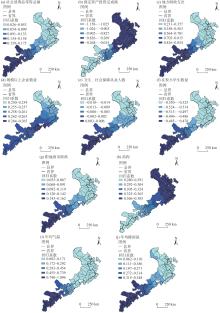
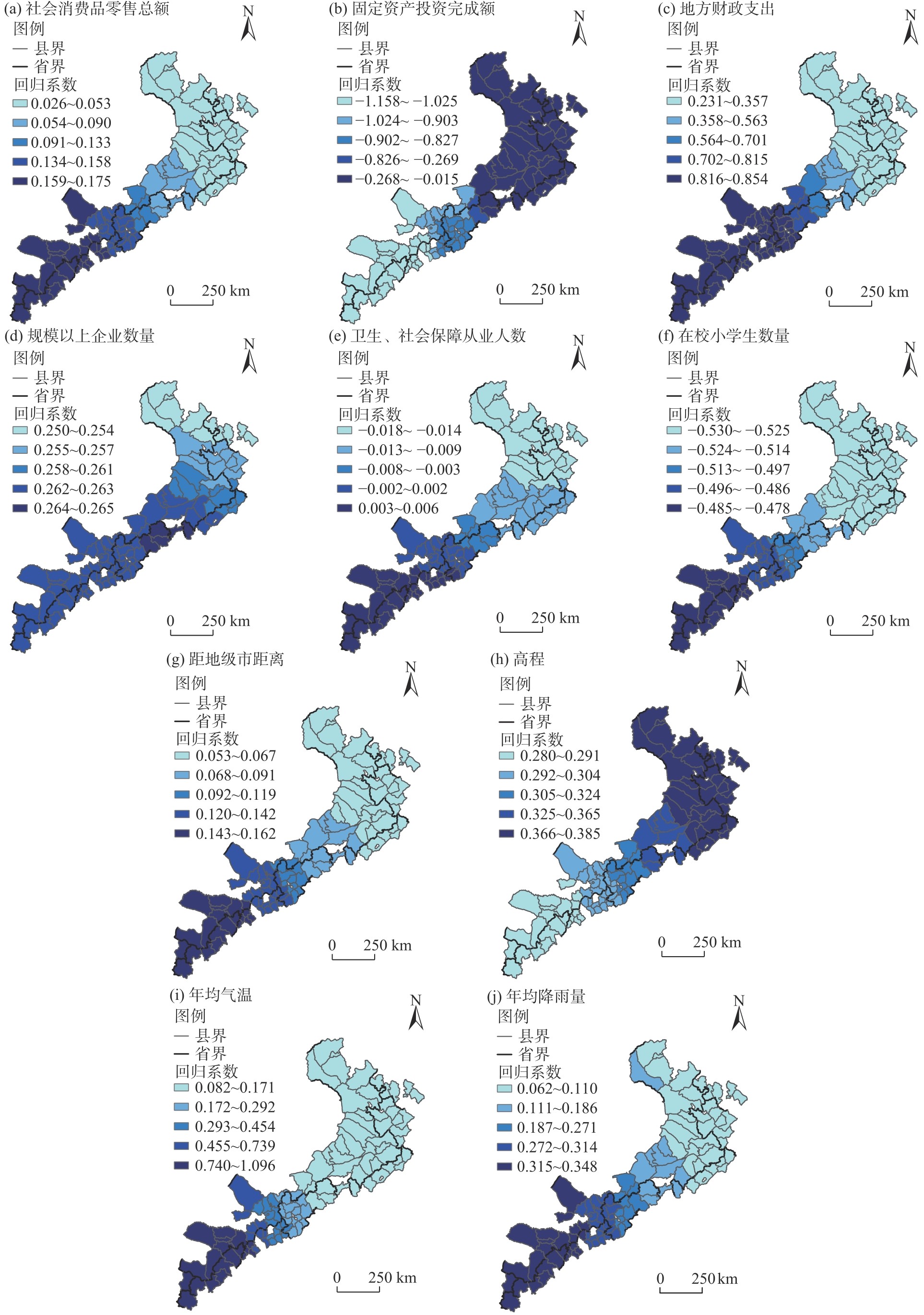
Fig. 4
Spatial heterogeneity of county shrinkage drivers in agro-pastoral zone of north China from 2000 to 2020"
Tab. 5
Statistics of regression coefficient in MGWR model"
| 指标 | 平均值 | 标准差 | 最小值 | 中位数 | 最大值 | VIF | 带宽 |
|---|---|---|---|---|---|---|---|
| 社会消费品零售总额 | 0.108 | 0.057 | 0.026 | 0.140 | 0.175 | 3.678 | 105 |
| 固定资产投资完成额 | -0.562 | 0.487 | -1.158 | -0.854 | -0.015 | 1.188 | 50 |
| 地方财政支出 | 0.621 | 0.264 | 0.231 | 0.826 | 0.854 | 2.474 | 82 |
| 规模以上企业数量 | 0.260 | 0.004 | 0.250 | 0.262 | 0.265 | 1.821 | 105 |
| 卫生、社会保障从业人数 | -0.005 | 0.008 | -0.018 | -0.001 | 0.006 | 4.980 | 105 |
| 在校小学生数量 | -0.506 | 0.020 | -0.530 | -0.501 | -0.478 | 4.968 | 105 |
| 距地级市距离 | 0.102 | 0.039 | 0.053 | 0.111 | 0.162 | 1.017 | 105 |
| 高程 | 0.329 | 0.039 | 0.280 | 0.308 | 0.385 | 1.610 | 105 |
| 年均气温 | 0.372 | 0.329 | 0.082 | 0.204 | 1.096 | 1.517 | 54 |
| 年均降雨量 | 0.215 | 0.108 | 0.062 | 0.263 | 0.348 | 1.427 | 90 |
| [21] | 李宛聪, 李红, 王士君, 等. 东北地区收缩城市识别及其建设用地扩张时空演变[J]. 资源科学, 2024, 46(2): 368-385. |
| [ Li Wancong, Li Hong, Wang Shijun, et al. Identification of shrinking cities in northeast China and spatiotemporal evolution of construction land expansion[J]. Resources Science, 2024, 46(2): 368-385. ] | |
| [22] | 刘玉博, 张学良. 长江经济带局部城市收缩、发展分异与空间作用机理探讨[J]. 华东师范大学学报(哲学社会科学版), 2023, 55(4): 129-143, 179. |
| [ Liu Yubo, Zhang Xueliang. The phenomenon, development differentiation and spatial mechanism of local cities shrinkage in Yangtze River Economic Belt[J]. Journal of East Normal University (Humanities and Social Sciences Edition), 2023, 55(4): 129-143, 179. ] | |
| [23] | 杜志威, 李郇. 珠三角快速城镇化地区发展的增长与收缩新现象[J]. 地理学报, 2017, 72(10): 1800-1811. |
| [ Du Zhiwei, Li Xun. Growth or shrinkage: New phenomena of regional development in the rapidly-urbanising Pearl River Delta[J]. Acta Geographica Sinica, 2017, 72(10): 1800-1811. ] | |
| [24] | 许舜威, 周少甫. 产业结构变迁对城市收缩影响的实证检验[J]. 统计与决策, 2022, 38(20): 108-112. |
| [ Xu Shunwei, Zhou Shaofu. An empirical test of the impact of industrial structure change on urban contraction[J]. Statistics and Decision, 2022, 38(20): 108-112. ] | |
| [25] | 林雄斌, 杨家文, 张衔春, 等. 我国城市收缩测度与影响因素分析——基于人口与经济变化的视角[J]. 人文地理, 2017, 32(1): 82-89. |
| [ Lin Xiongbin, Yang Jiawen, Zhang Xianchun, et al. Measuring shrinking cities and influential factors in urban China: Perspective of population and economy[J]. Human Geography, 2017, 32(1): 82-89. ] | |
| [26] | 韩蕾, 齐晓明, 郝军. 内蒙古东部地区县域人口收缩的时空格局及驱动力分析[J]. 干旱区资源与环境, 2022, 36(8): 60-67. |
| [1] | 孙平军, 王柯文. 中国东北三省城市收缩的识别及其类型划分[J]. 地理学报, 2021, 76(6): 1366-1379. |
| [ Sun Pingjun, Wang Kewen. Identification and stage division of urban shrinkage in the three provinces of northeast China[J]. Acta Geographica Sinica, 2021, 76(6): 1366-1379. ] | |
| [2] | 郑殿元, 文琦, 王银, 等. 中国村域人口空心化分异机制及重构策略[J]. 经济地理, 2019, 39(2): 161-168, 189. |
| [ Zheng Dianyuan, Wen Qi, Wang Yin, et al. Differentiation mechanism and reconstruction strategy of rural population hollowing in China[J]. Economic Geography, 2019, 39(2): 161-168, 189. ] | |
| [3] | 庄佳, 陈友华. 人口负增长、城市收缩与国家抉择[J]. 人口与发展, 2023, 29(6): 31-42, 58. |
| [ Zhuang Jia, Chen Youhua. Negative population growth, city shrinking and national choices[J]. Population and Development, 2023, 29(6): 31-42, 58. ] | |
| [4] | 陈姝兴, 丁登龙, 吴康. 借用规模视角下中国城市收缩时空特征及其空间溢出效应[J]. 经济地理, 2024, 44(3): 66-75. |
| [ Chen Shuxing, Ding Denglong, Wu Kang. Spatiotemporal characteristics and spatial spillover effects of urban shrinkage in China: Based on the perspective of borrowed size[J]. Economic Geography, 2024, 44(3): 66-75. ] | |
| [5] | Häußermann H, Siebel W. Die schrumpfende stadt und die stadtsoziologie[C]//Friedrichs J. Soziologische stadtforschung. Wiesbaden: VS Verlag für Sozialwissenschaften, 1988: 78-94. |
| [6] | 张浩哲, 杨庆媛. 中国资源型收缩城市“人口-土地-产业”耦合协调分析[J]. 世界地理研究, 2024, 33(1): 163-177. |
| [ Zhang Haozhe, Yang Qingyuan. Characteristics of “population-land-industry” coordinated development of resource-based shrinking cities in China[J]. World Regional Studies, 2024, 33(1): 163-177. ] | |
| [26] | [ Han Lei, Qi Xiaoming, Hao Jun. Spatiotemporal pattern of county population shrinkage in eastern Inner Mongolia and driving force analysis[J]. Journal of Arid Land Resource and Environment, 2022, 36(8): 60-67. ] |
| [27] | 陈肖飞, 郜瑞瑞, 韩腾腾, 等. 人口视角下黄河流域城市收缩的空间格局与影响因素[J]. 经济地理, 2020, 40(6): 37-46. |
| [ Chen Xiaofei, Gao Ruirui, Han Tengteng, et al. Spatial pattern and influencing factors of urban shrinkage in the Yellow River Basin from the perspective of population change[J]. Economic Geography, 2020, 40(6): 37-46. ] | |
| [28] | 宁雷, 连华, 牛月, 等. 城镇发展的收缩状态识别、分类及因素探讨——以黄河流域甘肃段为例[J]. 干旱区地理, 2023, 46(3): 492-504. |
| [ Ning Lei, Lian Hua, Niu Yue, et al. Identification, classification and factors of contraction of urban development: A case of Gansu section of the Yellow River Basin[J]. Arid Land Geography, 2023, 46(3): 492-504. ] | |
| [29] | 陈棋, 薛东前, 马蓓蓓, 等. 黄土高原地区人口收缩格局与驱动力分析[J]. 干旱区地理, 2021, 44(1): 258-267. |
| [ Chen Qi, Xue Dongqian, Ma Beibei, et al. Population shrinking pattern and driving forces in the Loess Plateau region[J]. Arid Land Geography, 2021, 44(1): 258-267. ] | |
| [30] | 赵哈林, 赵学勇, 张铜会, 等. 北方农牧交错带的地理界定及其生态问题[J]. 地球科学进展, 2002(5): 739-747. |
| [ Zhao Halin, Zhao Xueyong, Zhang Tonghui, et al. Boundary line on agro-pasture zigzag zone in north China and its problems on eco-environment[J]. Advances in Earth Science, 2002(5): 739-747. ] | |
| [31] | 马利邦, 石志浩, 李梓妍, 等. “人-地-业”协调与区位优势双重视角下农村居民点整理——以河西走廊金昌市为例[J]. 地理科学, 2023, 43(3): 476-487. |
| [ Ma Libang, Shi Zhihao, Li Ziyan, et al. Rural residential land consolidation based on “population-land-industry” coordination and location superiority: A case study in Jinchang City, Hexi corridor of Gansu Province[J]. Scientia Geographica Sinica, 2023, 43(3): 476-487. ] | |
| [32] | He X J, Guan D J, Zhou L L, et al. Quantifying spatiotemporal patterns and influencing factors of urban shrinkage in China within a multidimensional framework: A case study of the Yangtze River Economic Belt[J]. Sustainable Cities and Society, 2023, 91: 104452, doi: 10.1016/J.SCS.2023.104452. |
| [7] | 李郇, 吴康, 龙瀛, 等. 局部收缩: 后增长时代下的城市可持续发展争鸣[J]. 地理研究, 2017, 36(10): 1997-2016. |
| [ Li Xun, Wu Kang, Long Ying, et al. Academic debates upon shrinking cities in China for sustainable development[J]. Geographical Research, 2017, 36(10): 1997-2016. ] | |
| [8] | Alves D, Barreira A P, Guimarães M H, et al. Historical trajectories of currently shrinking Portuguese cities: A typology of urban shrinkage[J]. Cities, 2016, 52: 20-29. |
| [9] | Mallach A, Haase A, Hattori K. The shrinking city in comparative perspective: Contrasting dynamics and responses to urban shrinkage[J]. Cities, 2017, 69(9): 102-108. |
| [10] | 鲁彦, 文琦, 夏四友, 等. 宁夏人口与经济分布的地域差异及其格局演变研究[J]. 生态经济, 2017, 33(10): 106-110. |
| [ Lu Yan, Wen Qi, Xia Siyou, et al. Regional differences of population and economic distribution in Ningxia[J]. Ecological Economy, 2017, 33(10): 106-110. ] | |
| [11] | Hattori K, Kaido K, Matsuyuki M. The development of urban shrinkage discourse and policy response in Japan[J]. Cities, 2017, 69: 124-132. |
| [12] | Radzimski A. Changing policy responses to shrinkage: The case of dealing with housing vacancies in eastern Germany[J]. Cities, 2016, 50(2): 197-205. |
| [13] | 杨东峰, 殷成志. 如何拯救收缩的城市: 英国老工业城市转型经验及启示[J]. 国际城市规划, 2013, 28(6): 50-56. |
| [ Yang Dongfeng, Yin Chengzhi. How to save the shrinking cities: Old industrial cities’ transition in the UK[J]. Urban Planning International, 2013, 28(6): 50-56. ] | |
| [14] | 孙平军. 城市收缩: 内涵·中国化·研究框架[J]. 地理科学进展, 2022, 41(8): 1478-1491. |
| [33] | 张帅. 中国城市收缩的时空演变及其驱动机理研究[D]. 济南: 山东师范大学, 2021. |
| [ Zhang Shuai. Research on the spatio-temporal evolution and driving mechanism of urban shrinkage in China[D]. Jinan: Shandong Normal University, 2021. ] | |
| [34] | 孙青, 张晓青, 路广. 中国城市收缩的数量、速度和轨迹[J]. 城市问题, 2019(8): 24-29. |
| [ Sun Qing, Zhang Xiaoqing, Lu Guang. Quantity, speed and trajectory of urban contraction in China[J]. Urban Problems, 2019(8): 24-29. ] | |
| [35] | 刘振, 戚伟, 齐宏纲, 等. 1990—2015年中国县市尺度人口收缩的演变特征及影响因素[J]. 地理研究, 2020, 39(7): 1565-1579. |
| [ Liu Zhen, Qi Wei, Qi Honggang, et al. The evolution of regional population decline and its driving factors at the county level in China from 1990 to 2015[J]. Geographical Research, 2020, 39(7): 1565-1579. ] | |
| [36] | 张帅, 王成新, 李博. 东北三省城市经济弹性空间分异及其影响因素研究[J]. 人文地理, 2019, 34(4): 73-80. |
| [ Zhang Shuai, Wang Chengxin, Li Bo. Spatial differntiation of urban economic elasticity and its influencing factors in northeast China[J]. Human Geography, 2019, 34(4): 73-80. ] | |
| [37] | 张帅, 王成新, 王敬, 等. 中国城市收缩的综合测度及其时空分异特征研究[J]. 中国人口·资源与环境, 2020, 30(8): 72-82. |
| [ Zhang Shuai, Wang Chengxin, Wang Jing, et al. On the comprehensive measurement of urban shrink in China and its spatio-temporal differentiation[J]. China Population, Resources and Environment, 2020, 30(8): 72-82. ] | |
| [38] | Zhang K L, Feng R R, Zhang Z C, et al. Exploring the driving factors of remote sensing ecological index changes from the perspective of geospatial differentiation: A case study of the Weihe River Basin, China[J]. International Journal of Environmental Research and Public Health, 2022, 19(17): 10930, doi: 10.3390/ijerph191710930. |
| [14] | [ Sun Pingjun. Urban shrinkage: Connotation-Sinicization-framework of analysis[J]. Progress in Geography, 2022, 41(8): 1478-1491. ] |
| [15] | Zhou Y, Li C G, Zheng W S, et al. Identification of urban shrinkage using NPP-VIIRS nighttime light data at the county level in China[J]. Cities, 2021, 118: 103373, doi: 10.1016/j.cities.2021.103373. |
| [16] | 丁晓明, 王成新, 张宇, 等. 中国老工业基地城市收缩的时空演变及影响因素分析[J]. 世界地理研究, 2023, 32(11): 94-107. |
| [ Ding Xiaoming, Wang Chengxin, Zhang Yu, et al. Spatio-temporal evolution and influencing factors of urban shrinkage in China’s old industrial bases[J]. World Regional Studies, 2023, 32(11): 94-107. ] | |
| [17] | 夏四友, 文琦, 赵媛, 等. 榆林市人口与经济空间关系及格局演变实证研究[J]. 农业现代化研究, 2017, 38(6): 1067-1074. |
| [ Xia Siyou, Wen Qi, Zhao Yuan, et al. An analysis of the spatial relationship and pattern evolution of population and economy of Yulin City[J]. Research of Agricultural Modernization, 2017, 38(6): 1067-1074. ] | |
| [18] | 高詹, 张明斗. 黄河流域收缩型城市效率的异质性及空间效应分析[J]. 城市问题, 2021(4): 4-11. |
| [ Gao Zhan, Zhang Mingdou. Heterogeneity and spatial effect analysis of shrinking city efficiency in the Yellow River Basin[J]. Urban Problems, 2021(4): 4-11. ] | |
| [19] | 高禄年, 董会和. 城市收缩背景下的资源型城市发展与效率评价: 以鞍山市为例[J]. 中国矿业, 2022, 31(3): 42-48. |
| [ Gao Lunian, Dong Huihe. Development and efficiency evaluation of resource-based cities under the background of urban shrinkage: A case study of Anshan City[J]. China Mining Magazine, 2022, 31(3): 42-48. ] | |
| [20] | 钱凤魁, 朱益梅, 张晓霞, 等. 辽宁省城市收缩综合测度及影响因素分析[J]. 中国土地科学, 2021, 35(9): 74-83. |
| [ Qian Fengkui, Zhu Yimei, Zhang Xiaoxia, et al. Comprehensive measurement and analysis of urban shrinkage and influencing factors in Liaoning Province[J]. China Land Science, 2021, 35(9): 74-83. ] | |
| [39] | 叶博文, 孙标, 赵云靓, 等. 2000—2022年内蒙古生境质量时空演变及驱动力分析[J/OL]. 环境科学. [2024-11-21]. https://doi.org/10.13227/j.hjkx.202407134. |
| [ Ye Bowen, Sun Biao, Zhao Yunliang, et al. Spatial-temporal evolution and driving force analysis of habitat quality in Inner Mongolia from 2000 to 2022[J/OL]. Environmental Science. [ 2024-11-21]. https://doi.org/10.13227/j.hjkx.202407134. ] | |
| [40] | 闫广华, 陈曦, 张云. 基于随机森林模型的东北地区收缩城市分布格局及影响因素研究[J]. 地理科学, 2021, 41(5): 880-889. |
| [ Yan Guanghua, Chen Xi, Zhang Yun. Shrinking cities distribution pattern and influencing factors in northeast China based on random forest model[J]. Scientia Geographica Sinica, 2021, 41(5): 880-889. ] | |
| [41] | 张云峰. 内蒙古城镇收缩的时空演变及影响因素研究[D]. 呼和浩特: 内蒙古师范大学, 2023. |
| [ Zhang Yunfeng. Spatio-temporal evolution and influencing factors of urban shrinkage in Inner Mongolia[D]. Hohhot: Inner Mongolia Normal University, 2023. ] | |
| [42] | 张旭亮, 周思敏. 中国县域人口收缩空间格局与影响因素[J]. 经济地理, 2023, 43(7): 43-51. |
| [ Zhang Xuliang, Zhou Simin. Evolution of regional population decline and its driving factors at the county level in China[J]. Economic Geography, 2023, 43(7): 43-51. ] | |
| [43] | 武荣伟, 王堠崟, 王远鑫, 等. 2000—2020年中国县域人口老龄化分布格局及其影响因素[J]. 热带地理, 2024, 44(8): 1500-1512. |
| [ Wu Rongwei, Wang Houyin, Wang Yuanxin, et al. Spatial-temporal patterns and driving factors of population aging in China at the county level during 2000—2020[J]. Tropical Geography, 2024, 44(8): 1500-1512. ] | |
| [44] | 吴浩, 王秀, 周宏浩, 等. 东北三省资源型收缩城市经济效率与生计脆弱性的时空分异与协调演化特征[J]. 地理科学, 2019, 39(12): 1962-1971. |
| [ Wu Hao, Wang Xiu, Zhou Honghao, et al. Spatial-temporal pattern of economic efficiency and livelihood vulnerability of resource-based shrinking cities and their coordinated evolution characteristics in the three provinces of northeast China[J]. Scientia Geographica Sinica, 2019, 39(12): 1962-1971. ] |
|
||