Arid Land Geography ›› 2025, Vol. 48 ›› Issue (7): 1255-1266.doi: 10.12118/j.issn.1000-6060.2024.601
• Tourism Geography • Previous Articles Next Articles
TIAN Zhifu1( ), YU Yajuan1,2, HUANG Chenyu1
Received:2024-10-09
Revised:2024-11-05
Online:2025-07-25
Published:2025-07-04
TIAN Zhifu, YU Yajuan, HUANG Chenyu. Spatial distribution characteristics and influencing factors of tourism elements in counties of Inner Mongolia based on POI data[J].Arid Land Geography, 2025, 48(7): 1255-1266.

Tab. 1
Tourism POI classification statistics in counties of Inner Mongolia"
| 核心要素 | 具体分类 | 数量 占比/% |
|---|---|---|
| “食” | 中国菜、外国菜、农家乐、牧家乐、咖啡厅、小吃快餐等 | 59.98 |
| “住” | 星级酒店、经济型连锁酒店、旅馆、青年旅舍、民宿、露营地等 | 12.48 |
| “行” | 飞机场、火车站、口岸、地铁站、服务区、港口码头、汽车租赁等 | 0.96 |
| “游” | 博物馆、景点、动物园、植物园、纪念馆、水族馆、科技馆、展览馆等 | 5.24 |
| “购” | 购物中心、便利店、超市、免税店、商业街等 | 19.76 |
| “娱” | 冰雪运动、电影院、度假村、剧场、马术&赛马、水上运动等 | 1.58 |
Tab. 2
Nearest neighbor index of tourism elements in counties of Inner Mongolia"
| 要素类型 | 最近邻指数 | Z值 | P值 |
|---|---|---|---|
| “食” | 0.05 | -564.12 | 0.01 |
| “住” | 0.07 | -250.84 | 0.01 |
| “行” | 0.26 | -55.63 | 0.01 |
| “游” | 0.50 | -88.31 | 0.01 |
| “购” | 0.09 | -310.70 | 0.01 |
| “娱” | 0.20 | -76.43 | 0.01 |
| “六要素” | 0.14 | -657.30 | 0.01 |
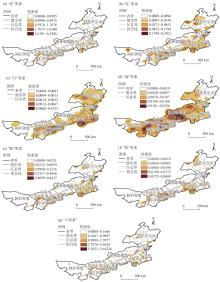
Fig. 1
Kernel density distributions of tourism elements in counties of Inner Mongolia"

Tab. 3
Evaluation index system and weights of tourism element development levels in counties of Inner Mongolia"
| 目标层 | 准则层 | 权重/% | 指标层 |
|---|---|---|---|
| 内蒙古县域旅游要素发展水平 | “食” | 6.01(人均指标) | 每万人拥有“食”要素的设施数 |
| 19.73(地均指标) | 每万平方千米拥有“食”要素的设施数 | ||
| “住” | 20.32(人均指标) | 每万人拥有“住”要素的设施数 | |
| 16.47(地均指标) | 每万平方千米拥有“住”要素的设施数 | ||
| “行” | 17.12(人均指标) | 每万人拥有“行”要素的设施数 | |
| 15.28(地均指标) | 每万平方千米拥有“行”要素的设施数 | ||
| “游” | 37.03(人均指标) | 每万人拥有“游”要素的设施数 | |
| 10.46(地均指标) | 每万平方千米拥有“游”要素的设施数 | ||
| “购” | 6.45(人均指标) | 每万人拥有“购”要素的设施数 | |
| 17.39(地均指标) | 每万平方千米拥有“购”要素的设施数 | ||
| “娱” | 13.07(人均指标) | 每万人拥有“娱”要素的设施数 | |
| 20.67(地均指标) | 每万平方千米拥有“娱”要素的设施数 |
Tab. 4
Global Moran’s I of tourism element development level in counties of Inner Mongolia"
| 要素类型 | 全局莫兰指数 | Z值 | P值 |
|---|---|---|---|
| “食” | 0.44 | 12.58 | 0.01 |
| “住” | 0.35 | 10.13 | 0.01 |
| “行” | 0.36 | 10.49 | 0.01 |
| “游” | 0.33 | 9.31 | 0.01 |
| “购” | 0.36 | 10.29 | 0.01 |
| “娱” | 0.45 | 12.84 | 0.01 |
| “六要素” | 0.42 | 12.11 | 0.01 |
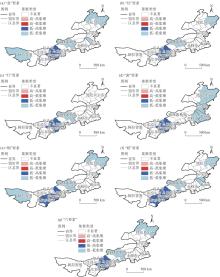
Fig. 2
LISA distributions of tourism elements in counties of Inner Mongolia"

Tab. 5
Measurement index system and detection results of the influencing factors of the spatial pattern of tourism element development levels in counties of Inner Mongolia"
| 分析框架 | 具体指标 | 指标属性 | 指标释义 | q值 | 解释力排序 |
|---|---|---|---|---|---|
| 经济 | 国内生产总值 | 正向 | 表征经济规模和增长情况 | 0.41*** | 8 |
| 第三产业国内生产总值占比 | 正向 | 表征经济结构和发展水平 | 0.29*** | 10 | |
| 人均可支配收入 | 正向 | 表征居民消费能力 | 0.47*** | 6 | |
| 公共预算收入 | 正向 | 表征政府财政收入状况 | 0.34*** | 9 | |
| 夜间灯光数据 | 正向 | 表征经济活跃程度 | 0.82*** | 1 | |
| 社会 | 年末户籍人口 | 正向 | 表征人口规模 | 0.06 | - |
| 公路里程 | 正向 | 表征交通基础设施情况 | 0.55*** | 3 | |
| 行政区面积 | 正向 | 表征行政区划大小 | 0.17*** | 13 | |
| 城镇化率 | 正向 | 表征社会发展程度 | 0.42*** | 7 | |
| 文化 | 中小学数 | 正向 | 表征全民教育程度 | 0.18*** | 11 |
| 影剧院数 | 正向 | 表征文旅产业的发展状况 | 0.50*** | 5 | |
| 文体娱乐业就业人数 | 正向 | 表征文化活力和多样性 | 0.67*** | 2 | |
| 平均受教育年限 | 正向 | 表征教育发展水平 | 0.52*** | 4 | |
| 自然 | 建成区绿化覆盖率 | 正向 | 表征居民生活环境质量 | 0.12* | 14 |
| PM2.5 | 负向 | 表征空气污染水平 | 0.18*** | 12 | |
| 污水处理率 | 正向 | 表征居民生活环境质量 | 0.10* | 15 | |
| 平均降水量 | 正向 | 表征人居环境气候条件 | 0.12 | - |
| [1] | 廉同辉, 余菜花, 包先建, 等. 基于模糊综合评价的主题公园游客满意度研究——以芜湖方特欢乐世界为例[J]. 资源科学, 2012, 34(5): 937-980. |
| [ Lian Tonghui, Yu Caihua, Bao Xianjian, et al. Research on the satisfication of theme park visitors based on fuzzy comprehension evaluation: A case study in Wuhu Fantawild Adventure[J]. Resources Science, 2012, 34(5): 973-980. ] | |
| [2] | 亢雄, 马耀峰. 对旅游“六要素”的再思考[J]. 旅游论坛, 2009, 2(4): 475-478. |
| [ Kang Xiong, Ma Yaofeng. Rethinking six components in tourism[J]. Tourism Forum, 2009, 2(4): 475-478. ] | |
| [3] | 吕俊芳. 旅游主体与旅游六要素的创新思考[J]. 渤海大学学报(哲学社会科学版), 2011, 35(4): 39-41. |
| [ Lü Junfang. Innovative thinking on the tourism subject and the six elements of tourism[J]. Journal of Bohai University (Philosophy and Social Science Edition), 2011, 35(4): 39-41. ] | |
| [4] | 符文洋. 重新审视“旅游六要素”[J]. 中州大学学报, 2014, 31(5): 14-17. |
| [ Fu Wenyang. Review of the “six elements of tourism”[J]. Journal of Zhongzhou University, 2014, 31(5): 14-17. ] | |
| [5] | 张玉莲. 论旅游第七要素——“知”[J]. 中南林业科技大学学报(社会科学版), 2015, 9(1): 49-55. |
| [ Zhang Yulian. On the seventh element of travelling: Knowledge[J]. Journal of Central South University of Forestry & Technology (Social Sciences Edition), 2015, 9(1): 49-55. ] | |
| [6] | 涂绪谋. 论旅游的第七要素“思”[J]. 四川师范大学学报(社会科学版), 2009, 36(3): 107-112. |
| [ Tu Xumou. On the seventh element of tourism: Thought[J]. Journal of Sichuan Normal University (Social Science Edition), 2009, 36(3): 107-112. ] | |
| [7] | 鲁明勇, 覃琴. 旅游要素的多维系统认知与拓展升级研究[J]. 商学研究, 2018, 25(3): 106-114. |
| [ Lu Mingyong, Qin Qin. Multidimensional system cognition and expansion upgrading of tourism elements[J]. Commercial Science Research, 2018, 25(3): 106-114. ] | |
| [8] | Wang T, Wu P, Ge Q, et al. Ticket prices and revenue levels of tourist attractions in China: Spatial differentiation between prefectural units[J]. Tourism Management, 2021, 83: 1-19. |
| [9] | Zhang Y L, Xiao X, Zheng C H, et al. Is tourism participation in projected areas the best livelihood strategy from the perspective of community development and environmental protection[J]. Journal of Sustainable Tourism, 2020, 28(4): 587-605. |
| [10] | Jamieson W. Overtourism management competencies in Asian urban heritage areas[J]. International Journal of Tourism Cities, 2019, 5(4): 581-597. |
| [11] | Dredge D. Destination place planning and design[J]. Annals of Tourism Research, 1999, 26(4): 772-791. |
| [12] | Agusti D P I. Territorial distribution of tourist attractions. Comparing projected and perceived image in Uruguay[J]. Economia Sociedad Y Territorio, 2018, 18(58): 735-762. |
| [13] | 翟辅东. 旅游六要素的理论属性探讨[J]. 旅游学刊, 2006(4): 18-22. |
| [ Zhai Fudong. Probe into the six components in tourism[J]. Tourism Tribune, 2006(4): 18-22. ] | |
| [14] | 胡抚生. 基于旅游六要素的旅游产业范围探讨[J]. 旅游学刊, 2007(11): 10-11. |
| [ Hu Fusheng. Discussion on the scope of the tourism industry based on the six elements of tourism[J]. Tourism Tribune, 2007(11): 10-11. ] | |
| [15] | 闵祥晓, 邓咏珊, 郭浩明, 等. 基于旅游六要素的中山市旅游形象游客感知调查[J]. 现代商业, 2015(23): 102-104. |
| [ Min Xiangxiao, Deng Yongshan, Guo Haoming, et al. A survey on tourist perception of Zhongshan City’s tourism image based on the six elements of tourism[J]. Modern Business, 2015(23): 102-104. ] | |
| [16] | 张鸿敏. 乡村振兴背景下乡村旅游要素与空间规划设计[J]. 智慧农业导刊, 2023, 3(22): 91-95. |
| [ Zhang Hongmin. Rural tourism elements and spatial planning design under the background of rural revitalization[J]. Smart Agriculture Guide, 2023, 3(22): 91-95. ] | |
| [17] | 肖博鸿, 马源. 广州历史街区旅游要素空间分布与交通可达性关联研究[J]. 经济地理, 2024, 44(4): 231-240. |
| [ Xiao Bohong, Ma Yuan. Correlation study between spatial distribution of tourism elements and transportation accessibility in historic districts of Guangzhou City[J]. Economic Geography, 2024, 44(4): 231-240. ] | |
| [18] | 林章林, 程智. 黄山市旅游要素空间结构与旅游环境的耦合关系[J]. 地域研究与开发, 2020, 39(2): 94-98, 110. |
| [ Lin Zhanglin, Cheng Zhi. Study on coupling relationship between spatial structure of tourism elements and tourism environment in Huangshan City[J]. Areal Research and Development, 2020, 39(2): 94-98, 110. ] | |
| [19] | 王娟, 赵婕, 封洁洁. 青岛市历史街区街道结构与旅游要素空间分布关联研究[J]. 西北师范大学学报(自然科学版), 2022, 58(6): 61-69. |
| [ Wang Juan, Zhao Jie, Feng Jiejie. Study of the spatial relations of streets structure and tourism elements distribution in historic district in Qingdao City[J]. Journal of Northwest Normal University (Natural Science Edition), 2022, 58(6): 61-69. ] | |
| [20] | 赵中华, 汪宇明. 基于长江三角洲案例的区域旅游交通配置优化研究[J]. 地域研究与开发, 2007, 26(3): 51-55. |
| [ Zhao Zhonghua, Wang Yuming. Study on optimization of regional tourist traffic based on the Yangtze River Delta[J]. Areal Research and Development, 2007, 26(3): 51-55. ] | |
| [21] | 刘刚, 张再生, 吴绍玉. 主客共享视域下旅游城市空间治理策略及路径探究——以海南省三亚市为例[J]. 城市发展研究, 2020, 27(2): 1-6. |
| [ Liu Gang, Zhang Zaisheng, Wu Shaoyu. Study on tourism city spatial governance strategy and path in the vision of host-guest sharing: The case of Sanya City of Hainan Province[J]. Urban Development Studies, 2020, 27(2): 1-6. ] | |
| [22] | 杜兰, 葛军莲, 王宏志, 等. 基于POI网络信息的景区最优游客接待中心选址研究——以南京钟山景区智慧旅游为例[J]. 华中师范大学学报(自然科学版), 2014, 48(4): 613-619. |
| [ Du Lan, Ge Junlian, Wang Hongzhi, et al. Study on scenic-oriented optimal site selection of tourist service center based on the POI network data: A case of intelligent tourism of Zhongshan scenic, Nanjing[J]. Journal of Huazhong Normal University (Natural Science Edition), 2014, 48(4): 613-619. ] | |
| [23] | 王珺颖, 谢德体, 王三, 等. 基于POI提取的山地丘陵区乡村旅游空间分布研究——以重庆市农家乐为例[J]. 中国农业资源与区划, 2020, 41(5): 257-267. |
| [ Wang Junying, Xie Deti, Wang San, et al. Research on spatial distribution of rural tourism in mountainous and hilly areas based on POI extraction: A case study of Chongqing City[J]. Chinese Journal of Agricultural Resources and Regional Planning, 2020, 41(5): 257-267. ] | |
| [24] | 汪秋菊, 刘宇, 李新, 等. 中国主要城市旅游要素网络关注空间演化特征[J]. 世界地理研究, 2017, 26(1): 45-55. |
| [ Wang Qiuju, Liu Yu, Li Xin, et al. Evolution characteristics of 24 major cities’ network attention degree of six elements of tourism in China[J]. World Regional Studies, 2017, 26(1): 45-55. ] | |
| [25] | 陈洪星, 杨德刚, 徐红涛, 等. 基于POI的住宿业时空格局演化及与旅游景点的空间关联研究[J]. 干旱区地理, 2020, 43(5): 1382-1390. |
| [ Chen Hongxing, Yang Degang, Xu Hongtao, et al. Spatial and temporal evolution of the accommodation industry and spatial association with tourist spots based on POI[J]. Arid Land Geography, 2020, 43(5): 1382-1390. ] | |
| [26] | 莫惠斌, 罗珂, 王少剑, 等. 广州市中心城区餐饮店空间分异与机制差异研究——基于传统店与外卖店的对比[J]. 地理研究, 2022, 41(12): 3318-3334. |
| [ Mo Huibin, Luo Ke, Wang Shaojian, et al. Spatial heterogenicity and mechanism difference of restaurant in the central urban area of Guangzhou: A comparison between traditional restaurant and take-out restaurant[J]. Geographical Research, 2022, 41(12): 3318-3334. ] | |
| [27] | 郭艳萍, 刘敏. 基于POI数据的山西省旅游景区分类及空间分布特征[J]. 地理科学, 2021, 41(7): 1246-1255. |
| [ Guo Yanping, Liu Min. Classification and spatial distribution characteristics of tourist attractions in Shanxi Province based on POI data[J]. Scientia Geographica Sinica, 2021, 41(7): 1246-1255. ] | |
| [28] | 于亚娟. 基于POI数据的内蒙古公共文化设施空间结构与影响因素[J]. 干旱区地理, 2025, 48(3): 528-538. |
| [ Yu Yajuan. Spatial structure and influencing factors of Inner Mongolia’s public cultural facilities based on POI data[J]. Arid Land Geography, 2025, 48(3): 528-538. ] | |
| [29] | 范梦余, 张辉, 陈怡宁. 内蒙古视觉旅游形象的时空感知研究——基于DeepSentiBank的地理标记照片分析[J]. 干旱区资源与环境, 2020, 34(10): 194-200. |
| [ Fan Mengyu, Zhang Hui, Chen Yining. Spatiotemporal analysis of visual tourism images in Inner Mongolia from the perspective of tourists[J]. Journal of Arid Land Resources and Environment, 2020, 34(10): 194-200. ] | |
| [30] | Clark P J, Evans F C. Distance to nearest neighbor as a measure of spatial relationships in populations[J]. Ecology, 1954, 35: 445-453. |
| [31] | 陈慧霖, 李加林, 王中义, 等. 乡村振兴背景下浙江省3A级景区村庄空间结构特征与影响因子分析[J]. 自然资源学报, 2022, 37(9): 2467-2484. |
| [ Chen Huilin, Li Jialin, Wang Zhongyi, et al. Spatial structure characteristics and influencing factors of 3A-level scenic spots (villages) in Zhejiang Province under the background of rural revitalization[J]. Journal of Natural Resources, 2022, 37(9): 2467-2484. ] | |
| [32] | 牛冰洁, 殷平, 申鹏霞. 高铁站区住宿业时空分布特征及影响因素研究——基于城市规模的视角[J]. 干旱区资源与环境, 2023, 37(4): 80-89. |
| [ Niu Bingjie, Yin Ping, Shen Pengxia. Spatial-temporal characteristics of accommodation industry in high-speed railway station area and impacting factors: A perspective of urban scale[J]. Journal of Arid Land Resources and Environment, 2023, 37(4): 80-89. ] | |
| [33] | 李小月, 余斌, 王彬燕. 江汉平原城乡经济循环格局演变及其畅通优化研究[J]. 地理科学进展, 2024, 43(5): 936-949. |
| [ Li Xiaoyue, Yu Bin, Wang Binyan. Change in the pattern of urban-rural economic circulation and optimization in the Jianghan Plain region[J]. Progress in Geography, 2024, 43(5): 936-949. ] | |
| [34] | 吴清, 焦义彬, 冯嘉晓, 等. 共同富裕背景下乡村旅游地返贫风险监测及防范——以广东南平村为例[J]. 地域研究与开发, 2024, 43(3): 174-179. |
| [ Wu Qing, Jiao Yibin, Feng Jiaxiao, et al. Monitoring and preventing the risk of returning to poverty in rural tourism places in the context of common prosperity: Taking Nanping village of Guangdong Province as example[J]. Areal Research and Development, 2024, 43(3): 174-179. ] | |
| [35] | Joo D, Woosnam K M, Shafer C S, et al. Considering Tobler’s first law of geography in a tourism context[J]. Tourism Management, 2016, 62: 350-359. |
| [36] | 马浩, 涂静. 批发零售业水平对物流业竞争力的空间影响[J]. 财经理论研究, 2024(1): 97-112. |
| [ Ma Hao, Tu Jing. Spatial influence of wholesale and retail trade level on logistics competitiveness[J]. Journal of Finance and Economics Theory, 2024(1): 97-112. ] | |
| [37] | 刘培学, 王欢颖, 陈伟, 等. 新冠疫情对旅游景区客源市场需求的空间分异影响——以南京夫子庙景区为例[J]. 地理科学, 2022, 42(7): 1250-1259. |
| [ Liu Peixue, Wang Huanying, Chen Wei, et al. Spatially divergent impact of the COVID-19 epidemic on source markets of tourism destination: A case study of the Confucius Temple in Nanjing[J]. Scientia Geographica Sinica, 2022, 42(7): 1250-1259. ] | |
| [38] | 王劲峰, 徐成东. 地理探测器: 原理与展望[J]. 地理学报, 2017, 72(1): 116-134. |
| [ Wang Jinfeng, Xu Chengdong. Geodetector: Principle and prospective[J]. Acta Geographica Sinica, 2017, 72(1): 116-134. ] | |
| [39] | 杨雨, 宋福铁, 张杰. 基于地理探测器的中国金融网络空间结构特征及影响因素研究[J]. 干旱区地理, 2023, 46(9): 1524-1535. |
| [ Yang Yu, Song Futie, Zhang Jie. Spatial structure characteristics and influencing factors of financial network of China based on geodetectors[J]. Arid Land Geography, 2023, 46(9): 1524-1535. ] | |
| [40] | 朱佩娟, 黄秋菊, 万义良, 等. 中国城市儿童公共服务设施配置水平的空间分异及其影响因素[J]. 经济地理, 2023, 43(11): 55-67. |
| [ Zhu Peijuan, Huang Qiuju, Wan Yiliang, et al. Spatial differentiation and influencing factors of the allocation level of urban children’s public service facilities in China[J]. Economic Geography, 2023, 43(11): 55-67. ] | |
| [41] | 万红莲, 王晓利, 黄敏, 等. 基于POI数据的关中平原城市群县域旅游要素空间格局及影响因素研究[J]. 干旱区资源与环境, 2024, 38(6): 200-208. |
| [ Wan Honglian, Wang Xiaoli, Huang Min, et al. Spatial pattern of county tourism elements in Guanzhong Plain urban agglomeration and influencing factors: Point of interest-based analyses[J]. Journal of Arid Land Resources and Environment, 2024, 38(6): 200-208. ] | |
| [42] | 陈英杰, 吴金华. 基于POI数据的西安市旅游要素空间格局与影响因素研究[J]. 测绘地理信息, 2023, 48(4): 96-100. |
| [ Chen Yingjie, Wu Jinhua. Research on the spatial pattern and influencing factors of tourism components in Xi’an based on POI data[J]. Journal of Geomatics, 2023, 48(4): 96-100. ] | |
| [43] | 吴立周, 权东计, 朱海霞. 西安城区餐饮老字号空间格局及其影响因素研究[J]. 世界地理研究, 2017, 26(5): 105-114, 127. |
| [ Wu Lizhou, Quan Dongji, Zhu Haixia. Study on the spatial distribution of time-honored catering brand and its influencing factors in Xi’an[J]. World Regional Studies, 2017, 26(5): 105-114, 127. ] | |
| [44] | 甘畅, 王凯. 武陵山片区高质量景区空间分布格局及其影响因素[J]. 长江流域资源与环境, 2021, 30(9): 2115-2125. |
| [ Gan Chang, Wang Kai. Spatial distribution pattern and influencing factors of high-quality scenic spots in Wuling Mountains area[J]. Resources and Environment in the Yangtze Basin, 2021, 30(9): 2115-2125. ] | |
| [45] | 吴志祥, 张志斌, 赵学伟, 等. 中国西北地区A级旅游景区时空分布格局及影响因素[J]. 干旱区地理, 2023, 46(12): 2061-2073. |
| [ Wu Zhixiang, Zhang Zhibin, Zhao Xuewei, et al. Spatiotemporal distribution pattern and influencing factors of A-level tourist attractions in northwestern China[J]. Arid Land Geography, 2023, 46(12): 2061-2073. ] |
|
||