Arid Land Geography ›› 2025, Vol. 48 ›› Issue (12): 2232-2246.doi: 10.12118/j.issn.1000-6060.2025.074
• Regional Development • Previous Articles Next Articles
WANG Yanwen1( ), YANG Huan2(), TU Peiyue2, DING Hao3, JING Ying4, HE Chao5,6
Received:2025-02-16
Revised:2025-04-11
Online:2025-12-25
Published:2025-12-30
Contact:
YANG Huan
E-mail:wensomone@163.com;yanghuan_@whu.edu.cn
WANG Yanwen, YANG Huan, TU Peiyue, DING Hao, JING Ying, HE Chao. Impact of urban expansion on habitat quality in the northern Tianshan Mountain economic zone[J].Arid Land Geography, 2025, 48(12): 2232-2246.
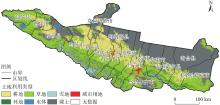
Fig. 1
Schematic diagram of the study area"
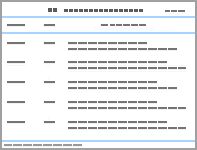
Tab. 1
Data information in this study"
| 数据名称 | 类型(分辨率) | 时间跨度 | 来源 |
|---|---|---|---|
| 过去的人口、GDP | 统计数据 | 2000—2023年 | 《中国统计年鉴》 |
| 未来的人口、GDP | 栅格数据/0.5° | 2024—2050年 | Science Data Bank Platform, |
| 土地利用/覆盖(LULC) | 栅格数据/30 m | 2000—2023年 | China Land Cover Dataset, |
| 高程、坡度 | 栅格数据/90 m | 2000年 | Google Earth Engine,SRTM Digital Elevation Data (Version 4) |
| 行政区划、城市中心 | 矢量数据 | 2023年 | 标准地图服务, |
| 路网、河流 | 矢量数据 | 2013、2023年 | Open Street Map, |
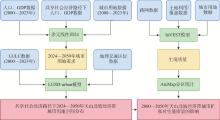
Fig. 2
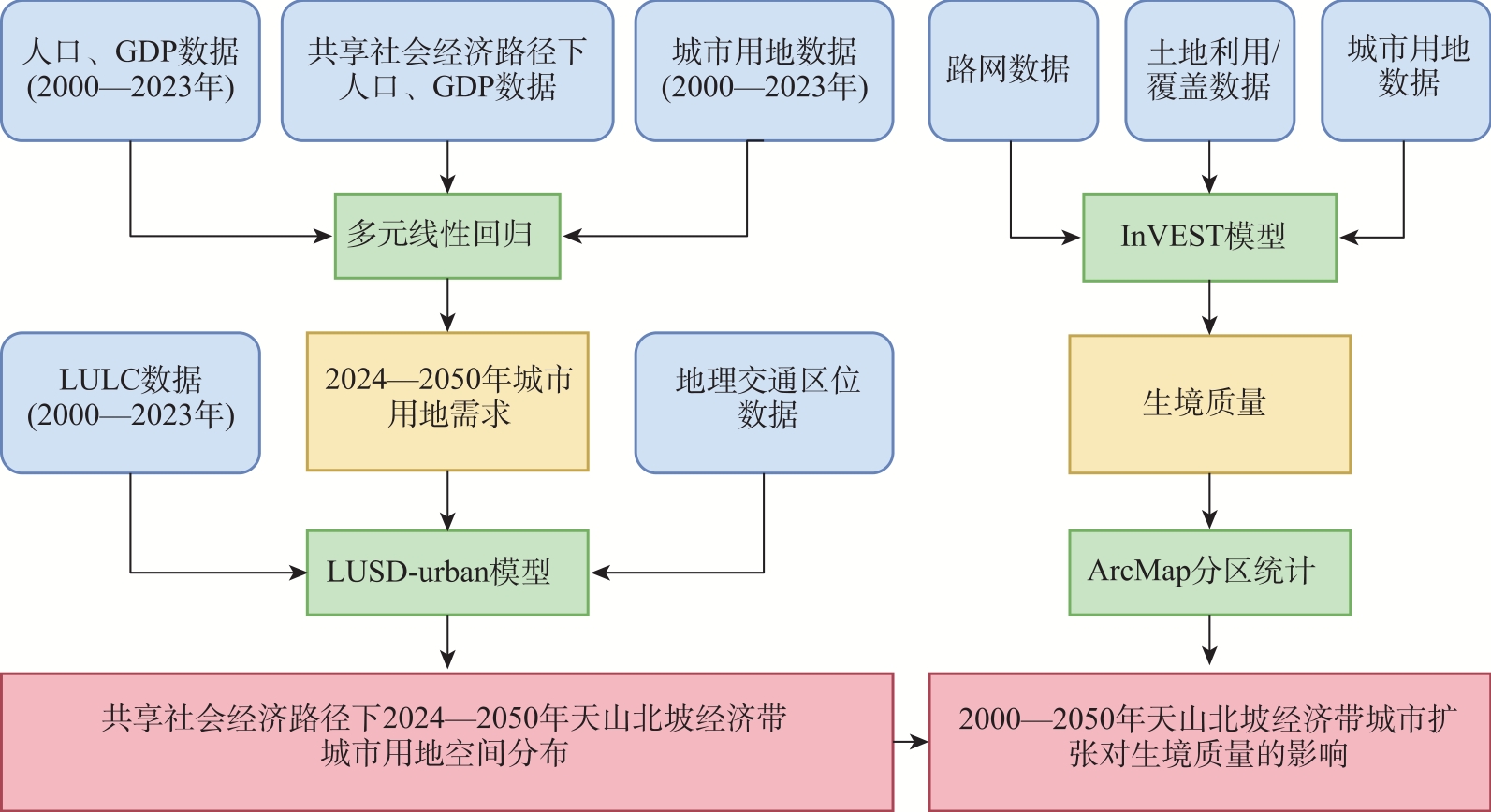
Methodology framework"
Tab. 2
Changes of urban land use and habitat quality in the northern Tianshan Mountain economic zone from 2000 to 2023"
| 城市 | 城市用地 | 生境质量 | |||||||||
|---|---|---|---|---|---|---|---|---|---|---|---|
| 2000年 | 2023年 | 扩张面积/km2 | 扩张率/% | 趋势/km2·a-1 | 2000年 | 2023年 | 损失 | 损失率/% | 趋势/a-1 | ||
| 温泉县 | 0.23 | 3.44 | 3.21 | 1395.65 | 0.12 | 0.777 | 0.746 | 0.031 | 3.946 | -0.006 | |
| 博乐市 | 30.37 | 90.29 | 59.92 | 197.30 | 2.56 | 0.694 | 0.672 | 0.022 | 3.182 | -0.004 | |
| 精河县 | 26.41 | 270.41 | 244.00 | 923.89 | 10.04 | 0.578 | 0.547 | 0.031 | 5.418 | -0.006 | |
| 乌苏市 | 53.06 | 192.23 | 139.17 | 262.29 | 6.92 | 0.596 | 0.580 | 0.015 | 2.551 | -0.004 | |
| 克拉玛依市 | 15.82 | 82.91 | 67.09 | 424.08 | 3.08 | 0.324 | 0.309 | 0.015 | 4.679 | -0.003 | |
| 奎屯市 | 28.80 | 98.30 | 69.50 | 241.32 | 3.48 | 0.760 | 0.636 | 0.123 | 16.248 | -0.029 | |
| 沙湾市 | 23.84 | 105.12 | 81.28 | 340.94 | 3.70 | 0.575 | 0.553 | 0.021 | 3.739 | -0.006 | |
| 石河子市 | 19.78 | 80.17 | 60.39 | 305.31 | 2.91 | 0.553 | 0.527 | 0.027 | 4.851 | -0.005 | |
| 玛纳斯县 | 20.52 | 80.34 | 59.82 | 291.52 | 2.82 | 0.492 | 0.488 | 0.005 | 0.952 | -0.001 | |
| 呼图壁县 | 11.43 | 47.82 | 36.39 | 318.37 | 1.76 | 0.597 | 0.562 | 0.035 | 5.810 | -0.011 | |
| 昌吉市 | 33.16 | 107.79 | 74.63 | 225.06 | 3.51 | 0.611 | 0.570 | 0.042 | 6.827 | -0.009 | |
| 米泉市 | 49.93 | 124.79 | 74.86 | 149.93 | 3.52 | 0.493 | 0.462 | 0.031 | 6.302 | -0.007 | |
| 阜康市 | 12.43 | 41.68 | 29.25 | 235.32 | 1.38 | 0.491 | 0.428 | 0.063 | 12.886 | -0.013 | |
| 吉木萨尔县 | 5.29 | 18.11 | 12.82 | 242.34 | 0.54 | 0.494 | 0.438 | 0.056 | 11.289 | -0.009 | |
| 奇台县 | 9.29 | 24.46 | 15.17 | 163.29 | 0.63 | 0.387 | 0.364 | 0.022 | 5.805 | -0.005 | |
| 木垒哈萨克县 | 22.55 | 23.37 | 0.82 | 3.64 | 0.01 | 0.586 | 0.530 | 0.056 | 9.622 | -0.010 | |
| 乌鲁木齐市 | 188.81 | 364.88 | 176.07 | 93.25 | 7.56 | 0.674 | 0.615 | 0.059 | 8.738 | -0.012 | |
| 整体 | 551.72 | 1756.11 | 1204.39 | 218.30 | 54.70 | 0.551 | 0.520 | 0.031 | 5.574 | -0.008 | |
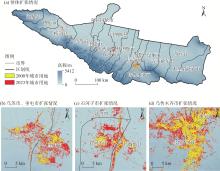
Fig. 3
Comparison of the spatial distribution of urban land use in the overall and key areas of the northern Tianshan Mountain economic zone from 2000 to 2023"
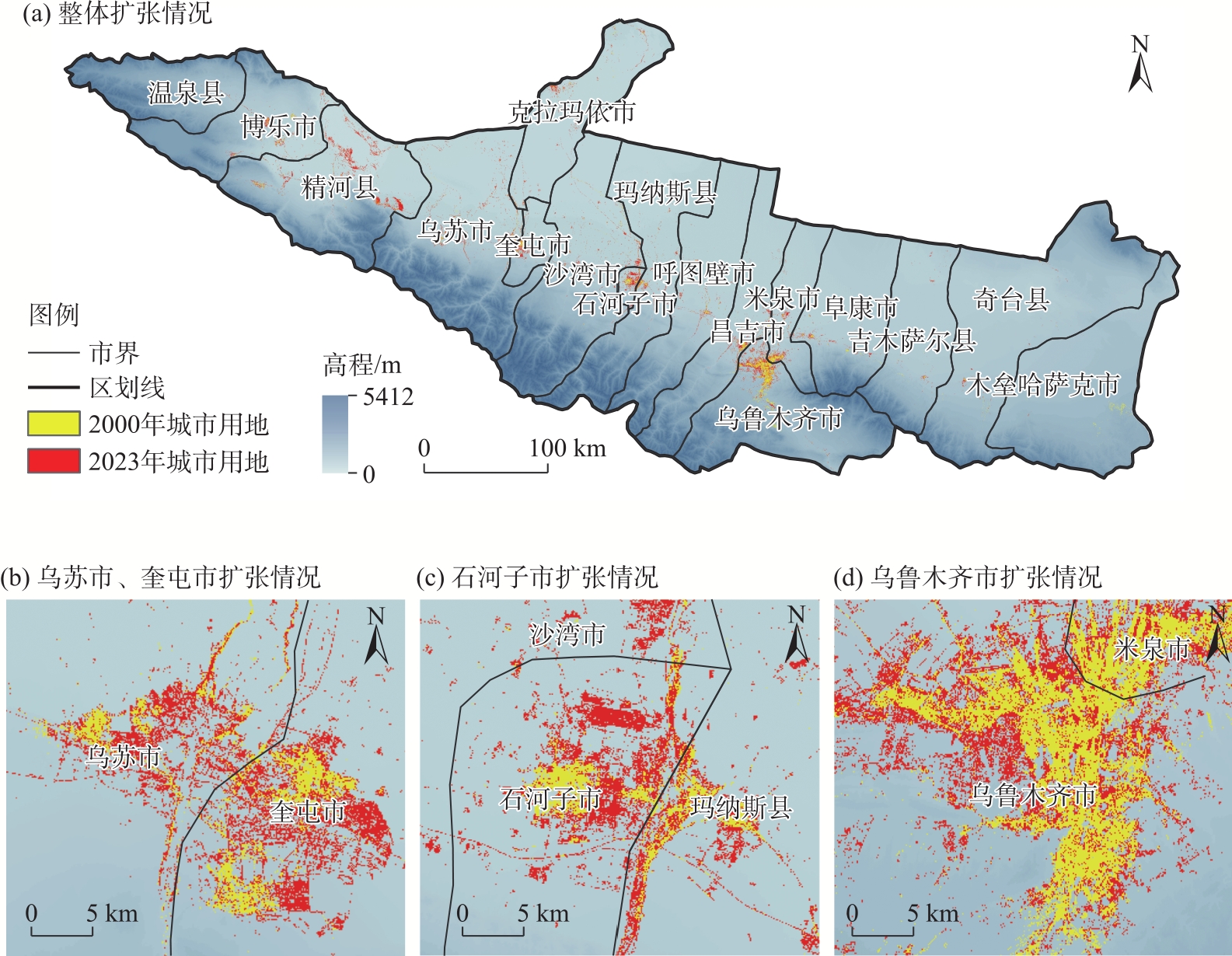
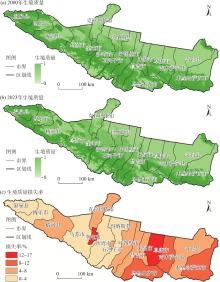
Fig. 4
Spatial distribution comparison and loss rate of habitat quality in the northern Tianshan Mountain economic zone from 2000 to 2023"
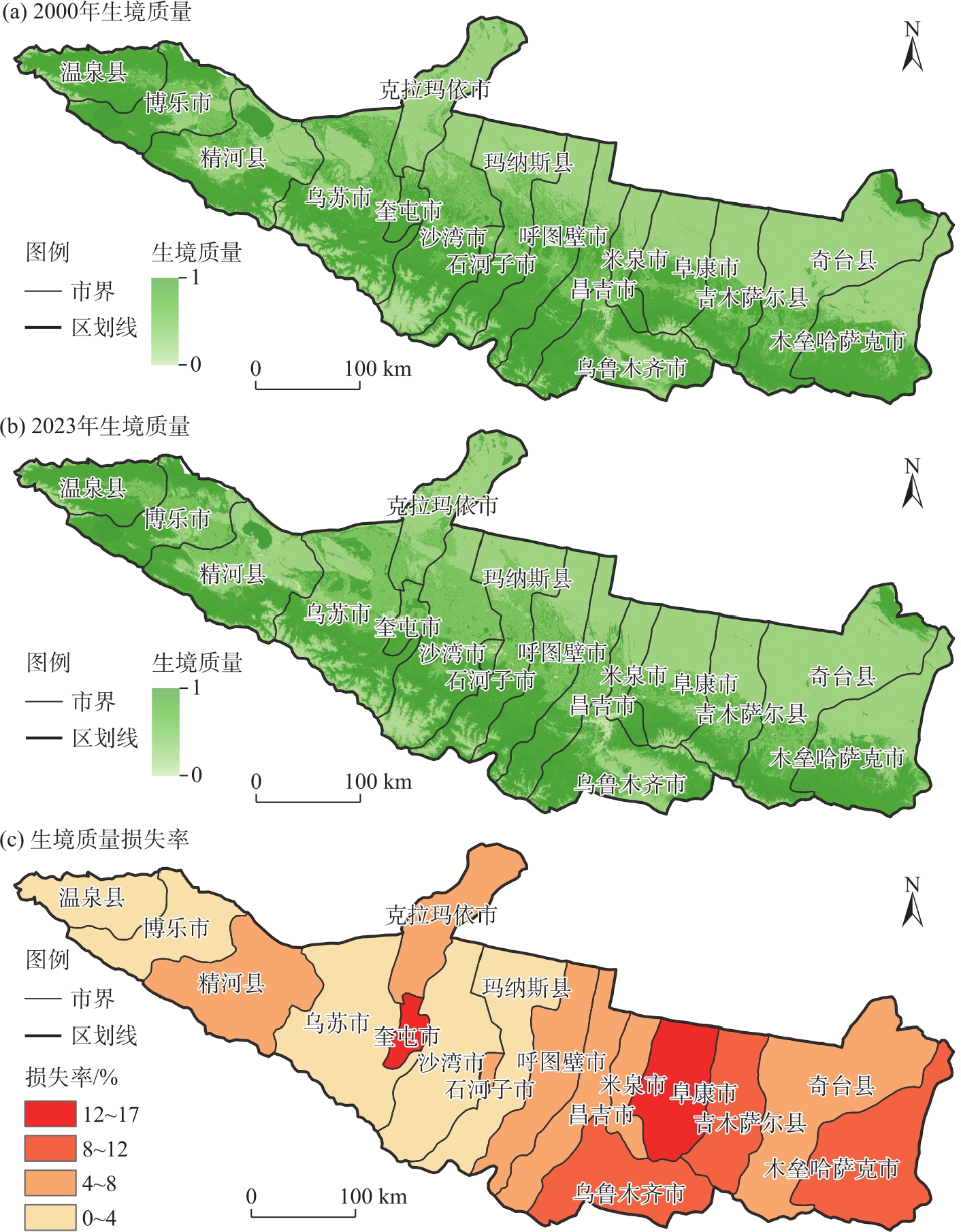
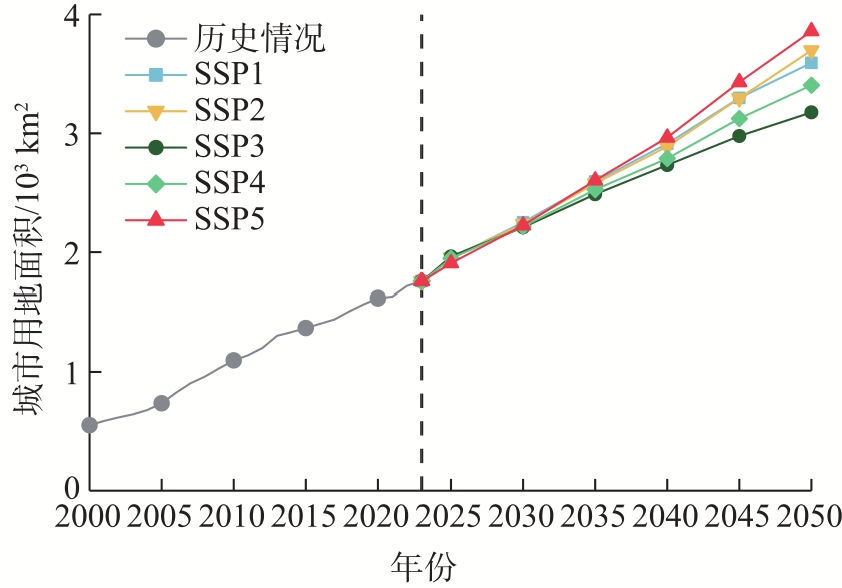
Fig. 5
Changes in urban land area in the northern Tianshan Mountain economic zone from 2000 to 2023 and urban land demand from 2024 to 2050"
Tab. 3
Changes of urban land use and habitat quality in the northern Tianshan Mountain economic zone from 2023 to 2050"
| 城市 | 城市用地 | 生境质量 | |||||
|---|---|---|---|---|---|---|---|
| 2023—2050年扩张面积/km2 | 扩张率/% | 趋势/km2·a-1 | 2023—2050年损失/10-2 | 损失率/% | 趋势/10-3·a-1 | ||
| 温泉县 | 0.02~0.03 | 0.58~0.87 | 0.00~0.01 | 0.00~0.00 | 0.00~0.00 | 0.00~0.00 | |
| 博乐市 | 51.64~69.02 | 57.19~76.44 | 9.01~12.88 | 0.35~0.46 | 0.52~0.69 | -0.86~-0.61 | |
| 精河县 | 129.59~195.43 | 47.92~72.27 | 24.31~38.13 | 0.50~0.75 | 0.91~1.37 | -1.47~-0.94 | |
| 乌苏市 | 215.74~335.97 | 112.23~174.78 | 37.58~57.39 | 0.81~1.23 | 1.40~2.13 | -2.18~-1.42 | |
| 克拉玛依市 | 90.95~178.02 | 109.70~214.71 | 16.42~25.76 | 0.60~1.14 | 1.94~3.69 | -1.77~-1.10 | |
| 奎屯市 | 98.68~140.91 | 100.39~143.35 | 15.69~23.39 | 3.79~5.26 | 5.95~8.26 | -8.84~-6.17 | |
| 沙湾市 | 77.77~125.63 | 73.98~119.51 | 14.02~21.69 | 0.38~0.59 | 0.69~1.07 | -1.05~-0.68 | |
| 石河子市 | 83.51~114.75 | 104.17~143.13 | 13.92~19.72 | 9.55~12.69 | 18.13~24.10 | -21.38~-15.72 | |
| 玛纳斯县 | 75.82~116.51 | 94.37~145.02 | 12.98~19.78 | 0.43~0.64 | 0.89~1.32 | -1.15~-0.74 | |
| 呼图壁县 | 57.09~84.12 | 119.39~175.91 | 10.68~15.67 | 0.41~0.60 | 0.74~1.07 | -1.15~-0.77 | |
| 昌吉市 | 123.78~184.30 | 114.83~170.98 | 21.93~33.47 | 1.10~1.61 | 1.93~2.82 | -2.99~-1.96 | |
| 米泉市 | 107.76~160.78 | 86.35~128.84 | 18.05~27.41 | 2.01~2.90 | 4.35~6.28 | -5.14~-3.37 | |
| 阜康市 | 36.70~52.41 | 88.05~125.74 | 6.65~10.03 | 0.32~0.45 | 0.74~1.05 | -0.86~-0.58 | |
| 吉木萨尔县 | 1.89~2.48 | 10.44~13.69 | 0.33~0.47 | 0.02~0.03 | 0.05~0.06 | -0.05~-0.03 | |
| 奇台县 | 1.94~2.53 | 7.93~10.34 | 0.34~0.49 | 0.01~0.01 | 0.02~0.03 | -0.02~-0.02 | |
| 木垒哈萨克县 | 0.00~0.00 | 0.00~0.00 | 0.00~0.00 | 0.00~0.00 | 0.00~0.00 | 0.00~0.00 | |
| 乌鲁木齐市 | 267.28~340.20 | 73.25~93.24 | 46.10~59.51 | 1.78~2.24 | 2.89~3.64 | -3.91~-3.06 | |
| 整体 | 1420.16~2103.09 | 80.87~119.76 | 244.03~369.38 | 0.57~0.82 | 1.10~1.58 | -1.48~-0.99 | |
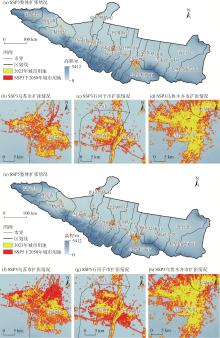
Fig. 6
Comparison of spatial distribution of urban land use in the northern Tianshan Mountain economic zone from 2023 to 2050"

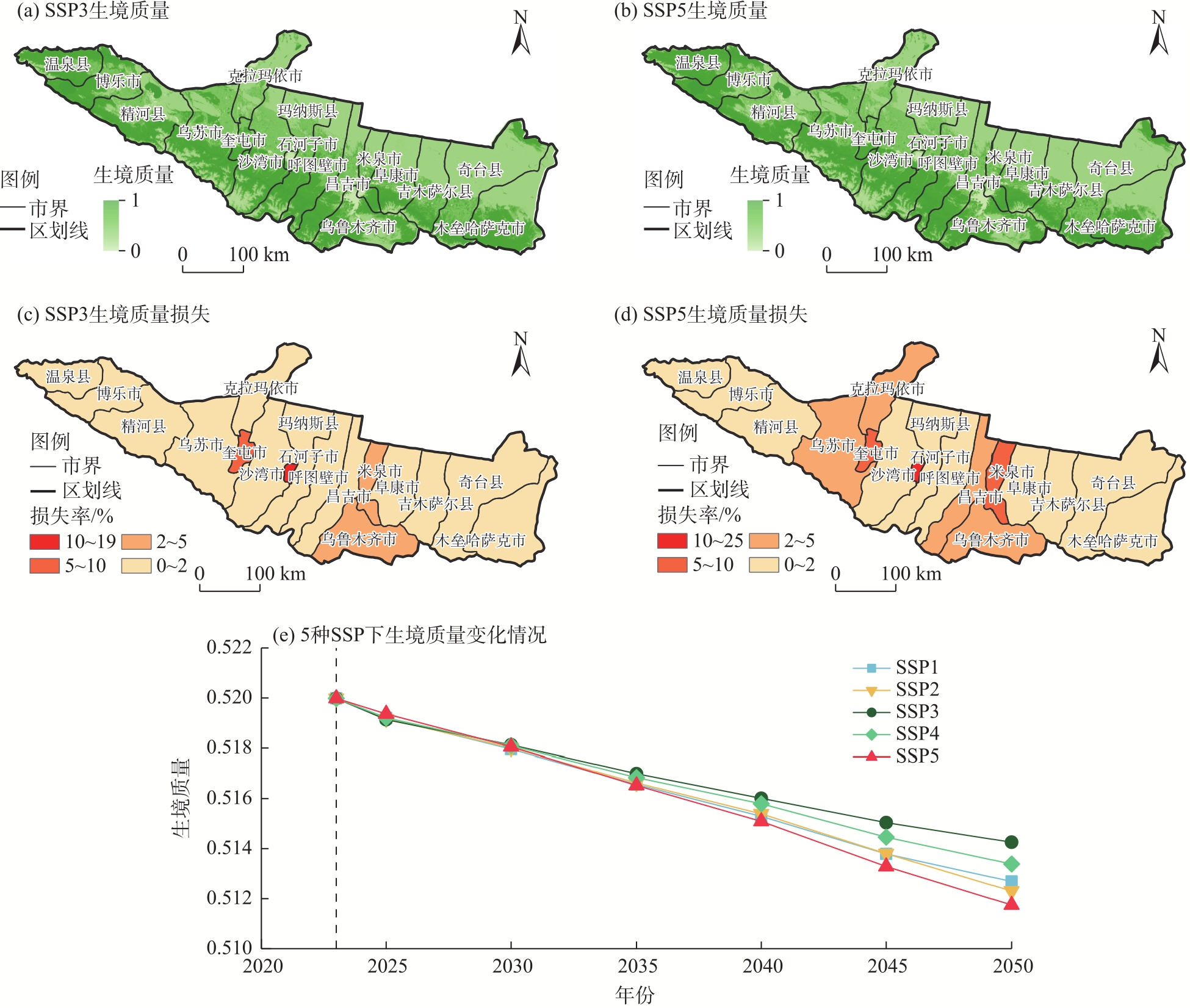
Fig. 7
Habitat quality loss in the northern Tianshan Mountain economic zone from 2023 to 2050"
| [1] | Liu X Z, Li X S, Yang J, et al. How to resolve the conflicts of urban functional space in planning: A perspective of urban moderate boundary[J]. Ecological Indicators, 2022, 144: 109495, doi: 10.1016/j.ecolind.2022.109495. |
| [2] |
王勇, 孙瑞欣. 土地利用变化对区域水-能源-粮食系统耦合协调度的影响——以京津冀城市群为研究对象[J]. 自然资源学报, 2022, 37(3): 582-599.
doi: 10.31497/zrzyxb.20220303 |
|
[Wang Yong, Sun Ruixin. Impact of land use change on coupling coordination degree of regional water-energy-food system: A case study of Beijing-Tianjin-Hebei urban agglomeration[J]. Journal of Natural Resources, 2022, 37(3): 582-599.]
doi: 10.31497/zrzyxb.20220303 |
|
| [3] |
张敏, 杨励雅, 胡卓玮, 等. 长江经济带城市扩张的时空分异特征及影响机制[J]. 地理学报, 2024, 79(2): 439-461.
doi: 10.11821/dlxb202402010 |
|
[Zhang Min, Yang Liya, Hu Zhuowei, et al. Spatiotemporal differentiation and influencing mechanism of urban expansion in the Yangtze River Economic Belt, China[J]. Acta Geographica Sinica, 2024, 79(2): 439-461.]
doi: 10.11821/dlxb202402010 |
|
| [4] | 师静, 鲁雪媛, 陈旭. 昆明市城市化及城市热岛效应对植被净初级生产力的影响[J]. 草业科学, 2022, 39(12): 2589-2603. |
| [Shi Jing, Lu Xueyuan, Chen Xu. Study on the impact of urbanization and urban heat island effect on net primary productivity in Kunming[J]. Pratacultural Science, 2022, 39(12): 2589-2603.] | |
| [5] | Arshad S, Ahmad S R, Abbas S, et al. Quantifying the contribution of diminishing green spaces and urban sprawl to urban heat island effect in a rapidly urbanizing metropolitan city of Pakistan[J]. Land Use Policy, 2022, 113: 105874, doi: 10.1016/j.landusepol.2021.105874. |
| [6] | 王桂林, 张炜. 中国城市扩张及空间特征变化对PM2.5污染的影响[J]. 环境科学, 2019, 40(8): 3447-3456. |
| [Wang Guilin, Zhang Wei. Effects of urban expansion and changes in urban characteristics on PM2.5 pollution in China[J]. Environmental Science, 2019, 40(8): 3447-3456.] | |
| [7] |
Khan A A, Arshad S, Mohsin M. Population growth and its impact on urban expansion: A case study of Bahawalpur, Pakistan[J]. Universal Journal of Geoscience, 2014, 2(8): 229-241.
doi: 10.13189/ujg.2014.020801 |
| [8] |
马丽莎, 刘殿锋, 刘耀林. 城市扩张与生态空间非线性动态耦合关系梯度分析模型[J]. 地球信息科学学报, 2023, 25(10): 1968-1985.
doi: 10.12082/dqxxkx.2023.230178 |
| [Ma Lisha, Liu Dianfeng, Liu Yaolin. Modelling gradient changes of non-linear dynamic coupling relationships between urban expansion and ecological land[J]. Journal of Geo-information Science, 2023, 25(10): 1968-1985.] | |
| [9] |
Seto K C, Güneralp B, Hutyra L R. Global forecasts of urban expansion to 2030 and direct impacts on biodiversity and carbon pools[J]. Proceedings of the National Academy of Sciences, 2012, 109(40): 16083-16088.
doi: 10.1073/pnas.1211658109 |
| [10] | Yang H, Wang Y W, Tu P Y, et al. Evaluating the effects of future urban expansion on ecosystem services in the Yangtze River Delta urban agglomeration under the shared socioeconomic pathways[J]. Ecological Indicators, 2024, 160: 111831, doi: 10.1016/j.ecolind.2024.111831. |
| [11] |
张学儒, 周杰, 李梦梅. 基于土地利用格局重建的区域生境质量时空变化分析[J]. 地理学报, 2020, 75(1): 160-178.
doi: 10.11821/dlxb202001012 |
|
[Zhang Xueru, Zhou Jie, Li Mengmei. Analysis on spatial and temporal changes of regional habitat quality based on the spatial pattern reconstruction of land use[J]. Acta Geographica Sinica, 2020, 75(1): 160-178.]
doi: 10.11821/dlxb202001012 |
|
| [12] |
吴健生, 岳新欣, 秦维. 基于生态系统服务价值重构的生态安全格局构建: 以重庆两江新区为例[J]. 地理研究, 2017, 36(3): 429-440.
doi: 10.11821/dlyj201703003 |
| [Wu Jiansheng, Yue Xinxin, Qing Wei. The establishment of ecological security patterns based on the redistribution of ecosystem service value: A case study in the Liangjiang New Area, Chongqing[J]. Geographical Research, 2017, 36(3): 429-440.] | |
| [13] | 潘耀, 尹云鹤, 侯文娟, 等. 基于土地利用及植被覆盖变化的黄河源区生境质量时空变化特征[J]. 生态学报, 2022, 42(19): 7978-7988. |
| [Pan Yao, Yin Yunhe, Hou Wenjuan, et al. Spatiotemporal variation of habitat quality in the source region of the Yellow River based on land use and vegetation cover changes[J]. Acta Ecologica Sinica, 2022, 42(19): 7978-7988.] | |
| [14] |
戴云哲, 李江风, 杨建新. 长沙都市区生境质量对城市扩张的时空响应[J]. 地理科学进展, 2018, 37(10): 1340-1351.
doi: 10.18306/dlkxjz.2018.10.004 |
|
[Dai Yunzhe, Li Jiangfeng, Yang Jianxin. Spatiotemporal responses of habitat quality to urban sprawl in the Changsha metropolitan area[J]. Progress in Geography, 2018, 37(10): 1340-1351.]
doi: 10.18306/dlkxjz.2018.10.004 |
|
| [15] |
Terrado M, Sabater S, Chaplin-Kramer B, et al. Model development for the assessment of terrestrial and aquatic habitat quality in conservation planning[J]. Science of the Total Environment, 2016, 540: 63-70.
doi: 10.1016/j.scitotenv.2015.03.064 |
| [16] |
安文举, 鱼亦凡, 郝姗姗, 等. 基于土地利用变化的陕北多沙粗沙区生境质量演变及响应分析[J]. 干旱区地理, 2024, 47(3): 474-484.
doi: 10.12118/j.issn.1000-6060.2023.385 |
|
[An Wenju, Yu Yifan, Hao Shanshan, et al. Evolution and response analysis of habitat quality in more sediments and coarse sediments region of northern Shaanxi based on land use change[J]. Arid Land Geography, 2024, 47(3): 474-484.]
doi: 10.12118/j.issn.1000-6060.2023.385 |
|
| [17] |
Sun X Y, Jiang Z, Liu F, et al. Monitoring spatio-temporal dynamics of habitat quality in Nansihu Lake Basin, eastern China, from 1980 to 2015[J]. Ecological Indicators, 2019, 102: 716-723.
doi: 10.1016/j.ecolind.2019.03.041 |
| [18] | Gomes E, Inácio M, Bogdzevič K, et al. Future scenarios impact on land use change and habitat quality in Lithuania[J]. Environmental Research, 2021, 197: 111101, doi: 10.1016/j.envres.2021.111101. |
| [19] | Yang L Y, Pan S P, Chen W X, et al. Spatially non-stationary response of habitat quality to land use activities in World’s protected areas over 20 years[J]. Journal of Cleaner Production, 2023, 419: 138245, doi: 10.1016/j.jclepro.2023.138245. |
| [20] |
Sallustio L, De Toni A, Strollo A, et al. Assessing habitat quality in relation to the spatial distribution of protected areas in Italy[J]. Journal of Environmental Management, 2017, 201: 129-137.
doi: S0301-4797(17)30613-8 pmid: 28651222 |
| [21] | Mengist W, Soromessa T, Feyisa G L. Landscape change effects on habitat quality in a forest biosphere reserve: Implications for the conservation of native habitats[J]. Journal of Cleaner Production, 2021, 329: 129778, doi: 10.1016/j.jclepro.2021.129778. |
| [22] | 周璐红, 曹瑞超. 黄土高原生境质量时空演变及其驱动因素[J]. 水土保持通报, 2022, 42(6): 343-350. |
| [Zhou Luhong, Cao Ruichao. Spatial-temporal evolution of habitat quality and its influencing factors in Loess Plateau[J]. Bulletin of Soil and Water Conservation, 2022, 42(6): 343-350.] | |
| [23] | 张露尹, 朱大明, 左小清, 等. 基于InVEST模型的多情景下滇中城市群生境质量时空演变特征及预测[J]. 兰州大学学报(自然科学版), 2024, 60(4): 547-555. |
| [Zhang Luyin, Zhu Daming, Zuo Xiaoqing, et al. Spatiotemporal evolution characteristics and prediction of habitat quality in the Central Yunnan urban agglomeration under multiple scenarios based on the InVEST model[J]. Journal of Lanzhou University (Natural Sciences), 2024, 60(4): 547-555.] | |
| [24] | 王新兴, 赵雪雁. 天山北坡经济带经济韧性与生态韧性的时空耦合研究[J]. 生态学报, 2024, 44(21): 9670-9683. |
| [Wang Xinxing, Zhao Xueyan. Spatial and temporal coupling research of economic resilience and ecological resilience in the northern slope economic belt of Tianshan Mountains[J]. Acta Ecologica Sinica, 2024, 44(21): 9670-9683.] | |
| [25] |
王婷, 沈赣华, 刘兵, 等. 天山北坡经济带水库群时空变化特征及驱动机制[J]. 干旱区研究, 2024, 41(9): 1456-1467.
doi: 10.13866/j.azr.2024.09.03 |
|
[Wang Ting, Shen Ganhua, Liu Bing, et al. Evolution characteristics of spatial and temporal distribution pattern and driving force analysis of reservoirs in the economic zone on the north slope of Tianshan Mountains[J]. Arid Zone Research, 2024, 41(9): 1456-1467.]
doi: 10.13866/j.azr.2024.09.03 |
|
| [26] | Yang J, Huang X. The 30 m annual land cover dataset and its dynamics in China from 1990 to 2019[J]. Earth System Science Data Discussions, 2021, 13(8): 3907-3925. |
| [27] | Nguyen H H, Venohr M, Gericke A, et al. Dynamics in impervious urban and non-urban areas and their effects on run-off, nutrient emissions, and macroinvertebrate communities[J]. Landscape and Urban Planning, 2023, 231: 104639, doi: 10.1016/j.landurbplan.2022.104639. |
| [28] | 姜彤, 赵晶, 景丞, 等. IPCC共享社会经济路径下中国和分省人口变化预估[J]. 气候变化研究进展, 2017, 13(2): 128-137. |
| [Jiang Tong, Zhao Jing, Jing Cheng, et al. National and provincial population projected to 2100 under the shared socioeconomic pathways in China[J]. Climate Change Research, 2017, 13(2): 128-137.] | |
| [29] | 姜彤, 赵晶, 曹丽格, 等. 共享社会经济路径下中国及分省经济变化预测[J]. 气候变化研究进展, 2018, 14(1): 50-58. |
| [Jiang Tong, Zhao Jing, Cao Lige, et al. Projection of national and provincial economy under the shared socioeconomic pathways in China[J]. Climate Change Research, 2018, 14(1): 50-58.] | |
| [30] |
He C Y, Okada N, Zhang Q F, et al. Modeling urban expansion scenarios by coupling cellular automata model and system dynamic model in Beijing, China[J]. Applied Geography, 2006, 26(3-4): 323-345.
doi: 10.1016/j.apgeog.2006.09.006 |
| [31] | Song S X, Liu Z F, He C Y, et al. Evaluating the effects of urban expansion on natural habitat quality by coupling localized shared socioeconomic pathways and the land use scenario dynamics-urban model[J]. Ecological Indicators, 2020, 112: 106071, doi: 10.1016/j.ecolind.2020.106071. |
| [32] |
Zhang D, Huang Q X, He C Y, et al. Impacts of urban expansion on ecosystem services in the Beijing-Tianjin-Hebei urban agglomeration, China: A scenario analysis based on the shared socioeconomic pathways[J]. Resources, Conservation and Recycling, 2017, 125: 115-130.
doi: 10.1016/j.resconrec.2017.06.003 |
| [33] | He C Y, Zhang D, Huang Q X, et al. Assessing the potential impacts of urban expansion on regional carbon storage by linking the LUSD-urban and InVEST models[J]. Environmental Modelling & Software, 2016, 75: 44-58. |
| [34] | Huang M, Wang Z C, Pan X H, et al. Delimiting China’s urban growth boundaries under localized shared socioeconomic pathways and various urban expansion modes[J]. Earth’s Future, 2022, 10(6): e2021EF002572, doi: 10.1029/2021EF002572. |
| [35] | Hall L S, Krausman P R, Morrison M L. The habitat concept and a plea for standard terminology[J]. Wildlife Society Bulletin, 1997: 173-182. |
| [36] |
Xie W X, Huang Q X, He C Y, et al. Projecting the impacts of urban expansion on simultaneous losses of ecosystem services: A case study in Beijing, China[J]. Ecological Indicators, 2018, 84: 183-193.
doi: 10.1016/j.ecolind.2017.08.055 |
| [37] | Wang Y Z, Gu X C, Yu H R. Spatiotemporal variation in the Yangtze River delta urban agglomeration from 1980 to 2020 and future trends in ecosystem services[J]. Land, 2023, 12(4): 929, doi: 10.3390/land12040929. |
| [38] |
Lü R, Zhang J M, Xu M Q, et al. Impacts of urbanization on ecosystem services and their temporal relations: A case study in northern Ningxia, China[J]. Land Use Policy, 2018, 77: 163-173.
doi: 10.1016/j.landusepol.2018.05.022 |
| [39] | 黄建毅, 刘毅, 马丽, 等. 城市区域的发展定位研究——以大克拉玛依地区为例[J]. 干旱区资源与环境, 2012, 26(9): 119-124. |
| [Huang Jianyi, Liu Yi, Ma Li, et al. Study on the development orientation of the city regions: Taking wide Karamay areas for an example[J]. Journal of Arid Land Resources and Environment, 2012, 26(9): 119-124.] | |
| [40] | 孙桂丽, 陆海燕, 禹明柱, 等. 天山北坡经济带生态脆弱性评价及驱动力分析[J]. 西南农业学报, 2022, 35(9): 2161-2170. |
| [Sun Guili, Lu Haiyan, Yu Mingzhu, et al. Ecological vulnerability spatial-time distribution and driving forces analysis in the economic belt on the northern slope of Tianshan Mountains[J]. Southwest China Journal of Agricultural Sciences, 2022, 35(9): 2161-2170.] | |
| [41] | 邓铭江. 天山北坡经济带 “三生空间”发展格局与智能水网体系建设[J]. 干旱区地理, 2020, 43(5): 1155-1168. |
|
[Deng Mingjiang. Development pattern of production-living-ecological spaces and construction of a smart water network system for the economic belt on the north slope of the Tianshan Mountains[J]. Arid Land Geography, 2020, 43(5): 1155-1168.]
doi: 10.12118/j.issn.1000-6060.2020.05.01 |
|
| [42] | 廖娜, 王月健, 徐海量, 等. 新疆玛纳斯河流域绿洲耕地扩张差异与驱动力研究[J]. 中国生态农业学报(中英文), 2021, 29(6): 1008-1017. |
| [Liao Na, Wang Yuejian, Xu Hailiang, et al. Differences in and driving forces of cultivated land expansion in the Manas River Basin oasis, Xinjiang[J]. Chinese Journal of Eco-Agriculture, 2021, 29(6): 1008-1017.] | |
| [43] | 如克亚·热合曼, 阿里木江·卡斯木, 哈力木拉提·阿布来提, 等. 基于InVEST模型的天山北坡城市群生境质量时空演化研究[J]. 生态与农村环境学报, 2022, 38(9): 1112-1121. |
| [Reheman Rukeya, Kasim Alim, Ablat Halmurat, et al. Research on the temporal and spatial evolution of habitat quality in urban agglomeration on the northern slope of Tianshan Mountains based on InVEST model[J]. Journal of Ecology and Rural Environment, 2022, 38(9): 1112-1121.] | |
| [44] | 唐宏, 杨德刚, 乔旭宁, 等. 天山北坡区域发展与生态环境协调度评价[J]. 地理科学进展, 2009, 28(5): 805-813. |
|
[Tang Hong, Yang Degang, Qiao Xuning, et al. Evaluation of coordination degree between regional development and eco-environment on the northern slope of the Tianshan Mountains[J]. Progress in Geography, 2009, 28(5): 805-813.]
doi: 10.11820/dlkxjz.2009.05.020 |
|
| [45] | Li Y G, Liu W, Feng Q, et al. The role of land use change in affecting ecosystem services and the ecological security pattern of the Hexi regions, northwest China[J]. Science of the Total Environment, 2023, 855: 158940, doi: 10.1016/j.scitotenv.2022.158940. |
| [46] | 陈武迪, 刘晓煌, 李洪宇, 等. 新疆天山1990—2050年生态系统服务功能及安全格局[J]. 中国地质, 2024, 51(5): 1644-1663. |
| [Chen Wudi, Liu Xiaohuang, Li Hongyu, et al. Ecosystem service function and security pattern of Tianshan Mountains in Xinjiang from 1990 to 2050[J]. Geology in China, 2024, 51(5): 1644-1663.] |
|
||