Arid Land Geography ›› 2025, Vol. 48 ›› Issue (11): 2005-2018.doi: 10.12118/j.issn.1000-6060.2024.751
• Ecology and Environment • Previous Articles Next Articles
CHU Wenxi1( ), YANG Xinjun1,2(), LI Runyang1
Received:2024-12-10
Revised:2025-01-21
Online:2025-11-25
Published:2025-11-26
Contact:
YANG Xinjun
E-mail:13526208565@163.com;yangxj@nwu.edu.cn
CHU Wenxi, YANG Xinjun, LI Runyang. Coupling coordination relationship and influencing factors between urban resilience and ecosystem services in the Guanzhong Plain urban agglomeration[J].Arid Land Geography, 2025, 48(11): 2005-2018.

Fig. 1
Schematic diagram of the study area"


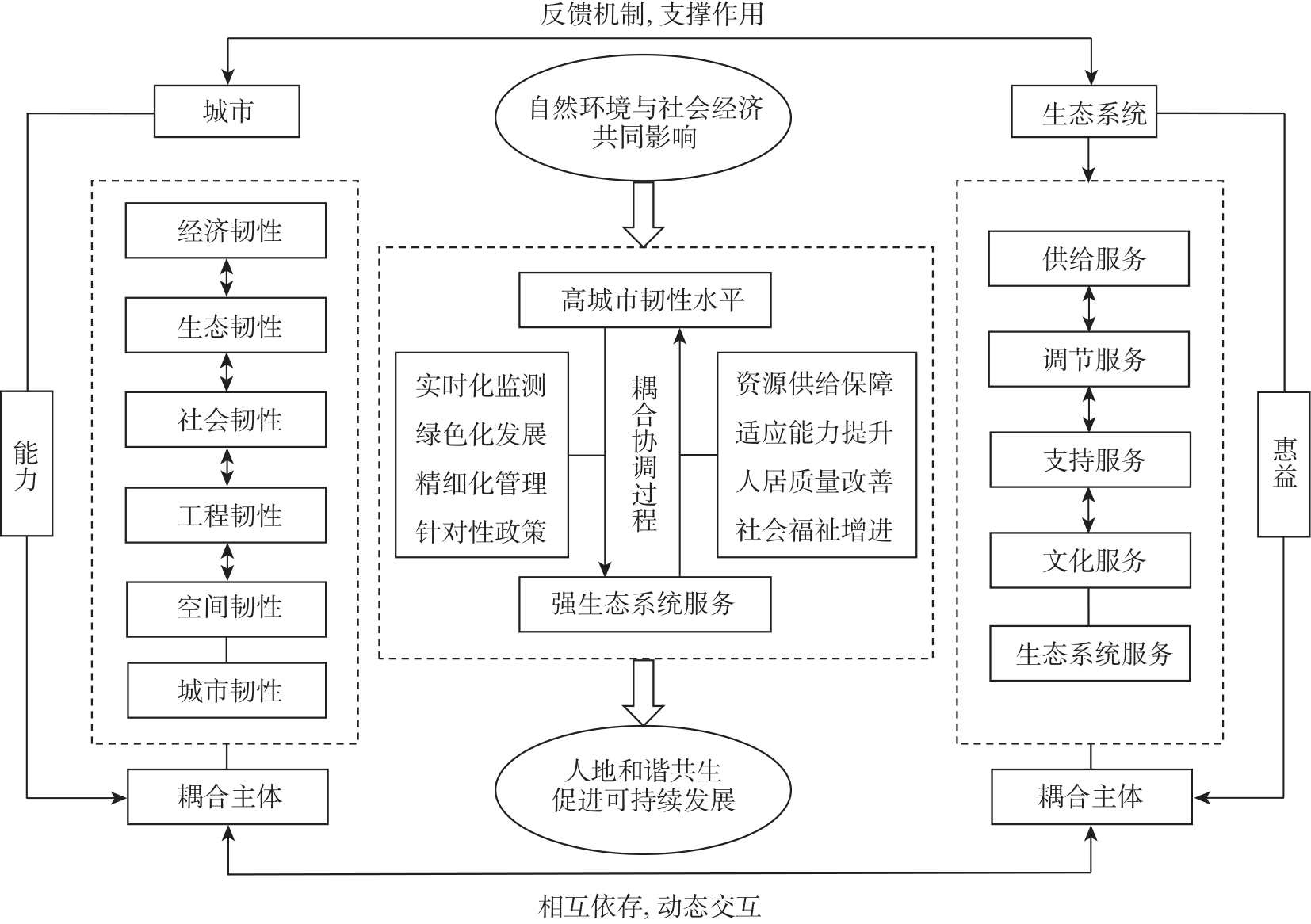
Fig. 2
Framework of the coupling coordination mechanism of urban resilience and ecosystem services"
Tab. 1
Indicator system of Guanzhong Plain urban agglomeration urban resilience evaluation"
| 目标层 | 准则层 | 要素层 | 指标层 | 属性 | 权重 |
|---|---|---|---|---|---|
| 城市韧性 | 经济韧性 | 经济基础 | 人均地区生产总值/元 | 正 | 0.047 |
| 固定资产投资增长率/% | 正 | 0.012 | |||
| 经济结构 | 第三产业占GDP比重/% | 正 | 0.040 | ||
| 产业结构多样化指数 | 正 | 0.008 | |||
| 科学技术支出占财政支出比重/% | 正 | 0.061 | |||
| 经济活力 | 城镇居民人均可支配收入/元 | 正 | 0.041 | ||
| 实际利用外资金额占GDP的比重/% | 正 | 0.133 | |||
| 生态韧性 | 生态发展水平 | 建成区绿化覆盖率/% | 正 | 0.012 | |
| 人均公园绿地面积/m2 | 正 | 0.014 | |||
| 污染治理水平 | 污水处理厂集中处理率/% | 正 | 0.015 | ||
| 工业固体废物综合利用率/% | 正 | 0.017 | |||
| 生态压力 | 工业SO2排放量/t | 负 | 0.008 | ||
| 社会韧性 | 社会保障水平 | 在岗职工平均工资/元 | 正 | 0.049 | |
| 社会保障和就业支出占财政支出比重/% | 正 | 0.025 | |||
| 社会保险指数 | 正 | 0.042 | |||
| 社会管理水平 | 公共管理与社会组织从业人员占总人口比/% | 正 | 0.031 | ||
| 社会创新水平 | 每万人在校大学生数/人 | 正 | 0.104 | ||
| 社会压力 | 城镇登记的失业率/% | 负 | 0.026 | ||
| 工程韧性 | 基础设施完善水平 | 人均城市道路面积/m2 | 正 | 0.020 | |
| 每万人公共汽车数/辆 | 正 | 0.038 | |||
| 建成区排水管道密度/km∙km-2 | 正 | 0.021 | |||
| 医疗卫生保障水平 | 每万人卫生机构床位数/张 | 正 | 0.034 | ||
| 互联网普及水平 | 互联网宽带接入用户数/104户 | 正 | 0.094 | ||
| 空间韧性 | 城市集聚性 | 斑块聚集度 | 正 | 0.038 | |
| 城市多样性 | 景观形状指数 | 正 | 0.025 | ||
| 城市连通性 | 最大斑块指数 | 正 | 0.025 | ||
| 城市破碎度 | 斑块密度指数 | 负 | 0.023 |
Tab. 2
Classification of coupling coordination development levels"
| 大类 | 耦合协调度(D) | 基本类型 |
|---|---|---|
| 失调衰退类 | 0.00<D≤0.25 | 严重失调衰退类 |
| 0.25<D≤0.40 | 中度失调衰退类 | |
| 过渡发展类 | 0.40<D≤0.50 | 濒临失调衰退类 |
| 0.50<D≤0.60 | 初级协调发展类 | |
| 协调发展类 | 0.60<D≤0.75 | 中级协调发展类 |
| 0.75<D≤1.00 | 良好协调发展类 |

Fig. 3
Overall urban resilience level in the Guanzhong Plain urban agglomeration"
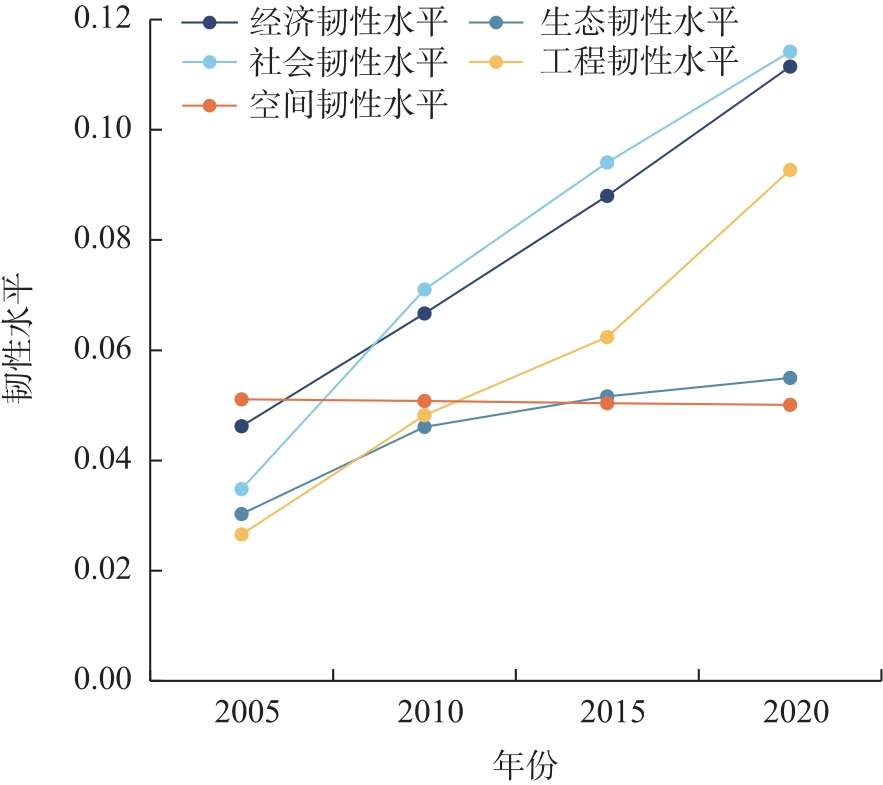

Fig. 4
Spatial changes of urban resilience levels in the Guanzhong Plain urban agglomeration"
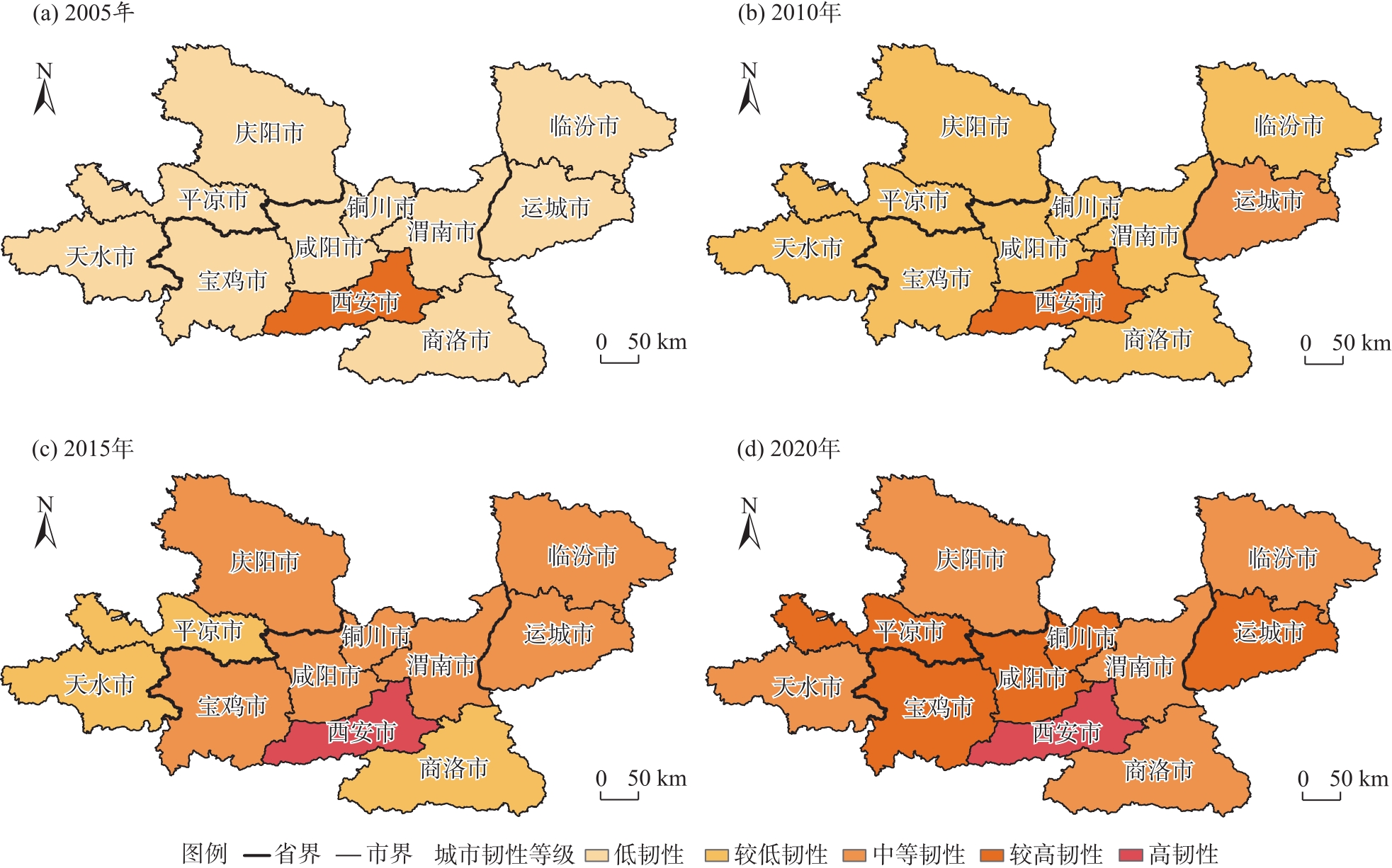

Fig. 5
Spatial and temporal distribution patterns of ecosystem services in the Guanzhong Plain urban agglomeration"
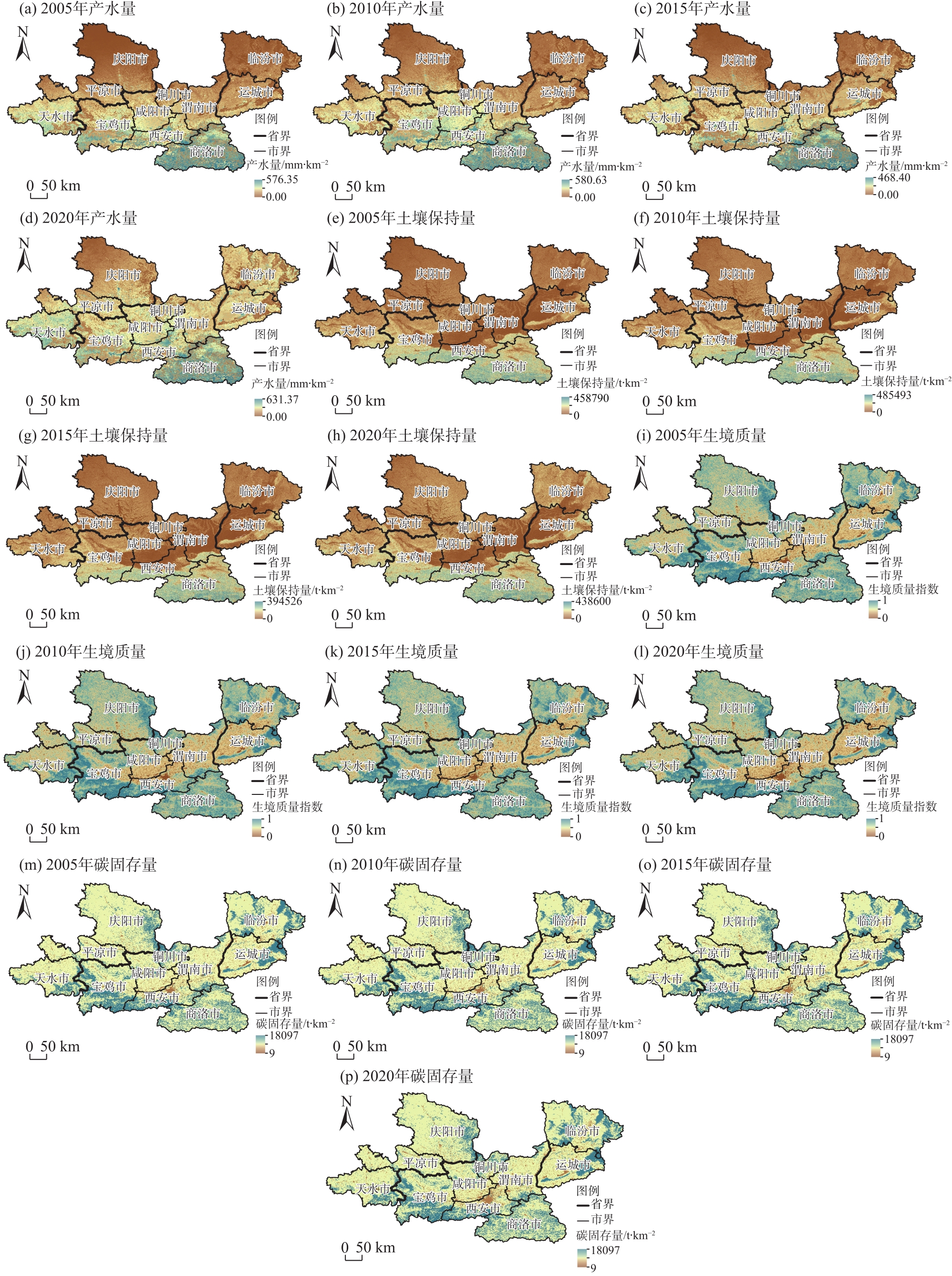

Fig. 6
Temporal evolution of the coupling coordination degree of urban resilience and four ecosystem services in the Guanzhong Plain urban agglomeration"


Fig. 7
Spatial changes of the coupling coordination degree of urban resilience and ecosystem services in the Guanzhong Plain urban agglomeration"

Tab. 3
Factors influencing the coupling coordination degree"
| 维度 | 影响因子 | 含义 |
|---|---|---|
| 自然环境 | 地形起伏度(X1) | 地形地貌 |
| 植被覆盖度(X2) | 生态环境 | |
| 年均气温(X3) | 气候条件 | |
| 社会经济 | 规模以上工业总产值(X4) | 工业水平 |
| 外贸依存度(X5) | 经济开放度 | |
| 专利申请总量增长率(X6) | 创新水平 | |
| 教育支出占财政支出比重(X7) | 人才投入 | |
| 人口密度(X8) | 城市集聚水平 | |
| 城镇化率(X9) | 城市进程 |
Tab. 4
Detection results of factors affecting the coupling coordination of urban resilience and ecosystem services in the Guanzhong Plain urban agglomeration"
| 影响因子 | 2005年 | 2010年 | 2015年 | 2020年 | 平均值 | 排序 | ||||||||
|---|---|---|---|---|---|---|---|---|---|---|---|---|---|---|
| q值 | 排序 | q值 | 排序 | q值 | 排序 | q值 | 排序 | |||||||
| X1 | 0.137*** | 6 | 0.052*** | 7 | 0.187*** | 6 | 0.148*** | 8 | 0.131 | 7 | ||||
| X2 | 0.261*** | 4 | 0.143*** | 6 | 0.387*** | 3 | 0.417*** | 4 | 0.302 | 5 | ||||
| X3 | 0.100*** | 7 | 0.021*** | 9 | 0.005 | 9 | 0.164*** | 7 | 0.095 | 9 | ||||
| X4 | 0.153*** | 5 | 0.844*** | 3 | 0.166*** | 7 | 0.299*** | 5 | 0.366 | 3 | ||||
| X5 | 0.572*** | 1 | 0.868*** | 1 | 0.758*** | 1 | 0.425*** | 3 | 0.656 | 1 | ||||
| X6 | 0.080*** | 9 | 0.042*** | 8 | 0.151*** | 8 | 0.132*** | 9 | 0.101 | 8 | ||||
| X7 | 0.091*** | 8 | 0.191*** | 5 | 0.720*** | 2 | 0.188*** | 6 | 0.298 | 6 | ||||
| X8 | 0.312*** | 3 | 0.233*** | 4 | 0.356*** | 4 | 0.509*** | 1 | 0.352 | 4 | ||||
| X9 | 0.469*** | 2 | 0.853*** | 2 | 0.309*** | 5 | 0.462*** | 2 | 0.522 | 2 | ||||

Fig. 8
Interaction detection results of factors affecting the coupling coordination of urban resilience and ecosystem services in the Guanzhong Plain urban agglomeration"

Tab. 5
Suggested management measures for cities in the Guanzhong Plain urban agglomeration"
| 城市 | 管理措施 |
|---|---|
| 西安市 | 辐射带动中小城市发展,推动科技创新和人才培育 |
| 宝鸡市 | 发展智能制造产业集群建设,推动工业绿色转型 |
| 咸阳市 | 引入资金和技术等,加快西咸一体化进程,加强生态 管理保护 |
| 铜川市 | 充分利用矿产资源,优化空间结构,实施规划全生命 周期管理 |
| 渭南市 | 推进湿地修复与退耕还林,提升城市社会韧性,保障 居民福祉 |
| 商洛市 | 完善基础设施网络,推进生态文明建设示范区创建, 培育新兴产业 |
| 天水市 | 贯彻陇东南发展规划,发展文旅产业,补足经济增长 动力 |
| 平凉市 | 建设现代农业示范园区,促进特色农业与生态协同发展 |
| 庆阳市 | 补齐基础设施短板,推进数字经济和生态产业发展 |
| 运城市 | 挖掘关公文化等本地特色资源,打造城市品牌,构建 绿色生态屏障 |
| 临汾市 | 推动煤化工产业转型,持续深化工业污染防治 |
| [1] |
方创琳. 中国城市群研究取得的重要进展与未来发展方向[J]. 地理学报, 2014, 69(8): 1130-1144.
doi: 10.11821/dlxb201408009 |
|
[Fang Chuanglin. Progress and the future direction of research into urban agglomeration in China[J]. Acta Geographica Sinica, 2014, 69(8): 1130-1144. ]
doi: 10.11821/dlxb201408009 |
|
| [2] | 张明斗, 冯晓青. 长三角城市群内各城市的城市韧性与经济发展水平的协调性对比研究[J]. 城市发展研究, 2019, 26(1): 82-91. |
| [Zhang Mingdou, Feng Xiaoqing. A comparative study of urban resilience and economic development level of cities in Yangtze River Delta urban agglomeration[J]. Urban Development Studies, 2019, 26(1): 82-91. ] | |
| [3] |
Costanza R, d’Arge R, de Groot R, et al. The value of the world’s ecosystem services and natural capital[J]. Nature, 1997, 387(6630): 253-260.
doi: 10.1038/387253a0 |
| [4] | 孙阳, 张落成, 姚士谋. 基于社会生态系统视角的长三角地级城市韧性度评价[J]. 中国人口·资源与环境, 2017, 27(8): 151-158. |
| [Sun Yang, Zhang Luocheng, Yao Shimou. Evaluating resilience of prefecture cities in the Yangtze River delta region from a socio-ecological perspective[J]. China Population, Resources and Environment, 2017, 27(8): 151-158. ] | |
| [5] | 邵亦文, 徐江. 城市韧性: 基于国际文献综述的概念解析[J]. 国际城市规划, 2015, 30(2): 48-54. |
| [Shao Yiwen, Xu Jiang. Understanding urban resilience: A conceptual analysis based on integrated international literature review[J]. Urban Planning International, 2015, 30(2): 48-54. ] | |
| [6] |
修春亮, 魏冶, 王绮. 基于“规模—密度—形态” 的大连市城市韧性评估[J]. 地理学报, 2018, 73(12): 2315-2328.
doi: 10.11821/dlxb201812004 |
|
[Xiu Chunliang, Wei Ye, Wang Qi. Evaluation of urban resilience of Dalian city based on the perspective of “size-density-morphology”[J]. Acta Geographica Sinica, 2018, 73(12): 2315-2328. ]
doi: 10.11821/dlxb201812004 |
|
| [7] | Liu H, Li X M, Tian S Z, et al. Research on the evaluation of resilience and influencing factors of the urban network structure in the three provinces of northeast China based on multiple flows[J]. Buildings, 2022, 12(7): 945, doi: 10.3390/buildings12070945. |
| [8] | Ribeiro P J G, Gonçalves L A P J. Urban resilience: A conceptual framework[J]. Sustainable Cities and Society, 2019, 50: 101625, doi: 10.1016/j.scs.2019.101625. |
| [9] |
焦柳丹, 王驴文, 张羽, 等. 基于多木桶模型的长三角城市群韧性水平评估研究[J]. 世界地理研究, 2024, 33(1): 96-106.
doi: 10.3969/j.issn.1004-9479.2024.01.2021989 |
|
[Jiao Liudan, Wang Lüwen, Zhang Yu, et al. Resilience assessment of the Yangtze River Delta urban agglomeration based on multi-barrel model[J]. World Regional Studies, 2024, 33(1): 96-106. ]
doi: 10.3969/j.issn.1004-9479.2024.01.2021989 |
|
| [10] |
史维良, 李博雅. 黄河流域三大城市群城市韧性空间网络结构研究[J]. 干旱区地理, 2024, 47(10): 1767-1780.
doi: 10.12118/j.issn.1000-6060.2024.058 |
|
[Shi Weiliang, Li Boya. Resilience spatial network structure of the three major urban agglomerations in the Yellow River Basin[J]. Arid Land Geography, 2024, 47(10): 1767-1780. ]
doi: 10.12118/j.issn.1000-6060.2024.058 |
|
| [11] | Liu L N, Lei Y L, Zhuang M H, et al. The impact of climate change on urban resilience in the Beijing-Tianjin-Hebei region[J]. Science of the Total Environment, 2022, 827: 154157, doi: 10.1016/j.scitotenv.2022.154157. |
| [12] | Zhang J M, Wang T, Goh M Y, et al. The effects of long-term policies on urban resilience: A dynamic assessment framework[J]. Cities, 2024, 153: 105294, doi: 10.1016/j.cities.2024.105294. |
| [13] |
曾志伟, 杨华, 宁启蒙, 等. 洞庭湖区土地利用强度演变及其对生态系统服务的影响[J]. 经济地理, 2022, 42(9): 176-185.
doi: 10.15957/j.cnki.jjdl.2022.09.020 |
|
[Zeng Zhiwei, Yang Hua, Ning Qimeng, et al. Temporal and spatial evolution of land use intensity and its impact on ecosystem services in Dongting Lake zone[J]. Economic Geography, 2022, 42(9): 176-185. ]
doi: 10.15957/j.cnki.jjdl.2022.09.020 |
|
| [14] | 嵇娟, 陈军飞, 丁童慧, 等. 长三角城市群城市洪涝韧性与生态系统服务的耦合协调关系[J]. 生态学报, 2024, 44(7): 2772-2785. |
| [Ji Juan, Chen Junfei, Ding Tonghui, et al. Coupling coordination between urban flood resilience and ecosystem services in the Yangtze River Delta urban agglomerations[J]. Acta Ecologica Sinica, 2024, 44(7): 2772-2785. ] | |
| [15] |
Zazula N, Birchall J S. Urban resilience through ecosystem services in Edmonton, Canada: An assessment of gaps and recommendations[J]. Urban Ecosystems, 2024, 27(5): 1819-1835.
doi: 10.1007/s11252-024-01561-x |
| [16] |
刘迪, 陈海, 张行, 等. 黄土丘陵沟壑区生态系统服务对人类福祉的影响及其群体差异[J]. 地理研究, 2022, 41(5): 1298-1310.
doi: 10.11821/dlyj020210558 |
| [Liu Di, Chen Hai, Zhang Hang, et al. The impact of ecosystem services on human well-being and its group differences in the loess hilly and gully region[J]. Geographical Research, 2022, 41(5): 1298-1310. ] | |
| [17] | Gao Y M, Zhang N J, Ma Q, et al. How is human well-being related to ecosystem services at town and village scales? A case study from the Yangtze River Delta, China[J]. Landscape Ecology, 2024, 39(7): 126, doi: 10.1007/s10980-024-01925-w. |
| [18] |
钱彩云, 巩杰, 张金茜, 等. 甘肃白龙江流域生态系统服务变化及权衡与协同关系[J]. 地理学报, 2018, 73(5): 868-879.
doi: 10.11821/dlxb201805007 |
|
[Qian Caiyun, Gong Jie, Zhang Jinqian, et al. Change and tradeoffs-synergies analysis on watershed ecosystem services: A case study of Bailongjiang Watershed, Gansu[J]. Acta Geographica Sinica, 2018, 73(5): 868-879. ]
doi: 10.11821/dlxb201805007 |
|
| [19] | Wang A Y, Liao X Y, Tong Z J, et al. Spatial-temporal dynamic evaluation of the ecosystem service value from the perspective of “production-living-ecological” spaces: A case study in Dongliao River Basin, China[J]. Journal of Cleaner Production, 2022, 333: 130218, doi: 10.1016/j.jclepro.2021.130218. |
| [20] |
李潇飞, 龚健, 叶菁, 等. 生态系统服务权衡协同下的甘肃省生态功能分区优化[J]. 干旱区地理, 2025, 48(3): 467-479.
doi: 10.12118/j.issn.1000-6060.2024.319 |
|
[Li Xiaofei, Gong Jian, Ye jing, et al. Optimization of ecological function zoning in Gansu Province under the trade-offs and synergies of ecosystem services[J]. Arid Land Geography, 2025, 48(3): 467-479. ]
doi: 10.12118/j.issn.1000-6060.2024.319 |
|
| [21] |
欧阳晓, 贺清云, 朱翔. 多情景下模拟城市群土地利用变化对生态系统服务价值的影响——以长株潭城市群为例[J]. 经济地理, 2020, 40(1): 93-102.
doi: 10.15957/j.cnki.jjdl.2020.01.011 |
|
[Ouyang Xiao, He Qingyun, Zhu Xiang. Simulation of impacts of urban agglomeration land use change on ecosystem services value under multi-scenarios: Case study in Changsha-Zhuzhou-Xiangtan urban agglomeration[J]. Economic Geography, 2020, 40(1): 93-102. ]
doi: 10.15957/j.cnki.jjdl.2020.01.011 |
|
| [22] |
Cazalis V, Loreau M, Henderson K. Do we have to choose between feeding the human population and conserving nature? Modelling the global dependence of people on ecosystem services[J]. Science of the Total Environment, 2018, 634: 1463-1474.
doi: 10.1016/j.scitotenv.2018.03.360 |
| [23] | 谢高地, 张彩霞, 张雷明, 等. 基于单位面积价值当量因子的生态系统服务价值化方法改进[J]. 自然资源学报, 2015, 30(8): 1243-1254. |
|
[Xie Gaodi, Zhang Caixia, Zhang Leiming, et al. Improvement of the evaluation method for ecosystem service value based on per unit area[J]. Journal of Natural Resources, 2015, 30(8): 1243-1254. ]
doi: 10.11849/zrzyxb.2015.08.001 |
|
| [24] |
Sandhu H, Sandhu S. Linking ecosystem services with the constituents of human well-being for poverty alleviation in eastern Himalayas[J]. Ecological Economics, 2014, 107: 65-75.
doi: 10.1016/j.ecolecon.2014.08.005 |
| [25] |
赵瑞东, 方创琳, 刘海猛. 城市韧性研究进展与展望[J]. 地理科学进展, 2020, 39(10): 1717-1731.
doi: 10.18306/dlkxjz.2020.10.011 |
|
[Zhao Ruidong, Fang Chuanglin, Liu Haimeng. Progress and prospect of urban resilience research[J]. Progress in Geography, 2020, 39(10): 1717-1731. ]
doi: 10.18306/dlkxjz.2020.10.011 |
|
| [26] | Zhao H L, Ai X N. Research on the coordinated development between land urbanization and population urbanization in Shaanxi Province, China[J]. Scientific Reports, 2024, 14(1): 7977, doi: 10.1038/s41598-024-58625-3. |
| [27] | Barbier E B. The policy implications of the Dasgupta review: Land use change and biodiversity: Invited paper for the special issue on “the economics of biodiversity: Building on the Dasgupta review” in environmental and resource economics[J]. Environmental & Resource Economics, 2022, 83(4): 911-935. |
| [28] |
孟阳阳, 何志斌, 刘冰, 等. 干旱区绿洲湿地空间分布及生态系统服务价值变化——以三大典型内陆河流域为例[J]. 资源科学, 2020, 42(10): 2022-2034.
doi: 10.18402/resci.2020.10.18 |
|
[Meng Yangyang, He Zhibin, Liu Bing, et al. Changes of spatial distribution and ecosystem service value of oasis wetlands in arid areas: Taking three typical inland river basins as examples[J]. Resources Science, 2020, 42(10): 2022-2034. ]
doi: 10.18402/resci.2020.10.18 |
|
| [29] | 李依汶, 林涛, 周文强, 等. 基于多情景模拟的洞庭湖流域生态系统服务价值研究[J]. 中国农业资源与区划, 2024, 45(10): 109-121. |
| [Li Yiwen, Lin Tao, Zhou Wenqiang, et al. Analysis of ecosysten service value with multi-scenario in Dongting Lake Basin[J]. Chinese Journal of Agricultural Resources and Regional Planning, 2024, 45(10): 109-121. ] | |
| [30] | Dai P C, Zhang S L, Chen Z X, et al. Perceptions of cultural ecosystem services in urban parks based on social network data[J]. Sustainability, 2019, 11(19): 5386, doi: 10.3390/su11195386. |
| [31] |
Huang S L, Lee Y C, Budd W W, et al. Analysis of changes in farm pond network connectivity in the peri-urban landscape of the Taoyuan area, Taiwan[J]. Environmental Management, 2012, 49: 915-928.
doi: 10.1007/s00267-012-9824-7 |
| [32] |
Mori A S, Takuya F, Takehiro S. Response diversity determines the resilience of ecosystems to environmental change[J]. Biological Reviews of the Cambridge Philosophical Society, 2013, 88(2): 349-364.
doi: 10.1111/brv.12004 pmid: 23217173 |
| [33] |
Cutter S L, Ash K D, Emrich C T. The geographies of community disaster resilience[J]. Global Environmental Change, 2014, 29: 65-77.
doi: 10.1016/j.gloenvcha.2014.08.005 |
| [34] |
黄梦涵, 张卫国. 中国四类资源型城市韧性水平比较与发展策略[J]. 经济地理, 2023, 43(1): 34-43.
doi: 10.15957/j.cnki.jjdl.2023.01.005 |
|
[Huang Menghan, Zhang Weiguo. Comparison of resilience levels and development strategies of four types of resource-based cities in China[J]. Economic Geography, 2023, 43(1): 34-43. ]
doi: 10.15957/j.cnki.jjdl.2023.01.005 |
|
| [35] |
李珊, 温榕冰, 李建军, 等. 中国五大城市群用地景观格局对碳排放绩效的影响[J]. 经济地理, 2023, 43(12): 91-102.
doi: 10.15957/j.cnki.jjdl.2023.12.009 |
|
[Li Shan, Wen Rongbing, Li Jianjun, et al. Impact of land use landscape pattern on carbon emission performance in five major urban agglomerations in China[J]. Economic Geography, 2023, 43(12): 91-102. ]
doi: 10.15957/j.cnki.jjdl.2023.12.009 |
|
| [36] |
Cumming G S. Spatial resilience: Integrating landscape ecology, resilience, and sustainability[J]. Landscape Ecology, 2011, 26: 899-909.
doi: 10.1007/s10980-011-9623-1 |
| [37] |
王富喜, 毛爱华, 李赫龙, 等. 基于熵值法的山东省城镇化质量测度及空间差异分析[J]. 地理科学, 2013, 33(11): 1323-1329.
doi: 10.13249/j.cnki.sgs.2013.011.1323 |
|
[Wang Fuxi, Mao Aihua, Li Helong, et al. Quality measurement and regional difference of urbanization in Shandong Province based on the entropy method[J]. Scientia Geographica Sinica, 2013, 33(11): 1323-1329. ]
doi: 10.13249/j.cnki.sgs.2013.011.1323 |
|
| [38] |
王淑佳, 孔伟, 任亮, 等. 国内耦合协调度模型的误区及修正[J]. 自然资源学报, 2021, 36(3): 793-810.
doi: 10.31497/zrzyxb.20210319 |
|
[Wang Shujia, Kong Wei, Ren Liang, et al. Research on misuses and modification of coupling coordination degree model in China[J]. Journal of Natural Resources, 2021, 36(3): 793-810. ]
doi: 10.31497/zrzyxb.20210319 |
|
| [39] | 李雪敏, 李同宁, 李道政, 等. 内蒙古县域生态系统服务与居民福祉耦合协调关系时空特征及影响因素研究[J]. 干旱区资源与环境, 2023, 37(7): 27-37. |
| [Li Xuemin, Li Tongning, Li Daozheng, et al. Spatial-temporal characteristics of county-range coupling coordination relationship between ecosystem services and human’s well-being in Inner Mongolia[J]. Journal of Arid Land Resources and Environment, 2023, 37(7): 27-37. ] | |
| [40] |
刘宪锋, 潘耀忠, 朱秀芳, 等. 2000—2014年秦巴山区植被覆盖时空变化特征及其归因[J]. 地理学报, 2015, 70(5): 705-716.
doi: 10.11821/dlxb201505003 |
|
[Liu Xianfeng, Pan Yaozhong, Zhu Xiufang, et al. Vegetation dynamics in Qinling-Daba Mountains in relation to climate factors between 2000 and 2014[J]. Acta Geographica Sinica, 2015, 70(5): 705-716. ]
doi: 10.11821/dlxb201505003 |
|
| [41] |
慕石雷, 杨玉欢, 乌日陶克套胡. 黄河流域五大城市群PM2.5时空演变与影响因素探讨[J]. 干旱区地理, 2024, 47(4): 707-719.
doi: 10.12118/j.issn.1000-6060.2023.088 |
|
[Mu Shilei, Yang Yuhuan, Wuritaoketaohu. Spatiotemporal evolution and influencing factors of PM2.5 in the five urban agglomerations in the Yellow River Basin[J]. Arid Land Geography, 2024, 47(4): 707-719. ]
doi: 10.12118/j.issn.1000-6060.2023.088 |
|
| [42] | 李全, 李腾, 杨明正, 等. 基于梯度分析的武汉市生态系统服务价值时空分异特征[J]. 生态学报, 2017, 37(6): 2118-2125. |
| [Li Quan, Li Teng, Yang Mingzheng, et al. Spatiotemporal variation of ecosystem services value based on gradient analysis in Wuhan: 2000—2010[J]. Acta Ecologica Sinica, 2017, 37(6): 2118-2125. ] |
|
||

