Arid Land Geography ›› 2026, Vol. 49 ›› Issue (3): 569-580.doi: 10.12118/j.issn.1000-6060.2025.229
• Regional Development • Previous Articles Next Articles
WANG Huili1,2( ), LI Niu1(), LIU Ying1, LIU Yonghan1
Received:2025-04-24
Revised:2025-05-23
Online:2026-03-25
Published:2026-03-24
Contact:
LI Niu
E-mail:hlwang@xaufe.edu.cn;liniu330@163.com
WANG Huili, LI Niu, LIU Ying, LIU Yonghan. Dynamic coupling and hierarchical obstacle analysis of water resources and ecological resilience in the Yellow River Basin[J].Arid Land Geography, 2026, 49(3): 569-580.
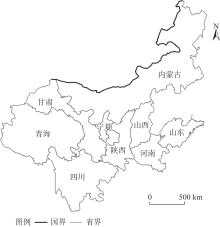
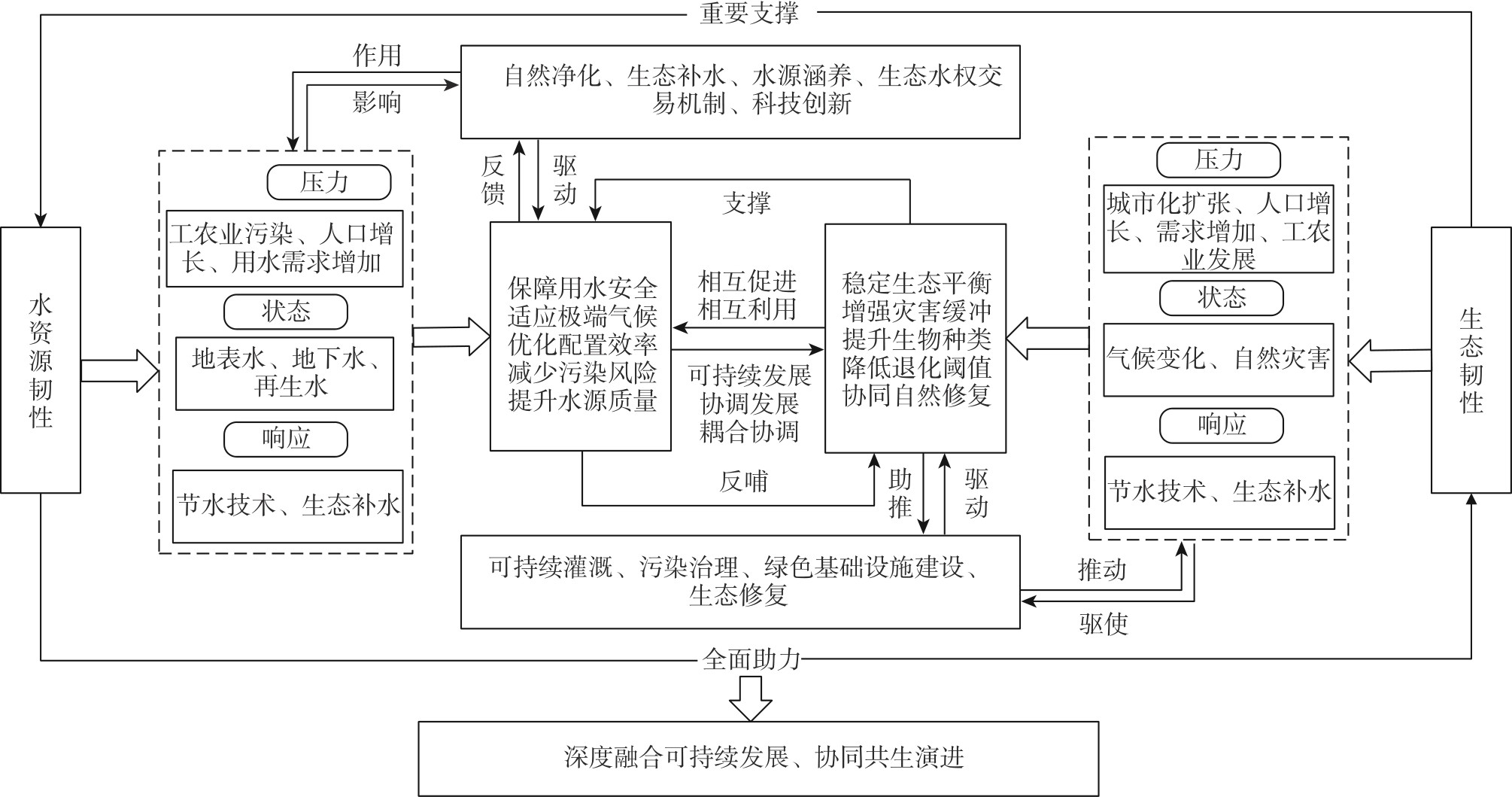
Fig. 1
Schematic diagram of the study area"
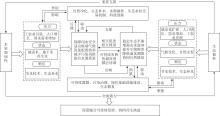
Fig. 2
Mechanism of interaction between water resource resilience and ecological resilience"
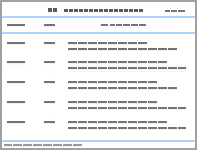
Tab. 1
Evaluation index system for water resource resilience and ecological resilience in the Yellow River Basin"
| 目标层 | 准则层 | 指标层 | 属性 | 层次分析法权重 | 熵值法权重 | 组合权重 |
|---|---|---|---|---|---|---|
| 水资源韧性 | 水资源压力(B1) | 人口密度(C1)/人·km-2 | - | 0.064 | 0.065 | 0.065 |
| 人口自然增长率(C2)/% | - | 0.031 | 0.046 | 0.037 | ||
| 万元GDP用水量(C3)/m2·(104元)-1 | - | 0.010 | 0.023 | 0.015 | ||
| 人均废水排放量(C4)/t·人-1 | - | 0.023 | 0.038 | 0.029 | ||
| 水资源开发利用率(C5)/% | - | 0.023 | 0.044 | 0.032 | ||
| 水资源状态(B2) | 产水系数(C6)/% | + | 0.088 | 0.085 | 0.087 | |
| 地表水(C7)/108 km3 | + | 0.273 | 0.238 | 0.259 | ||
| 地下水(C8)/108 km3 | + | 0.127 | 0.111 | 0.121 | ||
| 水资源总量(C9)/108 km3 | + | 0.227 | 0.201 | 0.216 | ||
| 水资源响应(B3) | 降水变异系数(C10)/% | + | 0.031 | 0.044 | 0.036 | |
| 城市污水处理率(C11)/% | + | 0.013 | 0.021 | 0.016 | ||
| 森林覆盖率(C12)/% | + | 0.090 | 0.085 | 0.088 | ||
| 生态韧性 | 生态压力(B4) | 人口密度(C13)/人·km-2 | - | 0.020 | 0.022 | 0.028 |
| 人均用水量(C14)/m2·人-1 | - | 0.020 | 0.033 | 0.021 | ||
| 人均工业烟(粉)尘排放量(C15)/t·人-1 | - | 0.029 | 0.020 | 0.031 | ||
| 工业SO2排放量(C16)/104 t | - | 0.098 | 0.082 | 0.067 | ||
| 生活垃圾清运量(C17)/104 t | - | 0.034 | 0.024 | 0.054 | ||
| 生态状态(B5) | 建成区绿化覆盖率(C18)/% | + | 0.031 | 0.084 | 0.028 | |
| 城市公园数量(C19)/个 | + | 0.202 | 0.084 | 0.155 | ||
| 公园绿地面积(C20)/104 km2 | + | 0.098 | 0.017 | 0.093 | ||
| 空气质量优良率(C21)/% | + | 0.008 | 0.123 | 0.011 | ||
| 水资源总量(C22)/108 km3 | + | 0.044 | 0.088 | 0.076 | ||
| 生态响应(B6) | 市容环卫专用车辆设备总数(C23)/辆 | + | 0.026 | 0.065 | 0.051 | |
| 无害化处理厂数量(C24)/座 | + | 0.101 | 0.115 | 0.086 | ||
| 排水管道长度(C25)/km | + | 0.047 | 0.112 | 0.074 | ||
| 治理废水项目完成投资(C26)/104元 | + | 0.022 | 0.082 | 0.058 | ||
| 城市生活垃圾清运量(C27)/104 t | + | 0.091 | 0.009 | 0.087 | ||
| 城市生活垃圾无害化处理率(C28)/% | + | 0.091 | 0.022 | 0.058 |
Tab. 2
Adjustment coefficients for the development of water resource resilience and ecological resilience in the Yellow River Basin"
| 子系统韧性 | 陕西 | 四川 | 青海 | 河南 | 山东 | 内蒙古 | 甘肃 | 宁夏 | 山西 |
|---|---|---|---|---|---|---|---|---|---|
| 水资源韧性 | 0.024 | 0.028 | 0.083 | 0.029 | 0.033 | 0.029 | 0.088 | 0.044 | 0.027 |
| 生态韧性 | -0.014 | 0.006 | 0.018 | 0.002 | -0.007 | 0.018 | 0.011 | 0.012 | 0.006 |
Tab. 3
Measuring results of water resource resilience and ecological resilience in the Yellow River Basin"
| 省区 | 水资源韧性 | 生态韧性 | |||||||
|---|---|---|---|---|---|---|---|---|---|
| 2011年 | 2015年 | 2019年 | 2022年 | 2011年 | 2015年 | 2019年 | 2022年 | ||
| 青海 | 0.342 | 0.323 | 0.427 | 0.381 | 0.198 | 0.184 | 0.246 | 0.256 | |
| 四川 | 0.764 | 0.756 | 0.863 | 0.769 | 0.404 | 0.468 | 0.612 | 0.663 | |
| 甘肃 | 0.221 | 0.217 | 0.282 | 0.271 | 0.169 | 0.201 | 0.293 | 0.318 | |
| 内蒙古 | 0.317 | 0.333 | 0.319 | 0.347 | 0.219 | 0.273 | 0.334 | 0.355 | |
| 宁夏 | 0.108 | 0.125 | 0.152 | 0.175 | 0.152 | 0.184 | 0.225 | 0.249 | |
| 陕西 | 0.394 | 0.333 | 0.368 | 0.376 | 0.293 | 0.300 | 0.369 | 0.410 | |
| 河南 | 0.238 | 0.218 | 0.201 | 0.251 | 0.307 | 0.361 | 0.506 | 0.544 | |
| 山西 | 0.201 | 0.191 | 0.208 | 0.247 | 0.220 | 0.266 | 0.351 | 0.377 | |
| 山东 | 0.227 | 0.156 | 0.189 | 0.307 | 0.497 | 0.555 | 0.765 | 0.828 | |
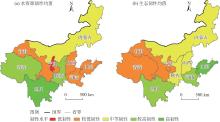
Fig. 3
Spatial variations of the mean values of water resource resilience and ecological resilience in the Yellow River Basin"
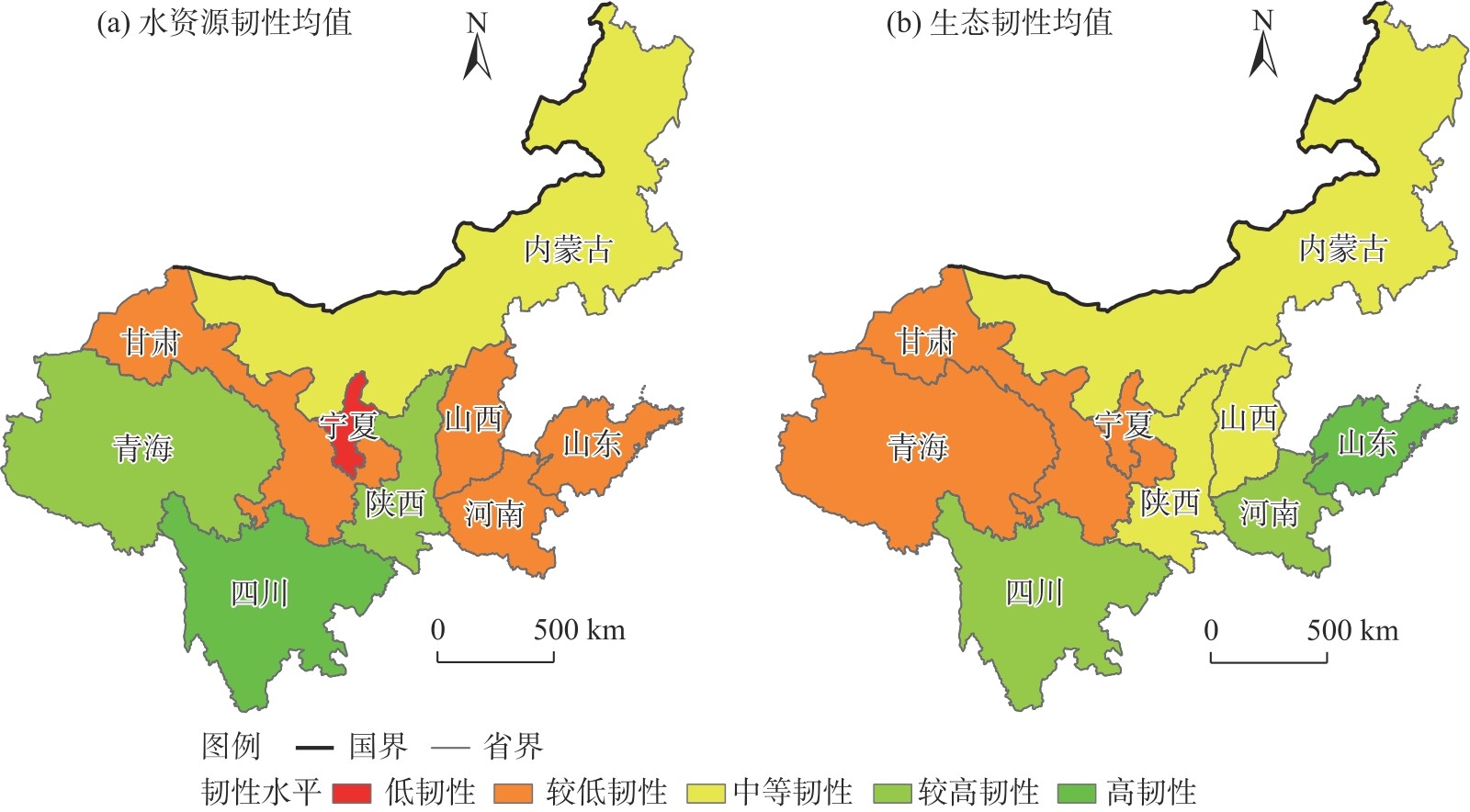
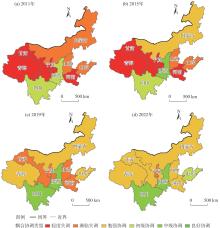
Fig. 4
Spatial differentiation of the coupling coordination degree of water resource resilience and ecological resilience in the Yellow River Basin"
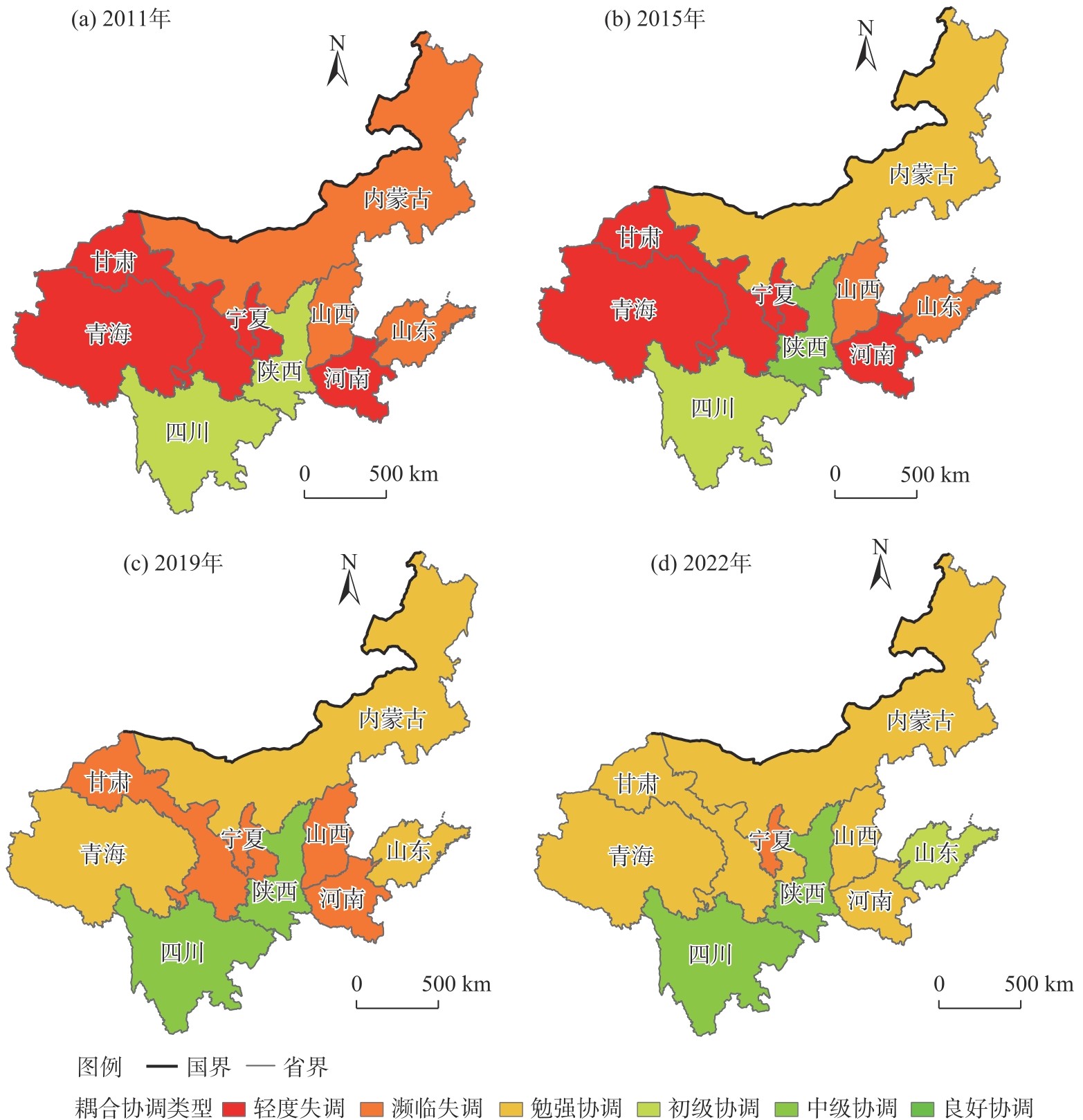
Fig. 5
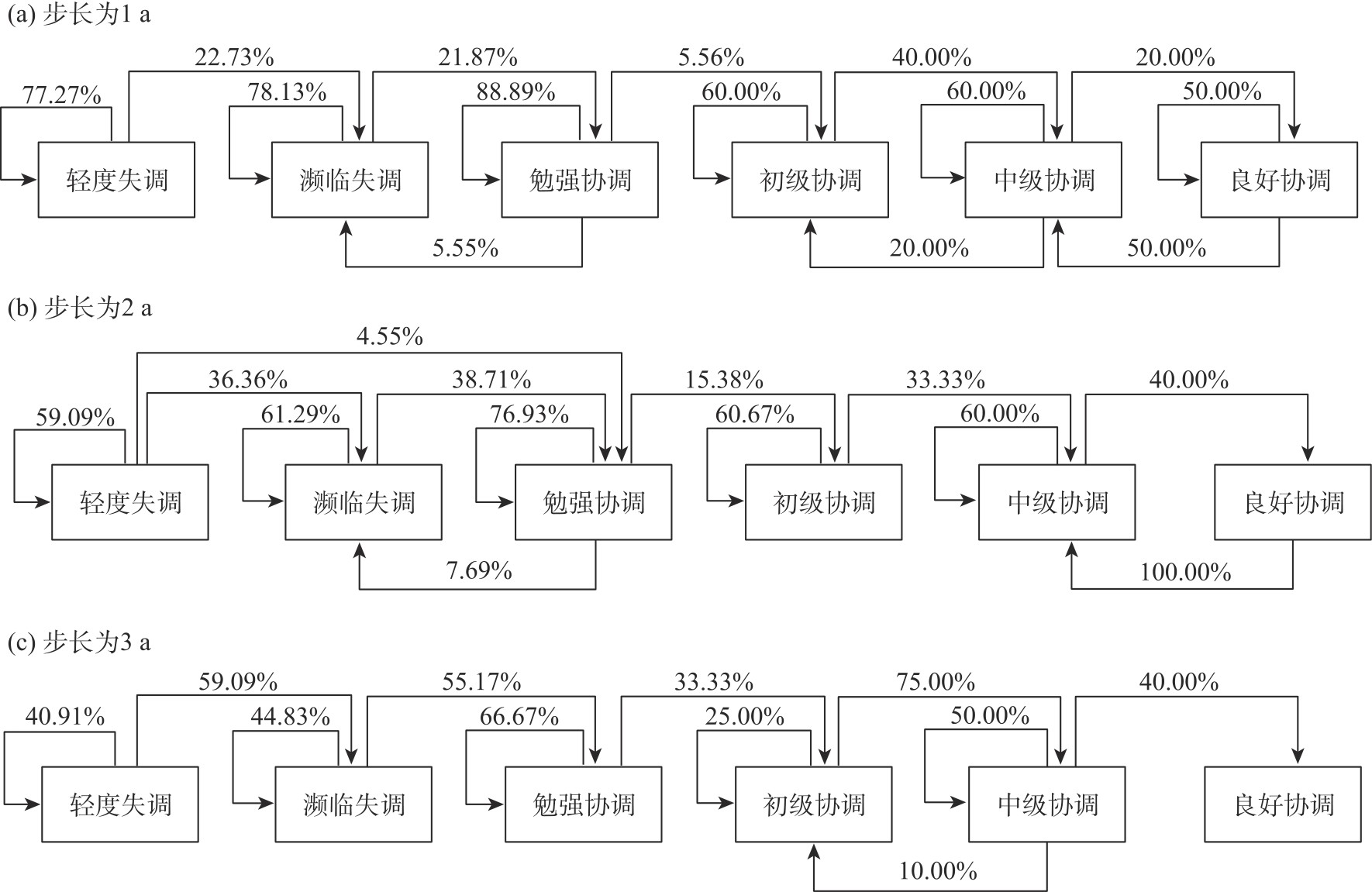
State transfer paths and probabilities of the coupling coordination degree between water resource resilience and ecological resilience in the Yellow River Basin"
Tab. 4
Main obstacle factors at the criterion level and indicator level of the coupling coordination degree between water resource resilience and ecological resilience in the Yellow River Basin"
| 年份 | 类别 | 准则层 | 指标层 | |||||||
|---|---|---|---|---|---|---|---|---|---|---|
| 第一 | 第二 | 第三 | 第一 | 第二 | 第三 | 第四 | 第五 | |||
| 2011 | 障碍因子 | B2 | B6 | B5 | C7 | C9 | C19 | C20 | C8 | |
| 障碍度 | 36.95 | 22.67 | 20.98 | 15.12 | 12.37 | 9.79 | 5.68 | 5.67 | ||
| 2015 | 障碍因子 | B2 | B6 | B5 | C7 | C9 | C19 | C8 | C20 | |
| 障碍度 | 38.96 | 21.47 | 20.47 | 15.76 | 12.92 | 9.31 | 6.05 | 5.34 | ||
| 2019 | 障碍因子 | B2 | B6 | B5 | C7 | C9 | C19 | C8 | C24 | |
| 障碍度 | 40.42 | 21.28 | 20.55 | 16.37 | 13.43 | 9.45 | 6.36 | 5.46 | ||
| 2022 | 障碍因子 | B2 | B6 | B5 | C7 | C9 | C19 | C8 | C26 | |
| 障碍度 | 44.37 | 20.85 | 18.83 | 18.20 | 14.88 | 7.97 | 6.93 | 5.20 | ||
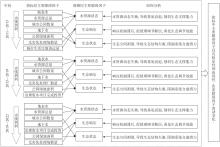
Fig. 6
Evolution and mechanism analysis of the obstacle factors in the coupling coordination degree of water resource resilience and ecological resilience"
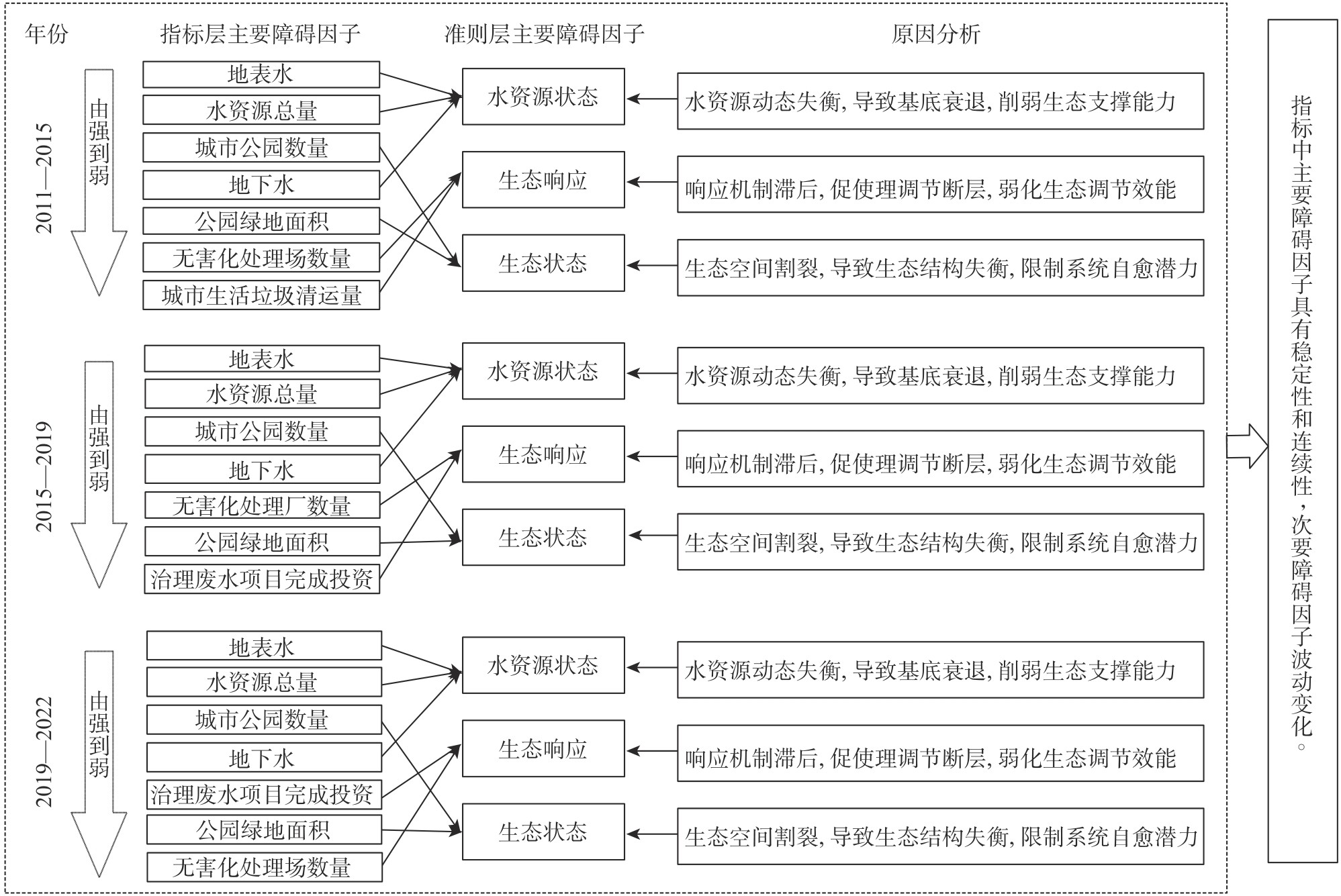
| [3] |
Holling C S. Resilience and stability of ecological systems[J]. Annual Review of Ecology and Systematics, 1973, 4(1): 1-24.
doi: 10.1146/ecolsys.1973.4.issue-1 |
| [4] | 刘晓锋, 刘俊祥. 生态韧性治理的意蕴及其路径分析[J]. 西南大学学报(社会科学版), 2024, 50(5): 103-115. |
| [Liu Xiaofeng, Liu Junxiang. The meaning and path analysis of ecological resilience governance[J]. Journal of Southwest University (Social Sciences Edition), 2024, 50(5): 103-115.] | |
| [5] |
Pickett S T A, Mcgrath B, Cadenasso M L, et al. Ecological resilience and resilient cities[J]. Building Research and Information, 2014, 42(2): 143-157.
doi: 10.1080/09613218.2014.850600 |
| [6] |
Hosseini S, Barker K, Ramirez-Marquez J E. A review of definitions and measures of system resilience[J]. Reliability Engineering and System Safety, 2016, 145: 147-161.
doi: 10.1016/j.ress.2015.09.012 |
| [7] |
孙才志, 孟程程. 中国区域水资源系统韧性与效率的发展协调关系评价[J]. 地理科学, 2020, 40(12): 2094-2104.
doi: 10.13249/j.cnki.sgs.2020.12.016 |
| [Sun Caizhi, Meng Chengcheng. Evaluation of the development coordination relationship between resilience and efficiency of regional water resources system in China[J]. Geographical Science, 2020, 40(12): 2094-2104.] | |
| [8] |
肖圣, 多玲花, 邹自力. 基于“ 风险-连通性-潜力 ”的南昌市生态韧性评估[J]. 应用生态学报, 2023, 34(3): 733-741.
doi: 10.13287/j.1001-9332.202303.022 |
|
[Xiao Sheng, Duo Linghua, Zou Zili. Assessment of ecological resilience in Nanchang based on “ risk-connectivity-potential ”[J]. Chinese Journal of Applied Ecology, 2023, 34(3): 733-741.]
doi: 10.13287/j.1001-9332.202303.022 |
|
| [9] |
王少剑, 崔子恬, 林靖杰, 等. 珠三角地区城镇化与生态韧性的耦合协调研究[J]. 地理学报, 2021, 76(4): 973-991.
doi: 10.11821/dlxb202104013 |
|
[Wang Shaojian, Cui Ziyi, Lin Jingjie, et al. Coupling relationship between urbanization and ecological resilience in the Pearl River Delta[J]. Acta Geographica Sinica, 2021, 76(4): 973-991.]
doi: 10.11821/dlxb202104013 |
|
| [10] |
白立敏, 修春亮, 冯兴华, 等. 中国城市韧性综合评估及其时空分异特征[J]. 世界地理研究, 2019, 28(6): 77-87.
doi: 10.3969/j.issn.1004-9479.2019.06.2018403 |
|
[Bai Limin, Xiu Chunliang, Feng Xinghua, et al. A comprehensive assessment of urban resilience and its spatial differentiation in China[J]. World Regional Studies, 2019, 28(6): 77-87.]
doi: 10.3969/j.issn.1004-9479.2019.06.2018403 |
|
| [11] | 龚萍, 任亚哲. 社会-生态视角下内蒙古耕地生态系统韧性时空格局演变特征研究[J]. 干旱区资源与环境, 2025, 39(1): 84-93. |
| [Gong Ping, Ren Yazhe. Evolution of spatial-temporal pattern of cultivated land ecosystem resilience in Inner Mongolia: A perspective of society-ecology[J]. Journal of Arid Land Resources and Environment, 2025, 39(1): 84-93.] | |
| [12] | 程莉, 黄兰稀, 严月岑, 等. 长江经济带乡村生态韧性测度及影响因素研究[J]. 中国农业资源与区划, 2024, 45(5): 11-23. |
| [Cheng Li, Huang Lanxi, Yan Yuecen, et al. Research on the measurement and influencing factors of rural ecologicai resilience in the Yangtze River Economic Belt[J]. Chinese Journal of Agricultural Resources and Regional Planning, 2024, 45(5): 11-23.] | |
| [13] | 赵政楠, 茹少峰, 薛飞. 黄河流域生态韧性的时空格局与分布动态演进——基于能值生态足迹模型的分析[J]. 中国人口·资源与环境, 2024, 34(8): 136-147. |
| [Zhao Zhengnan, Ru Shaofeng, Xue fei. Spatio-temporal pattern and dynamic evolution of ecological resilience in the Yellow River Basin: Based on the analysis of emergy ecological footprint model[J]. China Population, Resources and Environment, 2024, 34(8): 136-147.] | |
| [14] |
赵领娣, 孙兆旭. 海岸带城市经济发展质量与生态韧性协同发展演化及空间收敛特征[J]. 经济地理, 2023, 43(7): 119-129, 240.
doi: 10.15957/j.cnki.jjdl.2023.07.012 |
|
[Zhao Lingdi, Sun Zhaoxu. Evolution of coordinated development between economic development quality and ecological esilience in coastal cities and its spatial convergence features[J]. Economic Geography, 2023, 43(7): 119-129, 240.]
doi: 10.15957/j.cnki.jjdl.2023.07.012 |
|
| [15] |
汤洪霞, 杨淼, 李梦笛, 等. 山东半岛城市群城市韧性与新型城镇化耦合协调研究[J]. 地域研究与开发, 2024, 43(4): 85-90, 126.
doi: 10.3969/j.issn.1003-2363.2024.04.013 |
|
[Yang Hongxia, Sun Miao, Li Mengdi, et al. Research on coupling coordination of urban resilience and new-type urbanization in the Shandong Peninsula urban agglomeration[J]. Areal Research and Development, 2024, 43(4): 85-90, 126.]
doi: 10.3969/j.issn.1003-2363.2024.04.013 |
|
| [16] |
聂寒玉, 张颜辉, 李慧, 等. 黄河流域旅游生态韧性发展水平的时空演化及多尺度障碍因子分析[J]. 干旱区地理, 2025, 48(6): 1089-1102.
doi: 10.12118/j.issn.1000-6060.2024.504 |
|
[Nie Hanyu, Zhang Yanhui, Li Hui, et al. Spatiotemporal evolution and multi-scale barrier factor analysis of tourism ecological resilience in Yellow River Basin[J]. Arid Land Geography, 2025, 48(6): 1089-1102.]
doi: 10.12118/j.issn.1000-6060.2024.504 |
|
| [17] | 彭文斌, 谢晓琪. 环长株潭城市群生态韧性对城市更新的响应研究[J]. 长江流域资源与环境, 2024, 33(11): 2369-2378. |
| [Peng Wenbin, Xie Xiaoqi. Response of ecological resilience to urban renewal in Chang-Zhu-Tan urban agglomeration[J]. Resources and Environment in the Yangtze Basin, 2024, 33(11): 2369-2378.] | |
| [18] | 王静, 白文超, 蔚筱偲. 建筑业高质量发展与生态韧性耦合协调度的时空分布格局与动态演进[J]. 环境科学, 2026, 47(2): 972-986. |
| [Wang Jing, Bai Wenchao, Wei Xiaosi. Spatial-temporal distribution pattern and dynamic eolution of the coupling coordination degree between high-quality development of the construction industry and ecological resilience[J]. Environmental Science, 2026, 47(2): 972-986.] | |
| [19] | 汪顺生, 杨金月, 王爱丽, 等. 河南省黄河流域水资源-经济-生态系统耦合协调评价及预测[J]. 湖泊科学, 2022, 34(3): 919-934. |
|
[Wang Shunsheng, Yang Jinyue, Wang Aili, et al. Evaluation and forecast of coupling coordination of water resources, economy and ecosystem in the Yellow River Basin of Henan Province[J]. Journal of Lake Sciences, 2022, 34(3): 919-934.]
doi: 10.18307/2022.0314 |
|
| [20] | 赵丹宁, 薛晔, 冯梅. 黄河流域生态韧性与经济高质量发展协同演化规律研究[J]. 人民黄河, 2025, 47(1): 35-41, 66. |
| [Zhao Danning, Xue Ye, Feng Mei. Study on the co-evolutionary patterns of ecological resilience and high-quality economic development in the Yellow River Basin[J]. Yellow River, 2025, 47(1): 35-41, 66.] | |
| [21] | 赵伟, 骆佳玲. 三峡库区城镇化与生态韧性耦合协调的时空格局演变分析[J]. 长江流域资源与环境, 2024, 33(9): 1888-1904. |
| [Zhao Wei, Luo Jialing. Spatial-temporal pattern evolution of the coupling and coordination of urbanization and ecological resilience in the Three Gorges Reservoir area[J]. Resources and Environment in the Yangtze Basin, 2024, 33(9): 1888-1904.] | |
| [22] | 叶正伟, 孙艳丽. 基于PSR模型的江苏沿海大开发地区水环境安全评价——以盐城市为例[J]. 水土保持研究, 2013, 20(6): 197-202. |
| [Ye Zhengwei, Sun Yanli. Assessment on water environment security in the coastaldevelopment region in Jiangsu based on PSR model: A case study in Yancheng City[J]. Research of Soil and Water Conservation, 2013, 20(6): 197-202.] | |
| [23] |
王淑佳, 孔伟, 任亮, 等. 国内耦合协调度模型的误区及修正[J]. 自然资源学报, 2021, 36(3): 793-810.
doi: 10.31497/zrzyxb.20210319 |
|
[Wang Shujia, Kong Wei, Ren Liang, et al. Research on misuses and modification of coupling coordination degree model in China[J]. Journal of Natural Resources, 2021, 36(3): 793-810.]
doi: 10.31497/zrzyxb.20210319 |
|
| [24] |
侯彩霞, 张宇宙, 杨建平. 关中平原城市群水资源-社会-生态系统耦合协调及障碍因子分析[J]. 干旱区地理, 2025, 48(4): 717-727.
doi: 10.12118/j.issn.1000-6060.2024.280 |
|
[Hou Caixia, Zhang Yuzhou, Yang Jianping. Coupling coordination and obstacle factors of water-society-ecosystem in the Guanzhong Plain urban agglomeration[J]. Arid Land Geography, 2025, 48(4): 717-727.]
doi: 10.12118/j.issn.1000-6060.2024.280 |
|
| [25] | 张伟志, 陈学刚. 黄河流域低碳经济转型的时空格局、区域差异及动态演进[J]. 环境科学, 2025, 46(9): 5554-5565. |
| [Zhang Weizhi, Chen Xuegang. Spatiotemporal situstion, regional disparities, and dynamic evolution of low-carbon economic transition in the Yellow River Basin[J]. Environmental Science, 2025, 46(9): 5554-5565. | |
| [1] |
张明斗, 任衍婷, 刘耀彬. 中国水资源利用效率与生态韧性的协调度及动力因素研究[J]. 世界地理研究, 2025, 34(2): 168-180.
doi: 10.3969/j.issn.1004-9479.2025.02.20230240 |
|
[Zhang Mingdou, Ren Yanting, Liu Yaobin. Coordination degree and driving factors of water resources utilization efficiency and ecological resilience in China[J]. World Regional Studies, 2025, 34(2): 168-180.]
doi: 10.3969/j.issn.1004-9479.2025.02.20230240 |
|
| [2] | 王新兴, 赵雪雁. 天山北坡经济带经济韧性与生态韧性的时空耦合[J]. 生态学报, 2024, 44(21): 9670-9683. |
| [Wang Xinxing, Zhao Xueyan. Spatial and temporal coupling research of economic resilience and ecological resilience in the northern slope economic belt of Tianshan Mountains[J]. Acta Ecologica Sinica, 2024, 44(21): 9670-9683.] | |
| [26] | 程慧, 徐琼, 郭尧琦. 中国旅游生态效率的俱乐部趋同研究[J]. 华中师范大学学报(自然科学版), 2021, 55(2): 289-300. |
| [Cheng Hui, Xu Qiong, Guo Yaoqi. Club convergence research on China’s tourism eco-efficiency[J]. Journal of Central China Normal University (Natural Sciences Edtion), 2021, 55(2): 289-300.] |
|
||

