干旱区地理 ›› 2025, Vol. 48 ›› Issue (9): 1521-1530.doi: 10.12118/j.issn.1000-6060.2024.571 cstr: 32274.14.ALG2024571
杨安乐( ), 蒋晓辉(), 陈星弛, 张琳, 许芳冰
收稿日期:2024-09-22
修回日期:2024-12-22
出版日期:2025-09-25
发布日期:2025-09-17
通讯作者:
蒋晓辉(1972-),男,博士,教授,主要从事水文水资源研究. E-mail: xhjiang@nwu.edu.cn作者简介:杨安乐(1996-),男,博士研究生,主要从事水文水资源研究. E-mail: anleyang@outlook.com
基金资助:
YANG Anle(), JIANG Xiaohui(), CHEN Xingchi, ZHANG Lin, XU Fangbing
Received:2024-09-22
Revised:2024-12-22
Published:2025-09-25
Online:2025-09-17
摘要:
高强度的煤炭开采加剧了干旱半干旱区的水资源损耗与生态脆弱性,开展采煤对地表水和地下水损耗的研究,对水资源的可持续利用具有重要意义。以陕北侏罗纪、石炭-二叠纪和三叠纪煤田矿区为例,通过静储量、动储量和损耗量的方法定量识别2022年采煤破坏的水资源量。 结果表明:(1) 不同煤田水文地质特征差异显著,采空区面积、给水度、地下水破坏模数随含水层厚度和煤田类型不同而变化。(2) 煤炭开采已造成地下水静储量破坏量为5782.761×105 m3,2022年动储量破坏达2171.952×105 m3,主要集中在侏罗纪煤田的萨拉乌苏组含水层及烧变岩区。(3) 2022年矿井总涌水量2507.800×105 m3,采煤活动引发地表水损耗量486.889×10⁵ m3、地下水损耗量335.848×10⁵ m3,采煤对水资源的影响具有明显的区域性。研究结果揭示了采煤对水资源的定量影响,可为干旱区水资源保护与开发协同管理提供科学依据。
杨安乐, 蒋晓辉, 陈星弛, 张琳, 许芳冰. 煤炭开采对陕北三大煤田水资源影响的定量研究[J]. 干旱区地理, 2025, 48(9): 1521-1530.
YANG Anle, JIANG Xiaohui, CHEN Xingchi, ZHANG Lin, XU Fangbing. Quantitative research on the impact of coal mining on water resources of the three main coalfields in northern Shaanxi[J]. Arid Land Geography, 2025, 48(9): 1521-1530.
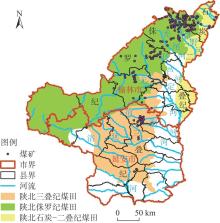
图1
研究区地理位置及煤田分布 注:基于自然资源部标准地图服务网站审图号为GS(2019)1822号的标准地图制作,底图边界无修改。下同。"
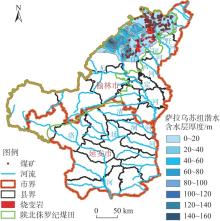
图2
陕北侏罗纪煤田中萨拉乌苏组潜水含水层厚度、烧变岩及煤矿分布 注:萨拉乌苏组潜水含水层厚度及烧变岩区分布来源于文献[2]。"
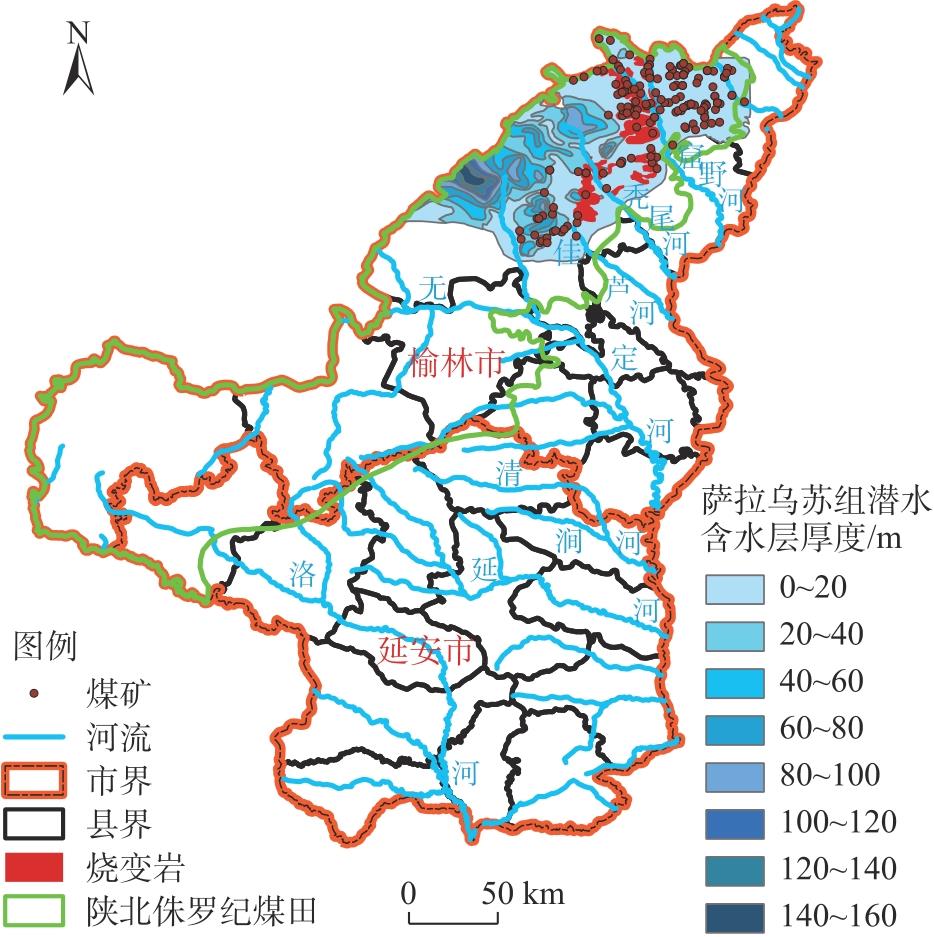

表1
陕北各煤田静储量与动储量的采空区面积统计"
| 煤田 | 水文地质 | 含水层 厚度/m | 静储量采空区 面积/105 m2 | 动储量采空区 面积/105 m2 |
|---|---|---|---|---|
| 侏罗纪 | 萨拉乌苏组 | 0~20 | 6374.965 | 4388.119 |
| 20~40 | 1725.858 | 1214.618 | ||
| 40~60 | 247.806 | 247.806 | ||
| 烧变岩 | - | 4090.030 | 3878.325 | |
| 石炭-二叠纪 | - | - | 442.684 | 326.526 |
| 三叠纪 | - | - | 932.143 | 515.428 |
表2
陕北各煤田不同水文地质类型的单位涌水量及给水度统计"
| 煤田 | 水文地质类型 | 区县 | 单位涌水量/L·s-1·m-1 | 给水度 |
|---|---|---|---|---|
| 侏罗纪 | 萨拉乌苏组 | 府谷县、神木市、榆阳区、横山区 | 1.000 | 0.021 |
| 烧变岩 | 神木市 | 1.739 | 0.036 | |
| 石炭-二叠纪 | 第四系松散孔隙潜水 | 府谷县 | 0.057 | 0.001 |
| 三叠纪 | 第四系松散岩类孔隙及裂隙潜水 | 子洲县、宝塔区、富县、黄陵县、子长市 | 0.186 | 0.004 |
表3
陕北各煤田采煤导致的地下水破坏模数统计"
| 煤田 | 水文 地质 | 含水层 厚度/m | 采空区面 积/105 m2 | 总排水 量/m3·h-1 | 破坏模数 /10-5 m3·h-1·m-2 |
|---|---|---|---|---|---|
| 侏罗纪 | 萨拉乌 苏组 | 0~20 | 4388.119 | 7851.580 | 1.789 |
| 20~40 | 1214.618 | 7921.544 | 6.522 | ||
| 40~60 | 247.806 | 1451.027 | 5.855 | ||
| 烧变岩 | - | 3878.325 | 11056.219 | 2.851 | |
| 石炭-二叠纪 | - | - | 326.526 | 51.864 | 0.159 |
| 三叠纪 | - | - | 515.428 | 295.631 | 0.574 |
表4
陕北各煤田地下水静储量统计"
| 煤田 | 水文地质 | 含水层厚度/m | 采空区面积/105 m2 | 含水层厚度/m | 单位涌水量/ L·s-1·m-1 | 给水度 | 静储量/105 m3 |
|---|---|---|---|---|---|---|---|
| 侏罗纪 | 萨拉乌苏组 | 0~20 | 6374.965 | 10.000 | 1.000 | 0.021 | 1338.743 |
| 20~40 | 1725.858 | 30.000 | 1.000 | 0.021 | 1087.291 | ||
| 40~60 | 247.806 | 50.000 | 1.000 | 0.021 | 260.196 | ||
| 烧变岩 | - | 4090.030 | 20.000 | 1.739 | 0.036 | 2944.822 | |
| 石炭-二叠纪 | - | - | 442.684 | 47.910 | 0.057 | 0.001 | 21.209 |
| 三叠纪 | - | - | 932.143 | 35.000 | 0.186 | 0.004 | 130.500 |
表5
陕北各煤田地下水动储量统计"
| 煤田 | 水文地质 | 含水层厚度/m | 采空区面 积/105 m2 | 塌陷区面 积/105 m2 | 总排水量 /m3·h-1 | 破坏模数 /10-5 m3·h-1·m-2 | 动储量 /m3·h-1 | 动储量 /105 m3 |
|---|---|---|---|---|---|---|---|---|
| 侏罗纪 | 萨拉乌苏组 | 0~20 | 4388.119 | 3660.146 | 7851.580 | 1.789 | 6548.001 | 573.605 |
| 20~40 | 1214.618 | 946.467 | 7921.544 | 6.522 | 6172.858 | 540.742 | ||
| 40~60 | 247.806 | 231.069 | 1451.027 | 5.855 | 1352.909 | 118.515 | ||
| 烧变岩 | - | 3878.325 | 3647.071 | 11056.219 | 2.851 | 10397.799 | 910.847 | |
| 石炭-二叠纪 | - | - | 326.526 | 289.586 | 51.864 | 0.159 | 46.044 | 4.033 |
| 三叠纪 | - | - | 515.428 | 481.488 | 295.631 | 0.574 | 276.374 | 24.210 |
图3
地表水与地下水损耗示意图 注: Q 地 下 水 损 耗为地下水损耗(m3·a-1); Q 总 涌 水 量为统计的矿井涌水量(m3·a-1); Q 入 渗 量为采煤破坏后水资源的入渗量,用动储量表示(m3·a-1); Q 地 表 水 损 耗为地表水损耗(m3·a-1); Q 矿 排 量为总涌水量经过矿区使用后的排水量(m3·a-1); Q 使 用 量为每年矿区消耗水量(m3·a-1)。"
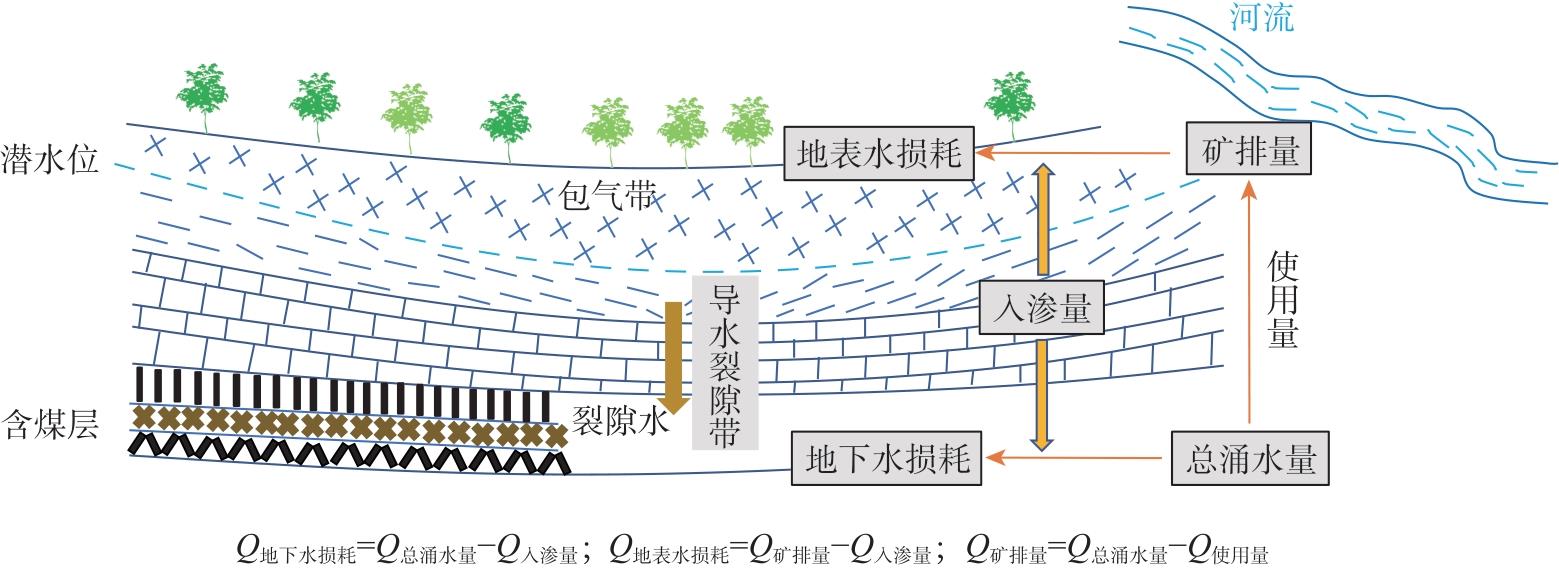
表6
2022年陕北各煤田采煤损耗的地表水和地下水"
| 煤田 | 水文地质 | 含水层 厚度/m | 涌水量 /105 m3 | 使用量 /105 m3 | 矿排量 /105 m3 | 入渗量 /105 m3 | 地表水损耗 /105 m3 | 地下水损耗 /105 m3 |
|---|---|---|---|---|---|---|---|---|
| 侏罗纪 | 萨拉乌苏组 | 0~20 | 687.798 | 308.668 | 379.130 | 573.605 | 194.475 | 114.193 |
| 20~40 | 693.927 | 204.557 | 489.370 | 540.742 | 51.372 | 153.185 | ||
| 40~60 | 127.110 | 44.400 | 82.710 | 118.515 | 35.805 | 8.595 | ||
| 烧变岩 | - | 968.525 | 240.972 | 727.553 | 910.847 | 183.294 | 57.678 | |
| 石炭-二叠纪 | - | - | 4.543 | 3.603 | 0.940 | 4.033 | 3.093 | 0.510 |
| 三叠纪 | - | - | 25.897 | 20.537 | 5.360 | 24.210 | 18.850 | 1.687 |
| 总计 | - | - | 2507.800 | 822.737 | 1685.063 | 2171.952 | 486.889 | 335.848 |
| [1] | Song J X, Yang Z Y, Xia J, et al. The impact of mining-related human activities on runoff in northern Shaanxi, China[J]. Journal of Hydrology, 2021, 598: 126235, doi: 10.1016/j.jhydrol.2021.126 235. |
| [2] | 侯恩科, 车晓阳, 冯洁, 等. 榆神府矿区含水层富水特征及保水采煤途径[J]. 煤炭学报, 2019, 44(3): 813-820. |
| [Hou Enke, Che Xiaoyang, Feng Jie, et al. Abundance of aquifers in Yushenfu coal field and the measures for water-preserved coal mining[J]. Journal of China Coal Society, 2019, 44(3): 813-820.] | |
| [3] | 彭苏萍, 毕银丽. 黄河流域煤矿区生态环境修复关键技术与战略思考[J]. 煤炭学报, 2020, 45(4): 1211-1221. |
| [Peng Suping, Bi Yinli. Strategic consideration and core technology about environmental ecological restoration in coal mine areas in the Yellow River Basin of China[J]. Journal of China Coal Society, 2020, 45(4): 1211-1221.] | |
| [4] | 常青锋, 刘宗斌. 陕北三叠纪煤田子长矿区涧峪岔勘查区水文地质特征及充水因素分析[J]. 地下水, 2016, 38(3): 203-205. |
| [Chang Qingfeng, Liu Zongbin. Hydrogeologic characterization and analysis of water filling factors in the Jianyucha exploration area, Zichang Mining District, Triassic Coalfield, north Shaanxi Province, China[J]. Ground Water, 2016, 38(3): 203-205.] | |
| [5] | 范立民, 孙魁, 李成, 等. 榆神矿区煤矿防治水的几点思考[J]. 煤田地质与勘探, 2021, 49(1): 182-188. |
| [Fan Limin, Sun Kui, Li Cheng, et al. Thoughts on mine water control and treatment in Yushen mining area[J]. Coal Geology & Exploration, 2021, 49(1): 182-188.] | |
| [6] | Yao Z, Luo Q Z, Li N, et al. Occurrence characteristics of Carboniferous-Permian tar-rich coal and its influencing factors in northern Shaanxi[J]. Coal Geology & Exploration, 2021, 49(3): 50-61, 68. |
| [7] | Wu X, Zhang W K, Ye Y M, et al. Is underground coal mining causing land degradation and significantly damaging ecosystems in semi-arid areas? A study from an ecological capital perspective[J]. Land Degradation & Development, 2020, 31(15): 1969-1989. |
| [8] | Chen W C, Li W P, Yang Z, et al. Analysis of mining-induced variation of the water table and potential benefits for ecological vegetation: A case study of Jinjitan coal mine in Yushenfu mining area, China[J]. Hydrogeology Journal, 2021, 29(4): 1629-1645. |
| [9] | 史晓琼, 杨泽元, 张艳娜, 等. 陕北高强度采煤对生态环境影响的研究进展[J]. 煤炭技术, 2016, 35(1): 314-316. |
| [Shi Xiaoqiong, Yang Zeyuan, Zhang Yanna, et al. Reviews of influence by high-intensity coal mining on ecological environment in northern Shaanxi[J]. Coal Technology, 2016, 35(1): 314-316.] | |
| [10] |
窦睿音, 张文洁, 陈晨. 陕西省“三生”空间格局演变与驱动机制研究[J]. 干旱区地理, 2023, 46(2): 264-273.
doi: 10.12118/j.issn.1000-6060.2022.046 |
|
[Dou Ruiyin, Zhang Wenjie, Chen Chen. Land use change based on production-living-ecology spaces and its driving forces in Shaanxi Province[J]. Arid Land Geography, 2023, 46(2): 264-273.]
doi: 10.12118/j.issn.1000-6060.2022.046 |
|
| [11] |
卓静, 胡皓, 何慧娟, 等. 陕北黄土高原生态脆弱性时空变异及驱动因素分析[J]. 干旱区地理, 2023, 46(11): 1768-1777.
doi: 10.12118/j.issn.1000-6060.2023.027 |
|
[Zhuo Jing, Hu Hao, He Huijuan, et al. Spatiotemporal variation and driving factors of ecological vulnerability in the Loess Plateau of northern Shaanxi[J]. Arid Land Geography, 2023, 46(11): 1768-1777.]
doi: 10.12118/j.issn.1000-6060.2023.027 |
|
| [12] |
张博, 曹丹平, 唐家奎. 应用GRACE和气象数据监测黄河流域陆地水储量时空变化[J]. 遥感技术与应用, 2024, 39(3): 699-707.
doi: 10.11873/j.issn.1004-0323.2024.3.0699 |
| [Zhang Bo, Cao Danping, Tang Jiakui. Application of GRACE and meteorological data to monitor terrestrial water storage in the Yellow River Basin[J]. Remote Sensing Technology and Application, 2024, 39(3): 699-707.] | |
| [13] | Wang S M, Wei J B, Song S J, et al. Influence of thick sandstone on development of overburden mining fissures in northern Shaanxi coal mining area of Yellow River Basin and suggestions on water-preserved coal mining[J]. Coal Geology & Exploration, 2022, 50(12): 2, doi: 10.12363/issn.1001-1986.22.08.0601. |
| [14] | Zhu T E, Li W P, Wang Q Q, et al. Study on the height of the mining-induced water-conducting fracture zone under the Q2l loess cover of the Jurassic coal seam in northern Shaanxi, China[J]. Mine Water and the Environment, 2020, 39(1): 57-67. |
| [15] | 赵春虎, 靳德武, 李智学, 等. 陕北榆神矿区煤层开采顶板涌水规律分析[J]. 煤炭学报, 2021, 46(2): 523-533. |
| [Zhao Chunhu, Jin Dewu, Li Zhixue, et al. Analysis of overlying aquifer water inrush above mining seam in Yushen mining area[J]. Journal of China Coal Society, 2021, 46(2): 523-533.] | |
| [16] | Wu C, Wu X, Zhu G, et al. Predicting mine water inflow and groundwater levels for coal mining operations in the Pangpangta coalfield, China[J]. Environmental Geology, 2019, 78(5): 1-13. |
| [17] |
刘晓琼, 陈云莎, 刘彦随, 等. 1974—2012年陕西省榆林市气候变化统计特征[J]. 中国沙漠, 2017, 37(2): 355-360.
doi: 10.7522/j.issn.1000-694X.2015.00034 |
|
[Liu Xiaoqiong, Chen Yunsha, Liu Yansui, et al. Statistical characteristics of climate change during 1974—2012 in Yulin, Shaanxi, China[J]. Journal of Desert Research, 2017, 37(2): 355-360.]
doi: 10.7522/j.issn.1000-694X.2015.00034 |
|
| [18] | Chen L F, Zhang H, Zhang X Y, et al. Vegetation changes in coal mining areas: Naturally or anthropogenically driven?[J]. Catena, 2022, 208: 105712, doi: 10.1016/j.catena.2021.105712. |
| [19] | 董震雨, 王双明. 采煤对陕北榆溪河流域地下水资源的影响分析——以杭来湾煤矿开采区为例[J]. 干旱区资源与环境, 2017, 31(3): 185-190. |
| [Dong Zhenyu, Wang Shuangming. Influence of coal exploitation on groundwater resources in Yuxi River Valley of northern Shaanxi[J]. Journal of Arid Land Resources and Environment, 2017, 31(3): 185-190.] | |
| [20] | Masood N, Hudson-Edwards K, Farooqi A. True cost of coal: Coal mining industry and its associated environmental impacts on water resource development[J]. Journal of Sustainable Mining, 2020, 19(3): 1, doi: 10.46873/2300-3960.1012. |
| [21] |
周亮, 唐建军, 刘兴科, 等. 黄土高原人口密集区城镇扩张对生境质量的影响——以兰州、西安-咸阳及太原为例[J]. 应用生态学报, 2021, 32(1): 261-270.
doi: 10.13287/j.1001-9332.202101.019 |
|
[Zhou Liang, Tang Jianjun, Liu Xingke, et al. Effects of urban expansion on habitat quality in densely populated areas on the Loess Plateau: A case study of Lanzhou, Xi’an-Xianyang and Taiyuan, China[J]. Chinese Journal of Applied Ecology, 2021, 32(1): 261-270.]
doi: 10.13287/j.1001-9332.202101.019 |
|
| [22] | 刘钊, 韩磊, 王丹月, 等. 陕北黄土高原煤矿区土壤理化性质及质量评价[J]. 煤炭学报, 2021, 46(5): 1555-1564. |
| [Liu Zhao, Han Lei, Wang Danyue, et al. Soil physicochemical properties and quality assessment in the coal mining area of Loess Plateau in northern Shaanxi Province[J]. Journal of China Coal Society, 2021, 46(5): 1555-1564.] | |
| [23] | 吴喜军, 李怀恩, 董颖, 等. 陕北地区煤炭开采等人类活动对河道径流影响的定量识别[J]. 环境科学学报, 2014, 34(3): 772-780. |
| [Wu Xijun, Li Huai’en, Dong Ying, et al. Quantitative identification of coal mining and other human activities on river runoff in northern Shaanxi region[J]. Acta Scientiae Circumstantiae, 2014, 34(3): 772-780.] | |
| [24] | 胡海峰, 廉旭刚, 蔡音飞, 等. 山西黄土丘陵采煤沉陷区生态环境破坏与修复研究[J]. 煤炭科学技术, 2020, 48(4): 70-79. |
| [Hu Haifeng, Lian Xugang, Cai Yinfei, et al. Study on ecological environment damage and restoration for coal mining-subsided area in loess hilly area of Shanxi Province[J]. Coal Science and Technology, 2020, 48(4): 70-79.] | |
| [25] | Wu X, Chen W Q, Deng X Y. Coupling and coordination of coal mining intensity and social-ecological resilience in China[J]. Ecological Indicators, 2021, 131: 108167, doi: 10.1016/j.ecolind.2021.108167. |
| [26] | 李振拴. 山西省煤炭开采对上覆裂隙水破坏及其利用的研究[J]. 中国煤田地质, 2007, 19(5): 35-37. |
| [Li Zhenshuan. A study on destruction induced by coal mining to overlying fissure water aquifer in Shanxi Province[J]. Coal Geology of China, 2007, 19(5): 35-37.] | |
| [27] | 时红, 张永波. 论煤炭开采对地下水资源量的破坏影响[J]. 山西科技, 2011, 26(1): 36-37, 39. |
| [Shi Hong, Zhang Yongbo. Destructive effect of coal mining on groundwater resources[J]. Shanxi Science and Technology, 2011, 26(1): 36-37, 39.] | |
| [28] | 吴喜军, 李怀恩, 董颖. 煤炭开采对水资源影响的定量识别——以陕北窟野河流域为例[J]. 干旱区地理, 2016, 39(2): 246-253. |
| [Wu Xijun, Li Huai’en, Dong Ying. Quantitative recognition of coal mining on water resources influence: A case of Kuye River in northern Shaanxi[J]. Arid Land Geography, 2016, 39(2): 246-253.] | |
| [29] | 李彩梅, 杨永刚, 秦作栋, 等. 基于FEFLOW和GIS技术的矿区地下水动态模拟及预测[J]. 干旱区地理, 2015, 38(2): 359-367. |
| [Li Caimei, Yang Yonggang, Qin Zuodong, et al. Simulation and prediction on variations of groundwater in mining area based on FEFLOW and GIS[J]. Arid Land Geography, 2015, 38(2): 359-367.] | |
| [30] | Sun K, Fan L M, Xia Y C, et al. Impact of coal mining on groundwater of Luohe formation in Binchang mining area[J]. International Journal of Coal Science & Technology, 2021, 8(1): 88-102. |
| [31] | Post D A, Crosbie R S, Viney N R, et al. Impacts of coal mining and coal seam gas extraction on groundwater and surface water[J]. Journal of Hydrology, 2020, 591: 125281, doi: 10.1016/j.jhydrol.2020.125281. |
| [32] |
蒋晓辉, 谷晓伟, 何宏谋. 窟野河流域煤炭开采对水循环的影响研究[J]. 自然资源学报, 2010, 25(2): 300-307.
doi: 10.11849/zrzyxb.2010.02.014 |
|
[Jiang Xiaohui, Gu Xiaowei, He Hongmou. The influence of coal mining on water resources in the Kuye River Basin[J]. Journal of Natural Resources, 2010, 25(2): 300-307.]
doi: 10.11849/zrzyxb.2010.02.014 |
|
| [33] | 姜良杰, 袁晓军. 陕北地区铁路煤炭运输需求分析及预测[J]. 铁道货运, 2024, 42(10): 39-48. |
| [Jiang Liangjie, Yuan Xiaojun. Analysis and forecast of railway coal transportation demand in northern Shaanxi region[J]. Railway Freight Transport, 2024, 42(10): 39-48.] | |
| [34] | 范立民. 生态脆弱区烧变岩研究现状及方向[J]. 西北地质, 2010, 43(3): 57-65. |
| [Fan Limin. Research status and research directions of burnt rocks in vulnerable ecological region[J]. Northwestern Geology, 2010, 43(3): 57-65.] | |
| [35] | 王秀丽, 宋乾坤, 田小甫, 等. 地铁工程建设对地下水流场影响分析: 以北京地铁十二号线为例[J]. 环境工程, 2023, 41(增刊2): 29-33. |
| [Wang Xiuli, Song Qiankun, Tian Xiaofu, et al. Analysis of influence of subway construction on groundwater flow: A case of metro line 12 in Beijing[J]. Environmental Engineering, 2023, 41(Suppl. 2): 29-33.] |
| [1] | 杨雪梅, 王让会, 刘春伟. 未来多情景下柯柯牙工程区水资源脆弱性评价及预测[J]. 干旱区地理, 2025, 48(4): 640-648. |
| [2] | 侯彩霞, 张宇宙, 杨建平. 关中平原城市群水资源-社会-生态系统耦合协调及障碍因子分析[J]. 干旱区地理, 2025, 48(4): 717-727. |
| [3] | 张杰, 屈建军, 陈海, 石金鑫, 马羽赫, 刘迪. 基于电路理论的生态安全格局时空演变与影响因素研究——以陕北黄土高原为例[J]. 干旱区地理, 2025, 48(3): 494-505. |
| [4] | 王平顺, 臧旭超, 厚富来, 田国良, 李璐, 韩学敏, 董少刚. 基于SD模型的巴彦淖尔市水资源供需平衡方案研究[J]. 干旱区地理, 2025, 48(2): 202-211. |
| [5] | 刘慧, 孙思奥, 方创琳, 周迪, 鲍超. 1990—2020年新疆用水量时空演化格局及影响因素分析[J]. 干旱区地理, 2024, 47(9): 1451-1461. |
| [6] | 朱成刚, 陈亚宁, 张明军, 车彦军, 孙美平, 赵锐锋, 汪洋, 刘玉婷. 昆仑山北坡水资源科学考察初报[J]. 干旱区地理, 2024, 47(7): 1097-1105. |
| [7] | 周洪华, 杨玉海, 朱成刚, 方功焕. 供需平衡视角下昆仑山北坡县域单元地表水资源开发利用潜力初探[J]. 干旱区地理, 2024, 47(7): 1106-1115. |
| [8] | 吴梦雨, 李冬杰, 韩玉国, 邱业, 曲芝旭. 河西走廊农田灌溉面积阈值分析[J]. 干旱区地理, 2024, 47(7): 1165-1174. |
| [9] | 褚家琦, 蒋志辉. 新疆农业水资源绿色效率时空演变及影响因素研究[J]. 干旱区地理, 2024, 47(7): 1231-1241. |
| [10] | 陈亚宁, 朱成刚, 李稚, 方功焕. 昆仑山北坡区域高质量发展面临的问题、机遇与挑战[J]. 干旱区地理, 2024, 47(5): 733-740. |
| [11] | 杨恕, 孙凌霄, 何婧, 李春兰, 于洋. 咸海变迁——危机和现状[J]. 干旱区地理, 2024, 47(2): 181-191. |
| [12] | 张宁,汪子晨,杨肖,陈彤,邢飞. 新疆水资源与农业种植系统耦合协调及时空差异研究——以粮食和棉花种植系统为例[J]. 干旱区地理, 2023, 46(3): 349-359. |
| [13] | 卓静,胡皓,何慧娟,王智,杨承睿. 陕北黄土高原生态脆弱性时空变异及驱动因素分析[J]. 干旱区地理, 2023, 46(11): 1768-1777. |
| [14] | 陈亚宁,李稚,方功焕. 中亚天山地区关键水文要素变化与水循环研究进展[J]. 干旱区地理, 2022, 45(1): 1-8. |
| [15] | 李秀花,吴纯渊. 中国西北五省区水资源利用的协调性分析[J]. 干旱区地理, 2022, 45(1): 9-16. |
|
||