干旱区地理 ›› 2025, Vol. 48 ›› Issue (6): 1103-1114.doi: 10.12118/j.issn.1000-6060.2024.512 cstr: 32274.14.ALG2024512
薛晨浩1,2( ), 白永平1(), 王生鹏2
收稿日期:2024-08-24
修回日期:2024-11-24
出版日期:2025-06-25
发布日期:2025-06-18
通讯作者:
白永平(1961-),男,博士,教授,博士生导师,主要从事区域发展与区域管理等方面的研究. E-mail: baiyp@nwnu.edu.cn作者简介:薛晨浩(1988-),男,博士研究生,讲师,主要从事区域经济韧性等方面的研究. E-mail: xuechenhaovip@126.com
基金资助:
XUE Chenhao1,2(), BAI Yongping1(), WANG Shengpeng2
Received:2024-08-24
Revised:2024-11-24
Published:2025-06-25
Online:2025-06-18
摘要: 对沿黄地区经济韧性进行科学测度是提升区域经济韧性、实现高质量发展的重要步骤。构建指标体系从抵抗力、恢复力、转型力3个维度测度了2003—2022年沿黄地区经济韧性水平,引入泰尔指数和莫兰指数对沿黄地区经济韧性差异和空间相关性进行分析。结果表明:(1) 在研究期内,沿黄地区经济运行总体稳定,显示出较强的经济韧性,但是与全国经济韧性水平相比仍有较大差距。子系统中恢复力维度得分最高,转型力最低。(2) 较高韧性区主要分布在山东半岛、中西部省会城市与矿产资源富集城市,较低韧性地区主要为青海、宁夏、甘肃、陕西、河南大部分地区、内蒙古西部、山东西部,地级尺度的经济韧性具有明显的中心外围结构。(3) 研究期内沿黄地区经济韧性水平的总体差异在多数年份呈缩小趋势,区域内差异贡献率均大于75%,区域内协同发展问题应引起重视。(4) 研究期内沿黄地区经济韧性的莫兰指数均为正值,总体上呈正相关,局部空间聚类分布以低-低集聚区和高-高集聚区为主,前者主要集中在青海、甘肃、宁夏,后者主要分布于山东。
薛晨浩, 白永平, 王生鹏. 基于多维评价方法的沿黄地区经济韧性时空分异规律[J]. 干旱区地理, 2025, 48(6): 1103-1114.
XUE Chenhao, BAI Yongping, WANG Shengpeng. Spatio-temporal differentiation of economic resilience in the Yellow River region based on multidimensional evaluation methods[J]. Arid Land Geography, 2025, 48(6): 1103-1114.
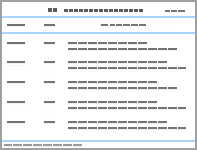
表1
沿黄地区经济韧性评价指标体系"
| 目标层 | 系统层 | 准则层 | 指标层 | 单位 | 指标方向 |
|---|---|---|---|---|---|
| 沿黄地区经济韧性 | 抵抗力 | 经济发展水平 | 人均GDP | 元 | + |
| 人均固定资产投资 | 元 | + | |||
| 财政自给率 | % | + | |||
| 产业链结构与水平 | 制造业总产值 | 104元 | + | ||
| 第一产业增加值占GDP的比重 | % | - | |||
| 劳动密集型制造业产业链占比 | % | - | |||
| 恢复力 | 产业调整能力 | 地区工业规模 | 104元 | + | |
| 单位GDP能耗 | 104 tce | - | |||
| 产业结构高级化指数 | — | + | |||
| 产业结构多样化指数 | — | + | |||
| 经济普惠水平 | 人均可支配收入 | 元 | + | ||
| 外贸结构 | 外贸依存度 | % | + | ||
| 就业水平 | 就业人员占总人口比重 | % | + | ||
| 转型力 | 创新支撑能力 | R&D支出占GDP的比重 | % | + | |
| 规上工业企业有效专利数 | 件 | + | |||
| 高技术产业企业数 | 个 | + | |||
| 人力资本支持 | 万人在校大学生数 | 人 | + | ||
| 绿色转型能力 | 区域旅游收入 | 108元 | + |
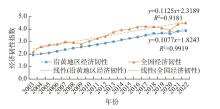
图1
2003—2022年中国与沿黄地区经济韧性对比"
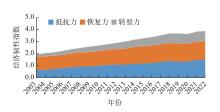
图2
2003—2022年沿黄地区经济韧性子系统演变"
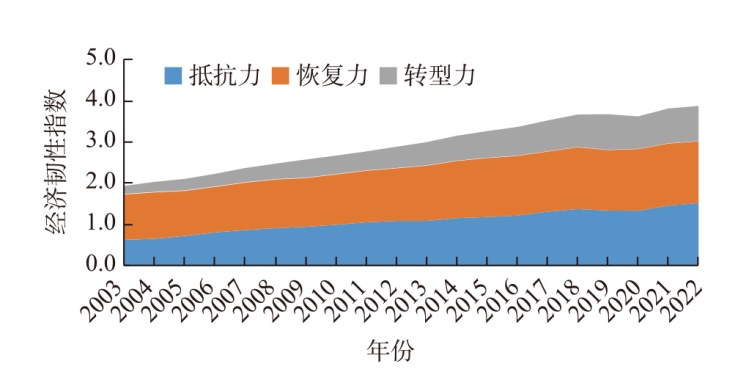
图3
2003—2022年沿黄地区各省(区)经济韧性指数"
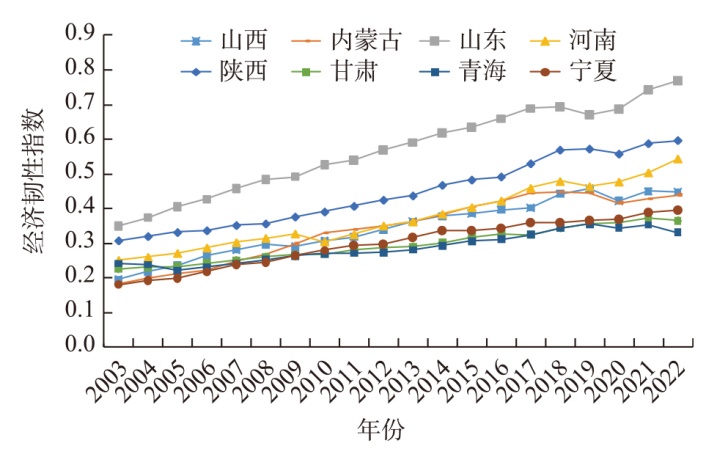
图4
2003—2022年沿黄地区经济韧性类型空间格局 注:基于自然资源部标准地图服务网站审图号为GS(2020)4630号的标准地图制作,底图边界无修改。下同。"
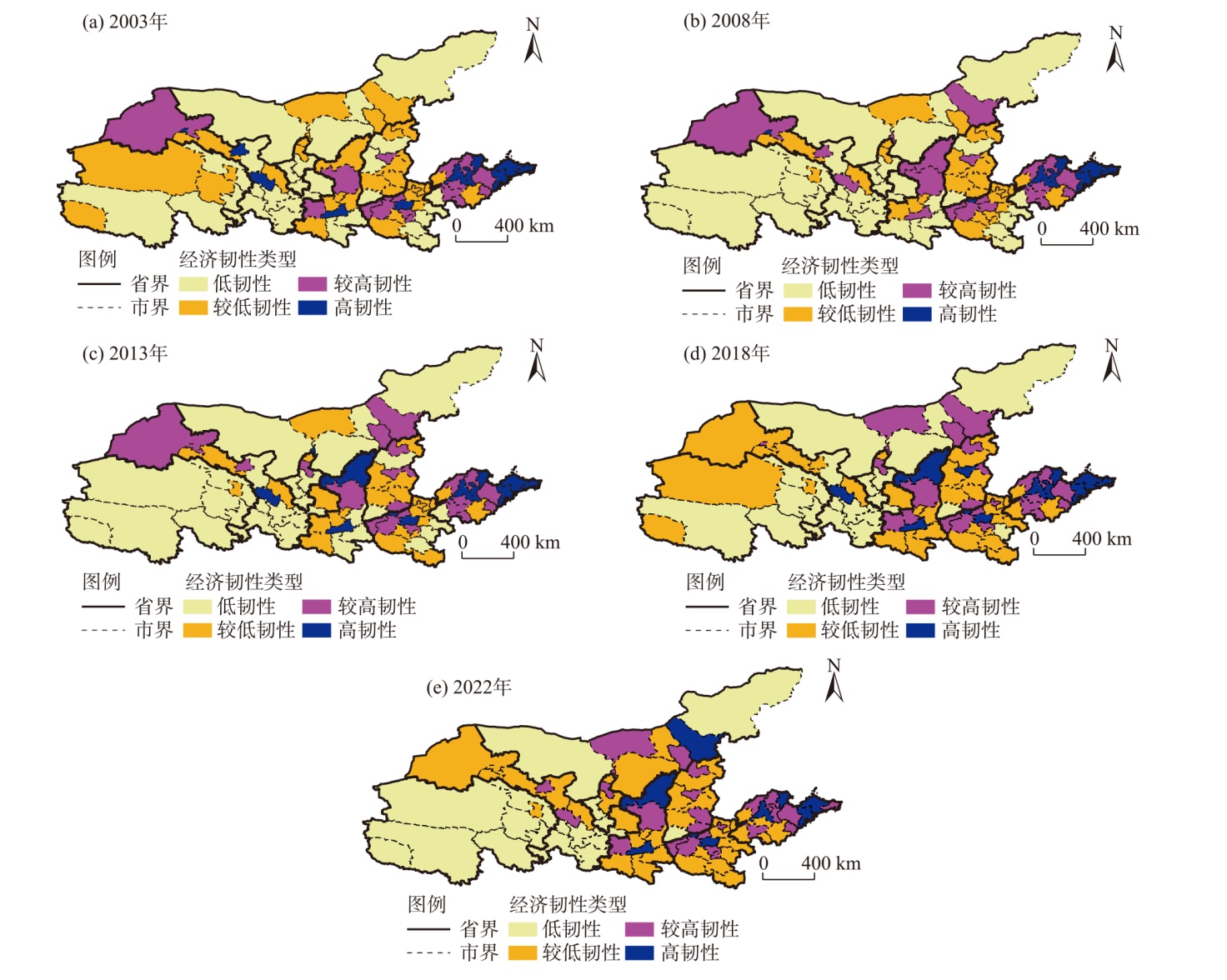
表2
2003—2022年沿黄地区经济韧性泰尔指数及贡献率"
| 年份 | 总体差异 | 区域间差异 | 区域间差异贡献率/% | 区域内差异 | 区域内差异贡献率/% | |||||||
|---|---|---|---|---|---|---|---|---|---|---|---|---|
| 总体 | 上游 | 中游 | 下游 | 总体 | 上游 | 中游 | 下游 | |||||
| 2003 | 0.22 | 0.03 | 15.82 | 0.18 | 0.09 | 0.03 | 0.07 | 84.18 | 39.93 | 11.76 | 32.49 | |
| 2004 | 0.22 | 0.04 | 19.24 | 0.18 | 0.08 | 0.03 | 0.07 | 80.76 | 35.05 | 12.03 | 33.68 | |
| 2005 | 0.22 | 0.05 | 20.92 | 0.18 | 0.07 | 0.03 | 0.08 | 79.08 | 32.54 | 11.89 | 34.65 | |
| 2006 | 0.21 | 0.05 | 22.48 | 0.16 | 0.07 | 0.03 | 0.07 | 77.52 | 31.16 | 13.36 | 33.00 | |
| 2007 | 0.20 | 0.05 | 22.87 | 0.16 | 0.06 | 0.03 | 0.07 | 77.13 | 29.49 | 14.25 | 33.38 | |
| 2008 | 0.20 | 0.04 | 22.04 | 0.15 | 0.06 | 0.03 | 0.06 | 77.96 | 30.30 | 15.21 | 32.45 | |
| 2009 | 0.16 | 0.02 | 12.83 | 0.14 | 0.07 | 0.03 | 0.04 | 87.17 | 42.07 | 18.19 | 26.91 | |
| 2010 | 0.16 | 0.02 | 11.72 | 0.14 | 0.07 | 0.03 | 0.05 | 88.28 | 41.00 | 16.56 | 30.72 | |
| 2011 | 0.15 | 0.02 | 11.47 | 0.14 | 0.07 | 0.03 | 0.04 | 88.53 | 43.35 | 16.47 | 28.72 | |
| 2012 | 0.15 | 0.02 | 13.45 | 0.13 | 0.06 | 0.03 | 0.04 | 86.55 | 41.52 | 16.90 | 28.13 | |
| 2013 | 0.15 | 0.02 | 16.58 | 0.12 | 0.06 | 0.02 | 0.04 | 83.42 | 39.64 | 15.21 | 28.57 | |
| 2014 | 0.14 | 0.03 | 20.20 | 0.11 | 0.05 | 0.02 | 0.04 | 79.80 | 35.76 | 15.06 | 28.99 | |
| 2015 | 0.13 | 0.03 | 21.84 | 0.10 | 0.05 | 0.02 | 0.04 | 78.16 | 35.30 | 13.43 | 29.43 | |
| 2016 | 0.13 | 0.03 | 21.97 | 0.10 | 0.05 | 0.02 | 0.04 | 78.03 | 35.69 | 13.55 | 28.79 | |
| 2017 | 0.14 | 0.03 | 24.34 | 0.11 | 0.05 | 0.02 | 0.04 | 75.66 | 33.98 | 14.25 | 27.43 | |
| 2018 | 0.13 | 0.03 | 22.69 | 0.10 | 0.05 | 0.02 | 0.04 | 77.31 | 34.99 | 13.87 | 28.45 | |
| 2019 | 0.12 | 0.03 | 21.97 | 0.09 | 0.04 | 0.02 | 0.03 | 78.03 | 36.21 | 15.01 | 26.82 | |
| 2020 | 0.11 | 0.03 | 22.95 | 0.09 | 0.04 | 0.02 | 0.03 | 77.05 | 34.24 | 14.68 | 28.13 | |
| 2021 | 0.12 | 0.03 | 21.46 | 0.09 | 0.04 | 0.02 | 0.03 | 78.54 | 36.11 | 15.77 | 26.66 | |
| 2022 | 0.13 | 0.03 | 21.61 | 0.10 | 0.05 | 0.02 | 0.03 | 78.39 | 37.92 | 17.06 | 23.41 | |
表3
2003—2022年沿黄地区经济韧性的全局莫兰指数"
| 年份 | Moran’s I | P值 | 年份 | Moran’s I | P值 |
|---|---|---|---|---|---|
| 2003 | 0.19 | 0.000 | 2013 | 0.20 | 0.000 |
| 2004 | 0.22 | 0.000 | 2014 | 0.22 | 0.000 |
| 2005 | 0.24 | 0.000 | 2015 | 0.22 | 0.000 |
| 2006 | 0.25 | 0.000 | 2016 | 0.22 | 0.000 |
| 2007 | 0.27 | 0.000 | 2017 | 0.23 | 0.000 |
| 2008 | 0.29 | 0.000 | 2018 | 0.21 | 0.000 |
| 2009 | 0.16 | 0.000 | 2019 | 0.14 | 0.000 |
| 2010 | 0.18 | 0.000 | 2020 | 0.17 | 0.000 |
| 2011 | 0.17 | 0.000 | 2021 | 0.18 | 0.000 |
| 2012 | 0.18 | 0.000 | 2022 | 0.20 | 0.000 |
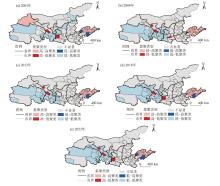
图5
2003—2022年沿黄地区经济韧性空间集聚类型"

| [1] | Holling C S. Resilience and stability of ecological systems[J]. Annual Review of Ecology and Systematics, 1973, 4(4): 1-23. |
| [2] | Berkes F, Folke C. Linking social and ecological systems: Management practices and social mechanisms for building resilience[M]. Cambridge: Cambridge University Press, 1998: 13-20. |
| [3] | Folke C. Resilience: The emergence of a perspective for social-ecological systems analyses[J]. Global Environmental Change, 2006, 16(3): 253-267. |
| [4] | Martin R. Roepke lecture in economic geography: Rethinking regional path dependence: Beyond lock-in to evolution[J]. Economic Geography, 2010, 86(1): 1-27. |
| [5] | Martin R. Regional economic resilience, hysteresis and recessionary shocks[J]. Journal of Economic Geography, 2012, 12(1): 1-32. |
| [6] | Boschma R. Towards an evolutionary perspective on regional resilience[J]. Regional Studies, 2014, 49(5): 733-751. |
| [7] | 贺灿飞, 盛涵天. 区域经济韧性: 研究综述与展望[J]. 人文地理, 2023, 38(1): 1-10. |
| [He Canfei, Sheng Hantian. Regional economic resilience: A review and future development outlook[J]. Human Geography, 2023, 38(1): 1-10. ] | |
| [8] | Simmie J, Martin R. The economic resilience of regions: Towards an evolutionary approach[J]. Cambridge Journal of Regions, Economy and Society, 2010, 3(1): 27-43. |
| [9] |
Martin R, Gardiner B. The resilience of cities to economic shocks: A tale of four recessions (and the challenge of Brexit)[J]. Papers in Regional Science, 2019, 98(4): 1801-1832.
doi: 10.1111/pirs.12430 |
| [10] |
陈梦远. 国际区域经济韧性研究进展——基于演化论的理论分析框架介绍[J]. 地理科学进展, 2017, 36(11): 1435-1444.
doi: 10.18306/dlkxjz.2017.11.012 |
|
[Chen Mengyuan. An international literature review of regional economic resilience: Theories and practices based on the evolutionary perspective[J]. Progress in Geography, 2017, 36(11): 1435-1444. ]
doi: 10.18306/dlkxjz.2017.11.012 |
|
| [38] |
张学波, 李亚宁, 马海涛, 等. 基于适应性循环的环渤海地区经济韧性演化分异机制[J]. 地理研究, 2024, 43(5): 1126-1145.
doi: 10.11821/dlyj020230818 |
| [Zhang Xuebo, Li Yaning, Ma Haitao, et al. Evolution differentiation mechanism of economic resilience in the Bohai Rim region based on the adaptive cycle theory[J]. Geographical Research, 2024, 43(5): 1126-1145. ] | |
| [39] |
杨永春, 穆焱杰, 张薇. 黄河流域高质量发展的基本条件与核心策略[J]. 资源科学, 2020, 42(3): 409-423.
doi: 10.18402/resci.2020.03.01 |
|
[Yang Yongchun, Mu Yanjie, Zhang Wei. Basic conditions and core strategies of high-quality development in the Yellow River Basin[J]. Resources Science, 2020, 42(3): 409-423. ]
doi: 10.18402/resci.2020.03.01 |
|
| [40] | 任保平, 邹起浩. 新发展阶段中国经济发展的韧性: 评价、影响因素及其维护策略[J]. 中国软科学, 2024(3): 15-25. |
| [Ren Baoping, Zou Qihao. Resilience of China’s economic development in the new development stage: Evaluation, influencing factors and maintenance strategies[J]. China Soft Science, 2024(3): 15-25. ] | |
| [41] | 石玉堂, 王晓丹, 陈凯旋. 新质生产力与城市经济韧性: 理论逻辑与经验证据[J]. 重庆大学学报(社会科学版), 2024, 30(5): 29-45. |
| [Shi Yutang, Wang Xiaodan, Chen Kaixuan. New quality productivity and urban economic resilience: Theoretical logic and empirical evidence[J]. Journal of Chongqing University (Social Science Edition), 2024, 30(5): 29-45. ] | |
| [11] | Christopherson S, Michie J, Tyler P. Regional resilience: Theoretical and empirical perspectives[J]. Cambridge Journal of Regions, Economy and Society, 2010, 3(1): 3-10. |
| [12] | Martin R, Gardiner B, Pike A, et al. Economic shocks and the differential resilience of places[J]. Regional Studies Policy Impact Books, 2021, 3(2): 73-85. |
| [13] |
胡晓辉, 董柯, 杨宇. 战略耦合演化视角下的区域经济韧性分析框架[J]. 地理研究, 2021, 40(12): 3272-3286.
doi: 10.11821/dlyj020210293 |
| [Hu Xiaohui, Dong Ke, Yang Yu. An analytical framework on regional economic resilience from the perspective of evolutionary strategic coupling[J]. Geographical Research, 2021, 40(12): 3272-3286. ] | |
| [14] |
生延超, 谭左思, 李倩, 等. 数字经济能否促进黄河流域旅游经济韧性提升?[J]. 干旱区地理, 2023, 46(10): 1704-1713.
doi: 10.12118/j.issn.1000-6060.2023.090 |
|
[Sheng Yanchao, Tan Zuosi, Li Qian, et al. Can the digital economy promote the resilience of the tourism economy in the Yellow River Basin?[J]. Arid Land Geography, 2023, 46(10): 1704-1713. ]
doi: 10.12118/j.issn.1000-6060.2023.090 |
|
| [15] |
王松茂, 牛金兰. 山东省旅游经济与城市生态韧性协同演化研究[J]. 地理学报, 2023, 78(10): 2591-2608.
doi: 10.11821/dlxb202310013 |
|
[Wang Songmao, Niu Jinlan. Co-evolution of tourism economy and urban ecological resilience in Shandong Province[J]. Acta Geographica Sinica, 2023, 78(10): 2591-2608. ]
doi: 10.11821/dlxb202310013 |
|
| [16] |
朱静敏, 卢小丽. 数字经济提升旅游经济韧性的作用机制及空间效应[J]. 地理科学进展, 2024, 43(10): 2004-2020.
doi: 10.18306/dlkxjz.2024.10.008 |
|
[Zhu Jingmin, Lu Xiaoli. Mechanism of impact and spatial effects of digital economy in enhancing tourism economic resilience[J]. Progress in Geography, 2024, 43(10): 2004-2020. ]
doi: 10.18306/dlkxjz.2024.10.008 |
|
| [17] |
张路, 林国栋, 吕晓. 产业结构升级视角下城市经济韧性空间分异及其驱动因素[J]. 地理科学, 2024, 44(9): 1577-1586.
doi: 10.13249/j.cnki.sgs.20230239 |
|
[Zhang Lu, Lin Guodong, Lü Xiao. Spatial differentiation and driving factors of urban economic resilience from the perspective of industrial structure upgrading[J]. Scientia Geographica Sinica, 2024, 44(9): 1577-1586. ]
doi: 10.13249/j.cnki.sgs.20230239 |
|
| [18] |
谭俊涛, 赵宏波, 刘文新, 等. 中国区域经济韧性特征与影响因素分析[J]. 地理科学, 2020, 40(2): 173-181.
doi: 10.13249/j.cnki.sgs.2020.02.002 |
|
[Tan Juntao, Zhao Hongbo, Liu Wenxin, et al. Regional economic resilience and influential mechanism during economic crises in China[J]. Scientia Geographica Sinica, 2020, 40(2): 173-181. ]
doi: 10.13249/j.cnki.sgs.2020.02.002 |
|
| [19] |
宁静, 朱冉, 张馨元, 等. 内蒙古区县城市韧性评价与分析[J]. 干旱区地理, 2023, 46(7): 1217-1226.
doi: 10.12118/j.issn.1000-6060.2022.537 |
|
[Ning Jing, Zhu Ran, Zhang Xinyuan, et al. Evaluation and analysis of urban resilience of districts and counties in Inner Mongolia[J]. Arid Land Geography, 2023, 46(7): 1217-1226. ]
doi: 10.12118/j.issn.1000-6060.2022.537 |
|
| [20] |
关皓明, 杨青山, 浩飞龙, 等. 基于“产业-企业-空间”的沈阳市经济韧性特征[J]. 地理学报, 2021, 76(2): 415-427.
doi: 10.11821/dlxb202102012 |
|
[Guan Haoming, Yang Qingshan, Hao Feilong, et al. Economic resilience characteristics of Shenyang City based on a perspective of industry-enterprise-space[J]. Acta Geographica Sinica, 2021, 76(2): 415-427. ]
doi: 10.11821/dlxb202102012 |
|
| [21] | 李博, 曲艺. 中国沿海地区产业演化路径依赖及突破对区域经济韧性的影响[J]. 地理学报, 2023, 78(4): 824-839. |
|
[Li Bo, Qu Yi. Influence of industrial evolution path dependence and path creation on regional economic resilience: Taking the coastal areas of China as an example[J]. Acta Geographica Sinica, 2023, 78(4): 824-839. ]
doi: 10.11821/dlxb202304004 |
|
| [22] |
彭荣熙, 刘涛, 曹广忠. 中国东部沿海地区城市经济韧性的空间差异及其产业结构解释[J]. 地理研究, 2021, 40(6): 1732-1748.
doi: 10.11821/dlyj020200486 |
| [Peng Rongxi, Liu Tao, Cao Guangzhong. Spatial pattern of urban economic resilience in eastern coastal China and industrial explanation[J]. Geographical Research, 2021, 40(6): 1732-1748. ] | |
| [23] |
李连刚, 张平宇, 程钰, 等. 黄河流域经济韧性时空演变与影响因素研究[J]. 地理科学, 2022, 42(4): 557-567.
doi: 10.13249/j.cnki.sgs.2022.04.001 |
|
[Li Liangang, Zhang Pingyu, Cheng Yu, et al. Spatio-temporal evolution and influencing factors of economic resilience in the Yellow River Basin[J]. Scientia Geographica Sinica, 2022, 42(4): 557-567. ]
doi: 10.13249/j.cnki.sgs.2022.04.001 |
|
| [24] |
仇方道, 尹鹏星, 谭俊涛, 等. 沿海城市经济韧性演化特征及影响机理——以连云港市为例[J]. 地理科学, 2023, 43(11): 1944-1955.
doi: 10.13249/j.cnki.sgs.2023.11.007 |
|
[Qiu Fangdao, Yin Pengxing, Tan Juntao, et al. Evolution characteristics and influence mechanism of economic resilience in coastal cities: A case study of Lianyungang[J]. Scientia Geographica Sinica, 2023, 43(11): 1944-1955. ]
doi: 10.13249/j.cnki.sgs.2023.11.007 |
|
| [25] |
张学波, 吴江楠, 王振波, 等. 中国地级以上城市医疗服务韧性的时空分异与驱动力分析[J]. 地理科学进展, 2024, 43(7): 1273-1289.
doi: 10.18306/dlkxjz.2024.07.002 |
|
[Zhang Xuebo, Wu Jiangnan, Wang Zhenbo, et al. Spatial-temporal differentiation and driving forces of medical service resilience of prefecture-level cities in China[J]. Progress in Geography, 2024, 43(7): 1273-1289. ]
doi: 10.18306/dlkxjz.2024.07.002 |
|
| [26] | 叶飞文. 经济韧性测度指标体系设计与实证研究[J]. 调研世界, 2024(11): 17-26. |
| [Ye Feiwen. Design and empirical study of an economic resilience measurement index system[J]. The World of Survey and Research, 2024(11): 17-26. ] | |
| [27] | 齐昕, 张景帅, 徐维祥. 浙江省县域经济韧性发展评价研究[J]. 浙江社会科学, 2019(5): 40-46. |
| [Qi Xin, Zhang Jingshuai, Xu Weixiang. A study on the evaluation of the development of county economic resilience in Zhejiang Province[J]. Zhejiang Social Sciences, 2019(5): 40-46. ] | |
| [28] | 刘晓星, 张旭, 李守伟. 中国宏观经济韧性测度——基于系统性风险的视角[J]. 中国社会科学, 2021(1): 12-32. |
| [Liu Xiaoxing, Zhang Xu, Li Shouwei. Measurement of China’s macroeconomic resilience: A systemic risk perspective[J]. Social Sciences in China, 2021(1): 12-32. ] | |
| [29] |
胡志强, 苗长虹, 熊雪蕾, 等. 产业集聚对黄河流域工业韧性的影响研究[J]. 地理科学, 2021, 41(5): 824-831.
doi: 10.13249/j.cnki.sgs.2021.05.010 |
|
[Hu Zhiqiang, Miao Changhong, Xiong Xuelei, et al. Influence of industrial agglomeration on the industrial resilience of the Yellow River Basin[J]. Scientia Geographica Sinica, 2021, 41(5): 824-831. ]
doi: 10.13249/j.cnki.sgs.2021.05.010 |
|
| [30] |
孙久文, 陈超君, 孙铮. 黄河流域城市经济韧性研究和影响因素分析——基于不同城市类型的视角[J]. 经济地理, 2022, 42(5): 1-10.
doi: 10.15957/j.cnki.jjdl.2022.05.001 |
|
[Sun Jiuwen, Chen Chaojun, Sun Zheng. Urban economic resilience and its influencing factors in the Yellow River Basin: From the perspective of different types of city[J]. Economic Geography, 2022, 42(5): 1-10. ]
doi: 10.15957/j.cnki.jjdl.2022.05.001 |
|
| [31] | 张跃胜, 谭宇轩, 金文俊. 黄河流域城市经济韧性影响因素分析与路径识别: 基于动态QCA的考察[J]. 现代财经(天津财经大学学报), 2024, 44(3): 37-53. |
| [Zhang Yuesheng, Tan Yuxuan, Jin Wenjun. Grouping analysis and path identification of factors influencing the economic resilience of cities in the Yellow River Basin: An examination based on dynamic QCA[J]. Modern Finance and Economics-Journal of Tianjin University of Finance and Economics, 2024, 44(3): 37-53. ] | |
| [32] | 叶文显. 黄河流域经济韧性的时空演变特征与影响因素[J]. 统计与决策, 2024, 40(17): 132-137. |
| [Ye Wenxian. The spatiotemporal evolution characteristics and influencing factors of economic resilience in the Yellow River Basin[J]. Statistics & Decision, 2024, 40(17): 132-137. ] | |
| [33] | 王兆峰, 张先甜. 黄河流域旅游经济系统韧性的时空差异特征及其影响因素[J]. 地理与地理信息科学, 2023, 39(3): 112-121. |
| [Wang Zhaofeng, Zhang Xiantian. Spatio-temporal differences and influencing factors of resilience of tourism economic system in the Yellow River Basin[J]. Geography and Geo-information Science, 2023, 39(3): 112-121. ] | |
| [34] | 周文慧, 钞小静. 黄河流域数字基础设施、经济发展韧性与生态环境保护的耦合协调发展分析——基于三元系统耦合协调模型[J]. 干旱区资源与环境, 2023, 37(9): 1-9. |
| [Zhou Wenhui, Chao Xiaojing. Coupling coordinated development of digital infrastructure, economic resilience and environmental protection in the Yellow River Basin: An approach of ternary system coupling coordination model[J]. Journal of Arid Land Resources and Environment, 2023, 37(9): 1-9. ] | |
| [35] | 史佳璐. 绿色发展视域下黄河流域城市群经济韧性研究[D]. 济南: 山东师范大学, 2023. |
| [Shi Jialu. Study on the economic resilience of the Yellow River Basin urban agglomeration under the perspective of green development[D]. Jinan: Shandong Normal University, 2023. ] | |
| [36] | Haining R. Spatial data analysis: Theory and practice[M]. Cambridge: Cambridge University, 2003: 53-78. |
| [37] | 刘虹, 薛东前, 马蓓蓓. 基于ESDA分析的关中城市群县域经济空间分析研究[J]. 干旱区资源与环境, 2012, 26(4): 55-60. |
| [Liu Hong, Xue Dongqian, Ma Beibei. Spatial variability of county economies in Guanzhong City Agglomeration based on ESDA[J]. Journal of Arid Land Resources and Environment, 2012, 26(4): 55-60. ] |
| [1] | 王逸菲, 孔德臻, 罗宇煊, 毛锦凰, 王梅梅. 人口增减分化对兰西城市群城市经济韧性的影响与作用路径[J]. 干旱区地理, 2025, 48(6): 1020-1030. |
| [2] | 朱怡婷, 赵晨, 曹开军, 梁桂仙, 姚昊. 国家矿山公园游憩满意度影响因素研究[J]. 干旱区地理, 2025, 48(3): 549-558. |
| [3] | 李刚. 高质量发展的新疆实践:评估体系构建及测度研究[J]. 干旱区地理, 2025, 48(1): 143-152. |
| [4] | 马明德, 李俊杰, 薛晨皓. 宁夏区域发展对环境胁迫的时空演变及驱动机制分析[J]. 干旱区地理, 2024, 47(6): 1061-1072. |
| [5] | 周成, 赵亚玲, 任敏敏, 靳轶婷, 吕丝丝. 黄河流域国家湿地公园时空分异、重心演化与驱动因素分析[J]. 干旱区地理, 2024, 47(3): 506-514. |
| [6] | 周霞, 王佳. 中国省域经济韧性与生态效率测度及其协同演化分析[J]. 干旱区地理, 2024, 47(2): 319-331. |
| [7] | 王松茂, 宁文萍, 牛金兰, 安康. 黄河流域城市生态韧性时空分异及收敛研究——基于七大城市群61个城市的实证分析[J]. 干旱区地理, 2024, 47(1): 93-103. |
| [8] | 李逸, 赵媛, 鄢继尧, 王珂. 与中国涉贸的“一带一路”主要国家原油出口力评估及障碍因素分析[J]. 干旱区地理, 2023, 46(10): 1732-1743. |
| [9] | 生延超, 谭左思, 李倩, 许玲玲. 数字经济能否促进黄河流域旅游经济韧性提升?[J]. 干旱区地理, 2023, 46(10): 1704-1713. |
| [10] | 张新成, 高楠, 王琳艳, 李锦敬. 红色旅游高质量发展评价指标体系与培育路径研究——以红色旅游城市为例[J]. 干旱区地理, 2022, 45(6): 1927-1937. |
| [11] | 张志高, 徐晓曼, 郭超凡, 蔡茂堂, 袁征, 张明哲. 近61 a黄河流域霜冻日期时空分异特征及影响因素[J]. 干旱区地理, 2022, 45(6): 1685-1694. |
| [12] | 王钰凯,郭辉. 新疆旅游业生态效率时空分异与收敛性研究[J]. 干旱区地理, 2022, 45(4): 1320-1331. |
| [13] | 张军民,荣城,马玉香. 新疆城镇化绿色发展时空分异及驱动因子探究[J]. 干旱区地理, 2022, 45(1): 251-262. |
| [14] | 王全喜, 孙鹏举, 刘学录, 任君, 刘永康. 甘肃省土地利用空间协调度时空分异及态势分析[J]. 干旱区地理, 2020, 43(1): 271-279. |
| [15] | 田丰收, 刘新平, 原伟鹏. 新疆和田地区耕地面源污染生态风险评价[J]. 干旱区地理, 2019, 42(2): 295-304. |
|
||

